




FBMC-OTFS Waveform Design for Integrated Sensing and Communications
-
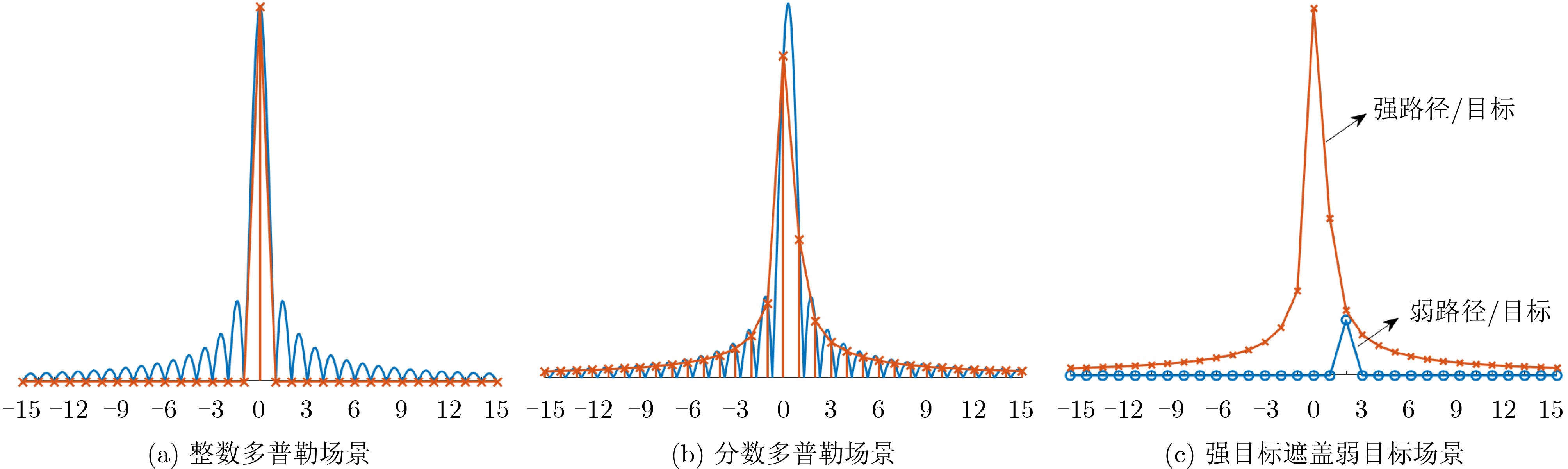
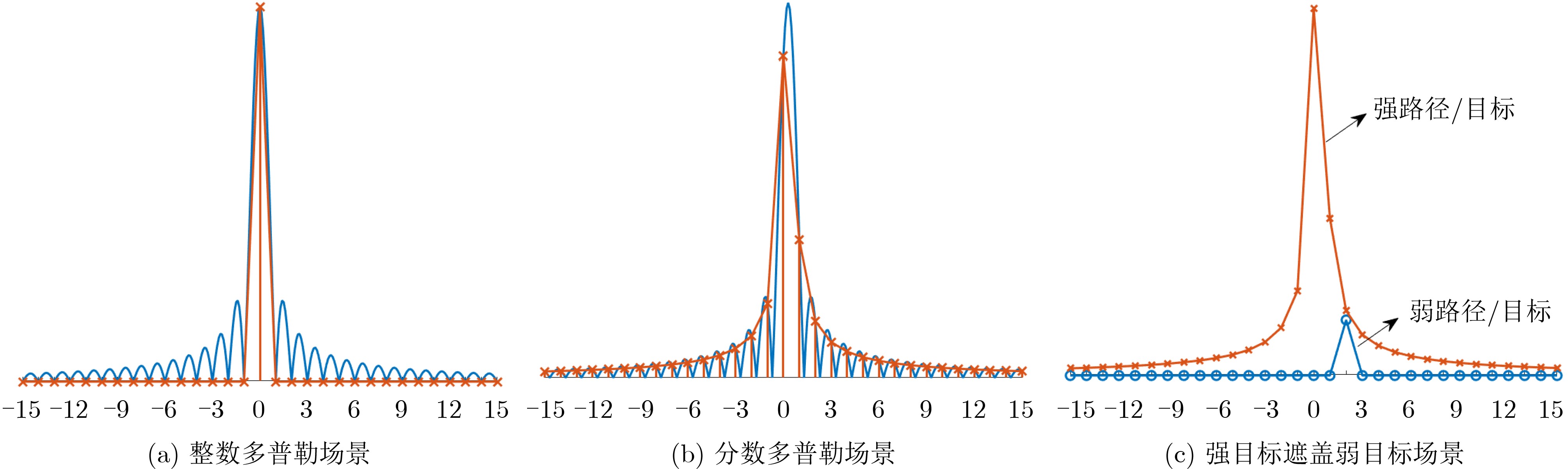
摘要: 随着6G技术的发展,通感一体化(ISAC)技术逐渐被广泛关注和研究,在这个领域中,正交时频空(OTFS)信号由于优秀的抗时变特性而具有很大的应用潜力。然而,OTFS易受分数时延和多普勒频移的影响,二者会产生弥散效应,造成通信数据和雷达导频的相互干扰;并且,在目标检测中,强目标的旁瓣可能会淹没弱目标,降低雷达检测概率和信道估计准确度。本文结合多载波滤波器组(FBMC)的低旁瓣特性,提出了一种FBMC-OTFS波形设计方法,并建立了包含分数时延和分数多普勒的信道模型。多载波滤波器组的原型滤波器可以有效降低OTFS波形的多普勒旁瓣,缓解多普勒弥散效应。在分数时延和多普勒频移联合信道模型上,结合恒虚警率(CFAR)算法实现对信道的估计,并通过最大比合并(MRC)算法优化信道估计结果。仿真结果表明,在强弱目标功率差为18.5 dB时,FBMC-OTFS波形仍可实现弱目标的有效检测,而传统OTFS波形无法检测;在信噪比为20 dB且检测到全部目标时,系统误码率显著低于传统OTFS波形。外场实验的结果进一步验证了FBMC-OTFS波形在实际ISAC场景中的可行性与优越性。Abstract:
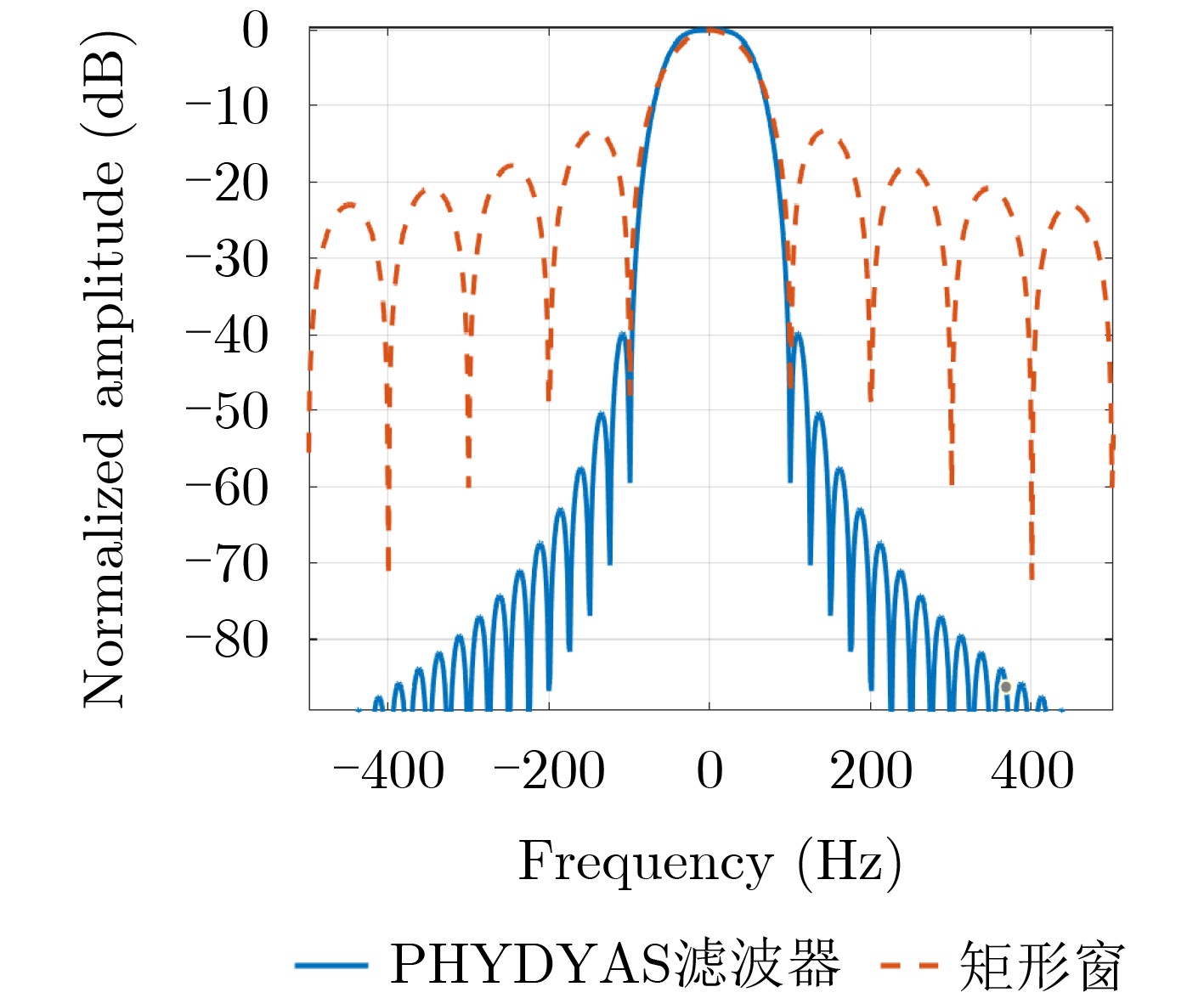
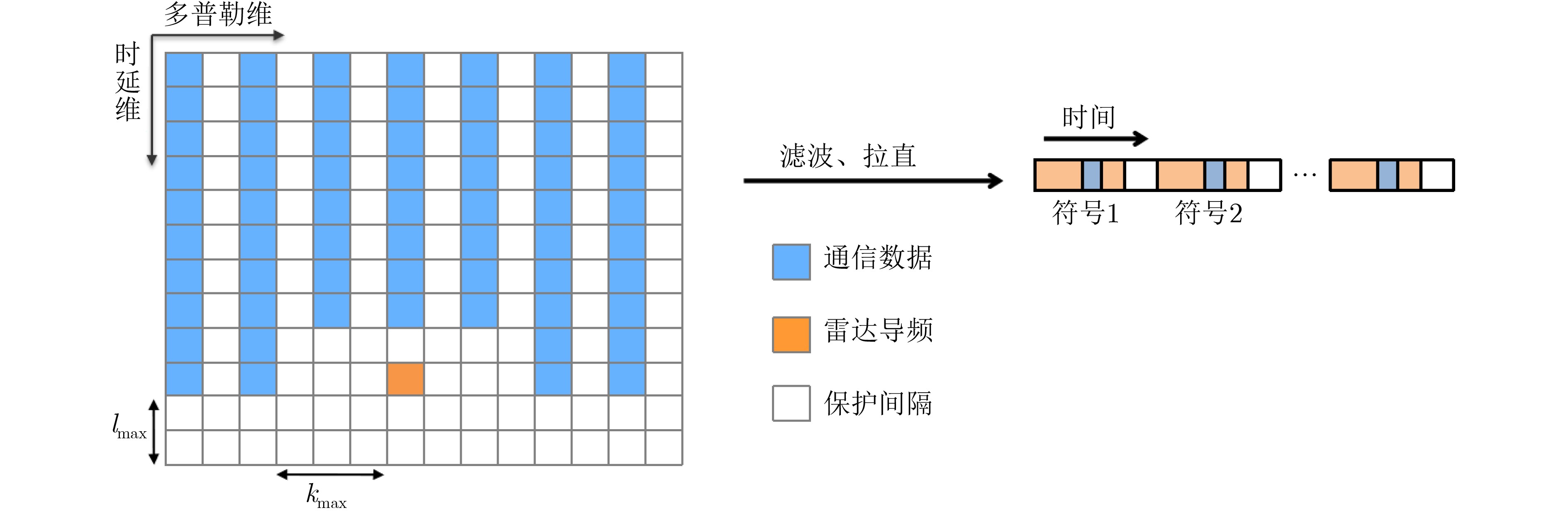
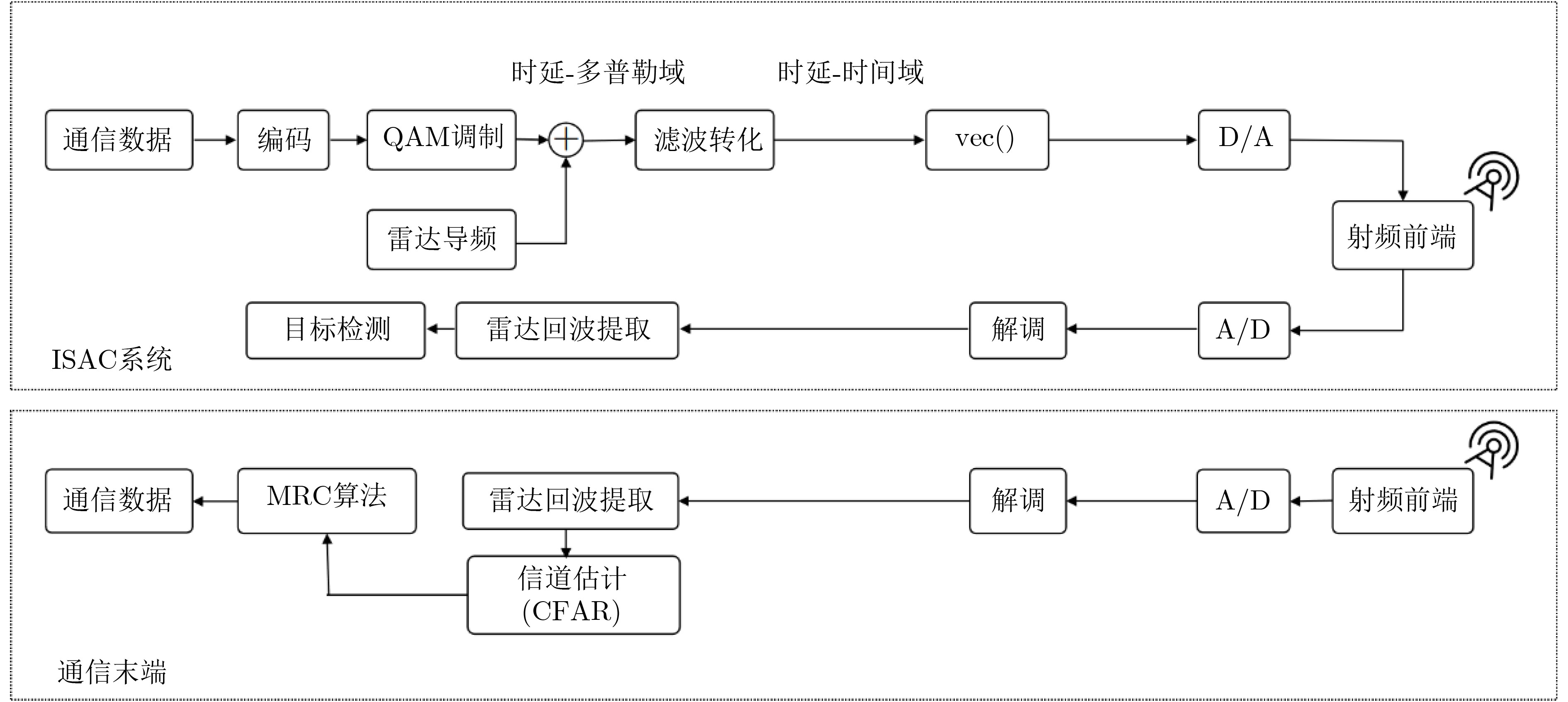
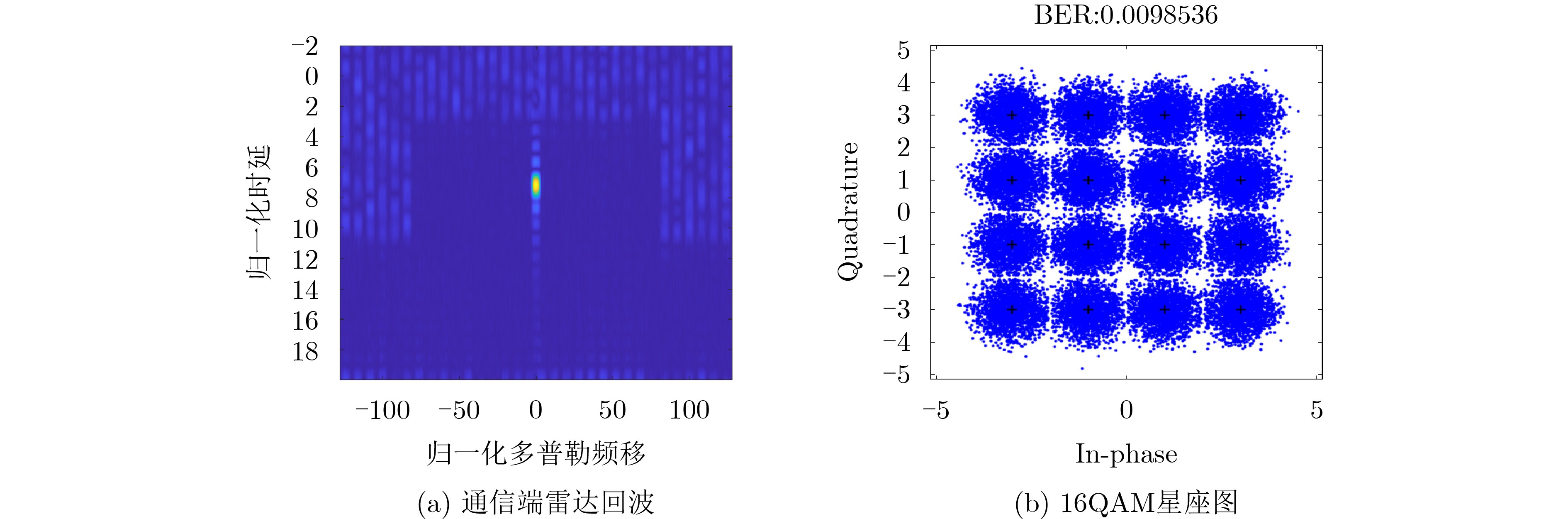
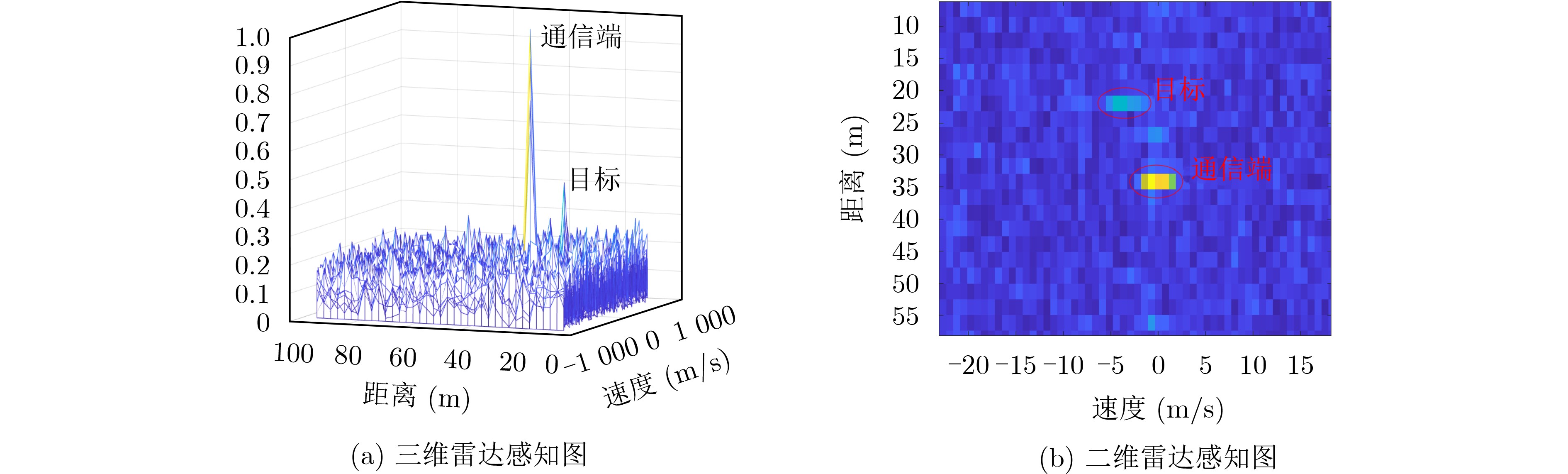
Objective With the continuous advancement of 6G and integrated sensing and communication (ISAC) technologies, wireless communications are progressively moving towards high-mobility scenarios. In such environments, traditional orthogonal frequency division multiplexing (OFDM) signals are susceptible to Doppler shifts, which compromise the orthogonality of subcarriers and introduce inter-carrier interference, thereby degrading communication performance. OTFS signals, constructed on a discrete delay-Doppler two-dimensional grid, exhibit robust resilience to time-varying channels because each symbol experiences nearly the same channel effect during transmission. However, the limited delay and Doppler resolutions of OTFS waveforms inevitably lead to fractional delays and fractional Doppler shifts in practical applications, which cause dispersion effects that impair both communication capabilities and target detection performance in ISAC systems. This paper aims to mitigate the dispersion effects in OTFS signals and enhance the stability and reliability of ISAC systems through waveform and signal processing design. Methods This paper employs a low-sidelobe prototype filter from the filter bank multicarrier (FBMC) family to modulate the OTFS signal. The prototype filter effectively suppresses Doppler sidelobes and mitigates Doppler dispersion effects, while introducing only marginal mainlobe widening compared with an OTFS waveform carrying the same number of data symbols. A guard interval is established between communication data symbols and radar pilots in the delay-Doppler domain to prevent mutual interference, thereby establishing the FBMC-OTFS signal model. In channel modeling, fractional delays and fractional Doppler shifts are jointly considered to accurately characterize the practical channel. Furthermore, drawing on the constant false alarm rate (CFAR) algorithm widely used in radar detection, channel estimation is performed for the FBMC-OTFS system in the delay-Doppler domain, improving target detection accuracy while reducing computational complexity. Finally, the maximum ratio combining (MRC) algorithm is applied to signal detection, iteratively eliminating inter-symbol interference to reduce the bit error rate. Results and Discussions This paper presents both simulation and field experiment results in multi-path channel scenarios, comparing the proposed FBMC-OTFS waveform with traditional OTFS waveforms. The results show that when the power difference between the strong and weak targets is 18.5 dB, the FBMC-OTFS signal can still detect the weaker target, whereas the OTFS waveform fails to do so. When both waveforms successfully detect all targets (at a 9 dB strong-to-weak target power difference), FBMC-OTFS achieves a significantly lower bit error rate (BER) than OTFS at an SNR of 20 dB. Moreover, the Doppler sidelobes of the FBMC-OTFS signal are nearly imperceptible, while those of the OTFS signal are distinctly visible: the peak sidelobe ratio (PSLR) and integrated sidelobe ratio (ISLR) of FBMC-OTFS are reduced to −29.82 dB and −22.15 dB, respectively. This sidelobe suppression is achieved at the cost of a reduced spectral efficiency, which is approximately one eighth of that of conventional OTFS. Field experiments further validate the feasibility of the FBMC-OTFS waveform in practical ISAC scenarios. Conclusions This paper proposes an FBMC-OTFS waveform tailored for ISAC applications, along with its corresponding signal processing methods. By modulating the OTFS waveform with the PHYDYAS prototype filter, the proposed approach effectively suppresses Doppler dispersion effects and mitigates the mutual interference between communication data and radar pilots, enabling reliable weak-target detection. The established channel model jointly accounts for fractional delays and fractional Doppler shifts. The CFAR algorithm, originally developed for radar detection, is applied to channel estimation, achieving robust path detection while reducing computational complexity, and is complemented by an MRC-based signal detector. Simulation and field experiments demonstrate that, compared with traditional OTFS, FBMC-OTFS significantly reduces Doppler sidelobes and can detect weak targets that OTFS fails to resolve, at the cost of a reduced spectral efficiency of about one eighth. The results provide a viable waveform solution for ISAC applications in 6G high-mobility scenarios. -
Key words:
- ISAC /
- FBMC /
- OTFS /
- wireless communication /
- radar sensing
-
表 1 频域下PHYDYAS滤波器的参数Hk取值
$ K $ $ {H}_{0} $ $ {H}_{1} $ $ {H}_{2} $ $ {H}_{3} $ 2 1 $ \sqrt{2}/2 $ 3 1 0.9114 0.4114 4 1 0.9719 $ \sqrt{2}/2 $ 0.2351  下载: 导出CSV
1 MRC算法
输入:时延-时域估计数据初始值 $ {\hat{Z}}^{0}[m,n] $;信道响应估计值
$ {\hat{v}}_{m,l}(n) $;最大迭代次数 $ {i}_{\max } $输出:时延-时域检测结果$ A[m,n] $ 1:$ g[m,n]=\displaystyle\sum\nolimits_{l}\,\hat{v}_{m+l,l}^{†}(n){\hat{v}}_{m+l,l}(n) $ 2:$ \Delta {Z}^{0}[m,n]=Z[m,n]-\displaystyle\sum\nolimits_{l}\,{\hat{v}}_{m,l}(n){\hat{Z}}^{0}[m-l,n] $ 3:for $ i=1,i< {i}_{\max };i++,do $ 4: $ {f}^{i}[m,n]=\displaystyle\sum\nolimits_{l}\,\hat{v}_{m+l,l}^{*}(n)\Delta {Z}^{i-1}[m+l,n] $ 5: $ {\hat{Z}}^{i}[m,n]={\hat{Z}}^{i-1}[m,n]+\dfrac{{f}^{i}[m,n]}{g[m,n]} $ 6: $ \begin{array}{cc}\Delta {Z}^{i}\left[m+l,n\right]=\Delta {Z}^{i}\left[m+l,n\right]-\displaystyle\sum\nolimits_{l}\,{\hat{v}}_{m+l,l}\left(n\right)\\\left({\hat{Z}}^{i}\left[m,n\right]-{\hat{Z}}^{i-1}\left[m,n\right]\right)\end{array} $ 7: if $ \Delta {Z}^{i}[m,n]\geq \Delta {Z}^{i-1}[m,n] $ then 8: break 9: end if 10:end for 11:$ A[m,n]={\hat{Z}}^{i}[m,n] $
下载: 导出CSV
表 2 仿真参数设置
参数名称 取值 Matlab版本 R2024a 载波频率 6 GHz 子载波间隔 30 KHz FBMC-OTFS符号数$ N $ 64 OTFS符号数$ N $ 256 子载波数$ M $ 512 MRC算法迭代次数 8 路径/目标时延抽头 [1.0, 4.3, 4.3] 路径/目标多普勒抽头 [0.0, 1.2, 9.2] 路径/目标增益 [0.6, 1.0, 0.35]
下载: 导出CSV
表 3 系统通信性能仿真结果
目标信噪比差 波形 弱目标 BER
(SNR=20 dB)18.5 dB OTFS 未检出 - FBMC-OTFS 检出 0.0010 9 dB OTFS 检出 0.0741 FBMC-OTFS 检出 0.0092
下载: 导出CSV
表 4 系统雷达性能仿真结果
波形 峰值旁瓣比 积分旁瓣比 3 dB主瓣宽度 FBMC-OTFS波形
($ N $=64)–29.82 dB –22.15 dB 3.93×1/(256$ T $) OTFS波形($ N $=64) –12.76 dB –9.57 dB 3.61×1/(256$ T $) OTFS波形($ N $=256) –13.77 dB –10.79 dB 0.91×1/(256$ T $)
下载: 导出CSV
表 5 外场实验参数设置
参数名称 取值 载波频率$ {f}_{c} $ 6 GHz 子载波间隔$ \Delta f $ 30 KHz 符号持续时间$ T $ 33.3 us 带宽$ B $ 30.72 MHz 符号数$ N $ 512 子载波数$ M $ 1024 MRC算法迭代次数 8
下载: 导出CSV
-
[1] YANG Ping, XIAO Yue, XIAO Ming, et al. 6G wireless communications: Vision and potential techniques[J]. IEEE Network, 2019, 33(4): 70–75. doi: 10.1109/MNET.2019.1800418. [2] RAFIQUE W, RANI BARAI J, FAPOJUWO A O, et al. A survey on beyond 5G network slicing for smart cities applications[J]. IEEE Communications Surveys & Tutorials, 2025, 27(1): 595–628. doi: 10.1109/COMST.2024.3410295. [3] CHIRIYATH A R, PAUL B, and BLISS D W. Radar-communications convergence: Coexistence, cooperation, and co-design[J]. IEEE Transactions on Cognitive Communications and Networking, 2017, 3(1): 1–12. doi: 10.1109/TCCN.2017.2666266. [4] LIU Yongjun, LIAO Guisheng, XU Jingwei, et al. Adaptive OFDM integrated radar and communications waveform design based on information theory[J]. IEEE Communications Letters, 2017, 21(10): 2174–2177. doi: 10.1109/LCOMM.2017.2723890. [5] YU Xiaohui, YU Shucheng, LIU Xiqing, et al. On normalized least mean square based interference cancellation algorithm for integrated sensing and communication systems[J]. ZTE Communications, 2024, 22(3): 21–28. doi: 10.12142/ZTECOM.202403004. [6] CHENG Xiang, DUAN Dongliang, GAO Shijian, et al. Integrated sensing and communications (ISAC) for vehicular communication networks (VCN)[J]. IEEE Internet of Things Journal, 2022, 9(23): 23441–23451. doi: 10.1109/JIOT.2022.3191386. [7] 林粤伟, 张奇勋, 尉志青, 等. 通信感知一体化硬件设计——现状与展望[J]. 电子与信息学报, 2025, 47(1): 1–21. doi: 10.11999/JEIT240012.LIN Yuewei, ZHANG Qixun, WEI Zhiqing, et al. Status and prospect of hardware design on integrated sensing and communication[J]. Journal of Electronics & Information Technology, 2025, 47(1): 1–21. doi: 10.11999/JEIT240012. [8] WANG Shixiong, DAI Wei, WANG Haowei, et al. Robust waveform design for integrated sensing and communication[J]. IEEE Transactions on Signal Processing, 2024, 72: 3122–3138. doi: 10.1109/TSP.2024.3410142. [9] ZHANG Shoushuo, LIU Rang, LI Ming, et al. Target detection in ISAC systems with active RISs: A multi-perspective observation approach[J]. IEEE Transactions on Cognitive Communications and Networking, 2025, 11(5): 2923–2937. doi: 10.1109/TCCN.2025.3573418. [10] DAHLMAN E, PARKVALL S, and SKOLD J. 5G NR: The Next Generation Wireless Access Technology[M]. 6277 Sea Harbor Drive Orlando: Academic Press, Inc. , 2018. [11] WANG Dezhi, HUANG Chongwen, LIU Lei, et al. Exploring channel estimation and signal detection for ODDM-based ISAC systems[J]. IEEE Wireless Communications Letters, 2024, 13(8): 2270–2274. doi: 10.1109/LWC.2024.3411637. [12] 张洪伟, 李国军, 叶昌荣, 等. 高速移动环境OTSM通信双迭代判决反馈均衡研究[J]. 电子学报, 2024, 52(6): 1801–1808. doi: 10.12263/DZXB.20230460.ZHANG Hongwei, LI Guojun, YE Changrong, et al. Research on double iterative decision feedback equalization of OTSM communication in high-speed mobile environment[J]. Acta Electronica Sinica, 2024, 52(6): 1801–1808. doi: 10.12263/DZXB.20230460. [13] TEK Y I and BASAR E. Joint delay-Doppler index modulation for orthogonal time frequency space modulation[J]. IEEE Transactions on Communications, 2024, 72(7): 3985–3993. doi: 10.1109/TCOMM.2024.3370827. [14] LI Buyi, YUAN Weijie, LIU Fan, et al. OTFS-based ISAC: How delay Doppler channel estimation assists environment sensing?[J]. IEEE Wireless Communications Letters, 2024, 13(12): 3563–3567. doi: 10.1109/LWC.2024.3478744. [15] 廖勇, 李雪. 一种低复杂度的正交时频空系统接收机设计[J]. 电子与信息学报, 2024, 46(6): 2418–2424. doi: 10.11999/JEIT230625.LIAO Yong and LI Xue. Low complexity receiver design for orthogonal time frequency space systems[J]. Journal of Electronics & Information Technology, 2024, 46(6): 2418–2424. doi: 10.11999/JEIT230625. [16] HASHIMOTO N, OSAWA N, YAMAZAKI K, et al. Channel estimation and equalization for CP-OFDM-based OTFS in fractional Doppler channels[C]. 2021 IEEE International Conference on Communications Workshops (ICC Workshops), Montreal, Canada, 2021: 1–7. doi: 10.1109/ICCWorkshops50388.2021.9473532. [17] ROU H S, DE ABREU G T F, CHOI J, et al. From orthogonal time–frequency space to affine frequency-division multiplexing: A comparative study of next-generation waveforms for integrated sensing and communications in doubly dispersive channels[J]. IEEE Signal Processing Magazine, 2024, 41(5): 71–86. doi: 10.1109/MSP.2024.3422653. [18] WANG Xuehan, SHI Xu, WANG Jintao, et al. On the Doppler squint effect in OTFS systems over doubly-dispersive channels: Modeling and evaluation[J]. IEEE Transactions on Wireless Communications, 2023, 22(12): 8781–8796. doi: 10.1109/TWC.2023.3265989. [19] CHENG Yiyan, CAO Yashuai, and LV Tiejun. Dual squint effect-aware data detection for MIMO-OTFS-based LEO satellite systems[C]. 2025 IEEE Globecom Workshops (GC Wkshps), Taipei, China, 2025: 951–956. doi: 10.1109/GCWkshps68340.2025.11591065. [20] DUAN Mingming, ZHANG Pengfei, ZHANG Shun, et al. Channel estimation and hybrid precoding for massive MIMO-OTFS system with doubly squint[J]. IEEE Transactions on Communications, 2025, 73(10): 9388–9404. doi: 10.1109/TCOMM.2025.3562357. [21] 蒋占军, 刘庆达, 张鈜, 等. 高速移动通信系统中OTFS分数多普勒信道估计加窗研究[J]. 电子与信息学报, 2022, 44(2): 646–653. doi: 10.11999/JEIT210561.JIANG Zhanjun, LIU Qingda, ZHANG Hong, et al. Study on OTFS fractional Doppler channel estimation and windowing in high-speed mobile communication systems[J]. Journal of Electronics & Information Technology, 2022, 44(2): 646–653. doi: 10.11999/JEIT210561. [22] KOBAYASHI R T and ABRÃO T. FBMC prototype filter design via convex optimization[J]. IEEE Transactions on Vehicular Technology, 2019, 68(1): 393–404. doi: 10.1109/TVT.2018.2879856. [23] ROSHDY R A, ABOUL-DAHAB M A, and FOUAD M M. A modified interference approximation scheme for improving preamble based channel estimation performance in FBMC system[J]. International Journal of Computer Networks & Communications, 2020, 12(1): 19–35. doi: 10.5121/ijcnc.2020.12102. [24] CHEN Da, WEI Houze, and CHEN Yun. Joint prototype filter and symbol distribution optimization for sidelobe suppression of FBMC-OQAM signals[J]. IEEE Transactions on Wireless Communications, 2025, 24(6): 4996–5008. doi: 10.1109/TWC.2025.3545427. [25] SEXTON C, BODINIER Q, FARHANG A, et al. Coexistence of OFDM and FBMC for underlay D2D communication in 5G networks[C]. 2016 IEEE Globecom Workshops (GC Wkshps), Washington, USA, 2016: 1–7. doi: 10.1109/GLOCOMW.2016.7848863. [26] AMMAR K, HAI BELKACEM O B, and BOUALLEGUE R. OQAM-FBMC based radar sensing and wireless communication in V2V context[C]. 2021 IEEE Symposium on Computers and Communications (ISCC), Athens, Greece, 2021: 1–6. doi: 10.1109/ISCC53001.2021.9631502. [27] LIU Gaogao, YANG Wenbo, WANG Youming, et al. MIMO FBMC-based joint radar imaging and electronic jamming[J]. IEEE Geoscience and Remote Sensing Letters, 2023, 20: 3506005. doi: 10.1109/LGRS.2023.3292925. [28] BELLANGER M G. Specification and design of a prototype filter for filter bank based multicarrier transmission[C]. 2001 IEEE International Conference on Acoustics, Speech, and Signal Processing. Proceedings (Cat. No. 01CH37221), Salt Lake City, USA, 2001: 2417–2420. doi: 10.1109/ICASSP.2001.940488. [29] LIU Lei, MA Chao, DUAN Yong, et al. Channel estimation and iterative decoding for underwater acoustic OTFS communication systems[J]. Journal of Marine Science and Engineering, 2024, 12(9): 1559. doi: 10.3390/jmse12091559. [30] 宋强健, 朱立东. 面向OTFS系统的扩频峰均比抑制[J]. 信号处理, 2025, 41(4): 638–646. doi: 10.12466/xhcl.2025.04.005.SONG Qiangjian and ZHU Lidong. Spread spectrum peak-to-average power ratio suppression for OTFS system[J]. Journal of Signal Processing, 2025, 41(4): 638–646. doi: 10.12466/xhcl.2025.04.005. [31] GALI J B, RAY P, and DAS G. GLRT based adaptive-thresholding for CFAR-detection of Pareto-target in Pareto-distributed clutter[J]. Journal of Signal Processing Systems, 2024, 96(4/5): 313–326. doi: 10.1007/s11265-024-01909-8. [32] ROBEY F C, FUHRMANN D R, KELLY E J, et al. A CFAR adaptive matched filter detector[J]. IEEE Transactions on Aerospace and Electronic Systems, 1992, 28(1): 208–216. doi: 10.1109/7.135446. [33] ELIAS F G M and FERNÁNDEZ E M G. An analysis of energy detector based on improved approximations of the chi-square distributions[J]. EURASIP Journal on Wireless Communications and Networking, 2021, 2021(1): 44. doi: 10.1186/s13638-021-01915-5. [34] TANG Huijun, ZHANG Jieling, ZHAO Zhidong, et al. Joint optimization based on two-phase GNN in RIS- and DF-assisted MISO systems with fine-grained rate demands[J]. IEEE Transactions on Wireless Communications, 2025, 24(12): 9989–10002. doi: 10.1109/TWC.2025.3576298. [35] FAN Dou, YANG Xiaodong, ZHAO Nan, et al. Exercise monitoring and assessment system for home-based respiratory rehabilitation[J]. IEEE Sensors Journal, 2022, 22(19): 18890–18902. doi: 10.1109/JSEN.2022.3200984. [36] THAJ T and VITERBO E. Low complexity iterative rake decision feedback equalizer for zero-padded OTFS systems[J]. IEEE Transactions on Vehicular Technology, 2020, 69(12): 15606–15622. doi: 10.1109/TVT.2020.3044276. [37] PRIYA P, VITERBO E, and HONG Yi. Low complexity MRC detection for OTFS receiver with oversampling[J]. IEEE Transactions on Wireless Communications, 2024, 23(2): 1459–1473. doi: 10.1109/TWC.2023.3289610. -

 下载:


图(11) / 表(6)
计量
- 文章访问数: 9
- HTML全文浏览量: 1
- PDF下载量: 1
- 被引次数: 0
