




Secrecy Performance Analysis of Multi-tag Bistatic Backscatter Communication Systems With Outdated CSI and Link Correlation
-
摘要: 针对信道时变及链路相关条件下多标签双站反向散射通信系统的安全传输问题,该文提出一种基于反向散射链路信道增益排序的标签选择方案。充分考虑标签选择阶段与传输阶段之间的信道状态信息不一致,以及合法链路与窃听链路之间的相关性,在独立非同分布瑞利信道下,推导了系统保密中断概率的闭式表达式及高发射功率下的渐近表达式,并从合法链路与窃听链路增益比的角度分析了系统保密性能的变化规律。分析结果表明:信道状态信息过时会显著削弱系统保密性能;当合法链路与窃听链路增益比固定时,系统在高发射功率区域存在保密中断平层,而提高该增益比可有效缓解该性能瓶颈;此外,在该文考虑的模型下,合法链路与窃听链路的相关性能够降低窃听链路相对占优的概率,从而改善系统保密性能。最后,蒙特卡罗仿真验证了理论推导的准确性,并表明所提方案在信道状态信息过时条件下仍能有效提升系统保密性能。Abstract:
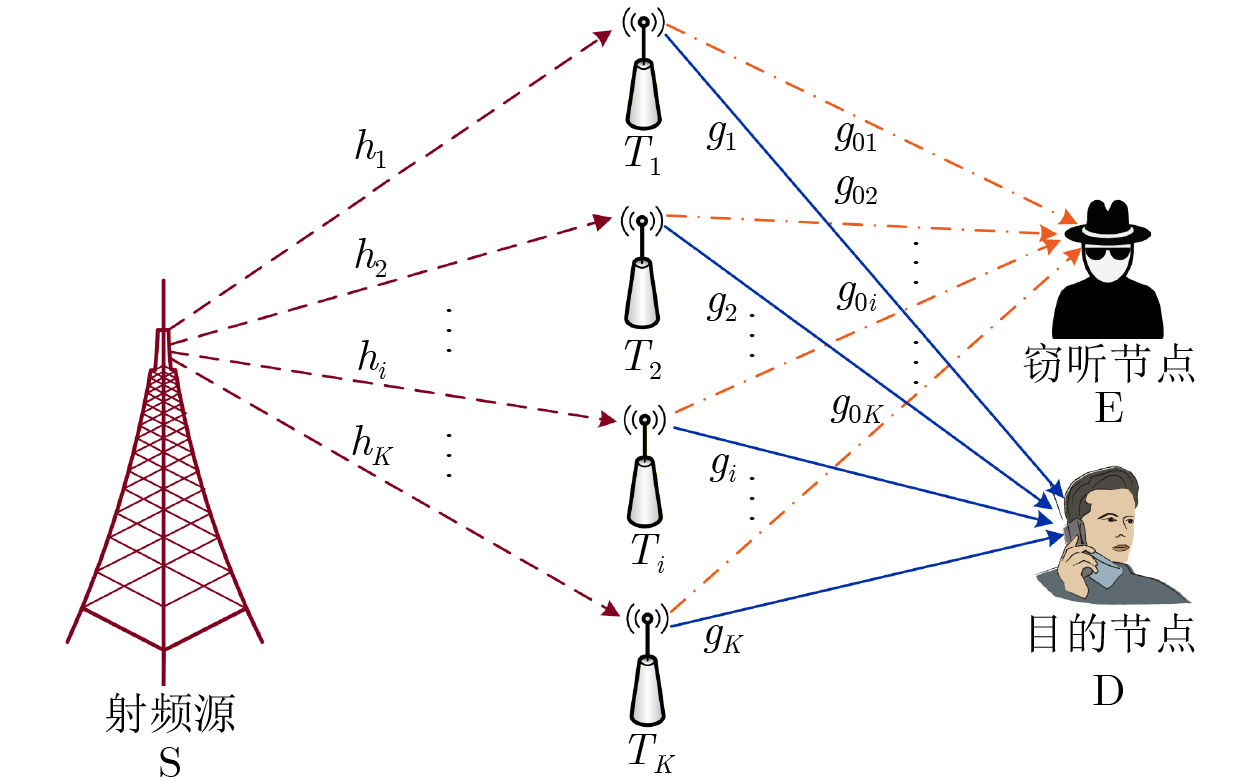
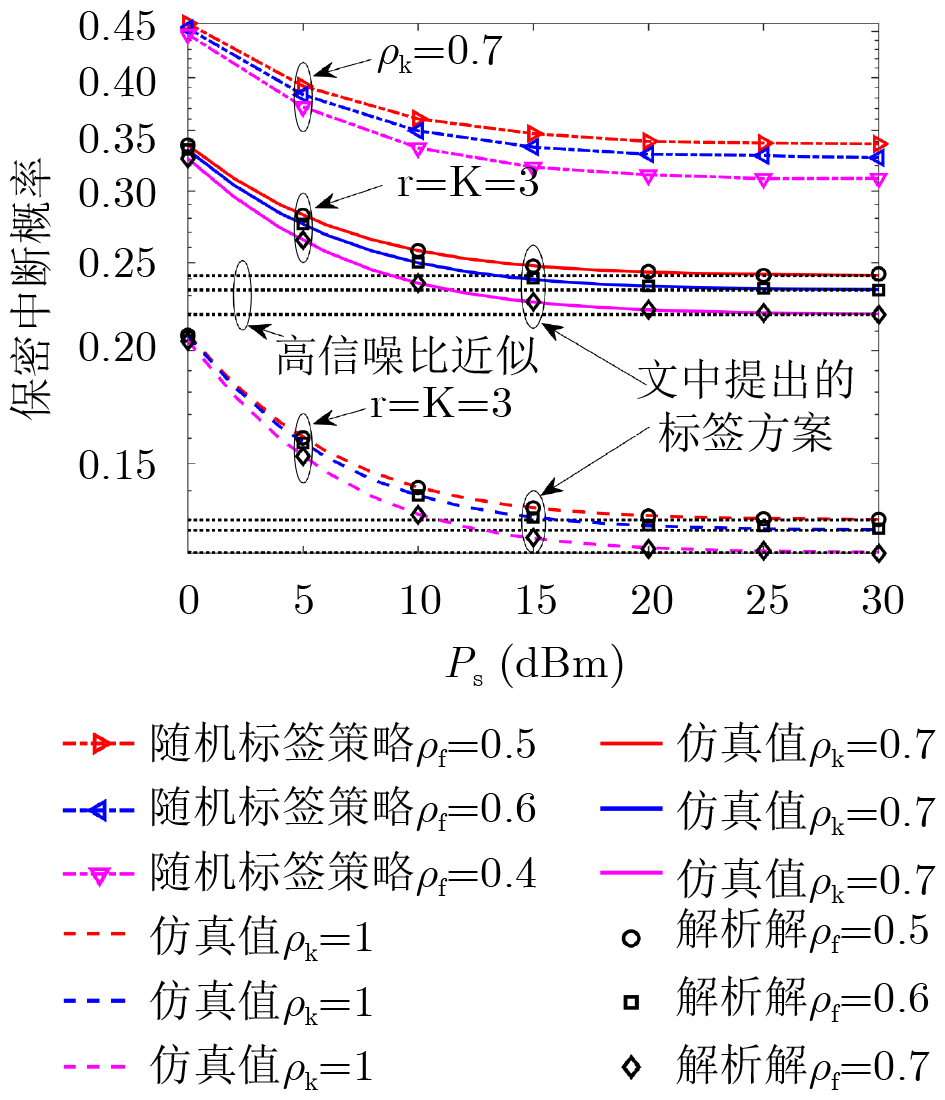
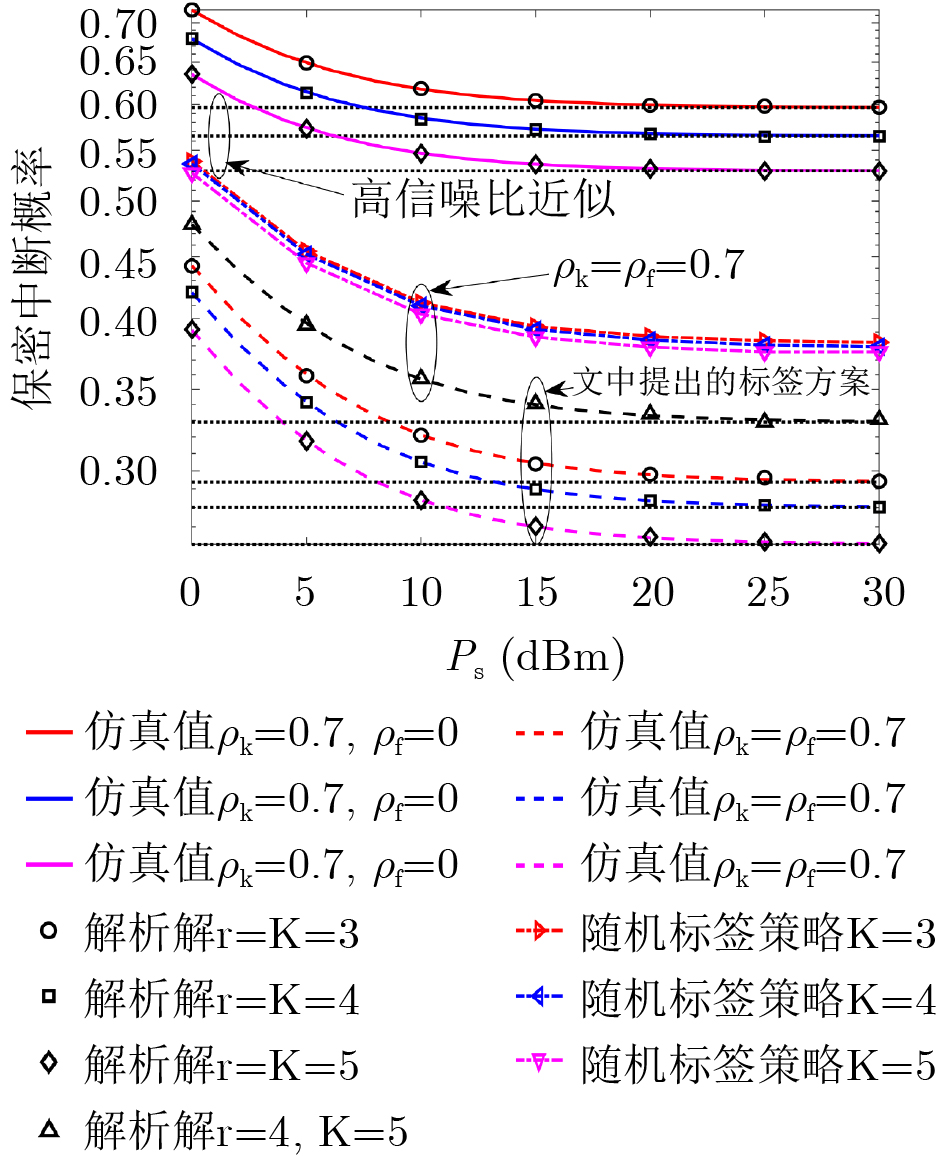
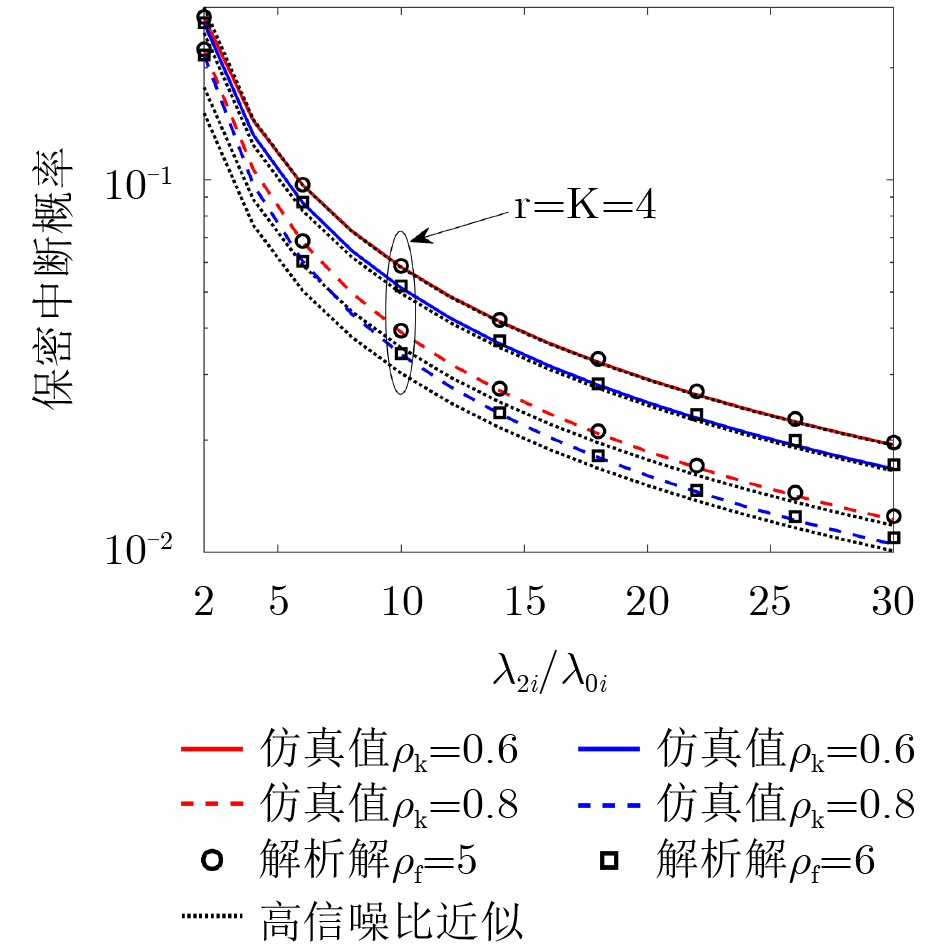
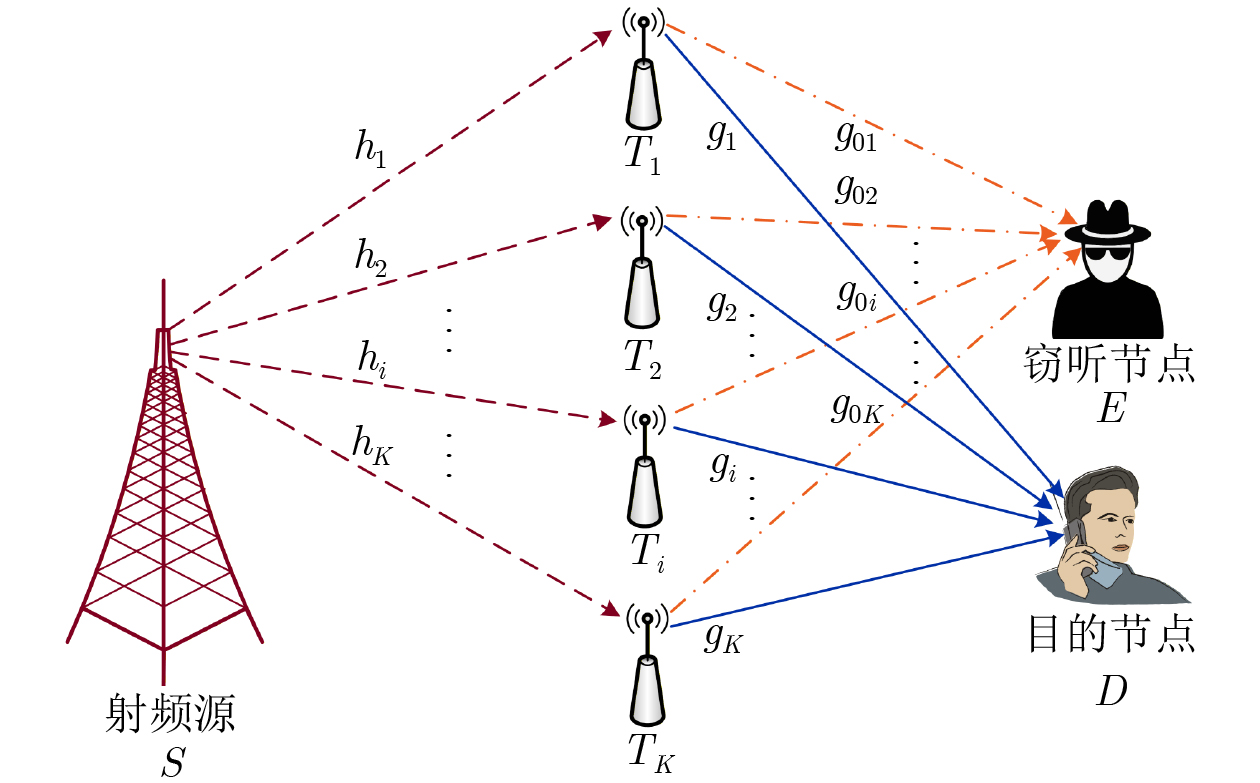
Objective Due to feedback delay, the Channel State Information (CSI) used during tag selection may become outdated before data transmission, causing a mismatch between the selected tag and the tag with the largest backscatter-link channel gain during transmission. Most existing studies of outdated CSI assume independent and identically distributed (i.i.d.) channels, which may not adequately reflect the heterogeneous characteristics of practical links caused by different propagation distances. In addition, when the eavesdropper is close to the destination, the legitimate and eavesdropping links may experience correlated fading. Neglecting these factors may cause theoretical results to deviate from actual system performance. Accordingly, under independent and non-identically distributed (i.n.i.d.) channel conditions, the secrecy performance of a multi-tag Bistatic Backscatter Communication (BBC) system is studied under the joint effects of outdated CSI and correlation between the legitimate and eavesdropping links. Methods Candidate tags are ranked according to their backscatter-link channel gains, and the tag with the largest backscatter-link channel gain is selected for transmission. An outdated CSI model is introduced to characterize the mismatch between the CSI used during tag selection and the CSI during data transmission. Because tag selection depends only on the backscatter-link CSI, CSI aging is modeled only for this link. A correlated Rayleigh fading model is used to characterize the statistical dependence between the legitimate and eavesdropping links. Under i.n.i.d. Rayleigh fading channel, order statistics are used to derive the Probability Density Function (PDF) of the selected tag’s outdated backscatter-link channel gain, whereas the joint PDF of the legitimate- and eavesdropping-link channel gains is derived by incorporating their correlated fading relationship. Based on these results, closed-form and high-transmit-power asymptotic expressions for the Secrecy Outage Probability (SOP) are derived. The secrecy performance is further analyzed in terms of the legitimate-to-eavesdropping channel-gain ratio. Results and Discussions Monte Carlo simulations validate the analytical and asymptotic results. The results show that outdated CSI significantly degrades secrecy performance because feedback delay causes the CSI used during tag selection to differ from the CSI during transmission, so the selected tag may no longer provide the largest backscatter-link channel gain. For a fixed legitimate-to-eavesdropping channel-gain ratio, a secrecy outage floor emerges at high transmit power ( Fig. 2 ), indicating that increasing transmit power alone cannot eliminate this performance bottleneck. In contrast, increasing the legitimate-to-eavesdropping channel-gain ratio effectively mitigates the outage floor and yields a secrecy diversity order of 1 with respect to this ratio (Fig. 4 ). Under the considered system model, correlation between the legitimate and eavesdropping links also improves secrecy performance (Fig. 3 ) by reducing the probability that the legitimate link experiences severe fading while the eavesdropping link remains strong. Moreover, despite outdated CSI, the proposed tag selection scheme based on backscatter-link channel-gain ranking remains effective and consistently outperforms random tag selection (Fig. 3 ).Conclusions A secrecy-performance analysis framework is developed for multi-tag BBC systems with outdated CSI and correlated legitimate and eavesdropping links. Closed-form SOP and high-transmit-power asymptotic expressions characterize the effects of outdated CSI, link correlation, and the legitimate-to-eavesdropping channel-gain ratio. The results identify outdated CSI as a major source of secrecy degradation and indicate that low-latency feedback is beneficial. Increasing the legitimate-link gain advantage over the eavesdropping link and selecting tags according to backscatter-link channel-gain ranking effectively improve secrecy performance. -
表 1 主要符号及其物理意义
符号 符号含义 $ K $ 候选标签总数 $ i $ 原始标签索引 $ r $ 升序排列后的阶次 $ {i}_{\left(r\right)} $ 第$ r $个升序排序位置对应的标签索引 $ {i}^{*}\triangleq {i}_{\left(K\right)} $ 反向散射链路增益最大标签的索引 $ {T}_{{{i}^{*}}} $ 本文选取的反向散射链路增益最大的标签 $ {g}_{{{i}^{*}}} $ 选择阶段选定标签的反向散射链路信道系数 $ g_{{i}^{*}}^{\tau } $ 传输阶段选定标签的反向散射链路信道系数 $ {h}_{{{i}^{*}}} $ 仅表示选定标签对应的前向链路信道系数 $ {g}_{0{{i}^{*}}} $ 仅表示选定标签对应的窃听链路信道系数 $ {\lambda }_{1{{i}^{*}}} $ $ S\rightarrow {T}_{{{i}^{*}}} $链路的方差 $ {\lambda }_{2{{i}^{*}}} $ $ {T}_{{{i}^{*}}}\rightarrow D $链路的方差 $ {\lambda }_{0{{i}^{*}}} $ $ {T}_{{{i}^{*}}}\rightarrow E $链路的方差  下载: 导出CSV
-
[1] GU Bowen, LI Dong, DING Haiyang, et al. Breaking the interference and fading gridlock in backscatter communications: State-of-the-art, design challenges, and future directions[J]. IEEE Communications Surveys & Tutorials, 2025, 27(2): 870–911. doi: 10.1109/COMST.2024.3436082. [2] CUI Ziqi, WANG Gongpu, XU Rongtao, et al. Backscatter communications for green internet of things: Practical prototypes, open challenges, and standardization[J]. IEEE Internet of Things Magazine, 2025, 8(3): 32–39. doi: 10.1109/IOTM.001.2400127. [3] AHMED M, SHAHWAR M, KHAN F, et al. NOMA-based backscatter communications: Fundamentals, applications, and advancements[J]. IEEE Internet of Things Journal, 2024, 11(11): 19303–19327. doi: 10.1109/JIOT.2024.3391219. [4] MONDAL S, BEPARI D, CHANDRA A, et al. A comprehensive survey on NOMA-based backscatter communication for IoT applications[J]. IEEE Internet of Things Journal, 2025, 12(12): 18929–18953. doi: 10.1109/JIOT.2025.3548581. [5] 徐勇军, 徐娟, 田秦语, 等. 基于统计信道状态信息的智能反射面辅助反向散射通信系统鲁棒资源分配算法[J]. 电子与信息学报, 2024, 46(5): 1986–1995. doi: 10.11999/JEIT231169.XU Yongjun, XU Juan, TIAN Qinyu, et al. Robust resource allocation algorithm for reconfigurable intelligent surface-assisted backscatter communication systems based on statistical channel state information[J]. Journal of Electronics & Information Technology, 2024, 46(5): 1986–1995. doi: 10.11999/JEIT231169. [6] 徐勇军, 邱友静, 张海波. 智能反射面辅助的环境反向散射通信系统信道估计算法研究[J]. 电子与信息学报, 2025, 47(1): 75–83. doi: 10.11999/JEIT240395.XU Yongjun, QIU Youjing, and ZHANG Haibo. Channel estimation for intelligent reflecting surface assisted ambient backscatter communication systems[J]. Journal of Electronics & Information Technology, 2025, 47(1): 75–83. doi: 10.11999/JEIT240395. [7] 刘英挺, 周治洋, 耿梦丹, 等. 反向散射通信中标签选择策略中断性能分析[J]. 电子与信息学报, 2024, 46(6): 2401–2408. doi: 10.11999/JEIT231001.LIU Yingting, ZHOU Zhiyang, GENG Mengdan, et al. Outage performance of tag selection scheme for backscatter communication systems[J]. Journal of Electronics & Information Technology, 2024, 46(6): 2401–2408. doi: 10.11999/JEIT231001. [8] 叶迎晖, 徐瑞, 田雨佳, 等. 反向散射通信技术的研究与发展[J]. 电信科学, 2024, 40(1): 1–23. doi: 10.11959/j.issn.1000-0801.2024001.YE Yinghui, XU Rui, TIAN Yujia, et al. Research and development of backscatter communications technology[J]. Telecommunications Science, 2024, 40(1): 1–23. doi: 10.11959/j.issn.1000-0801.2024001. [9] 张晓茜, 徐勇军. 面向零功耗物联网的反向散射通信综述[J]. 通信学报, 2022, 43(11): 199–212. doi: 10.11959/j.issn.1000-436x.2022199.ZHANG Xiaoxi and XU Yongjun. Survey on backscatter communication for zero-power IoT[J]. Journal on Communications, 2022, 43(11): 199–212. doi: 10.11959/j.issn.1000-436x.2022199. [10] LEI Yaxiong, YE Yinghui, CHU Xiaoli, et al. On the strict secrecy outage probability of wirelessly powered backscatter communications[J]. IEEE Transactions on Vehicular Technology, 2025, 74(5): 8345–8350. doi: 10.1109/TVT.2024.3523389. [11] LI Xingwang, JIANG Junjie, WANG Hao, et al. Physical layer security for wireless-powered ambient backscatter cooperative communication networks[J]. IEEE Transactions on Cognitive Communications and Networking, 2023, 9(4): 927–939. doi: 10.1109/TCCN.2023.3270425. [12] ZHANG Yu, GAO Feifei, FAN Lisheng, et al. Secure communications for multi-tag backscatter systems[J]. IEEE Wireless Communications Letters, 2019, 8(4): 1146–1149. doi: 10.1109/LWC.2019.2909199. [13] LIU Yingting, YE Yinghui, and HU R Q. Secrecy outage probability in backscatter communication systems with tag selection[J]. IEEE Wireless Communications Letters, 2021, 10(10): 2190–2194. doi: 10.1109/LWC.2021.3095969. [14] LIU Zhipeng, YE Yinghui, CHU Xiaoli, et al. Secrecy performance of backscatter communications with multiple self-powered tags[J]. IEEE Communications Letters, 2022, 26(12): 2875–2879. doi: 10.1109/LCOMM.2022.3201031. [15] LAI Xiazhi, FAN Lisheng, LEI Xianfu, et al. Distributed secure switch-and-stay combining over correlated fading channels[J]. IEEE Transactions on Information Forensics and Security, 2019, 14(8): 2088–2101. doi: 10.1109/TIFS.2019.2891932. [16] MICHALOPOULOS D S, SURAWEERA H A, KARAGIANNIDIS G K, et al. Amplify-and-forward relay selection with outdated channel estimates[J]. IEEE Transactions on Communications, 2012, 60(5): 1278–1290. doi: 10.1109/TCOMM.2012.032012.110430. [17] LI Enyu, WANG Xuhu, WU Zeju, et al. Outage performance of DF relay selection schemes with outdated CSI over Rayleigh fading channels[J]. IET Communications, 2018, 12(8): 984–993. doi: 10.1049/iet-com.2017.0611. [18] DENG Dan, LI Xingwang, DANG Shuping, et al. Outage analysis for tag selection in reciprocal backscatter communication systems[J]. IEEE Wireless Communications Letters, 2022, 11(2): 210–214. doi: 10.1109/LWC.2021.3122429. [19] LEI Yaxiong, YE Yinghui, CHU Xiaoli, et al. Partial secrecy performance analysis for wirelessly powered backscatter communications[J]. IEEE Wireless Communications Letters, 2025, 14(11): 3460–3464. doi: 10.1109/LWC.2025.3594264. [20] JEFFREY A and ZWILLINGER D. Table of Integrals, Series, and Products[M]. 7th ed. London, U. K. : AcademicPress, 2007: 1–1221. [21] FAN Lisheng, LEI Xianfu, YANG Nan, et al. Secrecy cooperative networks with outdated relay selection over correlated fading channels[J]. IEEE Transactions on Vehicular Technology, 2017, 66(8): 7599–7603. doi: 10.1109/TVT.2017.2669240. [22] LIU Yingting, ZHOU Zhiyang, YE Yinghui, et al. Outage performance analysis for mutualistic symbiotic backscatter communication systems[J]. IEEE Transactions on Vehicular Technology, 2025, 74(2): 3457–3462. doi: 10.1109/TVT.2024.3472042. [23] WANG Jun, DING Xiangyu, ZHANG Qianqian, et al. Multiple access design for symbiotic radios: Facilitating massive IoT connections with cellular networks[J]. IEEE Transactions on Wireless Communications, 2024, 23(1): 201–216. doi: 10.1109/TWC.2023.3276887. -

 下载:
下载:

图(4) / 表(1)
计量
- 文章访问数: 352
- HTML全文浏览量: 67
- PDF下载量: 31
- 被引次数: 0
