




Resource Allocation and Node Deployment for Multi-UAV Integrated Localization and Communication with Differentiated Requirements
-
摘要: 面向地面网络覆盖薄弱和全球导航卫星系统受限环境中智能终端的差异化通信定位需求,该文研究了无地面基站场景下无人机网络通信定位一体化服务的资源分配与节点部署问题。具体而言,如何通过无人机网络的资源分配与节点部署,最大程度满足终端的差异化通信定位服务需求。由于网络中物理资源被通信与定位服务共享且节点部署位置同时影响数据传输与协同定位,导致上述问题高度耦合且具有海量状态空间,较难求解。该文综合考虑终端在传输数据量、最低通信速率、定位精度门限等方面的差异以及终端服务优先级的不同,构建依赖无人机拓扑的网络服务价值模型。针对资源分配与节点部署耦合形成的混合非凸问题,提出一种网络服务价值驱动的迭代优化算法:在每轮迭代中,首先针对当前节点部署构造服务级连续资源代理,以分段一维搜索和价格二分交替优化时频资源,并将连续解恢复为原问题的可行解;随后依据资源响应生成结构化部署候选,经代理排序与束搜索筛选后,对保留的候选部署在新的服务关系下执行资源响应,以网络服务价值作为新部署及其对应资源分配结果的验收依据,直至无候选部署能够带来超过阈值的改进从而结束迭代。仿真结果表明,所提方法能够有效提高无人机网络的服务价值,并在双功能服务之间实现面向终端需求的资源权衡。Abstract:
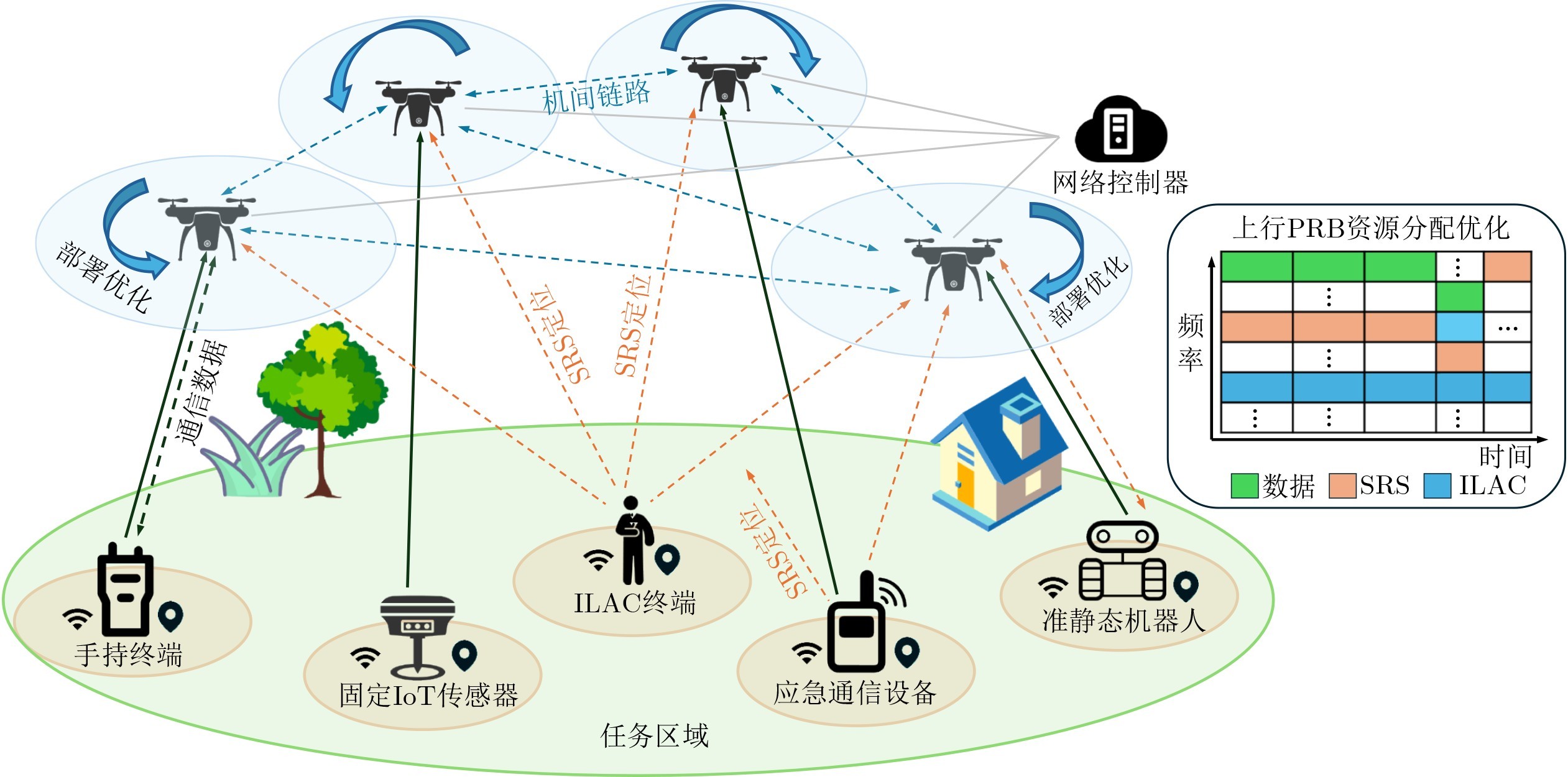
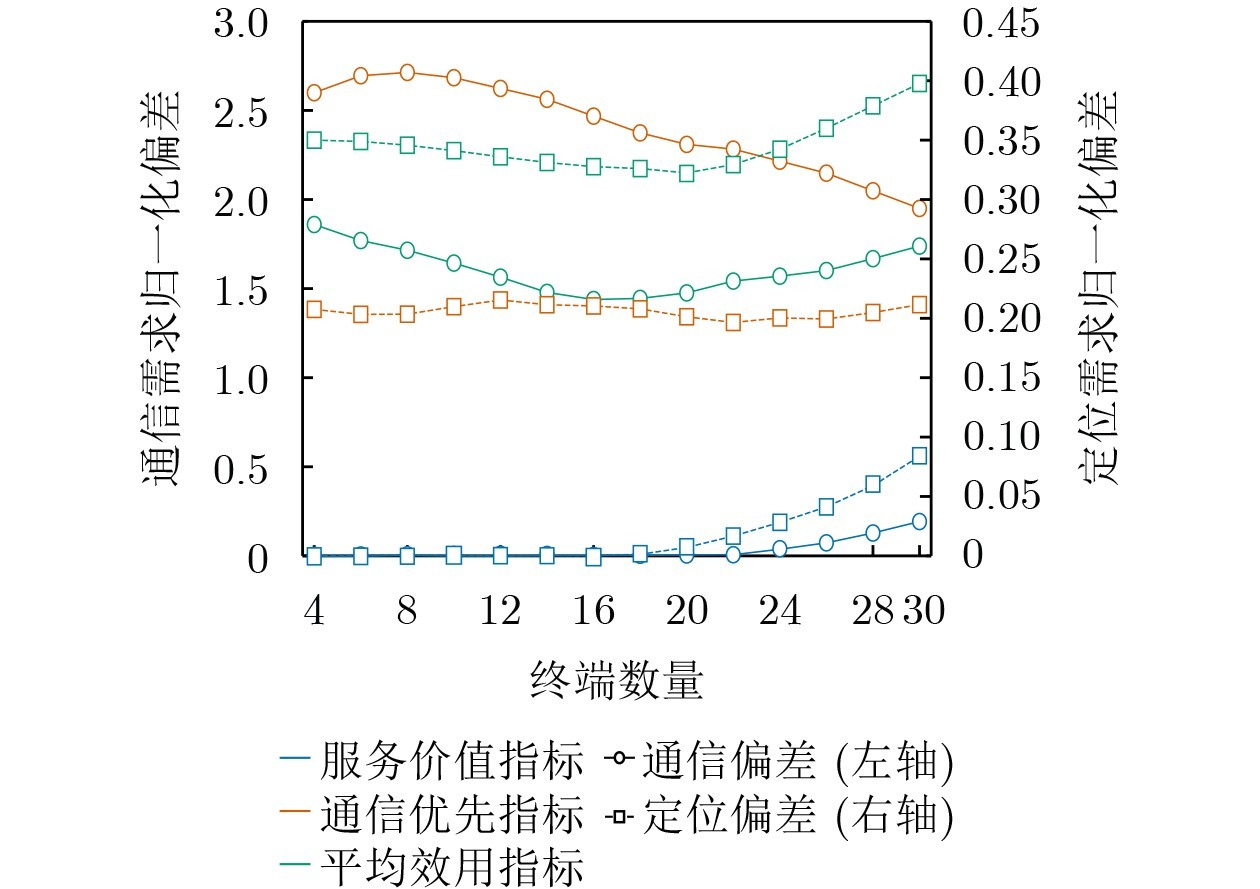
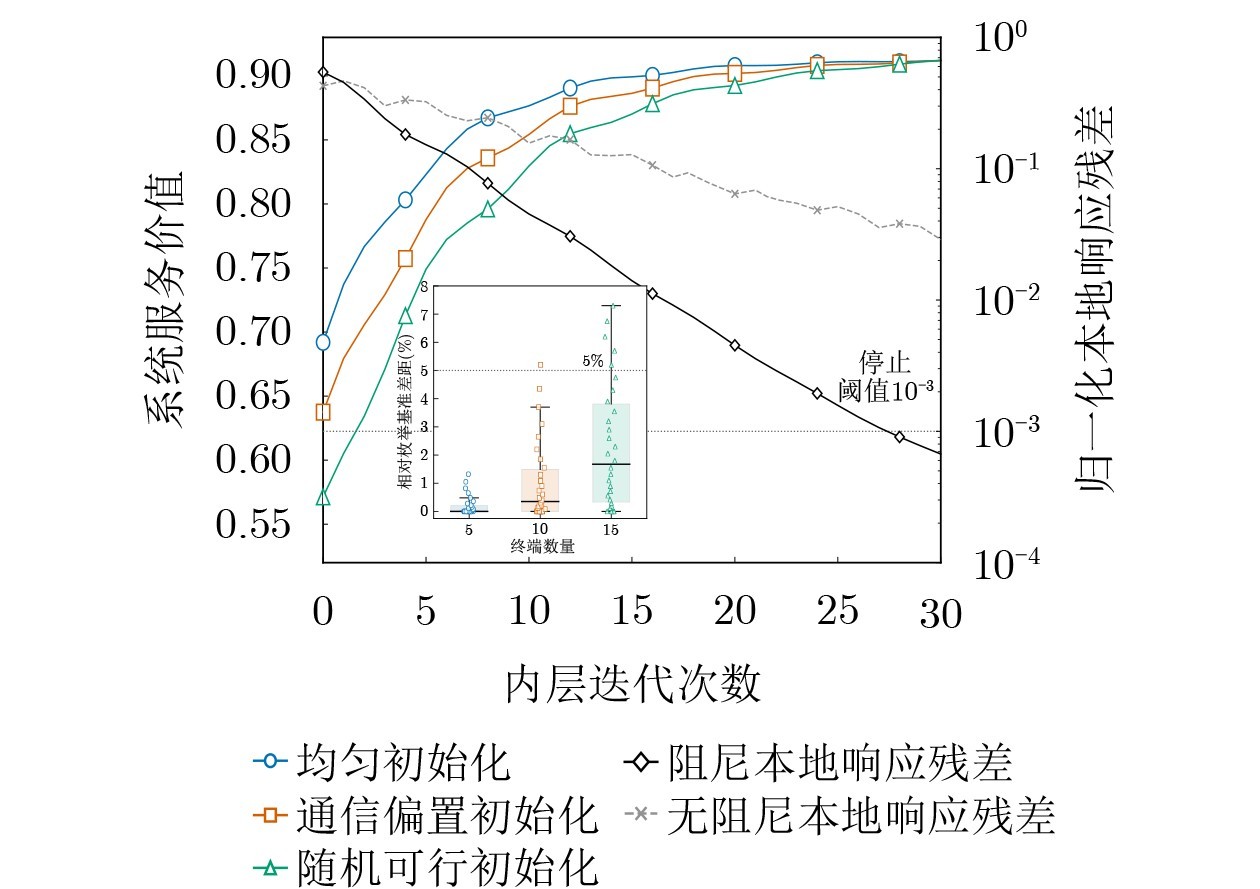
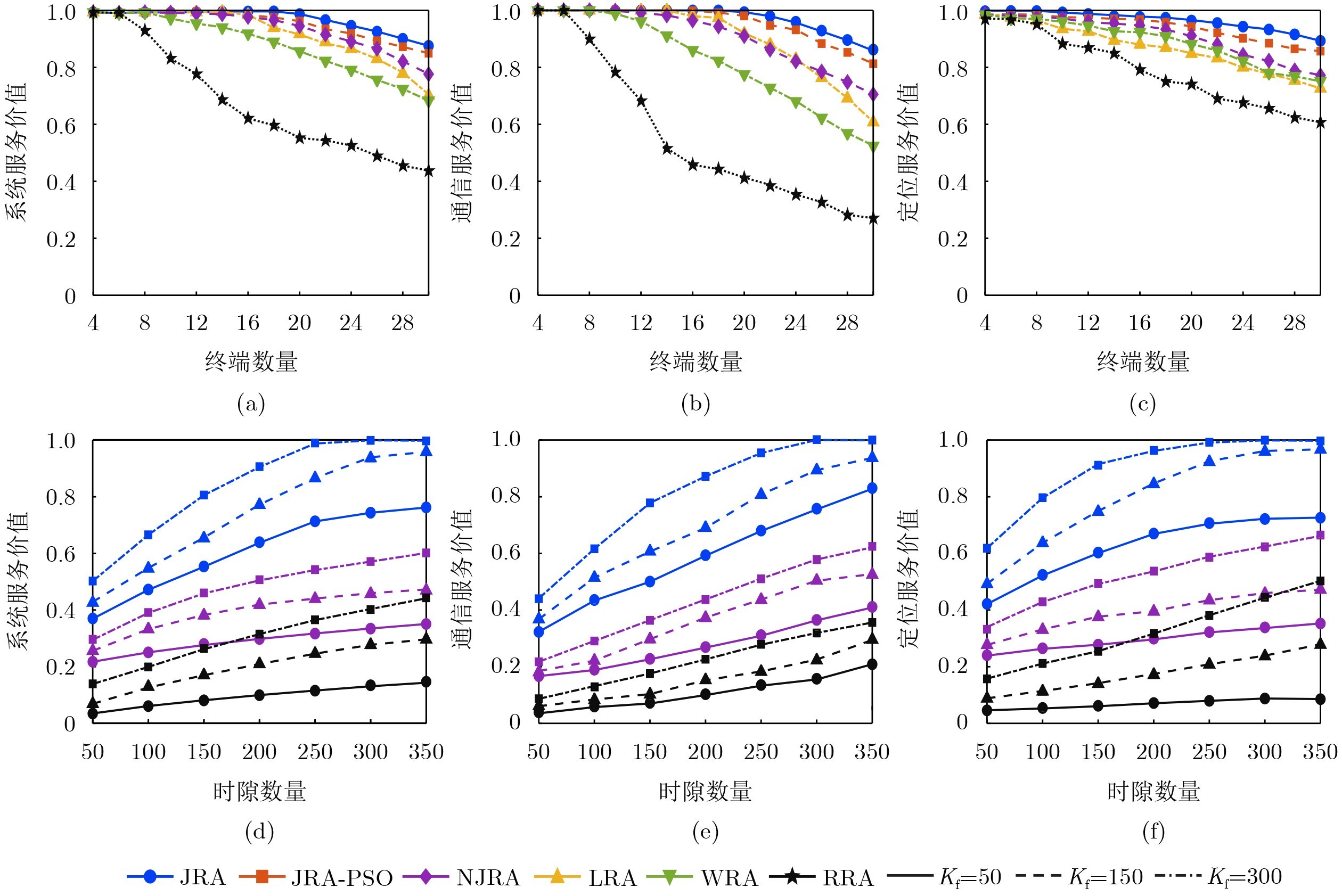
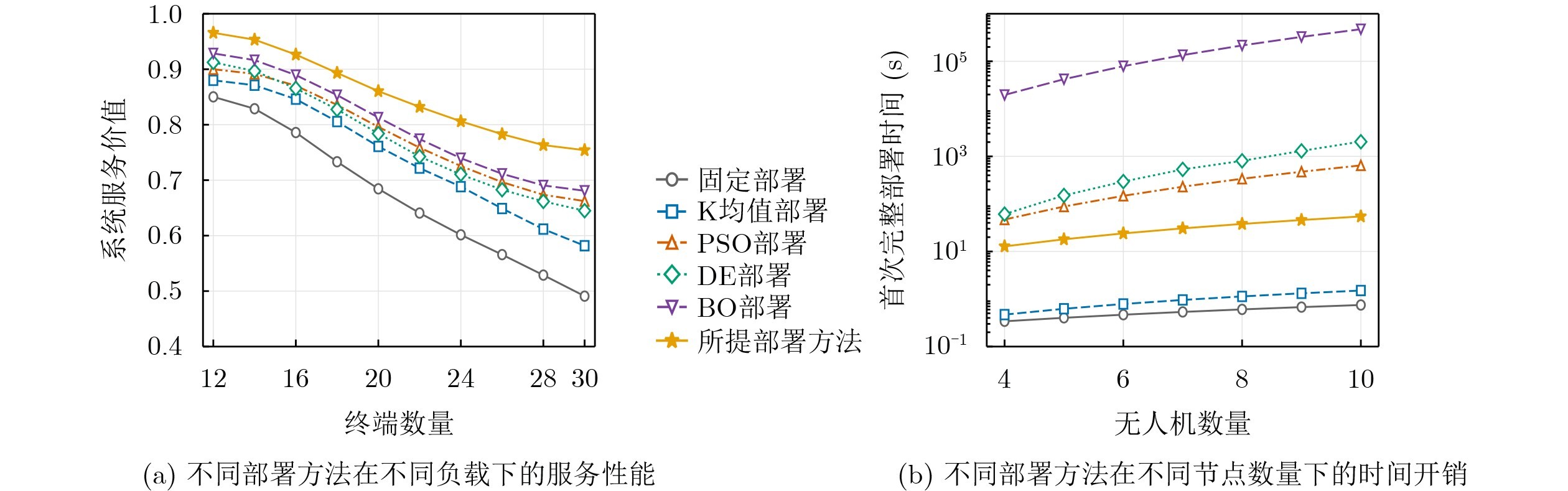
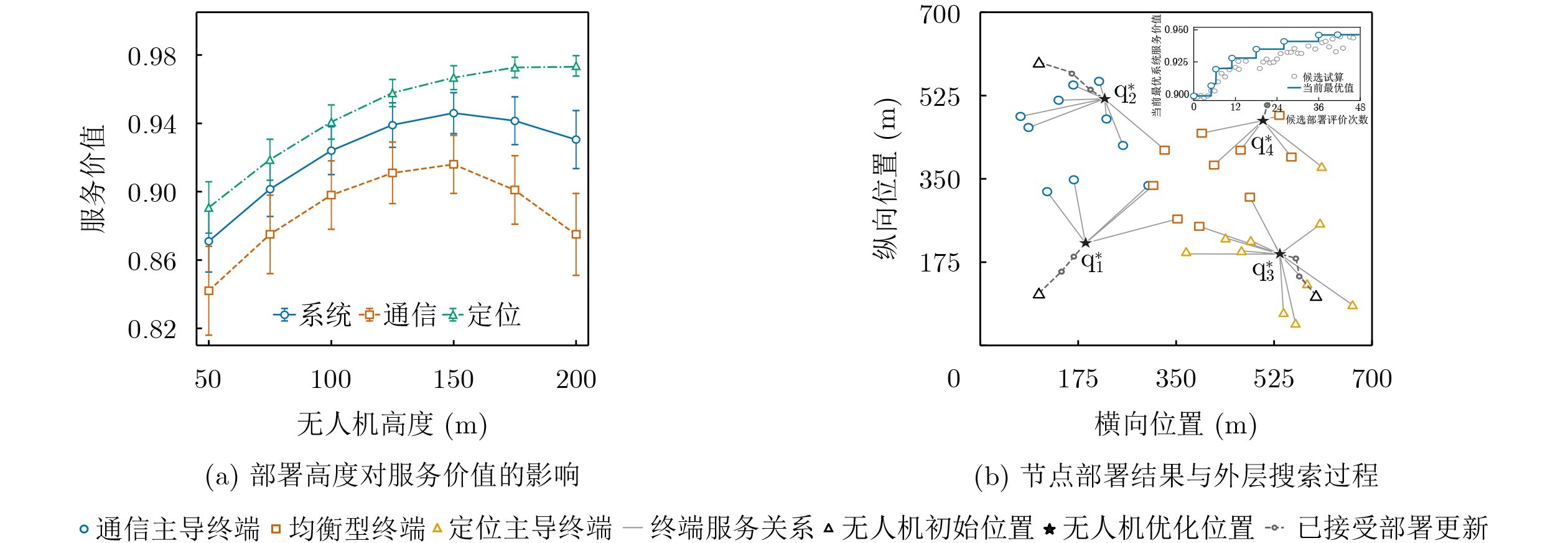
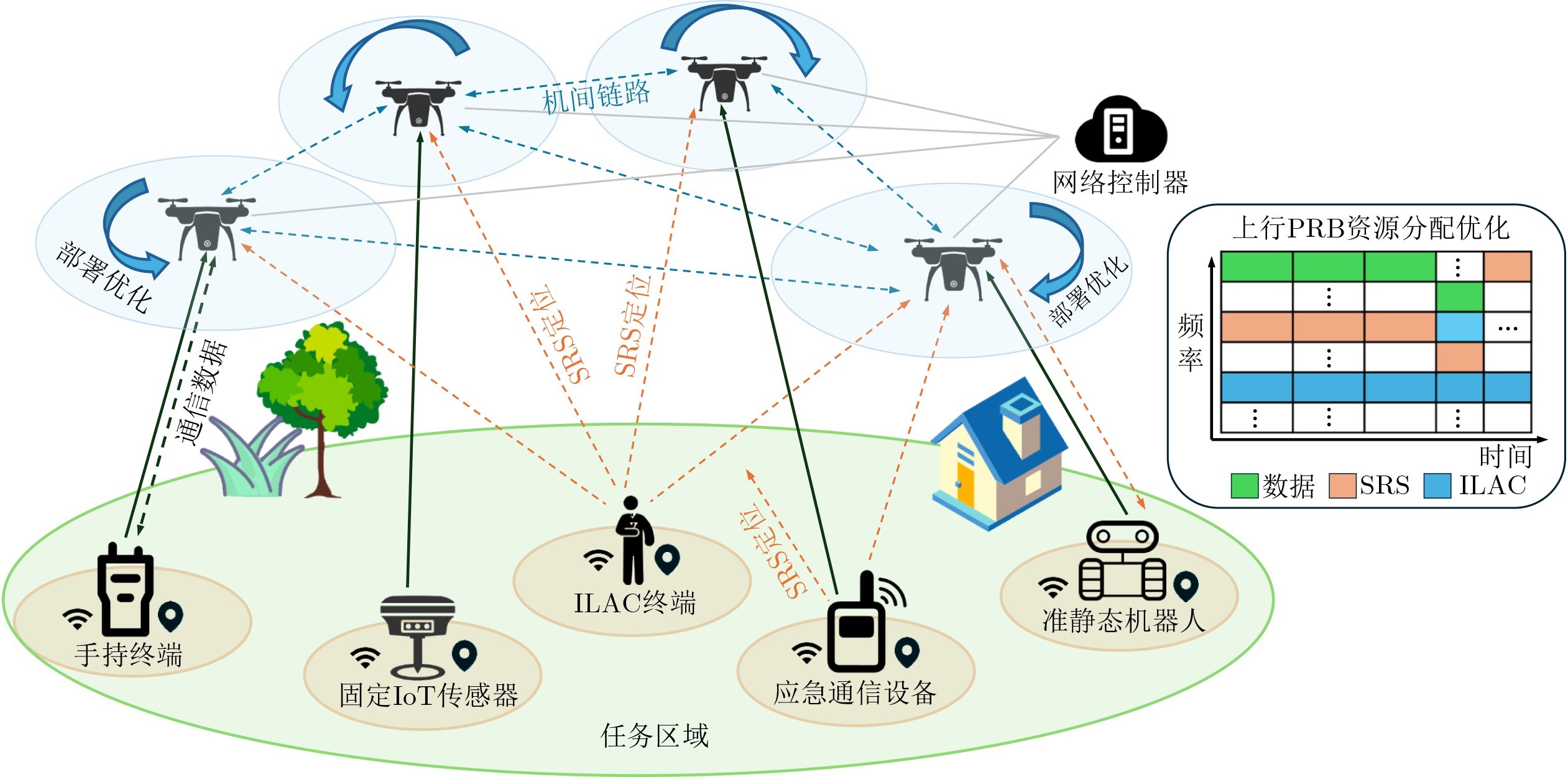
Objective In areas with weak ground-network coverage or limited Global Navigation Satellite System (GNSS) availability, multiple dual-functional Unmanned Aerial Vehicles (UAVs) can provide uplink communication and cooperative localization services. Ground terminals have different requirements for data volume, minimum communication rate, localization-accuracy threshold, service priority, and communication and localization service weights. Maximizing communication rate, localization accuracy, or a weighted sum of the two cannot directly reflect these differentiated requirements. A service below its activation threshold may be unusable, whereas resources allocated after demand saturation provide little additional value. A quasi-static service period with prior terminal positions is therefore considered. A topology-dependent Value of Service (VoS) is formulated, and Physical Resource Block (PRB) scheduling and UAV positions are jointly optimized. Methods Data or Sounding Reference Signals (SRSs) are transmitted by terminals over assigned PRBs. Time Difference of Arrival (TDoA) measurements are formed by synchronized UAVs, and a probabilistic air-to-ground channel model determines communication access and valid localization anchors. Communication VoS combines a sigmoidal rate utility with data completeness. Position Error Bound (PEB), derived from the accumulated Fisher Information Matrix (FIM), is mapped to an exponential utility to quantify localization VoS. Terminal priorities and communication and localization service weights are used to aggregate the two service values. The resulting problem P0 couples binary scheduling, non-concave utilities, time-frequency resources, service relationships, localization geometry, and UAV positions. For a fixed topology, the average number of allocated PRBs and active slots are used to construct a continuous service-level resource profile. This profile approximates the original schedule but does not provide an upper bound. Bandwidth responses are obtained by deterministic one-dimensional branch-and-bound search with damped Newton refinement and shadow-price bisection. Slot responses are obtained by deterministic comparison of a finite set of service-boundary, integer-slot, and feasible-domain-boundary candidates. Adjacent-integer recovery and deterministic slot packing are then used to construct a feasible integer schedule under resource-capacity and terminal-power constraints. If packing fails, the upward-rounded component with the smallest unit VoS loss is rolled back, and the schedule is repacked. VoS is then recomputed from the recovered integer schedule. Thus, the reported schedules remain feasible for P0 without any claim of global optimality. The fixed-topology resource-allocation procedure produces a complete resource response, including the recovered feasible schedule and its VoS, which is subsequently used to drive deployment. Coverage-repair, localization-geometry-improvement, and resource-saving candidates are generated according to service deficits, service relationships, and resource consumption. Normalized proxy scores, per-UAV candidate truncation, and beam search reduce the number of complete resource-response evaluations. For each retained deployment, service relationships are rebuilt, including communication access and localization anchors, and the FIM and resource allocation are recomputed. A candidate is accepted only when the VoS gain obtained from its complete resource response exceeds the preset threshold. The resulting outer sequence is monotonic and bounded and converges to a stable point within the generated candidate set. Resource allocation and node deployment remain coupled throughout the procedure. For each retained topology, communication access, localization anchors, the FIM, and the feasible integer schedule are recomputed before VoS is evaluated. Proxy scores are used only to rank candidates, whereas final acceptance is always based on the complete resource response. The next topology is therefore not selected from distance or localization geometry alone. The accepted update reflects terminal demand, resource scarcity, and localization geometry under the same feasible scheduling constraints used in the objective. This design keeps the optimization objective consistent with the final deployment decision and avoids a geometry-only selection rule. Results and Discussions Simulations are conducted in a 700 m × 700 m area with four UAVs at a baseline deployment height of 150 m. Communication-dominant, localization-dominant, and balanced terminals are included in equal proportions. At each load, all methods share 30 independent scenarios and identical random seeds. The deployment-height experiment reports a 95% confidence interval based on 1 000 scenario-level bootstrap resamples. For fair comparisons, all resource-allocation methods use the same topology, resource pool, and random scenarios. All deployment methods use the same proposed joint resource-allocation response, are evaluated from a cold start, and are subject to the same cap on complete resource-response evaluations, with initialization and training costs included. VoS-driven allocation yields smaller communication-rate and localization-accuracy demand deviations than the communication-priority and average-utility metrics because service saturation redirects resources from overprovisioned requests to insufficiently served requests ( Fig. 2 ). In the convergence test, three feasible initializations converge to similar system VoS values. Damping suppresses oscillations near transitions between non-concave segments, and the small-scale benchmark indicates limited empirical loss from the continuous response and integer recovery (Fig. 3 ). With increasing terminal load, the proposed joint allocator outperforms a Particle Swarm Optimization (PSO)-based slot-response variant, as well as non-joint, learning-based, weight-driven, and random allocation methods (Fig. 4 ). Communication service is more sensitive to terminal load because both communication rate and data completeness must be maintained, whereas localization service accumulates information across anchors and slots. Resource-pool tests further show that additional bandwidth provides little benefit when slots are scarce, whereas increasing SRS bandwidth more directly improves localization. The structured deployment search achieves higher VoS with shorter end-to-end deployment time than PSO, Differential Evolution (DE), and Bayesian Optimization (BO) by focusing complete resource-response evaluations on service-aware candidates (Fig. 5 ). VoS first increases and then decreases with UAV deployment height because improved line-of-sight probability and multi-anchor visibility compete with increased propagation distance and path loss. Horizontal deployment updates balance communication-link quality and localization geometry according to terminal requirements (Fig. 6 ).Conclusions The proposed framework evaluates communication and localization services according to demand satisfaction and coordinates time-frequency resource allocation with iterative UAV deployment updates through complete resource responses and structured candidate search. It improves demand matching, system VoS, deployment efficiency, and interpretability while preserving feasibility under the original scheduling constraints. Prior terminal positions and a quasi-static service period are assumed. Future work will address dynamic terminal movement and changing demands over longer service periods through dynamic resource allocation and continuous UAV trajectory optimization. -
1 服务价值驱动的资源分配与节点部署算法
输入:初始部署$ {\boldsymbol{Q}}^{(0)} $,终端请求$ {s}_{j} $,资源池$ (K_{\rm{f}},K_{\mathrm{t}}) $,最大迭
代次数$ {I}_{\text{out}} $,阈值$ \varepsilon $,候选参数$ ({K}_{q},{W}_{{\mathrm{b}}},L) $输出:部署$ {\boldsymbol{Q}}^{*} $,可行排程$ {\boldsymbol{U}}^{*} $,服务价值$ V_{\text{sys}}^{*} $ (1) 初始化$ n=0 $, $ {\mathcal{G}}^{(0)}=\mathcal{G}({\boldsymbol{Q}}^{(0)}) $ (2) $ ({\boldsymbol{\xi }}^{(0)},{\boldsymbol{U}}^{(0)},V_{\text{sys}}^{(0)})=\mathcal{R}({\boldsymbol{Q}}^{(0)},{\mathcal{G}}^{(0)}) $ (3) FOR $ n=0:{I}_{\text{out}}-1 $ (4) 生成结构化候选并经代理与束搜索保留$ L $个,加入当前部署
为第0个候选,并令$ \boldsymbol{Q}_{0}^{(n)}={\boldsymbol{Q}}^{(n)} $, $ V_{0}^{(n)}=V_{\text{sys}}^{(n)} $(5) FOR $ m=1:L $ (6) $ \mathcal{G}_{m}^{(n)}=\mathcal{G}(\boldsymbol{Q}_{m}^{(n)}) $, $ (\boldsymbol{\xi }_{m}^{(n)},\boldsymbol{U}_{m}^{(n)},V_{m}^{(n)})=\mathcal{R}(\boldsymbol{Q}_{m}^{(n)},\mathcal{G}_{m}^{(n)}) $ (7) END FOR (8) $ {m}^{*}\text{=arg}{\max }_{m\in\{0,1,\cdots,L\}}V_{m}^{(n)} $ (9) IF$ V_{{m}^{*}}^{(n)}>V_{\text{sys}}^{(n)}+\varepsilon $,同步更新 $ \boldsymbol{Q},\boldsymbol{\xi },\boldsymbol{U},{V}_{\text{sys}} $;ELSE
BREAK(10) END IF;END FOR  下载: 导出CSV
表 1 仿真参数设置表
参数 数值 频域PRB数量$ {K}_{{\mathrm{f}}} $ $ \left[50,300\right]\in{\mathbb{N}}^{+} $ 时域时隙数$ {K}_{{\mathrm{t}}} $ $ \left[150,350\right]\in{\mathbb{N}}^{+} $ 通信数据需求$ d_{j}^{\rm c} $ $ \left[0.8,3.5\right]\ \mathrm{Mbit} $ 定位精度需求$ {\sigma }_{j} $ $ \left[0.5,10\right] \;{\mathrm{m}}$ 单时隙业务PRB上限$ K_{j}^{{q}_{\max }} $ $ 50 $ 单服务时隙数上限$ \tau _{j}^{{q}_{\max}} $ $ 30 $ 3类终端需求权重($ w_{j}^{\rm c},w_{j}^{\rm l} $) $ \left(0.2{,}0.8\right),\;(0.5{,}0.5),\;(0.8{,}0.2) $ 单PRB带宽时隙参数($ {B}_{0},{T}_{0} $) $ \left(180\;\text{kHz},1\;\text{ms}\right) $ 信道参数($ {f}_{{\mathrm{c}}},{a}_{\text{e}},{b}_{\text{e}},{\eta }_{\text{LoS}},{\eta }_{\text{NLoS}} $) $ \left(2.1\;\text{GHz},9.61{,}0.16{,}1\;\text{dB},20\;\text{dB}\right) $ ToA测量模型参数($ \psi , $$ \varsigma _{}^{2} $) $ (1.2665×10 $–2 $ ,6×10 $–18$ {\text{s}}^{2}) $ 噪声与功率谱密度($ {N}_{0},{P}_{0} $) $ \left(-174\;\text{dBm/Hz},-49.5\;\text{dBm/Hz}\right) $ 最大发射功率$ {P}_{\max } $ $ 23\;\text{dBm} $ 超参数($ {I}_{{\mathrm{in}}},{I}_{{\mathrm{out}}},\varepsilon $) $ (30,50,10 $–3 $ ) $ Monte Carlo次数$ {N}_{{\mathrm{MC}}} $ $ 30 $
下载: 导出CSV
-
[1] 新华社. 中华人民共和国国民经济和社会发展第十五个五年规划纲要[EB/OL]. https://www.gov.cn/yaowen/liebiao/202603/content_7062633.htm, 2026. XINHUA News Agency. Outline of the 15th Five-Year Plan (2026–2030) for National Economic and Social Development[EB/OL]. https://www.gov.cn/yaowen/liebiao/202603/content_7062633.htm, 2026 (in Chinese). [2] 于宝泉, 杨炜伟, 王权, 等. 无人机辅助通感一体化系统中的信息年龄分析优化[J]. 电子与信息学报, 2024, 46(5): 1996-2003. doi: 10.11999/JEIT231175.YU Baoquan, YANG Weiwei, WANG Quan, et al. Age of Information Analysis and Optimization in Unmanned Aerial Vehicles-assisted Integrated Sensing and Communication Systems[J]. Journal of Electronics & Information Technology, 2024, 46(5): 1996-2003. doi: 10.11999/JEIT231175. [3] 孙伟皓, 王海, 秦蓁, 等. 机会无人机辅助数据收集的组网和资源分配方法[J]. 电子与信息学报, 2025, 47(5): 1381–1391. doi: 10.11999/JEIT241053.SUN Weihao, WANG Hai, QIN Zhen, et al. Networking and resource allocation methods for opportunistic UAV-assisted data collection[J]. Journal of Electronics & Information Technology, 2025, 47(5): 1381–1391. doi: 10.11999/JEIT241053. [4] YANG Yang, CHEN Mingzhe, BLANKENSHIP Y, et al. Positioning using wireless networks: Applications, recent progress, and future challenges[J]. IEEE Journal on Selected Areas in Communications, 2024, 42(9): 2149–2178. doi: 10.1109/JSAC.2024.3423629. [5] YANG Zheyuan, BI Suzhi, and ZHANG Y J A. Deployment optimization of dual-functional UAVs for integrated localization and communication[J]. IEEE Transactions on Wireless Communications, 2023, 22(12): 9672–9687. doi: 10.1109/TWC.2023.3273159. [6] JIANG Yifan, WU Qingqing, CHEN Wen, et al. UAV-enabled integrated sensing and communication: Tracking design and optimization[J]. IEEE Communications Letters, 2024, 28(5): 1024–1028. doi: 10.1109/LCOMM.2024.3379504. [7] WU Jun, YUAN Weijie, and BAI Lin. On the interplay between sensing and communications for UAV trajectory design[J]. IEEE Internet of Things Journal, 2023, 10(23): 20383–20395. doi: 10.1109/JIOT.2023.3287991. [8] LI Biwei, WANG Xianbin, XIN Yan, et al. Value of service maximization in integrated localization and communication system through joint resource allocation[J]. IEEE Transactions on Communications, 2023, 71(8): 4957–4971. doi: 10.1109/TCOMM.2023.3280212. [9] 3GPP. TS 38.211 V17.0. 0-2022 NR Physical channels and modulation[S]. Sophia Antipolis, European Telecommunications Standards Institute (ETSI), 2022. [10] SHEN Yuan and WIN M Z. Fundamental limits of wideband localization—part I: A general framework[J]. IEEE Transactions on Information Theory, 2010, 56(10): 4956–4980. doi: 10.1109/TIT.2010.2060110. [11] KELLY F P, MAULLOO A K, and TAN D K H. Rate control for communication networks: Shadow prices, proportional fairness and stability[J]. Journal of the Operational Research Society, 1998, 49(3): 237–252. doi: 10.1057/palgrave.jors.2600523. [12] KWON G, CONTI A, PARK H, et al. Joint communication and localization in millimeter wave networks[J]. IEEE Journal of Selected Topics in Signal Processing, 2021, 15(6): 1439–1454. doi: 10.1109/JSTSP.2021.3113115. [13] YANG Liu, WEI Yifei, FENG Zhiyong, et al. Deep reinforcement learning-based resource allocation for integrated sensing, communication, and computation in vehicular network[J]. IEEE Transactions on Wireless Communications, 2024, 23(12): 18608–18622. doi: 10.1109/TWC.2024.3470873. [14] 金飞鸿, 张静, 谢亚琴. 用户需求差异化场景下信息年龄优先的多无人机部署及资源分配方法[J]. 电子与信息学报, 2026, 48(1): 253–263. doi: 10.11999/JEIT251062.JIN Feihong, ZHANG Jing, and XIE Yaqin. AoI-prioritized multi-UAV deployment and resource allocation method in scenarios with differentiated user requirements[J]. Journal of Electronics & Information Technology, 2026, 48(1): 253–263. doi: 10.11999/JEIT251062. [15] XU Renjie, HUANG Zhaoke, WANG Chenwei, et al. Evolving collaborative differential evolution for dynamic multi-objective UAV path planning[J]. IEEE Transactions on Vehicular Technology, 2026, 75(5): 7456–7468. doi: 10.1109/TVT.2025.3632847. [16] BENZAGHTA M, GERACI G, LÓPEZ-PÉREZ D, et al. Cellular network design for UAV corridors via data-driven high-dimensional Bayesian optimization[J]. IEEE Transactions on Wireless Communications, 2025, 24(9): 7530–7545. doi: 10.1109/TWC.2025.3561066. -

 下载:
下载:

图(6) / 表(2)
计量
- 文章访问数: 260
- HTML全文浏览量: 49
- PDF下载量: 24
- 被引次数: 0
