




Sum-Rate Maximization for Pinching-Antenna-Assisted Downlink NOMA-ISAC Transmission
-
摘要: 非正交多址接入(NOMA)与通信感知一体化(ISAC)融合能够有效提升频谱利用率和无线感知能力,夹持天线(PA)通过沿介质波导灵活调控辐射位置,为通感融合系统设计提供了新的实现途径。该文针对PA辅助的下行NOMA-ISAC系统展开研究,在通信服务质量(QoS)和感知性能约束下,通过联合优化功率分配与PA位置以最大化系统和速率。由于优化变量耦合且PA位置最小间距约束使可行域呈非连续分布,所建问题具有非凸性。为此,提出一种交替优化(AO)算法,将原问题分解为功率分配优化和夹持天线位置优化两个子问题,分别采用逐次凸逼近(SCA)和分段区间搜索方法求解。仿真结果表明,所提方法较基准方案能有效提升系统和速率,并在性能与计算复杂度之间取得较好折中。Abstract:
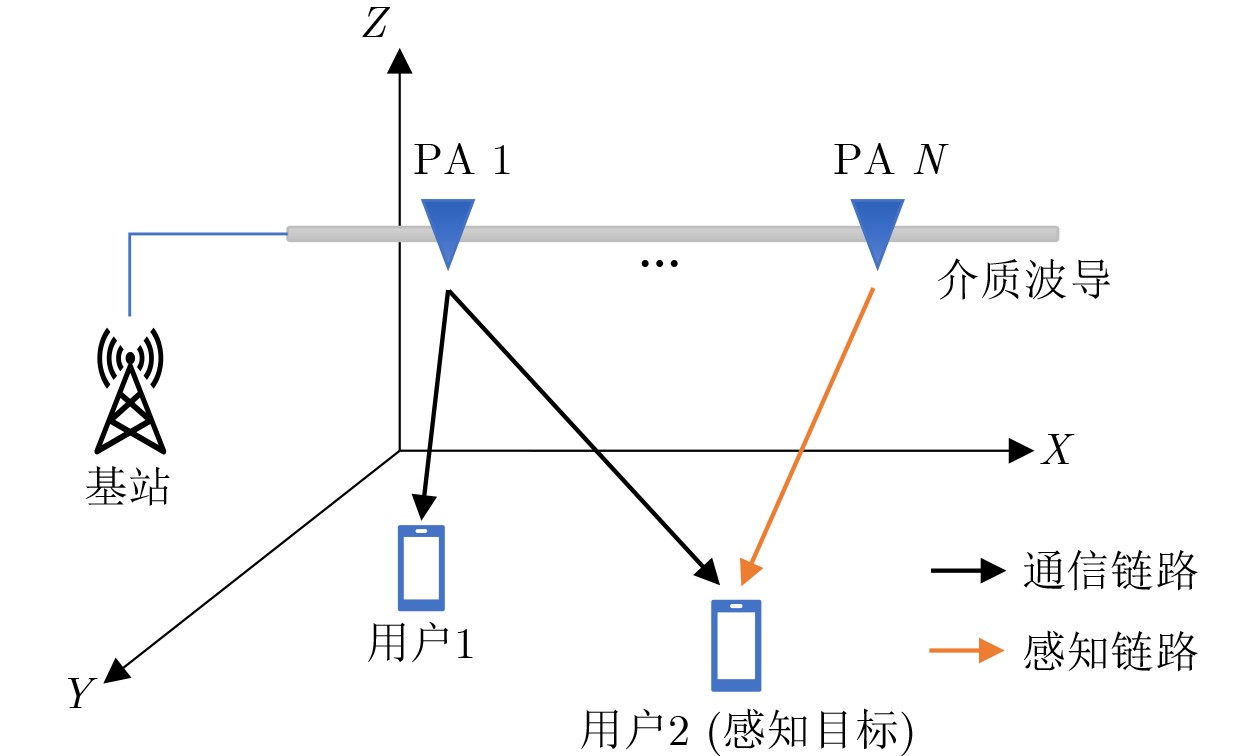
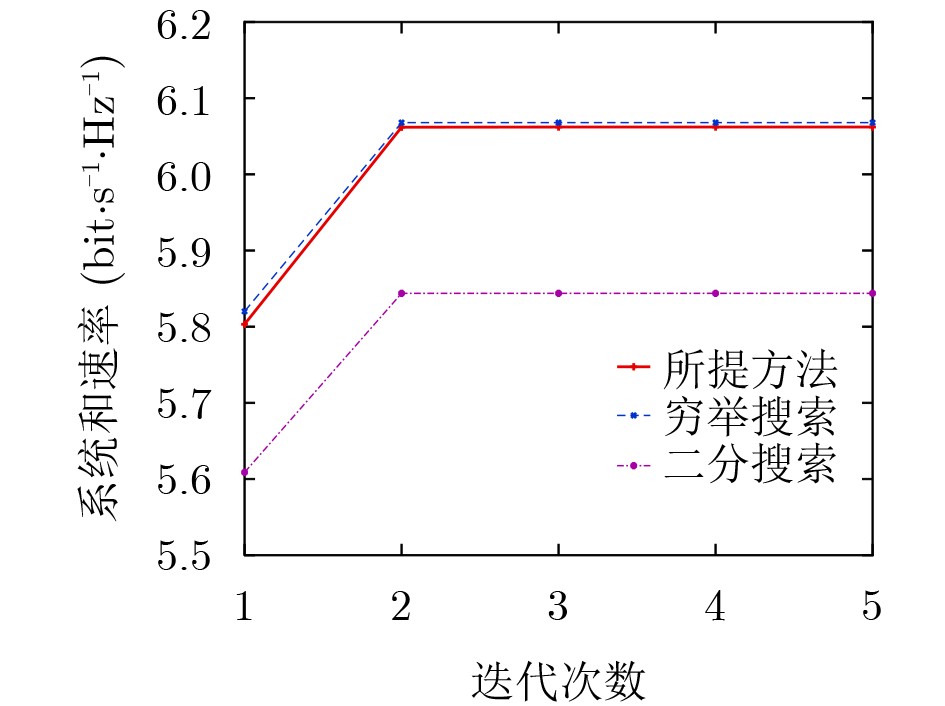
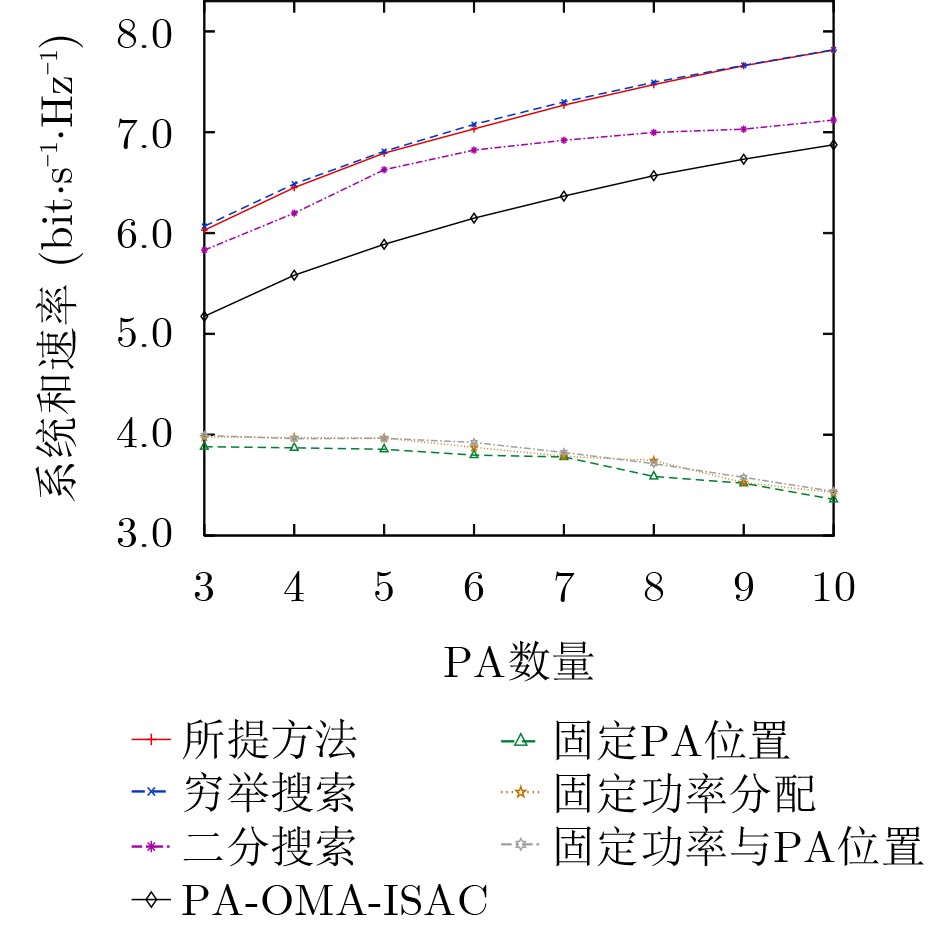
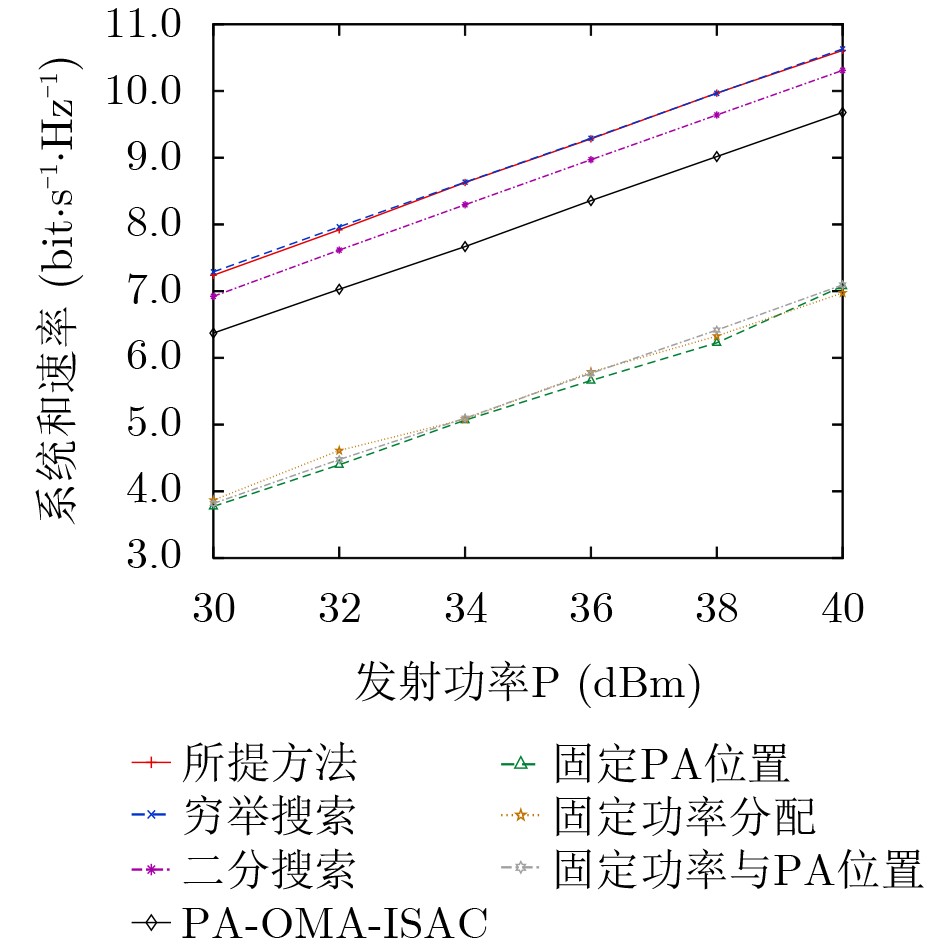
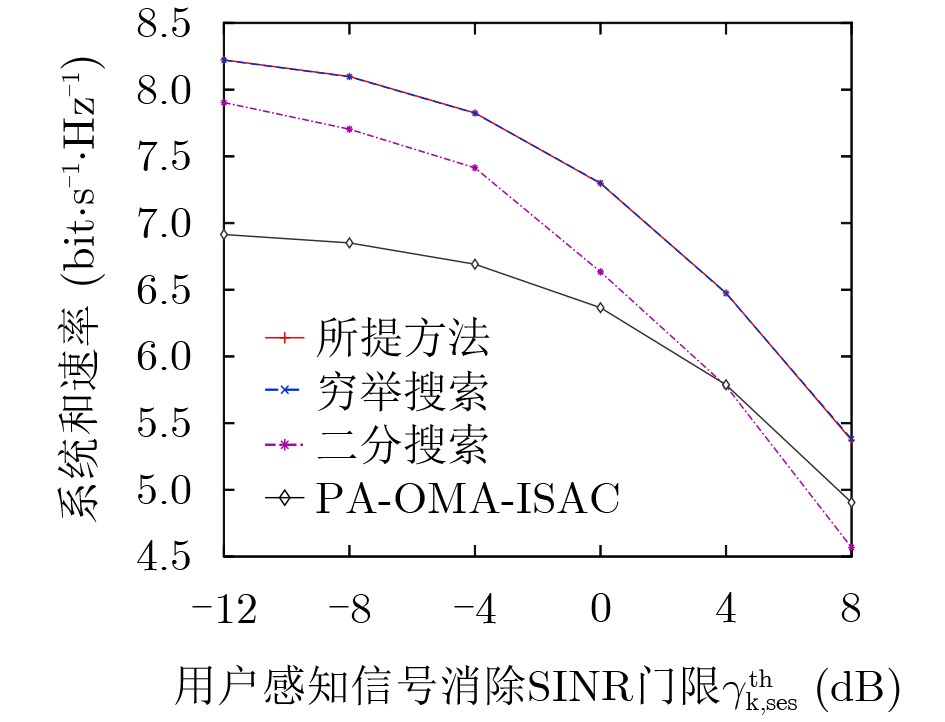
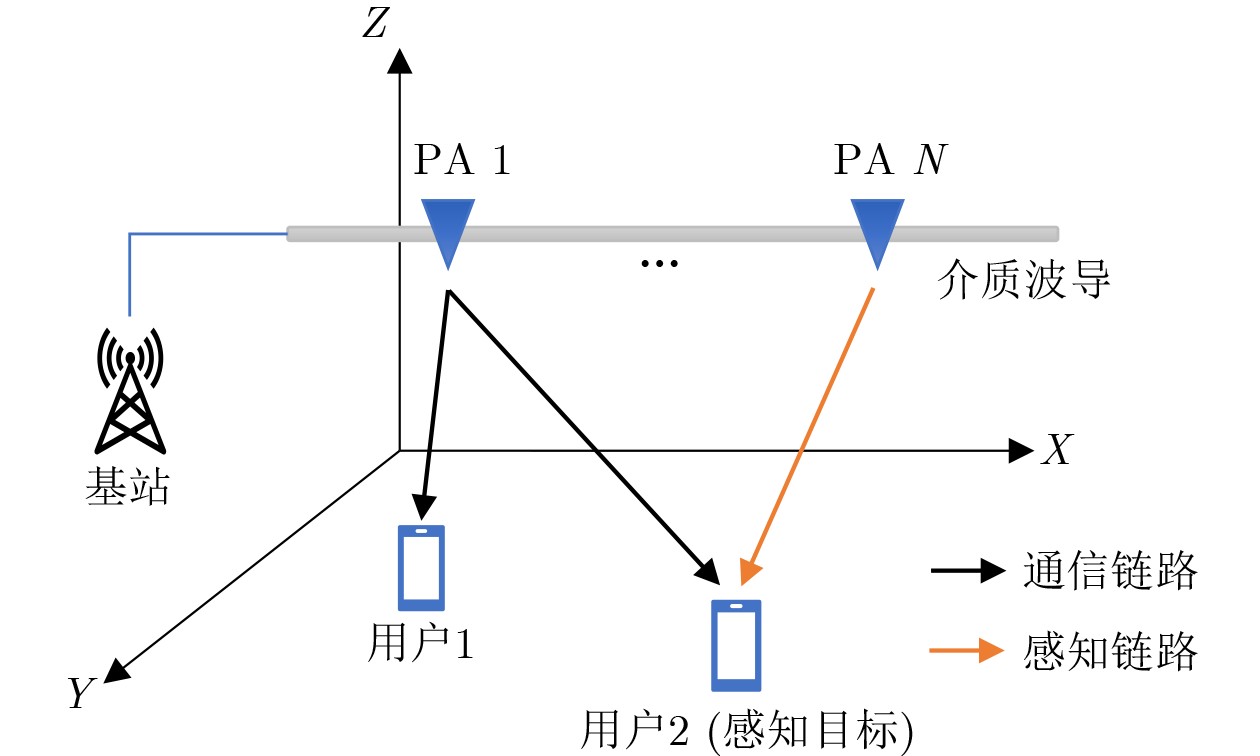
Objective Non-Orthogonal Multiple Access (NOMA) and Integrated Sensing and Communication (ISAC) are regarded as promising techniques for future wireless networks. Pinching Antenna (PA) systems have provided a new reconfigurable transmission architecture by generating controllable radiation points along a dielectric waveguide, which provides a new approach for NOMA-ISAC system design. However, existing studies mainly focus on PA-assisted NOMA, PA-assisted ISAC, or fixed-position antenna activation in PA-assisted NOMA-ISAC systems, while the joint design of power allocation and continuous PA positions in PA-assisted downlink NOMA-ISAC systems remains insufficiently investigated. The interaction among NOMA interference, sensing-signal detection, successive interference cancellation, PA position design, and other factors has not been fully considered. Therefore, a PA-assisted downlink NOMA-ISAC system is studied, and the system sum rate is maximized under communication quality-of-service requirements and sensing performance constraints. Methods For the PA-assisted downlink NOMA-ISAC system, a joint sum-rate maximization problem is formulated under communication Quality-of-Service (QoS) requirements and sensing performance constraints. The power allocation coefficients and PA positions are jointly optimized to improve the system sum rate. Since the optimization variables are highly coupled and the PA minimum-spacing constraint leads to a discontinuous feasible region, the formulated problem is non-convex. To solve this problem, an Alternating Optimization (AO) scheme is proposed. The original problem is decomposed into two subproblems, namely power allocation optimization and PA position optimization. The power allocation subproblem is solved by Successive Convex Approximation (SCA), while the PA position subproblem is solved by a partitioned-interval search method. Results and Discussions The proposed method converges within a few iterations, and its sum-rate performance is very close to that of the exhaustive-search benchmark, while clearly outperforming the bisection-based benchmark ( Fig. 2 ). The system sum rate increases with the number of PAs and then gradually tends to saturate (Fig. 3 ), because additional PAs provide more spatial degrees of freedom, while the power allocated to each PA decreases under a fixed total transmit power. Compared with the baseline schemes, the proposed scheme achieves a higher sum rate, indicating that the performance gain comes from the joint design of power allocation and PA positions rather than from single-variable optimization. Under different power budgets, the proposed method also maintains a performance close to exhaustive search and shows a stable advantage over the other algorithms (Fig. 4 ). These results demonstrate that the proposed method provides an effective performance-complexity tradeoff for PA-assisted downlink NOMA-ISAC transmission. The sensitivity analysis also shows that the proposed method remains close to exhaustive search under different sensing-signal cancellation SINR thresholds (Fig. 5 ).Conclusions A PA-assisted downlink NOMA-ISAC system is investigated in this paper. By jointly optimizing the power allocation coefficients and PA positions, a system sum-rate maximization problem is formulated under communication QoS requirements and sensing performance constraints. To address the non-convexity and discontinuous feasible region caused by the strong coupling among optimization variables and the PA minimum-spacing constraint, an AO-based solution framework is proposed. In this framework, the power allocation subproblem is handled by SCA, while the PA position optimization subproblem is solved by a partitioned-interval search method. Simulation results show that the proposed method converges within a small number of iterations, achieves performance close to exhaustive search with lower computational complexity, and outperforms the baseline schemes. These results verify the effectiveness of the joint design of power allocation and PA positions. Future work will further consider multi-user and multi-target scenarios, imperfect channel state information, and more accurate sensing echo models, so as to improve the applicability of PA-assisted NOMA-ISAC systems in complex practical environments. -
表 1 仿真参数
参数 数值 载波频率$ {f}_{0} $(GHz) 28 噪声功率$ {\sigma }^{2} $(dBm) –90 波导长度$ L $(m) 10 波导馈电点$ {\psi }_{0}=(0,{y}_{0},{z}_{0}) $ (0,3,4) 用户位置$ {\psi }_{1} $, $ {\psi }_{2} $ (2,3,0), (6,4,0) 波导有效折射率$ {n}_{\text{neff}} $ 1.4 PA数量$ N $ 3~10 基站总发射功率$ P $(dBm) 30~40 通信QoS SINR门限$ {\gamma }^{\text{th}} $ 1 目标感知SNR门限$ \gamma _{\text{ses}}^{\text{th}} $ 1 用户感知信号消除SINR门限$ \gamma _{k\text{,ses}}^{\text{th}} $ 1  下载: 导出CSV
-
[1] DING Zhiguo, LEI Xianfu, KARAGIANNIDIS G K, et al. A survey on non-orthogonal multiple access for 5G networks: Research challenges and future trends[J]. IEEE Journal on Selected Areas in Communications, 2017, 35(10): 2181–2195. doi: 10.1109/JSAC.2017.2725519. [2] 王正强, 成蕖, 樊自甫, 等. 非正交多址系统资源分配研究综述[J]. 电信科学, 2018, 34(8): 136–146. doi: 10.11959/j.issn.1000-0801.2018236.WANG Zhengqiang, CHENG Qu, FAN Zifu, et al. A survey of resource allocation in non-orthogonal multiple access systems[J]. Telecommunications Science, 2018, 34(8): 136–146. doi: 10.11959/j.issn.1000-0801.2018236. [3] GONZÁLEZ-PRELCIC N, KESKIN M F, KALTIOKALLIO O, et al. The integrated sensing and communication revolution for 6G: Vision, techniques, and applications[J]. Proceedings of the IEEE, 2024, 112(7): 676–723. doi: 10.1109/JPROC.2024.3397609. [4] 徐金雷, 赵俊湦, 卢华兵, 等. 面向6G的多维扩展通感一体化研究综述[J]. 电子与信息学报, 2024, 46(5): 1672–1683. doi: 10.11999/JEIT231045.XU Jinlei, ZHAO Junsheng, LU Huabing, et al. An overview on multi-dimensional expanded integrated sensing and communication for 6G[J]. Journal of Electronics & Information Technology, 2024, 46(5): 1672–1683. doi: 10.11999/JEIT231045. [5] WANG Zhaolin, LIU Yuanwei, MU Xidong, et al. NOMA empowered integrated sensing and communication[J]. IEEE Communications Letters, 2022, 26(3): 677–681. doi: 10.1109/LCOMM.2022.3140271. [6] 李美玲, 朱芸灿, 申陈宁, 等. 智能超表面辅助的非正交多址接入车联网通感一体传输与资源分配优化[J]. 电子与信息学报, 2025, 47(4): 1043–1051. doi: 10.11999/JEIT240842.LI Meiling, ZHU Yuncan, SHEN Chenning, et al. RIS-assisted ISAC with non-orthogonal multiple access transmission and resource allocation optimization in vehicular networks[J]. Journal of Electronics & Information Technology, 2025, 47(4): 1043–1051. doi: 10.11999/JEIT240842. [7] 李兴旺, 王新莹, 田心记, 等. 基于非理想条件可重构智能超表面辅助无线携能通信-非正交多址接入系统通感性能研究[J]. 电子与信息学报, 2024, 46(6): 2434–2442. doi: 10.11999/JEIT231395.LI Xingwang, WANG Xinying, TIAN Xinji, et al. Communication and sensing performance analysis of RIS-assisted SWIPT-NOMA system under non-ideal conditions[J]. Journal of Electronics & Information Technology, 2024, 46(6): 2434–2442. doi: 10.11999/JEIT231395. [8] JIANG Chengjun, ZHANG Chensi, HUANG Chongwen, et al. Exploiting RIS in secure beamforming design for NOMA-assisted integrated sensing and communication[J]. IEEE Internet of Things Journal, 2024, 11(17): 28123–28136. doi: 10.1109/JIOT.2024.3416319. [9] SALEM A A, SAAD M, ABDALLAH S, et al. Movable-antenna-aided covert ISAC-NOMA networks: Joint antenna positioning and resource allocation[J]. IEEE Open Journal of the Communications Society, 2025, 6: 9373–9391. doi: 10.1109/OJCOMS.2025.3627607. [10] YANG Zheng, WANG Ning, SUN Yanshi, et al. Pinching antennas: Principles, applications and challenges[J]. IEEE Wireless Communications, 2026, 33(2): 175–184. doi: 10.1109/MWC.2025.3607867. [11] LIU Yuanwei, WANG Zhaolin, MU Xidong, et al. Pinching-antenna systems: Architecture designs, opportunities, and outlook[J]. IEEE Communications Magazine, 2026, 64(1): 190–196. doi: 10.1109/MCOM.001.2500037. [12] ZHOU Ziwu, YANG Zheng, CHEN Gaojie, et al. Sum-rate maximization for NOMA-assisted pinching-antenna systems[J]. IEEE Wireless Communications Letters, 2025, 14(9): 2728–2732. doi: 10.1109/LWC.2025.3578312. [13] ZENG Ming, LI Xingwang, WANG Ji, et al. Energy-efficient resource allocation for NOMA-assisted uplink pinching-antenna systems[J]. IEEE Wireless Communications Letters, 2025, 14(11): 3695–3699. doi: 10.1109/LWC.2025.3600899. [14] ZHANG Zheng, WANG Zhaolin, MU Xidong, et al. Integrated sensing and communications for pinching-antenna systems (PASS)[J]. IEEE Communications Letters, 2025, 29(12): 2929–2933. doi: 10.1109/LCOMM.2025.3619778. [15] QIN Yunhui, FU Yaru, and ZHANG Haijun. Joint antenna position and transmit power optimization for pinching antenna-assisted ISAC systems[J]. IEEE Wireless Communications Letters, 2025, 14(11): 3535–3539. doi: 10.1109/LWC.2025.3597719. [16] QIN Yunhui, FU Yaru, LIANG Yan, et al. Pinching-antenna systems (PASS): Paving the way for 6G ISAC innovations[J]. IEEE Communications Magazine, 2026, 64(5): 212–218. doi: 10.1109/MCOM.001.2500439. [17] XIA Zixuan, SUN Yanshi, ZHOU Momiao, et al. Antenna activation and power allocation for pinching antenna assisted ISAC-NOMA systems[C]. Proceedings of the 11th International Conference on Intelligent Computing and Signal Processing, Hefei, China, 2026: 283–288. doi: 10.1109/ICSP69961.2026.11540556. [18] ZENG Ming, WANG Ji, LI Xingwang, et al. Sum rate maximization for NOMA-assisted uplink pinching-antenna systems[J]. IEEE Wireless Communications Letters, 2026, 15: 280–284. doi: 10.1109/LWC.2025.3624761. -

 下载:
下载:

图(5) / 表(1)
计量
- 文章访问数: 131
- HTML全文浏览量: 25
- PDF下载量: 12
- 被引次数: 0
