




Preamble-Referenced Cyclic Cross-correlation Chirp Spread Spectrum Communication Technology in Complex Multipath Environments
-
摘要: 针对地面无人平台在复杂多径环境下的短突发可靠通信问题,该文研究强多径、载波频率偏移(CFO)、定时偏移(TO)、采样频率偏移(SFO)与带内干扰共同作用下的鲁棒检测技术,构造前导参考循环互相关线性调频扩频(PRCC-CSS)方法。该方法联合设计帧结构、同步估计与载荷检测:前导up-chirp与帧同步定界符down-chirp的互补频域索引联合估计整数CFO与TO;相邻前导相位差、平均谱主峰邻域和跨符号bin漂移分别估计小数CFO、小数TO和SFO;载荷检测以前导平均谱构造帧参考谱,与载荷谱循环互相关完成符号判决。该文参数设置下的仿真表明,在加性高斯白噪声、扩展典型城市(ETU)信道模型及ETU叠加干扰场景下,PRCC-CSS较直接序列扩频获得更低能量门限;在ETU加干扰下较非相干和相干峰值检测获得更低信干噪比门限。此外,基于软件无线电的原型验证系统在ETU、5 dB干扰信号功率比条件下可靠帧保留率达90%以上,通过筛选的可靠帧内未观测到符号与比特错误。因此,所提技术将多径频域结构由不利扰动转化为可匹配参考特征,可作为复杂短突发可靠通信的候选物理层方案。Abstract:
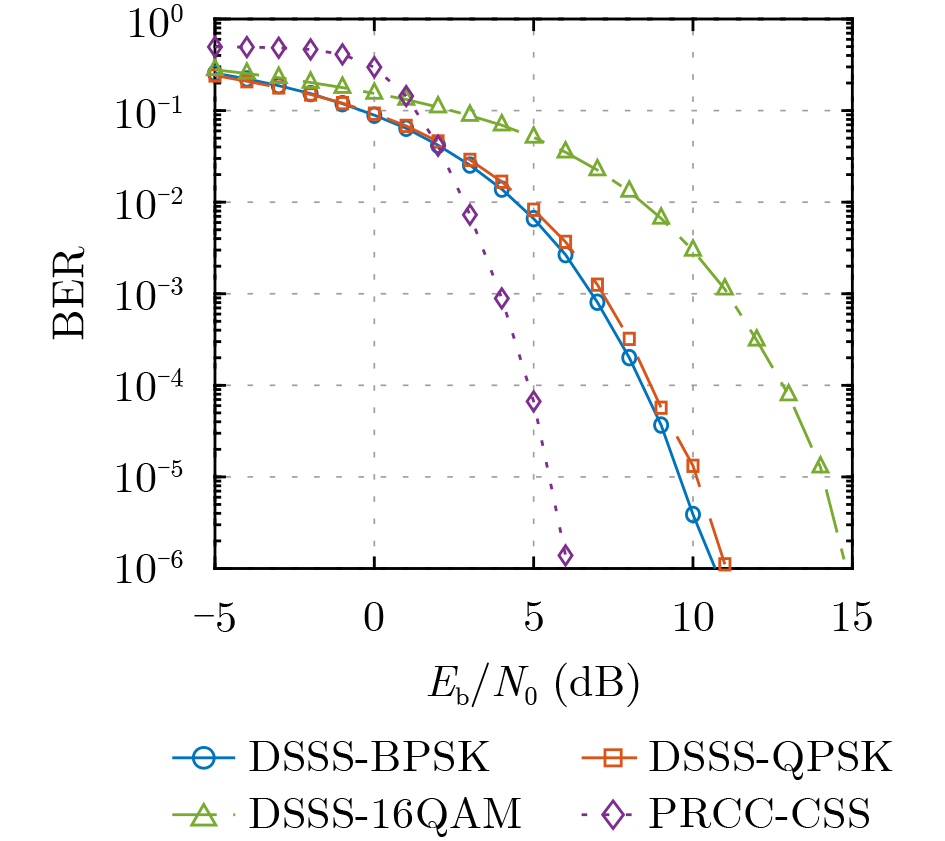
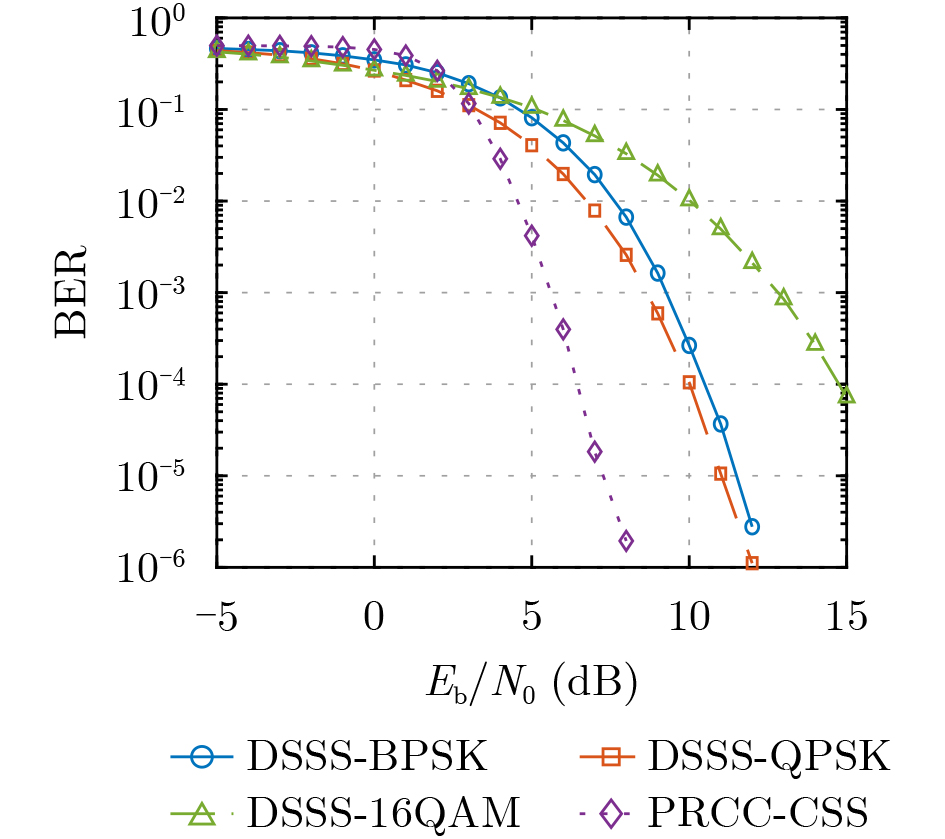
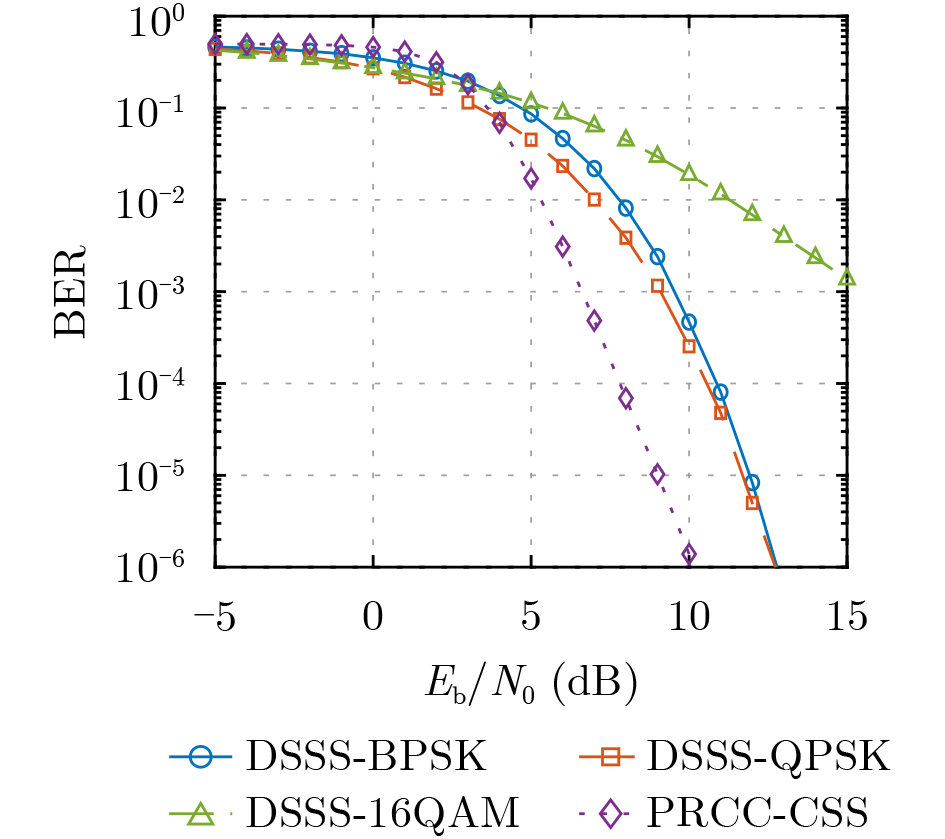
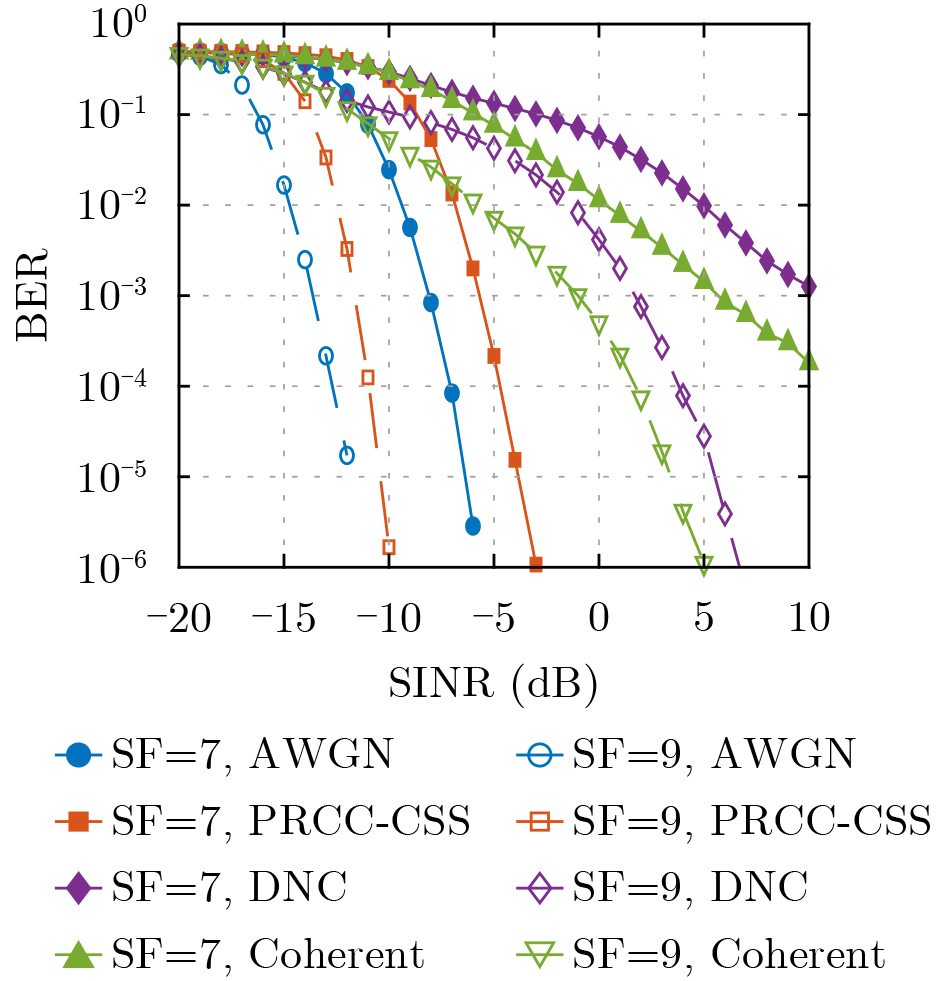
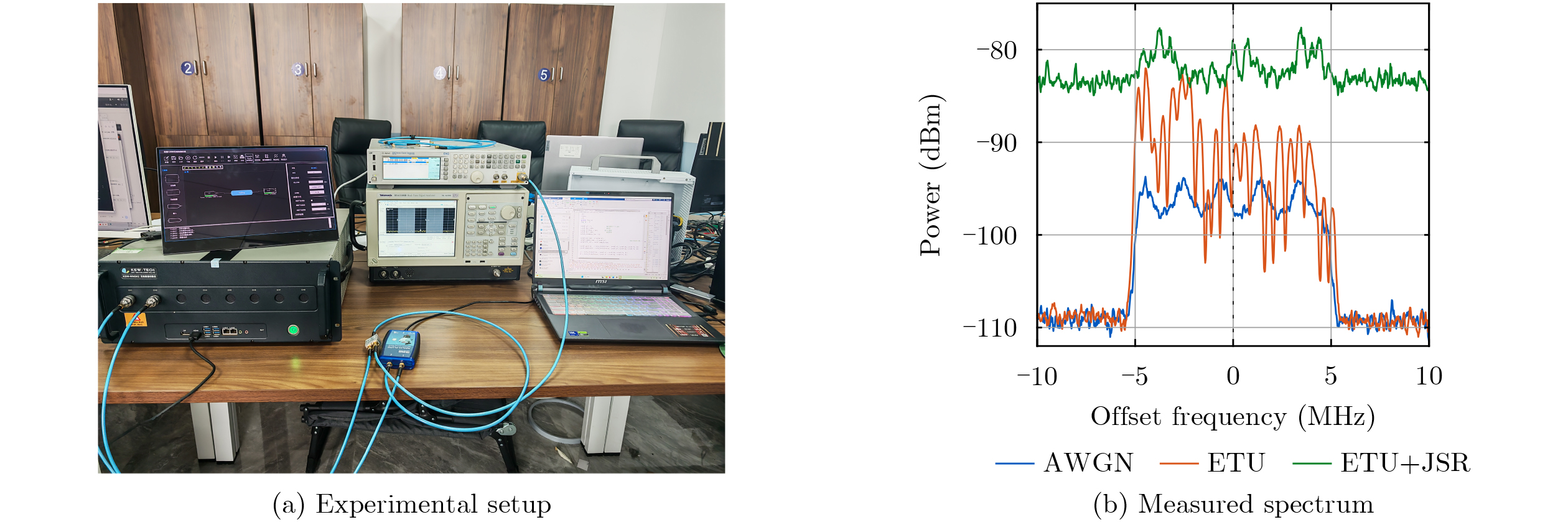
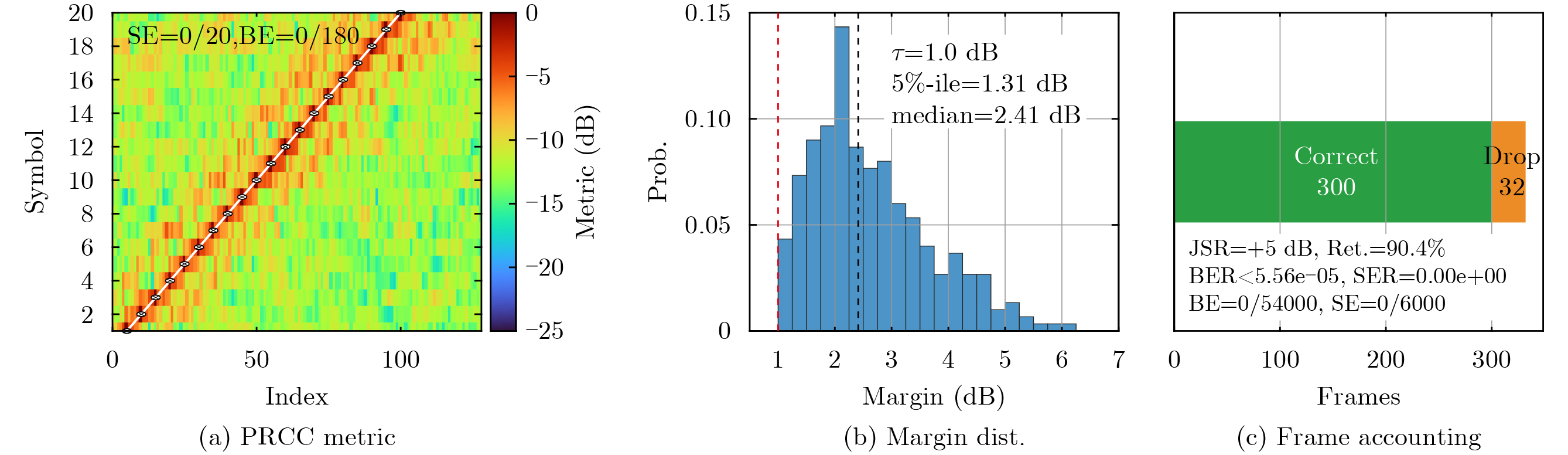
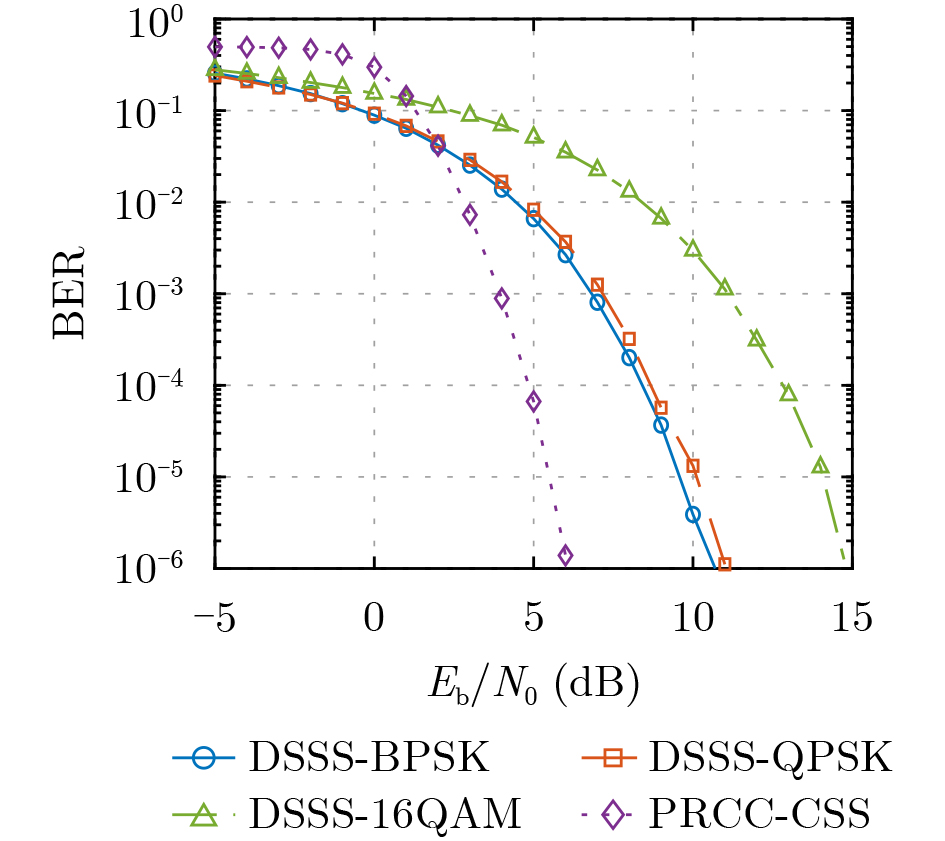
Objective Ground unmanned platforms operating in urban streets, industrial parks, and underground passages require reliable short-burst command-and-control communication. In these complex near-ground environments, reception is affected by strong multipath fading, large Carrier Frequency Offset (CFO), residual Timing Offset (TO), Sampling Frequency Offset (SFO), and in-band interference from coexisting wireless systems. Conventional Chirp Spread Spectrum (CSS) receivers based on single-peak decisions in the dechirp-Discrete Fourier Transform (DFT) domain are vulnerable to multipath-induced spectral splitting and interference-induced bin masking. Direct-Sequence Spread Spectrum (DSSS) receivers can also be sensitive to synchronization errors under combined offsets and show reduced energy efficiency under multipath. Robust handling of these impairments is therefore required for low-latency control links and for the coexistence of unmanned ground platforms with legacy wireless infrastructure in dense deployments. Methods A Preamble-Referenced Cyclic Cross-correlation CSS (PRCC-CSS) scheme is proposed in which frame structure, synchronization estimation, and payload detection are jointly designed. Each frame consists of multiple identical up-chirp preamble symbols, a down-chirp Start-of-Frame Delimiter (SFD), and CSS-modulated payload symbols. Integer CFO and TO are jointly estimated from closed-form linear combinations of the complementary frequency-domain indices at the dechirp-DFT outputs of the up-chirp preamble and down-chirp SFD. Fractional CFO is estimated from inter-symbol phase differences between adjacent preamble symbols, whereas fractional TO is estimated by interpolation around the main peak of the averaged preamble spectrum. Under a common oscillator-reference assumption, SFO-induced bin drift is compensated using the clock-offset relation derived from CFO. After offset compensation, the averaged preamble spectrum is used to construct a frame-specific reference spectrum that represents the current multipath frequency-domain structure. Each payload symbol is then detected by cyclically cross-correlating its spectrum with the reference spectrum over candidate cyclic shifts. The shift corresponding to the maximum cyclic cross-correlation is selected as the demodulated symbol index. In this way, the multipath-induced frequency-domain structure is converted from an adverse perturbation into a matchable intra-frame reference feature. Multipath-robust structure-matched payload detection is therefore achieved without explicit path-by-path channel estimation. Results and Discussions PRCC-CSS is evaluated under identical bandwidth, sampling rate, and processing gain at a target Bit Error Rate (BER) of 10–4. First, it is compared with three DSSS baselines using Binary Phase-Shift Keying (BPSK), Quadrature Phase-Shift Keying (QPSK), and 16-ary Quadrature Amplitude Modulation (16QAM) under three channel conditions. Under Additive White Gaussian Noise (AWGN, Fig. 1), PRCC-CSS reaches the target BER at approximately 4.9 dB Eb/N0, compared with 8.5~9.0 dB for the best DSSS baseline. This result indicates that chirp index modulation combined with preamble-referenced correlation provides frequency-domain energy aggregation independent of a specific multipath profile. Under the Extended Typical Urban (ETU) channel without interference ( Fig. 2 ), PRCC-CSS requires approximately 6.5 dB Eb/N0, compared with approximately 10.0 dB for the best DSSS baseline. The reference spectrum captures and reuses the per-frame multipath frequency-domain structure, whereas finite-finger DSSS-RAKE is more strongly affected by path-capture and code-synchronization errors. Under ETU with in-band interference at a Jamming-to-Signal Ratio (JSR) of 5 dB (Fig. 3 ), PRCC-CSS requires approximately 7.8~8.0 dB Eb/N0, compared with 10.8~11.0 dB for the best DSSS baseline. The reference and payload spectra experience nearly the same multipath frequency-domain structure within a frame, which helps preserve decision separability during cyclic cross-correlation. By contrast, DSSS-RAKE accumulates residual interference across its combining fingers. Second, PRCC-CSS is compared with Dechirp Non-Coherent (DNC) and coherent peak detection at Spreading Factor (SF)=7 and SF=9 under ETU with interference (Fig. 4 ). At SF=7, DNC does not reach the target BER within the tested Signal-to-Interference-plus-Noise Ratio (SINR) range. At SF=9, DNC requires approximately 4 dB SINR. PRCC-CSS reaches the same target at approximately –5 dB SINR at SF=7 and –11 dB at SF=9, corresponding to an SINR threshold improvement of approximately 9~15 dB. These results show that the gain is mainly attributable to frame-wide cyclic matching rather than phase compensation alone. Third, a Software-Defined Radio (SDR) prototype is evaluated on an ETU-emulated channel at JSR = 5 dB (Figs. 5 and6 ). Of the 332 received frames, 300 are retained as reliable, corresponding to a frame retention rate of 90.4%. Among the retained frames, no symbol errors are observed in 6 000 payload symbols, and no bit errors are observed in 54 000 payload bits. The retained-frame conditional BER therefore has a one-sided 95% upper confidence bound of 5.56 × 10⁻⁵.Conclusions The proposed PRCC-CSS scheme jointly integrates integer and fractional CFO and TO estimation, SFO estimation, and cyclic cross-correlation payload detection. At BER=10–4, PRCC-CSS reduces the required Eb/N0 by approximately 2.8~4.1 dB relative to the best DSSS baseline using BPSK, QPSK, or 16QAM across AWGN, ETU, and ETU with JSR=5 dB. Under ETU with interference, PRCC-CSS reduces the required SINR by approximately 9~15 dB relative to DNC at SF=7 and SF=9 and maintains a further consistent margin over coherent peak detection. In the SDR prototype, 90.4% of the received frames are retained, and the retained-frame conditional BER has a one-sided 95% upper confidence bound of 5.56×10⁻⁵. By using the multipath-induced frequency-domain structure as a matchable intra-frame reference feature rather than as a perturbation, PRCC-CSS provides a candidate physical-layer solution for reliable short-burst communication in complex near-ground environments. Future work will extend the scheme to higher-order CSS modulation, multi-antenna diversity reception, and adaptive reference-spectrum updating for time-varying channels. -
表 1 仿真参数设置
参数 设置 带宽/采样率 B=Fs=10 MHz 载频 fc=2 GHz CSS符号长度 SF=7/9, N=128/512 主要信道 AWGN, ETU, ETU+干扰 DSSS基线 BPSK, QPSK, 16QAM;9-finger RAKE/MRC Chirp基线 传统DNC、相干峰值检测 主要指标 BER-Eb/N0, BER-SINR,帧保留率  下载: 导出CSV
-
[1] RODA-SANCHEZ L, ZANZI L, LI Xi, et al. Network digital twin for 5G-enabled mobile robots[C]. 2025 IEEE Wireless Communications and Networking Conference (WCNC), Milan, Italy, 2025: 1–6. doi: 10.1109/WCNC61545.2025.10978546. [2] 王昱, 张旭秀. 一种结合选择性通信与冲突解决的多智能体路径规划方法[J]. 电子与信息学报, 2025, 47(8): 2830–2840. doi: 10.11999/JEIT250122.WANG Yu and ZHANG Xuxiu. A multi-agent path finding strategy combining selective communication and conflict resolution[J]. Journal of Electronics & Information Technology, 2025, 47(8): 2830–2840. doi: 10.11999/JEIT250122. [3] LAMRI I E, NEDIL M, TEMMAR M N E, et al. Near-ground propagation channel modeling and analysis in underground mining environment at 2.4 GHz[J]. IEEE Open Journal of Antennas and Propagation, 2025, 6(2): 445–459. doi: 10.1109/OJAP.2025.3527334. [4] 王诗雨, 汪西明, 可臻怡, 等. 无人机通信多模抗干扰: 融合二维迁移强化学习的协同决策方法[J]. 电子与信息学报, 2025, 47(11): 4200–4210. doi: 10.11999/JEIT250566.WANG Shiyu, WANG Ximing, KE Zhenyi, et al. Multi-mode anti-jamming for UAV communications: A cooperative mode-based decision-making approach via two-dimensional transfer reinforcement learning[J]. Journal of Electronics & Information Technology, 2025, 47(11): 4200–4210. doi: 10.11999/JEIT250566. [5] 杨和林, 郑梦婷, 刘帅, 等. 恶意干扰下的无人机辅助边缘计算加权能耗与时延智能优化[J]. 电子与信息学报, 2024, 46(7): 2879–2887. doi: 10.11999/JEIT230986.YANG Helin, ZHENG Mengting, LIU Shuai, et al. Intelligent weighted energy consumption and delay optimization for UAV-assisted MEC under malicious jamming[J]. Journal of Electronics & Information Technology, 2024, 46(7): 2879–2887. doi: 10.11999/JEIT230986. [6] 李振东, 谭维凤, 康成斌, 等. 直接序列扩频系统抗干扰能力研究[J]. 电子与信息学报, 2021, 43(1): 116–123. doi: 10.11999/JEIT191007.LI Zhendong, TAN Weifeng, KANG Chengbin, et al. Research on anti-interference ability of direct sequence spread spectrum system[J]. Journal of Electronics & Information Technology, 2021, 43(1): 116–123. doi: 10.11999/JEIT191007. [7] GARELLO R. Serial multicode direct sequence spread spectrum with applications to satellite navigation pilot channels[J]. IEEE Communications Letters, 2024, 28(11): 2603–2607. doi: 10.1109/LCOMM.2024.3457693. [8] MALEKI A, NGUYEN H H, BEDEER E, et al. A tutorial on chirp spread spectrum modulation for LoRaWAN: Basics and key advances[J]. IEEE Open Journal of the Communications Society, 2024, 5: 4578–4612. doi: 10.1109/OJCOMS.2024.3433502. [9] 花敏, 赵伟. LoRa物理层同步及解调性能研究[J]. 计算机应用研究, 2023, 40(7): 2146–2150. doi: 10.19734/j.issn.1001-3695.2022.11.0639.HUA Min and ZHAO Wei. Research of synchronization and demodulation performance for LoRa physical layer[J]. Application Research of Computers, 2023, 40(7): 2146–2150. doi: 10.19734/j.issn.1001-3695.2022.11.0639. [10] HUANG Peng, LIU Jiaojiao, MA Biyun, et al. Phase-rotation-based CFO estimation and compensation method for reliable LoRa[J]. IEEE Internet of Things Journal, 2025, 12(11): 18455–18458. doi: 10.1109/JIOT.2025.3558720. [11] DEMESLAY C, ROSTAING P, and GAUTIER R. Theoretical performance of LoRa system in multipath and interference channels[J]. IEEE Internet of Things Journal, 2022, 9(9): 6830–6843. doi: 10.1109/JIOT.2021.3114439. [12] LIU Jiaojiao, YAN Yuanmei, YU Hua, et al. Approximate BER performance of LoRa modulation with heavy multipath interference[J]. IEEE Wireless Communications Letters, 2023, 12(5): 853–857. doi: 10.1109/LWC.2023.3246132. [13] GUO Yurong and LIU Zujun. Time-delay-estimation-liked detection algorithm for LoRa signals over multipath channels[J]. IEEE Wireless Communications Letters, 2020, 9(7): 1093–1096. doi: 10.1109/LWC.2020.2981597. [14] DEMESLAY C, ROSTAING P, and GAUTIER R. Simple and efficient LoRa receiver scheme for multipath channel[J]. IEEE Internet of Things Journal, 2022, 9(17): 15771–15785. doi: 10.1109/JIOT.2022.3151257. [15] LIU Jiaojiao, YAN Yuanmei, HUANG Peng, et al. Block interleaved chirp spreading LoRa modulation over multipath channels[J]. IEEE Transactions on Vehicular Technology, 2024, 73(7): 10840–10844. doi: 10.1109/TVT.2024.3387910. [16] XU Zhenqiang, TONG Shuai, XIE Pengjin, et al. From demodulation to decoding: Toward complete LoRa PHY understanding and implementation[J]. ACM Transactions on Sensor Networks, 2022, 18(4): 64. doi: 10.1145/3546869. [17] SZAFRANSKI D and REINHARDT A. PreCo: Ultra-low SNR LoRa demodulation using pre-computed packet correlation[C]. 2025 IEEE 26th International Symposium on a World of Wireless, Mobile and Multimedia Networks (WoWMoM), Fort Worth, USA, 2025: 239–248. doi: 10.1109/WoWMoM65615.2025.00050. [18] ETSI. LTE; Evolved universal terrestrial radio access (E-UTRA); User Equipment (UE) radio transmission and reception[EB/OL]. https://policycommons.net/artifacts/51180444/lte-evolved-universal-terrestrial-radio-access-e-utra-user-equipment-ue-radio-transmission-and-reception/52079121/, 2026. -

 下载:
下载:

图(6) / 表(1)
计量
- 文章访问数: 204
- HTML全文浏览量: 47
- PDF下载量: 10
- 被引次数: 0
