




Dynamic Multi-objective Optimization for Rumor Control in Time-varying Social Networks
-
摘要: 在线社交网络已成为谣言滋生与传播的核心平台,对网络空间与社会治理构成严峻挑战。相较于直接阻断网络结构的谣言控制策略,基于信息竞争的“反谣言”传播策略因其灵活、非侵入性等更具应用前景。然而,现有研究主要基于静态网络假设,忽略了用户信念随自然衰减与外部事件冲击等因素而动态演化、进而导致信息传播概率与竞争优先级持续变化的现实。为应对此挑战,本文首先构建了时变信念驱动的竞争级联模型(DyBCC),通过引入时变用户信念,突破了信息传播规则静态的局限。在此基础上,将反谣言种子用户选择问题形式化为动态多目标优化问题(DMOP-RC)。为求解该问题,设计了一种基于预测-记忆策略与多种群协同的动态多目标优化算法(PM3EA),通过主种群精细搜索、记忆种群知识重用、探索种群全局探索的分工协作机制,实现对时变Pareto前沿的自适应追踪。实验结果表明PM3EA在综合性能指标上优于对比算法,同时本文通过案例研究从节点信念演化与信息传播趋势两个层面进一步验证了所提出的模型和算法对时变社交网络谣言控制的显著效果。Abstract:
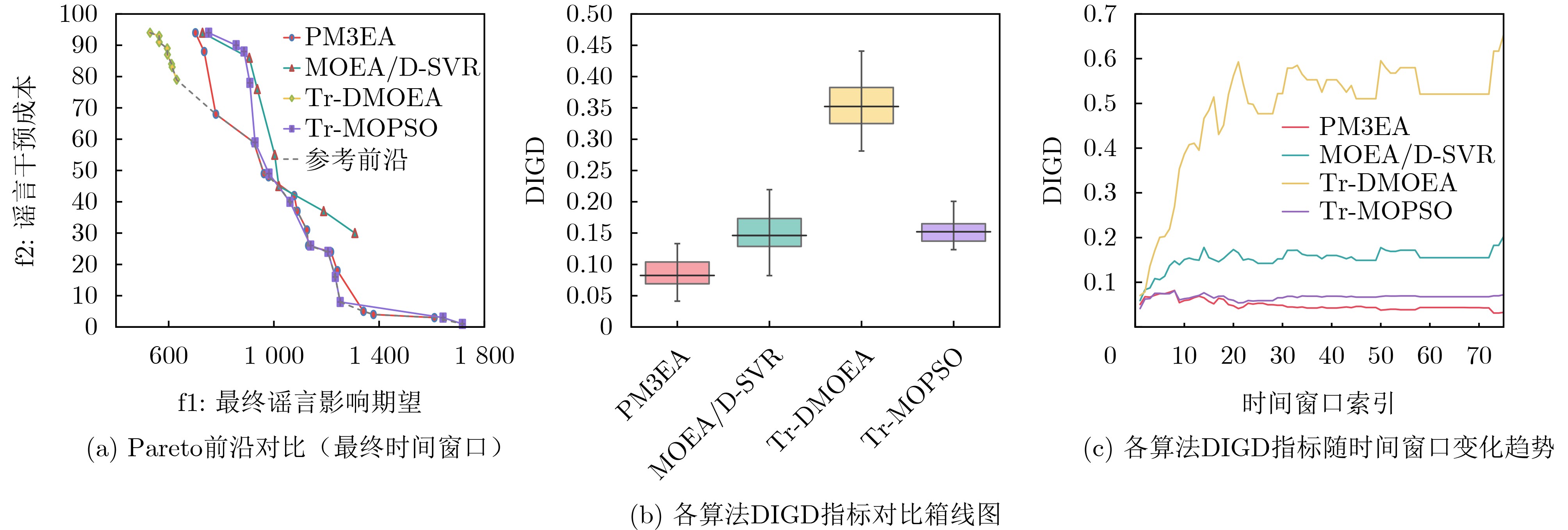
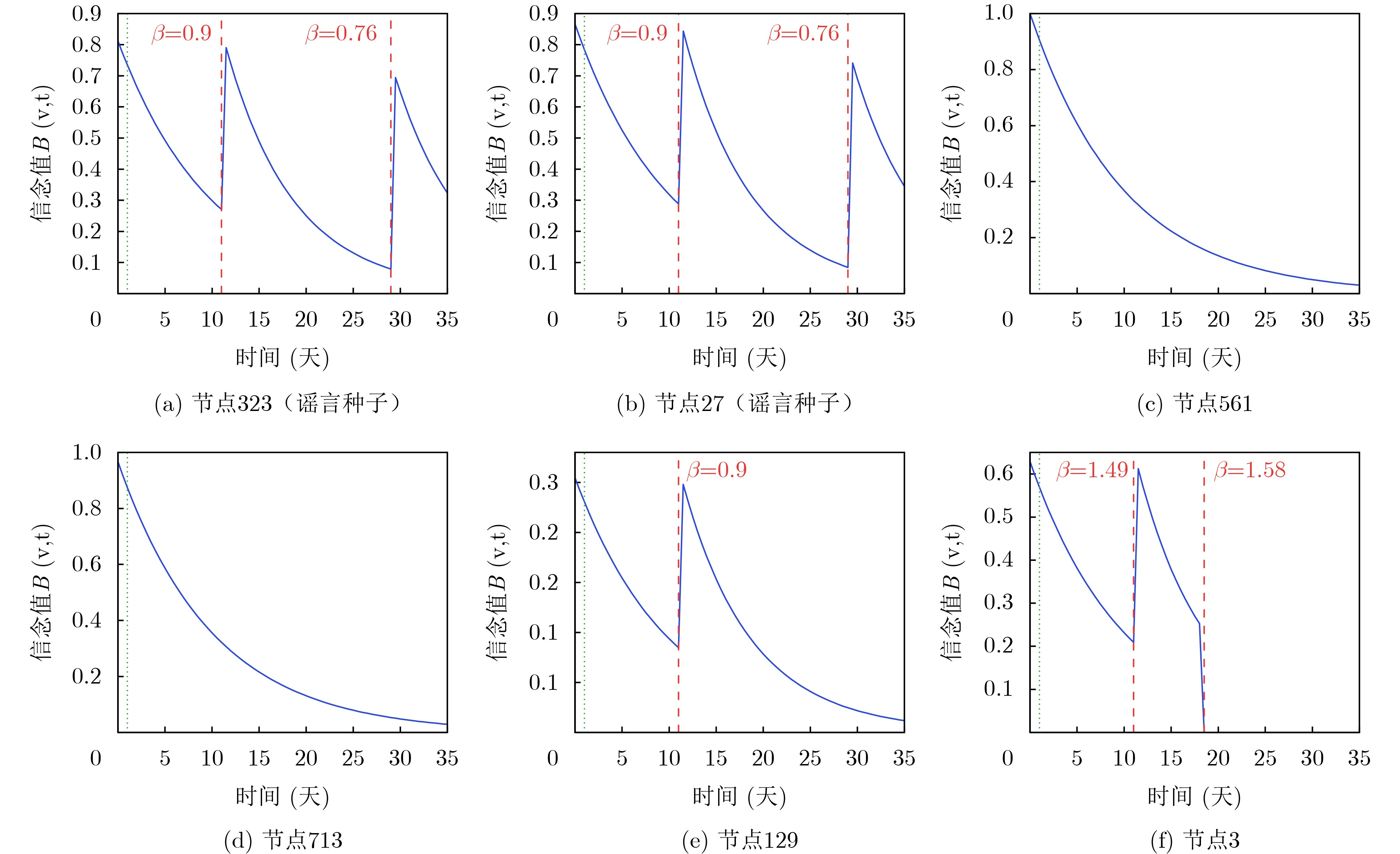
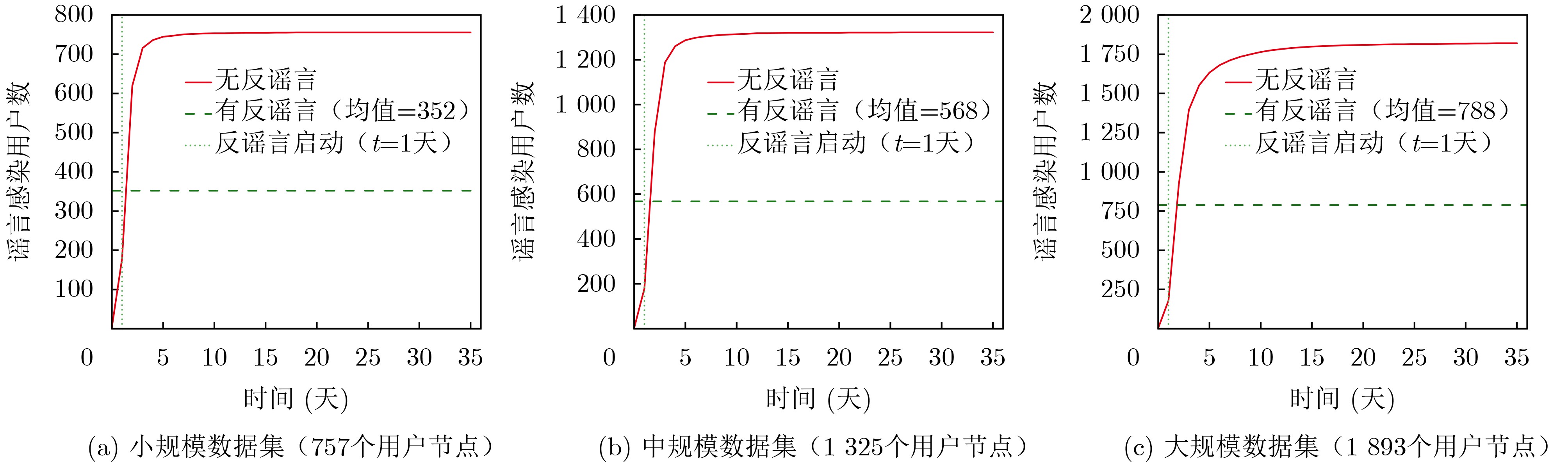
Objective The rapid dissemination of rumors in online social networks (OSNs) poses significant threats to societal stability. Counter-rumor strategy, which combats misinformation by proactively spreading factual information, is a promising non-intrusive countermeasure. Its essence is a resource-constrained optimization problem: selecting an optimal set of seed users to initiate the counter-rumor, aiming to simultaneously minimize the rumor's final influence and the intervention cost. However, existing research predominantly relies on a static network assumption, neglecting the intrinsic dynamic nature of OSNs where user influence, activity, and susceptibility evolve over time and are perturbed by external events. Strategies optimized for a static snapshot of the network often fail when the environment changes, highlighting a critical gap. This work addresses this gap by formally modeling the problem as a Dynamic Multi-objective Optimization Problem (DMOP). The necessity lies in developing an adaptive framework that can track the time-varying optimal trade-off between control effectiveness and resource expenditure, which is essential for robust and practical rumor governance systems. Methods First, a Dynamic Belief-driven Competitive Cascade (DyBCC) model is proposed. Its core innovation is the time-varying user belief, B(v,t), which synthesizes static structural influence with a dynamic component driven by natural decay and external event shocks (Definition 2.1), providing a realistic stochastic simulation framework for competitive propagation under dynamic environments. Second, based on DyBCC, the counter-rumor seed selection is formalized as a Dynamic Multi-objective Optimization Problem for Rumor Control (DMOP-RC), with objectives to minimize expected rumor impact f1 and seed cost f2, where both the objective function and the Pareto-optimal set change over time. Third, to solve DMOP-RC, a Prediction-Memory guided Multi-population Evolutionary Algorithm (PM3EA) is designed. It maintains three collaborative populations: a main population Pm using MOEA/D for local exploitation, a memory archive Pa storing historical elites, and an exploration population Pe using Differential Evolution for global search. A key mechanism is its adaptive response to detected environmental changes (Algorithm 1). Results and Discussions The proposed framework is evaluated in a dynamic environment constructed from a real-world OSN dataset. Algorithm Performance: PM3EA is compared against three dynamic multi-objective optimizers. In terms of the comprehensive Dynamic Inverted Generational Distance (DIGD), PM3EA achieves a significantly superior value of 0.0996 ±0.0569 (Table 2 ,Fig. 3b ). Visually, the final Pareto front obtained by PM3EA is the closest to the reference front and shows the best distribution (Fig. 3a ). Its DIGD value remains consistently the lowest and most stable across all time windows, demonstrating robust tracking capability (Fig. 3c ). Model and Strategy Validation: A detailed case study provides micro- and macro-level insights. The evolution of individual node beliefs visually demonstrates the dynamic competition captured by the DyBCC model, showing patterns like belief oscillation in rumor seeds and sudden "clearance" in some nodes upon effective counter-rumor exposure (Fig. 5 ). At the macro level, the effectiveness of the rumor control method is demonstrated on three datasets of different scales (Fig. 6 ), quantitatively proving the suppression effect of the derived seed set.Conclusions This work systematically tackles adaptive rumor control in dynamic social networks. The primary contributions are: 1) The DyBCC model effectively captures the core dynamic of information competition by integrating time-varying user belief, providing a more realistic foundation than static models. 2) The DMOP-RC formulation correctly frames the seed selection as a dynamic trade-off, aligning with practical needs. 3) The PM3EA algorithm, with its tri-population synergy and adaptive change-response mechanisms, demonstrates superior performance in tracking the time-varying Pareto front, outperforming established counterparts. The experiments, from algorithm comparison to case study, holistically validate the effectiveness and superiority of the proposed framework. This work provides a complete methodology for developing intelligent, self-adaptive online rumor governance systems. Future work may explore integrating more complex user behavior models and online learning mechanisms. -
1 PM3EA(Prediction-Memory guided Multi-population dynamic Multi-objective Evolutionary Algorithm)整体框架
输入:社交网络G, 动态环境ξ(t), 预算K, 最大函数评估次数
MaxFEs输出:每个时间窗[tτ, tτ+1)内的动态Pareto最优解集PSτ 1: 初始化:在t0时刻,随机生成满足约束的主种群Pm;初始化空
记忆种群Pa;初始化探索种群Pe2: τ= 0; // 环境周期索引 3: while 已消耗函数评估次数 < MaxFEs do 4: change_detected = False 5: // 阶段一:稳定环境下的协同进化 6: while change_detected == False do 7: 评估Pm, Pe中所有个体的适应度F(x,ξ(t)); 8: 更新记忆种群Pa(基于精英保留与拥挤距离); 9: 对Pm执行MOEA/D操作(邻域内交叉、变异、选择); 10: 对Pe执行差分进化操作; 11: change_detected = 环境变化检测(); 12: end while 13: // 阶段二:环境变化检测与响应 14: tτ+1= tcurrent; // 记录变化时刻 15: 计算环境变化强度Δξ; 16: if Δξ < θ then // 局部搜索 17: 对Pm中的解进行预测初始化; 18: 从Pa中重激活Q个最相关历史解,替换Pm中的较差解; 19: else // 全局搜索 20: 增强Pe的探索能力; 21: 基于Pe的探索结果,重新初始化Pm; 22: end if 23: 输出当前环境周期[tτ, tcurrent)的Pareto解集:PSτ =
NonDominated(Pm∪Pa);24: τ=τ+1; 25: end while  下载: 导出CSV
表 1 PM3EA算法主要参数设置值
参数 设置值 参数 设置值 参数 设置值 主种群Pm 100 环境检测间隔 10 差分进化缩放因子F 0.5 记忆种群Pa 30 检测个体数 5 差分进化交叉概率CR 0.9 探索种群Pe 30 变化检测阈值ε 0.05 MOEA/D邻域大小 20 最大迭代次数 2000 变化分类阈值θ 0.025 知识迁移间隔(代) 10 最大函数评估次数 10000 基础变异概率pbase 0.1 迁移精英数量 5 蒙特卡洛模拟次数 20 切比雪夫惩罚系数γ 0.05 Jaccard相似度阈值 0.3
下载: 导出CSV
表 2 各算法归一化动态性能指标对比(*代表性能最优)
算法 DIGD↓ PM3EA 0.0996 ±0.0569 *MOEA/D-SVR 0.1538 ±0.0424 Tr-DMOEA 0.3556 ±0.0437 Tr-MOPSO 0.1487 ±0.0305
下载: 导出CSV
表 3 PM3EA算法及其变体在数据集上获得的DIGD数值对比(*代表性能最优)
算法变体 DIGD↓ PM3EA 0.0277 ±0.0121 *PM3EA-NoPrediction 0.0758 ±0.0264 PM3EA-NoMemory 0.1992 ±0.0978 PM3EA-NoExplore 0.0436 ±0.0320
下载: 导出CSV
-
[1] WU Shufang, GAO Mengjiao, and ZHU Jie. Considering dual-followers to dynamically model and analyze online rumor propagation[J]. Information Processing & Management, 2026, 63(1): 104301. doi: 10.1016/j.ipm.2025.104301. [2] 胡泽, 陈志南, 杨宏宇. 多源特征融合增强的虚假新闻检测方法[J]. 电子与信息学报, 2025, 47(8): 2919–2934. doi: 10.11999/JEIT250041.HU Ze, CHEN Zhinan, and YANG Hongyu. A fake news detection approach enhanced by multi-source feature fusion[J]. Journal of Electronics & Information Technology, 2025, 47(8): 2919–2934. doi: 10.11999/JEIT250041. [3] 王艳, 孙钦东, 荣东柱, 等. 伪影间共性机理驱动的多域感知社交网络深度伪造视频检测[J]. 电子与信息学报, 2024, 46(9): 3713–3721. doi: 10.11999/JEIT240025.WANG Yan, SUN Qindong, RONG Dongzhu, et al. Deepfake video detection on social networks using multi-domain aware driven by common mechanism analysis between artifacts[J]. Journal of Electronics & Information Technology, 2024, 46(9): 3713–3721. doi: 10.11999/JEIT240025. [4] YU Zhenhua, YAN Rumeng, WU Shixing, et al. Dynamic analysis and immune control strategy of a rumor propagation model considering network topology[J]. Chaos, Solitons & Fractals, 2026, 208: 118287. doi: 10.1016/j.chaos.2026.118287. [5] HUANG Dawen, WU Wenjie, BI Jichao, et al. Timeliness-aware rumor sources identification in community-structured dynamic online social networks[J]. Information Sciences, 2025, 689: 121508. doi: 10.1016/j.ins.2024.121508. [6] XIA Yang, JIANG Haijun, and YU Shuzhen. Exploring the dynamics of group-based internet rumors propagation: A novel model from the perspective of random hypergraphs[J]. Information Processing & Management, 2025, 62(1): 103941. doi: 10.1016/j.ipm.2024.103941. [7] DONG Chen, XU Guiqiong, and MENG Lei. CRB: A new rumor blocking algorithm in online social networks based on competitive spreading model and influence maximization[J]. Chinese Physics B, 2024, 33(8): 088901. doi: 10.1088/1674-1056/ad531f. [8] ZIARI M and MOGHADDAM CHARKARI N. Rumor detection and propagation on social networks: A survey[J]. Expert Systems with Applications, 2026, 295: 128798. doi: 10.1016/j.eswa.2025.128798. [9] DING Xuejun, LI Mengyu, TIAN Yong, et al. RBOTUE: Rumor blocking considering outbreak threshold and user experience[J]. IEEE Transactions on Engineering Management, 2024, 71: 13396–13414. doi: 10.1109/TEM.2021.3111640. [10] 荆军昌, 张志勇, 班爱莹, 等. 关键节点双目标优化的虚假信息传播控制模型[J]. 西安电子科技大学学报, 2024, 51(1): 201–209. doi: 10.19665/j.issn1001-2400.20230209.JING Junchang, ZHANG Zhiyong, BAN Aiying, et al. Disinformation spreading control model based on key nodes bi-objective optimization[J]. Journal of Xidian University, 2024, 51(1): 201–209. doi: 10.19665/j.issn1001-2400.20230209. [11] PARIMI P and ROUT R R. Genetic algorithm based rumor mitigation in online social networks through counter-rumors: A multi-objective optimization[J]. Information Processing & Management, 2021, 58(5): 102669. doi: 10.1016/j.ipm.2021.102669. [12] TONG Guangmo, WU Weili, GUO Ling, et al. An efficient randomized algorithm for rumor blocking in online social networks[J]. IEEE Transactions on Network Science and Engineering, 2020, 7(2): 845–854. doi: 10.1109/TNSE.2017.2783190. [13] TANG Zhen, HE Qiang, JIANG Runze, et al. Stop rumors fast: A multiobjective blocking approach with deep reinforcement learning in social networks[J]. IEEE Transactions on Artificial Intelligence, 2026, 7(3): 1430–1442. doi: 10.1109/TAI.2025.3597883. [14] KEMPE D, KLEINBERG J, and TARDOS É. Maximizing the spread of influence through a social network[C]. The 9th ACM SIGKDD International Conference on Knowledge Discovery and Data Mining, Washington, USA, 2003: 137–146. doi: 10.1145/956750.956769. [15] BUDAK C, AGRAWAL D, and EL ABBADI A. Limiting the spread of misinformation in social networks[C]. The 20th International Conference on World Wide Web, Hyderabad, India, 2011: 665–674. doi: 10.1145/1963405.1963499. [16] EBBINGHAUS H, RUGER H A, and BUSSENIUS C E, translation. Memory: A Contribution to Experimental Psychology[M]. Teachers College Press, 1913. doi: 10.1037/10011-000. (查阅网上资料,未找到对应的出版地和页码信息,请确认)(查阅网上资料,doi打不开,请确认). [17] MYERS S A, ZHU Chenguang, and LESKOVEC J. Information diffusion and external influence in networks[C]. The 18th ACM SIGKDD International Conference on Knowledge Discovery and Data Mining, Beijing, China, 2012: 33–41. doi: 10.1145/2339530.2339540. [18] ZHANG Qingfu and LI Hui. MOEA/D: A multiobjective evolutionary algorithm based on decomposition[J]. IEEE Transactions on Evolutionary Computation, 2007, 11(6): 712–731. doi: 10.1109/TEVC.2007.892759. [19] OPSAHL T and PANZARASA P. Clustering in weighted networks[J]. Social Networks, 2009, 31(2): 155–163. doi: 10.1016/j.socnet.2009.02.002. [20] CAO Leilei, XU Lihong, GOODMAN E D, et al. Evolutionary dynamic multiobjective optimization assisted by a support vector regression predictor[J]. IEEE Transactions on Evolutionary Computation, 2020, 24(2): 305–319. doi: 10.1109/TEVC.2019.2925722. [21] JIANG Min, HUANG Zhongqiang, QIU Liming, et al. Transfer learning-based dynamic multiobjective optimization algorithms[J]. IEEE Transactions on Evolutionary Computation, 2018, 22(4): 501–514. doi: 10.1109/TEVC.2017.2771451. [22] PENG Zhou, ZHENG Jinhua, ZOU Juan, et al. Novel prediction and memory strategies for dynamic multiobjective optimization[J]. Soft Computing, 2015, 19(9): 2633–2653. doi: 10.1007/s00500-014-1433-3. -

 下载:
下载:


图(6) / 表(4)
计量
- 文章访问数: 159
- HTML全文浏览量: 32
- PDF下载量: 6
- 被引次数: 0
