




WiFi RFFID: A Lightweight Temporal Convolutional Network Integrating Multi-scale and Channel Attention
-
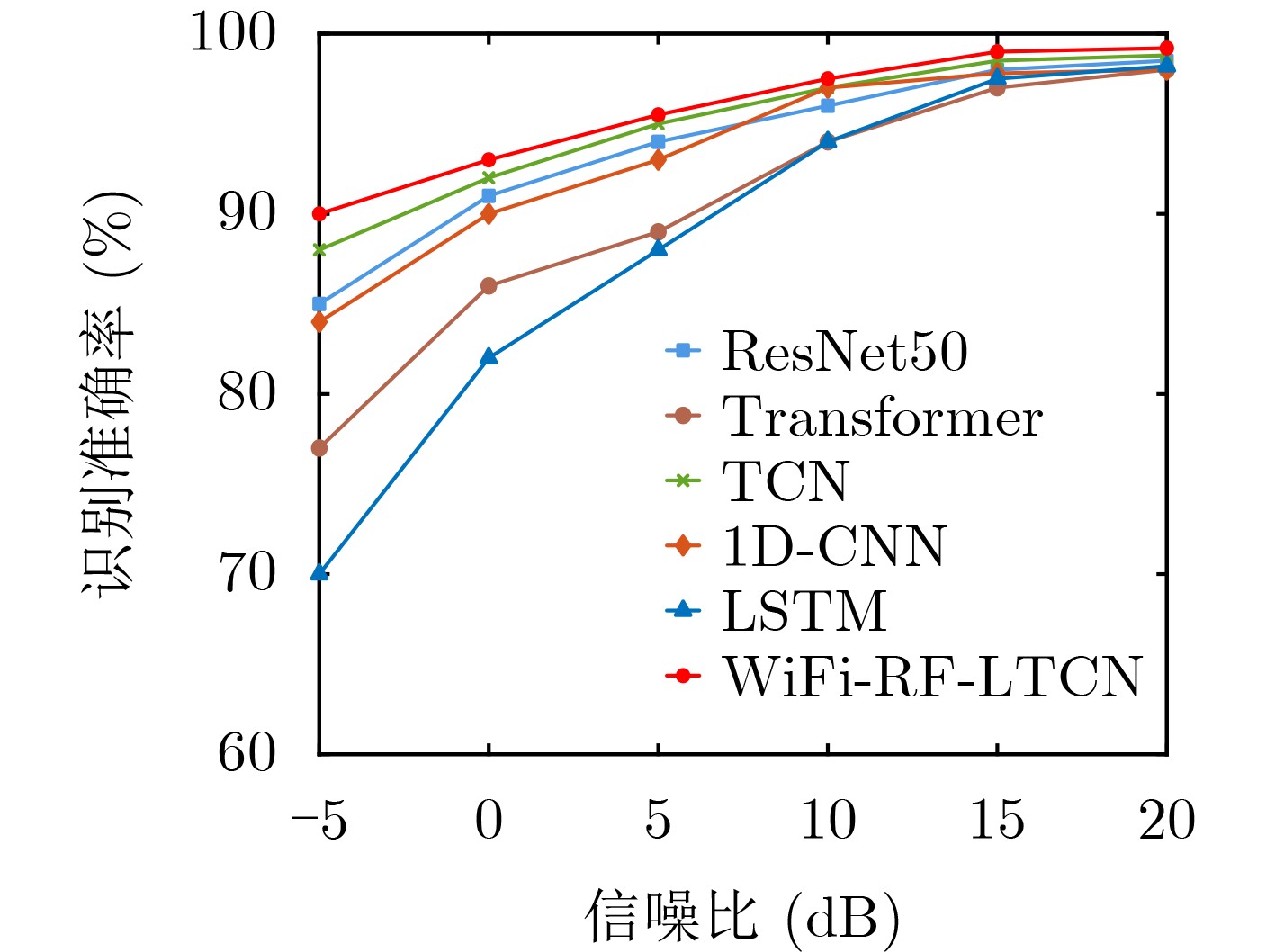
摘要: 随着WiFi技术在企业无线局域网、工业物联网、智慧城市、智能家居等场景中的广泛应用,其安全问题日益受到关注。射频指纹识别技术能够利用硬件固有差异实现设备身份验证,为WiFi设备的安全应用提供有效手段。该文提出一种基于轻量时序卷积网络的WiFi射频指纹识别方法,以应对多设备、动态信道环境下的鲁棒性与计算效率问题。首先,从WiFi物理层前导序列中提取由硬件差异引入的射频指纹,并通过I/Q信号、幅度和相位进行多维度表示;然后采用膨胀卷积层对长时序信号进行建模,捕捉其时序依赖关系,同时设计多尺度卷积分支以增强对短时局部波形的敏感度;进一步引入通道注意力机制,通过自适应加权突出关键特征并抑制冗余信息。实验结果表明,所提方法在不同信噪比及设备规模条件下均能保持较高的识别准确率(0 dB下93.12%, 20 dB下99.27%)和较低的推理时间(单条0.41 ms)。相比其他深度学习模型,该方法在维持高精度的同时显著降低计算开销,适用于资源受限的嵌入式平台。Abstract:
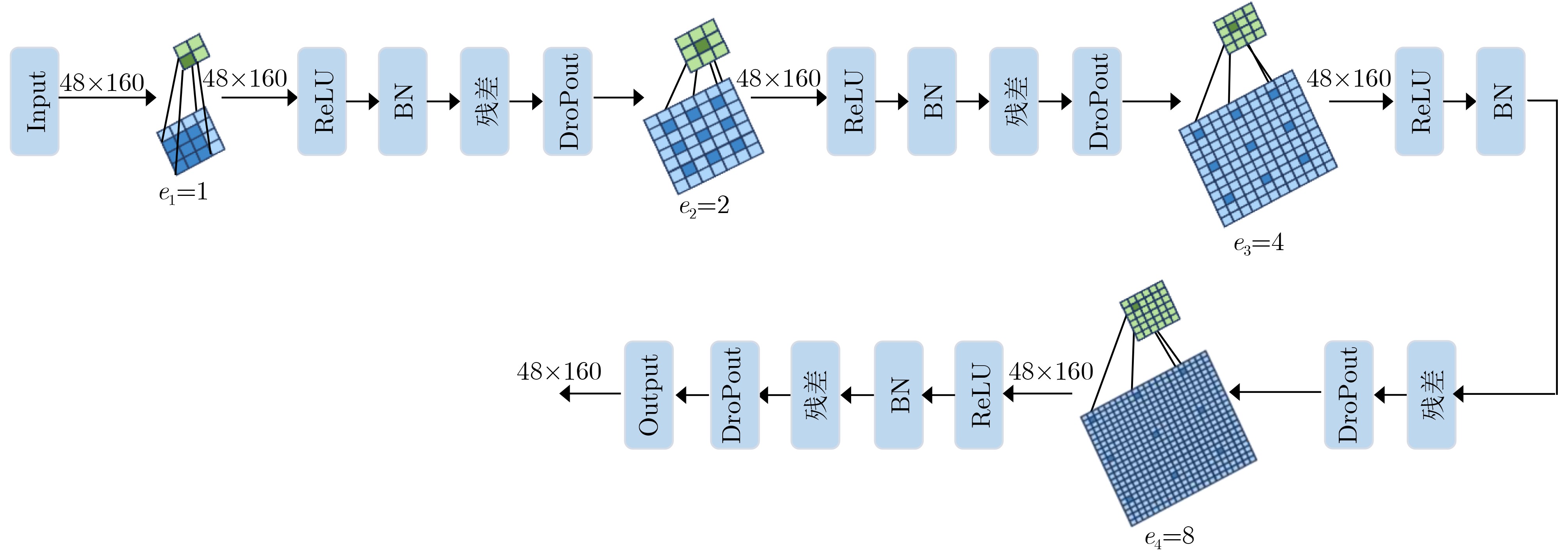
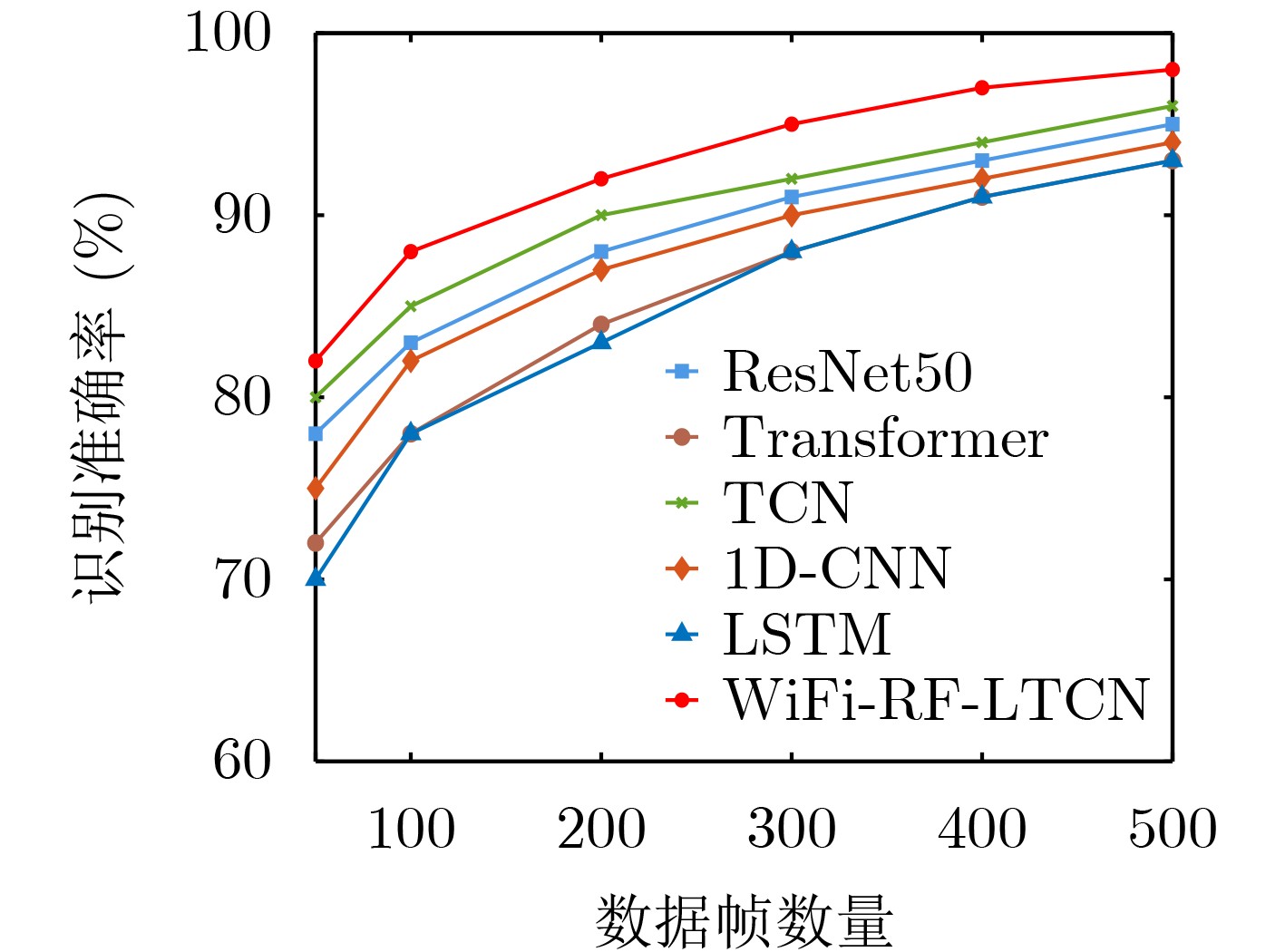
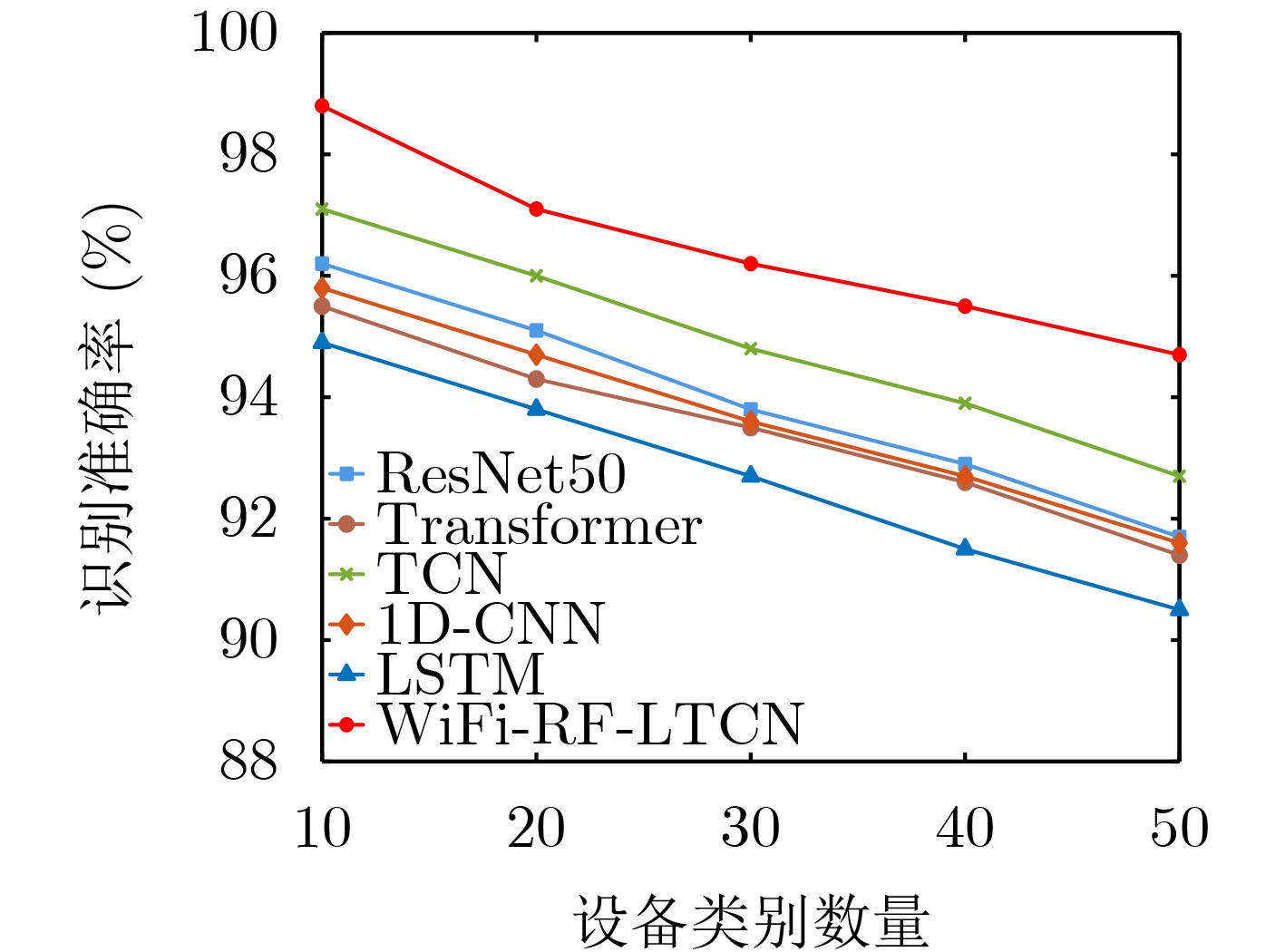
Objective With the widespread deployment of WiFi in industrial Internet of Things (IoT), enterprise wireless local area networks, and smart home scenarios, security vulnerabilities have become increasingly prominent. Radio Frequency Fingerprint IDentification (RFFID) leverages hardware-induced variations introduced during manufacturing to authenticate devices, providing an effective solution for physical-layer security. However, existing RFFID methods often face challenges in balancing recognition robustness under dynamic channel conditions and computational efficiency for deployment on resource-constrained platforms. This paper aims to develop a lightweight and efficient RFFID method that achieves high recognition accuracy under varying channel conditions and device scales while maintaining low computational complexity for embedded systems. Methods This paper proposes WiFi-RF-LTCN, a lightweight temporal convolutional network for WiFi RFFID. The method processes the Legacy Long Training Field (L-LTF) sequence from the WiFi physical-layer preamble. First, multi-dimensional features, including I/Q components, amplitude, and phase, are extracted to form a four-channel input. The proposed network consists of two parallel branches: a temporal dilated convolution branch with residual connections to capture long-range temporal dependencies in the signal, and a multi-scale learnable convolution branch with different kernel sizes to enhance sensitivity to short-term local waveform distortions. Subsequently, a channel attention mechanism based on the squeeze-and-excitation block adaptively fuses features from both branches, highlighting discriminative RF fingerprint features while suppressing redundant information. Finally, the model is trained and evaluated on a simulated WiFi dataset incorporating diverse transmitter impairments and multipath channel effects. Results and Discussions Extensive experiments demonstrate that WiFi-RF-LTCN achieves superior performance under various conditions. It achieves recognition accuracy of 93.12% at 0 dB Signal-to-Noise Ratio (SNR) and 99.27% at 20 dB SNR. The model maintains robust performance with limited training data, achieving an accuracy of 82.21% with only 50 samples per device, and exhibits good scalability as the number of devices increases. Ablation experiments verify the effectiveness of each component, with the complete model achieving an average accuracy of 96.30% with an inference time of 0.41 ms. Compared with Transformer, ResNet50, TCN, 1D-CNN, and LSTM, WiFi-RF-LTCN achieves accuracy improvements of 2.84, 2.36, 1.40, 2.62, and 3.61 percentage points, respectively. Moreover, it requires only 0.17 M parameters, substantially reducing computational overhead compared with ResNet50 (23.54 M) and Transformer (0.85 M), whose inference times are 3.9381 ms and 0.8953 ms, respectively. Conclusions This paper presents a lightweight temporal convolutional network, WiFi-RF-LTCN, for WiFi device identification using RFFID. By integrating multi-scale feature extraction, temporal modeling, and channel attention, the proposed method effectively captures subtle hardware-induced distortions and demonstrates strong robustness to noise and channel variations. Experimental results verify that WiFi-RF-LTCN achieves a favorable balance between recognition accuracy and computational cost, outperforming existing deep learning methods. Its low parameter count and short inference time make it suitable for real-time deployment on resource-constrained embedded platforms, providing an effective solution for enhancing physical-layer security in IoT and other wireless applications. -
表 1 射频非理想参数设置
参数 取值/范围/分布 载波频偏$ \Delta {f}_{i} $ 发射端注入范围±4 ppm均匀分布,接收端通过L-STF/L-LTF进行粗、细补偿后残余<100 Hz 相位噪声$ {\phi }_{i}(t) $ 高斯白噪声,逐样本独立,单样本相位标准差约$ 6.3\times {10}^{-4} $ rad,相噪电平参数按设备在[0.01, 0.3]内随机分布 PA线性增益$ {\alpha }_{i} $ 每设备固定,服从[1.2, 2.8]的均匀分布 PA非线性强度$ {\beta }_{i} $ 每设备固定,随$ {\alpha }_{i} $在[0.05,1.95]内取值 PA指数参数$ \gamma $ 全局设置为1.2 PA 比例系数$ \kappa $ 全局设置为0.5 直流偏置$ {\varepsilon }_{i} $ 幅度为信号幅度的0.001%~0.06%,相位均匀分布 多径路径数$ {L}_{\text{p}} $ 全局设置为5 多径传播时延$ {\tau }_{i,l} $ 各径相对首径的时延,[0, 2.2, 4.6, 7.1, 11.3]个采样间隔 多径平均功率 [0, –2, –6, –12, –18] dB,各径复增益实部与虚部独立且均服从零均值高斯分布,增益幅度服从瑞利分布  下载: 导出CSV
表 2 不同方法的RFFID性能对比
对比模型 参数量(M) 推理时间(ms) 准确率(%) ResNet50 23.54 3.9381 93.94 Transformer 0.85 0.8953 93.46 TCN 0.96 1.2089 94.90 1D-CNN 12.17 2.2893 93.68 LSTM 0.55 0.6281 92.69 WiFi-RF-LTCN 0.17 0.4130 96.30
下载: 导出CSV
表 3 WiFi-RF-LTCN不同结构配置下的RFFID性能
时域膨胀
卷积多尺度可
学习分支通道注意力 参数量
(M)平均准确率
(%)推理时间
(ms)√ √ × 0.1623 95.72 0.2343 √ × √ 0.1459 94.83 0.3439 × √ √ 0.0452 91.55 0.1262 √ × × 0.1451 93.24 0.1869 × √ × 0.0321 87.15 0.0698 √ √ √ 0.1728 96.30 0.4130
下载: 导出CSV
表 4 不同CFO处理方式下的识别准确率
配置 CFO处理方式 相位噪声/
PA/直流准确率(%) (a) 未补偿CFO 注入±4 ppm,不补偿 有 99.10 (b) 已补偿CFO 注入±4 ppm,粗/细补偿 有 93.12 (c) 全移除CFO CFO完美补偿 有 85.72 (d) 仅保留CFO 补偿后仅残余频偏 无 66.26
下载: 导出CSV
-
[1] HUANG Jinyang, LIU Bin, MIAO Chenglin, et al. PhyFinAtt: An undetectable attack framework against PHY layer fingerprint-based WiFi authentication[J]. IEEE Transactions on Mobile Computing, 2024, 23(7): 7753–7770. doi: 10.1109/TMC.2023.3338954. [2] ZHANG Junqing, SHEN Guanxiong, SAAD W, et al. Radio frequency fingerprint identification for device authentication in the internet of things[J]. IEEE Communications Magazine, 2023, 61(10): 110–115. doi: 10.1109/MCOM.003.2200974. [3] SHEN Guanxiong, ZHANG Junqing, MARSHALL A, et al. Towards scalable and channel-robust radio frequency fingerprint identification for LoRa[J]. IEEE Transactions on Information Forensics and Security, 2022, 17: 774–787. doi: 10.1109/TIFS.2022.3152404. [4] SHEN Guanxiong, ZHANG Junqing, MARSHALL A, et al. Toward length-versatile and noise-robust radio frequency fingerprint identification[J]. IEEE Transactions on Information Forensics and Security, 2023, 18: 2355–2367. doi: 10.1109/TIFS.2023.3266626. [5] PENG Linning, PENG Haichuan, FU Hua, et al. Channel-robust radio frequency fingerprint identification for cellular uplink LTE devices[J]. IEEE Internet of Things Journal, 2024, 11(10): 17154–17169. doi: 10.1109/JIOT.2024.3358904. [6] SHAO Yanwei, LIU Jiawei, ZENG Yuan, et al. A radio frequency fingerprinting scheme using learnable signal representation[J]. IEEE Communications Letters, 2024, 28(1): 73–77. doi: 10.1109/LCOMM.2023.3336901. [7] 聂伟, 张中洋, 杨小龙, 等. 基于梅尔倒谱系数的无人机探测与识别方法[J]. 电子与信息学报, 2025, 47(4): 1076–1084. doi: 10.11999/JEIT241111.NIE Wei, ZHANG Zhongyang, YANG Xiaolong, et al. Unmanned aerial vehicles detection and recognition method based on Mel frequency cepstral coefficients[J]. Journal of Electronics & Information Technology, 2025, 47(4): 1076–1084. doi: 10.11999/JEIT241111. [8] WANG Yu, OHTSUKI T, SUN Zhi, et al. Avoiding shortcuts: Enhancing channel-robust specific emitter identification via single-source domain generalization[J]. IEEE Transactions on Wireless Communications, 2025, 24(4): 3163–3176. doi: 10.1109/TWC.2025.3528568. [9] CAI Zhenxin, WANG Yu, JIANG Qi, et al. Toward intelligent lightweight and efficient UAV identification with RF fingerprinting[J]. IEEE Internet of Things Journal, 2024, 11(15): 26329–26339. doi: 10.1109/JIOT.2024.3395466. [10] WANG Shiyuan, YAO Rugui, ZUO Xiaoya, et al. SFCNN: Separation and fusion convolutional neural network for radio frequency fingerprint identification[J]. International Journal of Intelligent Systems, 2024, 2024(1): 4366040. doi: 10.1155/int/4366040. [11] WANG Qiexiang, SUN Yazhou, WANG Zhongfang, et al. Model-based RF fingerprint extraction approach for robust IoT device identification[J]. IEEE Internet of Things Journal, 2025, 12(12): 21915–21930. doi: 10.1109/JIOT.2025.3549231. [12] XIN Jiawei, CHEN Minjie, and HU Cong. Radio frequency fingerprint recognition method based on adaptive energy path integrated projection and trans-MAML method[J]. IEEE Access, 2025, 13: 163481–163493. doi: 10.1109/ACCESS.2025.3610669. [13] SINGH M, SINGH S P, and SATIJA U. High-mobility emitter identification framework using RF-fingerprints in orthogonal time-frequency space system[J]. IEEE Communications Letters, 2025, 29(1): 26–30. doi: 10.1109/LCOMM.2024.3490386. [14] FADUL M K M, REISING D R, WEERASENA L P, et al. Improving RF-DNA fingerprinting performance in an indoor multipath environment using semi-supervised learning[J]. IEEE Transactions on Information Forensics and Security, 2024, 19: 3194–3209. doi: 10.1109/TIFS.2024.3360851. [15] ZHANG Yibin, ZHANG Qianyun, ZHAO Haitao, et al. Multisource heterogeneous specific emitter identification using attention mechanism-based RFF fusion method[J]. IEEE Transactions on Information Forensics and Security, 2024, 19: 2639–2650. doi: 10.1109/TIFS.2024.3353594. [16] PAN Rui, CHEN Hui, CHEN Hongyang, et al. Equalization-assisted domain adaptation for radio frequency fingerprint identification[J]. IEEE Wireless Communications Letters, 2024, 13(7): 1868–1872. doi: 10.1109/LWC.2024.3393922. [17] ZHANG Tiantian, XU Dongyang, MA Jing, et al. Deep federated fractional scattering network for heterogeneous edge Internet of vehicles fingerprinting: Theory and implementation[J]. IEEE Internet of Things Journal, 2025, 12(5): 4935–4952. doi: 10.1109/JIOT.2024.3501387. [18] ZHANG Tiantian, XU Dongyang, MA Jing, et al. Augmented V2V radio fingerprinting with heterogeneous federated scattering network for autonomous vehicle road cooperation[J]. IEEE Transactions on Vehicular Technology, 2025, 74(10): 15848–15865. doi: 10.1109/TVT.2025.3568199. [19] 孙丽婷, 柳征, 黄知涛. 接收域分离的跨接收系统通用性辐射源指纹识别[J]. 电子与信息学报, 2024, 46(10): 3966–3978. doi: 10.11999/JEIT240171.SUN Liting, LIU Zheng, and HUANG Zhitao. Universal radio frequency fingerprinting across receiving systems using receiving domain separation[J]. Journal of Electronics & Information Technology, 2024, 46(10): 3966–3978. doi: 10.11999/JEIT240171. [20] WANG Yatong, CAO Bin, WEN Zhongyi, et al. Domain adaptation-based radio frequency fingerprint identification for industrial cyber-physical systems[J]. IEEE Network, 2025, 39(4): 21–28. doi: 10.1109/MNET.2025.3550907. [21] 郑庆河, 陈斌, 余礼苏, 等. 基于注意力动态融合与混合剪枝Transformer的高速移动通信调制识别方法[J]. 电子与信息学报, 2026, 48(7): 3059–3070. doi: 10.11999/JEIT251211.ZHENG Qinghe, CHEN Bin, YU Lisu, et al. Modulation recognition method for high-speed mobile communication based on attention dynamic fusion and hybrid pruning Transformer[J]. Journal of Electronics & Information Technology, 2026, 48(7): 3059–3070. doi: 10.11999/JEIT251211. -


 下载:
下载:






图(9) / 表(4)
计量
- 文章访问数: 182
- HTML全文浏览量: 40
- PDF下载量: 19
- 被引次数: 0
