




Side-Channel Analysis of Complete ZUC Algorithm Keys Using Maximum Likelihood Extraction and Multi-Task Learning
-
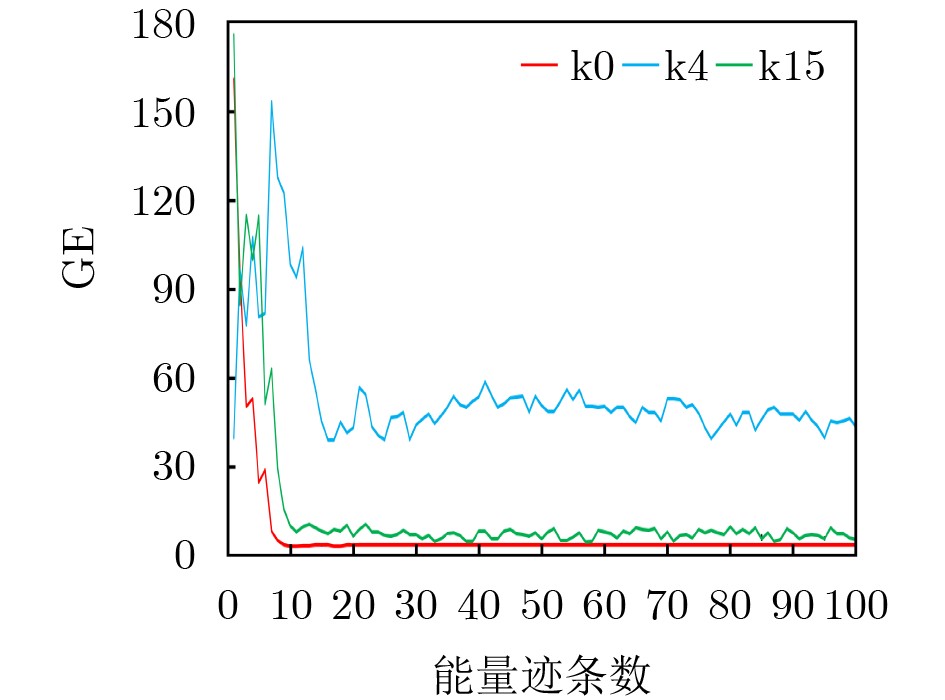
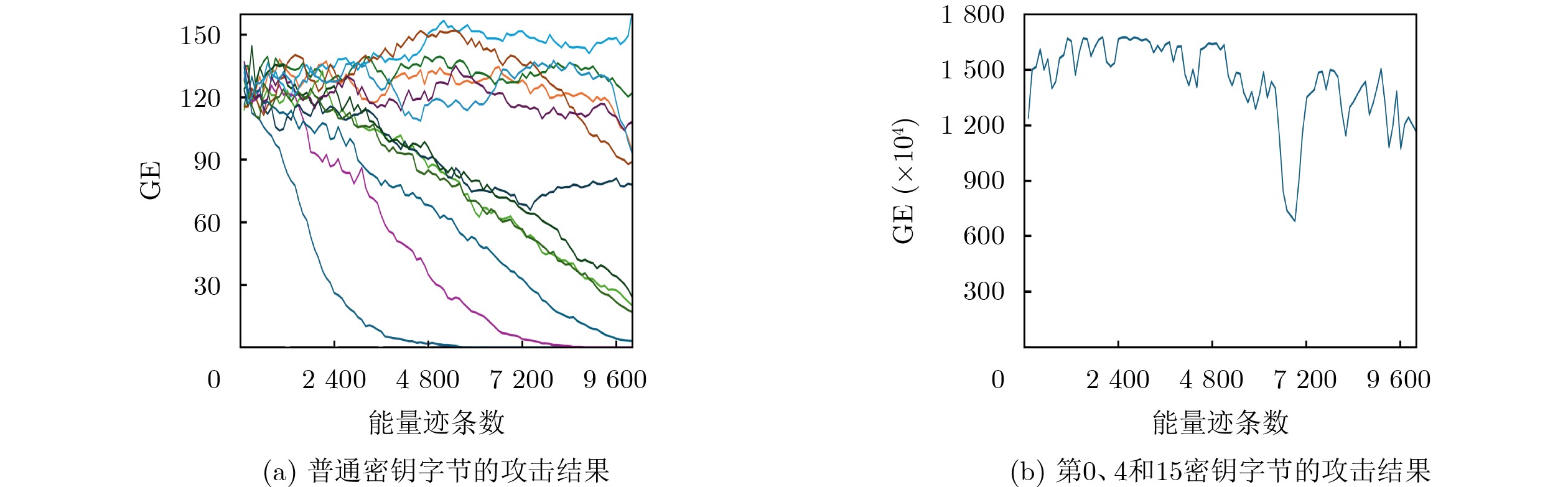
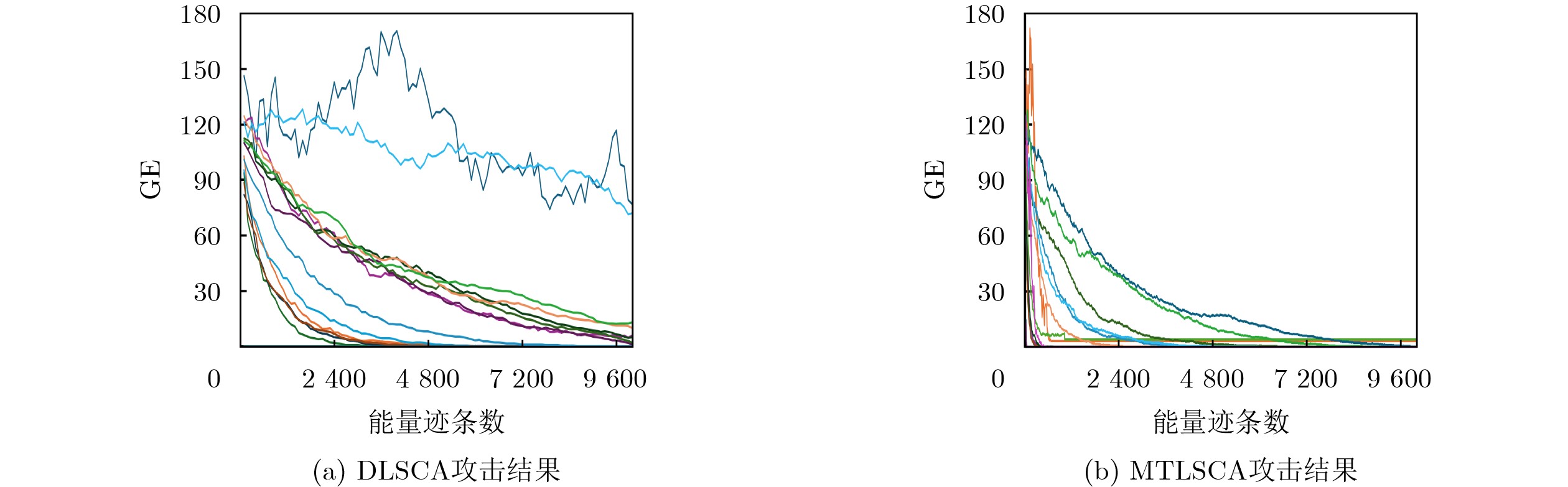
摘要: 针对ZUC算法侧信道分析中的密钥字节等价关系导致猜测熵难以收敛与多S盒结构未充分利用两个问题,该文提出一种结合最大似然函数值提取与多任务学习的侧信道分析方法。首先,针对第6轮三个密钥字节模加重叠导致的等价类问题,提出基于最大似然函数值提取的猜测熵范围压缩策略,将猜测熵从224量级压缩至28量级。其次,利用ZUC算法四个S盒共享同一密钥字节的结构特点,设计多任务学习网络,通过对数似然概率融合提升攻击效果。实验表明,该方法在软件实现上仅需2条能量迹即可恢复全部密钥,优于单任务深度学习侧信道分析的8条能量迹及相关功耗分析的185条能量迹。针对硬件实现,在消耗
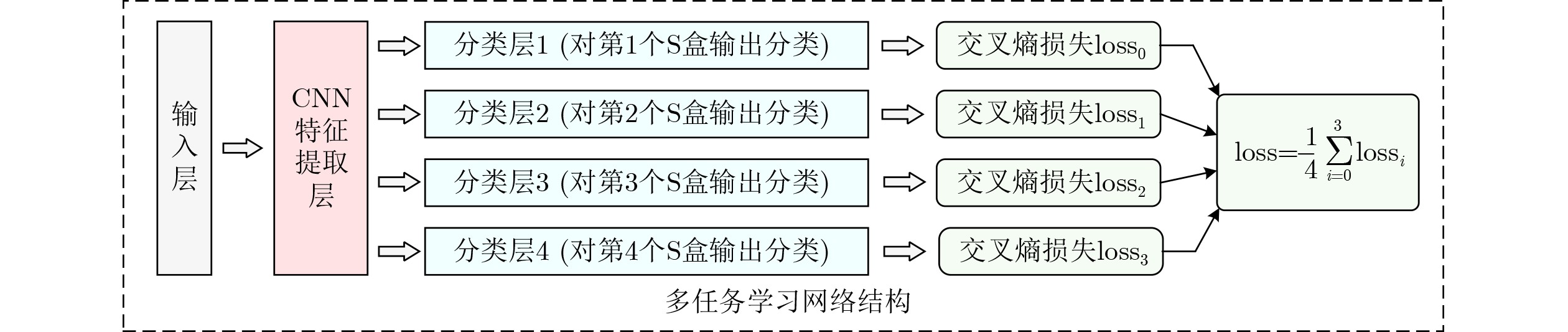
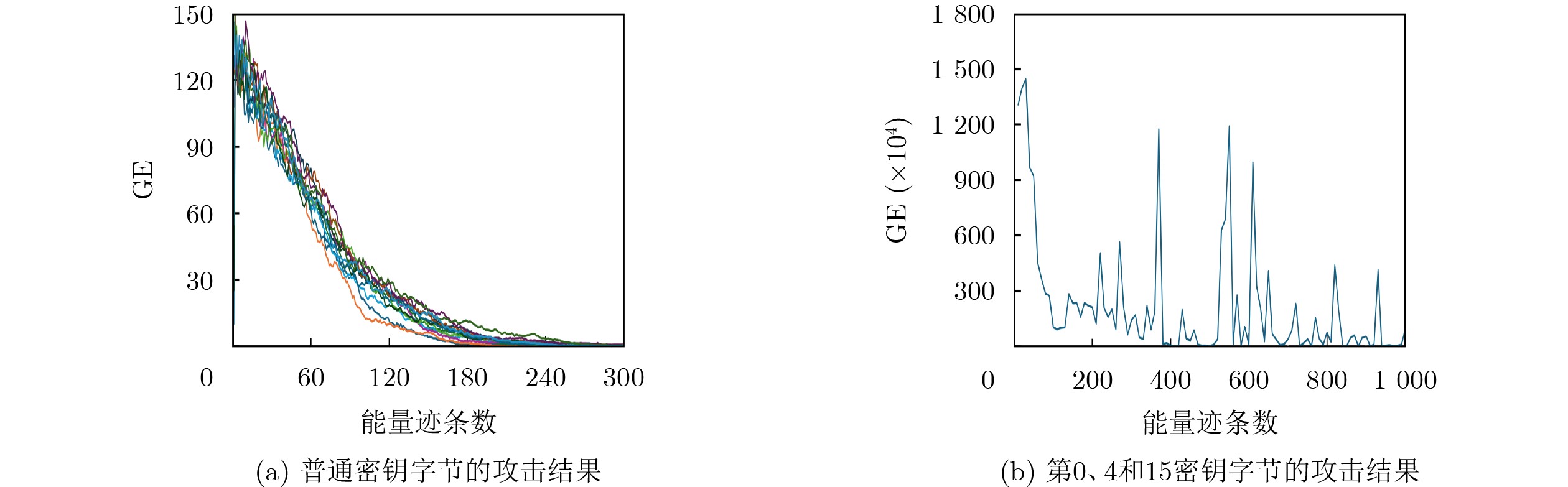
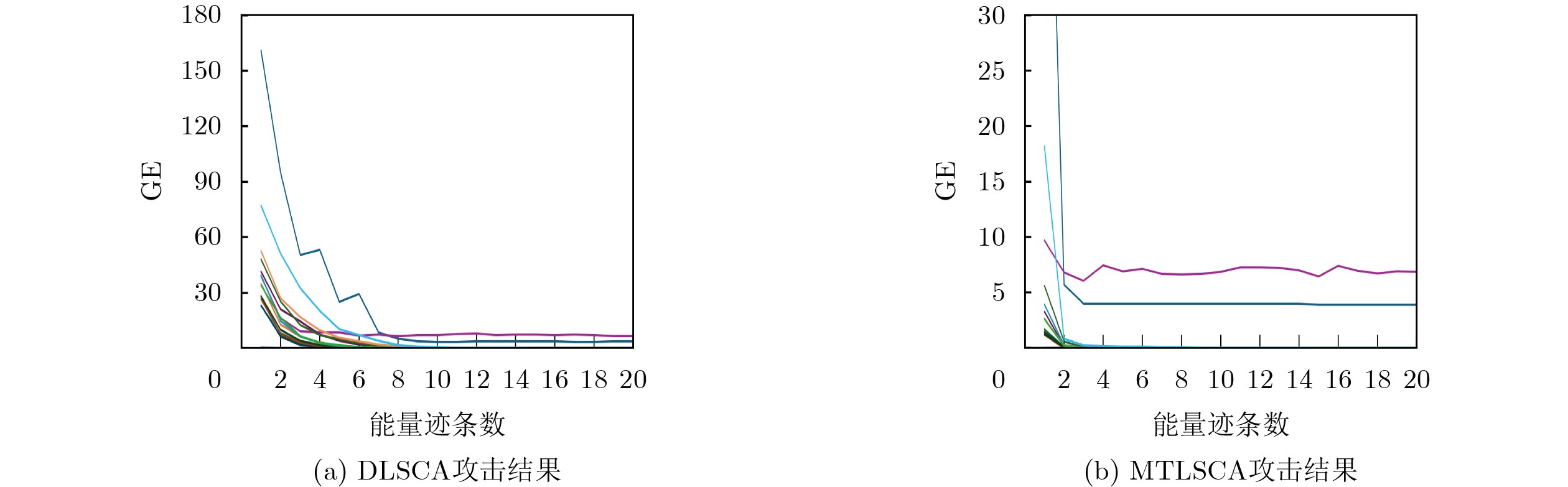
10000 条测试集数据的条件下,该方法成功恢复全部16字节密钥,而传统相关功耗分析仅能恢复3字节,单任务深度学习侧信道分析恢复12字节。本文揭示的密钥字节等价类问题表明,密码算法的代数结构会对侧信道分析构成限制,攻击需结合代数分析。此外,攻击者需考虑多路并行泄露的融合效应,而非仅局限于单一攻击路径,从而提高攻击效率。Abstract:Objective This paper addresses two issues in side-channel analysis of the ZUC algorithm: slow guessing entropy convergence caused by key-byte equivalence relations, and the underutilization of its multi-S-box structure. A method combining maximum likelihood extraction with multi-task learning is proposed to enable efficient complete key recovery. Methods First, to tackle the equivalence class problem caused by modular addition overlap of three key bytes in round 6, a guess entropy range compression strategy based on maximum likelihood value extraction is introduced, reducing the candidate space from 224 to 28. Second, leveraging the structural feature of the ZUC algorithm where four S-boxes share the same key byte, a multi-task learning network is designed. This network is trained using multi-branch cross-entropy joint loss, and the attack effectiveness is improved by fusing multiple log-likelihood probabilities. Results and Discussions For the 224 equivalence class space caused by modular addition and bit overlap among three key bytes in round 6, the proposed maximum likelihood extraction strategy stably compresses the guessing entropy range to a single-byte scale, overcoming the convergence difficulty of direct global sorting. For software implementation, this method requires only two power traces to recover the entire 128-bit key, outperforming single-task deep learning side-channel analysis, which requires eight traces, and traditional correlation power analysis, which requires 185 traces. For hardware implementation, when 10000 test traces are consumed, traditional correlation power analysis can only recover three key bytes, single-task deep learning side-channel analysis recovers 12, whereas the proposed method successfully recovers all 16 bytes.Conclusions Sometimes, the algebraic structure of cryptographic algorithms imposes constraints on side-channel analysis, requiring attackers to incorporate algebraic analysis during an attack. In addition, attackers should consider the combined effect of multiple parallel leakages, rather than only focusing on the attack results of a single path, so as to improve attack efficiency. -
Key words:
- ZUC Algorithm /
- Side-Channel Analysis /
- Deep Learning /
- Multi-Task Learning
-
表 1 超参数设置
超参数 搜索范围 DLSCA MTLSCA 学习率 0.00001 ~0.0010.0001 0.0001 批处理大小 50~500 100 200 激活函数 relu, tanh, selu relu relu 迭代次数 10~200 10~200 10~200 卷积核数量 16, 32, 64, 128 64 64 卷积核大小 5~50 10 10 池化窗口大小 2~10 2 2  下载: 导出CSV
-
[1] LAFITTE F, MARKOWITCH O, and VAN HEULE D. SAT based analysis of LTE stream cipher ZUC[C]. Proceedings of the 6th International Conference on Security of Information and Networks, Aksaray, Turkey, 2013: 110–116. doi: 10.1145/2523514.2523533. [2] 关杰, 丁林, 刘树凯. SNOW3G与ZUC流密码的猜测决定攻击[J]. 软件学报, 2013, 24(6): 1324–1333. doi: 10.3724/SP.J.1001.2013.04287.GUAN Jie, DING Lin, and LIU Shukai. Guess and determine attack on SNOW3G and ZUC[J]. Journal of Software, 2013, 24(6): 1324–1333. doi: 10.3724/SP.J.1001.2013.04287. [3] TANG Ming, CHENG Pingpan, and QIU Zhenlong. Differential power analysis on ZUC algorithm[EBOL]. https://eprint.iacr.org/2012/299, 2012. [4] 唐明, 高剑, 孙乐昊, 等. 嵌入式平台下ZUC算法的侧信道频域攻击[J]. 山东大学学报: 理学版, 2014, 49(9): 29–34. doi: 10.6040/j.issn.1671-9352.2.2014.259.TANG Ming, GAO Jian, SUN Lehao, et al. Side channel attacks in frequency domain for ZUC algorithm in embedded platform[J]. Journal of Shandong University: Natural Science, 2014, 49(9): 29–34. doi: 10.6040/j.issn.1671-9352.2.2014.259. [5] 严迎建, 杨昌盛, 李伟, 等. ZUC序列密码算法的选择IV相关性能量分析攻击[J]. 电子与信息学报, 2015, 37(8): 1971–1977. doi: 10.11999/JEIT141604.YAN Yingjian, YANG Changsheng, LI Wei, et al. Chosen-IV correlation power analysis attack of ZUC stream cipher[J]. Journal of Electronics & Information Technology, 2015, 37(8): 1971–1977. doi: 10.11999/JEIT141604. [6] 吴一, 赵昱霖, 潘雨洋, 等. 针对ZUC算法硬件实现的相关能量攻击与多粒度时域敏感区域检测[J]. 密码学报(中英文), 2024, 11(3): 637–648. doi: 10.13868/j.cnki.jcr.000699.WU Yi, ZHAO Yulin, PAN Yuyang, et al. Correlation power analysis of hardware-implemented ZUC algorithms and multi-granularity time-domain sensitive area detection[J]. Journal of Cryptologic Research, 2024, 11(3): 637–648. doi: 10.13868/j.cnki.jcr.000699. [7] 赵毅强, 闫明凯, 张启智, 等. 基于多阶段相关功耗分析的SM4-XTS侧信道分析方法[J]. 电子与信息学报, 2024, 46(11): 4161–4169. doi: 10.11999/JEIT240183.ZHAO Yiqiang, YAN Mingkai, ZHANG Qizhi, et al. SM4-XTS side channel analysis method based on multi-stage CPA[J]. Journal of Electronics & Information Technology, 2024, 46(11): 4161–4169. doi: 10.11999/JEIT240183. [8] PICEK S, PERIN G, MARIOT L, et al. SoK: Deep learning-based physical side-channel analysis[J]. ACM Computing Surveys, 2023, 55(11): 227. doi: 10.1145/3569577. [9] 肖冲, 唐明. 基于深度学习的侧信道分析综述[J]. 计算机学报, 2025, 48(3): 694–720. doi: 10.11897/SP.J.1016.2025.00694.XIAO Chong and TANG Ming. A survey on deep learning-based side-channel analysis[J]. Chinese Journal of Computers, 2025, 48(3): 694–720. doi: 10.11897/SP.J.1016.2025.00694. [10] FUKUDA Y, YOSHIDA K, and FUJINO T. CA-SCA: Non-profiled deep learning-based side-channel attacks by using cluster analysis[J]. IEICE Transactions on Fundamentals of Electronics, Communications and Computer Sciences, 2025, E108. A(3): 227–241. doi: 10.1587/transfun.2024cip0014. [11] 袁庆军, 张浩金, 樊昊鹏, 等. DTDS: 用于侧信道能量分析的Dilithium数据集[J]. 电子与信息学报, 2025, 47(8): 2499–2508. doi: 10.11999/JEIT250048.YUAN Qingjun, ZHANG Haojin, FAN Haopeng, et al. DTDS: Dilithium dataset for power analysis[J]. Journal of Electronics & Information Technology, 2025, 47(8): 2499–2508. doi: 10.11999/JEIT250048. [12] GAO Wubiao, CAI Juesong, YAN Yingjian, et al. Side-channel analysis based on multiple leakage models ensemble[J]. IEEE Transactions on Dependable and Secure Computing, 2026, 23(2): 3864–3879. doi: 10.1109/tdsc.2025.3641165. [13] HU Fanliang, SHEN Jian, MA Haoyu, et al. Cross-attention for AES mode variation in side-channel analysis[C]. Proceedings of 2025 62nd ACM/IEEE Design Automation Conference, San Francisco, USA, 2025: 1–7. doi: 10.1109/DAC63849.2025.11132714. [14] 顾泽鹏, 陈琳, 蔡爵嵩, 等. 面向深度学习侧信道分析的多属性决策模型评估方法研究[J]. 电子与信息学报, 2026, 48(9): 3800–3810. doi: 10.11999/JEIT260198.GU Zepeng, CHEN Lin, CAI Juesong, et al. A multi-dimensional scenario-based evaluation method for deep learning side-channel analysis using a multi-attribute decision model[J]. Journal of Electronics & Information Technology, 2026, 48(9): 3800–3810. doi: 10.11999/JEIT260198. [15] 徐杨, 李锴彬, 何星星. 融合卷积块注意力机制与三元组度量学习的深度侧信道攻击方法[J]. 电子与信息学报, 2026, 48(8): 3638–3648. doi: 10.11999/JEIT260140.XU Yang, LI Kaibin, and HE Xingxing. Deep side-channel attack method integrating convolutional block attention mechanism and triplet metric learning[J]. Journal of Electronics & Information Technology, 2026, 48(8): 3638–3648. doi: 10.11999/JEIT260140. [16] CARUANA R. Multitask learning[J]. Machine Learning, 1997, 28(1): 41–75. doi: 10.1023/A:1007379606734. [17] ABDELSAMIE M M, AZAB S S, and HEFNY H A. Deep multi-task learning: A review of concepts, methods, and cross-domain applications[J]. International Journal of Data Science and Analytics, 2026, 21(1): 77. doi: 10.1007/s41060-025-00892-y. [18] KIRCHDORFER L, SESTERHENN T, BARTELT C, et al. Investigating uncertainty weighting for multi-task learning: Insights and analytical alternative[J]. International Journal of Computer Vision, 2026, 134(1): 8. doi: 10.1007/s11263-025-02625-x. [19] MAGHREBI H. Deep learning based side-channel attack: A new profiling methodology based on multi-label classification[EB/OL]. https://eprint.iacr.org/2020/436, 2020. [20] MASURE L and STRULLU R. Side-channel analysis against ANSSI's protected AES implementation on ARM: End-to-end attacks with multi-task learning[J]. Journal of Cryptographic Engineering, 2023, 13(2): 129–147. doi: 10.1007/s13389-023-00311-7. [21] MARQUET T and OSWALD E. A comparison of multi-task learning and single-task learning approaches[C]. Proceedings of the International Conference on Applied Cryptography and Network Security Workshops, Kyoto, Japan, 2023: 121–138. doi: 10.1007/978-3-031-41181-6_7. [22] MARQUET T and OSWALD E. Exploring multi-task learning in the context of masked AES implementations[C]. Proceedings of the 15th International Workshop Constructive Side-Channel Analysis and Secure Design, Gardanne, France, 2024: 93–112. doi: 10.1007/978-3-031-57543-3_6. [23] HAJRA S, MUKHOPADHYAY D, and CHATTERJEE S. UNIDLE: A unified framework for deep learning-based side-channel analysis[EB/OL]. https://eprint.iacr.org/2024/1437, 2024. [24] LIAO Jiale, WANG Huanyu, WANG Junnian, et al. Switch-T: A novel multi-task deep-learning network for cross-device side-channel attack[J]. Journal of Information Security and Applications, 2025, 93: 104146. doi: 10.1016/j.jisa.2025.104146. [25] LE H T, HOANG V P, DO N T, et al. MT-MO: Efficient and robust non-profiled side-channel analysis using multitask learning[C]. Proceedings of 2026 International Conference on Artificial Intelligence in Information and Communication, Tokyo, Japan, 2026: 1104–1109. doi: 10.1109/ICAIIC68212.2026.11454298. [26] 关志. GmSSL: 支持国密算法和TLCP的开源加密库[EB/OL]. https://github.com/guanzhi/GmSSL, 2023. (查阅网上资料,请核对网址与文献是否相符)(查阅网上资料,未找到对应的英文翻译,请确认并补充). -

 下载:

图(11) / 表(1)
计量
- 文章访问数: 19
- HTML全文浏览量: 4
- PDF下载量: 2
- 被引次数: 0
