




Physics-Aware Reconstruction for MilliMeter-Wave Radar Gait Recognition Under Complex Wearing Scenarios
-
摘要: 毫米波雷达步态识别在智能安防领域具有重要应用潜力,但在实际应用中,复杂着装(如大衣、背包等)会引入非稳定高频干扰,降低了现有模型的识别性能。其主要原因是现有方法没能充分考虑多普勒频率与人体运动之间的物理映射关系。针对上述问题,该文提出一种基于物理感知微多普勒重构与自适应干扰抑制的步态识别框架。该框架利用人体运动产生的多普勒频率与生物力学机理间的映射关系,将混叠的原始微多普勒频谱分离为躯干与四肢专属频带,从物理特征层面隔离复杂着装因素(如穿大衣、挎包等)引入的噪声干扰。在此基础上,设计加权注意力抑制机制,对衣服遮挡引起的高频异常噪声进行自适应建模,并增强判别性躯干特征表示,实现鲁棒特征融合。在公开数据集MMRGait-1.0上的实验结果表明,所提方法在仅0.75 GFLOPs的计算开销下取得了89.7%的平均Rank-1识别率;在大衣遮挡等复杂场景下仍可达到85.1%的识别精度,较基线方法提升近18%。实验结果验证了该方法在复杂着装条件下的有效性与鲁棒性。Abstract:
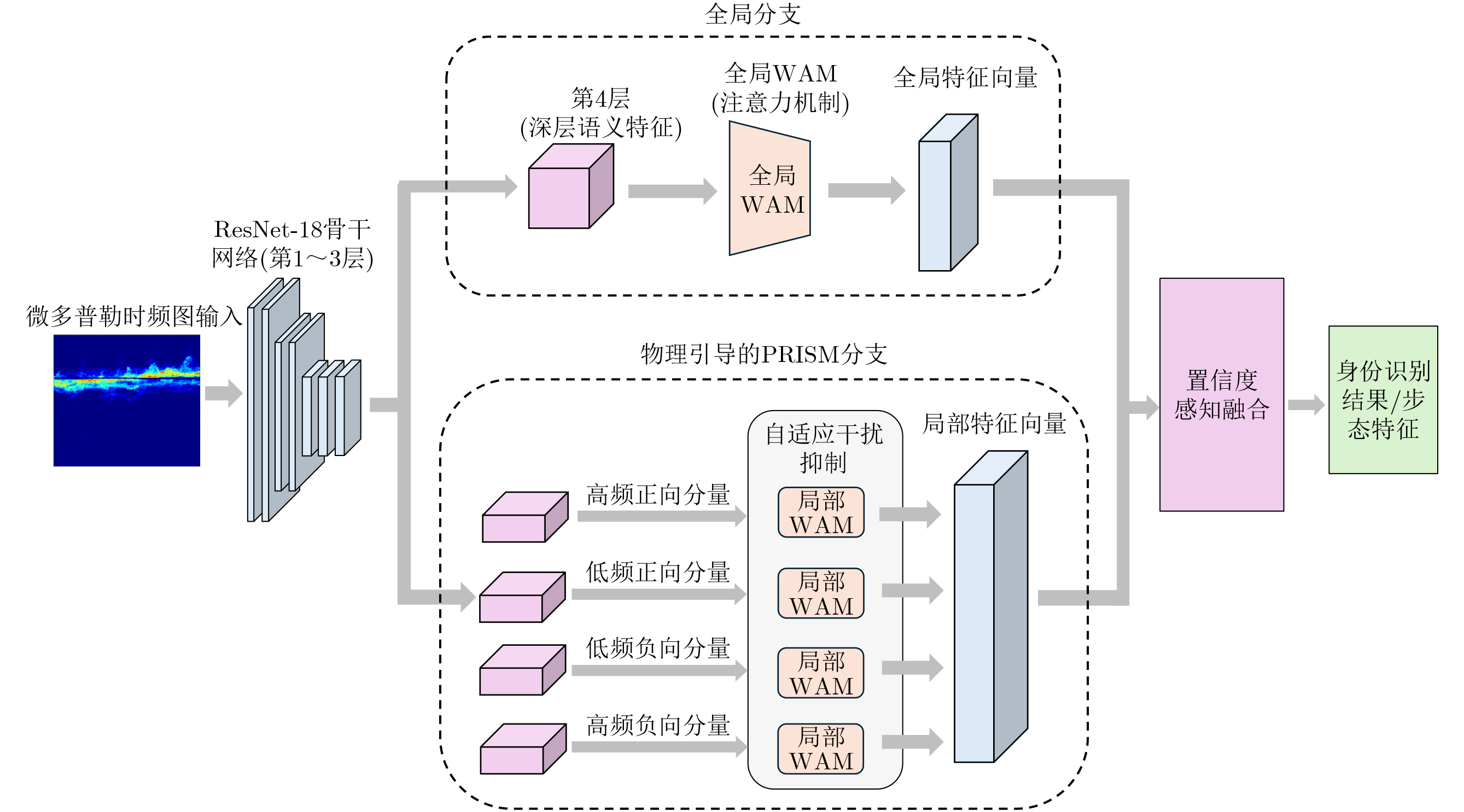
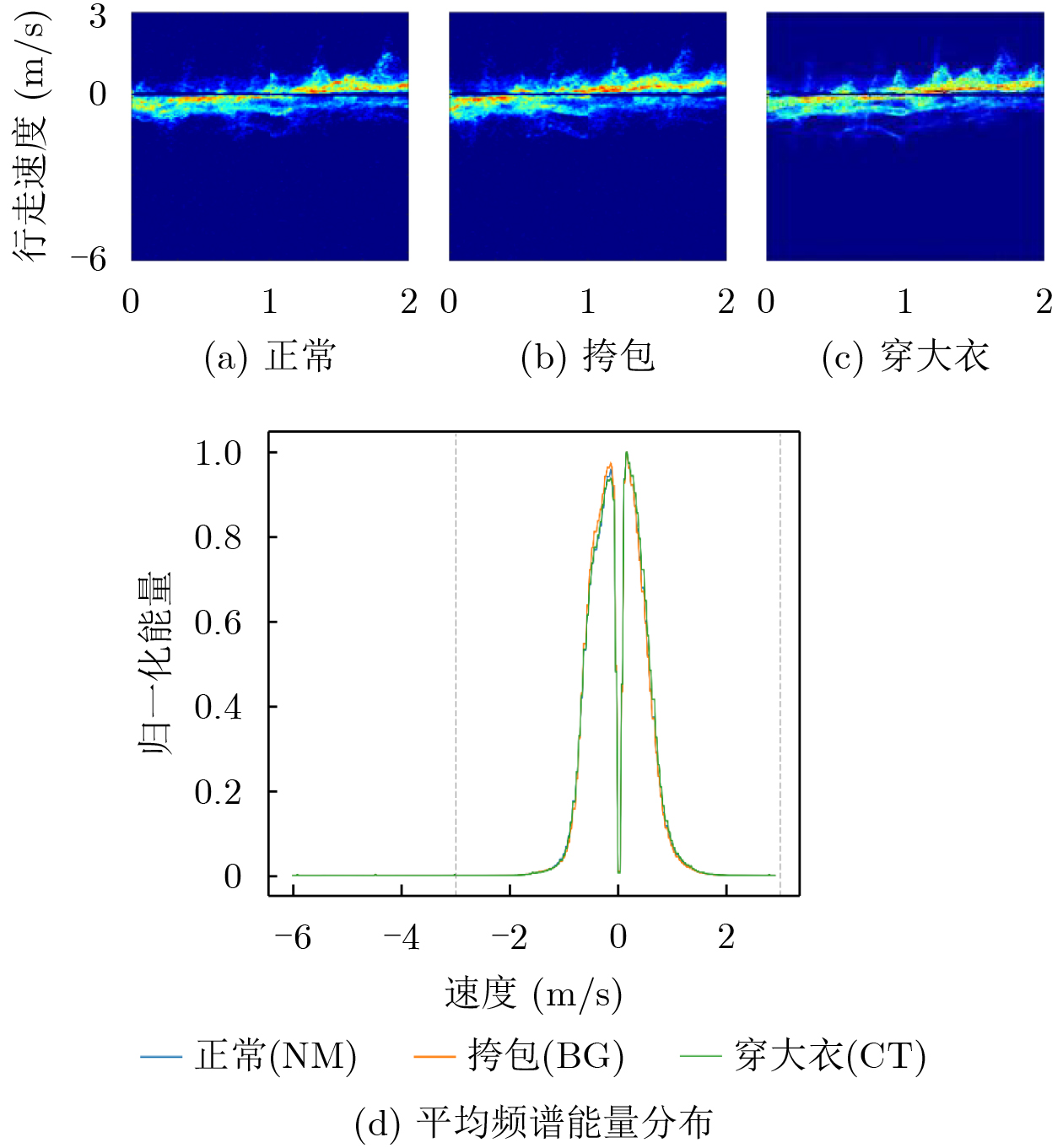
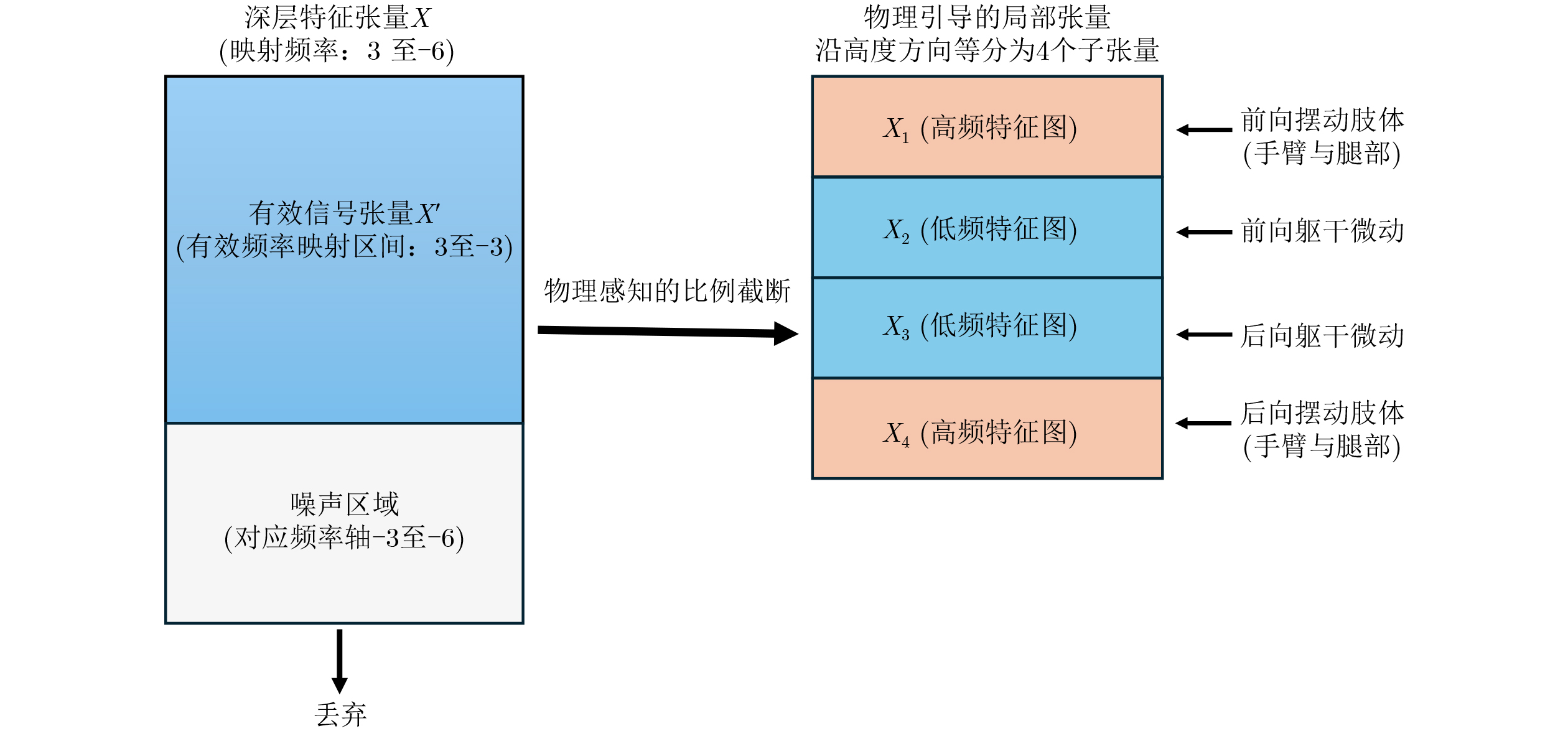
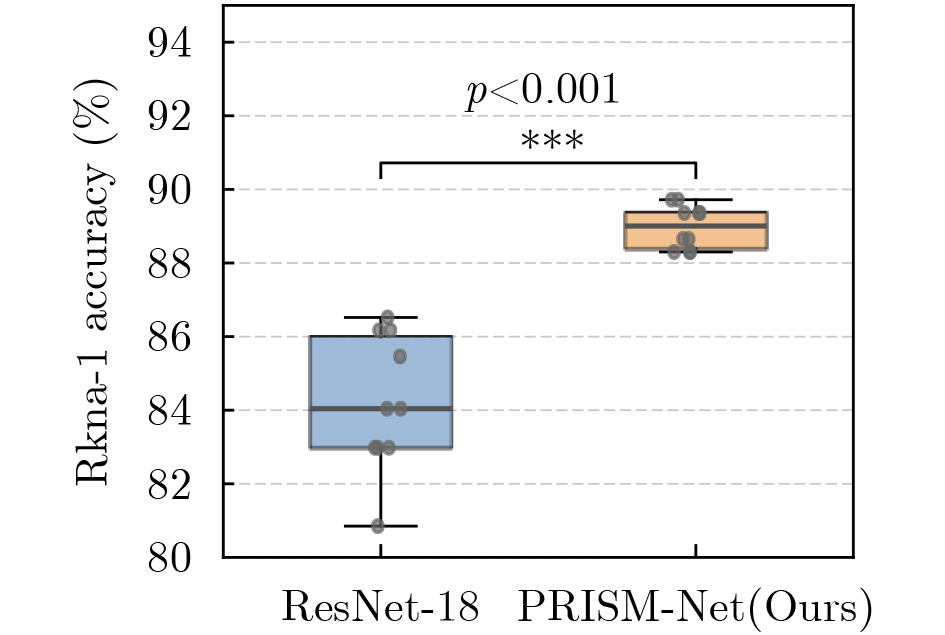
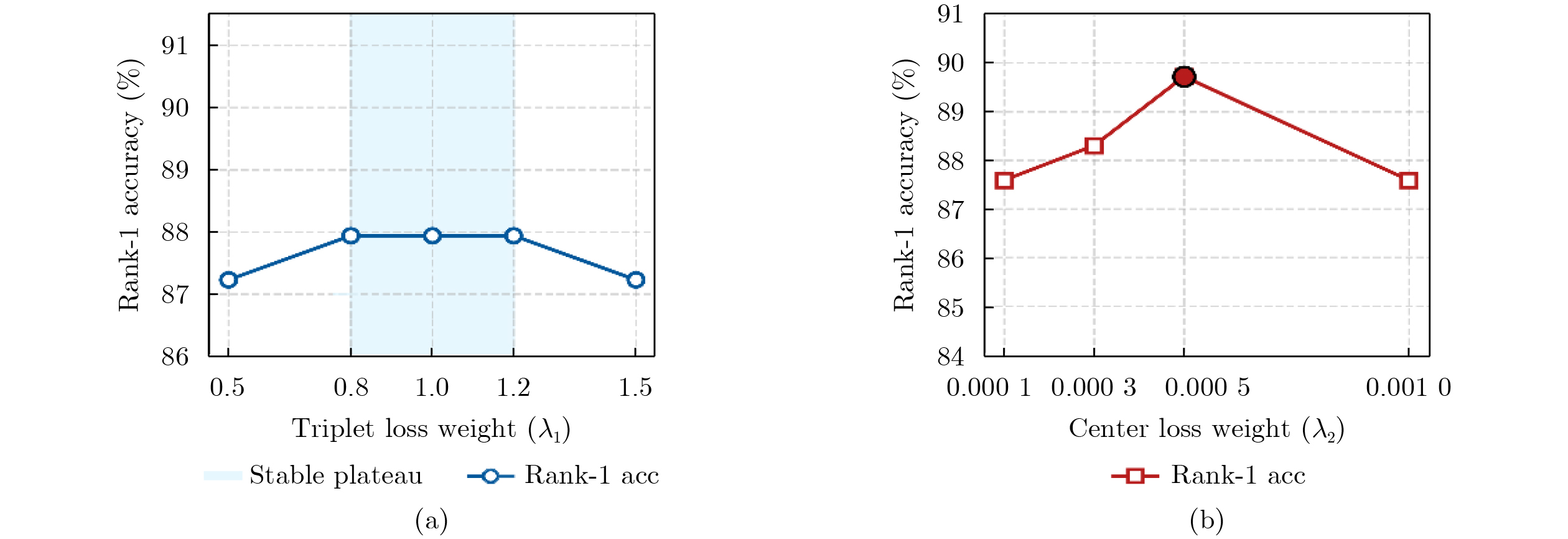
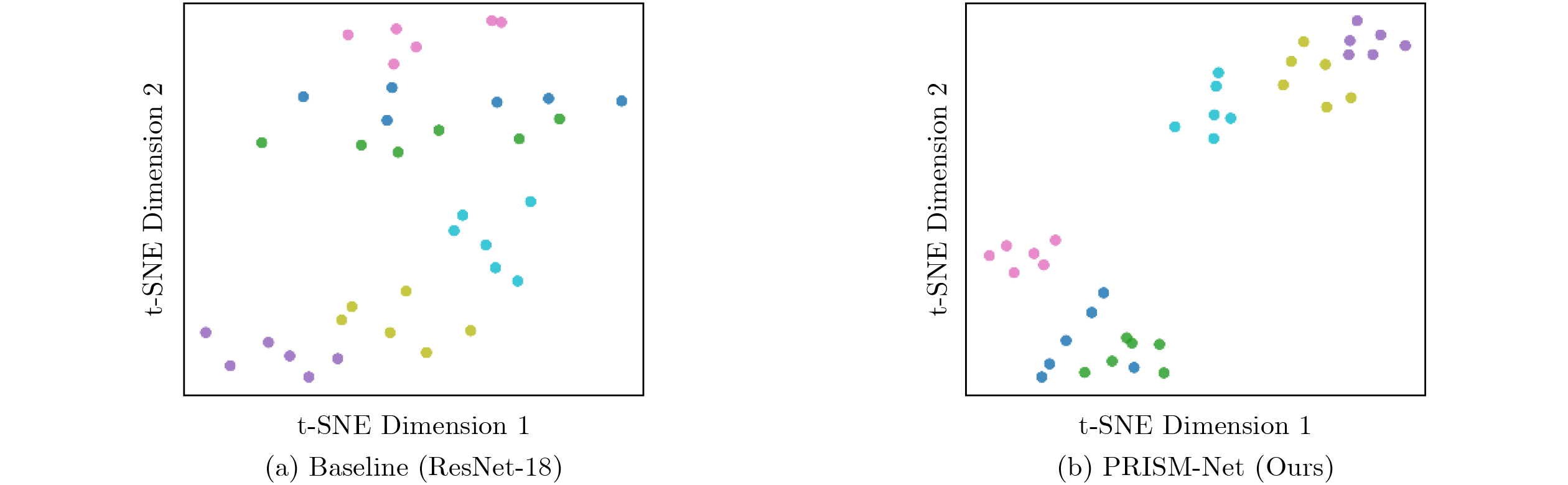
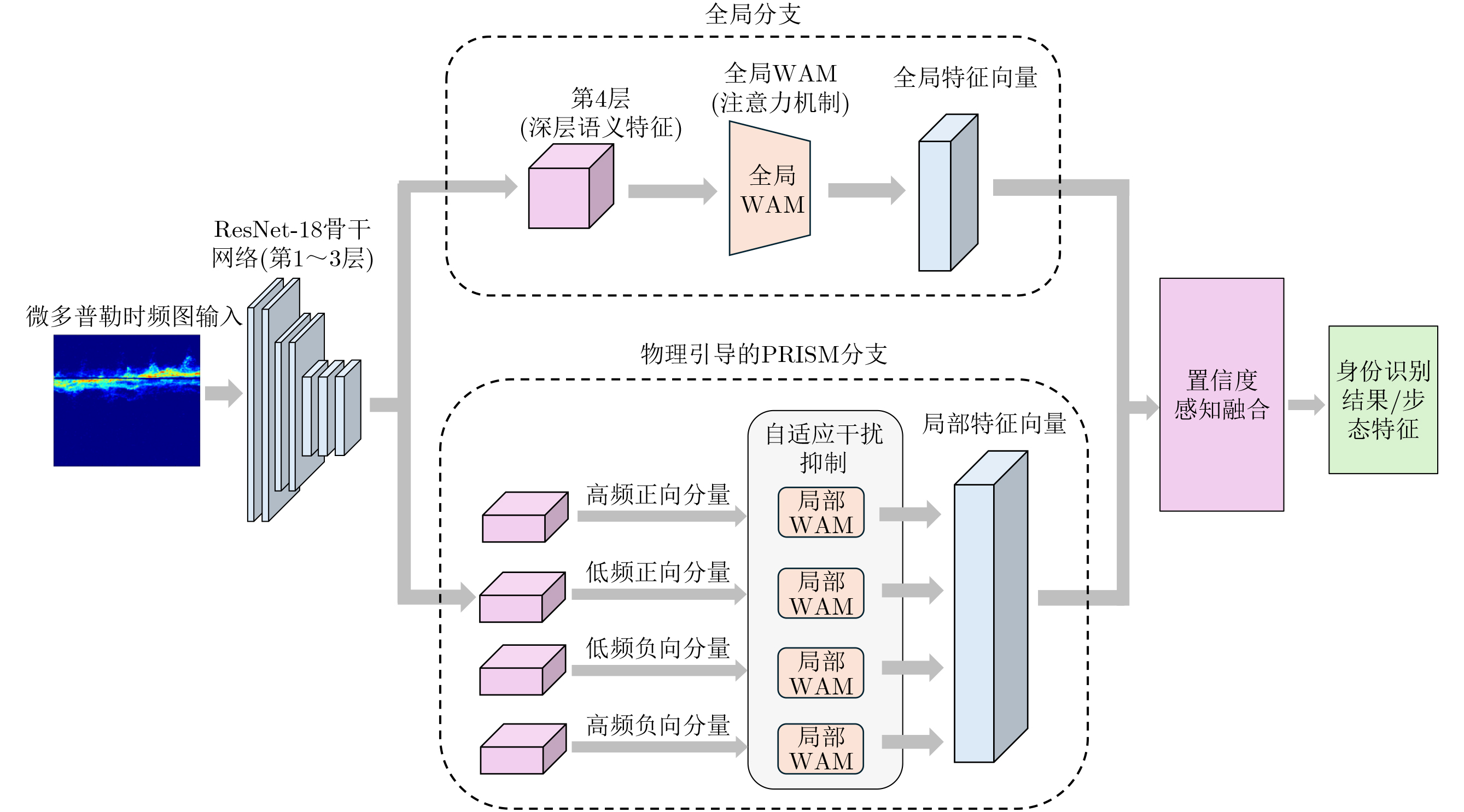
Objective MilliMeter-Wave Radar (MMW Radar) gait recognition has demonstrated considerable potential for non-contact biometric identification because of its inherent advantages in privacy preservation and robustness to variable lighting conditions. However, practical deployment remains challenging under complex wearing conditions, such as long coats or backpacks. These external factors introduce non-stationary high-frequency interference, resulting in spectral aliasing and masking of intrinsic micro-Doppler (m-D) features. Conventional deep learning methods generally treat m-D spectrograms as generic images and overlook the physical relationship between Doppler frequency and human motion. Therefore, clothing-induced interference is easily confused with motion-related features, resulting in reduced recognition performance. This study proposes a physics-aware framework that integrates radar signal physics with human biomechanics to achieve frequency-domain decoupling and adaptive interference suppression for robust radar-based gait recognition under complex wearing conditions. Methods To reduce clothing-induced interference, this paper proposes PRISM-Net, a physics-aware gait recognition framework for MMW Radar. The framework is built on the biomechanical characteristics of human motion, where the torso, representing the primary body mass, generates relatively stable low-frequency Doppler components, whereas limb motion produces higher-frequency periodic components. (1) Physics-aware Frequency Structural Reconstruction: Instead of uniformly processing the entire m-D spectrogram, the proposed method performs Physics-aware Frequency Structural Reconstruction by exploiting the velocity distribution associated with different body parts. The original aliased m-D spectrogram is reconstructed into torso- and limb-related frequency components. Low-frequency components preserve stable identity-discriminative features, whereas high-frequency components characterize limb motion. This frequency-domain structural reconstruction isolates spectral regions that are most susceptible to clothing-induced interference, thereby reducing interference propagation. (2) Weighted Attention Mechanism (WAM): The WAM adaptively reweights feature responses according to the reliability of different frequency components. Because clothing-induced interference predominantly affects high-frequency regions, the WAM suppresses interference-contaminated high-frequency responses while enhancing stable torso features, thereby improving feature fusion and recognition robustness. (3) Experimental Configuration: The proposed method is evaluated on the MMRGait-1.0 dataset under a subject-independent evaluation protocol. The training set contains data from 74 subjects, while the remaining 47 unseen subjects are used for testing. All m-D spectrograms are resized to 224 × 224 pixels. The network is optimized using the AdamW optimizer with a joint loss comprising Cross-Entropy Loss, Triplet Loss, and Center Loss to improve both classification performance and feature discriminability. Results and Discussions Experimental results demonstrate the effectiveness of incorporating biomechanical priors into gait recognition. As shown in Table 2, PRISM-Net achieves an average Rank-1 accuracy of 89.7% under the 90° side-view condition. In the coat (CT) scenario, the proposed method maintains a Rank-1 accuracy of 85.1%, representing an 18.1% improvement over ShuffleNetV2 and a 7.4% improvement over the ResNet-18 baseline. Model stability is verified through ten independent trials. As illustrated in Fig. 1 , PRISM-Net achieves a standard deviation of ±0.55%, compared with ±1.75% for the baseline model. An independent-samples t-test yields p<0.001, confirming that the improvement is statistically significant. Ablation results inTable 3 further verify the contribution of each component. Removing Physics-aware Frequency Structural Reconstruction reduces the CT Rank-1 accuracy to 75.5%, demonstrating the importance of physics-aware frequency-domain decoupling for preventing feature distortion. The WAM further improves CT accuracy by 4.2% through adaptive suppression of high-frequency interference. Regarding computational complexity,Table 4 shows that PRISM-Net contains 11.33 M parameters and requires only 0.75 GFLOPs. Compared with computationally intensive 3D convolution-based models requiring more than 10 GFLOPs, the proposed method achieves superior recognition performance with significantly lower computational complexity. Furthermore, the t-SNE visualization inFig. 7 shows more compact intra-class distributions and clearer inter-class separation, demonstrating improved feature discriminability.Conclusions The proposed PRISM-Net demonstrates that incorporating biomechanical priors into deep learning improves the robustness of MMW Radar gait recognition under complex wearing conditions. By combining Physics-aware Frequency Structural Reconstruction with the Weighted Attention Mechanism, the proposed framework effectively performs frequency-domain decoupling and suppresses clothing-induced high-frequency interference. Experimental results on the MMRGait-1.0 dataset demonstrate that the proposed method achieves high Rank-1 accuracy with low computational complexity, indicating its potential for real-time security applications on edge computing devices. -
表 3 消融实验(%)
模型变体 正常 (NM) 挎包 (BG) 穿大衣 (CT) 平均 (Mean) Global Stream Only 94.7 84.0 75.5 84.8 PRISM Stream Only 94.7 87.2 73.4 85.1 No WAM 90.4 84.0 80.9 85.1 PRISM-Net(本文) 95.7 88.3 85.1 89.7  下载: 导出CSV
-
[1] PAPANASTASIOU V S, TROMMEL R P, HARMANNY R I A, et al. Deep Learning-based identification of human gait by radar micro-Doppler measurements[C]. 2020 17th European Radar Conference (EuRAD), Utrecht, Netherlands, 2021: 49–52. doi: 10.1109/EuRAD48048.2021.00024. [2] DING Minhao, LV Ping, PENG Yiqun, et al. A stable gait recognition algorithm under multiview and multiwear using millimeter-wave radar[J]. IEEE Sensors Journal, 2024, 24(22): 38135–38143. doi: 10.1109/JSEN.2024.3454714. [3] 史秋彦, 叶宁, 徐康, 等. 基于ConvRNN-ResNet的毫米波步态识别方法[J]. 计算机应用与软件, 2025, 42(1): 108–115. doi: 10.3969/j.issn.1000-386x.2025.01.016.SHI Qiuyan, YE Ning, XU Kang, et al. ConvRNN-ResNet network for gait recognition using millimeter wave radar[J]. Computer Applications and Software, 2025, 42(1): 108–115. doi: 10.3969/j.issn.1000-386x.2025.01.016. [4] XIA Zhaoyang, DING Genming, WANG Hui, et al. Person identification with millimeter-wave radar in realistic smart home scenarios[J]. IEEE Geoscience and Remote Sensing Letters, 2022, 19: 3509405. doi: 10.1109/LGRS.2021.3117001. [5] 刘琳琳, 左家永, 王洪雁. 基于微多普勒效应的人体身份深度识别方法[J]. 传感器与微系统, 2025, 44(1): 146–151. doi: 10.13873/J.1000-9787(2025)01-0146-06.LIU Linlin, ZUO Jiayong, and WANG Hongyan. Human identity deep recognition method based on micro-Doppler effect[J]. Transducer and Microsystem Technologies, 2025, 44(1): 146–151. doi: 10.13873/J.1000-9787(2025)01-0146-06. [6] HUANG Ling, LEI Dong, ZHENG Bowen, et al. Lightweight multi-domain fusion model for through-wall human activity recognition using IR-UWB radar[J]. Applied Sciences, 2024, 14(20): 9522. doi: 10.3390/app14209522. [7] HUANG Ling, ZHENG Bowen, ZHANG Tingting, et al. Lightweight similar human action recognition through walls via IR-UWB radar and multi-domain feature fusion[J]. IEEE Access, 2025, 13: 182315–182330. doi: 10.1109/ACCESS.2025.3620410. [8] 孙延鹏, 贺韶枫, 屈乐乐. 基于微多普勒信号分离和SqueezeNet的人体身份识别[J]. 雷达科学与技术, 2023, 21(5): 511–516,525. doi: 10.3969/j.issn.1672-2337.2023.05.006.SUN Yanpeng, HE Shaofeng, and QU Lele. Human identity recognition based on micro-Doppler signal separation and SqueezeNet[J]. Radar Science and Technology, 2023, 21(5): 511–516,525. doi: 10.3969/j.issn.1672-2337.2023.05.006. [9] HE Xianxian, ZHANG Yunhua, and DONG Xiao. Gait-based human recognition based on millimetre wave multiple input multiple output radar point cloud constructed using velocity-depth-time[J]. IET Radar, Sonar & Navigation, 2024, 18(8): 1381–1389. doi: 10.1049/rsn2.12577. [10] WU Qiuxia, WANG Zicheng, SU Kunming, et al. GSTNet: Gait Spatio-Temporal Network for gait recognition using millimeter-wave radar[C]. 2024 IEEE International Conference on Acoustics, Speech and Signal Processing (ICASSP), Seoul, Korea, 2024: 4855–4859. doi: 10.1109/ICASSP48485.2024.10447288. [11] 丁轩宇, 靳标, 张贞凯. DGCN-MFW: 一种面向毫米波雷达三维点云的轻量化人体动作识别网络[J]. 电子与信息学报, 2026, 48(4): 1740–1750. doi: 10.11999/JEIT251087.DING Xuanyu, JIN Biao, and ZHANG Zhenkai. DGCN-MFW: A lightweight human action recognition network for millimeter-wave radar 3D point clouds[J]. Journal of Electronics & Information Technology, 2026, 48(4): 1740–1750. doi: 10.11999/JEIT251087. [12] MA Chongrun and LIU Zhenyu. mDS-PCGR: A bimodal gait recognition framework with the fusion of 4-D radar point cloud sequences and micro-Doppler signatures[J]. IEEE Sensors Journal, 2024, 24(6): 8227–8240. doi: 10.1109/JSEN.2024.3355421. [13] 孙延鹏, 王爽, 屈乐乐, 等. 基于点云数据与微多普勒谱图多模态特征的雷达步态识别[J/OL]. 雷达科学与技术, https://link.cnki.net/urlid/34.1264.tn.20251112.1509.002, 2025.SUN Yanpeng, WANG Shuang, QU Lele, et al. Radar gait recognition based on point cloud and micro-doppler multimodal features[J/OL]. Radar Science and Technology, https://link.cnki.net/urlid/34.1264.tn.20251112.1509.002, 2025. [14] 江嘉玮, 郭剑, 袁铭蔚, 等. 基于多特征融合的调频连续波雷达步态识别方法[J/OL]. 计算机应用, https://link.cnki.net/urlid/51.1307.TP.20251127.1650.002, 2025. doi: 10.11772/j.issn.1001-9081.2025091139.JIANG Jiawei, GUO Jian, YUAN Mingwei, et al. Gait recognition method based on multi-feature fusion using frequency-modulated continuous-wave radar[J/OL]. Journal of Computer Applications, https://link.cnki.net/urlid/51.1307.TP.20251127.1650.002, 2025. doi: 10.11772/j.issn.1001-9081.2025091139. [15] 孟洪杰, 杜延墨. 基于改进GaitSet的跨视角步态识别方法[J]. 机械管理开发, 2025, 40(1): 268–270,276. doi: 10.16525/j.cnki.cn14-1134/th.2025.01.091.MENG Hongjie and DU Yanmo. Cross-view gait recognition based on improved GaitSet[J]. Mechanical Management and Development, 2025, 40(1): 268–270,276. doi: 10.16525/j.cnki.cn14-1134/th.2025.01.091. [16] 曹子康, 裴颂文, 黄立波. 融合多尺度特征表示和注意力机制的步态识别模型[J]. 上海理工大学学报, 2024, 46(6): 589–599. doi: 10.13255/j.cnki.jusst.20241016002.CAO Zikang, PEI Songwen, and HUANG Libo. A gait recognition model fusing multi-scale feature representation and attention mechanism[J]. Journal of University of Shanghai for Science and Technology, 2024, 46(6): 589–599. doi: 10.13255/j.cnki.jusst.20241016002. [17] YANG Yang, ZHAO Dongxu, YANG Xiaoyi, et al. Open-scenario-oriented human gait recognition using radar micro-doppler signatures[J]. IEEE Transactions on Aerospace and Electronic Systems, 2024, 60(5): 6420–6432. doi: 10.1109/TAES.2024.3403077. [18] NI Zhongfei and HUANG Binke. Open-set human identification based on gait radar micro-Doppler signatures[J]. IEEE Sensors Journal, 2021, 21(6): 8226–8233. doi: 10.1109/JSEN.2021.3052613. [19] 孙延鹏, 王宇薇, 屈乐乐. 基于雷达微多普勒特征的开集步态识别[J]. 无线电通信技术, 2026, 52(2): 465–473. doi: 10.3969/j.issn.1003-3114.2026.02.023.SUN Yanpeng, WANG Yuwei, and QU Lele. Open-set gait recognition based on radar micro-Doppler features[J]. Radio Communications Technology, 2026, 52(2): 465–473. doi: 10.3969/j.issn.1003-3114.2026.02.023. [20] 杜兰, 李逸明, 薛世鲲, 等. 结合相似度预测和阈值自动求解的开集条件下毫米波雷达点云步态识别方法[J]. 电子与信息学报, 2025, 47(6): 1850–1863. doi: 10.11999/JEIT241034.DU Lan, LI Yiming, XUE Shikun, et al. Millimeter-wave radar point cloud gait recognition method under open-set conditions based on similarity prediction and automatic threshold estimation[J]. Journal of Electronics & Information Technology, 2025, 47(6): 1850–1863. doi: 10.11999/JEIT241034. [21] 谭浩楠, 董玫, 陈伯孝. 多干扰环境下车载毫米波雷达干扰抑制算法研究[J]. 电子与信息学报, 2025, 47(11): 4285–4295. doi: 10.11999/JEIT250617.TAN Haonan, DONG Mei, and CHEN Boxiao. The research on interference suppression algorithms for millimeter-wave radar in multi-interference environments[J]. Journal of Electronics & Information Technology, 2025, 47(11): 4285–4295. doi: 10.11999/JEIT250617. [22] 杜兰, 陈晓阳, 石钰, 等. MMRGait-1.0: 多视角多穿着条件下的雷达时频谱图步态识别数据集[J]. 雷达学报, 2023, 12(4): 892–905. doi: 10.12000/JR22227.DU Lan, CHEN Xiaoyang, SHI Yu, et al. MMRGait-1.0: A radar time-frequency spectrogram dataset for gait recognition under multi-view and multi-wearing conditions[J]. Journal of Radars, 2023, 12(4): 892–905. doi: 10.12000/JR22227. [23] DANG Xiaochao, TANG Yangyang, HAO Zhanjun, et al. PGGait: Gait recognition based on millimeter-wave radar spatio-temporal sensing of multidimensional point clouds[J]. Sensors, 2024, 24(1): 142. doi: 10.3390/s24010142. [24] FAN Chao, PENG Yunjie, CAO Chunshui, et al. GaitPart: Temporal part-based model for gait recognition[C]. 2020 IEEE/CVF Conference on Computer Vision and Pattern Recognition (CVPR), Seattle, USA, 2020: 14213–14221. doi: 10.1109/CVPR42600.2020.01423. -

 下载:
下载:


图(7) / 表(4)
计量
- 文章访问数: 467
- HTML全文浏览量: 248
- PDF下载量: 11
- 被引次数: 0
