




Resource Allocation for Multi-UAV Relay Networks in 6G Semantic Communication
-
摘要: 针对6G多无人机中继网络在动态环境下面临的通信资源受限与传输效能瓶颈,该文引入语义通信范式以降低系统对高带宽的依赖,并提出一种基于两阶段混合强化学习的联合资源优化方法。首先,综合考虑语义符号数量、无人机飞行轨迹、功率控制与信道分配,构建了以最大化语义通信服务质量和长期用户公平性为目标的资源优化模型。其次,设计了两阶段资源分配框架,利用改进的容量感知K均值算法进行负载均衡预部署以规避无效探索,并采用带参数共享的循环独立近端策略优化算法求解动态联合策略。仿真结果表明,该文所提方法具有良好的收敛性,能在保证用户公平性的同时有效提升语义传输效率并降低传输时延。Abstract:
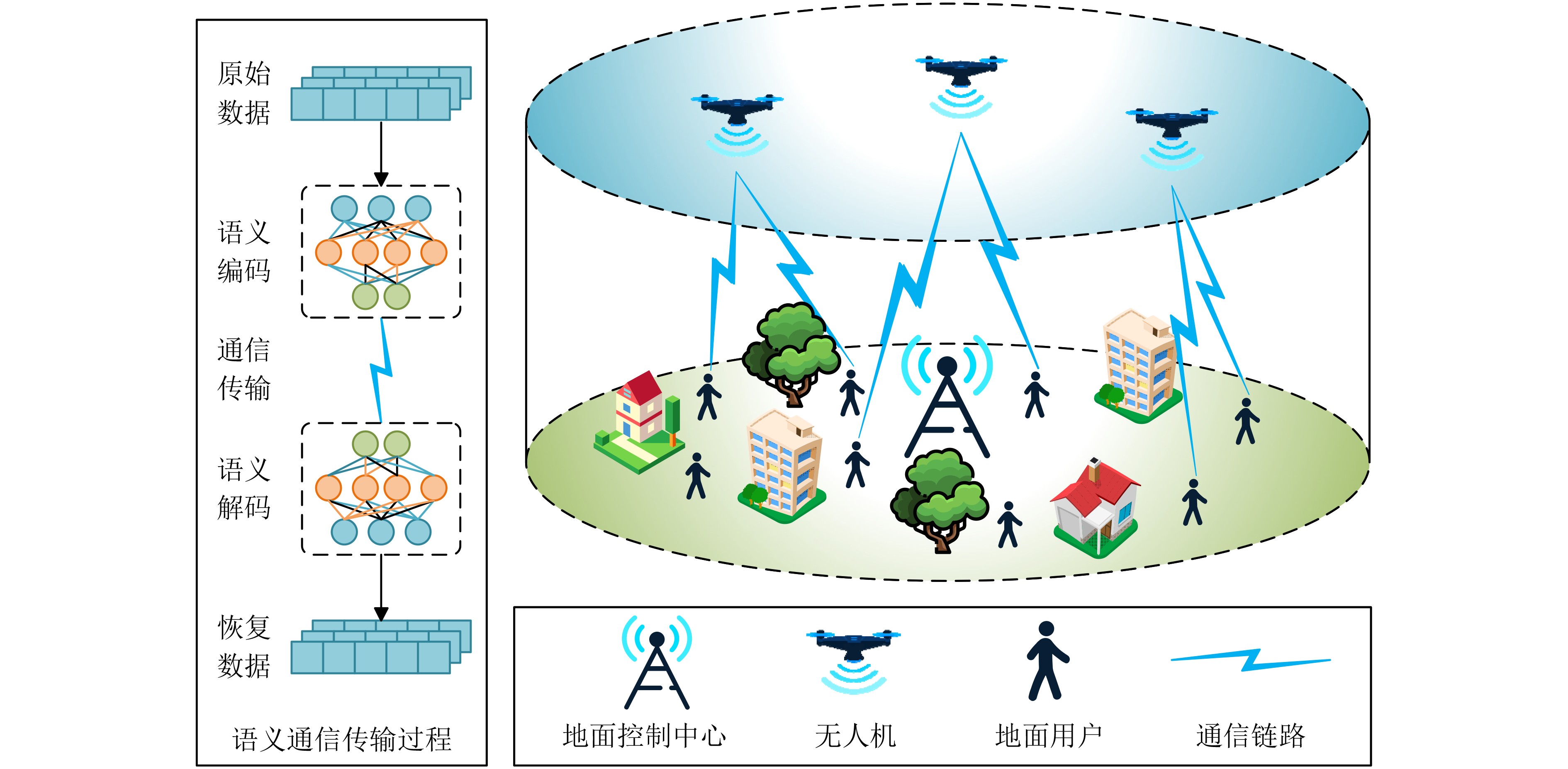
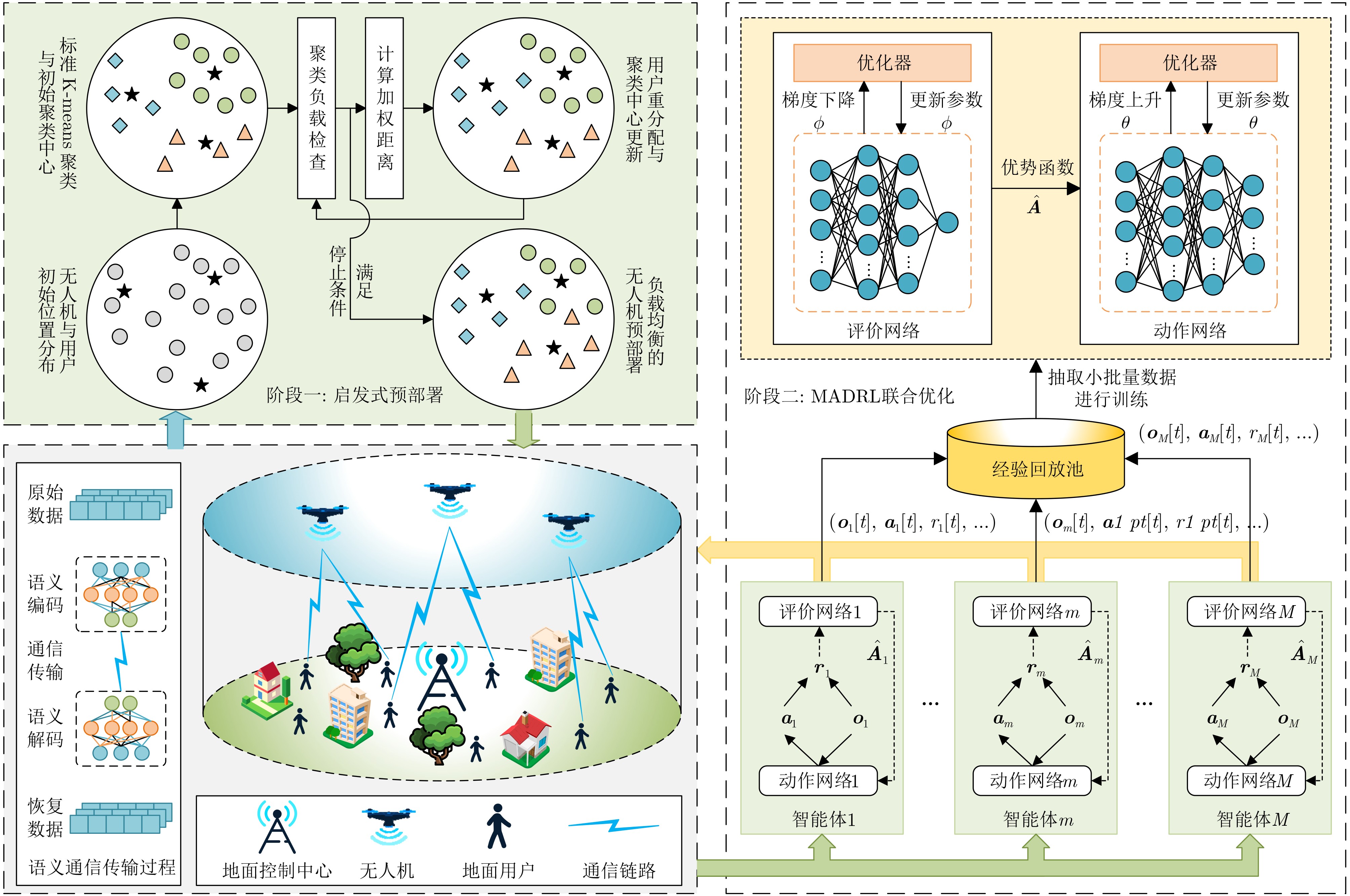
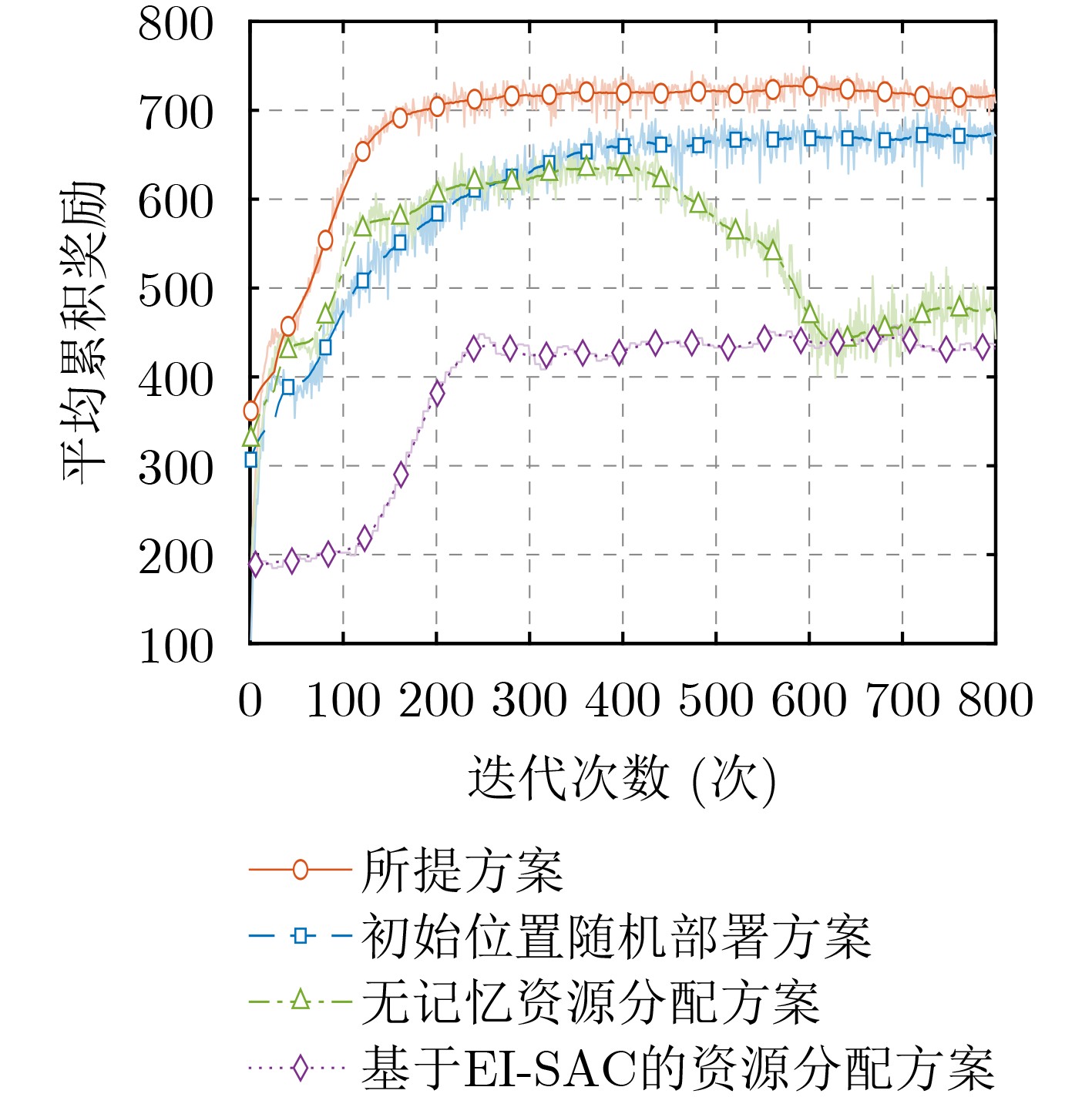
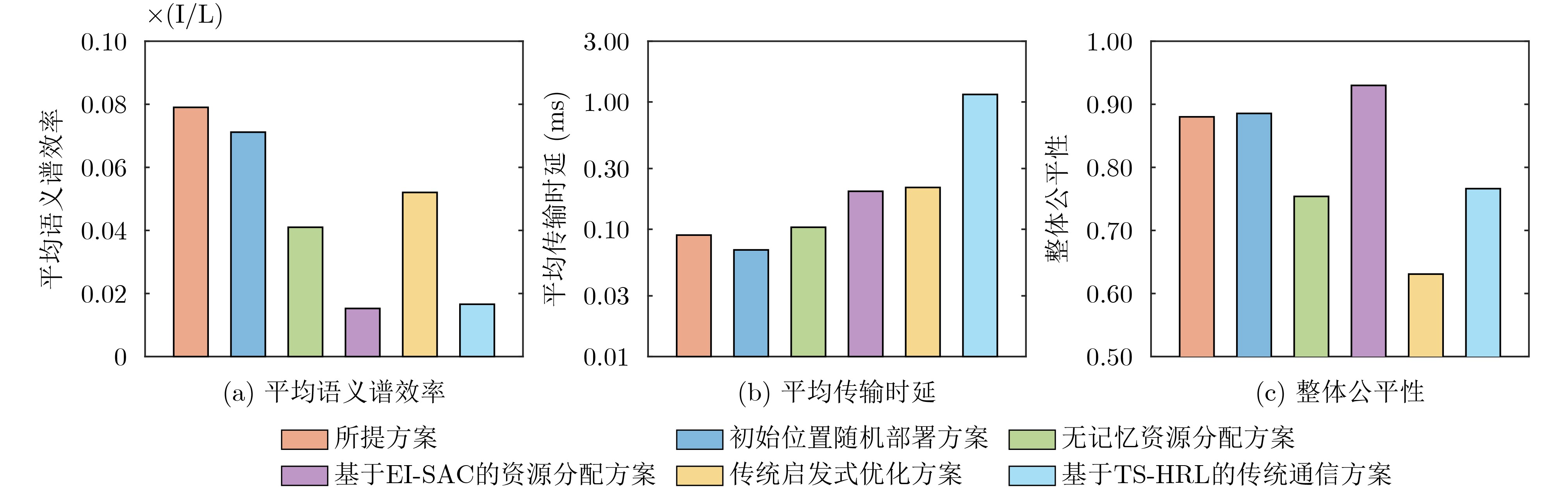
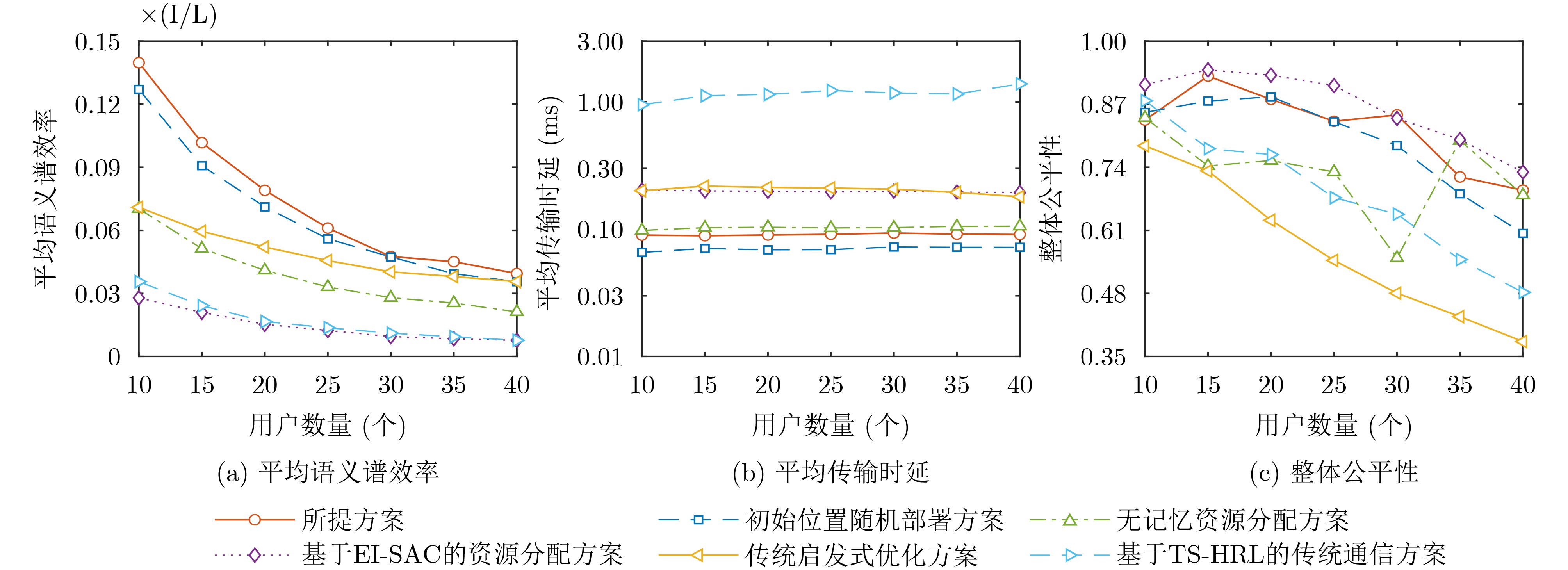
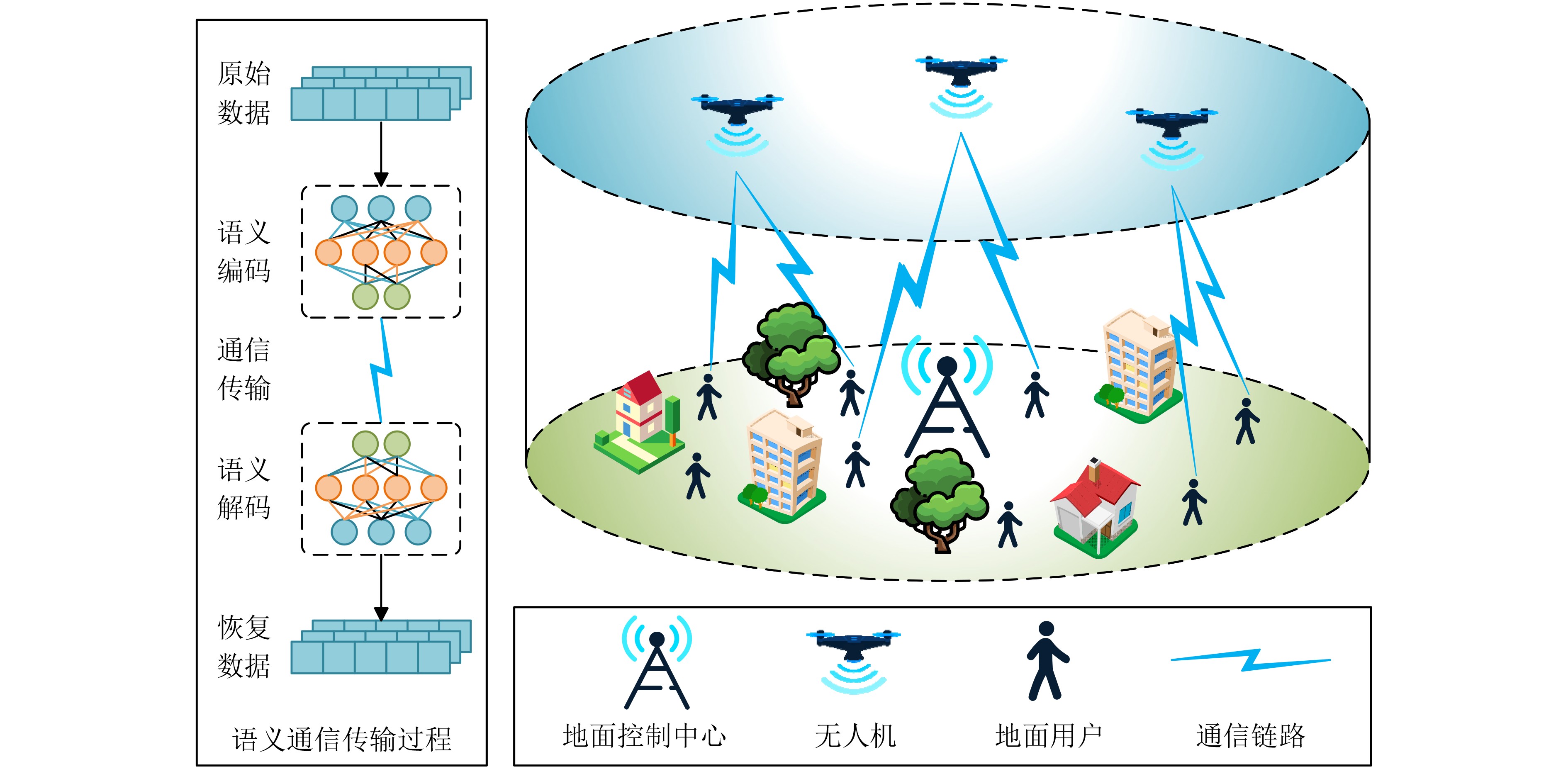
Objective Sixth-Generation (6G) mobile networks aim to achieve global seamless coverage through space-air-ground integrated architectures. In this context, Unmanned Aerial Vehicles (UAVs) serve as mobile aerial relay nodes to support massive ground-user access in complex environments. However, traditional data-oriented communication paradigms incur substantial bandwidth overhead, limiting their applicability in spectrum-constrained UAV networks. In addition, conventional centralized resource allocation methods are difficult to implement in real time because of highly dynamic network topologies and the strong coupling among multidimensional resources. To address these challenges, semantic communication has emerged as a communication paradigm that extracts semantic information at the transmitter and reconstructs it at the receiver, thereby reducing redundant data transmission. Existing semantic-driven resource allocation methods, however, primarily focus on static terrestrial networks or single-UAV scenarios and do not adequately address coverage limitations and co-channel interference in multi-UAV relay networks. Therefore, a joint resource optimization model and a distributed resource allocation framework are proposed to improve semantic transmission efficiency and long-term user fairness through the joint optimization of multidimensional resources, thereby supporting intelligent resource scheduling in future 6G integrated networks. Methods A joint resource optimization model is formulated for multi-UAV relay networks under the semantic communication paradigm ( Fig. 1 ), jointly optimizing the number of semantic symbols, UAV trajectories, power control, and channel allocation. To evaluate semantic communication performance, a Semantic Communication Quality of Service (SC-QoS) metric is proposed by combining Semantic Quantization Efficiency (SQE) with normalized transmission delay. The optimization objective is formulated as a Mixed-Integer NonLinear Programming (MINLP) problem that maximizes the weighted sum of system-wide SC-QoS and long-term user fairness measured by Jain’s fairness index. To solve this problem, a Two-Stage Hybrid Reinforcement Learning (TS-HRL) framework is proposed (Fig. 2 ). In the first stage, a Capacity-Aware K-means (CA-K-means) algorithm performs heuristic UAV pre-deployment. By introducing a dynamic distance compensation term based on residual capacity, edge users are guided toward lightly loaded UAVs, thereby achieving load balancing while preserving spatial proximity. In the second stage, the dynamic scheduling problem is formulated as a Decentralized Partially Observable Markov Decision Process (Dec-POMDP) and solved using a Recurrent Independent Proximal Policy Optimization with Parameter Sharing (R-IPPO-PS) algorithm (Algorithm 1). The algorithm employs Long Short-Term Memory (LSTM) networks to aggregate historical observations and action trajectories, enabling the inference of hidden environmental states. Furthermore, the parameter-sharing mechanism improves training efficiency as the number of agents increases, while the association preference decoupling strategy transforms discrete channel allocation decisions into continuous association preference variables to facilitate policy optimization.Results and Discussions The proposed TS-HRL framework is evaluated in a dynamic environment with randomly moving ground users. Convergence analysis shows that the proposed method achieves a higher initial reward and converges with fewer iterations than the random deployment, memoryless resource allocation, and Enhanced Independent Soft Actor-Critic (EI-SAC) baselines ( Fig. 3 ). By combining LSTM-based temporal modeling with CA-K-means pre-deployment, the proposed framework reduces ineffective exploration and improves convergence stability. Compared with conventional bit-based communication, the semantic communication framework increases Semantic Spectral Efficiency (S-SE) by 3.6-fold, reduces transmission delay by 92.1%, and improves fairness by 14.3% (Fig. 4 ). Within the semantic communication framework, compared with the memoryless and heuristic schemes, the proposed method improves S-SE by 92.7% and 51.9%, reduces transmission delay by 13.5% and 57.7%, and improves fairness by 17.3% and 39.7%, respectively. Although the EI-SAC baseline achieves a fairness index of 0.93, its S-SE remains relatively low. In contrast, the proposed TS-HRL framework maintains a high level of fairness while achieving an S-SE approximately 4.3 times that of EI-SAC. Compared with random deployment, the proposed method improves S-SE by 11.3% with only a 1.1% decrease in fairness, demonstrating a better balance between transmission efficiency and fairness. As the number of users increases from 10 to 40, most baseline methods exhibit decreases in S-SE and fairness because of intensified co-channel interference and spectrum limitations (Fig. 5 ). In contrast, the adaptive scheduling strategy and global fairness reward mechanism mitigate performance degradation and maintain the average transmission delay below 0.1 ms. These results demonstrate that the proposed method improves overall system performance while ensuring long-term user fairness.Conclusions This paper investigates joint resource allocation and trajectory optimization for dynamic 6G multi-UAV relay networks under the semantic communication paradigm. A joint optimization model that couples the number of semantic symbols, UAV trajectories, power control, and channel allocation is formulated to maximize SC-QoS and long-term user fairness. To address the high-dimensional coupling of the optimization problem, a TS-HRL framework integrating CA-K-means pre-deployment with the R-IPPO-PS algorithm is proposed for multidimensional resource scheduling under partial observability. Simulation results demonstrate the convergence, stability, and scalability of the proposed method under different user densities. Through distributed multi-agent cooperation among UAVs, the proposed method improves semantic transmission efficiency and reduces transmission delay while maintaining long-term service fairness for ground users. These findings provide an effective approach to intelligent resource allocation for UAV-assisted semantic communication in future space-air-ground integrated networks. -
1 基于R-IPPO-PS的联合资源分配算法
输入:最大回合数$ {N}_{\text{eps}} $,回合内时隙数T,每次参数更新迭代数
$ {N}_{\text{epoch}} $输出:优化后的共享网络参数$ \theta ,\phi $ (1) 初始化参数$ \theta $,$ \phi $,同步旧策略参数$ {\theta }_{\text{old}}\leftarrow \theta $,初始化经验回
放池D(2) 对于每个回合$ e\in \{1,2,\cdots ,{N}_{\text{eps}}\} $: (3) 获取初始观测$ {\boldsymbol{o}}_{m}[0] $,初始化LSTM的隐藏状态$ {\boldsymbol{h}}_{m}[0] $与
细胞状态$ {\boldsymbol{c}}_{m}[0] $(4) 对于每个时隙$ t\in \{1,2,\cdots ,T\} $: (5) 通过MLP与LSTM更新隐藏状态$ ({\boldsymbol{h}}_{m}[t],{\boldsymbol{c}}_{m}[t]) $,采
样独立动作$ {\boldsymbol{a}}_{m}[t] $(6) 执行联合动作,获取奖励$ {r}_{m}[t] $与下一时刻观测
$ {\boldsymbol{o}}_{m}[t+1] $(7) 结束循环 (8) 获取本回合的交互轨迹$ {\tau }_{m} $,采用GAE计算优势函数
$ \widehat{A}[t] $,并将完整交互数据存入D(9) 对于每次训练迭代$ j\in \{1,2,\cdots ,{N}_{\text{epoch}}\} $: (10) 从D中抽取小批量数据,最大化总目标函数
$ J(\theta ,\phi ) $,联合更新参数$ \theta $与$ \phi $(11) 结束循环 (12) 更新旧策略参数$ {\theta }_{\text{old}}\leftarrow \theta $,并清空经验回放池D (13) 结束循环  下载: 导出CSV
表 1 仿真参数设置
参数 参数值 载波频率 $ {f}_{\text{c}}=2.4 $ GHz 热噪声功率谱密度 $ {n}_{0}=1.27\times {10}^{-20} $ W/Hz LoS路径损耗指数 $ {\eta }_{\text{a}}=9.61 $ NLoS路径损耗指数 $ {\eta }_{\text{b}}=0.16 $ 语义保真度阈值 $ {\xi }_{\text{th}}=0.8 $ 每回合最大步数 T=600 时隙持续时间 $ {\delta }_{t}=0.1 $ s
下载: 导出CSV
表 2 训练参数设置
参数 参数值 MLP隐藏层 [256, 256, 128] MLP激活函数 ReLU LSTM隐藏单元数 256 LSTM序列长度 40 学习率 $ \alpha =1.5\times {10}^{-5} $ 折扣因子 $ \gamma =0.85 $ GAE参数 $ \lambda =0.95 $ PPO裁剪阈值 $ \epsilon =0.09 $ SC-QoS权重系数 $ {w}_{1}=1.0,{w}_{2}=1.0 $ 优化目标权重系数 $ {w}_{\text{sc}}=1.0,{w}_{\text{f}}=1.0 $
下载: 导出CSV
-
[1] ZHANG Ruichen, DU Hongyang, NIYATO D, et al. Generative AI for space-air-ground integrated networks[J]. IEEE Wireless Communications, 2024, 31(6): 10–20. doi: 10.1109/MWC.016.2300547. [2] FENG Zikai, WU Di, HUANG Mengxing, et al. Graph-attention-based reinforcement learning for trajectory design and resource assignment in multi-UAV-assisted communication[J]. IEEE Internet of Things Journal, 2024, 11(16): 27421–27434. doi: 10.1109/JIOT.2024.3397823. [3] XIE Ping, CHEN Qian, WU Jingyan, et al. NOMA-based intelligent resource allocation and trajectory optimization for multi-UAVs assisted semantic communication networks[J]. Ad Hoc Networks, 2025, 171: 103762. doi: 10.1016/j.adhoc.2025.103762. [4] 张广驰, 顾泽霖, 崔苗. 空地协同通信感知一体化系统的轨迹与资源分配联合优化[J]. 电子与信息学报, 2024, 46(6): 2382–2390. doi: 10.11999/JEIT230716.ZHANG Guangchi, GU Zelin, and CUI Miao. Joint trajectory and resource allocation optimization for air-ground collaborative integrated sensing and communication systems[J]. Journal of Electronics & Information Technology, 2024, 46(6): 2382–2390. doi: 10.11999/JEIT230716. [5] 冯斯梦, 张云弈, 刘凯, 等. 低空混合障碍下无人机协同多智能体航迹规划[J]. 电子与信息学报, 2025, 47(5): 1291–1300. doi: 10.11999/JEIT250012.FENG Simeng, ZHANG Yunyi, LIU Kai, et al. Collaborative multi-agent trajectory optimization for unmanned aerial vehicles under low-altitude mixed-obstacle airspace[J]. Journal of Electronics & Information Technology, 2025, 47(5): 1291–1300. doi: 10.11999/JEIT250012. [6] 张平, 牛凯, 姚圣时, 等. 面向未来的语义通信: 基本原理与实现方法[J]. 通信学报, 2023, 44(5): 1–14. doi: 10.11959/j.issn.1000−436x.2023079.ZHANG Ping, NIU Kai, YAO Shengshi, et al. Semantic communications for future: Basic principle and implementation methodology[J]. Journal on Communications, 2023, 44(5): 1–14. doi: 10.11959/j.issn.1000−436x.2023079. [7] QIN Zhijin, GAO Feifei, LIN Bo, et al. A generalized semantic communication system: From sources to channels[J]. IEEE Wireless Communications, 2023, 30(3): 18–26. doi: 10.1109/MWC.013.2200553. [8] FU Yuzhou, CHENG Wenchi, ZHANG Wei, et al. Scalable extraction based semantic communication for 6G wireless networks[J]. IEEE Communications Magazine, 2024, 62(7): 96–102. doi: 10.1109/MCOM.021.2300269. [9] DING Yahao, YANG Zhaohui, PHAM Q V, et al. Distributed machine learning for UAV swarms: Computing, sensing, and semantics[J]. IEEE Internet of Things Journal, 2024, 11(5): 7447–7473. doi: 10.1109/JIOT.2023.3341307. [10] WANG Lingyi, WU Wei, ZHOU Fuhui, et al. Adaptive resource allocation for semantic communication networks[J]. IEEE Transactions on Communications, 2024, 72(11): 6900–6916. doi: 10.1109/TCOMM.2024.3405355. [11] YAN Lei, QIN Zhijin, ZHANG Rui, et al. Resource allocation for text semantic communications[J]. IEEE Wireless Communications Letters, 2022, 11(7): 1394–1398. doi: 10.1109/LWC.2022.3170849. [12] YAN Lei, QIN Zhijin, LI Chunfeng, et al. QoE-based semantic-aware resource allocation for multi-task networks[J]. IEEE Transactions on Wireless Communications, 2024, 23(9): 11958–11971. doi: 10.1109/TWC.2024.3386807. [13] XU Jiaqi, YAO Haipeng, ZHANG Ru, et al. Federated learning powered semantic communication for UAV swarm cooperation[J]. IEEE Wireless Communications, 2024, 31(4): 140–146. doi: 10.1109/MWC.005.2300147. [14] HOA N T, HAI C T T, LE HUNG H, et al. Joint edge computing and semantic communication in UAV-enabled networks[J]. IEEE Communications Letters, 2025, 29(1): 80–84. doi: 10.1109/LCOMM.2024.3496534. [15] DENG Yundi, LENG Supeng, ZHANG Ke, et al. Semantic communication assisted cooperative sensing in UAV networks[C]. 2025 10th International Conference on Computer and Communication System (ICCCS), Chengdu, China, 2025: 862–867. doi: 10.1109/ICCCS65393.2025.11069451. [16] SI Peiyuan, ZHAO Jun, LAM K Y, et al. UAV-assisted semantic communication with hybrid action reinforcement learning[C]. 2023 IEEE Global Communications Conference, Kuala Lumpur, Malaysia, 2023: 3801–3806. doi: 10.1109/GLOBECOM54140.2023.10437643. [17] XIE Wancheng, YANG Helin, and XIONG Zehui. Resource allocation for UAV-assisted anti-jamming semantic D2D networks: A graph reinforcement learning approach[J]. Computer Networks, 2025, 269: 111463. doi: 10.1016/j.comnet.2025.111463. [18] 时统志, 李博, 杨洪娟, 等. 基于传输公平性的多无人机通感一体化空间部署与波束成形设计[J]. 电子与信息学报, 2025, 47(1): 57–65. doi: 10.11999/JEIT240590.SHI Tongzhi, LI Bo, YANG Hongjuan, et al. Spatial deployment and beamforming for design multi-unmanned aerial vehicle-integrated sensing and communication based on transmission fairness[J]. Journal of Electronics & Information Technology, 2025, 47(1): 57–65. doi: 10.11999/JEIT240590. [19] HU Han, ZHU Xingwu, ZHOU Fuhui, et al. Resource allocation for multi-modal semantic communication in UAV collaborative networks[J]. IEEE Transactions on Communications, 2025, 73(9): 7599–7616. doi: 10.1109/TCOMM.2025.3552303. [20] YANG Helin, ZHAO Jun, NIE Jiangtian, et al. UAV-assisted 5G/6G networks: Joint scheduling and resource allocation based on asynchronous reinforcement learning[C]. IEEE Conference on Computer Communications Workshops (INFOCOM WKSHPS), Vancouver, Canada, 2021: 1–6. doi: 10.1109/INFOCOMWKSHPS51825.2021.9484604. [21] CHEN Ying, YANG Yaozong, WU Yuan, et al. Joint trajectory optimization and resource allocation in UAV-MEC systems: A lyapunov-assisted DRL approach[J]. IEEE Transactions on Services Computing, 2025, 18(2): 854–867. doi: 10.1109/TSC.2025.3544124. [22] TUSHA A and ARSLAN H. Interference burden in wireless communications: A comprehensive survey from PHY layer perspective[J]. IEEE Communications Surveys & Tutorials, 2025, 27(4): 2204–2246. doi: 10.1109/COMST.2024.3487068. [23] XIE Huiqiang, QIN Zhijin, LI G Y, et al. Deep learning enabled semantic communication systems[J]. IEEE Transactions on Signal Processing, 2021, 69: 2663–2675. doi: 10.1109/TSP.2021.3071210. [24] CHRYSOLOGOU A P, CHATZIDIAMANTIS N D, and KARAGIANNIDIS G K. Ergodic rate and fairness analysis of uplink RSMA with randomly deployed users[J]. IEEE Wireless Communications Letters, 2025, 14(11): 3764–3768. doi: 10.1109/LWC.2025.3603208. [25] TANG Qinqin, XIE Renchao, YU F R, et al. Decentralized computation offloading in IoT fog computing system with energy harvesting: A Dec-POMDP approach[J]. IEEE Internet of Things Journal, 2020, 7(6): 4898–4911. doi: 10.1109/JIOT.2020.2971323. [26] LI Rongyu, LU Wei, and CHU Jinghui. Multi-objective path planning for UAV swarm-assisted wireless information and power transfer system based on decentralized MADRL[J]. IEEE Open Journal of the Communications Society, 2025, 6: 8539–8555. doi: 10.1109/OJCOMS.2025.3615969. [27] CAI Xuli, LOHAN P, and KANTARCI B. Multi-agent deep reinforcement learning for optimized multi-UAV coverage and power-efficient UE connectivity[C]. 2025 IEEE 36th International Symposium on Personal, Indoor and Mobile Radio Communications (PIMRC), Istanbul, Turkey, 2025: 1–6. doi: 10.1109/PIMRC62392.2025.11274644. [28] GHOSH S, MUKHERJEE P, and GHOSH S C. Energy-efficient UAV movement and user-UAV association in multi-UAV networks[C]. 2025 IEEE International Mediterranean Conference on Communications and Networking (MeditCom), Nice, France, 2025: 1–6. doi: 10.1109/MeditCom64437.2025.11104463. [29] LIN Xinyi, LI Peizheng, and AIJAZ A. RL-driven semantic compression model selection and resource allocation in semantic communication systems[C].2025 IEEE 36th International Symposium on Personal, Indoor and Mobile Radio Communications (PIMRC), Istanbul, Turkey, 2025: 1–6. doi: 10.1109/PIMRC62392.2025.11274758. -

 下载:
下载:

图(5) / 表(3)
计量
- 文章访问数: 503
- HTML全文浏览量: 255
- PDF下载量: 30
- 被引次数: 0
