




Complex-domain Joint Spectrum Sensing Method for UAV Swarms in Complex Electromagnetic Environments
-
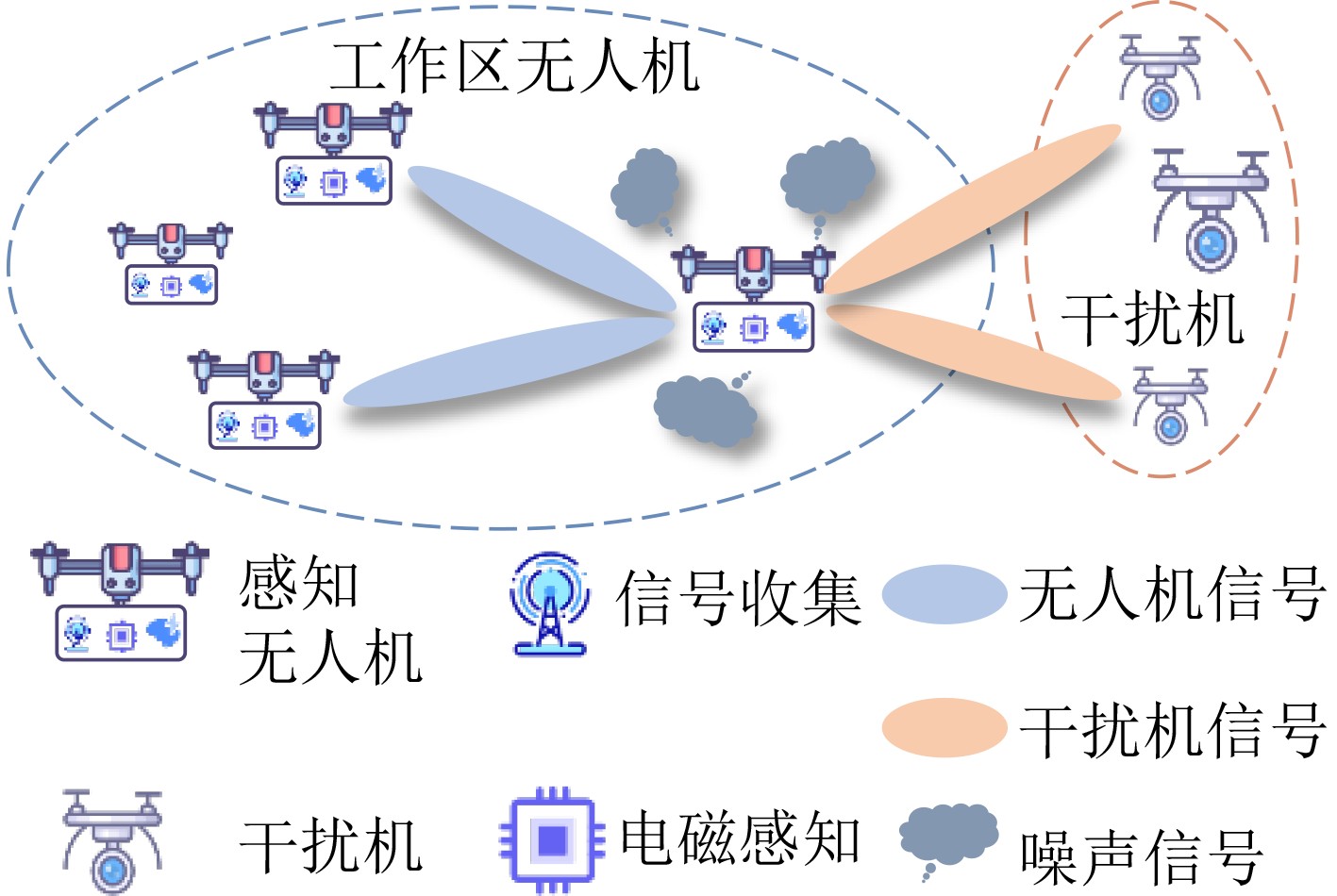
摘要: 在复杂电磁环境下,无人机群执行协同通信与动态频谱接入任务时,亟需对频谱占用状态及干扰重叠区域进行准确、快速的感知。现有频谱感知方法多将任务简化为单一信号检测,普遍存在低信噪比条件下鲁棒性不足、重叠干扰识别能力有限以及预处理开销较大等问题,难以满足复杂场景下无人机群对精细化电磁环境认知与实时感知的需求。针对上述问题,本文提出一种面向无人机群复杂电磁环境的复数域频谱联合感知方法。该方法构建复数域深度感知网络RadioSEUnet,直接对原始同相/正交(In-phase/Quadrature, I/Q)信号,并结合极坐标特征变换与通道注意力机制,形成幅度—相位双通道输入表征,实现频谱占用状态与干扰重叠区域的联合检测。实验在包含
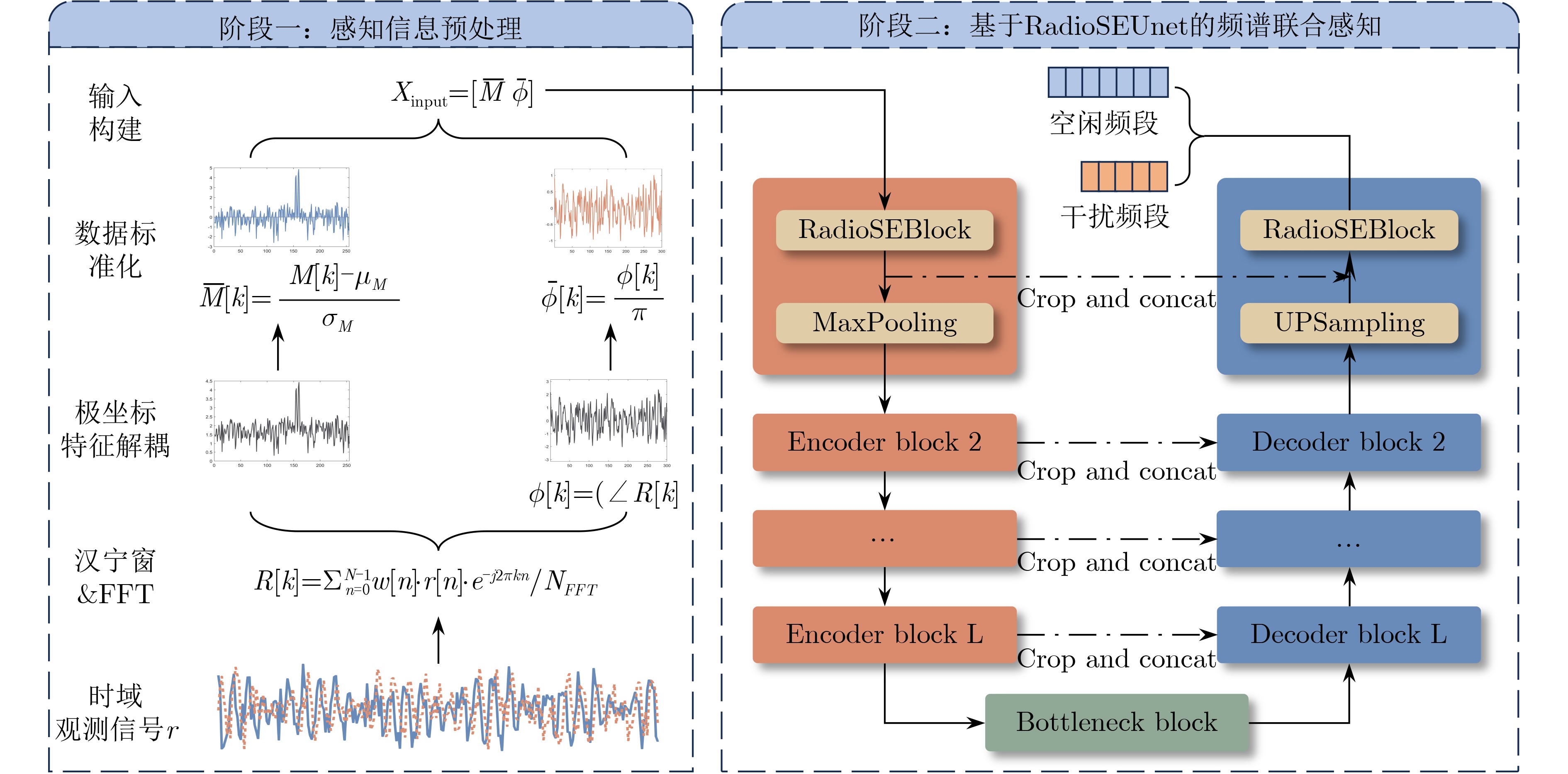
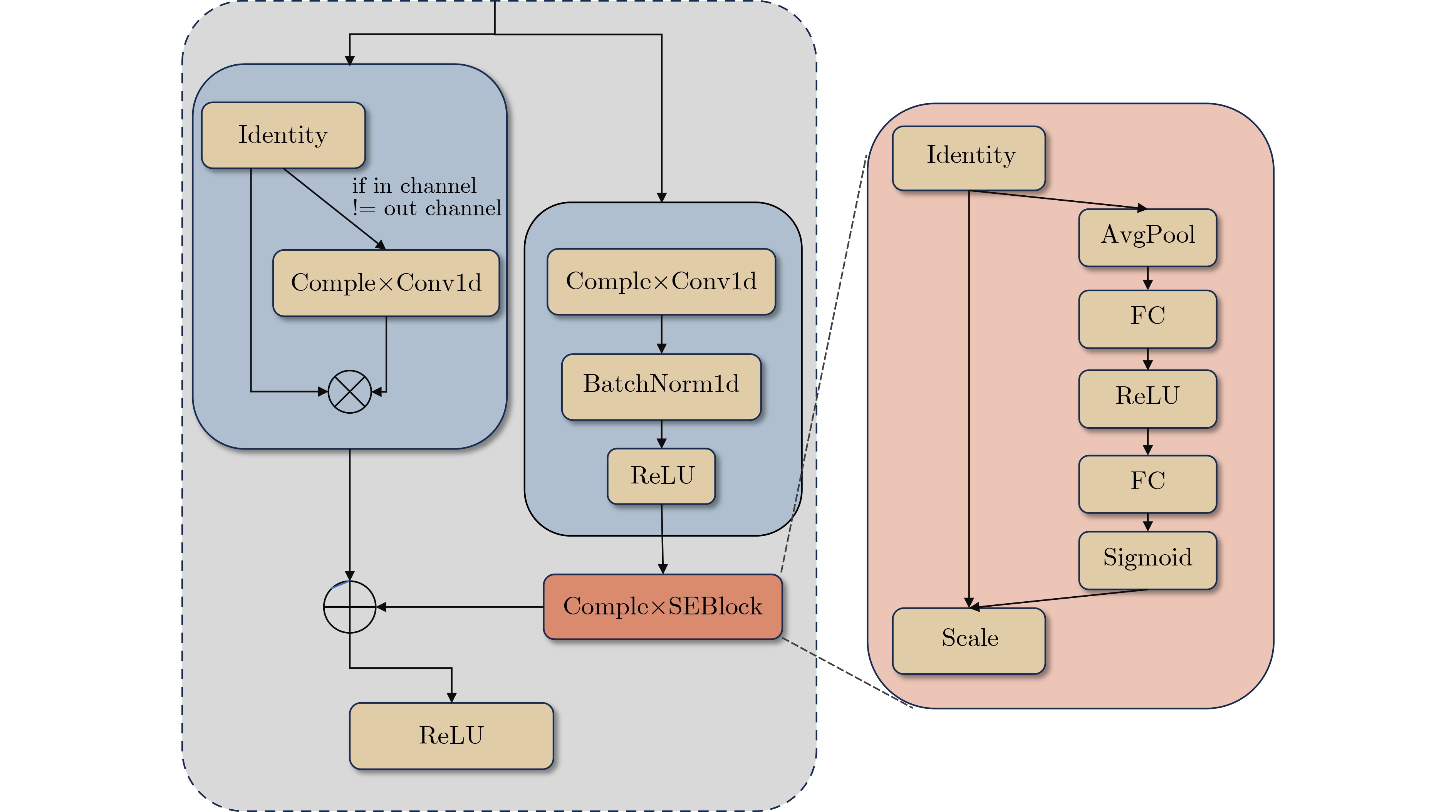
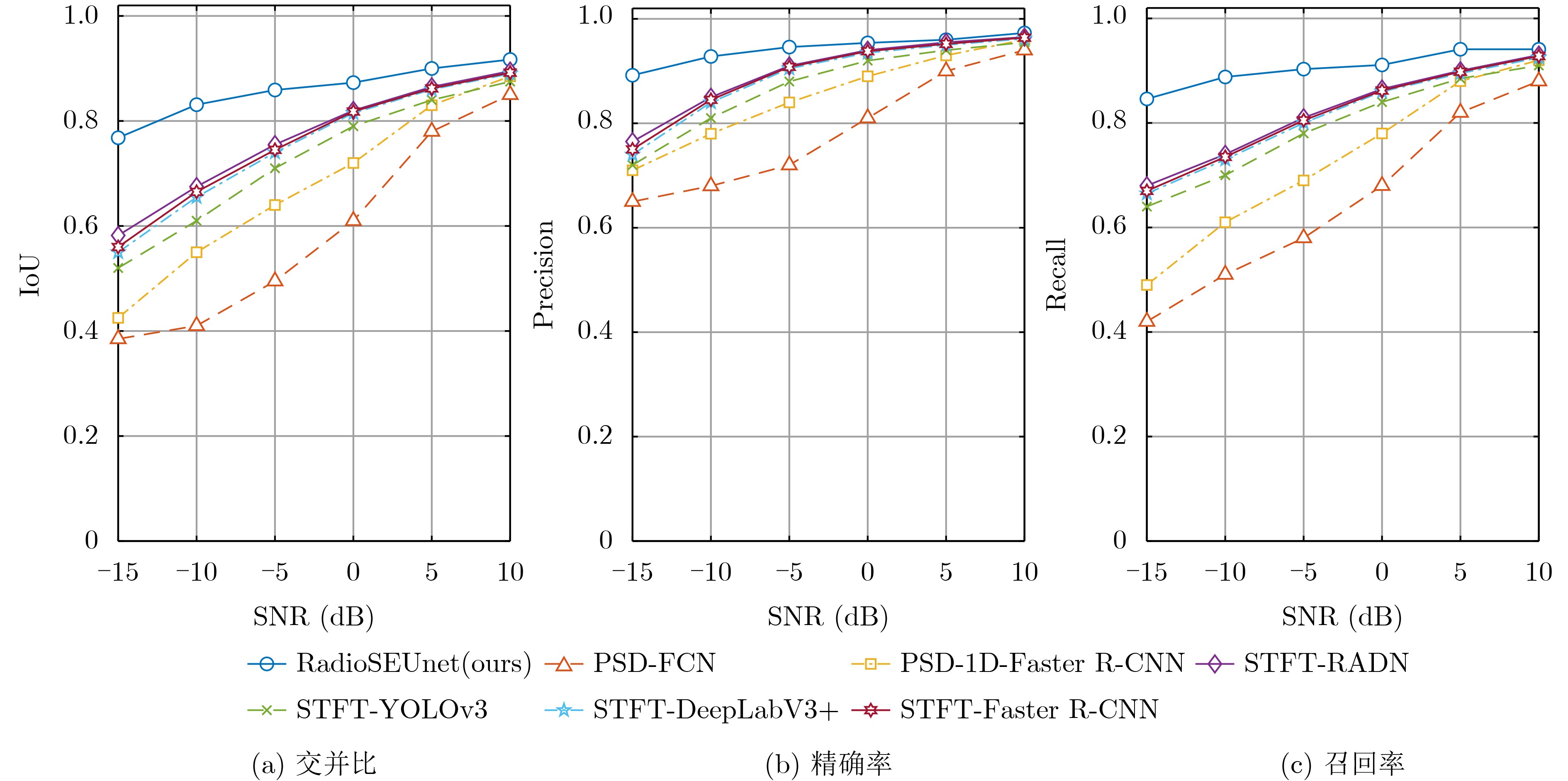
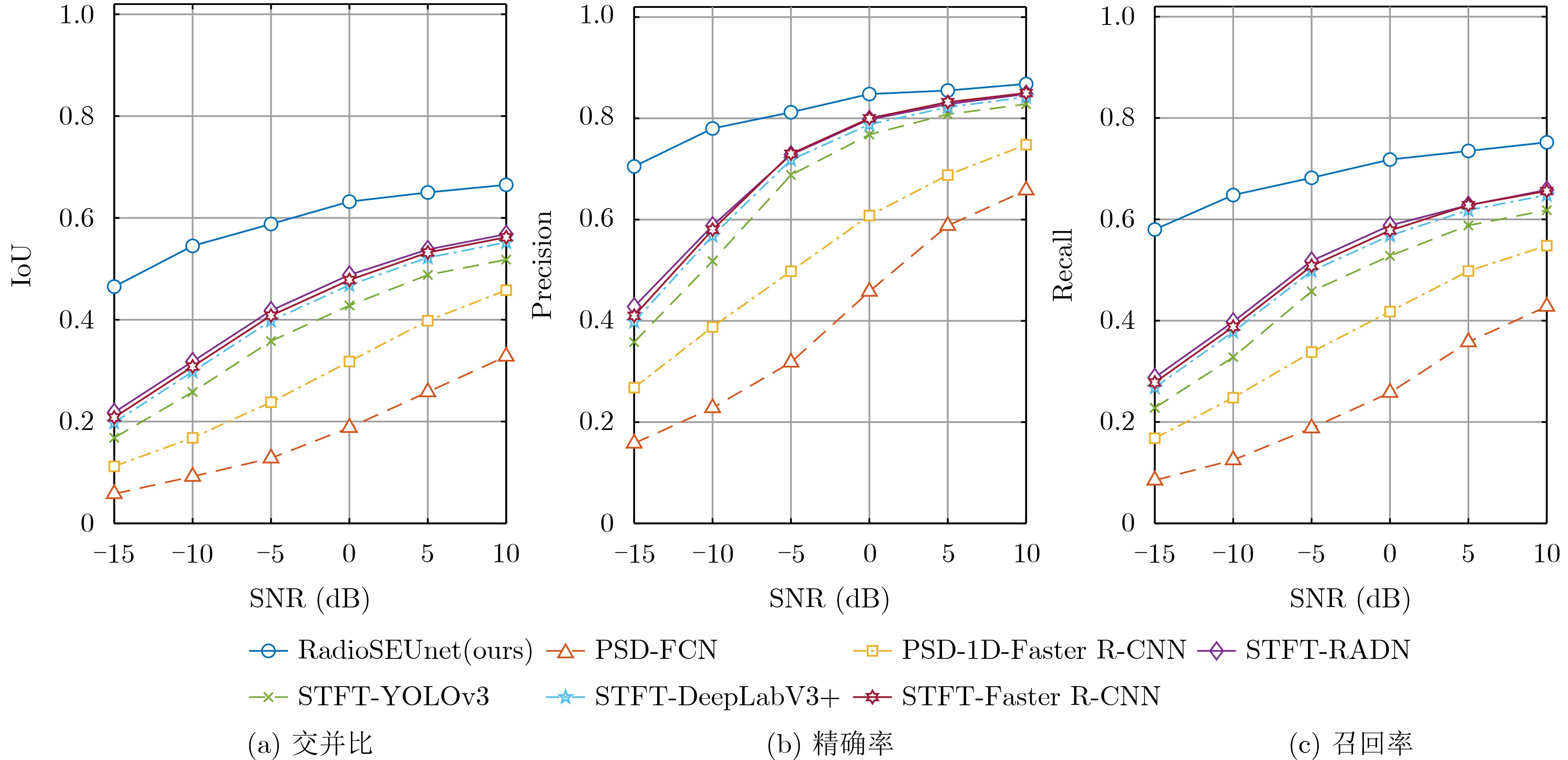
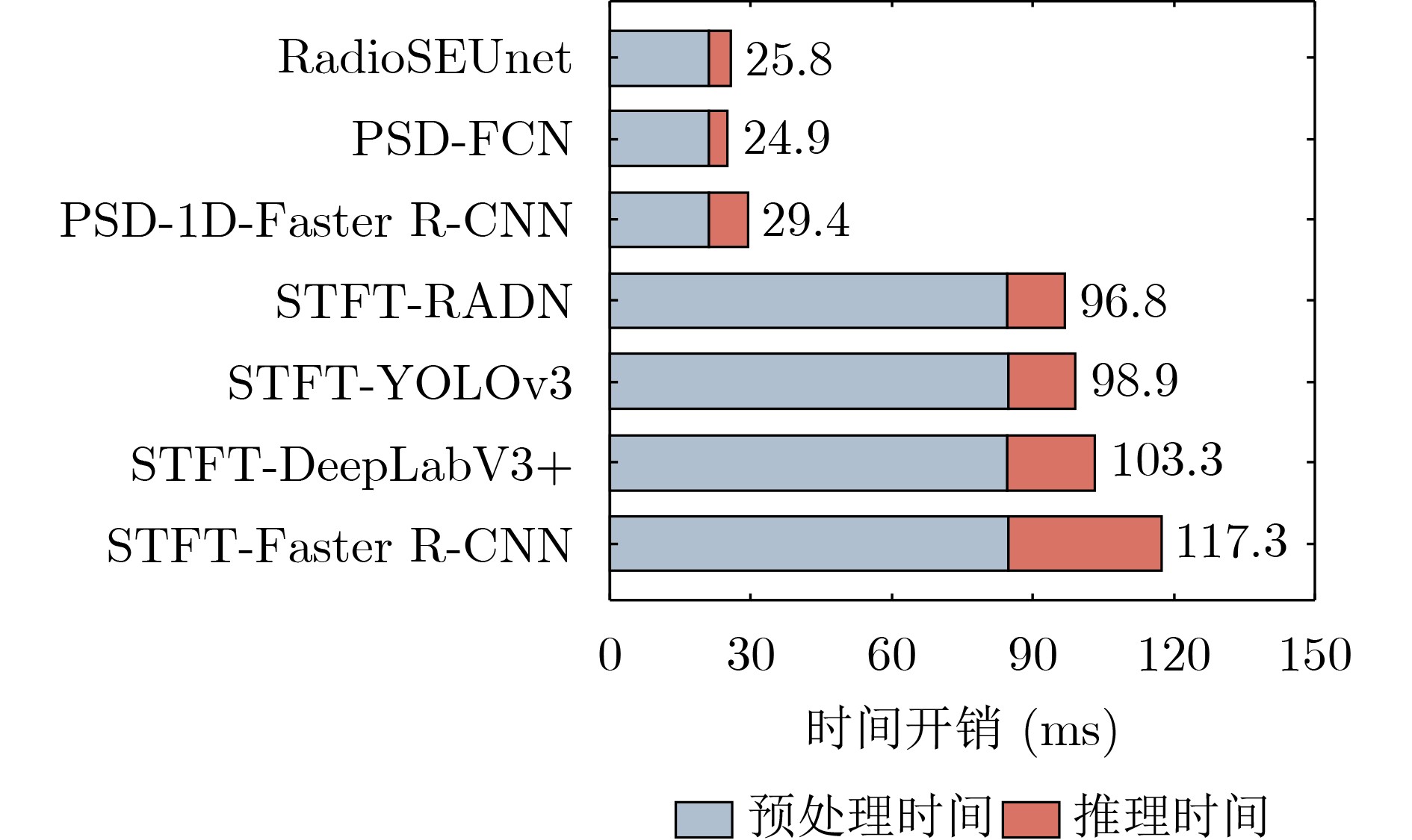
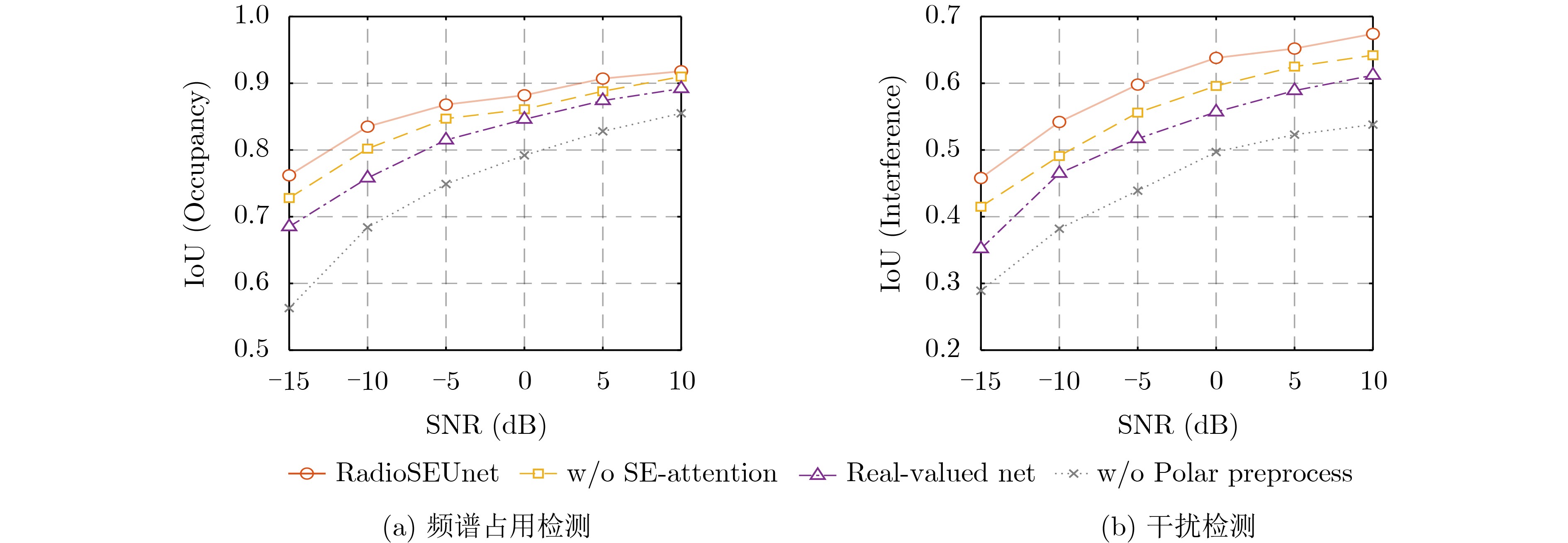
48000 条仿真数据与24000 条实测数据的频谱感知数据集上开展评估。结果表明,在–15 dB低信噪比条件下,所提方法在频谱占用检测任务上取得0.768的交并比和0.846召回率,在干扰重叠识别任务上取得0.456的交并比和0.768的精确率,均优于主流基线方法,同时,得益于高效的端到端处理范式,单次感知总时延仅约26 ms。上述结果表明,所提方法在检测精度、环境鲁棒性与实时处理能力上实现了良好平衡,可为无人机群复杂电磁环境下的动态频谱接入与抗干扰通信提供有效的感知支撑。Abstract:Objective The rapid development of the low-altitude economy is increasing the use of unmanned aerial vehicle (UAV) swarms in emergency communication, urban logistics, reconnaissance, and low-altitude network coverage. These applications require reliable spectrum awareness to support cooperative communication, dynamic spectrum access, and interference avoidance. However, low-altitude electromagnetic environments often contain low-SNR signals, multipath propagation, non-cooperative interference, and multiple coexisting transmissions. Conventional energy, cyclostationary-feature, and matched-filter detectors are sensitive to noise uncertainty, computational cost, or prior waveform knowledge. Learning-based methods can improve robustness, but many rely on power spectral density (PSD) or short-time Fourier transform (STFT) representations. These representations may weaken phase information or require costly two-dimensional time-frequency preprocessing. Existing methods also focus mainly on spectrum occupancy and provide limited information about overlapping transmissions. This study therefore develops a low-latency joint sensing method that preserves magnitude and phase information while estimating spectrum occupancy and interference overlap for each frequency bin. The method is intended for local spectrum sensing at UAV nodes under resource and latency constraints. Methods The proposed RadioSEUnet pipeline contains two stages: magnitude-phase feature construction and joint spectrum-state estimation. First, each complex baseband in-phase/quadrature (I/Q) sequence is multiplied by a Hann window and transformed using a one-dimensional fast Fourier transform (FFT). The resulting complex spectrum is decomposed into logarithmic magnitude and phase components. The two components are normalized separately and stacked as a two-channel feature tensor. Binary labels indicate spectrum occupancy and multi-signal overlap at each frequency bin. RadioSEUnet adopts a U-shaped encoder-bottleneck-decoder architecture with four encoder stages containing 64, 128, 256, and 512 channels. Each RadioSEBlock combines a complex-parameterized convolution, squeeze-and-excitation channel attention, and a residual connection. The convolution couples the magnitude and phase feature streams through constrained cross-channel operations. Two prediction heads convert the shared representation into a spectrum-occupancy probability mask and an interference-overlap probability mask. The model is optimized using an equally weighted sum of two binary cross-entropy losses. Training uses AdamW, cosine-annealing learning-rate scheduling, early stopping, a batch size of 64, and at most 200 epochs. The complete data collection contains 72,000 complex I/Q records, including 48,000 simulated records and 24,000 measured records. The simulated subset covers Wi-Fi, BLE, ZigBee, LoRa, QPSK/16QAM, FM, and AM signals. Signal-to-noise ratios range from –15 dB to 10 dB under additive white Gaussian noise and Rayleigh fading. The measured subset was collected using a USRP N310 in the 2.4–2.5 GHz ISM band at 100 MS/s over a 1 ms observation interval. The controlled quantitative evaluation uses an 8:1:1 split of the simulated subset. A separate simulated-to-measured protocol is defined in the main text to examine cross-domain generalization. RadioSEUnet is compared with six PSD- or STFT-based baselines under matched data splits and hardware conditions. Performance is measured using intersection over union (IoU), precision, recall, preprocessing time, inference time, and total sensing latency. Results and Discussions The SNR-dependent quantitative results reported here are obtained using the controlled simulated-data protocol. At -15 dB, RadioSEUnet achieves an IoU of 0.768 and a recall of 0.846 for spectrum occupancy detection. Compared with the second-best STFT-RADN baseline, these values correspond to absolute improvements of 0.186 and 0.166, respectively. For interference-overlap detection, RadioSEUnet achieves an IoU of 0.456 and a precision of 0.768 at –15 dB. The corresponding improvements over STFT-RADN are 0.246 and 0.275. The lower IoU for interference-overlap detection indicates that weak overlap boundaries remain difficult to separate from strong-signal sidelobes and background noise. The latency evaluation is conducted on the workstation specified in the main text. Magnitude-phase preprocessing requires 21.04 ms, and network inference requires 4.77 ms, producing a total sensing latency of approximately 25.81 ms. STFT-YOLOv3 requires 98.9 ms under the same hardware setting, so the proposed pipeline is approximately 3.8 times faster in this comparison. Ablation experiments show that magnitude-phase preprocessing, complex-parameterized feature coupling, and channel attention each improve low-SNR sensing performance. Removing the magnitude-phase preprocessing produces the largest degradation. These results indicate that preserving complementary magnitude and phase information is useful for weak-signal and interference-overlap detection. They do not, however, establish performance on airborne hardware or across unreported radio environments. Conclusions RadioSEUnet combines a magnitude-phase representation, constrained cross-channel feature coupling, channel attention, multiscale feature fusion, and dual-head prediction. It jointly estimates spectrum occupancy and interference-overlap states while avoiding two-dimensional STFT preprocessing. Under the controlled simulated-data protocol, the method provides higher point estimates than the six evaluated baselines at low SNR and reduces total sensing latency on the evaluated workstation. The present evidence is limited to the reported signal types, channel models, hardware configuration, and the 2.4–2.5 GHz measurement band. Quantitative simulated-to-measured results, tests on wider bands, additional interference types, repeated trials, and deployment on airborne edge hardware are still required. Future work will therefore focus on cross-domain validation, lightweight deployment, boundary-aware interference modeling, and integration with spectrum resource management for UAV networks. -
表 1 数据集参数设置
参数类型 项目 参数值/描述 仿真信号参数 信号调制类型 Wi-Fi, BLE, ZigBee, LoRa, QPSK/16QAM, FM, AM 信噪比范围 –15 dB~10 dB 信道环境 AWGN + Rayleigh Fading 真实信号参数 采集设备 USRP N310 采样率 100 MS/s 采样时间 1 ms 频率范围 2.4 GHz~2.5 GHz 样本信号共存数量 2~6个  下载: 导出CSV
-
[1] 朱政宇, 温鑫平, 李兴旺, 等. 面向低空经济的通感一体化关键技术[J]. 电子与信息学报, 2026, 48(2): 471–486. doi: 10.11999/JEIT250747.ZHU Zhengyu, WEN Xinping, LI Xingwang, et al. An overview on integrated sensing and communication for low altitude economy[J]. Journal of Electronics & Information Technology, 2026, 48(2): 471–486. doi: 10.11999/JEIT250747. [2] ALQUDSI Y and MAKARACI M. UAV swarms: Research, challenges, and future directions[J]. Journal of Engineering and Applied Science, 2025, 72(1): 12. doi: 10.1186/s44147-025-00582-3. [3] 胡杨林, 张天魁, 李博, 等. 无人机使能的通信感知一体化组网与技术研究综述[J]. 电子与信息学报, 2025, 47(4): 859–875. doi: 10.11999/JEIT241116.HU Yanglin, ZHANG Tiankui, LI Bo, et al. A survey on UAV-enabled integrated sensing and communication networking and technologies[J]. Journal of Electronics & Information Technology, 2025, 47(4): 859–875. doi: 10.11999/JEIT241116. [4] SOBRON I, DINIZ P S R, MARTINS W A, et al. Energy detection technique for adaptive spectrum sensing[J]. IEEE Transactions on Communications, 2015, 63(3): 617–627. doi: 10.1109/TCOMM.2015.2394436. [5] WILFRED A and O. R. O. A review of cyclostationary feature detection based spectrum sensing technique in cognitive radio networks[J]. E3 Journal of Scientific Research, 2016, 4(3): 41–47. doi: 10.18685/EJSR(4)3_EJSR-16-010. [6] ZHANG Xinzhi, CHAI Rong, and GAO Feifei. Matched filter based spectrum sensing and power level detection for cognitive radio network[C]. Proceedings of the 2014 IEEE Global Conference on Signal and Information Processing (GlobalSIP), Atlanta, USA, 2014: 1267–1270. doi: 10.1109/GlobalSIP.2014.7032326. [7] ZENG Yonghong, LIANG Yingchang, HOANG A T, et al. A review on spectrum sensing for cognitive radio: Challenges and solutions[J]. EURASIP Journal on Advances in Signal Processing, 2010, 2010(1): 381465. doi: 10.1155/2010/381465. [8] MA Jun, LI G Y, and JUANG B H. Signal processing in cognitive radio[J]. Proceedings of the IEEE, 2009, 97(5): 805–823. doi: 10.1109/JPROC.2009.2015707. [9] O'SHEA T J, ROY T, and CLANCY T C. Over-the-air deep learning based radio signal classification[J]. IEEE Journal of Selected Topics in Signal Processing, 2018, 12(1): 168–179. doi: 10.1109/JSTSP.2018.2797022. [10] LEES W M, WUNDERLICH A, JEAVONS P J, et al. Deep learning classification of 3.5-GHz band spectrograms with applications to spectrum sensing[J]. IEEE Transactions on Cognitive Communications and Networking, 2019, 5(2): 224–236. doi: 10.1109/TCCN.2019.2899871. [11] ZHANG Wenhan, FENG Mingjie, KRUNZ M, et al. Signal detection and classification in shared spectrum: A deep learning approach[C]. IEEE INFOCOM 2021 - IEEE Conference on Computer Communications, Vancouver, Canada, 2021: 1–10. doi: 10.1109/INFOCOM42981.2021.9488834. [12] HUANG Hao, LI Jianqing, WANG Jiao, et al. FCN-based carrier signal detection in broadband power spectrum[J]. IEEE Access, 2020, 8: 113042–113051. doi: 10.1109/ACCESS.2020.3003683. [13] NGUYEN G V, VAN PHAN C, and HUYNH-THE T. Accurate spectrum sensing with improved deepLabV3+ for 5G-LTE signals identification[C]. Proceedings of the 12th International Symposium on Information and Communication Technology, Ho Chi Minh, Vietnam, 2023: 221–227. doi: 10.1145/3628797.3628798. [14] MOREHOUSE T, MONTES C, and ZHOU Ruolin. An optimized faster region-based CNN for 1D spectrum sensing and signal identification in cluttered RF environments[C]. Proceedings of the 2023 IEEE Future Networks World Forum (FNWF), Baltimore, USA, 2023: 1–6. doi: 10.1109/FNWF58287.2023.10520407. [15] WANG Anyi, ZHU Tao, and MENG Qifeng. Spectrum sensing method based on STFT-RADN in cognitive radio networks[J]. Sensors, 2024, 24(17): 5792. doi: 10.3390/s24175792. [16] ABDELBASET S E, KASEM H M, KHALAF A A, et al. Deep learning-based spectrum sensing for cognitive radio applications[J]. Sensors, 2024, 24(24): 7907. doi: 10.3390/s24247907. [17] TRABELSI C, BILANIUK O, ZHANG Ying, et al. Deep complex networks[C]. Proceedings of the 6th International Conference on Learning Representations (ICLR), Vancouver, Canada, 2018. [18] ZHAO Zhongyuan, VURAN M C, GUO Fujuan, et al. Deep-waveform: A learned OFDM receiver based on deep complex-valued convolutional networks[J]. IEEE Journal on Selected Areas in Communications, 2021, 39(8): 2407–2420. doi: 10.1109/JSAC.2021.3087241. [19] SHIN S and VURAN M C. I can’t believe it’s not real: CV-MuSeNet: Complex-valued multi-signal segmentation[C]. Proceedings of the 2025 IEEE International Symposium on Dynamic Spectrum Access Networks (DySPAN), London, UK, 2025: 1–10. doi: 10.1109/DySPAN64764.2025.11115896. [20] 董培浩, 贾继斌, 周福辉, 等. 基于差分隐私联邦学习的低空无人机群宽带频谱感知[J]. 电子与信息学报, 2025, 47(5): 1345–1355. doi: 10.11999/JEIT241042.DONG Peihao, JIA Jibin, ZHOU Fuhui, et al. Differentially private federated learning based wideband spectrum sensing for the low-altitude unmanned aerial vehicle swarm[J]. Journal of Electronics & Information Technology, 2025, 47(5): 1345–1355. doi: 10.11999/JEIT241042. [21] 申滨, 李月, 王欣, 等. 小样本学习驱动的无线频谱状态感知[J]. 电子与信息学报, 2024, 46(4): 1231–1239. doi: 10.11999/JEIT230377.SHEN Bin, LI Yue, WANG Xin, et al. Wireless spectrum status sensing driven by few-shot learning[J]. Journal of Electronics & Information Technology, 2024, 46(4): 1231–1239. doi: 10.11999/JEIT230377. -

 下载:
下载:

图(7) / 表(1)
计量
- 文章访问数: 404
- HTML全文浏览量: 133
- PDF下载量: 4
- 被引次数: 0
