




Semantic-Driven Adaptive Joint Source-Channel Coding for UAV Disaster Image Transmission
-
摘要: 针对复杂无线信道下无人机灾害图像传输中存在的结构信息易损、弱细节退化以及保真度与感知质量难以兼顾等问题,提出一种语义驱动自适应联合信源信道编码方法(Semantic-Driven Adaptive Joint Source-Channel Coding, SDAJSCC)。该方法在编码端,构建多尺度语义与结构特征协同提取机制,增强灾害图像关键目标与弱结构细节的表征能力;在传输链路中,引入层级式信道—语义自适应调制与潜表示校正策略,提升时变衰落及非理想信道状态信息条件下的传输鲁棒性;在解码端,设计感知增强的保真—感知双分支重建架构,进一步提升复杂背景下主体结构与局部纹理的重建质量。实验结果表明,SDAJSCC在加性高斯白噪声、瑞利衰落及非理想信道状态信息条件下均获得稳定的综合性能增益;相较现有代表性联合信源信道编码方法,其峰值信噪比最高提高4.86 dB,并进一步提升了灾害关键区域重建质量、边缘连续性和高层内容一致性,推理速度达到34.5 帧/s。所提方法能够有效提升灾害关键结构保持能力与复杂信道鲁棒性,同时兼顾实时传输需求。Abstract:
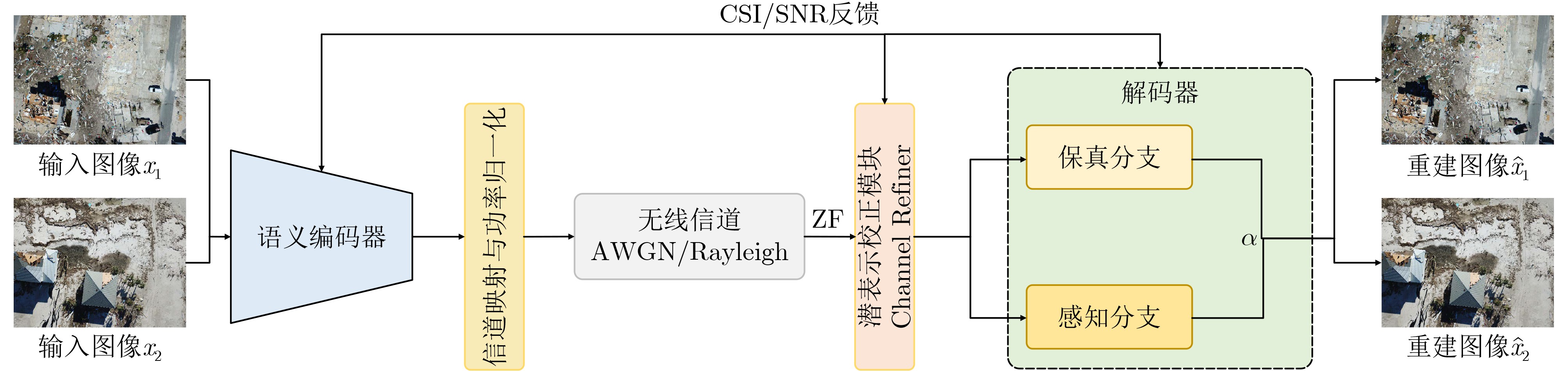
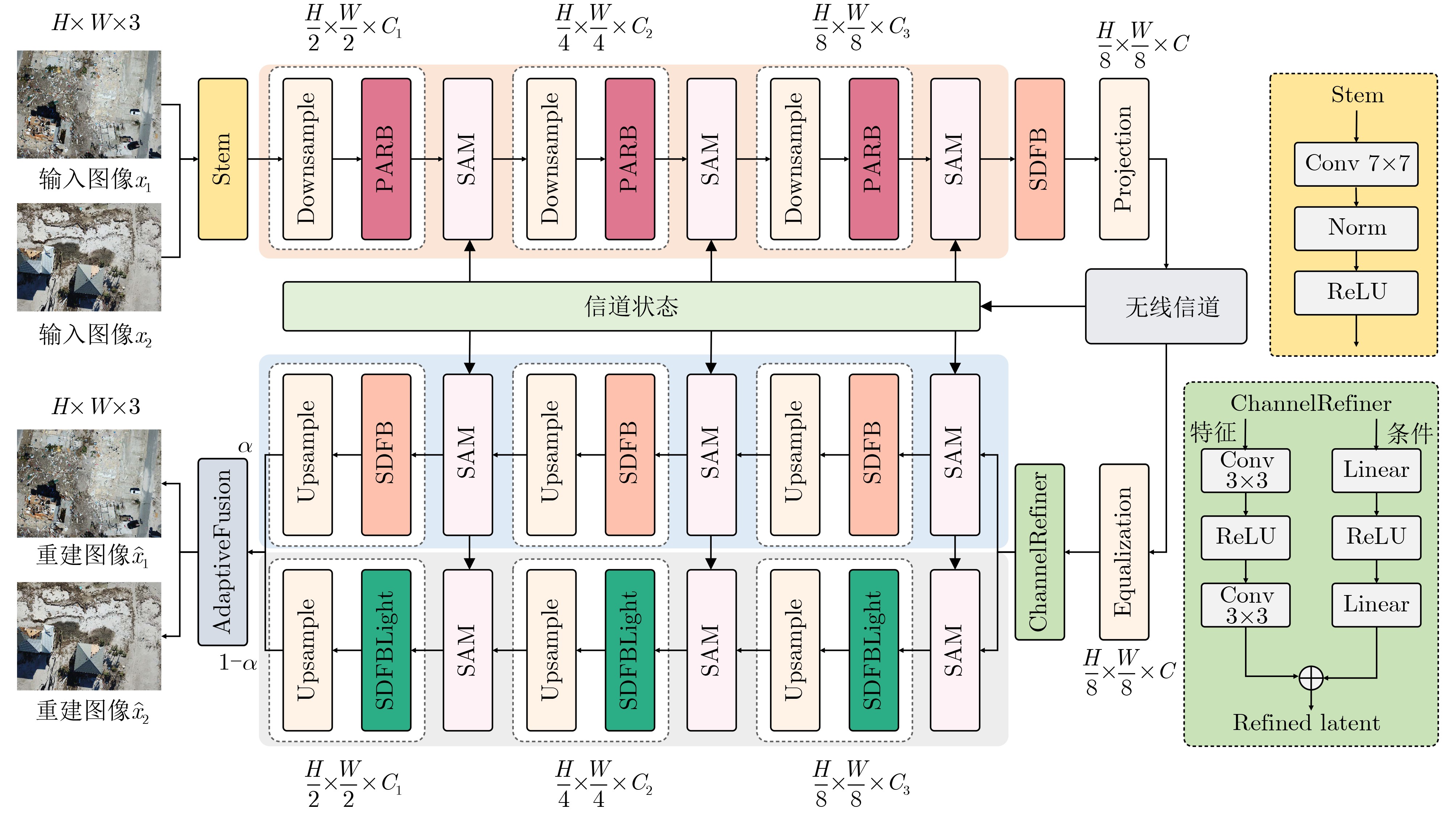
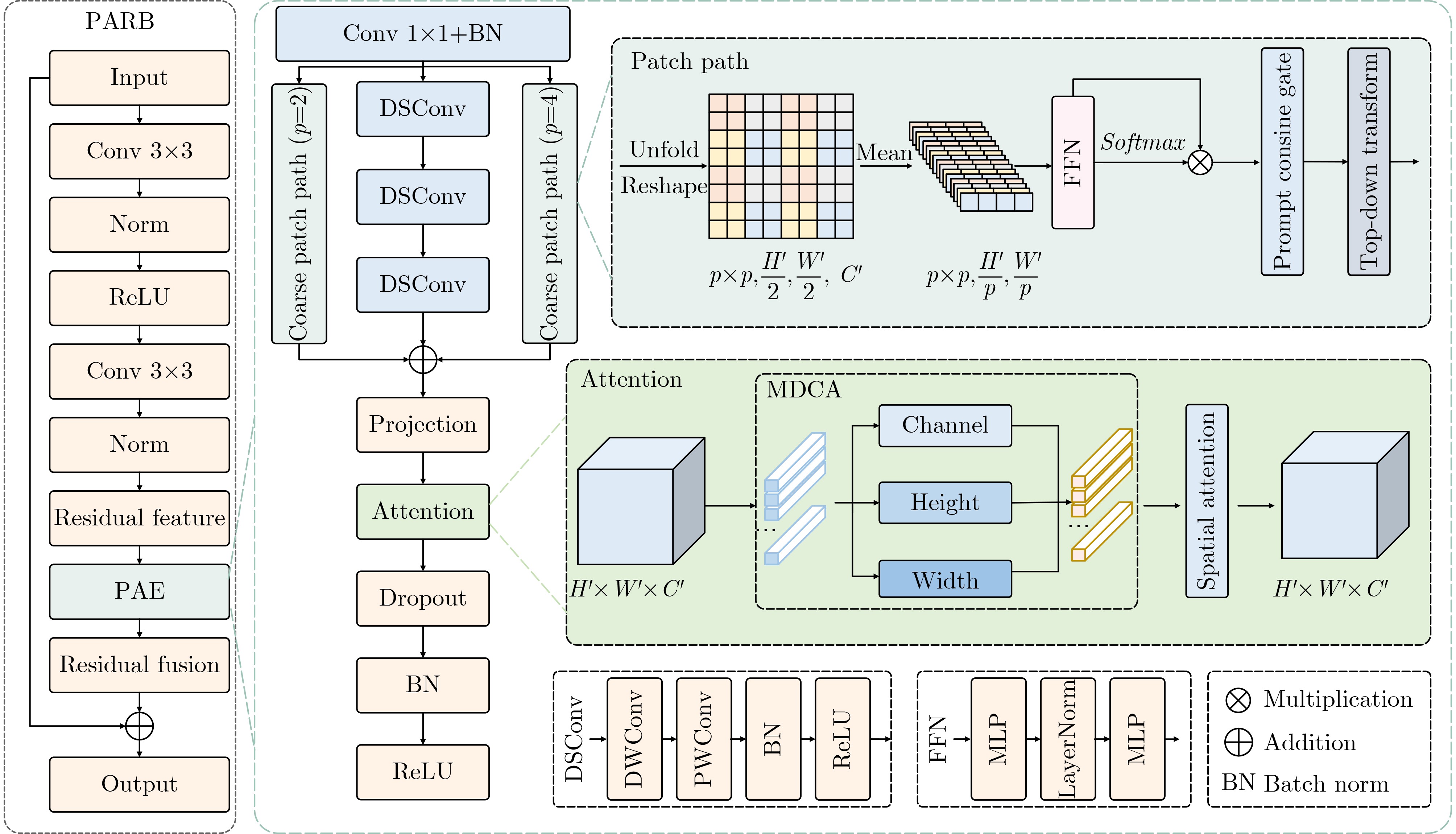
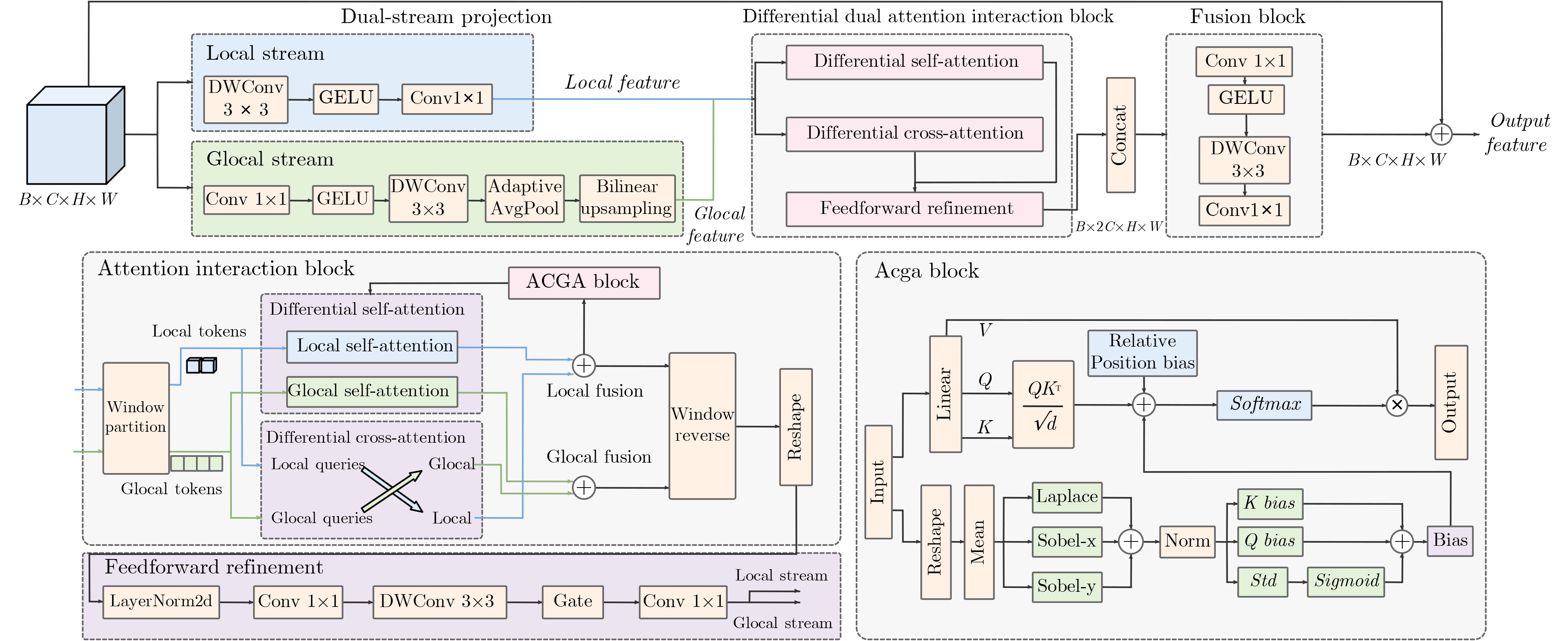
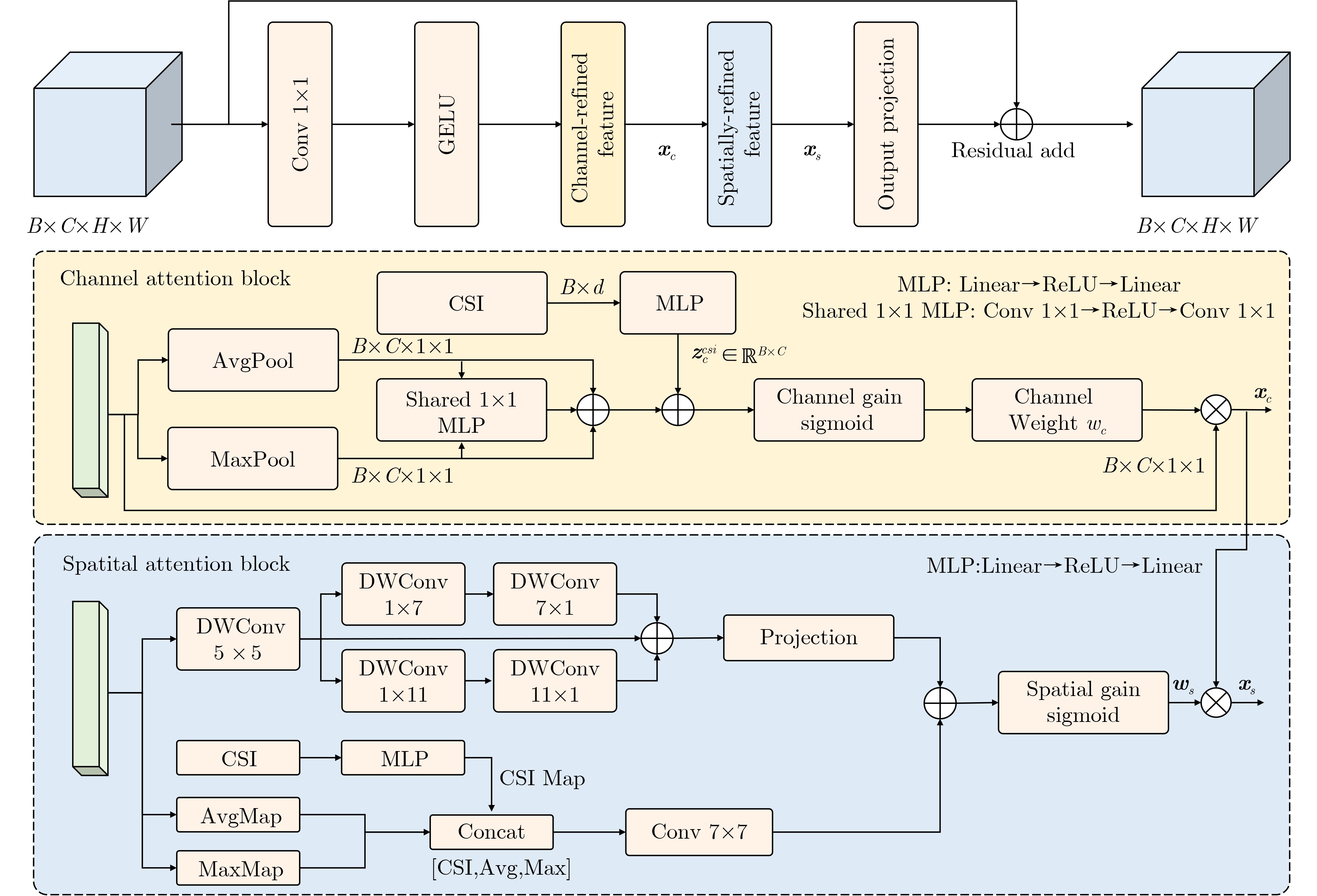
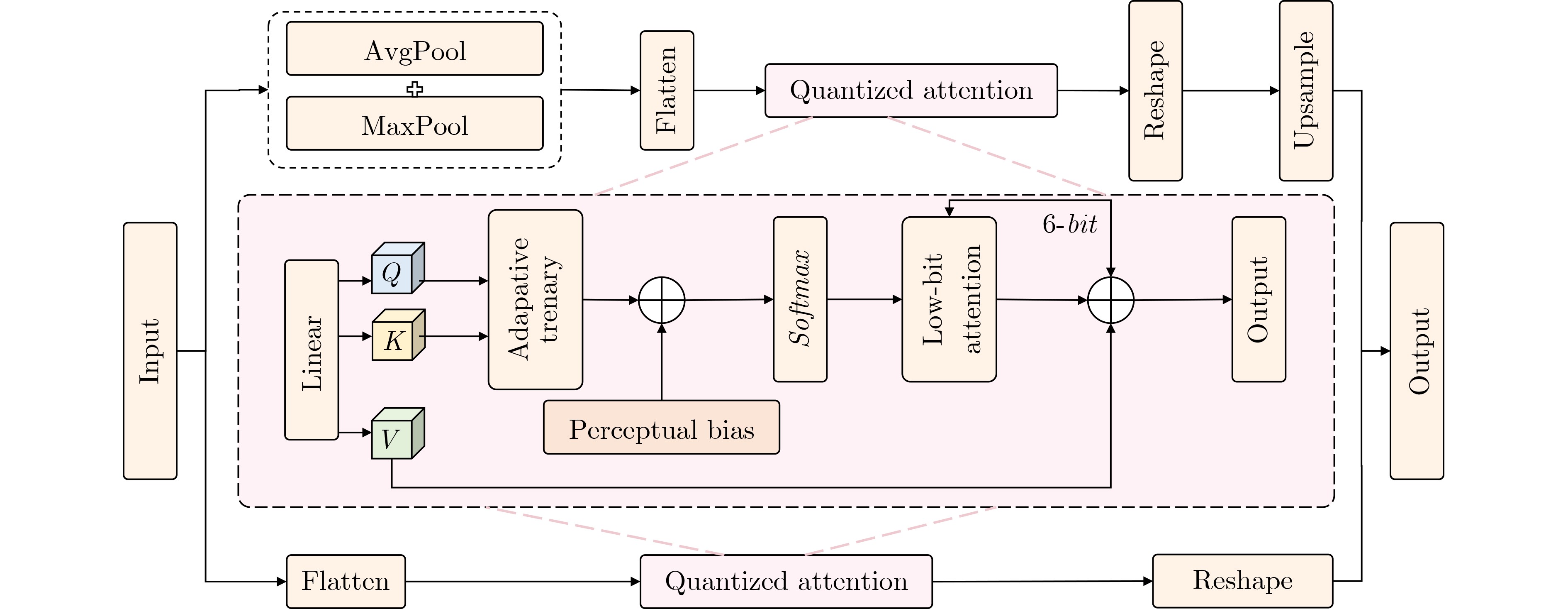
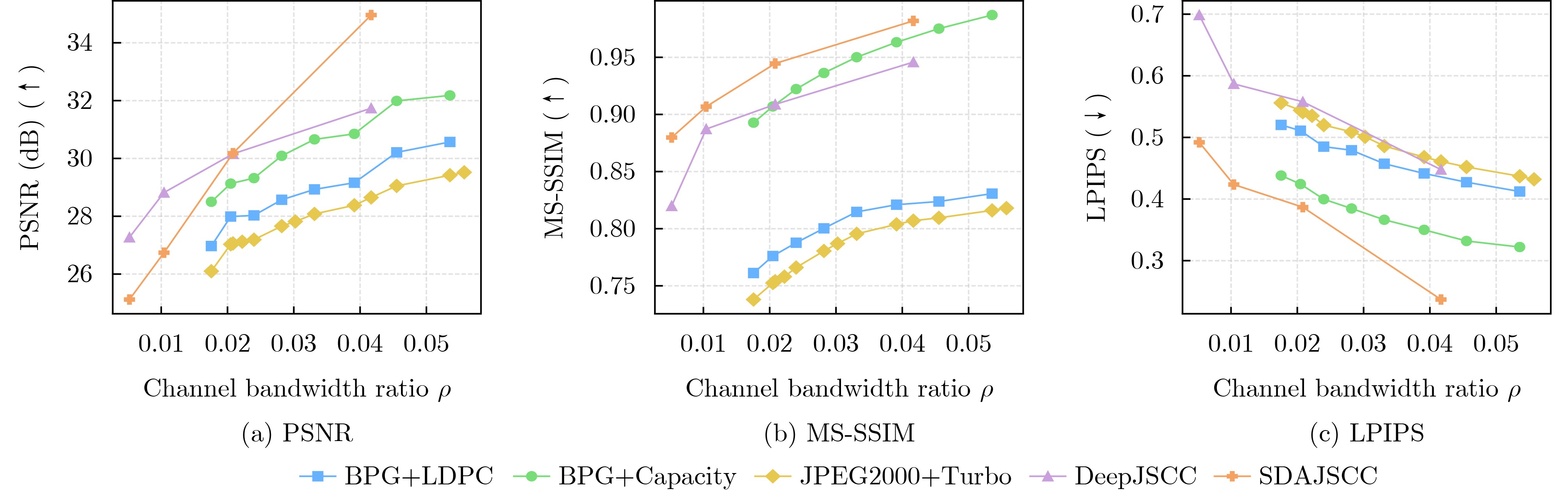
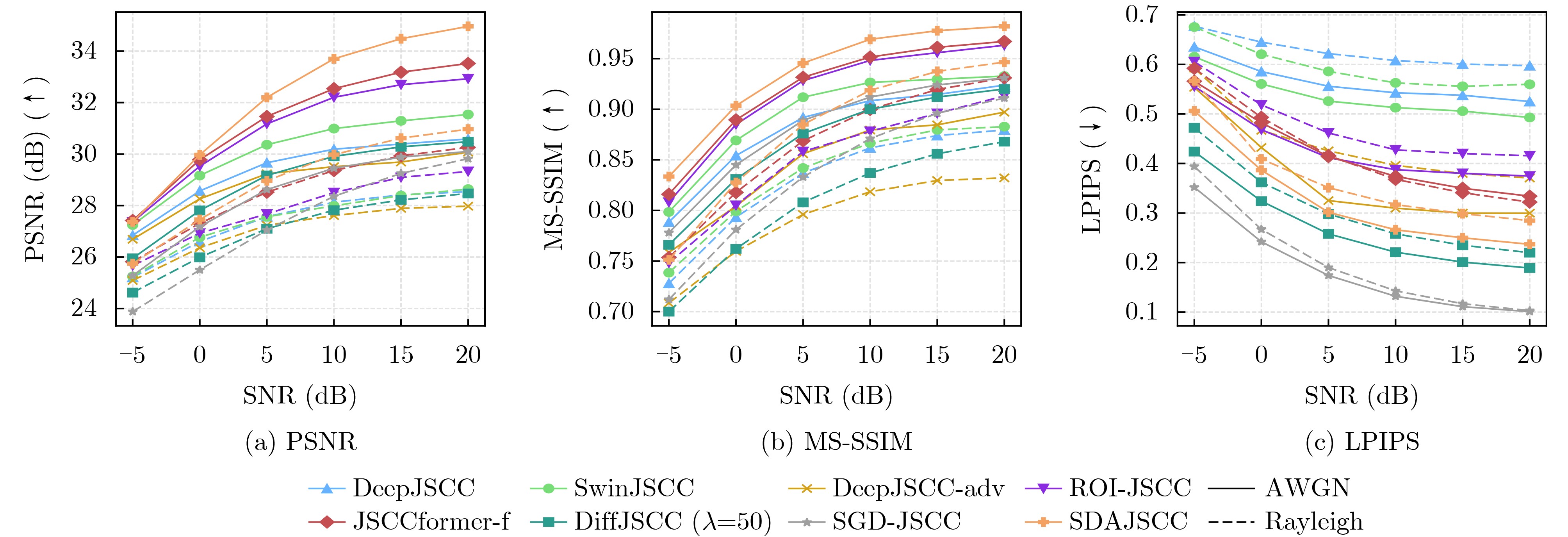
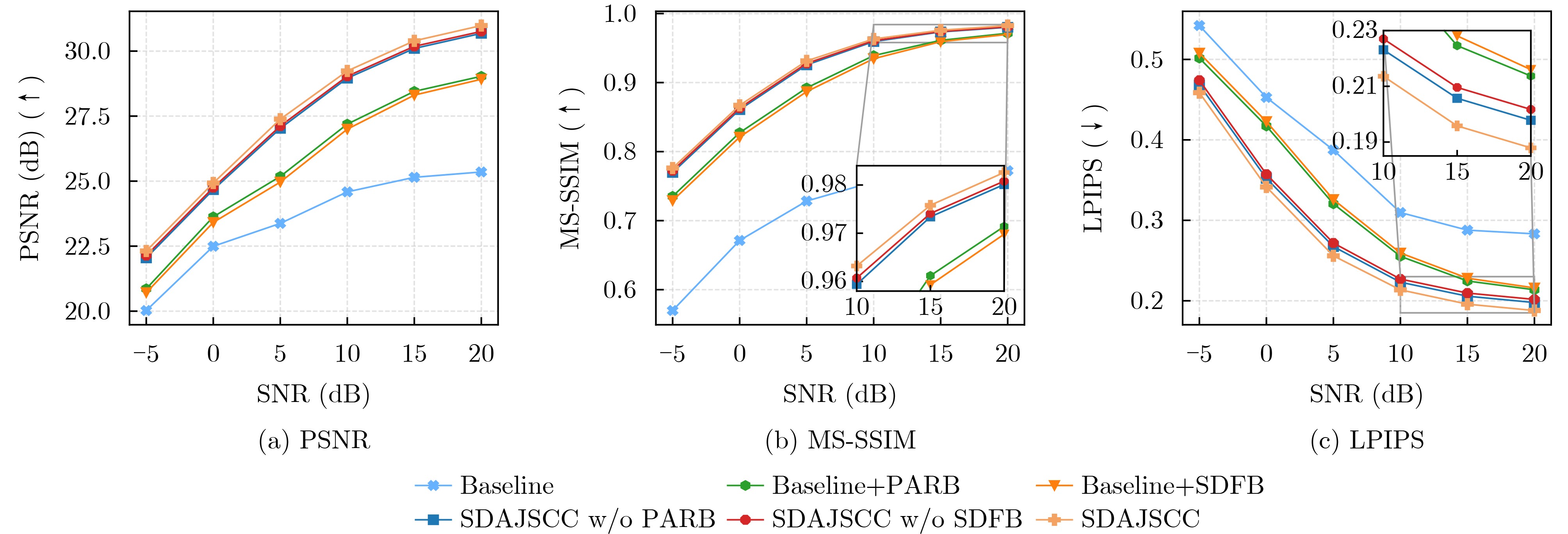
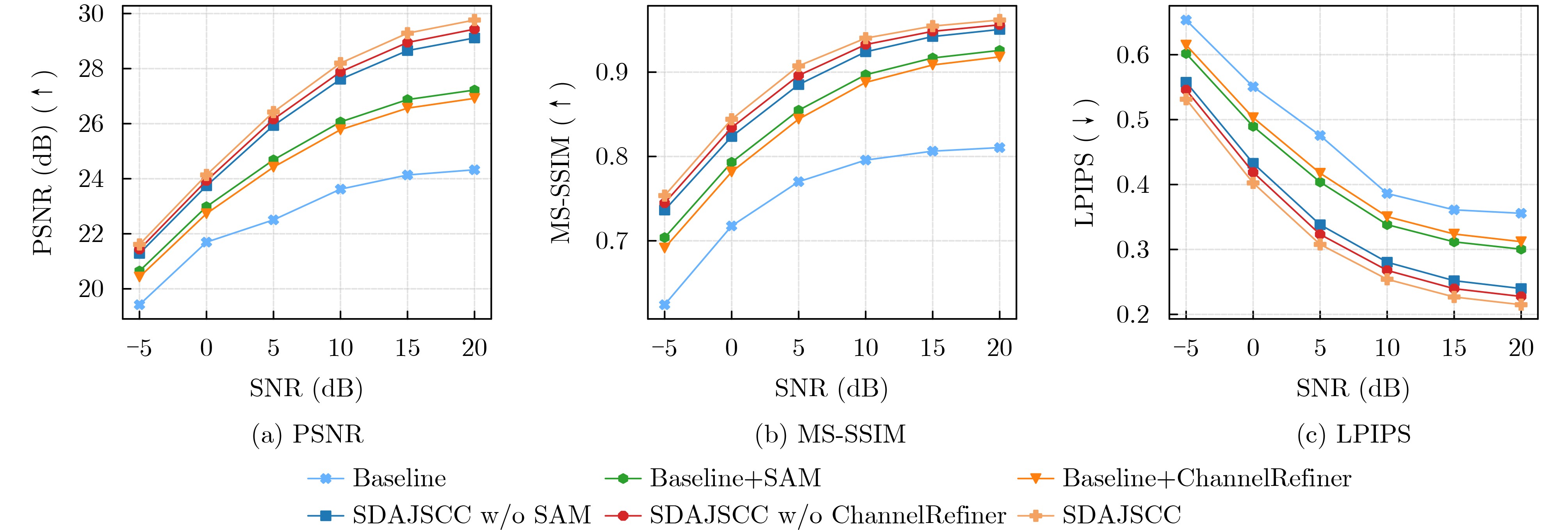
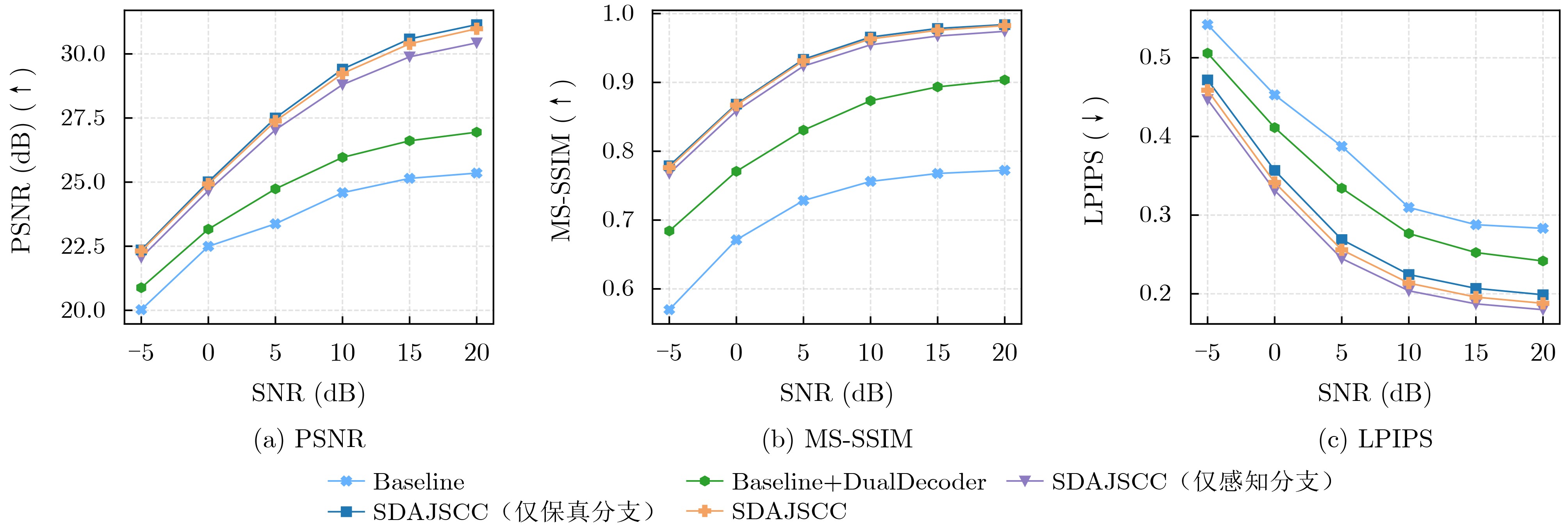
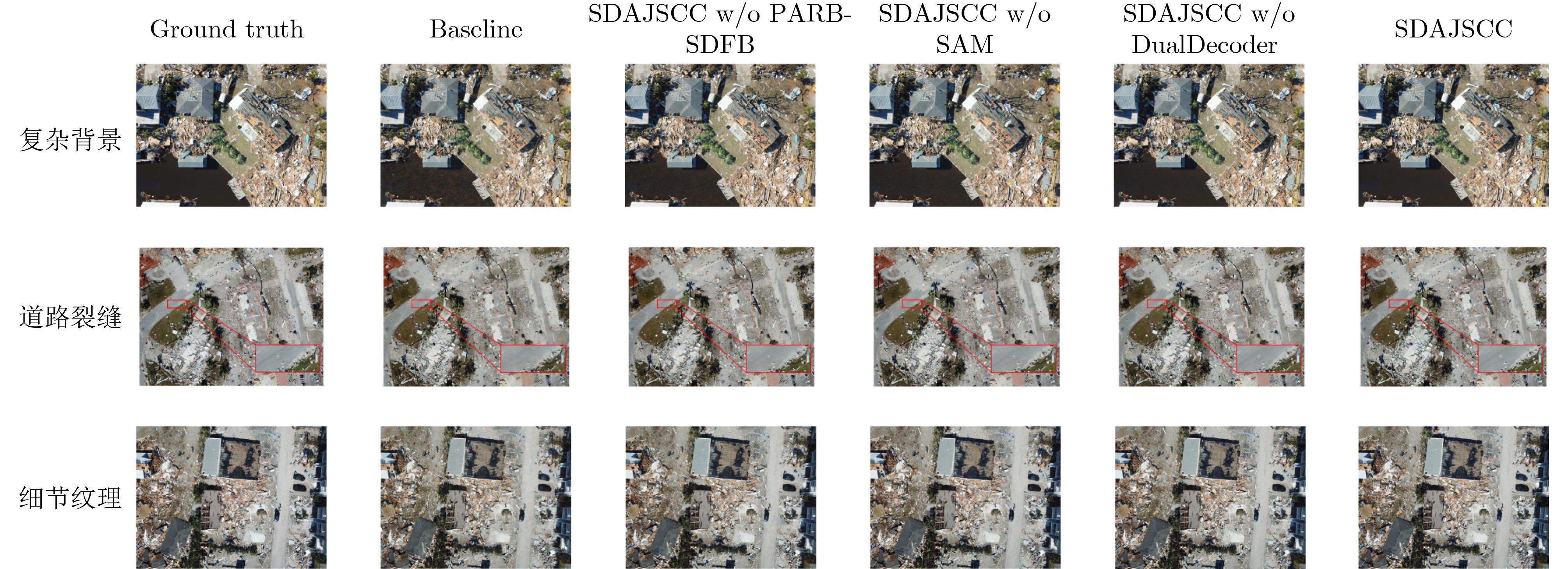
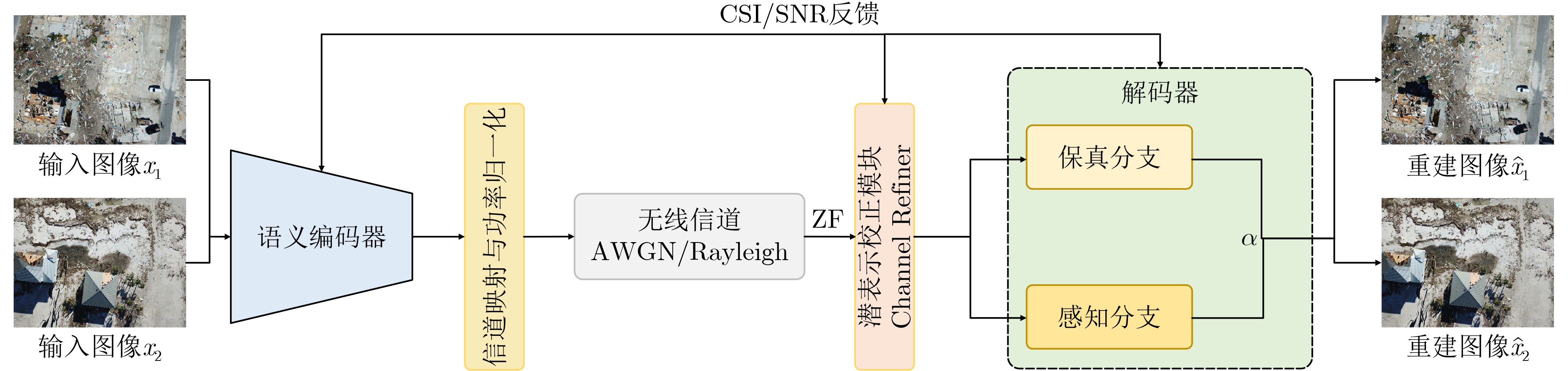
Objective Unmanned Aerial Vehicles (UAVs) provide flexible and rapid image acquisition for disaster assessment and emergency response. Reliable transmission of the acquired images is essential for interpreting damaged buildings, blocked roads, and other critical scene elements. However, disaster-area communication links are often constrained by limited bandwidth, noise, time-varying fading, and imperfect Channel State Information (CSI). Low-contrast boundaries, narrow cracks, and scattered damaged regions are particularly vulnerable to feature compression and channel distortion. Deep Joint Source-Channel Coding (DeepJSCC) enables image compression and transmission to be jointly optimized, but several limitations remain for disaster imagery. Global pixelwise objectives can assign insufficient importance to sparse weak structures, while feature downsampling can attenuate information that later channel adaptation cannot recover. Channel adaptation also needs to account for both channel conditions and the relative importance of image content. Furthermore, reconstruction must balance pixel fidelity, structural consistency, perceptual quality, and computational cost. This study therefore aims to develop a unified transmission framework that strengthens weak-structure representation, coordinates semantic features with channel conditions, and supports efficient reconstruction of UAV disaster images. Methods A Semantic-Driven Adaptive Joint Source-Channel Coding method, termed SDAJSCC, is proposed. Semantic importance is modeled implicitly in the feature domain through multiscale responses, curvature saliency, and channel-spatial attention. The encoder combines a Patch-Aware Residual Block (PARB) with a Semantic Differential Fusion Block (SDFB). PARB aggregates local and regional information at multiple patch scales, while SDFB combines local-global feature interaction with Adaptive Curvature-Guided Attention (ACGA). Curvature information supplements content similarity and relative positional information to strengthen responses to boundaries and structural discontinuities. A Semantic Adaptive Modulation (SAM) module is introduced at multiple encoding stages and at the final latent projection. Channel-dependent affine transformations and channel-spatial attention adjust feature responses using CSI and the Signal-to-Noise Ratio (SNR). This modulation operates before power normalization, allowing the relative responses of latent features to be adjusted while maintaining the average transmit-power constraint. The real-valued latent representation is mapped to complex channel symbols for transmission. At the receiver, regularized zero-forcing equalization limits noise amplification associated with small estimated channel gains. The remaining distortion is analyzed as a combination of signal-dependent mismatch and transformed noise. A ChannelRefiner then combines the equalized latent representation with channel information to predict a gated residual correction and a feature bias. The corrected features are reconstructed by two independently parameterized decoder branches. The fidelity branch emphasizes global structure and pixel consistency, whereas the perceptual branch incorporates a Perceptual Texture Transform Adaptation (PTTA) module. PTTA applies ternary quantization to query and key representations and 6-bit quantization to the value representation, together with a local texture bias. An AdaptiveFusion module predicts the relative contributions of the two reconstructions from their aggregated features and the channel state. All components are jointly trained using a primary reconstruction loss, auxiliary pixelwise supervision for both branches, and a Learned Perceptual Image Patch Similarity (LPIPS) loss. Experiments use xView2 and RescueNet image crops of 256 × 256 pixels. Training covers Additive White Gaussian Noise (AWGN) and Rayleigh fading channels, with SNR uniformly sampled from -5 to 20 dB. AdamW optimization and cosine learning-rate decay are used for 100,000 iterations with a batch size of 16. Evaluation includes Peak Signal-to-Noise Ratio (PSNR), Multi-Scale Structural Similarity (MS-SSIM), LPIPS, critical-region quality, edge preservation, feature similarity, and inference efficiency. Results and Discussions The bandwidth comparison on xView2 under AWGN at 20 dB shows improved structural and perceptual preservation under severe compression. At channel bandwidth ratios of 1/192 and 1/96, SDAJSCC has PSNR values 2.15 and 2.08 dB below DeepJSCC, respectively, but increases MS-SSIM by 0.0599 and0.0196 and reduces LPIPS by 29.6% and 27.8%. At a bandwidth ratio of 1/24, it improves PSNR by 6.31 dB and MS-SSIM by0.1749 over JPEG2000+Turbo, with a 48.6% reduction in LPIPS. These results indicate a trade-off between pixel fidelity and structural-perceptual preservation at very low bandwidth, followed by gains across all three metrics as bandwidth increases (Fig. 7 ). At a fixed bandwidth ratio of 1/24 and an SNR of 20 dB, SDAJSCC improves PSNR and MS-SSIM over JSCCFormer-f by 1.44 dB and0.0149 under AWGN, with a 29.1% reduction in LPIPS. Under Rayleigh fading, the corresponding improvements are 0.708 dB,0.0156 , and an 11.6% reduction in LPIPS. Diffusion-based methods obtain lower LPIPS in some cases, but exhibit lower PSNR and MS-SSIM, demonstrating the need to assess fidelity and perceptual quality together (Fig. 8 ). Ablation experiments on RescueNet at a bandwidth ratio of 1/24 support the complementary roles of the proposed components. Under AWGN at 20 dB, removing PARB reduces PSNR by 0.300 dB, while removing SDFB increases LPIPS by0.0138 , indicating their respective contributions to reconstruction fidelity and perceptual preservation (Fig. 9 ). Under Rayleigh fading at 20 dB, removing SAM or ChannelRefiner reduces PSNR by 0.652 or 0.332 dB, respectively, supporting the combination of transmitter-side adaptation and receiver-side correction (Fig. 10 ). Under AWGN at 20 dB, the complete dual-branch decoder reduces LPIPS by 5.5% relative to the fidelity-only branch, with a PSNR decrease of 0.161 dB, demonstrating an effective fidelity-perception compromise (Fig. 11 ). For imperfect CSI, the forward-link SNR is fixed at 10 dB under Rayleigh fading, and the CSI estimation SNR is varied independently. At a CSI estimation SNR of 0 dB, SDAJSCC achieves a PSNR of 24.34 dB, an MS-SSIM of 0.817, and an LPIPS of 0.357. Relative to the baseline, PSNR increases by 3.62 dB and LPIPS decreases by 28.2%. Across the tested CSI estimation conditions, ChannelRefiner provides PSNR gains of 0.52-0.57 dB within the complete framework (Table 2 ). Critical-region evaluation on RescueNet under Rayleigh fading at 10 dB and a bandwidth ratio of 1/24 uses damaged-building and blocked-road annotations to define the evaluation regions. Compared with the Region-of-Interest-Guided method (ROI-JSCC), SDAJSCC improves critical-region PSNR by 0.73 dB and reduces critical-region LPIPS by 14.3%, while increasing edge F1 and high-level feature cosine similarity by 0.035 and 0.032, respectively (Table 3 ). Qualitative comparisons under AWGN at 20 dB also show clearer road structures, building contours, and local textures in the complete model (Fig. 12 ). The model contains 29.34 million parameters and requires 18.94 billion floating-point operations per image. With 256 × 256 inputs and a batch size of one on an NVIDIA RTX4090 Graphics Processing Unit (GPU), its mean inference time is 0.029 s per image, equivalent to approximately 34.5 frames/s. The measurements exclude data loading and preprocessing. Compared with the tested diffusion-based methods using 50 reverse-denoising steps, inference latency decreases by 97.4%-98.5%, although JSCCFormer-f remains faster and less computationally demanding (Table 4 ).Conclusions SDAJSCC integrates multiscale semantic-structural representation, channel-semantic modulation, post-equalization latent correction, and adaptive dual-branch reconstruction within a jointly optimized framework. The experiments support improved preservation of disaster-relevant weak structures and robustness under the tested fading and imperfect-CSI conditions, together with a favorable balance between reconstruction quality and inference efficiency. The low-bandwidth results also identify the remaining trade-off between pixel fidelity and perceptual preservation. The reported processing speed is measured on a desktop GPU, while CSI robustness is evaluated using independent complex Gaussian estimation errors. Future work will investigate model compression, online adaptation to dynamic channels, and generalization to correlated and non-Gaussian CSI errors. -
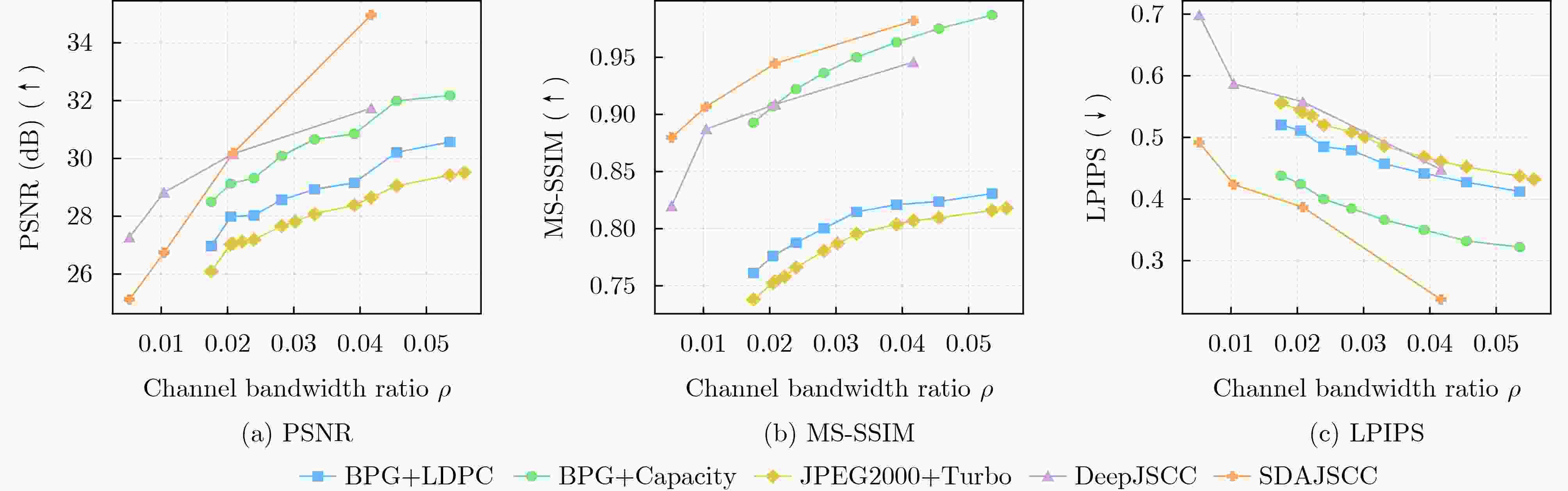
图 7 xView2数据集加性高斯白噪声信道$ \mathrm{SNR}=20~\text{dB} $条件下不同信道带宽比下的峰值信噪比、多尺度结构相似性和学习感知图像块相似度
表 1 主要符号说明
符号 维度或取值范围 物理含义 符号 维度或取值范围 物理含义 $ \boldsymbol{x} $ $ {\mathbb{R}}^{C×H×W} $ 输入无人机灾害图像 $ \boldsymbol{y} $ $ {\mathbb{C}}^{M} $ 接收信号 $ \boldsymbol{c} $ $ {\mathbb{R}}^{{{d}_{\text{c}}}} $ 信道状态描述向量 $ {\boldsymbol{z}}_{\text{eq}} $ $ {\mathbb{R}}^{2M} $ 均衡后实值潜表示 $ \boldsymbol{z} $ $ {\mathbb{R}}^{2M} $ 发送端实值语义潜表示 $ \hat{\boldsymbol{z}} $ $ {\mathbb{R}}^{2M} $ ChannelRefiner 校正后的潜表示 $ \boldsymbol{s} $ $ {\mathbb{C}}^{M} $ 未归一化复值信道符号 $ {\hat{\boldsymbol{x}}}_{\text{f}} $ $ {\mathbb{R}}^{C×H×W} $ 保真分支重建图像 $ \tilde{\boldsymbol{s}} $ $ {\mathbb{C}}^{M} $ 功率归一化后的发射符号 $ {\hat{\boldsymbol{x}}}_{\text{p}} $ $ {\mathbb{R}}^{C×H×W} $ 感知分支重建图像 $ \boldsymbol{h} $ $ {\mathbb{C}}^{M} $ 实际复信道增益 $ \alpha $ [0,1] 解码分支的自适应融合权重 $ \hat{\boldsymbol{h}} $ $ {\mathbb{C}}^{M} $ 接收端估计信道增益 $ \rho $ [0,1] 信道带宽比  下载: 导出CSV
表 2 非理想CSI条件下不同模型在RescueNet数据集上的性能比较
模型 CSI估计SNR/dB 0 dB 5 dB 10 dB 20 dB Baseline 20.72 / 0.676 / 0.497 21.86 / 0.722 / 0.452 22.74 / 0.758 / 0.414 23.29 / 0.786 / 0.393 Baseline + ChannelRefiner 21.48 / 0.704 / 0.458 22.63 / 0.748 / 0.417 23.48 / 0.782 / 0.382 24.02 / 0.805 / 0.366 SDAJSCC (无 ChannelRefiner) 23.81 / 0.801 / 0.382 25.26 / 0.855 / 0.338 26.46 / 0.897 / 0.299 27.36 / 0.924 / 0.276 SDAJSCC 24.34 / 0.817 / 0.357 25.83 / 0.871 / 0.316 27.02 / 0.911 / 0.282 27.88 / 0.934 / 0.262 注:实验采用瑞利衰落信道,信道带宽比为$ \rho = $1/24,实际前向链路SNR固定为10 dB,仅改变CSI估计误差强度。各单元格中的指标依次为PSNR/dB↑、MS-SSIM↑和LPIPS↓;粗体表示最优结果。CSI估计SNR定义为:$ {\gamma }_{\text{CSI}}=10{\log }_{10}(\mathbb{E}||\boldsymbol{h}||_{2}^{2}/\mathbb{E}||\boldsymbol{e}||_{2}^{2}) $
下载: 导出CSV
表 3 RescueNet数据集上不同方法的灾害关键区域与高层表征保持性能比较
方法 关键区域PSNR/dB↑ 关键区域LPIPS↓ 边缘F1↑ 高层特征余弦相似度↑ DeepJSCC 26.42 0.612 0.598 0.824 ROI-JSCC 27.36 0.447 0.711 0.871 SDAJSCC(无PARB-SDFB) 27.18 0.421 0.687 0.861 SDAJSCC 28.09 0.383 0.746 0.903 注:实验条件为瑞利衰落信道、ρ=1/24、SNR=10 dB;↑和↓分别表示数值越大和越小性能越优,粗体表示最优结果
下载: 导出CSV
表 4 不同方法的计算复杂度与推理效率比较
方法 参数量/M↓ 浮点运算量/GFLOPs↓ 单幅推理时延/(s/幅)↓ JSCCFormer-f(2024)[6] 13.46 13.85 0.012 DiffJSCC(2025)[11] 829.46 965.21 1.949 DeepJSCC-Diff(2024)[14] 324.73 428.64 1.227 SGD-JSCC(2026)[15] 250.33 268.72 1.103 SDAJSCC 29.34 18.94 0.029 注:所有方法均在输入尺寸为256×256、batch size为1和NVIDIA RTX 4090 GPU条件下测试。参数量统计完整推理网络的全部参数;浮点运算量按单幅图像完整推理过程统计,其中扩散类方法统一采用50步反向去噪;推理时延为预热100次后,采用CUDA同步计时1000 次所得平均值,不包含数据加载与预处理时间。各项复杂度指标均为数值越小越优,粗体表示最优结果,下划线表示次优结果
下载: 导出CSV
-
[1] GUO Ziji, LIU Danpu, and ZHANG Zhilong. Perception enhanced multimodal multitask semantic communication and resource management for UAV-assisted ISAC systems[J]. IEEE Transactions on Vehicular Technology, 2026, 75(6): 11051–11065. doi: 10.1109/TVT.2025.3650639. [2] LU Hao, YUAN Liang, CAO Ning, et al. DRJSCC: Deep joint source-channel coding for fast transmission and reconstruction of UAV disaster images[J]. Digital Signal Processing, 2026, 176: 106083. doi: 10.1016/j.dsp.2026.106083. [3] KURKA D B and GÜNDÜZ D. Bandwidth-agile image transmission with deep joint source-channel coding[J]. IEEE Transactions on Wireless Communications, 2021, 20(12): 8081–8095. doi: 10.1109/TWC.2021.3090048. [4] BOURTSOULATZE E, KURKA D B, and GÜNDÜZ D. Deep joint source-channel coding for wireless image transmission[J]. IEEE Transactions on Cognitive Communications and Networking, 2019, 5(3): 567–579. doi: 10.1109/TCCN.2019.2919300. [5] YANG Mingyu and KIM H S. Deep joint source-channel coding for wireless image transmission with adaptive rate control[C]. ICASSP 2022—2022 IEEE International Conference on Acoustics, Speech and Signal Processing, Singapore, Singapore, 2022: 5193–5197. doi: 10.1109/ICASSP43922.2022.9746335. [6] WU Haotian, SHAO Yulin, OZFATURA E, et al. Transformer-aided wireless image transmission with channel feedback[J]. IEEE Transactions on Wireless Communications, 2024, 23(9): 11904–11919. doi: 10.1109/TWC.2024.3386052. [7] WU Haotian, SHAO Yulin, BIAN Chenghong, et al. Deep joint source-channel coding for adaptive image transmission over MIMO channels[J]. IEEE Transactions on Wireless Communications, 2024, 23(10): 15002–15017. doi: 10.1109/TWC.2024.3422794. [8] YANG Mingyu, BIAN Chenghong, and KIM H S. OFDM-guided deep joint source channel coding for wireless multipath fading channels[J]. IEEE Transactions on Cognitive Communications and Networking, 2022, 8(2): 584–599. doi: 10.1109/TCCN.2022.3151935. [9] YANG Ke, WANG Sixian, DAI Jincheng, et al. SwinJSCC: Taming Swin transformer for deep joint source-channel coding[J]. IEEE Transactions on Cognitive Communications and Networking, 2025, 11(1): 90–104. doi: 10.1109/TCCN.2024.3424842. [10] 申滨, 李旋, 赖雪冰, 等. 基于Swin Transformer的宽带无线图传语义联合编解码方法[J]. 电子与信息学报, 2025, 47(8): 2665–2674. doi: 10.11999/JEIT250039.SHEN Bin, LI Xuan, LAI Xuebing, et al. Swin transformer-based wideband wireless image transmission semantic joint encoding and decoding method[J]. Journal of Electronics & Information Technology, 2025, 47(8): 2665–2674. doi: 10.11999/JEIT250039. [11] YANG Mingyu, LIU Bowen, WANG Boyang, et al. Diffusion-aided joint source channel coding for high realism wireless image transmission[J]. IEEE Transactions on Machine Learning in Communications and Networking, 2025, 3: 1227–1243. doi: 10.1109/TMLCN.2025.3628535. [12] TAN Kailin, DAI Jincheng, LIU Zhenyu, et al. Rate-distortion-perception controllable joint source-channel coding for high-fidelity generative semantic communications[J]. IEEE Transactions on Cognitive Communications and Networking, 2025, 11(2): 672–686. doi: 10.1109/TCCN.2024.3511960. [13] CHOI H and SEO D. Region-of-interest-guided deep joint source–channel coding for image transmission[J]. IEEE Communications Letters, 2026, 30: 392–396. doi: 10.1109/LCOMM.2025.3639610. [14] YILMAZ S F, NIU Xueyan, BAI Bo, et al. High perceptual quality wireless image delivery with denoising diffusion models[C]. IEEE INFOCOM 2024—IEEE Conference on Computer Communications Workshops, Vancouver, Canada, 2024: 1–5. doi: 10.1109/INFOCOMWKSHPS61880.2024.10620904. [15] ZHANG Maojun, WU Haotian, ZHU Guangxu, et al. Semantics-guided diffusion for deep joint source-channel coding in wireless image transmission[J]. IEEE Transactions on Wireless Communications, 2026, 25: 1547–1564. doi: 10.1109/TWC.2025.3591456. [16] 王文远, 周明宇, 王朝炜, 等. 面向空天地网络的弹性语义通信[J]. 电子与信息学报, 2025, 47(10): 3646–3657. doi: 10.11999/JEIT250077.WANG Wenyuan, ZHOU Mingyu, WANG Chaowei, et al. Resilient semantic communication for space-air-ground networks[J]. Journal of Electronics & Information Technology, 2025, 47(10): 3646–3657. doi: 10.11999/JEIT250077. [17] 张祖凡, 尹星然, 周建萍, 等. 面向语义重要性和鲁棒性的RIS增强语义通信系统[J]. 电子与信息学报, 2025, 47(8): 2608–2620. doi: 10.11999/JEIT250159.ZHANG Zufan, YIN Xingran, ZHOU Jianping, et al. RIS-enhanced semantic communication systems oriented towards semantic importance and robustness[J]. Journal of Electronics & Information Technology, 2025, 47(8): 2608–2620. doi: 10.11999/JEIT250159. [18] 陈阳, 马欢, 姬智, 等. 面向图像恢复任务的语义通信网络能耗优化[J]. 电子与信息学报, 2026, 48(1): 183–190. doi: 10.11999/JEIT250915.CHEN Yang, MA Huan, JI Zhi, et al. Optimization of energy consumption in semantic communication networks for image recovery tasks[J]. Journal of Electronics & Information Technology, 2026, 48(1): 183–190. doi: 10.11999/JEIT250915. [19] ZHANG R, ISOLA P, EFROS A A, et al. The unreasonable effectiveness of deep features as a perceptual metric[C]. 2018 IEEE/CVF Conference on Computer Vision and Pattern Recognition, Salt Lake City, USA, 2018: 586–595. doi: 10.1109/CVPR.2018.00068. [20] LIU Ze, LIN Yutong, CAO Yue, et al. Swin transformer: Hierarchical vision transformer using shifted windows[C]. 2021 IEEE/CVF International Conference on Computer Vision, Montreal, Canada, 2021: 9992–10002. doi: 10.1109/ICCV48922.2021.00986. [21] GUPTA R, GOODMAN B, PATEL N, et al. Creating xBD: A dataset for assessing building damage from satellite imagery[C]. Proceedings of the IEEE/CVF Conference on Computer Vision and Pattern Recognition Workshops, Long Beach, USA, 2019: 10–17. [22] RAHNEMOONFAR M, CHOWDHURY T, and MURPHY R. RescueNet: A high resolution UAV semantic segmentation dataset for natural disaster damage assessment[J]. Scientific Data, 2023, 10(1): 913. doi: 10.1038/s41597-023-02799-4. [23] WANG Zhou, SIMONCELLI E P, and BOVIK A C. Multiscale structural similarity for image quality assessment[C]. Proceedings of the 37th Asilomar Conference on Signals, Systems & Computers, Pacific Grove, USA, 2003: 1398–1402. doi: 10.1109/ACSSC.2003.1292216. -

 下载:

图(12) / 表(4)
计量
- 文章访问数: 21
- HTML全文浏览量: 1
- PDF下载量: 8
- 被引次数: 0
