




Triple-Band Effective Spoof Surface Plasmon Polariton (ESSPP)-SSPP Filter with Independently Controllable Cutoff Frequencies
-
摘要: 针对现有三通带滤波器存在截止频率难以独立调控、设计流程复杂等问题,本文提出一种基于等效人工表面等离子体激元(ESSPP)和人工表面等离子体激元(SSPP)混合模式的三通带滤波器解析设计方法。通过在基片集成波导中引入具有不同介电常数的多层介质结构及金属柱/凹槽阵列,分别激发ESSPP基模、一阶模及SSPP模式,从而形成三个独立可控的通带。本文推导了色散方程及各截止频率的解析表达式,阐明了结构参数对通带位置的独立调控机制。采用多层印刷电路板技术加工了一款C-Ku波段三通带滤波器样品,实测通带分别为5–6.3 GHz、8.8–10.9 GHz和16.3–18.7 GHz,插入损耗分别为0.6 dB、0.6 dB和0.7 dB。仿真与实测结果吻合良好,验证了所提方法可实现低损耗、高带外抑制且截止频率独立可控的三通带滤波器设计,并大幅简化了设计流程。Abstract:
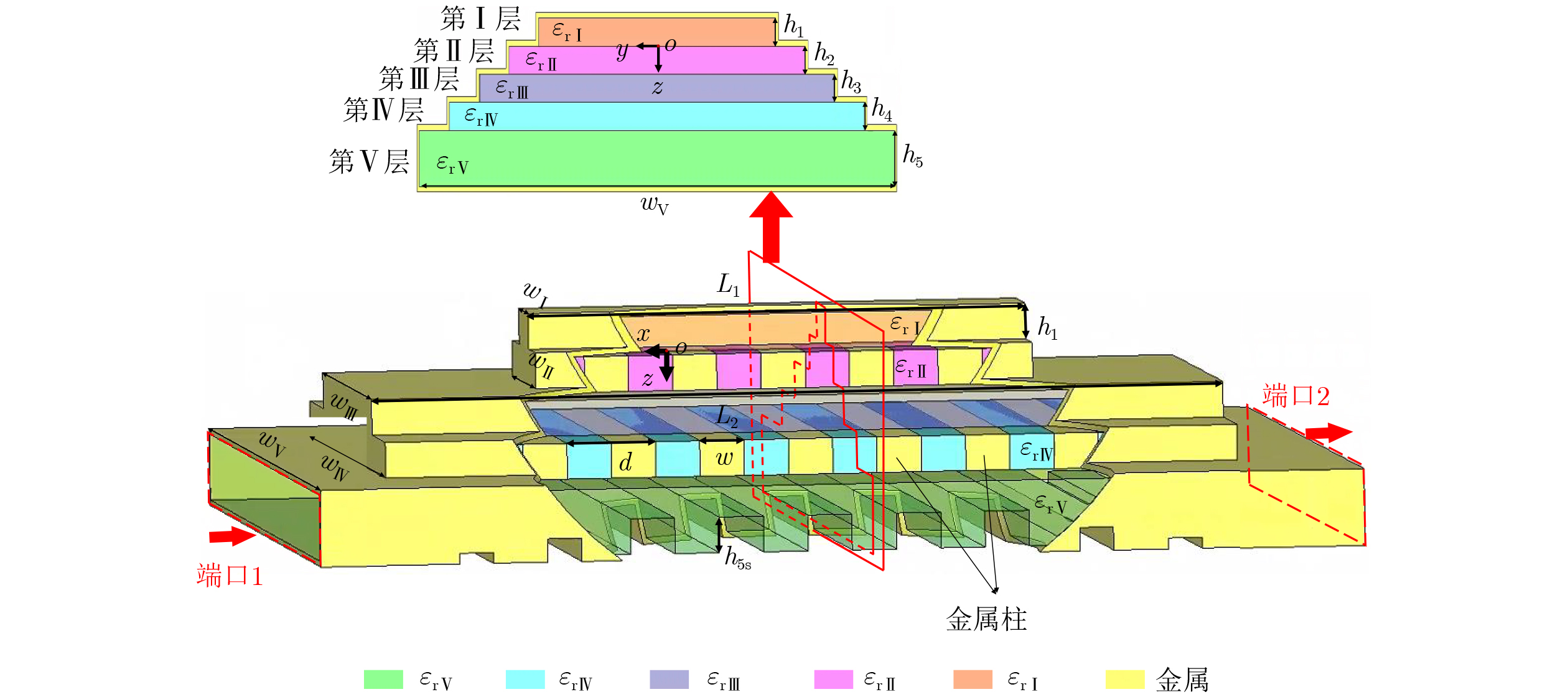
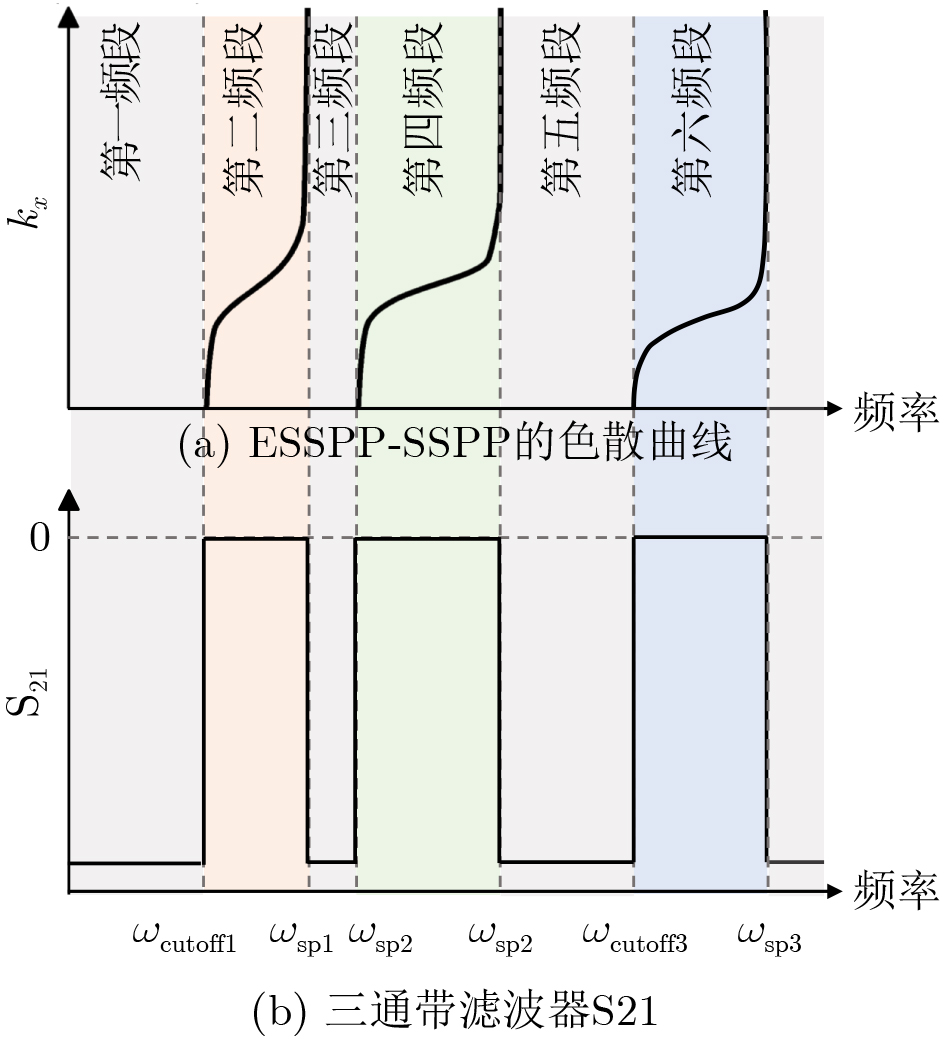
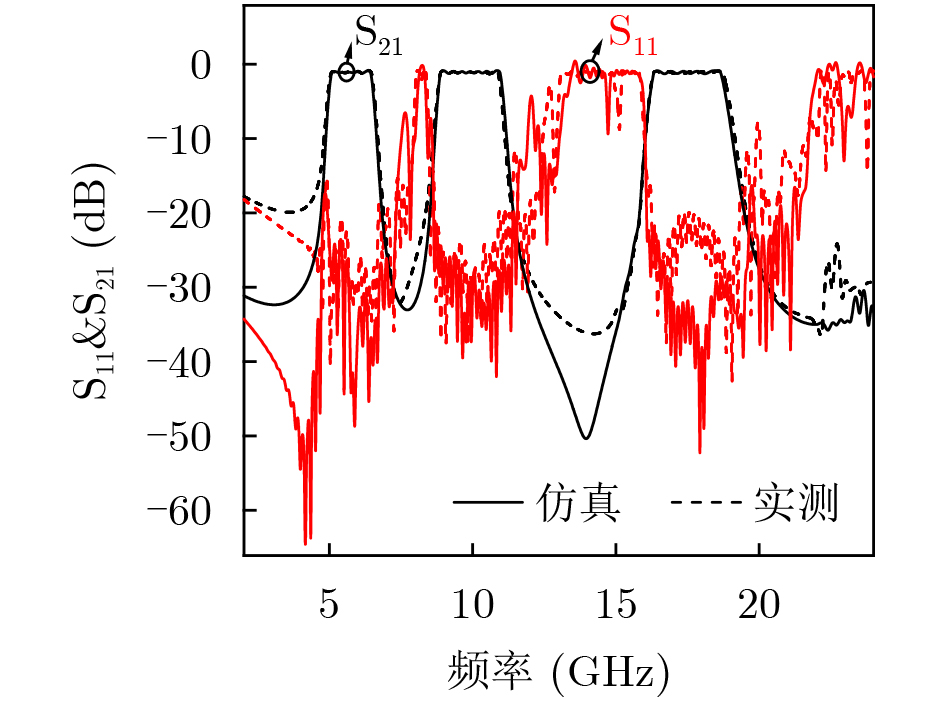
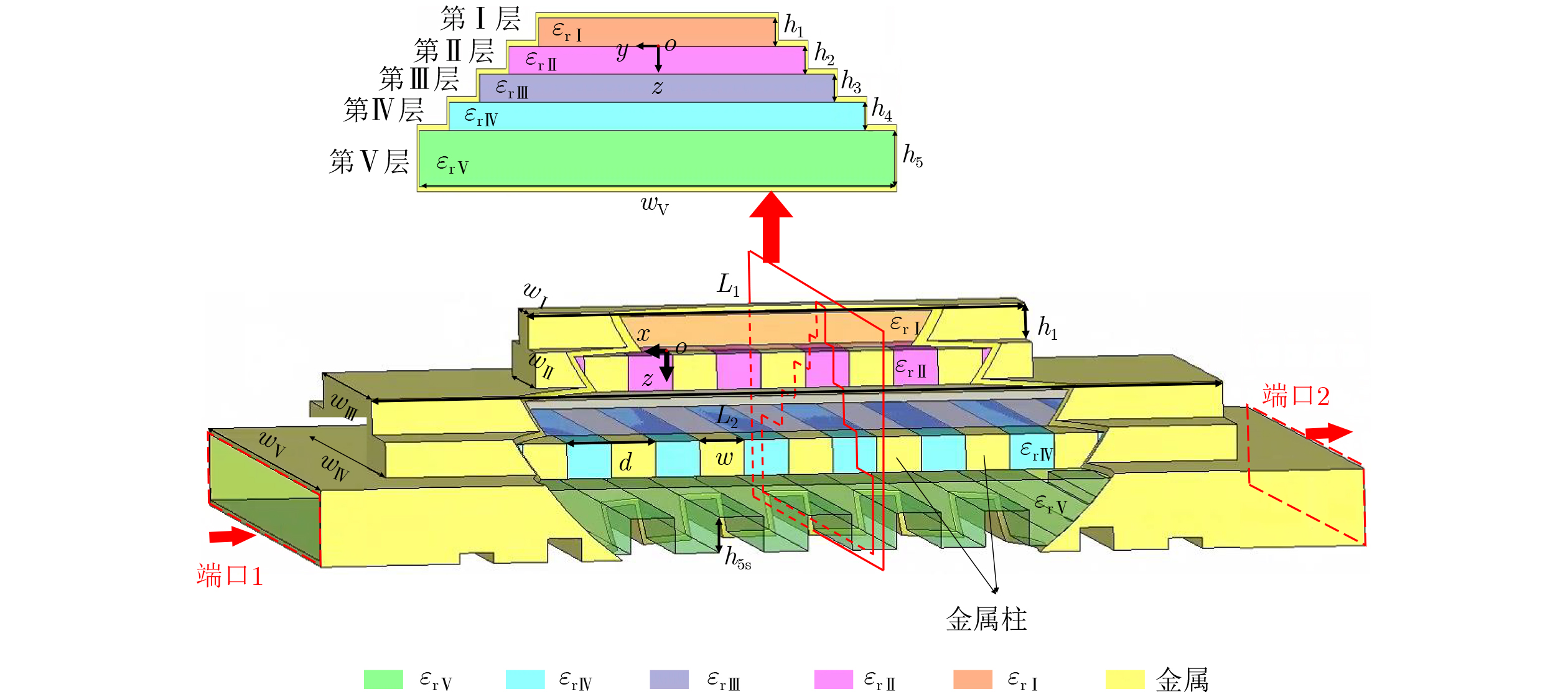
Objective The continuous evolution of modern wireless communication systems demands higher data rates, enhanced transmission capabilities, and diversified services. Among passive RF front-end components, multi-band bandpass filters play a critical role and have become a research hotspot. Although various design methods have been proposed to realize multi-band filtering, existing solutions commonly suffer from several drawbacks: the center frequencies and bandwidths of the passbands are difficult to tune independently, out-of-band rejection is often insufficient, and the design procedures are complicated. To overcome these limitations, this work aims to develop a triple-band bandpass filter with independently controllable cutoff frequencies, high selectivity, and a simplified analytical design procedure. The proposed approach introduces both effective spoof surface plasmon polariton (ESSPP) and spoof surface plasmon polariton (SSPP) modes in a waveguide environment, thereby enabling flexible and independent tuning of each passband’s position while maintaining excellent in-band and out-of-band performance. Methods The proposed triple-band filter is constructed by stacking five dielectric layers within a rectangular waveguide. Two rows of periodic metallic posts (layers II and IV) and a row of periodic grooves (layer Vs) are embedded to support ESSPP modes (fundamental and first-order) and SSPP modes, respectively. Specifically, the metallic post array in layer IV, located between the main waveguide (layer V) and a dielectric cavity (layer III), controls the upper cutoff frequency of the first passband, while the main waveguide determines its lower cutoff frequency. The grooves in the main waveguide control the lower cutoff frequency of the third passband. The metallic post array in layer II, situated between layer III and another dielectric cavity (layer I), independently controls the upper cutoff frequency of the second passband, and the dielectric cavity of layer III defines its lower cutoff frequency. The lower cutoff frequency of the third passband is adjusted by the dielectric cavity of layer I.By dividing the structure into six layers and applying boundary conditions at each interface, the dispersion equation of the ESSPP-SSPP modes is derived. The cutoff frequencies (ωcutoff1, ωcutoff2, ωcutoff3) and asymptotic frequencies (ωsp1, ωsp2, ωsp3) are expressed analytically as functions of the geometrical dimensions and relative permittivities of the layers. Solving the dispersion equation reveals that the three operating frequency bands correspond to the ESSPP fundamental mode, ESSPP first-order mode, and SSPP mode, respectively. The analysis demonstrates that each cutoff frequency can be independently controlled by selecting appropriate structural parameters: ωcutoff3 is independently tunable via εrI or wI (the permittivity or width of layer I); ωsp1 is controlled by layer IV; ωcutoff2 and ωsp2 are independently adjusted by layers III and II, respectively; and ωsp3 is controlled by the groove depth h5s. The lower cutoff frequency of the first passband (ωcutoff1) is set by layer V (εrV or wV), after which ωsp3 is fine-tuned using h5s. To validate the design, a C-Ku band triple-band filter is fabricated using multilayer printed circuit board (PCB) technology. The structural parameters are calculated directly from the analytical formulas without iterative numerical optimization. Results and Discussions The dispersion characteristics of the ESSPP-SSPP structure are first analyzed. Fig. 2(a) shows the dispersion curves, andFig. 2(b) presents the corresponding S21 response, which clearly divides the frequency range into six bands. In bands II, IV, and VI, propagation is supported – corresponding to the ESSPP mode along layer IV (first passband), the ESSPP mode along layer II (second passband), and the SSPP mode along layer Vs (third passband), respectively. The electric field distributions at these three bands are displayed inFig. 3(a) ,(b) , and(c) , respectively, confirming the mode profiles. Bands III and V are stopbands due to mode cutoff.The ability to independently control each cutoff frequency is systematically demonstrated.Fig. 4(i) and(j) illustrate that increasing εrI or wI causes a significant decrease in ωcutoff3, while ωcutoff1, ωcutoff2, ωsp1, ωsp2, and ωsp3 remain unchanged. Correspondingly,Fig. 5(i) and(j) show that only the third passband shifts downward in the S21 response, confirming independent tunability of ωcutoff3. Similarly,Fig. 4(a) and(b) andFig. 5(a) and(b) show that increasing εrV or wV decreases both ωcutoff1 and ωsp3 simultaneously; therefore, ωcutoff1 is first set by layer V, and then ωsp3 is independently adjusted by h5s as shown inFig. 4(k) andFig. 5(k) .Fig. 4(c) -(h) andFig. 5(c) -(h) further demonstrate independent control of ωsp1 (via layer IV), ωcutoff2 and ωsp2 (via layers III and II). The simulation results agree well with the analytical dispersion calculations, with only minor deviations attributed to the fact that only TE10 modes are considered in layers II and IV in the analytical model.For experimental validation, a triple-band filter sample operating in the C-Ku band is designed and fabricated using multilayer PCB technology. The structural parameters are directly calculated from equations (8)–(13): εrI = 1, εrII = 2.2, εrIII = 3.48, εrIV = 6.15, εrV = 9.8, wI = wII = 9.2 mm, wIII = wIV = 9.5 mm, wV = 10 mm, and h5s = 1.1 mm.Fig. 6(a) shows the layer-by-layer layout, andFig. 6(b) shows a photograph of the assembled sample. The detailed dimensions are listed inTable 1 .Fig. 7 presents the simulated and measured S11 and S21 responses. The measurement results show three passbands: 5–6.3 GHz, 8.8–10.9 GHz, and 16.3–18.7 GHz, with insertion losses of 0.6 dB, 0.6 dB, and 0.7 dB, respectively. The measured passbands match the ESSPP-SSPP frequency ranges calculated by the analytical formulas. Good agreement is observed between simulation and measurement, with slight discrepancies attributed to manufacturing tolerances. The filter exhibits excellent in-band and out-of-band selectivity.Conclusions An analytical design method for triple-band bandpass filters with independently controllable cutoff frequencies is proposed and validated. The method introduces both ESSPP and SSPP modes in a multilayer waveguide structure, enabling independent tuning of each passband’s lower and upper cutoff frequencies through separate geometrical and material parameters. The derived dispersion equations and analytical expressions for the cutoff frequencies provide a direct way to estimate structural parameters without relying on iterative numerical optimization, significantly simplifying the design procedure. A C-Ku band filter prototype is fabricated using multilayer PCB technology. Measured results demonstrate three low-loss passbands (0.6 dB, 0.6 dB, and 0.7 dB insertion loss) with high out-of-band rejection, confirming the effectiveness of the proposed approach. This design method can be extended to triple-band filters over a wide frequency range from microwave to millimeter-wave bands. -
表 1 三通带滤波器样品详细尺寸参数
参数 取值
(mm)参数 取值
(mm)参数 取值 h1 0.127 wI 9.2 εrI 1 h2 0.127 wII 9.2 εrII 2.2 h3 0.127 wIII 9.5 εrIII 3.48 h4 0.127 wIV 9.5 εrIV 6.15 h5 1.9 wV 10 εrV 9.8 h5s 1.1 L 95 W0 31.5 mm  下载: 导出CSV
-
[1] YAN Junjie, CHEN Fuchang, and LIN Ruicong. A triple-band bandpass filter based on triple-mode metal block resonators[J]. IEEE Microwave and Wireless Technology Letters, 2025, 35(2): 173–176. doi: 10.1109/LMWT.2024.3509141. [2] 寇鑫, 肖中银, 黄春艳, 等. 基于频率变换的双通带腔体滤波器的研究[J]. 电子与信息学报, 2012, 34(6): 1489–1493. doi: 10.3724/SP.J.1146.2011.01151.KOU Xin, XIAO Zhongyin, HUANG Chunyan, et al. Design of dual-band cavity filter using frequency transformation method[J]. Journal of Electronics & Information Technology, 2012, 34(6): 1489–1493. doi: 10.3724/SP.J.1146.2011.01151. [3] 朱轶智, 张晓娟, 方广有. 基于开路T型结构的小型化超宽阻带滤波器设计[J]. 电子与信息学报, 2010, 32(9): 2282–2286. doi: 10.3724/SP.J.1146.2009.01021.ZHU Yizhi, ZHANG Xiaojuan, and FANG Guangyou. Design for miniature filter with ultra-wide stopband based on open-stub T-shaped structure[J]. Journal of Electronics & Information Technology, 2010, 32(9): 2282–2286. doi: 10.3724/SP.J.1146.2009.01021. [4] 柯榕杰, 王洪斌, 程钰间. 小型化宽阻带折叠基片集成波导滤波器研究[J]. 电子与信息学报, 2026, 48(3): 1301–1310. doi: 10.11999/JEIT250869.KE Rongjie, WANG Hongbin, and CHENG Yujian. Research on a miniaturized wide stopband folded substrate integrated waveguide filter[J]. Journal of Electronics & Information Technology, 2026, 48(3): 1301–1310. doi: 10.11999/JEIT250869. [5] 李梦瑶, 张鹏飞, 冯浩, 等. 基于微波开口双频段谐振腔的雪层厚度测试技术研究[J]. 电子与信息学报, 2026, 48(1): 436–446. doi: 10.11999/JEIT250724.LI Mengyao, ZHANG Pengfei, FENG Hao, et al. Research on snow depth measurement technology based on dual-band microwave open resonant cavity[J]. Journal of Electronics & Information Technology, 2026, 48(1): 436–446. doi: 10.11999/JEIT250724. [6] 黄至源, 张云华, 赵晓雯. 一种加载寄生缝隙的Ku波段圆极化漏波天线[J]. 电子与信息学报, 2025, 47(11): 4628–4636. doi: 10.11999/JEIT250347.HUANG Zhiyuan, ZHANG Yunhua, and HAO Xiaowen. A Ku-band circularly polarized leaky-wave antenna loaded with parasitic slots[J]. Journal of Electronics & Information Technology, 2025, 47(11): 4628–4636. doi: 10.11999/JEIT250347. [7] WANG Zhe, WU Yongle, XU Zuoyu, et al. Adjustable triple-band triple-mode dielectric waveguide filter with multiple transmission zeros[J]. IEEE Microwave and Wireless Technology Letters, 2024, 34(6): 619–622. doi: 10.1109/LMWT.2024.3389968. [8] CAHYASIWI D A, ALAMSYAH R, ASTUTI D W, et al. A compact independent triple-band bandpass filter using mode splitting[J]. IEEE Microwave and Wireless Technology Letters, 2026, 36(6): 1019–1022. doi: 10.1109/LMWT.2026.3660836. [9] XU Ruofeng, WU Wenhan, KONG Xianglin, et al. Compact triple-band active switchable bandpass filter with enhanced passband isolation[J]. IEEE Microwave and Wireless Technology Letters, 2025, 35(8): 1190–1193. doi: 10.1109/LMWT.2025.3554867. [10] BARTLETT C, HÖFT M, WANG Y, et al. A novel hybrid-mode technique for multiband filter design[J]. IEEE Transactions on Terahertz Science and Technology, 2026, 16(5): 574–582. doi: 10.1109/TTHZ.2026.3659428. [11] LIU Zhanzhi, ZHANG Gang, ZHOU Xin, et al. Three-dimensional printed dual-band filter based on SIR-loaded sleeve coaxial resonant cavity[J]. IEEE Microwave and Wireless Technology Letters, 2025, 35(11): 1692–1695. doi: 10.1109/LMWT.2025.3588730. [12] LIU Fan, LIU Xin, MA Zhewang, et al. Miniaturized dual-band bandpass filter using triple-mode dielectric waveguide resonators with adjustable capacity in transmission zeros[J]. IEEE Microwave and Wireless Technology Letters, 2025, 35(6): 670–673. doi: 10.1109/LMWT.2025.3550814. [13] FAN Chunfeng, MA Sensen, LIU Qing, et al. Compact dual-band filters using single-cavity SIW and quarter-wavelength stripline resonators[J]. IEEE Microwave and Wireless Technology Letters, 2025, 35(8): 1122–1125. doi: 10.1109/LMWT.2025.3563499. [14] HE Yuxing, CHENG Lan, XIAO Lunyong, et al. Iterative synthesis of dual-band filters with separately assignable operating bands using bandpass polynomials and prototypes[J]. IEEE Microwave and Wireless Technology Letters, 2025, 35(1): 43–46. doi: 10.1109/LMWT.2024.3480709. [15] WU Yu and MA Kaixue. Design of dual-band bandpass filters based on metal-integrated suspended line technology[J]. IEEE Microwave and Wireless Technology Letters, 2024, 34(6): 615–618. doi: 10.1109/LMWT.2024.3384966. [16] WU Chao, ZHANG Shuqing, and WONG S W. Quasi-elliptic dual-band bandpass filter using flexible mixed coupling of inverted-L-shape coaxial resonator[J]. IEEE Microwave and Wireless Technology Letters, 2025, 35(2): 185–188. doi: 10.1109/LMWT.2024.3519338. [17] LI Jun, HUANG Shanshan, and ZHAO Jianzhong. Compact dual-wideband bandpass filter using a novel penta-mode resonator (PMR)[J]. IEEE Microwave and Wireless Components Letters, 2014, 24(10): 668–670. doi: 10.1109/LMWC.2014.2341014. [18] HSU K W, CHIEN C H, and TU W H. Compact dual-wideband bandpass filter using asymmetrical resonator[J]. Electronics Letters, 2013, 49(2): 123–124. doi: 10.1049/el.2012.3633. [19] GIOVAMPAOLA C D and ENGHETA N. Plasmonics without negative dielectrics[J]. Physical Review B, 2016, 93(19): 195152. doi: 10.1103/PhysRevB.93.195152. [20] LI Zhuo, LIU Liangliang, SUN Hengyi, et al. Effective surface Plasmon polaritons induced by modal dispersion in a waveguide[J]. Physical Review Applied, 2017, 7(4): 044028. doi: 10.1103/PhysRevApplied.7.044028. -

 下载:



图(7) / 表(1)
计量
- 文章访问数: 7
- HTML全文浏览量: 0
- PDF下载量: 0
- 被引次数: 0
