




Anomaly Detection on Irregular Signals in Adaptive Decay Reservoir Network Model Space
-
摘要: 工业系统中的信号常因传感器不稳定或通信丢包而出现不规则采样,传统插值与重采样易破坏底层动态特性,连续时间模型和深度学习方法虽能处理不均匀间隔,但训练开销大、对数据量要求高。针对该问题,本文提出一种自适应衰减储备池网络(Adaptive Decay Reservoir Network, ADRN)的模型空间学习框架。ADRN通过指数衰减机制在不规则时间间隔上更新隐藏状态,利用岭回归为每条信号拟合一个读出模型作为其表示,将后续分析转移到由拟合模型构成的模型空间中,并以时间间隔加权的重构损失和基于Fisher准则的可分离性损失联合优化模型空间的拟合质量与判别能力。在CWRU轴承数据集和SU齿轮箱数据集上的实验表明,所提方法在仅200条训练信号的低资源条件下于8个实验设置中的7个取得最高准确率,在SU数据集不同缺失率下的性能波动仅为2.8%,表现出更强的鲁棒性。在非旋转机械的TEP化工过程数据集上,本文方法在三种缺失率下的准确率均高于对比方法,验证了对不同工业对象的适应性。此外,训练时间较神经常微分方程方法降低约两个数量级。
-
关键词:
- 不规则信号 /
- 异常检测 /
- 自适应衰减储备池网络 /
- 模型空间学习 /
- 储备池计算
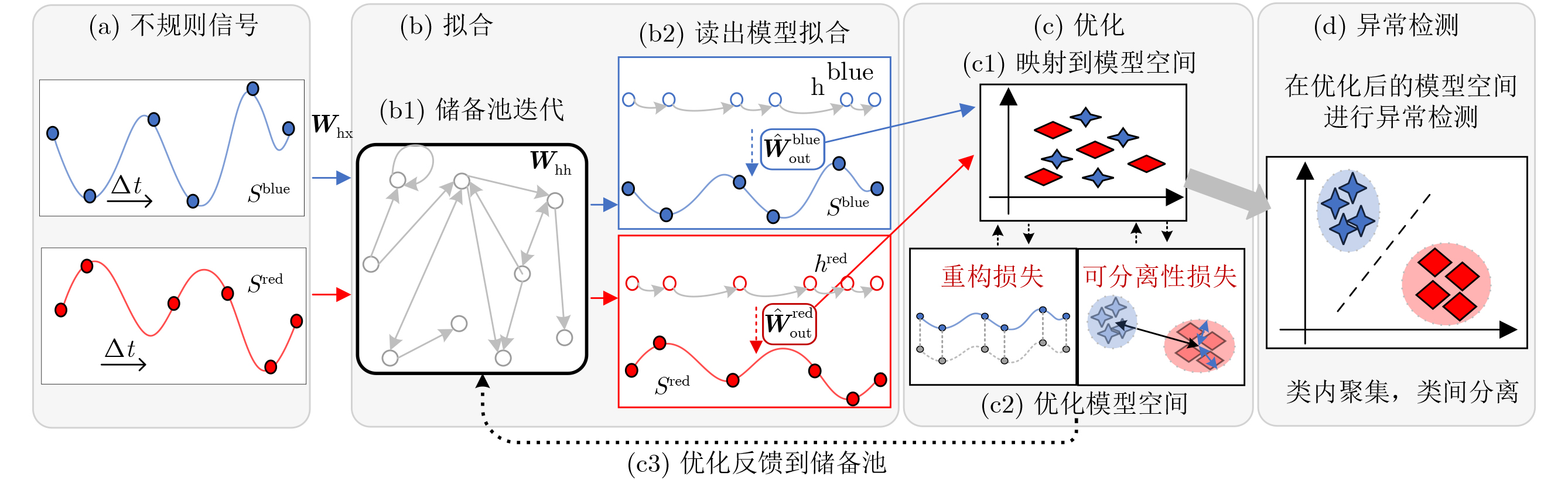
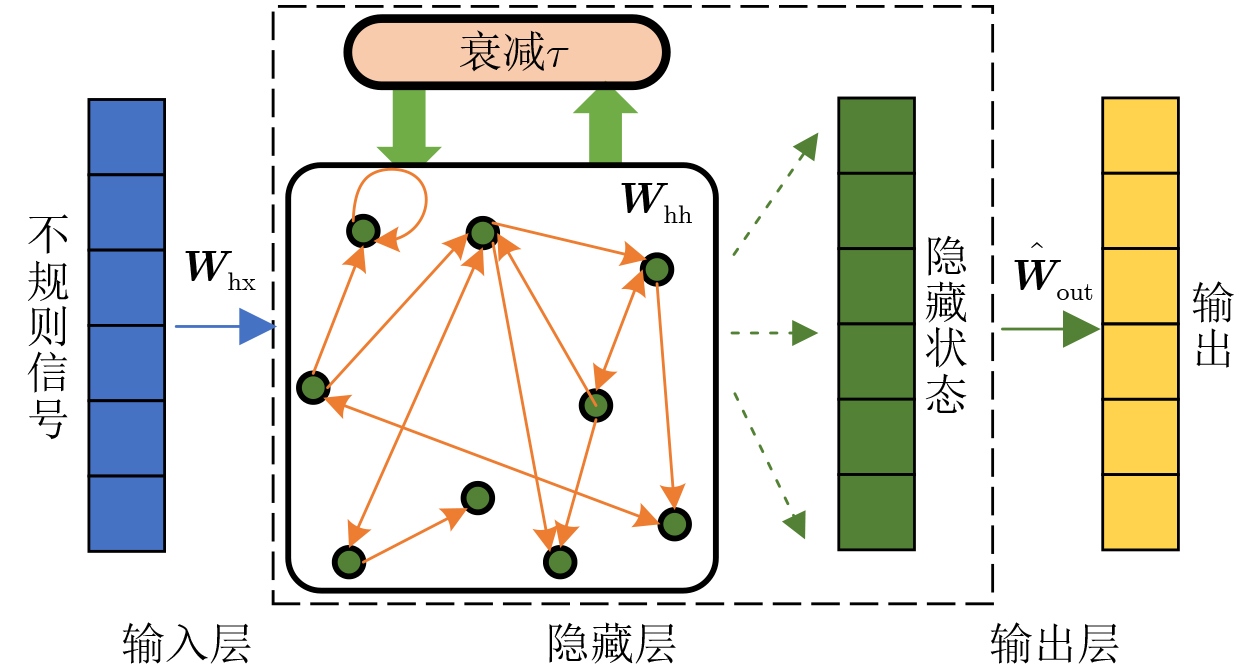
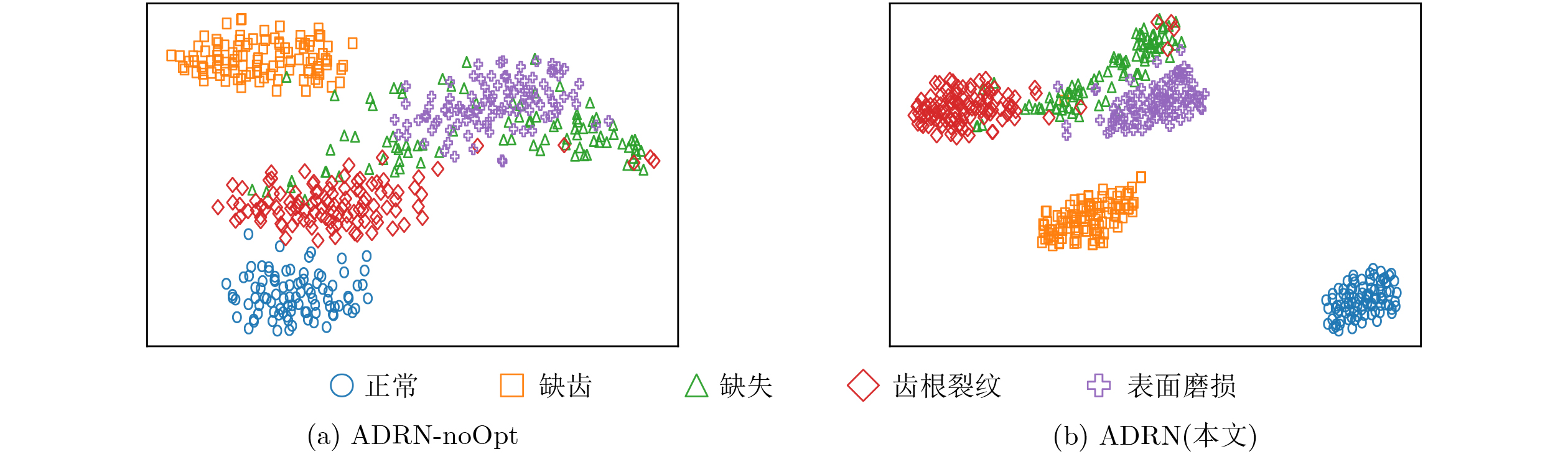
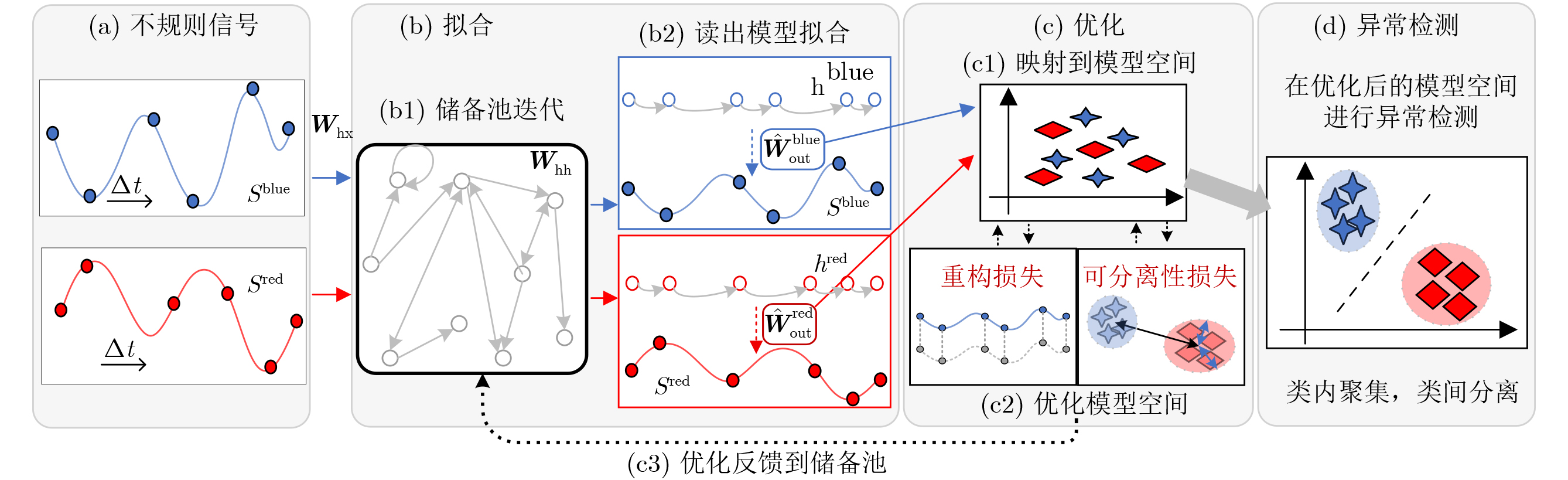
Abstract:Objective Signals acquired from industrial systems often exhibit irregular sampling due to sensor instability, intermittent operation, communication dropout, and multi-source asynchronous acquisition. This irregularity violates the uniform sampling assumption of most signal analysis methods and challenges anomaly detection. Interpolation and resampling may distort the underlying temporal dynamics, while continuous-time models based on neural ordinary differential equations as well as time-aware Transformers suffer from high training costs and strong dependence on large training sets, making them impractical under limited training resources. Model space learning offers an alternative by fitting each signal with a dynamic model and analyzing the fitted models instead of the raw signals. However, existing model space methods for irregular sampling rely on fixed reservoir configurations and lack adaptive optimization of the model space. This paper aims to develop an anomaly detection framework for irregularly sampled signals that is simultaneously robust to non-uniform intervals and efficient to train. Methods An adaptive model space learning framework based on the Adaptive Decay Reservoir Network (ADRN) is proposed ( Fig. 1 ). ADRN extends the echo state network by introducing an exponential decay mechanism derived from a linear ordinary differential equation (Fig. 2 ). Between consecutive observations, the hidden state decays according to a learnable decay rate over the actual elapsed time, so that the state update naturally adapts to non-uniform sampling intervals without numerical ordinary differential equation solvers. Each new observation then updates the decayed state through a nonlinear activation. Ridge regression with a closed-form solution then fits a readout model mapping hidden states to the original signal, and the fitted readout weights serve as a compact fixed-dimensional representation regardless of signal length. The model space is further optimized by two complementary losses. A time-interval-weighted reconstruction loss assigns higher weights to larger intervals, preventing densely sampled segments from dominating the optimization and improving fitting quality under non-uniform sampling. A separability loss inspired by Fisher discriminant analysis acts through a learnable projection matrix to minimize intra-class scatter and maximize inter-class separation in the projected model space. The two losses are combined into a joint objective that simultaneously updates the reservoir parameters, the decay rate, and the projection matrix, and gradients propagate through the differentiable closed-form ridge regression to enable end-to-end optimization. A downstream classifier, namely a support vector machine on CWRU and SU and a random forest on the higher-dimensional TEP model space, performs the final detection. The echo state property of ADRN is formally established, and the resulting spectral-norm condition is more relaxed than the classical one, allowing richer reservoir dynamics.Results and Discussions Experiments cover the CWRU bearing dataset (five subsets, 50% missing rate), the SU gearbox dataset (30%, 50%, and 70% missing rates), and the Tennessee Eastman Process (TEP) chemical dataset (19 classes, three missing rates), with only 200 labeled signals per subset for training on CWRU and SU. The proposed method achieves the highest accuracy in 7 of the 8 CWRU and SU settings ( Table 1 ), with accuracies ranging from 87.3% to 93.8% on CWRU. On SU, it maintains 94.4% accuracy even at a 70% missing rate, and the fluctuation across missing rates is only 2.8%, in contrast to 18.7% for ODE-RNN, while Neural CDE drops from 86.8% to 62.6%. Ablation studies confirm the contribution of each component (Table 1 ,Table 2 ). Removing the exponential decay reduces accuracy by up to 28.4 percentage points, and the interval weighting and the separability loss contribute complementary gains of 2.0 and 3.1 percentage points on SU at the 70% missing rate. t-SNE visualization shows that the optimized model space exhibits compact and clearly separated classes (Fig. 3 ). Training on a CWRU dataset completes in about 50 seconds, over two orders of magnitude faster than neural ordinary differential equation methods, which require3000 to7000 seconds (Table 3 ). Hyperparameter analysis indicates that a loss balance coefficient between 0.1 and 0.3 performs well and that a small reservoir suffices (Table 4 ). On TEP, a non-rotating-machinery industrial object whose faults manifest as changes in process dynamics, the proposed method attains the highest accuracy among all compared methods at every missing rate, with the largest margin of 7.0 percentage points at the highest missing rate (Table 5 ).Conclusions The ADRN based model space learning framework provides an effective solution for anomaly detection on irregularly sampled signals. The exponential decay mechanism enables interval-aware state updates without numerical ordinary differential equation solvers, ridge regression yields efficient closed-form readout fitting, and the joint optimization of the reconstruction and separability losses produces a model space with both high fitting quality and strong discriminative structure. The framework requires only a small reservoir of 10 to 50 dimensions and completes training within one minute, making it well suited to scenarios with limited training resources and irregular sampling. Future work includes adaptive reservoir sizing, extension to multivariate joint modeling, and validation in further domains such as structural health monitoring and biomedical or meteorological time series. -
表 1 各方法在不同数据集上的准确率对比(%)
方法 CWRU SU(缺失率) A B C D E 30% 50% 70% NFFT-SVM 17.4 20.8 19.3 17.4 18.2 93.7 86.1 83.4 GRU-Δt 77.1 55.9 58.9 60.1 65.7 95.3 90.3 88.5 GRU-Int 14.6 15.2 14.8 18.2 24.9 94.9 82.8 78.0 GRU-D 24.2 30.4 29.8 27.3 57.6 79.9 74.1 66.8 Warpformer 79.3 79.8 70.0 87.6 71.5 92.0 92.3 87.7 Latent ODE 81.2 72.8 70.2 72.3 83.4 88.3 83.6 77.0 ODE-RNN 82.2 84.2 80.3 85.3 81.7 99.3 91.8 80.6 Neural CDE 78.4 82.8 86.2 84.6 76.7 86.8 78.0 62.6 mTAND 26.1 16.1 13.8 12.3 13.1 83.1 82.0 80.6 SeFT 14.7 9.5 9.9 9.5 9.8 57.2 54.6 53.1 Raindrop 15.6 15.3 14.3 11.0 17.8 69.0 68.1 80.9 Ct-Echo 81.6 83.4 85.5 87.1 85.8 95.9 92.3 64.6 ADRN-noDec 63.8 65.4 70.7 76.8 64.6 94.9 83.6 68.0 ADRN-noOpt 86.3 86.7 89.2 87.3 81.2 95.6 94.4 90.4 ADRN(本文) 90.6 93.8 93.6 91.3 87.3 97.2 96.2 94.4  下载: 导出CSV
表 2 优化损失的细粒度消融(SU数据集, 准确率 %)
变体 $ {\varDelta }t $加权 可分离性损失 70%缺失率 ADRN-noOpt × × 90.4 ADRN-noWt × √ 92.4 ADRN-noSep √ × 91.3 ADRN(本文) √ √ 94.4
下载: 导出CSV
表 3 CWRU数据集上各方法训练时间对比
方法 训练时间 CWRU-A准确率(%) ADRN(本文) ~50 s 90.6 NFFT-SVM <5 s 17.4 Warpformer ~140 s 79.3 ODE-RNN ~ 6800 s82.2 Latent ODE ~ 6900 s81.2 Neural CDE ~ 3400 s78.4
下载: 导出CSV
表 4 超参数敏感性分析(CWRU-A, 准确率 %)
$ \alpha $ 准确率 $ {d}_{h} $ 准确率 0 87.1 10 87.5 0.05 89.3 20 90.6 0.1 90.4 30 89.6 0.3 90.6 50 88.3 0.5 88.6 100 85.1 1 88.3 150 85.7 10 86.2 200 86.7
下载: 导出CSV
表 5 各方法在TEP数据集上不同缺失率下的准确率对比(%)
方法 30% 50% 70% NFFT-SVM 64.1 62.9 60.8 GRU-Δt 59.5 59.5 59.1 GRU-Int 59.9 57.9 56.1 GRU-D 60.6 59.7 59.3 Warpformer 68.8 67.6 66.8 Latent ODE 58.0 59.0 57.4 ODE-RNN 59.6 58.8 56.2 Neural CDE 18.6 18.3 22.0 mTAND 49.8 50.8 49.9 SeFT 55.6 57.9 57.0 Raindrop 37.9 41.5 38.6 Ct-Echo 63.5 61.0 65.5 ADRN(本文) 72.2 70.4 73.8
下载: 导出CSV
-
[1] ZAMANZADEH DARBAN Z, WEBB G I, PAN Shirui, et al. Deep learning for time series anomaly detection: A survey[J]. ACM Computing Surveys, 2025, 57(1): 15. doi: 10.1145/3691338. [2] 王敏, 冯智彬, 吴德浩, 等. 非平稳过程异常监测方法: 综述与展望[J]. 中国科学: 信息科学, 2024, 54(8): 1807–1826. doi: 10.1360/SSI-2023-0377.WANG Min, FENG Zhibin, WU Dehao, et al. Overview and prospect of abnormal monitoring methods for non-stationary processes[J]. Scientia Sinica Informationis, 2024, 54(8): 1807–1826. doi: 10.1360/SSI-2023-0377. [3] 孙晨峰, 吕卫民, 戴洪德, 等. 一种基于TimeGAN和OCSVM的多元退化设备小子样数据增广方法[J]. 电子学报, 2022, 50(11): 2678–2687. doi: 10.12263/DZXB.20220079.SUN Chenfeng, LÜ Weimin, DAI Hongde, et al. A small sample data augmentation method for multivariate degradation equipment based on TimeGAN and OCSVM[J]. Acta Electronica Sinica, 2022, 50(11): 2678–2687. doi: 10.12263/DZXB.20220079. [4] 伍章俊, 许仁礼, 方刚, 等. 一种面向旋转机械多传感器故障诊断的模态融合深度聚类方法[J]. 电子与信息学报, 2025, 47(1): 244–259. doi: 10.11999/JEIT240648.WU Zhangjun, XU Renli, FANG Gang, et al. A modal fusion deep clustering method for multi-sensor fault diagnosis of rotating machinery[J]. Journal of Electronics & Information Technology, 2025, 47(1): 244–259. doi: 10.11999/JEIT240648. [5] JIA Xudong, PENG Wei, SHEN Chiran, et al. Spatio-temporal mixed graph neural controlled differential equations with adaptive connection sampling for irregular multivariate time series anomaly detection[C]. ICASSP 2025 - 2025 IEEE International Conference on Acoustics, Speech and Signal Processing (ICASSP), Hyderabad, India, 2025: 1–5. doi: 10.1109/ICASSP49660.2025.10888536. [6] WANG Jun, DU Wenjie, YANG Yiyuan, et al. Deep learning for multivariate time series imputation: A survey[C]. Proceedings of the Thirty-Fourth International Joint Conference on Artificial Intelligence, Montreal, Canada, 2025: 10696–10704. doi: 10.24963/ijcai.2025/1187. [7] 刘辉, 冯浩然, 马佳妮, 等. 融合空间自注意力感知的严重缺失多元时间序列插补算法[J]. 电子与信息学报, 2025, 47(10): 3917–3928. doi: 10.11999/JEIT250220.LIU Hui, FENG Haoran, MA Jiani, et al. Spatial self-attention incorporated imputation algorithm for severely missing multivariate time series[J]. Journal of Electronics & Information Technology, 2025, 47(10): 3917–3928. doi: 10.11999/JEIT250220. [8] CHE Zhengping, PURUSHOTHAM S, CHO K, et al. Recurrent neural networks for multivariate time series with missing values[J]. Scientific Reports, 2018, 8(1): 6085. doi: 10.1038/s41598-018-24271-9. [9] CHEN R T Q, RUBANOVA Y, BETTENCOURT J, et al. Neural ordinary differential equations[C]. Proceedings of the 32nd International Conference on Neural Information Processing Systems, Montréal, Canada, 2018: 6572–6583. doi: 10.5555/3327757.3327764. [10] KIDGER P, MORRILL J, FOSTER J, et al. Neural controlled differential equations for irregular time series[C]. Proceedings of the 34th Conference on Neural Information Processing Systems, 2020, 33: 6696–6707. (查阅网上资料, 本条文献会议地是线上, 请确认). [11] ZHANG Jiawen, ZHENG Shun, CAO Wei, et al. Warpformer: A multi-scale modeling approach for irregular clinical time series[C]. Proceedings of the 29th ACM SIGKDD Conference on Knowledge Discovery and Data Mining, Long Beach, USA, 2023: 3273–3285. doi: 10.1145/3580305.3599543. [12] CHEN Huanhuan, TIŇO P, RODAN A, et al. Learning in the model space for cognitive fault diagnosis[J]. IEEE Transactions on Neural Networks and Learning Systems, 2014, 25(1): 124–136. doi: 10.1109/TNNLS.2013.2256797. [13] CHEN Huanhuan, TANG Fengzhen, TINO P, et al. Model metric co-learning for time series classification[C]. Proceedings of the 24th International Conference on Artificial Intelligence, Buenos Aires, Argentina, 2015: 3387–3394. doi: 10.5555/2832581.2832721. [14] CHEN Ao, ZHOU Xiren, FAN Yizhan, et al. Underground diagnosis based on GPR and learning in the model space[J]. IEEE Transactions on Pattern Analysis and Machine Intelligence, 2024, 46(5): 3832–3844. doi: 10.1109/TPAMI.2023.3347739. [15] ZHOU Xiren, LIU Shikang, YAN Xinyu, et al. Reservoir-enhanced segment anything model for subsurface diagnosis[J]. Nature Communications, 2025, 16(1): 11080. doi: 10.1038/s41467-025-67382-4. [16] TANG Ziyu, ZHOU Xiren, CHEN Ao, et al. Inside and inside: Efficient anomaly detection by fully capturing the detailed dynamics[C]. ICASSP 2025 - 2025 IEEE International Conference on Acoustics, Speech and Signal Processing (ICASSP), Hyderabad, India, 2025: 1–5. doi: 10.1109/ICASSP49660.2025.10888333. [17] CHEN Ao, ZHOU Xiren, and CHEN Huanhuan. Efficient anomaly detection of irregular sequences in Ct-Echo model space[C]. Proceedings of the 39th Annual AAAI Conference on Artificial Intelligence, Philadelphia, USA, 2025: 15731–15739. doi: 10.1609/aaai.v39i15.33727. [18] JAEGER H. The "Echo State" approach to analysing and training recurrent neural networks[R]. GMD Report 148, 2001. [19] 任利强, 贾舒宜, 王海鹏, 等. 基于深度学习的时间序列分类研究综述[J]. 电子与信息学报, 2024, 46(8): 3094–3116. doi: 10.11999/JEIT231222.REN Liqiang, JIA Shuyi, WANG Haipeng, et al. A review of research on time series classification based on deep learning[J]. Journal of Electronics & Information Technology, 2024, 46(8): 3094–3116. doi: 10.11999/JEIT231222. [20] 周平, 曾扬洋, 张宇, 等. 基于跨时空注意力机制的多变量时间序列异常检测[J]. 中国科学: 信息科学, 2025, 55(5): 1157–1176. doi: 10.1360/SSI-2024-0274.ZHOU Ping, ZENG Yangyang, ZHANG Yu, et al. Multivariable time series anomaly detection based on cross spatial-temporal attention mechanism[J]. Scientia Sinica Informationis, 2025, 55(5): 1157–1176. doi: 10.1360/SSI-2024-0274. [21] 唐伦, 赵禹辰, 薛呈呈, 等. 一种基于时间序列分解和时空信息提取的云服务器异常检测模型[J]. 电子与信息学报, 2024, 46(6): 2638–2646. doi: 10.11999/JEIT230679.TANG Lun, ZHAO Yuchen, XUE Chengcheng, et al. A cloud server anomaly detection model based on time series decomposition and spatiotemporal information extraction[J]. Journal of Electronics & Information Technology, 2024, 46(6): 2638–2646. doi: 10.11999/JEIT230679. [22] 黄昱哲, 管永原, 魏松杰. 面向时序异常检测的可变视距多向扫描方法[J]. 电子学报, 2025, 53(9): 3410–3424. doi: 10.12263/DZXB.20250385.HUANG Yuzhe, GUAN Yongyuan, and WEI Songjie. Variable horizon multi-directional scanning method for time series anomaly detection[J]. Acta Electronica Sinica, 2025, 53(9): 3410–3424. doi: 10.12263/DZXB.20250385. [23] 郭铁峰, 贺建军, 申帅, 等. 基于动态规整与改进变分自编码器的异常电池在线检测方法[J]. 电子与信息学报, 2024, 46(2): 738–747. doi: 10.11999/JEIT230084.GUO Tiefeng, HE Jianjun, SHEN Shuai, et al. Abnormal battery on-line detection method based on dynamic time warping and improved variational auto-encoder[J]. Journal of Electronics & Information Technology, 2024, 46(2): 738–747. doi: 10.11999/JEIT230084. [24] RUBANOVA Y, CHEN R T Q, and DUVENAUD D K. Latent ordinary differential equations for irregularly-sampled time series[C]. Proceedings of the 33rd Conference on Neural Information Processing Systems, Vancouver, Canada, 2019: 5297–5307. [25] SHUKLA S N and MARLIN B. Multi-time attention networks for irregularly sampled time series[C]. International Conference on Learning Representations, Vienna, Austria, 2021. [26] CORTES C and VAPNIK V. Support-vector networks[J]. Machine Learning, 1995, 20(3): 273–297. doi: 10.1007/BF00994018. [27] JAEGER H, LUKOŠEVIČIUS M, POPOVICI D, et al. Optimization and applications of echo state networks with leaky- integrator neurons[J]. Neural Networks, 2007, 20(3): 335–352. doi: 10.1016/j.neunet.2007.04.016. [28] FISHER R A. The use of multiple measurements in taxonomic problems[J]. Annals of Eugenics, 1936, 7(2): 179–188. doi: 10.1111/j.1469-1809.1936.tb02137.x. [29] Case Western Reserve University. Bearing Data Center[EB/OL]. https://engineering.case.edu/bearingdatacenter/welcome, 2024. [30] SHAO Siyu, MCALEER S, YAN Ruqiang, et al. Highly accurate machine fault diagnosis using deep transfer learning[J]. IEEE Transactions on Industrial Informatics, 2019, 15(4): 2446–2455. doi: 10.1109/TII.2018.2864759. [31] DOWNS J J and VOGEL E F. A plant-wide industrial process control problem[J]. Computers & Chemical Engineering, 1993, 17(3): 245–255. doi: 10.1016/0098-1354(93)80018-I. [32] CHIANG L H, RUSSELL E L, and BRAATZ R D. Fault Detection and Diagnosis in Industrial Systems[M]. London, UK: Springer, 2001: 103–112. doi: 10.1007/978-1-4471-0347-9. [33] KEINER J, KUNIS S, and POTTS D. Using NFFT 3---A software library for various nonequispaced fast Fourier transforms[J]. ACM Transactions on Mathematical Software, 2009, 36(4): 19. doi: 10.1145/1555386.1555388. [34] HORN M, MOOR M, BOCK C, et al. Set functions for time series[C]. International Conference on Learning Representations, Addis Ababa, Ethiopia, 2020: 4353–4363. [35] ZHANG Xiang, ZEMAN M, TSILIGKARIDIS T, et al. Graph-guided network for irregularly sampled multivariate time series[C]. Proceedings of the Tenth International Conference on Learning Representations, 2022. (查阅网上资料, 本条文献会议地是线上, 请确认). -

 下载:
下载:

图(3) / 表(5)
计量
- 文章访问数: 145
- HTML全文浏览量: 22
- PDF下载量: 1
- 被引次数: 0
