




Iterative Parameter Estimation Method for Energy Detection Threshold in Ambient Backscatter
-
摘要: 在环境反向散射通信(AmBC)中,阅读器利用能量检测器恢复出标签信号,其检测门限所需参数由含有标签未知符号“1”和“0”的接收信号平均功率确定。现有参数估计方法假设标签以等概率发送符号“1”和“0”,因此直接对排序后的接收信号样本功率进行等分。但标签发送的符号数有限,因此符号“1”和“0”的数量并非严格相等,此时等分会导致样本错分,使得检测门限偏离最优值。为此,该文设计了一种基于迭代更新的检测门限参数估计方法,其核心思想是利用已有的判决结果对排序样本进行重新分组,并对门限参数进行迭代更新,实现检测门限的逐步修正。为了验证所提方法的有效性,在复高斯源、PSK源和QAM源3种典型环境射频源条件下进行了仿真。仿真结果表明,该方法能有效降低门限参数估计偏差,相较于现有排序分组的参数估计方法,仅需1次迭代更新,其检测误码率在复高斯源、PSK源和QAM源下即可实现约0.1, 1.5和1.3个数量级的性能提升。Abstract:
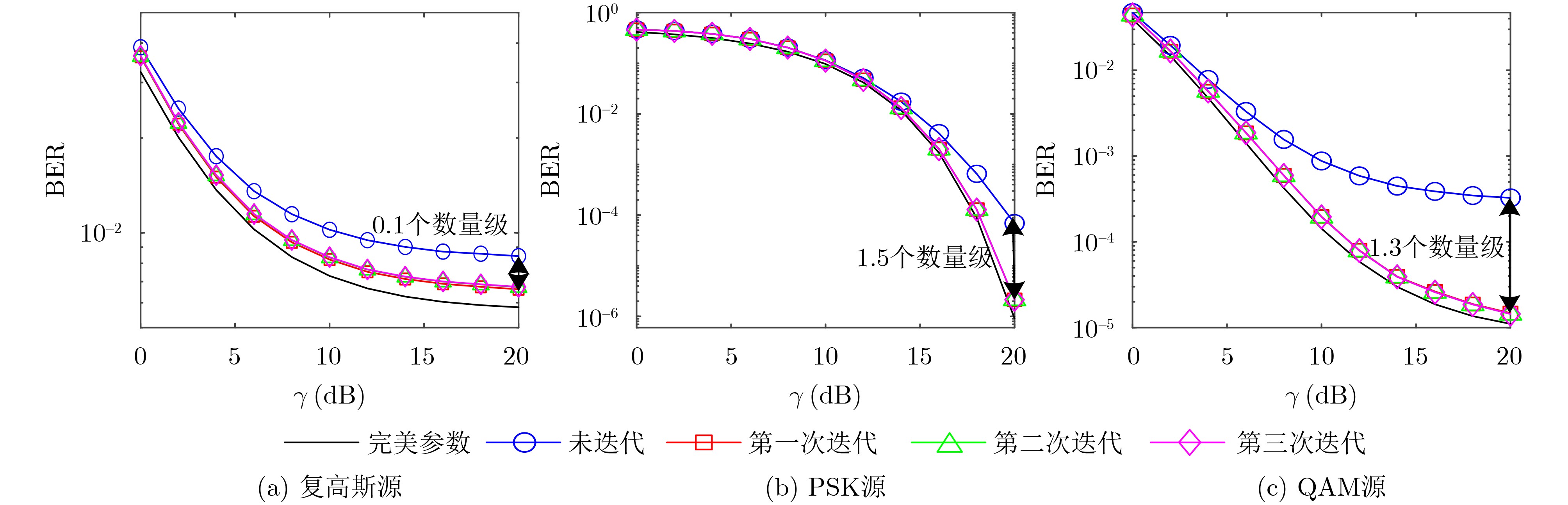
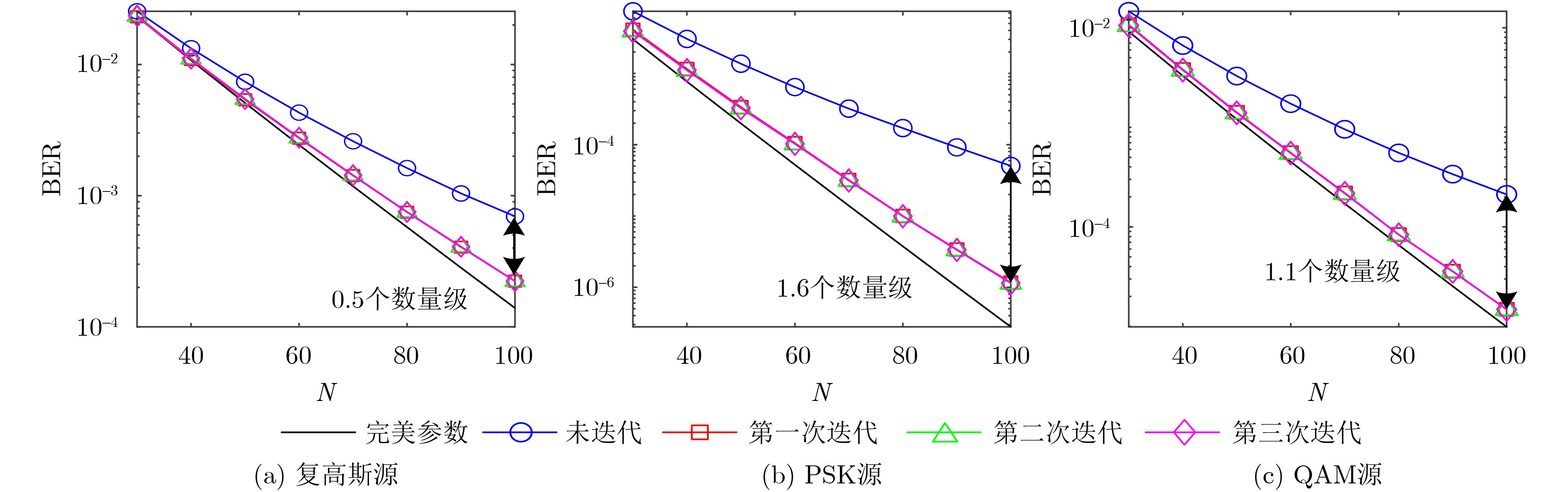
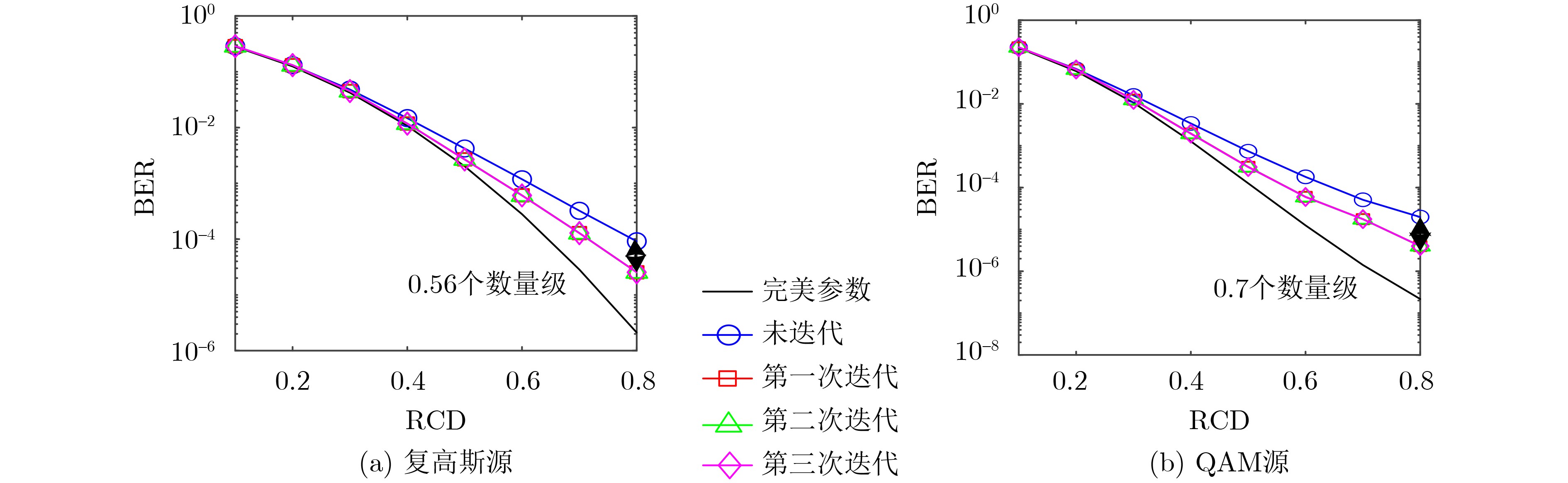
Objective In Ambient Backscatter Communication (AmBC) systems, a low-complexity Energy Detector (ED) is commonly employed at the reader to recover symbols transmitted by the tag. The detection performance of ED depends strongly on the accurate setting of the detection threshold, which is determined by the average received signal power corresponding to tag symbols “1” and “0”. Existing parameter estimation methods assume that the two symbols are transmitted with equal probability and therefore divide the sorted received signal power samples into two equal groups. However, because the number of transmitted symbols is finite, the actual numbers of symbols “1” and “0” are generally unequal. Therefore, equal partitioning introduces sample misclassification, causing the estimated threshold to deviate from its optimal value and reducing detection performance. To address this limitation, an iterative threshold parameter estimation method is proposed to reduce the parameter estimation bias caused by sample misclassification and improve the accuracy of detection threshold estimation. Methods An iterative threshold parameter estimation method is proposed to overcome the sample misclassification introduced by conventional sorting-based grouping. Because the initial detection threshold obtained by the sorting-based grouping method provides reliable decisions for most received samples, these initial decisions are used as the basis for sample reclassification. The received signal samples are then reclassified to iteratively update the threshold parameters, progressively refining the detection threshold. The proposed method is evaluated through simulations under three representative ambient radio-frequency source conditions: complex Gaussian, Phase-Shift Keying (PSK), and Quadrature Amplitude Modulation (QAM) sources. Results and Discussions Simulation results show that, over a wide range of Signal-to-Noise Ratio (SNR) values, the proposed iterative method substantially reduces the Bit Error Rate (BER) compared with the conventional sorting-based grouping method and approaches the theoretical lower bound obtained with perfect parameter estimation. At a given SNR, the proposed method improves BER by approximately 0.1, 1.5, and 1.3 orders of magnitude under complex Gaussian, PSK, and QAM sources, respectively ( Fig. 2 ). These results demonstrate that the proposed iterative method effectively corrects sample misclassification and reduces the performance loss caused by parameter estimation bias. Moreover, most of the performance gain is achieved after only one iteration, indicating rapid convergence with minimal additional computational overhead. Under different numbers of sampling points, BER improvements of approximately 0.5, 1.6, and 1.1 orders of magnitude are achieved under complex Gaussian, PSK, and QAM sources, respectively (Fig. 3 ). These results indicate that using the initial decisions for sample reclassification effectively reduces the estimation bias introduced by fixed equal partitioning, thereby improving detection performance under limited-sample conditions. Under different Relative Channel Difference (RCD) values, BER improvements of approximately 0.56 and 0.7 orders of magnitude are achieved under complex Gaussian and QAM sources, respectively (Fig. 4 ). As the RCD increases, the separation between the received signal power distributions becomes more pronounced, improving the accuracy of the initial decisions and enabling more reliable sample reclassification. This positive feedback process further refines the parameter estimates and improves detection performance.Conclusions An iterative threshold parameter estimation method is proposed to address the sample misclassification introduced by conventional sorting-based grouping in ED. The proposed method uses the initial decisions to reclassify the received signal samples and iteratively update the threshold parameters. In addition, closed-form expressions for the detection threshold and BER under QAM sources are derived. Simulation results demonstrate that the proposed method effectively reduces parameter estimation bias with only one iteration while maintaining robust performance under limited-sample and varying channel conditions. Significant BER improvements are achieved with minimal additional computational overhead, making the proposed method well suited for practical, high-reliability AmBC systems. -
[1] 3GPP. Study on solutions for ambient IoT (internet of things) in NR[R]. TR 38.769, 2024. [2] ZHANG Zhuo, YANG Liang, LEI Hongjiang, et al. Covert communication in RSMA-assisted ambient backscatter communication systems[J]. IEEE Transactions on Wireless Communications, 2025, 24(8): 6566–6579. doi: 10.1109/TWC.2025.3554667. [3] 叶迎晖, 徐瑞, 田雨佳, 等. 反向散射通信技术的研究与发展[J]. 电信科学, 2024, 40(1): 1–23. doi: 10.11959/j.issn.1000-0801.2024001.YE Yinghui, XU Rui, TIAN Yujia, et al. Research and development of backscatter communications technology[J]. Telecommunications Science, 2024, 40(1): 1–23. doi: 10.11959/j.issn.1000-0801.2024001. [4] CHAO Hua, TAO Tao, WANG Yonggang, et al. Architecture evolution for ambient power-enabled IoT in 5G-A and future cellular networks[J]. IEEE Internet of Things Magazine, 2025, 8(3): 48–54. doi: 10.1109/IOTM.001.2400128. [5] LI Xingwang, WANG Qunshu, ZENG Ming, et al. Physical-layer authentication for ambient backscatter-aided NOMA symbiotic systems[J]. IEEE Transactions on Communications, 2023, 71(4): 2288–2303. doi: 10.1109/TCOMM.2023.3245659. [6] AL-NAHARI A, JÄNTTI R, MISHRA D, et al. Ambient IoT: Backscatter-based connectivity topologies and outage behavior[J]. IEEE Transactions on Cognitive Communications and Networking, 2026, 12: 2369–2382. doi: 10.1109/TCCN.2025.3586219. [7] LI Xingwang, ZHAO Mengle, ZENG Ming, et al. Hardware impaired ambient backscatter NOMA systems: Reliability and security[J]. IEEE Transactions on Communications, 2021, 69(4): 2723–2736. doi: 10.1109/TCOMM.2021.3050503. [8] 徐勇军, 邱友静, 张海波. 智能反射面辅助的环境反向散射通信系统信道估计算法研究[J]. 电子与信息学报, 2025, 47(1): 75–83. doi: 10.11999/JEIT240395.XU Yongjun, QIU Youjing, ZHANG Haibo. Channel Estimation for Intelligent Reflecting Surface Assisted Ambient Backscatter Communication Systems[J]. Journal of Electronics & Information Technology, 2025, 47(1): 75–83. doi: 10.11999/JEIT240395. [9] 3GPP. NR; Ambient IoT device radio transmission and reception[R]. TS 38.191, 2025. [10] LU Kang, WANG Gongpu, QU Fengzhong, et al. Signal detection and BER analysis for RF-powered devices utilizing ambient backscatter[C]. 2015 International Conference on Wireless Communications & Signal Processing, Nanjing, China, 2015: 1–5. doi: 10.1109/WCSP.2015.7341107. [11] CHEN Yunfei and FENG Wei. Novel signal detectors for ambient backscatter communications in internet of things applications[J]. IEEE Internet of Things Journal, 2024, 11(3): 5388–5400. doi: 10.1109/JIOT.2023.3305645. [12] CHEN Jixiang, GUAN Quansheng, RONG Yue, et al. Detections for ambient backscatter communications systems with dynamic sources[J]. IEEE Transactions on Communications, 2025, 73(9): 7941–7951. doi: 10.1109/TCOMM.2025.3548758. [13] WANG Gongpu, GAO Feifei, FAN Rongfei, et al. Ambient backscatter communication systems: Detection and performance analysis[J]. IEEE Transactions on Communications, 2016, 64(11): 4836–4846. doi: 10.1109/TCOMM.2016.2602341. [14] TAO Qin, ZHONG Caijun, LIN Hai, et al. Symbol detection of ambient backscatter systems with Manchester coding[J]. IEEE Transactions on Wireless Communications, 2018, 17(6): 4028–4038. doi: 10.1109/TWC.2018.2819188. [15] QIAN Jing, GAO Feifei, WANG Gongpu, et al. Semi-coherent detection and performance analysis for ambient backscatter system[J]. IEEE Transactions on Communications, 2017, 65(12): 5266–5279. doi: 10.1109/TCOMM.2017.2738001. [16] CHENG Diancheng, WU Fan, ZHANG Cong, et al. Design and performance of passive virtual MIMO in ambient backscatter communication[J]. IEEE Wireless Communications Letters, 2024, 13(3): 612–616. doi: 10.1109/LWC.2023.3336864. [17] YE Yinghui, LI Ying, CHU Xiaoli, et al. Symbol detection in ambient backscatter communications under residual time synchronization errors[J]. IEEE Transactions on Communications, 2026, 74: 1669–1685. doi: 10.1109/TCOMM.2025.3635733. [18] LI Yuxin, LU Guangyue, YE Yinghui, et al. Timing synchronization and symbol detection in ambient backscatter communication[J]. IEEE Transactions on Wireless Communications, 2026, 25: 14212–14225. doi: 10.1109/TWC.2026.3675785. [19] 李莹, 叶迎晖, 施丽琴, 等. 残余时间同步误差下基于分数阶矩的AmBC检测方法[J]. 北京邮电大学学报, 2026, 49(1): 76–82,106. doi: 10.13190/j.jbupt.2025-030.LI Ying, YE Yinghui, SHI Liqin, et al. Fractional-order moment-based AmBC detection method under residual time synchronization errors[J]. Journal of Beijing University of Posts and Telecommunications, 2026, 49(1): 76–82,106. doi: 10.13190/j.jbupt.2025-030. [20] QIAN Jing, GAO Feifei, WANG Gongpu, et al. Noncoherent detections for ambient backscatter system[J]. IEEE Transactions on Wireless Communications, 2017, 16(3): 1412–1422. doi: 10.1109/TWC.2016.2635654. -

 下载:
下载:

图(4)
计量
- 文章访问数: 577
- HTML全文浏览量: 348
- PDF下载量: 29
- 被引次数: 0
