




A Reconfigurable Parallelized Coprocessor Design for the RISC-V-based Grain Cryptographic Algorithm
-
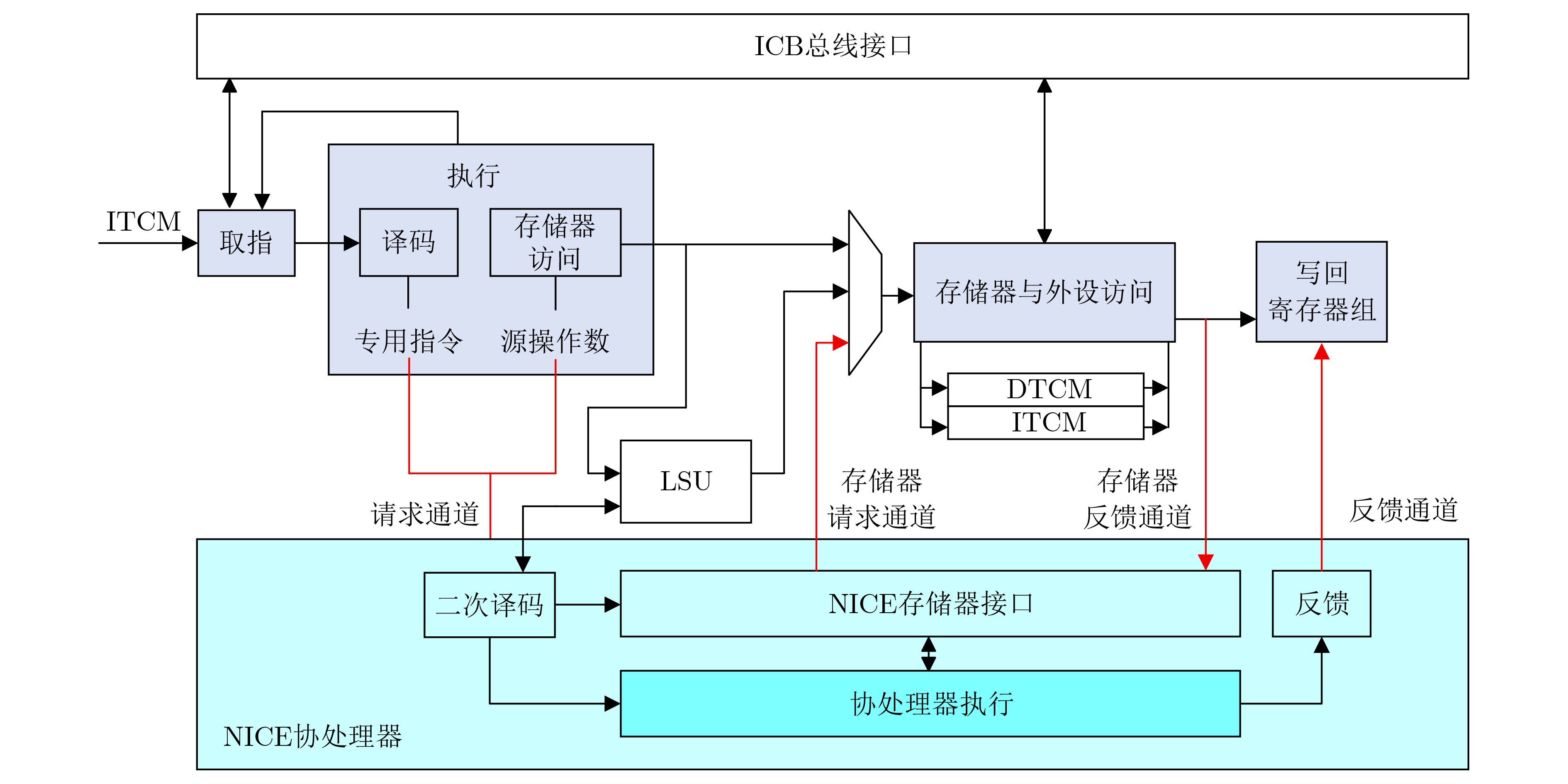
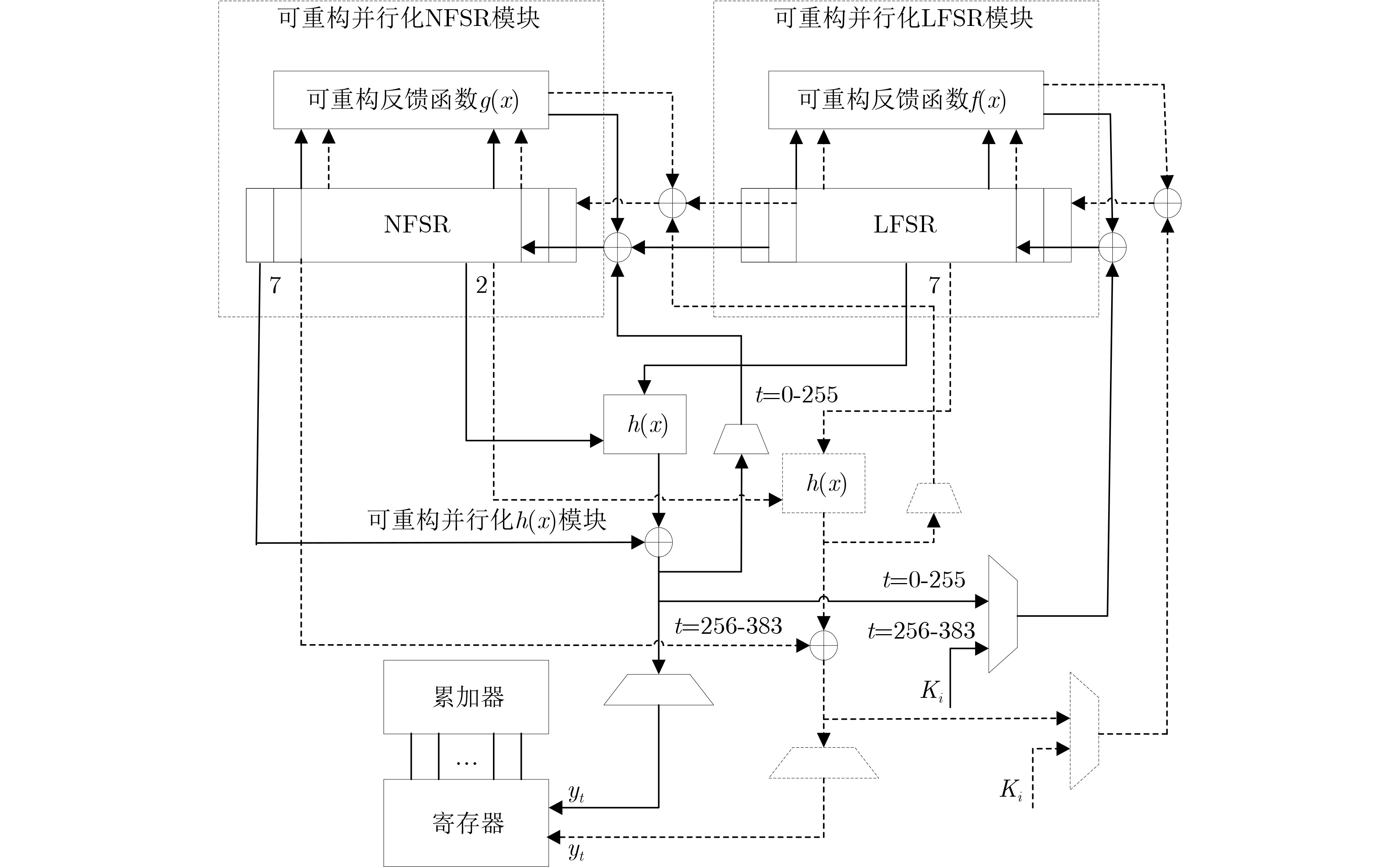
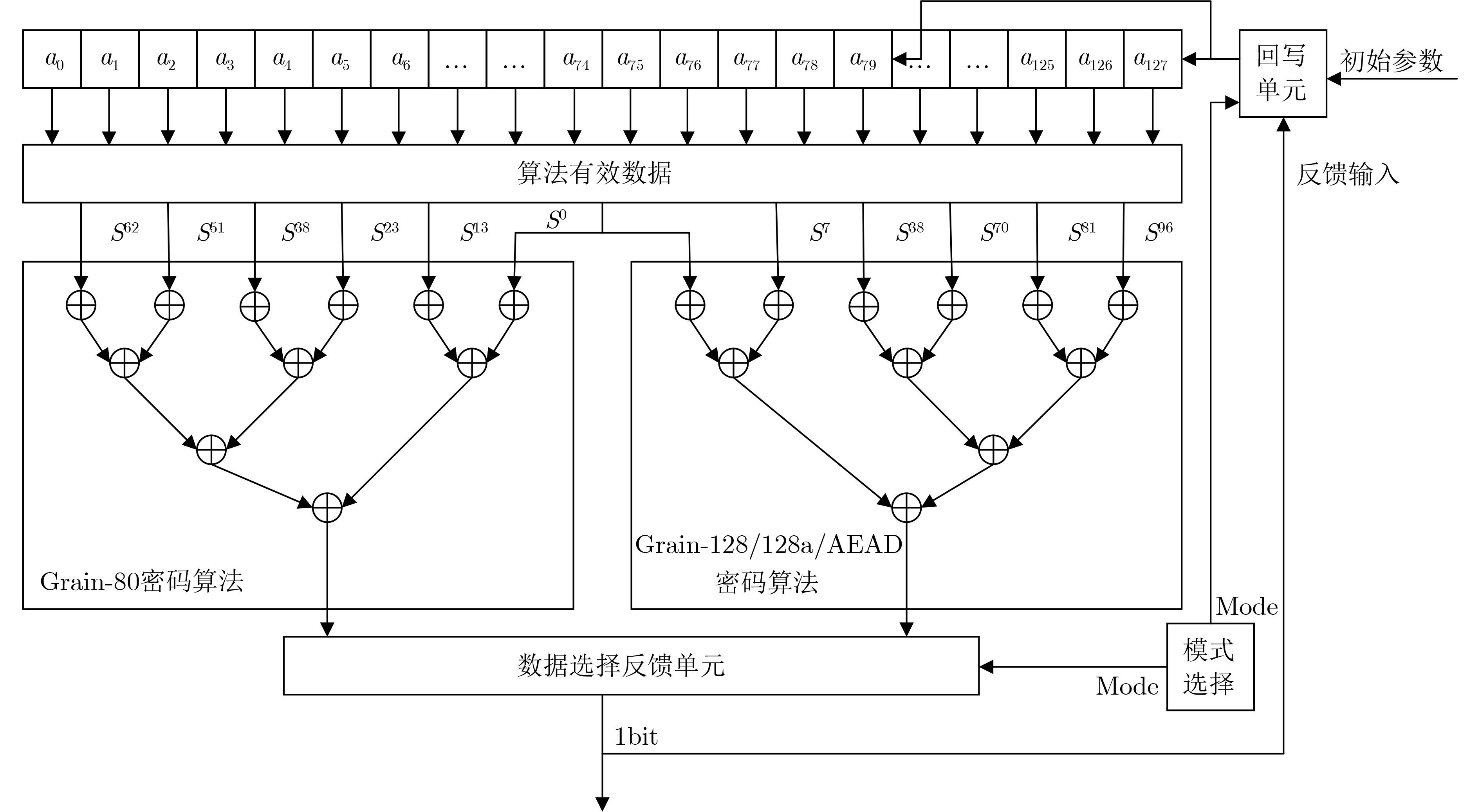
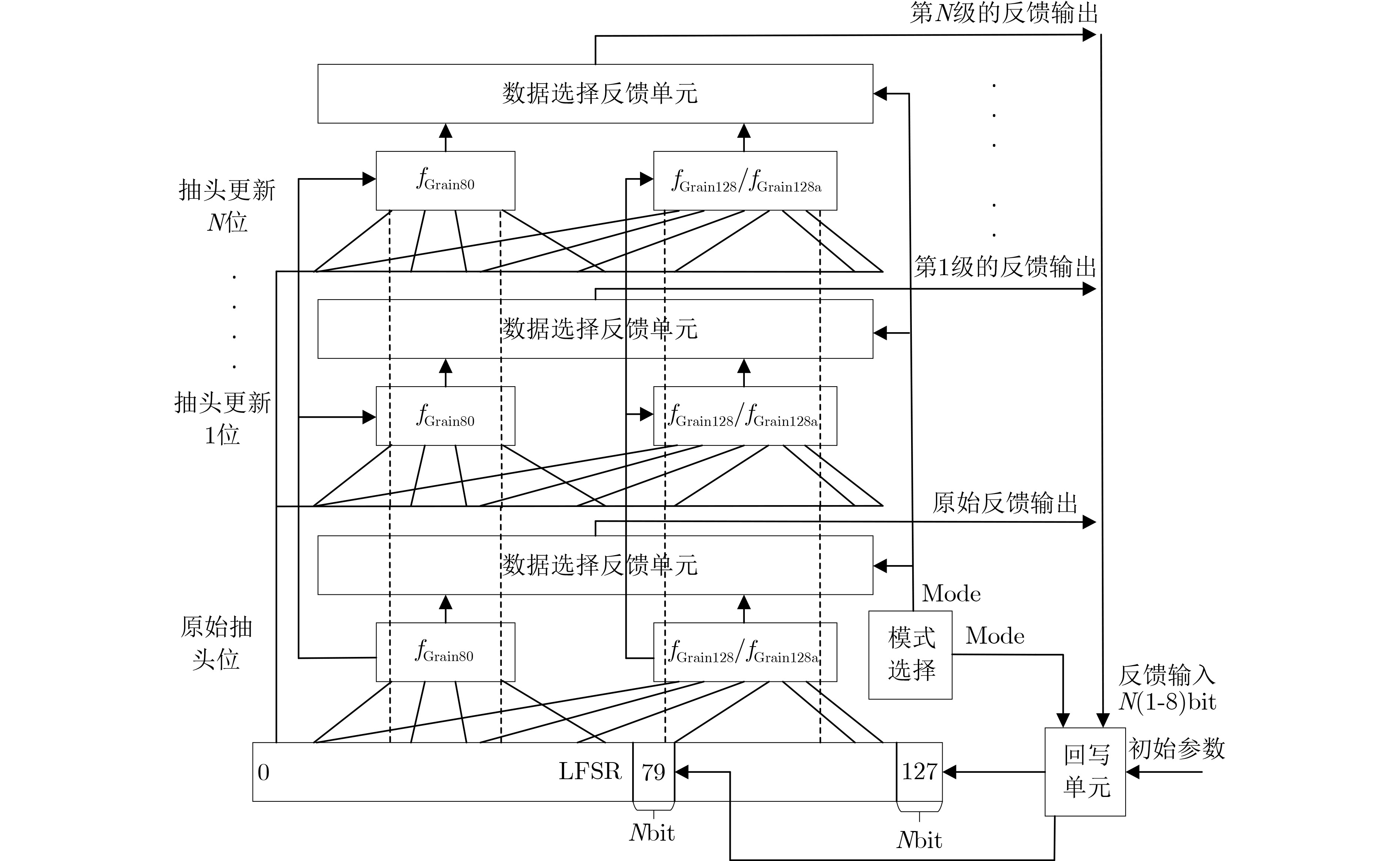
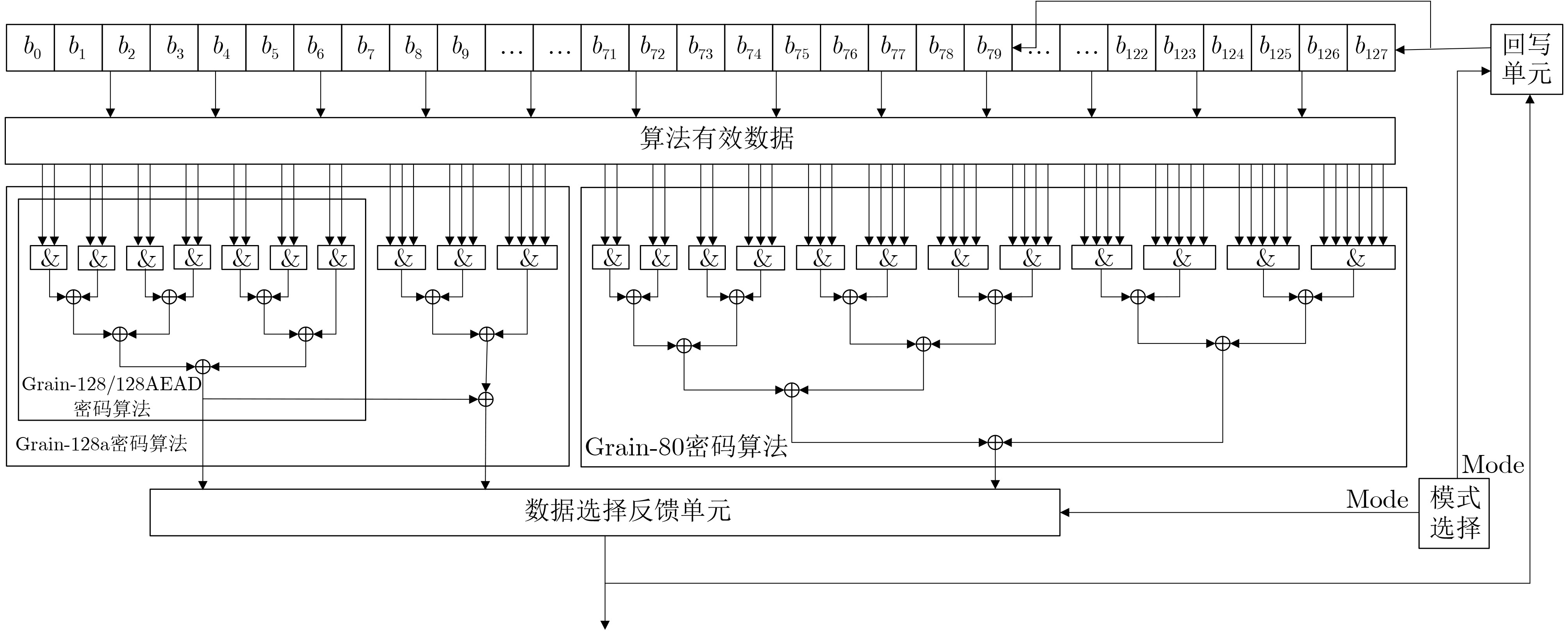
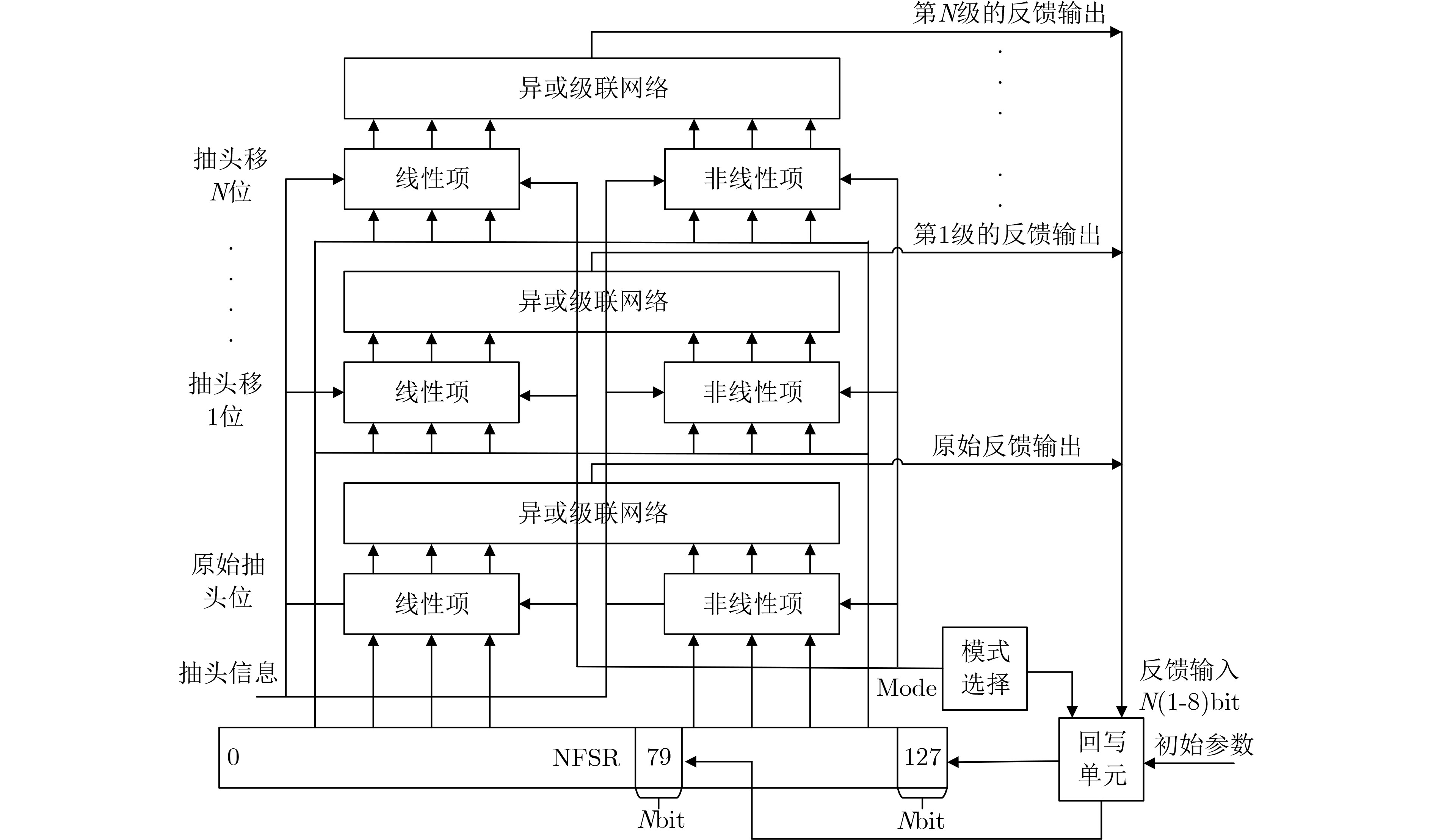
摘要: Grain系列密码算法广泛应用于射频识别(RFID)、物联网等资源受限的硬件环境,但通用处理器(GPP)实现性能低,专用集成电路(ASIC)实现灵活性差且成本高。针对该问题,该文采用专用指令扩展方式,提出一种基于RISC-V协处理器的Grain密码算法可重构并行化实现方案。该方案分析Grain系列算法中线性反馈移位寄存器和非线性反馈移位寄存器结构共性与差异,采用相同移位寄存器架构与面向算法的抽头网络,设计可重构并行化实现架构及相应的扩展指令,可高效支持Grain-80, Grain-128, Grain-128a与Grain-128AEAD 4种算法,并行粒度1~8灵活可调。实验结果表明,与无指令扩展的软件实现相比,基于蜂鸟E203平台,该方案完成密码处理流程的时钟周期数与指令条数由数万级降至129个与53条,吞吐率由0.33~9.18 Mbit/(s·Hz)提升至约200 Mbit/(s·Hz);硬件综合表明,该方案在65 nm工艺下面积为
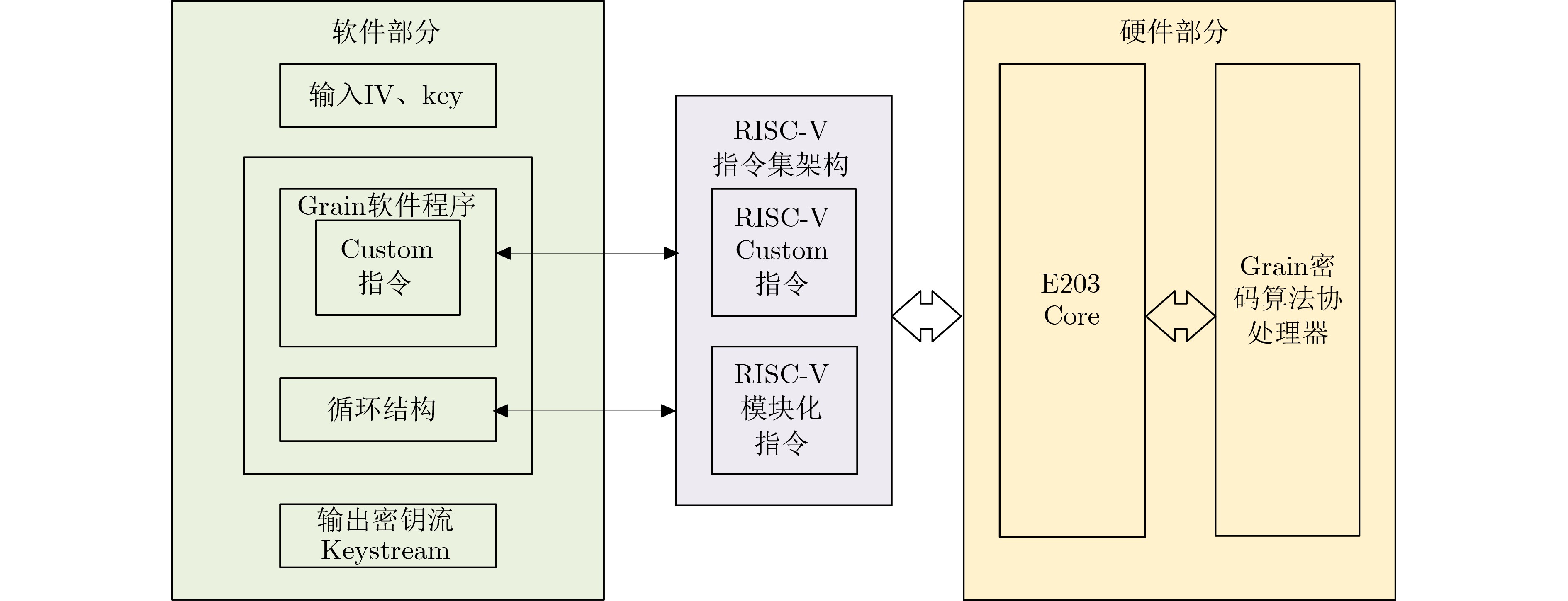
7252.55 μm2,吞吐率达1.56 Gbit/(s·Hz),虽较单算法ASIC实现面积略有增加,但可在同一架构上支持4种算法。该文所提实现方案在灵活性、处理效率与硬件开销之间实现了良好平衡。Abstract:Objective To address the performance limitations of Grain cryptographic algorithms on General-Purpose Processors (GPPs), as well as the inflexibility and high hardware overhead of Application-Specific Integrated Circuit (ASIC) implementations, a dedicated cryptographic hardware accelerator is integrated into an RISC-V coprocessor through a custom instruction extension mechanism. A reconfigurable parallelized architecture is proposed for the Grain algorithm family based on the RISC-V coprocessor interface. Corresponding custom instructions are designed to support the flexible and efficient execution of Grain-80, Grain-128, Grain-128a, and Grain-128AEAD on a unified hardware platform. The proposed architecture provides a favorable balance between processing efficiency, design flexibility, and hardware resource overhead, making it suitable for resource-constrained embedded systems. Methods A unified shift-register architecture is adopted to support flexible switching among Grain-80, Grain-128, Grain-128a, and Grain-128AEAD, with a configurable parallelization degree of 1 to 8. To implement the custom instructions for the Grain cryptographic algorithms, the software and hardware functions are analyzed, and the cryptographic process is divided between the processor and coprocessor to achieve efficient execution. The proposed coprocessor uses a streamlined architecture that reuses common hardware resources across the four algorithms. Combined with a configurable feedback tap selection network and feedback logic tailored to a predefined set of algorithms, the architecture enables reconfigurable parallel execution with limited additional hardware resource overhead. Results and Discussions The proposed custom instructions enable flexible implementation of four Grain cryptographic algorithms on the same hardware platform. Compared with implementations without instruction extensions, the proposed custom instructions reduce the number of clock cycles and instructions required for cryptographic processing while improving throughput ( Table 5 ). On the Hummingbird E203 platform with a parallelization degree of 4, the proposed implementation requires 105, 129, and 183 clock cycles for Grain-80, Grain-128/Grain-128a, and Grain-128AEAD, respectively, with corresponding throughputs of 220.67, 179.74, and 126.70 Mbit/(s·Hz). Compared with purely software-based implementations, the proposed approach substantially reduces both the number of executed instructions and the number of clock cycles (Table 5 ). Synthesis results further demonstrate that the coprocessor occupies 7 252.55 μm² in a 65 nm process and achieves a throughput of 1.56 Gbit/(s·Hz) at a parallelization degree of 4. Although the reconfigurable architecture requires slightly more area than a dedicated single-algorithm implementation, it supports four Grain algorithms on a unified hardware platform and provides improved hardware resource reuse and design flexibility.Conclusions A hardware-software cooperative reconfigurable parallelization scheme is designed to accelerate the Grain cryptographic algorithm family in lightweight embedded systems. The scheme exploits the RISC-V custom instruction extension mechanism and combines a unified shift-register architecture, a configurable feedback tap selection network, and feedback logic tailored to a predefined set of algorithms. Four algorithms, namely Grain-80, Grain-128, Grain-128a, and Grain-128AEAD, can therefore be flexibly selected and processed in parallel on a single hardware platform. This design improves processing efficiency while maintaining design flexibility and limiting hardware resource overhead. The present work focuses on reconfigurable parallelization for the Grain algorithm family. Future research will investigate more general reconfigurable architectures for nonlinear Boolean functions by incorporating configurable units, such as LookUp Tables (LUTs) or programmable logic arrays. Such architectures may further improve compatibility with multiple stream cipher algorithms while maintaining high throughput and low hardware resource overhead. -
表 1 硬件加速器的自定义扩展指令集
专用指令名称 内嵌汇编指令 功能 start_80 asm volatile(“.insn r 0x0b,0,7,x0,x0,x0”:“=r”(zero)) 启动Grain-80算法 start_128/128AEAD asm volatile(“.insn r 0x0b,0,15,x0,x0,x0”:“=r”(zero)) 启动Grain-128算法或
Grain-128AEAD算法start_128a asm volatile(“.insn r 0x0b,0,23,x0,x0,x0”:“=r”(zero)) 启动Grain-128a算法 data_load_I asm volatile(“.insn r 0x0b,3,0,x0,%1,%2”:“=r”(zero):“r”(lfsr[31:0]),“r”(nfsr[31:0])) 第1轮参数输入 data_load_II asm volatile(“.insn r 0x0b,3,1,x0,%1,%2”:“=r”(zero):“r”(lfsr[63:32]),“r”(nfsr[63:32])) 第2轮参数输入 data_load_III asm volatile(“.insn r 0x0b,3,2,x0,%1,%2”:“=r”(zero):“r”(lfsr[95:33]),“r”(nfsr[95:33])) 第3轮参数输入 data_load_IV asm volatile(“.insn r 0x0b,3,3,x0,%1,%2”:“=r”(zero):“r”(lfsr[127:96]),“r”(nfsr[127:96])) 第4轮参数输入 initial_80 asm volatile(“.insn r 0x0b,0,2,x0,x0,x0”:“=r”(zero)) 执行FSR指定轮的预热 initial_128/128a asm volatile(“.insn r 0x0b,0,10,x0,x0,x0”:“=r”(zero)) 执行FSR指定轮的预热 initial_128AEAD asm volatile(“.insn r 0x0b,0,18,x0,x0,x0”:“=r”(zero)) 执行FSR指定轮的预热 repeat_initial asm volatile(“.insn r 0x0b,0,19,x0,x0,x0”:“=r”(zero)) 执行密钥重引入 read_data_80 asm volatile(“.insn r 0x0b,4,0,%0,x0,x0”:“=r”(product)) 将密钥写入目的寄存器 read_data_128/128a asm volatile(“.insn r 0x0b,4,8,%0,x0,x0”:“=r”(product)) read_data_128AEAD asm volatile(“.insn r 0x0b,4,16,%0,x0,x0”:“=r”product))  下载: 导出CSV
表 2 协处理器各模块资源使用情况
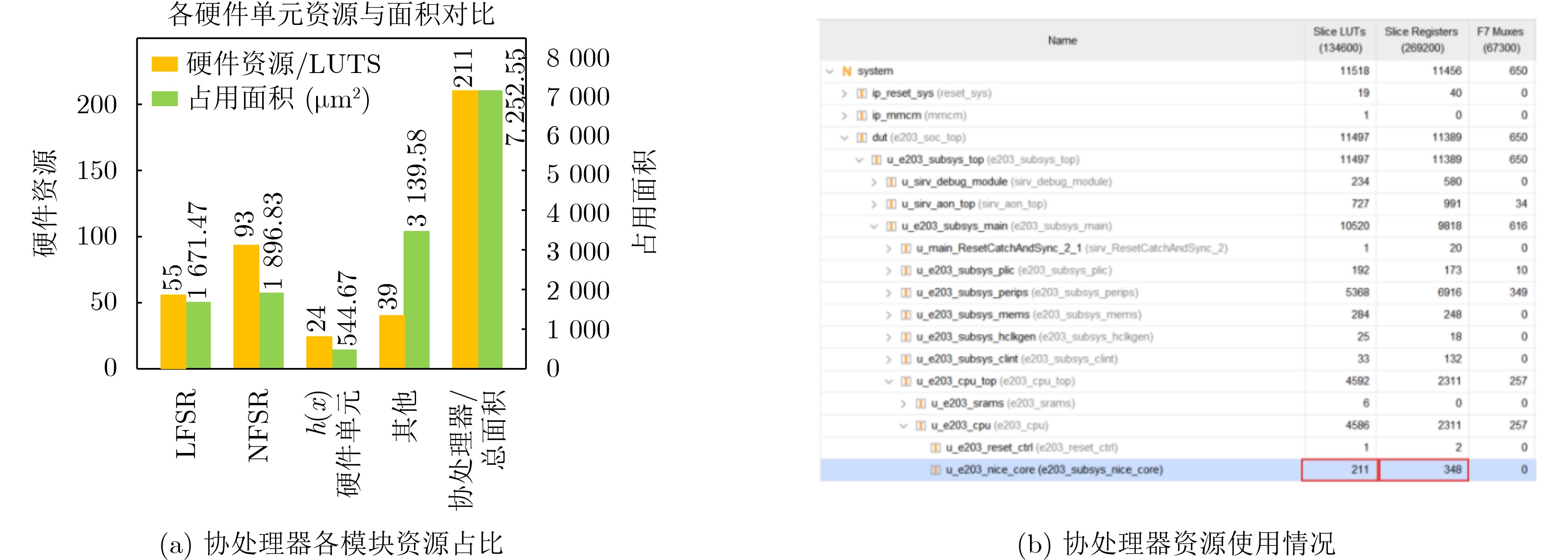
硬件单元 硬件资源(LUTs) 触发器(FFs) LFSR 55 (26.1%) 128 NFSR 93 (44.2%) 128 密钥流生成模块h(x) 24 (11.3%) 0 其他 39 (18.4%) 92 协处理器 211 (100%) 348
下载: 导出CSV
表 3 协处理器各模块资源占用情况
硬件单元 占用面积(μm2) 标准单元数(个) LFSR 1671.47 297 NFSR 1896.83 384 密钥流生成模块h(x) 544.67 192 其他 3139.58 794 协处理器 7252.55 1667
下载: 导出CSV
表 4 不同平台下的性能对比
实现方案 密码算法 实现方式 并行度 吞吐率
(Mbit/(s·Hz))时钟周期数
(cycle)指令数
(instrets)执行时间
(μs)无扩展指令 Grain-80 纯软件 4 0.646 35868 28963 358.68 Grain-128/128a 纯软件 4 0.474 48918 39208 489.18 Grain-128AEAD 纯软件 4 0.334 69412 52868 694.12 有扩展指令 Grain-80 软硬件协同 4 220.67 105 53 1.05 Grain-128/128a 软硬件协同 4 179.74 129 53 1.29 Grain-128AEAD 软硬件协同 4 126.70 183 61 1.83 文献[9] Grain-80 Intel 1 46.12 25590 20606 7.31 Grain-80 MSM8660 1 12.31 27843 22447 11.65 Grain-128 Intel 1 26.54 40788 32894 16.38 Grain-128 MSM8660 1 6.05 44431 35832 26.14
下载: 导出CSV
表 5 不同RISC-V平台的性能对比
实现平台 有无扩展指令 密码算法 时钟周期数
(cycle)吞吐率
(Mbit/(s·Hz))蜂鸟E203 无扩展指令 Grain-80 35868 0.646 Grain-128/128a 48918 0.474 Grain-128AEAD 69412 0.334 有扩展指令 Grain-80 105 220.67 Grain-128/128a 129 179.74 Grain-128AEAD 183 126.70 CVA6 无扩展指令 Grain-80 26058 0.889 Grain-128/128a 34337 0.675 Grain-128AEAD 50436 0.459 有扩展指令 Grain-80 72 321.81 Grain-128/128a 96 241.53 Grain-128AEAD 159 145.82 Rocket 无扩展指令 Grain-80 29652 0.781 Grain-128/128a 37694 0.615 Grain-128AEAD 53804 0.431 有扩展指令 Grain-80 96 241.36 Grain-128/128a 118 196.5 Grain-128AEAD 172 134.8
下载: 导出CSV
表 6 不同实现工艺的结果对比
实现方案 密码算法 工艺/器件 并行度 频率(MHz) 吞吐率(Gbit/(s·Hz)) 面积 门电路总数(个) 本文方案 可重构Grain ASIC 65nm 4 392 1.56 7252.55 μm2- 8 392 3.12 文献[4] Grain-80 ALTERA MAX II
EPM570T100C31 200 0.2 - 1435 2 211 0.422 - 1607 4 158 0.632 - 1950 8 148 1.18 - 2636 16 133 2.12 - 4008 文献[5] Grain-80 ASIC 90 nm 4 2800 11.2 5984 μm2- ASIC 90 nm 8 2300 18.4 8658 μm2- Grain-128 ASIC 90 nm 4 3000 12.0 7316 μm2- ASIC 90 nm 8 2900 23.2 9450 μm2- 文献[6] Grain-80 Virtex 7 1 592 0.592 169 slices - Virtex 7 16 571 9.14 180 slices - 文献[7] Grain-80 Artix-7 1 543 0.543 99 slices - Artix-7 16 543 8.69 1121 slices- 文献[8] 可重构Grain80/128 Altera Cyclone EP1C12 1 220 0.220 332 LE - 16 140 2.24 552 LE - ASIC 0.18μm 1 330 0.330 11967 μm2- 16 218 3.48 22543 μm2-
下载: 导出CSV
-
[1] ZHU Yufei, XING Zuocheng, XUE Jinhui, et al. Area-efficient parallel reconfigurable stream processor for symmetric cryptograph[J]. IEEE Access, 2021, 9: 28377–28392. doi: 10.1109/ACCESS.2021.3057866. [2] 陈艺文. 基于Grain类算法结构的流密码设计与分析[D]. [硕士论文], 桂林电子科技大学, 2023. doi: 10.27049/d.cnki.ggldc.2023.001518.CHEN Yiwen. Design and analysis of stream ciphers based on grain-like algorithm structure[D]. [Master dissertation], Guilin University of Electronic Technology, 2023. doi: 10.27049/d.cnki.ggldc.2023.001518. [3] MANSOURI S S and DUBROVA E. An improved hardware implementation of the grain stream cipher[C]. The 2010 13th Euromicro Conference on Digital System Design: Architectures, Methods and Tools, Lille, France, 2010: 433–440. doi: 10.1109/DSD.2010.49. [4] LI Wei, ZENG Xiaoyang, DAI Zibin, et al. A high energy-efficient reconfigurable VLIW symmetric cryptographic processor with loop buffer structure and chain processing mechanism[J]. Chinese Journal of Electronics, 2017, 26(6): 1161–1167. doi: 10.1049/cje.2017.06.010. [5] ANANTH R, RAO P R M V, and RAMAIAH N S. An efficient Grain-80 stream cipher with unrolling features to enhance the throughput on hardware platform[J]. Indonesian Journal of Electrical Engineering and Computer Science, 2024, 33(1): 218–226. doi: 10.11591/ijeecs.v33.i1.pp218-226. [6] GILL V K, CHENNA R T, KANDULA N K, et al. High throughput efficient implementation of grain v1, lizard and plantlet stream ciphers for resource constraint devices[J]. International Journal of Computing and Digital Systems, 2022, 12(1): 1051–1061. doi: 10.12785/ijcds/120184. [7] LI Bohan, ZHANG Hailong, and LIN Dongdai. Efficient (masked) hardware implementation of grain-128AEADv2[J]. Security and Communication Networks, 2023, 2023(1): 8044164. doi: 10.1155/2023/8044164. [8] MANSOURI S S and DUBROVA E. An improved hardware implementation of the grain-128a stream cipher[C]. International Conference on Information Security and Cryptology, Seoul, Korea, 2013: 278–292. doi: 10.1007/978-3-642-37682-5_20. [9] NAN Longmei, YANG Xuan, ZENG Xiaoyang, et al. A VLIW architecture stream cryptographic processor for information security[J]. China Communications, 2019, 16(6): 185–199. doi: 10.23919/jcc.2019.06.015. [10] 刘小罗, 林洪怡, 刘盼. RISC-V指令集架构及其应用综述[J]. 中国集成电路, 2025, 34(3): 16–20,49. doi: 10.3969/j.issn.1681-5289.2025.03.003.LIU Xiaoluo, LIN Hongyi, and LIU Pan. An overview of the RISC-V instruction set architecture and its applications[J]. China Integrated Circuit, 2025, 34(3): 16–20,49. doi: 10.3969/j.issn.1681-5289.2025.03.003. [11] 李伟, 别梦妮, 陈韬, 等. RISCV密码专用处理器能效概率模型与体系结构研究[J]. 电子与信息学报, 2021, 43(6): 1541–1549. doi: 10.11999/JEIT210004.LI Wei, BIE Mengni, CHEN Tao, et al. Research on energy efficiency probability model and architecture of RISCV cryptographic processor[J]. Journal of Electronics & Information Technology, 2021, 43(6): 1541–1549. doi: 10.11999/JEIT210004. [12] 于斌, 闵玉新, 张自豪, 等. 基于RISC-V指令扩展的双线性对协处理器设计[J]. 电子与信息学报, 2025, 47(9): 3137–3145. doi: 10.11999/JEIT250367.YU Bin, MIN Yuxin, ZHANG Zihao, et al. Design of a bilinear pairing coprocessor based on RISC-V instruction extension[J]. Journal of Electronics & Information Technology, 2025, 47(9): 3137–3145. doi: 10.11999/JEIT250367. [13] 王明登, 严迎建, 郭朋飞, 等. 基于RISC-V指令扩展方式的国密算法SM2、SM3和SM4的高效实现[J]. 电子学报, 2024, 52(8): 2850–2865. doi: 10.12263/DZXB.20230391.WANG Mingdeng, YAN Yingjian, GUO Pengfei, et al. Efficient implementation of national security algorithms SM2, SM3, and SM4 based on RISC-V instruction extension method[J]. Acta Electronica Sinica, 2024, 52(8): 2850–2865. doi: 10.12263/DZXB.20230391. [14] 李伟, 陈億, 陈韬, 等. 面向边缘计算的可重构CNN协处理器研究与设计[J]. 电子与信息学报, 2024, 46(4): 1499–1512. doi: 10.11999/JEIT230509.LI Wei, CHEN Yi, CHEN Tao, et al. A research and design of reconfigurable CNN co-processor for edge computing[J]. Journal of Electronics & Information Technology, 2024, 46(4): 1499–1512. doi: 10.11999/JEIT230509. [15] HELL M, JOHANSSON T, MAXIMOV A, et al. Grain-128AEADv2: Strengthening the initialization against key reconstruction[C]. 20th International Conference on Cryptology and Network Security, Vienna, Austria, 2021: 24–41. doi: 10.1007/978-3-030-92548-2_2. [16] 陈韬, 赵旺鹏, 别梦妮, 等. 格基后量子密码双域可重构多项式乘法运算单元架构研究[J]. 电子与信息学报, 2026, 48(4): 1646–1658. doi: 10.11999/JEIT250929.CHEN Tao, ZHAO Wangpeng, BIE Mengni, et al. Research on the architecture of dual-field reconfigurable polynomial multiplication unit for lattice-based post-quantum cryptography[J]. Journal of Electronics & Information Technology, 2026, 48(4): 1646–1658. doi: 10.11999/JEIT250929. [17] 李伟. 面向序列密码的反馈移位寄存器可重构并行化设计技术研究[D]. [硕士论文], 解放军信息工程大学, 2009.LI Wei. Research on technology of reconfigurable parallel feedback shift register targeted at stream ciphers[D]. [Master dissertation], PLA Information Engineering University, 2009. -

 下载:
下载:

图(9) / 表(6)
计量
- 文章访问数: 482
- HTML全文浏览量: 171
- PDF下载量: 17
- 被引次数: 0
