




A Lightweight True Random Number Generator Based on Chain-Coupled Oscillation Rings
-
摘要: 真随机数发生器(TRNG)作为一种重要的硬件安全原语,通过提取物理随机变量产生无法预测的真随机序列,为安全系统构建硬件可信根。然而,为了提升TRNG的随机性,往往需要引入大量熵源,导致整体硬件开销较高。为解决这一问题,本文提出一种基于链式耦合振荡环的轻量级TRNG。首先,通过推导伽罗瓦振荡环的状态方程,分析不规则振荡机理,为熵源电路设计提供指导。然后,设计延迟反馈异或环,以此构建链式熵源电路,并进行不规则振荡行为建模。最后通过实验验证,所提出的TRNG通过了NIST SP 800-22和NIST SP 800-90B测试,在Xilinx Artix-7 FPGA上的吞吐量为200Mbps,且硬件开销仅为11个LUT和4个DFF,在资源受限的轻量级场景具有良好的应用前景。Abstract:
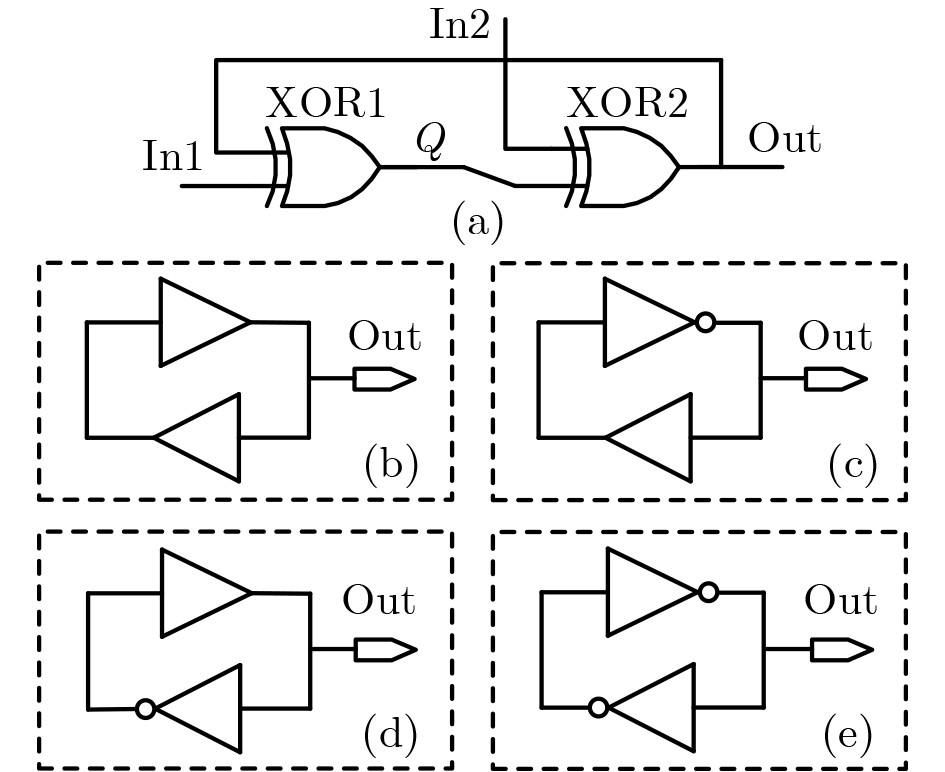
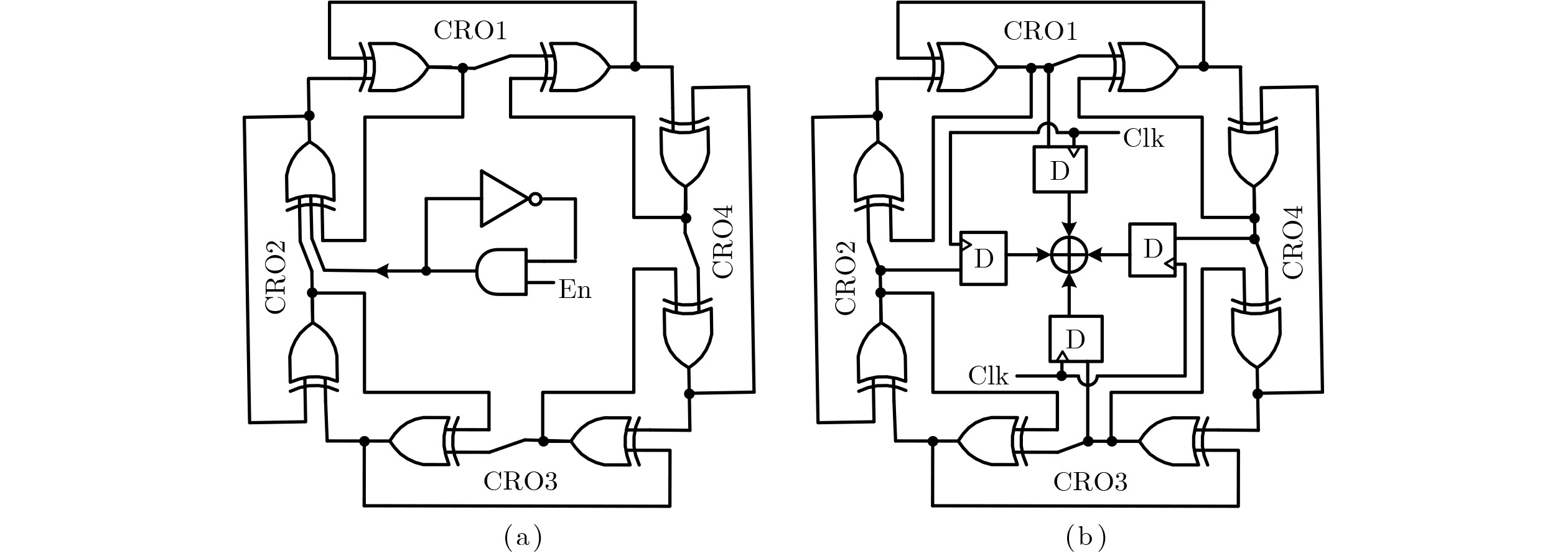
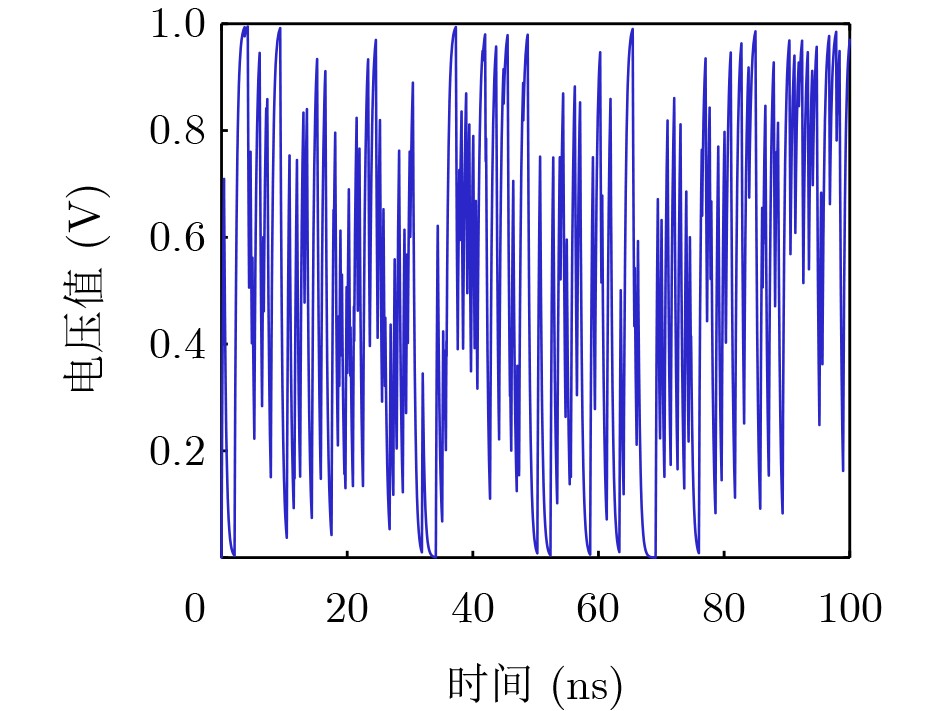
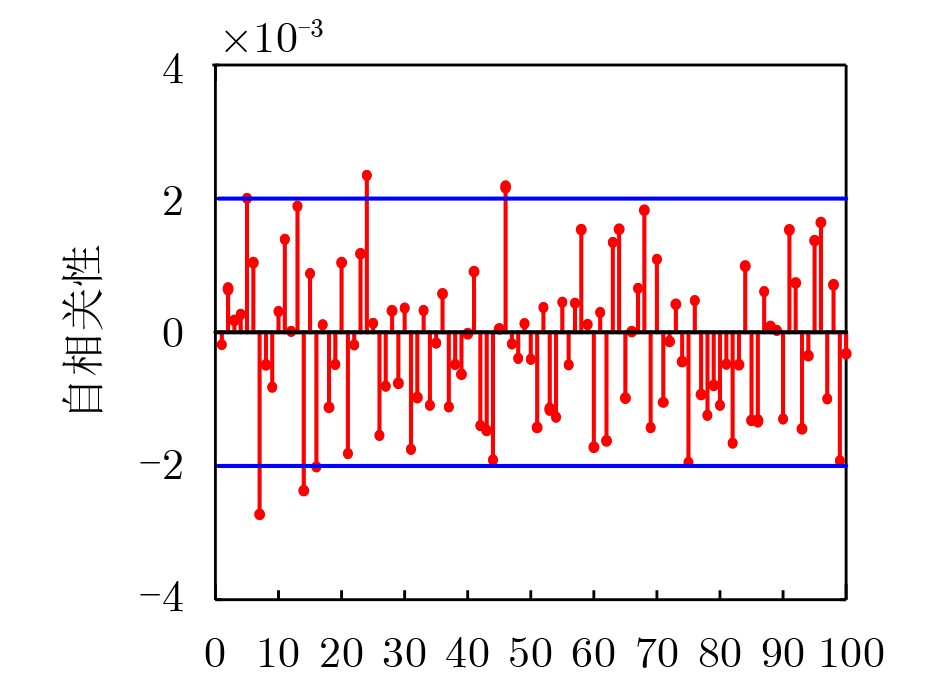
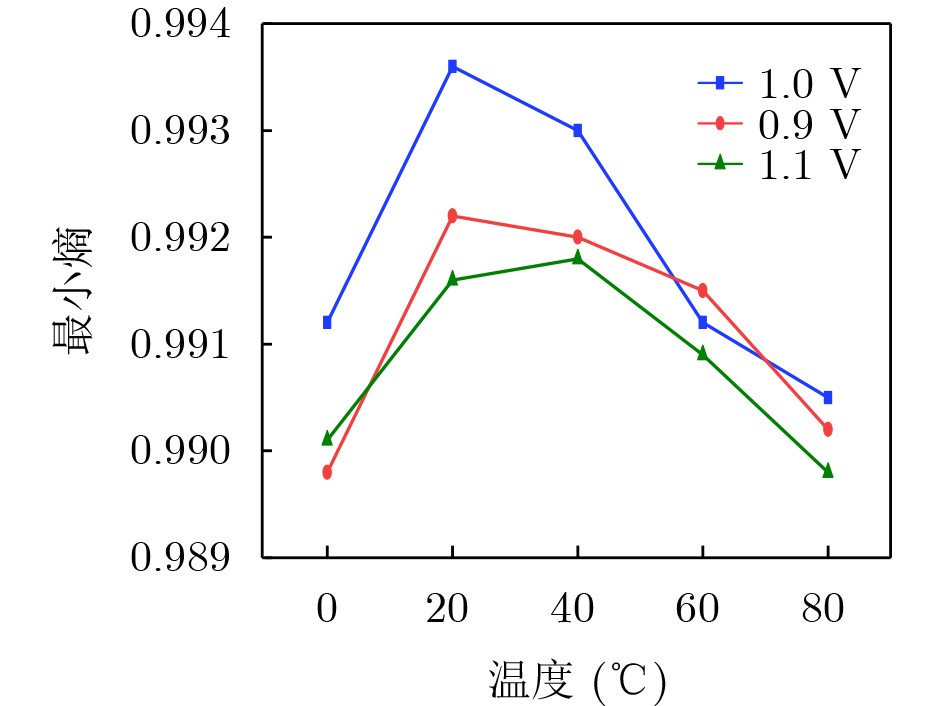
Objective With the rapid growth of the Internet of Things, 5G/6G, and satellite Internet, resource-constrained devices increasingly require high-quality random numbers for key generation, authentication, masking, and other security functions. Although pseudo-random number generators are efficient, their outputs may be predictable once the seed or internal state is compromised. True random number generators (TRNGs) offer a hardware root of trust by extracting entropy from physical randomness, but many existing designs rely on multiple entropy sources or complex post-processing, leading to increased area and power consumption. To address this issue, this paper proposes a lightweight TRNG based on chain-coupled oscillation rings for high-quality randomness with very low FPGA overhead. Methods Starting from the state evolution of a Galois oscillation ring (GARO), this work demonstrates that ideal matched-delay conditions can result in periodic and predictable oscillation. However, in practical circuits, delay mismatch, jitter, and process variation disturb the ideal evolution and can be exploited as entropy sources. On this basis, a compact delay-feedback XOR ring is proposed to enhance state uncertainty, introduce feedback competition, and improve randomness through inter-stage delay differences. In addition, a second-order oscillation ring is incorporated to eliminate the all-zero stop state and provide continuous excitation. Multiple rings are then chain-coupled, enabling adjacent rings to mutually interfere with one another and thereby generate stronger irregular oscillations. The proposed design is modeled in MATLAB and implemented on a Xilinx Artix-7 FPGA. Finally, we evaluate its performance by NIST SP 800-22, NIST SP 800-90B, bias, autocorrelation, and voltage-temperature robustness tests. Results and Discussions Simulation confirms that the proposed structure avoids stable periodic locking and produces sustained irregular oscillation. Experimental results show that the TRNG passes all NIST SP 800-22 tests and achieves an average minimum entropy of 0.9936 in NIST SP 800-90B test, outperforming conventional RO and GARO-based TRNGs under similar conditions. The measured bias is only0.0228 %, and the autocorrelation remains well below the threshold, indicating excellent statistical independence. The design also maintains high entropy over temperatures from 0 °C to 80 °C and supply voltages from 0.9 V to 1.1 V. Implemented on Artix-7, our proposed TRNG achieves 200 Mbps throughput using only 11 LUTs and 4 DFFs, with 0.108 W power consumption.Conclusions This paper presents a lightweight chain-coupled oscillation-ring TRNG that exploits delay mismatch, phase disturbance, and feedback competition to generate high-quality physical randomness. The theoretical analysis clarifies how practical nonidealities transform ideal periodic oscillation into irregular oscillation, providing a design basis for compact oscillator-based entropy sources. By combining delay-feedback XOR rings with chain-coupled mutual disturbance and continuous excitation, the proposed design enhances entropy while avoiding excessive hardware overhead and complex post-processing. FPGA implementation and statistical evaluations verify high entropy, low bias, and high randomness under voltage and temperature variations. Therefore, the proposed TRNG achieves high randomness quality and high throughput while effectively reducing hardware overhead, making it suitable for resource-constrained security applications such as IoT terminals, lightweight cryptographic modules, and embedded authentication systems. -
表 1 NIST SP 800-22测试结果
NIST SP 800‐22 P-value Prop Frequency 0.122325 9/10 Block Frequency 0.122325 10/10 Cumulative Sums* 0.534146 9/10 Runs 0.534146 10/10 Longest Run 0.739918 10/10 Rank 0.534146 10/10 FFT 0.534146 10/10 Non-Overlapping Template* 0.350485 10/10 Overlapping Template 0.534146 10/10 Universal 0.739918 10/10 Approximate Entropy 0.122325 10/10 Random Excursions* 0.122325 4/4 Random Excursions Variant* 0.534146 4/4 Serial* 0.350485 10/10 Linear Complexity 0.350485 10/10  下载: 导出CSV
表 2 NIST SP 800-90B测试结果
NIST SP 800-90B p-max h-min MCV 0.501419 0.995911 Collision 0.535156 0.901968 Markov 3.5811E-39 0.997772 Compression 0.5 1 t-Tuple 0.52187 0.938238 LRS 0.527233 0.923488 MultiMCW 0.500626 0.998193 Lag Prediction 0.501736 0.995001 MultiMMC 0.501556 0.995517 LZ78Y 0.500495 0.998571
下载: 导出CSV
表 3 TRNG综合性能对比
TRNG结构 硬件平台 吞吐量(Mbps) 功耗(W) 硬件开销 能效 文献[26] Artix-7 80 — 866LUTs — 文献[27] Artix-7 100 0.119 38LUTs / 121DFF 66.34 文献[28] Artix-7 1.25 0.023 152 LUTs / 16 DFFs 0.36 文献[29] Artix-7 275.8 0.049 24 LUTs / 33 DFFs 234.52 文献[30] Artix-7 620 0.068 23 LUTs / 14 DFFs / 4 MUXs 396.42 文献[31] Artix-7 150 0.124 12 LUTs / 10 DFFs 100.80 本文 Artix-7 200 0.108 11 LUTs / 4 DFFs 168.35
下载: 导出CSV
-
[1] SINHA S. State of IoT 2024: Number of connected IoT devices growing 13% to 18.8 billion globally[EB/OL]. https://iot-analytics.com/number-of-connected-iot-devices-2024/, 2024. [2] ZHANG Yuan and ZHANG Jiliang. MCT-TRNG: Multi-channel tetrahedral TRNG via metastability-enhanced entropy with 2.2 Gbps throughput[J]. ACM Transactions on Reconfigurable Technology and Systems, 2026, 19(7): 7. doi: 10.1145/3779443. [3] TRUONG N D, HAW J Y, ASSAD S M, et al. Machine learning cryptanalysis of a quantum random number generator[J]. IEEE Transactions on Information Forensics and Security, 2019, 14(2): 403–414. doi: 10.1109/TIFS.2018.2850770. [4] ZHANG Yuan, ZHONG Kuncai, and ZHANG Jiliang. High throughput and compact FPGA TRNGs based on hybrid entropy, reinforcement strategies, and automated exploration[J]. IEEE Transactions on Computer-Aided Design of Integrated Circuits and Systems, 2026, 45(1): 519–532. doi: 10.1109/TCAD.2025.3572838. [5] ZHANG Ruilin, CAO Ye, ZHANG Haochen, et al. Entropy improvement in latch-based true random number generator using negative bias temperature instability[J]. IEEE Transactions on Circuits and Systems I: Regular Papers, 2026, 73(4): 2585–2594. doi: 10.1109/TCSI.2025.3621604. [6] 倪天明, 俞俊勇, 彭青松, 等. 基于亚稳态叠加单元的高吞吐量真随机数发生器设计[J]. 电子与信息学报, 2024, 46(5): 2289–2297. doi: 10.11999/JEIT231166.NI Tianming, YU Junyong, PENG Qingsong, et al. Design of high throughput true random number generator based on metastability superposition cells[J]. Journal of Electronics & Information Technology, 2024, 46(5): 2289–2297. doi: 10.11999/JEIT231166. [7] KIM M, HA U, LEE K J, et al. A 82-nW chaotic map true random number generator based on a sub-ranging SAR ADC[J]. IEEE Journal of Solid-State Circuits, 2017, 52(7): 1953–1965. doi: 10.1109/JSSC.2017.2694833. [8] HOLCOMB D E, BURLESON W P, and FU K. Power-up SRAM state as an identifying fingerprint and source of true random numbers[J]. IEEE Transactions on Computers, 2009, 58(9): 1198–1210. doi: 10.1109/TC.2008.212. [9] LIU N, PINCKNEY N, HANSON S, et al. A true random number generator using time-dependent dielectric breakdown[C]. 2011 Symposium on VLSI Circuits - Digest of Technical Papers, Kyoto, Japan, 2011: 216–217. [10] LU Yingchun, XU Enpu, LIU Yujie, et al. Ultra-high efficiency TRNG IP based on mesh topology of coupled-XOR[J]. IEEE Transactions on Circuits and Systems I: Regular Papers, 2025, 72(6): 2754–2767. doi: 10.1109/TCSI.2025.3555325. [11] FUJIMOTO D, OSUKA S, OZAKI K, et al. Randomness evaluation method of an RO-based TRNG using amplitude probability distribution[J]. IEEE Transactions on Electromagnetic Compatibility, 2025, 67(5): 1444–1449. doi: 10.1109/TEMC.2025.3575089. [12] CUI Jianguo, YI Maoxiang, CAO Di, et al. Design of true random number generator based on multi-stage feedback ring oscillator[J]. IEEE Transactions on Circuits and Systems II: Express Briefs, 2022, 69(3): 1752–1756. doi: 10.1109/TCSII.2021.3111049. [13] NALLA ANANDAKUMAR N, SANADHYA S K, and HASHMI M S. FPGA-based true random number generation using programmable delays in oscillator-rings[J]. IEEE Transactions on Circuits and Systems II: Express Briefs, 2020, 67(3): 570–574. doi: 10.1109/TCSII.2019.2919891. [14] GRUJIĆ M and VERBAUWHEDE I. TROT: A three-edge ring oscillator based true random number generator with time-to-digital conversion[J]. IEEE Transactions on Circuits and Systems I: Regular Papers, 2022, 69(6): 2435–2448. doi: 10.1109/TCSI.2022.3158022. [15] MEI Faqiang, ZHANG Lei, GU Chongyan, et al. A highly flexible lightweight and high speed true random number generator on FPGA[C]. 2018 IEEE Computer Society Annual Symposium on VLSI (ISVLSI), Hong Kong, China, 2018: 399–404. doi: 10.1109/ISVLSI.2018.00079. [16] CHEN Yu, LIANG Huaguo, ZHANG Linghui, et al. High throughput dynamic dual entropy source true random number generator based on FPGA[J]. Microelectronics Journal, 2024, 145: 106113. doi: 10.1016/j.mejo.2024.106113. [17] EPSTEIN M, HARS L, KRASINSKI R, et al. Design and implementation of a true random number generator based on digital circuit artifacts[C]. Proceedings of 5th International Workshop on Cryptographic Hardware and Embedded Systems -- CHES 2003, Cologne, Germany, 2003: 152–165. doi: 10.1007/978-3-540-45238-6_13. [18] AHMED H O, REDIF S, and LI Yongfu. TeLo-ROPN TRNG: FPGA-based true random number generation using tent and logistic chaotic maps with ring oscillator array[J]. IEEE Transactions on Circuits and Systems I: Regular Papers, 2026, 73(5): 3532–3545. doi: 10.1109/TCSI.2025.3636579. [19] LIU Dongsheng, LIU Zilong, LI Lun, et al. A low-cost low-power ring oscillator-based truly random number generator for encryption on smart cards[J]. IEEE Transactions on Circuits and Systems II: Express Briefs, 2016, 63(6): 608–612. doi: 10.1109/tcsii.2016.2530800. [20] GOLIC J D J. New methods for digital generation and postprocessing of random data[J]. IEEE Transactions on Computers, 2006, 55(10): 1217–1229. doi: 10.1109/TC.2006.164. [21] DICHTL M. Fibonacci ring oscillators as true random number generators - a security risk[EB/OL]. https://eprint.iacr.org/2015/270, 2015. [22] SCHRAMM M, DOJEN R, and HEIGL M. Experimental assessment of FIRO- and GARO-based noise sources for digital TRNG designs on FPGAs[C]. 2017 International Conference on Applied Electronics (AE), Pilsen, Czech Republic, 2017: 1–6. doi: 10.23919/AE.2017.8053618. [23] GONG Lishuang, ZHANG Jianguo, SANG Luxiao, et al. The unpredictability analysis of Boolean chaos[J]. IEEE Transactions on Circuits and Systems II: Express Briefs, 2020, 67(10): 1854–1858. doi: 10.1109/TCSII.2019.2949571. [24] YAO Liang, KANG Peiyang, SHI Deqin, et al. IRCA-TRNG: A lightweight dual-ring chaotic TRNG with perturbation refresh for high throughput[J]. IEEE Transactions on Very Large Scale Integration (VLSI) Systems, 2025, 33(12): 3329–3340. doi: 10.1109/TVLSI.2025.3608292. [25] 张源, 罗静茹, 张吉良. SDL PUF: 高可靠自适应偏差锁定PUF电路[J]. 电子与信息学报, 2024, 46(5): 2274–2280. doi: 10.11999/JEIT231313.ZHANG Yuan, LUO Jingru, and ZHANG Jiliang. SDL PUF: A high reliability self-adaption deviation locking PUF[J]. Journal of Electronics & Information Technology, 2024, 46(5): 2274–2280. doi: 10.11999/JEIT231313. [26] DEMIR K and ERGUUN S. Random number generators based on irregular sampling and Fibonacci–Galois ring oscillators[J]. IEEE Transactions on Circuits and Systems II: Express Briefs, 2019, 66(10): 1718–1722. doi: 10.1109/TCSII.2019.2933280. [27] FRUSTACI F, SPAGNOLO F, PERRI S, et al. A high-speed FPGA-based true random number generator using metastability with clock managers[J]. IEEE Transactions on Circuits and Systems II: Express Briefs, 2023, 70(2): 756–760. doi: 10.1109/TCSII.2022.3211278. [28] PRATIHAR K, CHATTERJEE U, ALAM M, et al. Birds of the same feather flock together: A dual-mode circuit candidate for strong PUF-TRNG functionalities[J]. IEEE Transactions on Computers, 2023, 72(6): 1636–1651. doi: 10.1109/TC.2022.3218986. [29] LU Zhaojun, QIDIAO Houjia, CHEN Qidong, et al. An FPGA-compatible TRNG with ultra-high throughput and energy efficiency[C]. 2023 60th ACM/IEEE Design Automation Conference, San Francisco, USA, 2023: 1–6. doi: 10.1109/DAC56929.2023.10247746. [30] ZHANG Yuan, ZHONG Kuncai, and ZHANG Jiliang. DH-TRNG: A dynamic hybrid TRNG with ultra-high throughput and area-energy efficiency[C]. Proceedings of the 61st ACM/IEEE Design Automation Conference, San Francisco, USA, 2024: 95. doi: 10.1145/3649329.3656236. [31] YANG Shihao, LIANG Huaguo, HU Rong, et al. Lightweight hybrid entropy source true random number generator based on jitter and metastability[J]. IEEE Transactions on Circuits and Systems II: Express Briefs, 2024, 71(7): 3513–3517. doi: 10.1109/TCSII.2024.3363015. -


 下载:
下载:


图(7) / 表(3)
计量
- 文章访问数: 385
- HTML全文浏览量: 204
- PDF下载量: 12
- 被引次数: 0
