




LEO Satellite Multi-beam Multicast Precoding and User Grouping Joint Optimization Algorithm
-
摘要: 针对多波束低轨卫星(LEO)通信系统中全频率复用引发的波束间干扰,以及现有组播预编码算法计算复杂度高、用户分组公平性不足的挑战,该文提出一种高效的联合优化方案。首先,设计了一种基于卷积神经网络-长短期记忆网络(CNN-LSTM)混合架构的无监督深度学习预编码模型。该模型能够从信道状态信息(CSI)和信噪比(SNR)中有效提取特征,在满足单天线功率约束(PAC)的前提下最大化系统总速率,其在线计算复杂度仅随天线数量线性增长,显著低于传统方法的立方级复杂度。其次,针对DVB-S2X标准下基于帧的组播预编码对等容量用户分组的硬性要求,提出约束K-means(CK-means)和公平感知MAUG(FA-MAUG)用户分组算法。前者可在保证每组用户数量严格一致的同时维持较高的组内信道相似度;后者通过优先保障边缘弱用户分组质量,有效提升了系统公平性和整体鲁棒性。仿真结果表明,所提深度学习预编码方案在总速率性能上显著优于传统MMSE算法,在不同SNR下平均提升约48%。同时,改进的用户分组算法进一步增强了组内信道一致性并显著提高了系统吞吐量。研究结果展现了所提算法良好的实用价值和工程适用性,为多波束低轨卫星通信系统的资源优化提供了有效技术途径。Abstract:
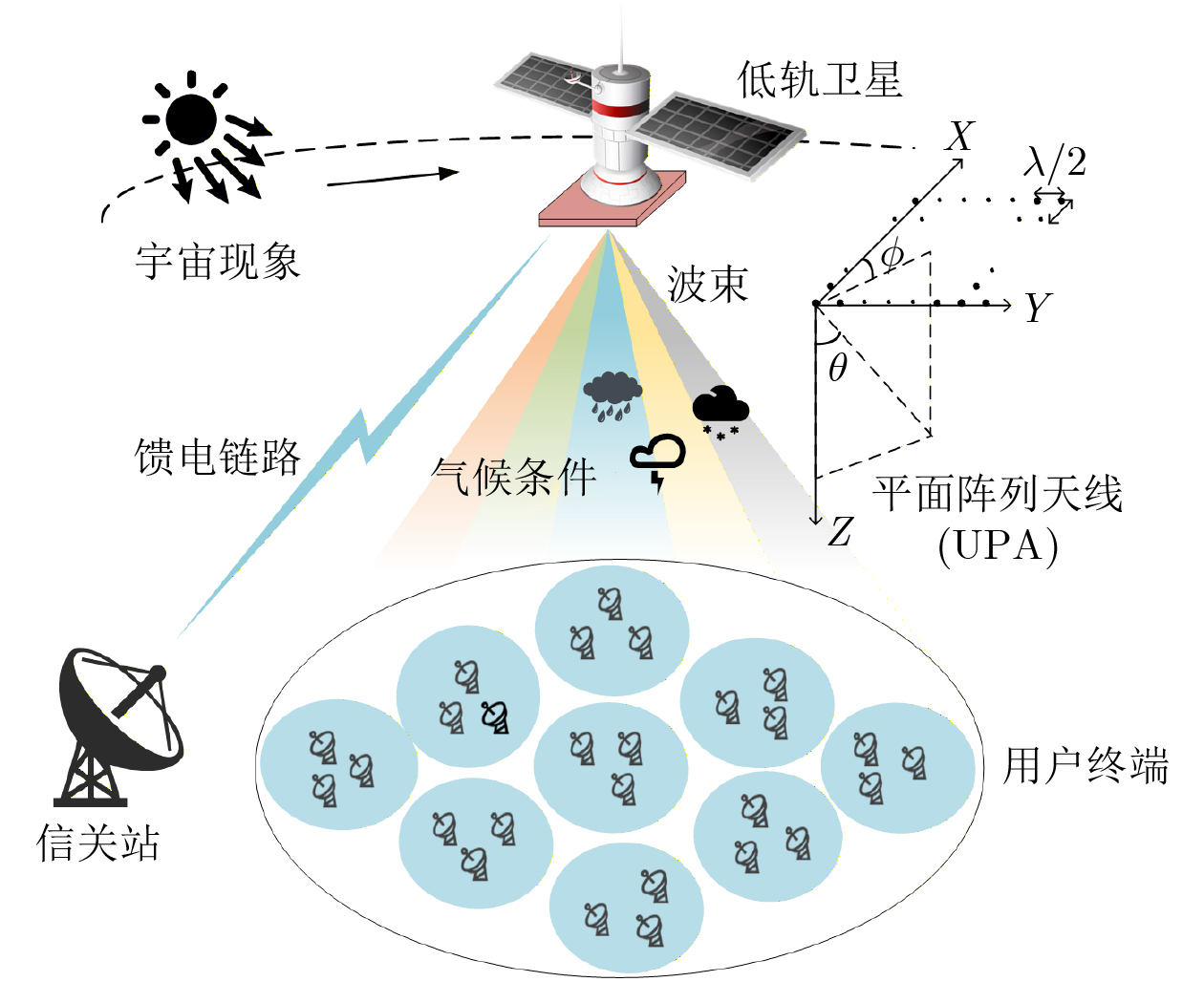
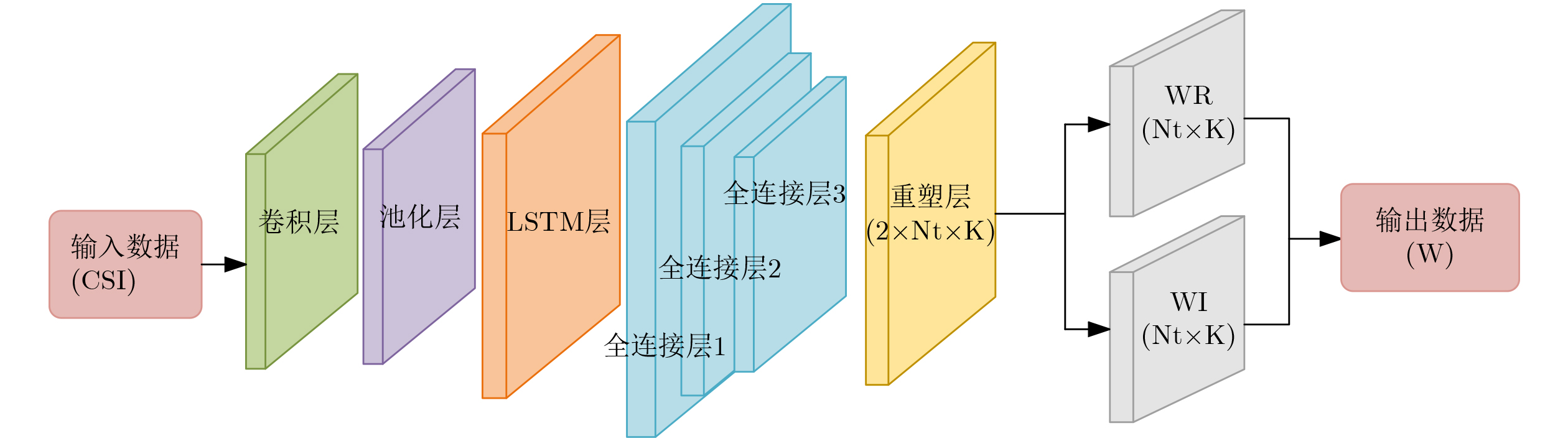
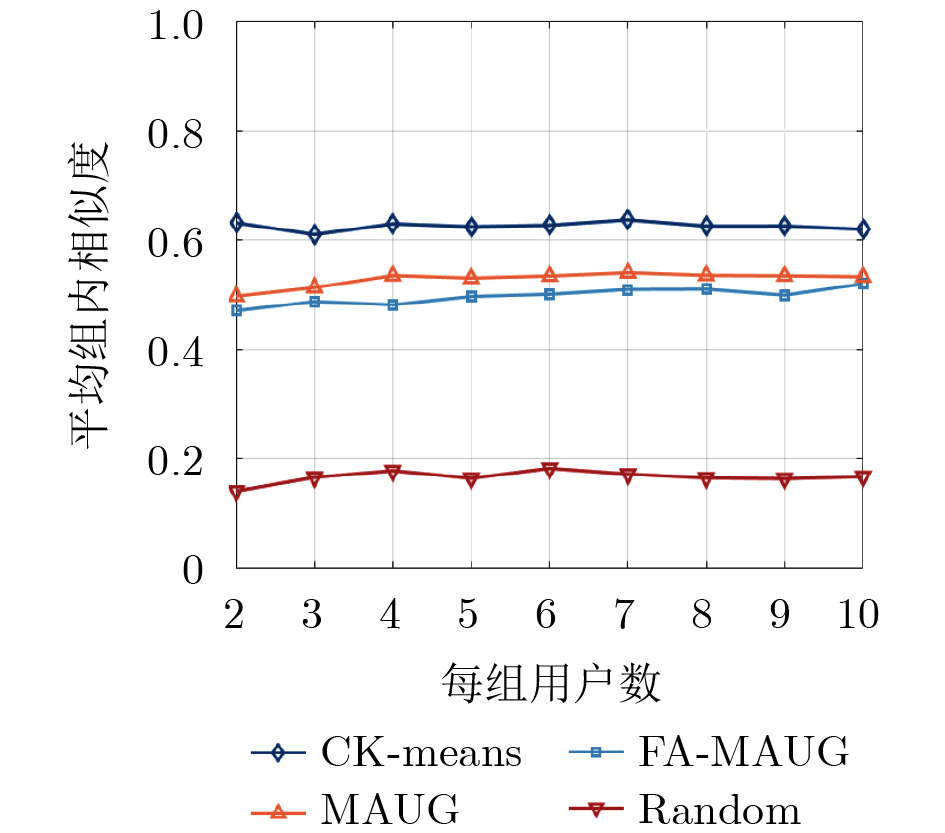
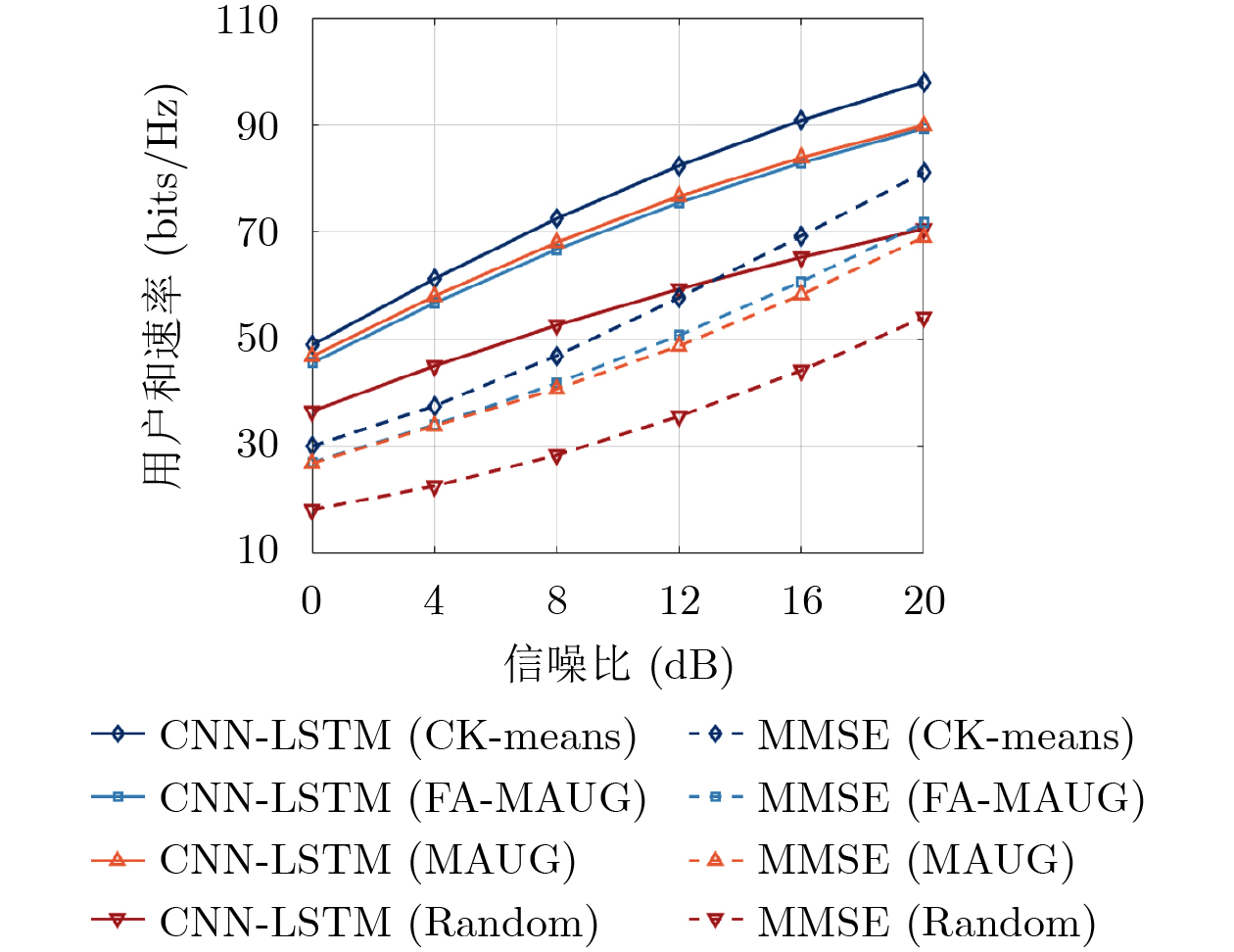
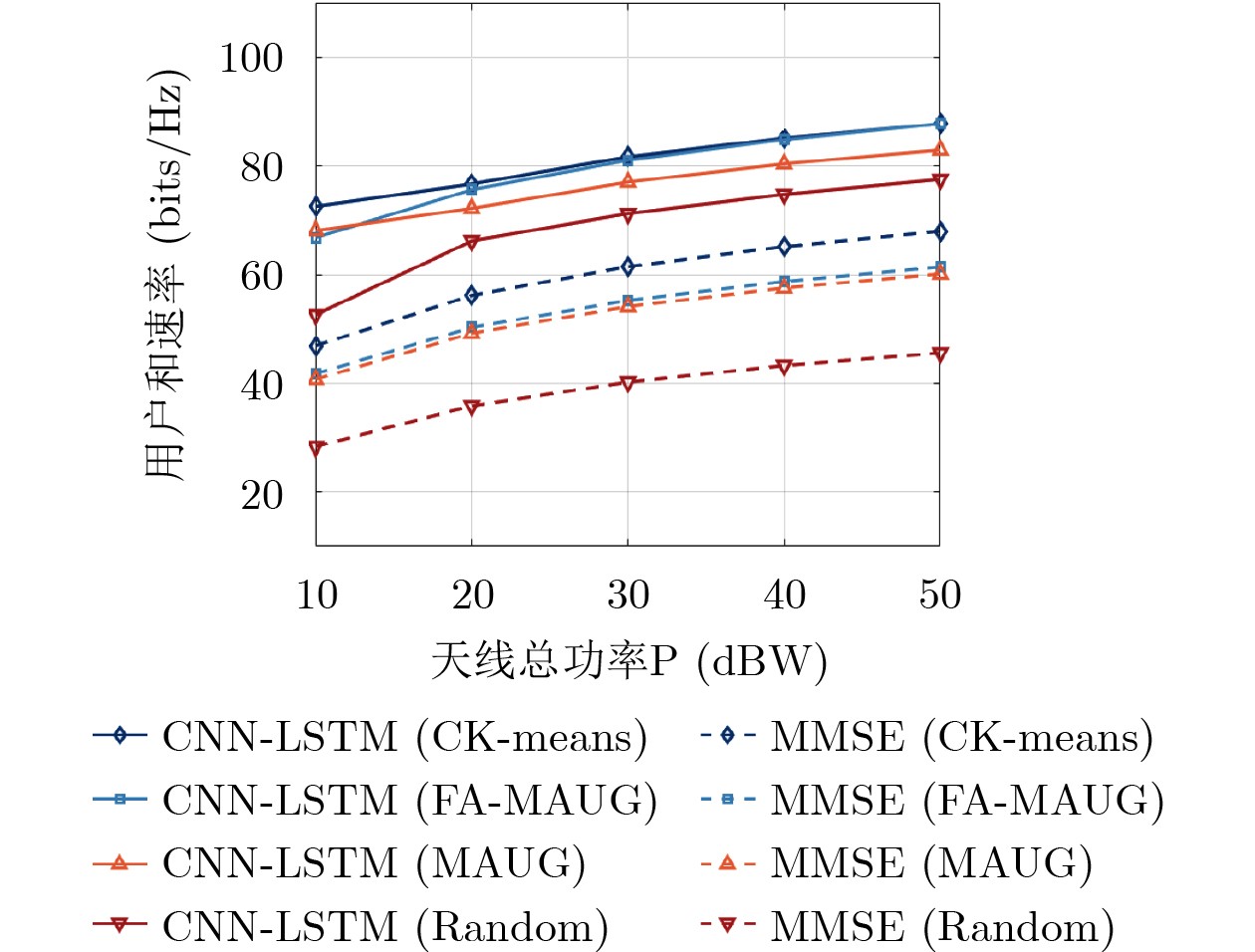
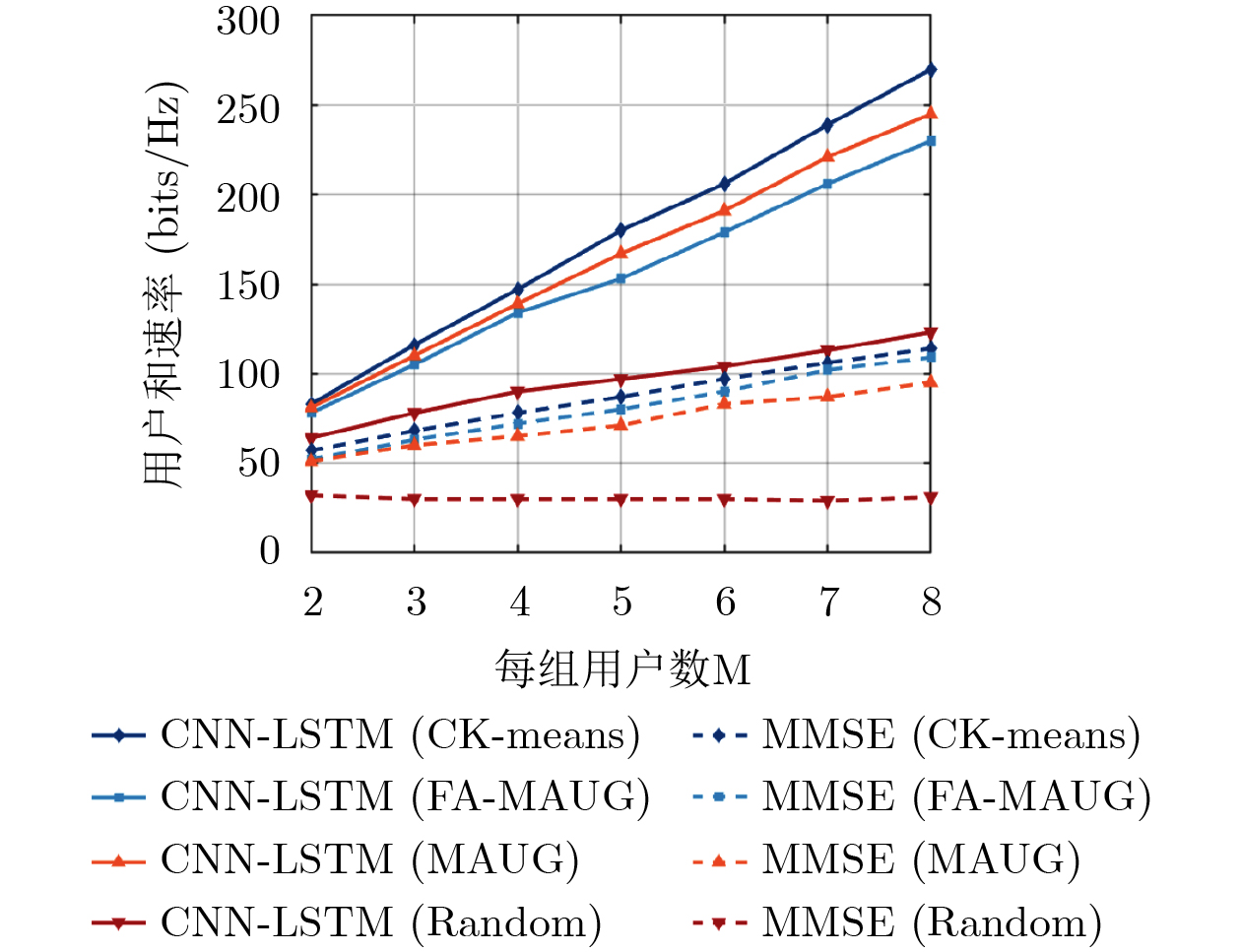
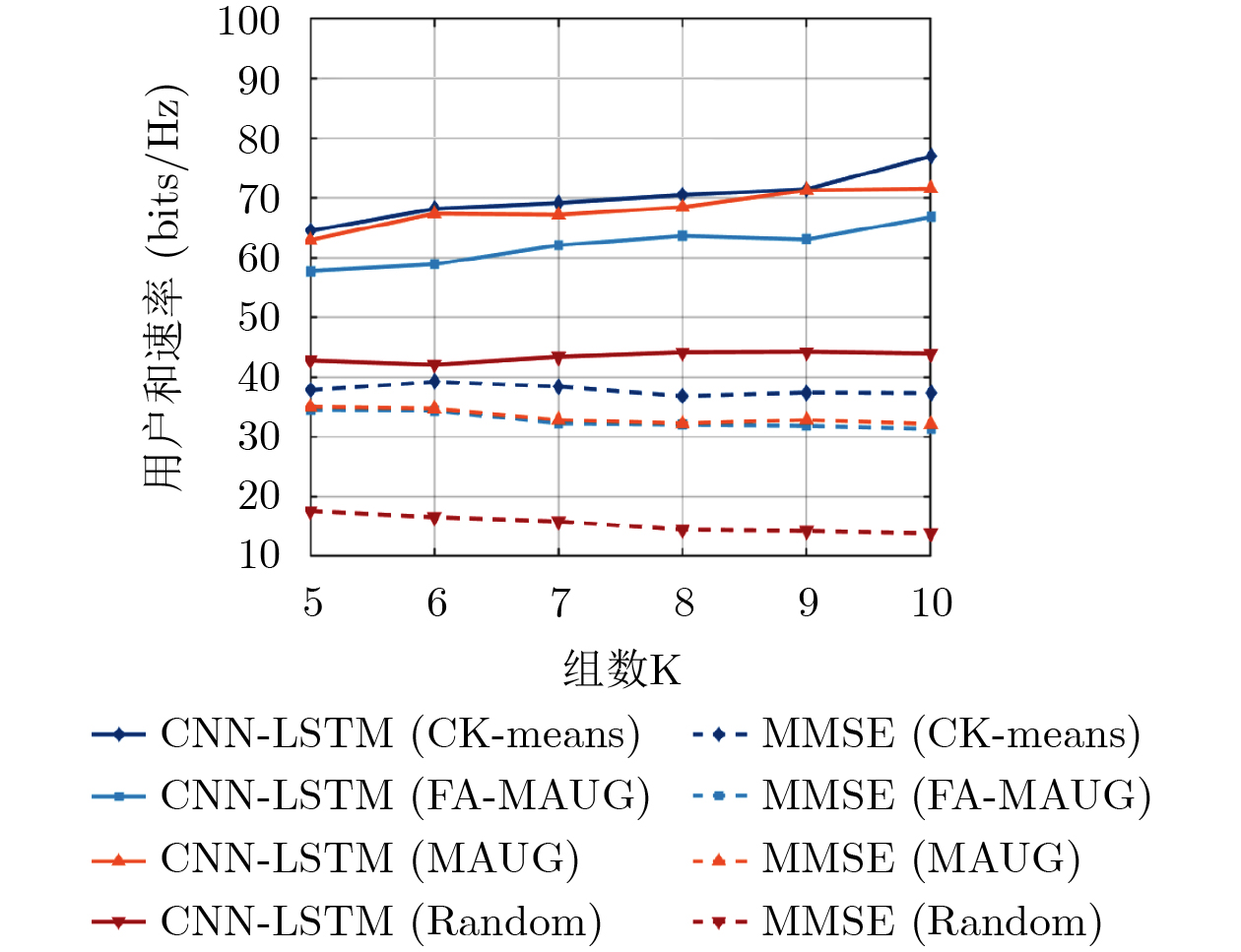
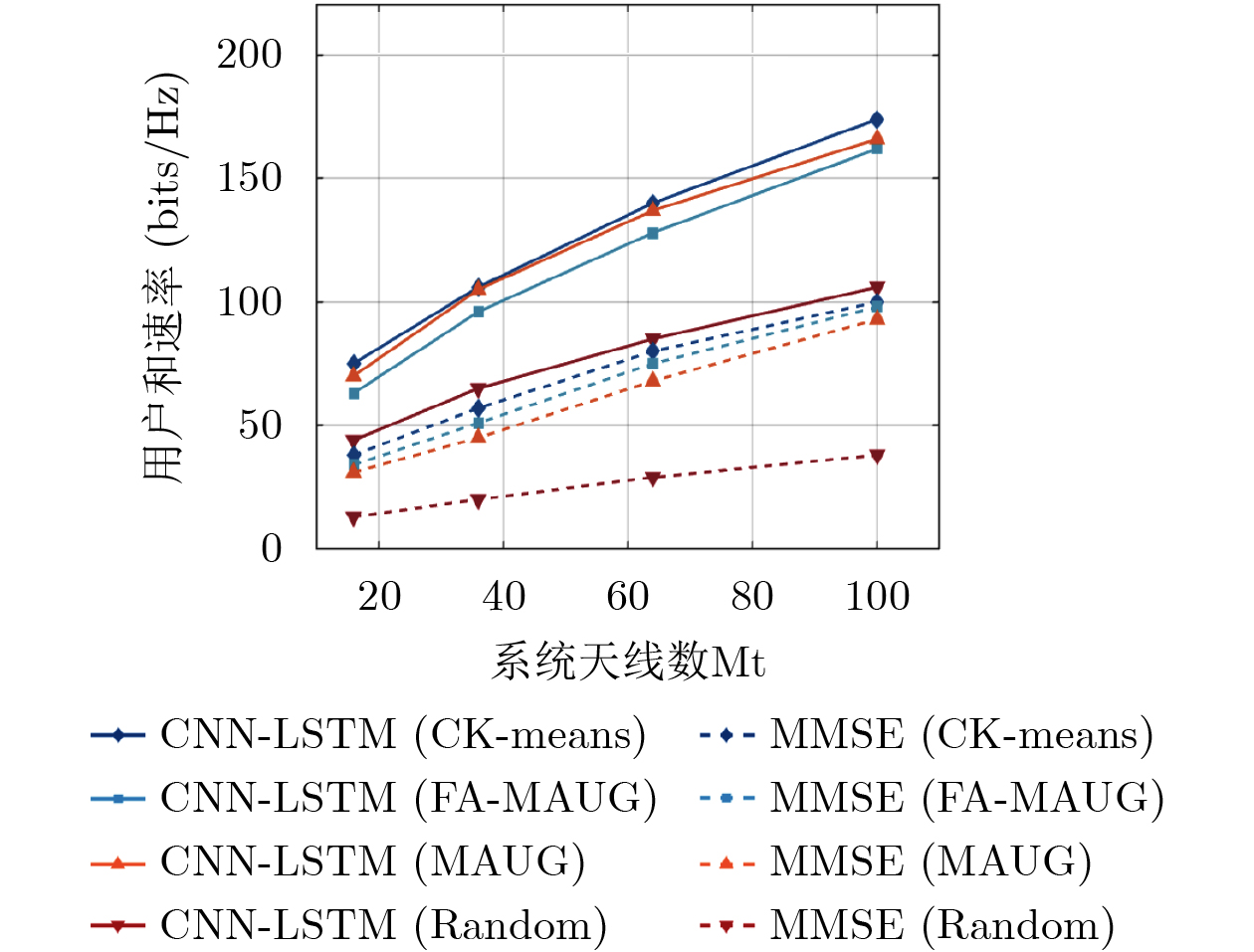
Objective In Sixth-Generation (6G) Low Earth Orbit (LEO) satellite communication systems, multicast precoding is adopted to mitigate severe inter-beam interference caused by Full Frequency Reuse (FFR). However, conventional precoding algorithms exhibit cubic computational complexity, limiting their applicability to massive Multiple-Input Multiple-Output (MIMO) systems. Existing user grouping methods also fail to satisfy the fixed group-size requirement specified by the DVB-S2X standard. To address these limitations, a joint optimization framework is proposed that combines a low-complexity unsupervised deep learning-based precoding model with improved user grouping algorithms to improve the system sum rate and fairness. Methods An unsupervised deep learning model based on a hybrid Convolutional Neural Network-Long Short-Term Memory (CNN-LSTM) architecture is proposed for precoding ( Fig. 2 ). The Convolutional Neural Network (CNN) extracts spatial features from Channel State Information (CSI), while the Long Short-Term Memory (LSTM) network captures high-level feature correlations. The model is trained by directly maximizing the system sum rate while satisfying the Per-Antenna power Constraint (PAC), without requiring supervised labels. For user grouping, two algorithms compatible with the DVB-S2X standard are developed. First, the CK-means algorithm extends conventional K-means clustering to ensure an equal number of users in each group while preserving high intra-group channel similarity. Second, the Fairness-Aware MAUG (FA-MAUG) algorithm prioritizes users with poor channel conditions during grouping, thereby improving system robustness and fairness.Results and Discussions The intra-group similarity metric is used to evaluate user grouping performance. The results show that the CK-means algorithm achieves an average similarity approximately 0.1 higher than that of the MAUG algorithm and nearly 0.5 higher than that of random grouping across different group sizes ( Fig. 3 ), resulting in improved beamforming gain. In terms of system sum rate, the proposed CNN-LSTM precoding combined with CK-means grouping consistently outperforms the conventional Minimum Mean Square Error (MMSE) algorithm under different Signal-to-Noise Ratios (SNRs) and total transmit power levels (Fig. 4 andFig. 5 ). Under different SNR conditions, the proposed CNN-LSTM precoding scheme improves the average system sum rate by 48.59% compared with the MMSE algorithm, whereas CK-means grouping increases the average system sum rate by 30.12% relative to random grouping. The effects of the number of users per group, the number of groups, and the number of antennas are further evaluated (Fig. 6 -Fig. 8 ), demonstrating that the proposed framework maintains superior performance across systems of different scales. Complexity analysis further shows that the proposed precoding method reduces the online computational complexity from the cubic complexity of the conventional MMSE algorithm to linear complexity with respect to the number of antennas, making it well suited for real-time deployment in large-scale LEO satellite communication systems.Conclusions A joint optimization framework is proposed for LEO satellite multicast communication systems to address the high computational complexity of precoding and the limited fairness of conventional user grouping methods. Simulation results demonstrate that the proposed framework substantially improves the system sum rate, achieving an average gain of 48.59% over the conventional MMSE algorithm under different SNR conditions while simultaneously reducing online computational complexity. The proposed framework provides an effective and scalable solution for multi-beam interference mitigation and resource optimization in future 6G LEO satellite communication systems. -
表 1 CNN-LSTM模型参数
模型层名称 输出维度 激活函数 参数量 输入层 64×36×1 \ 0 卷积层 32×64 ReLU 4672 LSTM层 64×1 \ 33024 全连接层1 512×1 ReLU 33280 全连接层2 256×1 ReLU 131328 全连接层3 128×1 sigmoid 32896  下载: 导出CSV
表 2 代表深度学习预编码算法在线计算复杂度
文献 模型 在线复杂度 Lin 2020[14] 端到端神经网络 $ O(({2N}_{{\mathrm{I}}}-1){N}_{{\mathrm{O}}}) $ Luo 2022[17] CNN+迭代优化算法 $ O({N}_{{\mathrm{o}}}{N}_{{\mathrm{i}}}+2{N}_{{\mathrm{t}}}{S)} $ Li 2025[13] 多智能体强化学习 $ O({N}_{{\mathrm{a}}}TB{N}_{{\mathrm{p}}}) $ 本文 端到端CNN+LSTM $ {O}\left({N}_{{\mathrm{o}}}{N}_{{\mathrm{i}}}+4{N}_{\text{L}}\left({N}_{\text{L}}+{N}_{\text{X}}\right)+\left(2{N}_{\text{I}}-1\right){N}_{\text{O}}\right) $ *$ {N}_{{\mathrm{o}}} $:卷积层输出维度;$ {N}_{{\mathrm{i}}} $:卷积层输入维度;$ S $:卷积层特征大小;$ {N}_{{\mathrm{O}}} $:全连接层输出维度;$ {N}_{{\mathrm{I}}} $:全连接层输入维度; $ {N}_{\text{X}} $:LSTM层输入维度;$ {N}_{{\mathrm{L}}} $:LSTM层隐藏层维度;$ {N}_{{\mathrm{a}}} $:智能体个数;$ T $:状态更新步数;$ B $:缓冲采样数;$ {N}_{{\mathrm{p}}} $:前向传播数量
下载: 导出CSV
1 约束K-means用户分组算法(CK-means)
输入:用户位置集合$ \mathcal{X}=\{{\boldsymbol{x}}_{1},{\boldsymbol{x}}_{2},\cdots ,{\boldsymbol{x}}_{{{N}_{\text{u}}}}\} $,组数$ K $,每个组
用户数$ M $输出:最优聚类集合$ \mathcal{G}=\{{\mathcal{G}}_{1},{\mathcal{G}}_{2},\cdots ,{\mathcal{G}}_{K}\} $ 1: 初始化$ K $个质心位置$ C= \{{\boldsymbol{c}}_{1},{\boldsymbol{c}}_{2},\cdots,{\boldsymbol{c}}_{K}\} $ 2: Repeat 3: 计算距离矩阵$ \boldsymbol{D}={\left|\left|{\boldsymbol{x}}_{i}-{\boldsymbol{c}}_{k}\right|\right|}^{2}\in {\mathbb{C}}^{{{N}_{\text{u}}}\times K},i\in \left\{1{,}2,\cdots ,{N}_{\text{u}}\right\} $,
$ k\in \{1{,}2,\cdots ,K\} $4: 将$ \boldsymbol{D} $中元素值按照升序重新排列 5: for $ \boldsymbol{D}\text{中元素}{\boldsymbol{d}}_{i,k},i\in \left\{1{,}2,\cdots ,{N}_{\text{u}}\right\},k\in \{1{,}2,\cdots ,K\} $ do 6: if用户$ {\boldsymbol{x}}_{i} $尚未被分配 and $ \left| {\mathcal{G}}_{k}\right| \lt M $ then
$ {\mathcal{G}}_{k}\leftarrow {\mathcal{G}}_{k}\cup \{{\boldsymbol{x}}_{i}\} $7: end if 8: end for 9: 更新质心:$ {\boldsymbol{c}}_{k}\leftarrow \dfrac{1}{\left| {\mathcal{G}}_{k}\right| }{\sum}_{\boldsymbol{x}\in {{\mathcal{G}}_{K}}}\boldsymbol{x},\;\forall k\in \{1{,}2,\cdots ,K\} $ 10: until质心集合$ C $不再发生变化 11: return最优聚类集合$ G $
下载: 导出CSV
2 公平感知MAUG用户分组算法(FA-MAUG)
输入:卫星天线数$ {N}_{\text{t}} $,用户数$ {N}_{\text{u}} $,组数$ K $,每组用户数$ M $,
用户信道向量$ {\tilde{\boldsymbol{h}}}_{i}\in {\mathbb{C}}^{{{N}_{\text{t}}}\times 1},i\in \{1{,}2,\cdots ,{N}_{\text{u}}\} $输出:最优分组集合 $ \mathcal{G}=\{{\mathcal{G}}_{1},{\mathcal{G}}_{2},\cdots ,{\mathcal{G}}_{K}\} $ 1: 初始化代表用户集合 $ \mathcal{I}=\mathit{\varnothing } $,剩余用户集合
$ U=\left\{1{,}2,\cdots ,{N}_{\text{u}}\right\} $2: 步骤1:选择代表用户 3: for $ i=1 $ to $ K $ do 4: for $ j\in U $ do 5: $ {\boldsymbol{g}}_{j}={\tilde{\boldsymbol{h}}}_{j}-\displaystyle\sum\limits_{q=1}^{i-1}\frac{\tilde{\boldsymbol{h}}_{j}^{\text{H}}{\boldsymbol{g}}_{q}}{\parallel {\boldsymbol{g}}_{q}{\parallel }^{2}}{\boldsymbol{g}}_{q} $ 6: end for 7: 选择代表用户:$ {j}^{*}=\arg \max \parallel {\boldsymbol{g}}_{j}\parallel $ 8: $ \mathcal{I}\leftarrow \mathcal{I}\cup \left\{{j}^{*}\right\},U\leftarrow U\smallsetminus \left\{{j}^{*}\right\},{\mathcal{G}}_{i}\leftarrow {\mathcal{G}}_{i}\cup \left\{{j}^{*}\right\},{\boldsymbol{g}}_{i}={\boldsymbol{g}}_{{{j}^{*}}} $ 9: end for 10: 步骤2:剩余用户分配 11: 将$ U $中剩余用户按照信道范数降序重新排列 12: for $ i\in U $ do 13: for$ j=1 $ to $ K $ do 14: if $ |{\mathcal{G}}_{j}|\leq M $ then计算用户$ i $与代表用户$ \mathcal{I}\{j\} $的相似度
$ {u}_{i,j}=\dfrac{\tilde{\boldsymbol{h}}_{\mathcal{I}\{j\}}^{\text{H}}{\tilde{\boldsymbol{h}}}_{i}}{\parallel {\tilde{\boldsymbol{h}}}_{i}{\parallel }^{2}}{\tilde{\boldsymbol{h}}}_{i} $15: end if 16: end for 17: 查找相似度最高的组并进行分配:
$ {j}^{*}=\arg \max {u}_{i,j},{\mathcal{G}}_{{{j}^{*}}}\leftarrow {\mathcal{G}}_{{{j}^{*}}}\cup \{i\} $18: end for 19: return最优聚类集合$ G $
下载: 导出CSV
表 3 用户分组算法计算复杂度
用户分组算法 计算复杂度 CK-means $ O\left(N_{\text{t}}N_{\text{u}}K+N_{\text{u}}K\log_2\left(N_{\text{u}}K\right)\right) $ FA-MAUG $ O\left(N_{\text{t}}N_{\text{u}}K^2+N_{\text{t}}N_{\text{u}}K+N_{\text{u}}\log_2N_{\text{u}}\right) $ MAUG $ O\left({N}_{\text{t}}{N}_{\text{u}}{K}^{2}+{N}_{\text{t}}{N}_{\text{u}}K\right) $
下载: 导出CSV
-
[1] KUMARI S and HOSSAIN A. Comprehensive review on performance analysis for satellite communication MIMO over terrestrial communication MIMO[J]. International Journal of Satellite Communications and Networking, 2026, 44(4): 445–463. doi: 10.1002/sat.70035. [2] 郑斌, 曾令昕, 黄辉, 等. 密集低轨卫星网络辅助地面通信的鲁棒波束赋形方法[J]. 电子与信息学报, 2025, 47(3): 623–632. doi: 10.11999/JEIT240732.ZHENG Bin, ZENG Lingxin, HUANG Hui, et al. Robust beamforming method for dense LEO satellite network assisted terrestrial communication[J]. Journal of Electronics & Information Technology, 2025, 47(3): 623–632. doi: 10.11999/JEIT240732. [3] European Telecommunications Standards Institute. ETSI EN 302 307-1 V1.4. 1 Second generation framing structure, channel coding and modulation systems for broadcasting, interactive services, news gathering and other broadband satellite applications; Part 1 (DVB-S2)[S]. Cedex: ETSI, 2014. [4] European Telecommunications Standards Institute. ETSI EN 302 307-2 V1.4. 1 Second generation framing structure, channel coding and modulation systems for broadcasting, interactive services, news gathering and other broadband satellite applications; Part 2: DVB-S2 Extensions (DVB-S2X)[S]. Cedex: ETSI, 2024. [5] CHRISTOPOULOS D, CHATZINOTAS S, and OTTERSTEN B. Multicast multigroup precoding and user scheduling for frame-based satellite communications[J]. IEEE Transactions on Wireless Communications, 2015, 14(9): 4695–4707. doi: 10.1109/TWC.2015.2424961. [6] SIDIROPOULOS N D, DAVIDSON T N, and LUO Zhiquan. Transmit beamforming for physical-layer multicasting[J]. IEEE Transactions on Signal Processing, 2006, 54(6): 2239–2251. doi: 10.1109/TSP.2006.872578. [7] YIN Shiqi and DONG Min. Computation-and-communication efficient coordinated multicast beamforming in massive MIMO networks[J]. IEEE Transactions on Communications, 2025, 73(9): 7811–7827. doi: 10.1109/TCOMM.2025.3541031. [8] CHRISTOPOULOS D, CHATZINOTAS S, ZHENG Gan, et al. Linear and nonlinear techniques for multibeam joint processing in satellite communications[J]. EURASIP Journal on Wireless Communications and Networking, 2012, 2012(1): 162. doi: 10.1186/1687-1499-2012-162. [9] WU S X, MA W K, and SO A M C. Physical-layer multicasting by stochastic transmit beamforming and Alamouti space-time coding[J]. IEEE Transactions on Signal Processing, 2013, 61(17): 4230–4245. doi: 10.1109/TSP.2013.2263500. [10] KARIPIDIS E, SIDIROPOULOS N D, and LUO Zhiquan. Quality of service and max-min fair transmit beamforming to multiple Cochannel multicast groups[J]. IEEE Transactions on Signal Processing, 2008, 56(3): 1268–1279. doi: 10.1109/TSP.2007.909010. [11] LUO Zhiquan, MA W, SO A M C, et al. Semidefinite relaxation of quadratic optimization problems[J]. IEEE Signal Processing Magazine, 2010, 27(3): 20–34. doi: 10.1109/MSP.2010.936019. [12] 李振东, 巴建乐, 苏洲, 等. 可移动天线赋能的ISAC系统中波束赋形与天线位置联合优化[J]. 电子与信息学报, 2025, 47(10): 3482–3491. doi: 10.11999/JEIT250146.LI Zhendong, BA Jianle, SU Zhou, et al. Joint beamforming and antenna position optimization in movable antenna empowered ISAC systems[J]. Journal of Electronics & Information Technology, 2025, 47(10): 3482–3491. doi: 10.11999/JEIT250146. [13] DONG Min and WANG Qiqi. Multi-group multicast beamforming: Optimal structure and efficient algorithms[J]. IEEE Transactions on Signal Processing, 2020, 68: 3738–3753. doi: 10.1109/TSP.2020.2994753. [14] LI Huiting, JIANG Yanxiang, HUANG Yige, et al. A multi-agent DRL method for distributed energy-efficient association and hybrid precoding in mmWave cell-free massive MIMO systems[J]. IEEE Communications Letters, 2025, 29(1): 70–74. doi: 10.1109/LCOMM.2024.3494537. [15] LIN Tian and ZHU Yu. Beamforming design for large-scale antenna arrays using deep learning[J]. IEEE Wireless Communications Letters, 2020, 9(1): 103–107. doi: 10.1109/LWC.2019.2943466. [16] SOHRABI F, ATTIAH K M, and YU Wei. Deep learning for distributed channel feedback and multiuser precoding in FDD massive MIMO[J]. IEEE Transactions on Wireless Communications, 2021, 20(7): 4044–4057. doi: 10.1109/TWC.2021.3055202. [17] ZHOU Huibin, GONG Xinrui, TSINOS C G, et al. GNN-enabled precoding for massive MIMO LEO satellite communications[J]. IEEE Transactions on Communications, 2025, 73(10): 9028–9042. doi: 10.1109/TCOMM.2025.3568216. [18] LUO Jie, FAN Jiancun, and ZHANG Jinbo. MDL-AltMin: A hybrid precoding scheme for mmWave systems with deep learning and alternate optimization[J]. IEEE Wireless Communications Letters, 2022, 11(9): 1925–1929. doi: 10.1109/LWC.2022.3188167. [19] YING Ming, CHEN Xiaoming, QI Qiao, et al. Deep learning-based joint channel prediction and multibeam precoding for LEO satellite internet of things[J]. IEEE Transactions on Wireless Communications, 2024, 23(10): 13946–13960. doi: 10.1109/TWC.2024.3406952. [20] ZHANG Yuxin, WANG Xingwei, LUO Xuewen, et al. A survey on AI-empowered task-oriented sensing, communication, and computation in 6G networks[J]. Computer Science Review, 2026, 60: 100899. doi: 10.1016/j.cosrev.2026.100899. [21] 李国权, 程涛, 郭永存, 等. 基于深度强化学习的IRS辅助认知无线电系统波束成形算法[J]. 电子与信息学报, 2025, 47(3): 657–665. doi: 10.11999/JEIT240447.LI Guoquan, CHENG Tao, GUO Yongcun, et al. Deep reinforcement learning based beamforming algorithm for IRS assisted cognitive radio system[J]. Journal of Electronics & Information Technology, 2025, 47(3): 657–665. doi: 10.11999/JEIT240447. [22] 薛青, 来东, 徐勇军, 等. 基于分布式联邦学习的毫米波通信系统波束配置方法[J]. 电子与信息学报, 2024, 46(1): 138–145. doi: 10.11999/JEIT221536.XUE Qing, LAI Dong, XU Yongjun, et al. Beam configuration for millimeter wave communication systems based on distributed federated learning[J]. Journal of Electronics & Information Technology, 2024, 46(1): 138–145. doi: 10.11999/JEIT221536. [23] DONG Hao, HUA Cunqing, LIU Lingya, et al. Intelligent reflecting surface-aided integrated terrestrial-satellite networks[J]. IEEE Transactions on Wireless Communications, 2023, 22(4): 2507–2522. doi: 10.1109/TWC.2022.3212049. [24] GUIDOTTI A and VANELLI‐CORALLI A. Clustering strategies for multicast precoding in multibeam satellite systems[J]. International Journal of Satellite Communications and Networking, 2020, 38(2): 85–104. doi: 10.1002/sat.1312. [25] SU Delong, LIU Lingya, XU Jing, et al. Multicast-aware user grouping for frame-based precoding in multibeam satellite systems[C]. ICC 2024 - IEEE International Conference on Communications, Denver, USA, 2024: 1855–1860. doi: 10.1109/ICC51166.2024.10622393. [26] YOO T and GOLDSMITH A. On the optimality of multiantenna broadcast scheduling using zero-forcing beamforming[J]. IEEE Journal on Selected Areas in Communications, 2006, 24(3): 528–541. doi: 10.1109/JSAC.2005.862421. [27] ZHANG Shuo, JIA Min, WEI Yuming, et al. User scheduling for multicast transmission in high throughput satellite systems[J]. EURASIP Journal on Wireless Communications and Networking, 2020, 2020(1): 133. doi: 10.1186/s13638-020-01749-7. -

 下载:
下载:

图(8) / 表(5)
计量
- 文章访问数: 346
- HTML全文浏览量: 134
- PDF下载量: 16
- 被引次数: 0
