




A Phase Transition Obstacle Avoidance Method for UAV Swarms Driven by Multistable Potential Fields
-
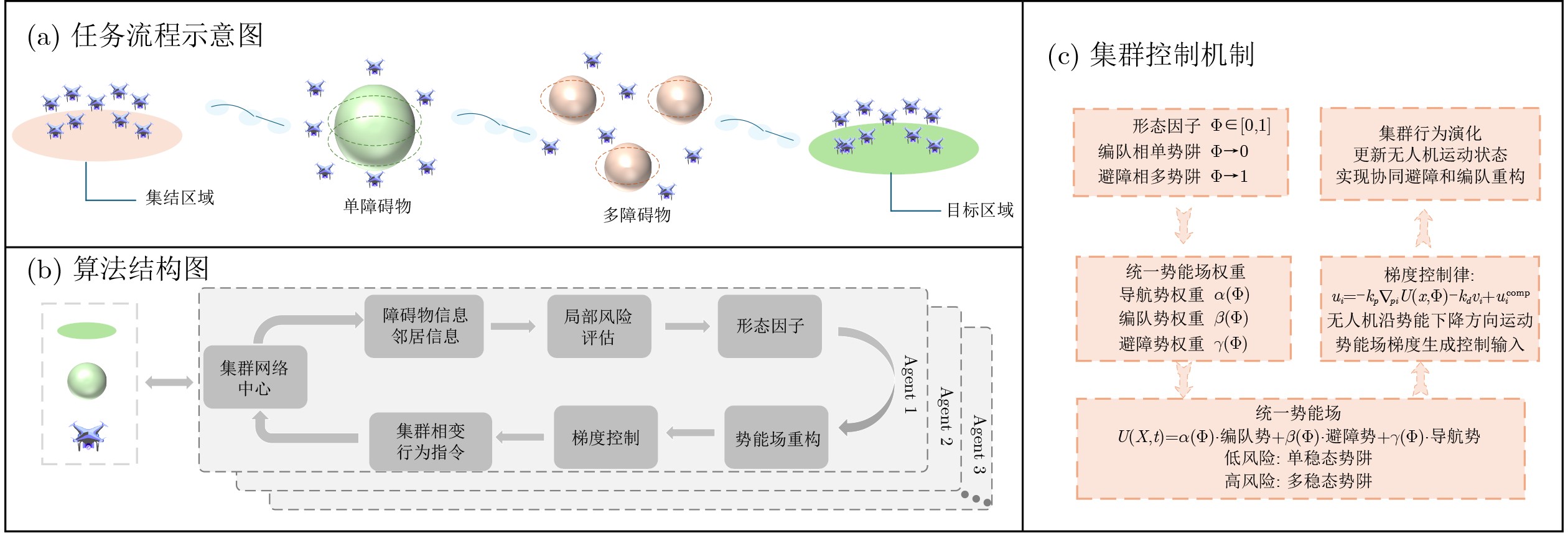
摘要: 针对动态环境下无人机集群避障过程中出现的行为模式切换不连续和控制抖振的问题,该文提出一种多稳态势能场驱动的无人机集群相变避障方法。该方法基于局部环境风险感知构建全局风险共识机制,并通过非线性映射生成形态因子作为集群行为演化的序参量;进一步构建包含编队势、避障势与导航势的统一时变势能场模型,通过形态因子驱动势能场的连续重构,使集群不同相态对应于势能场中的多稳态势阱,设计了基于势能场负梯度的分布式一致性控制律,引入阻尼项耗散系统动能,从而将集群行为变化刻画为势能场稳态结构的连续相变过程。仿真结果表明,相较阈值切换法,集群控制输入变化率降低约26%,控制峰值降低约18%。相较仿生分流方法,平均恢复时间缩短约16%,表明所提方法在动态环境下能够实现行为模式的连续演化与平滑控制,有效抑制抖振并提升集群整体稳定性与协同效率。Abstract:
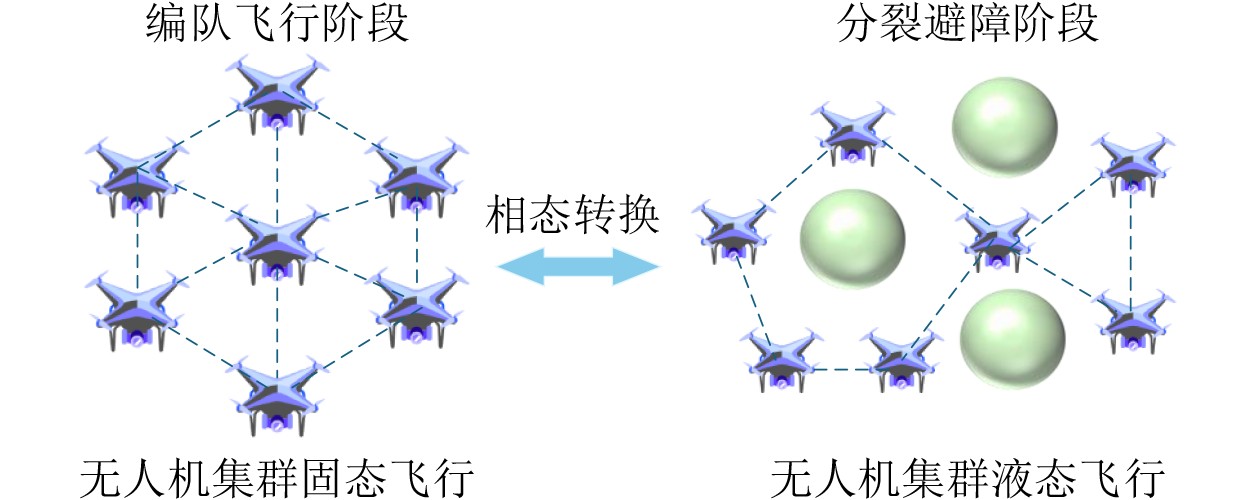
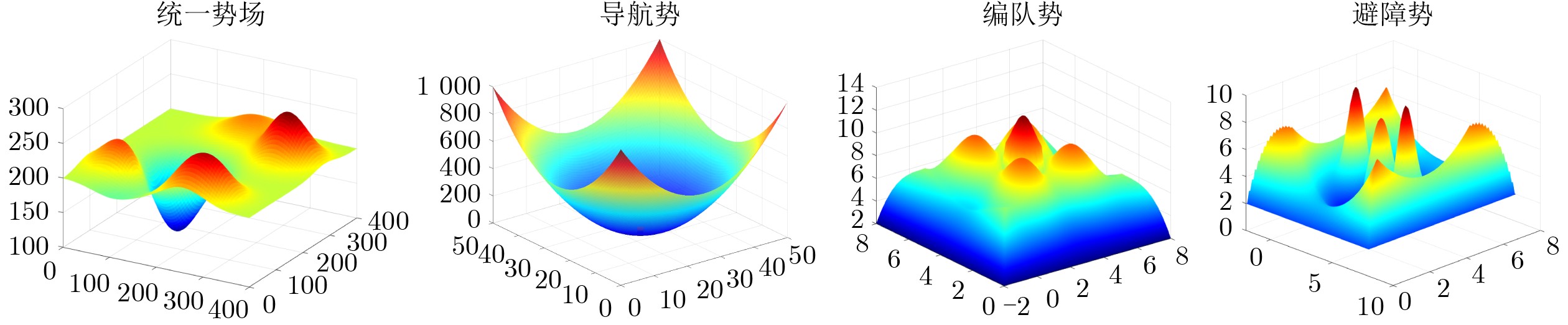
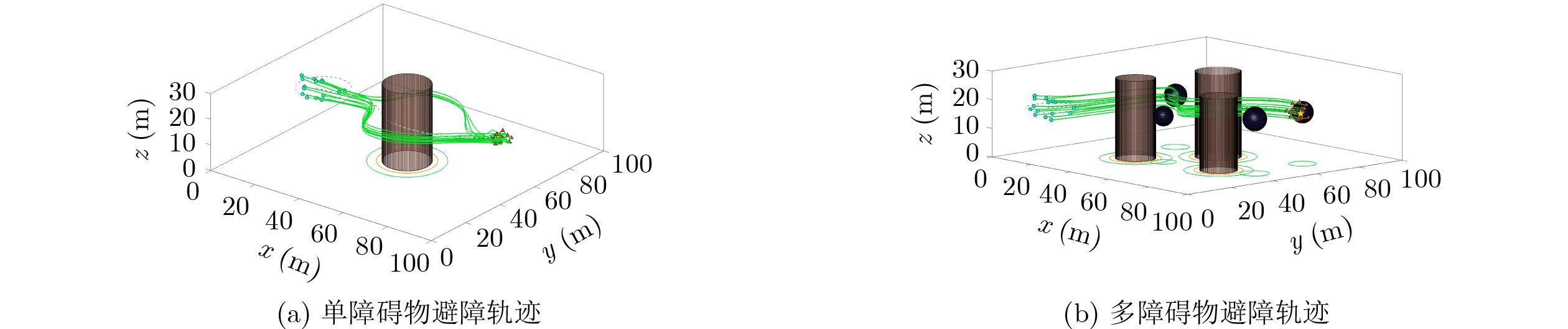
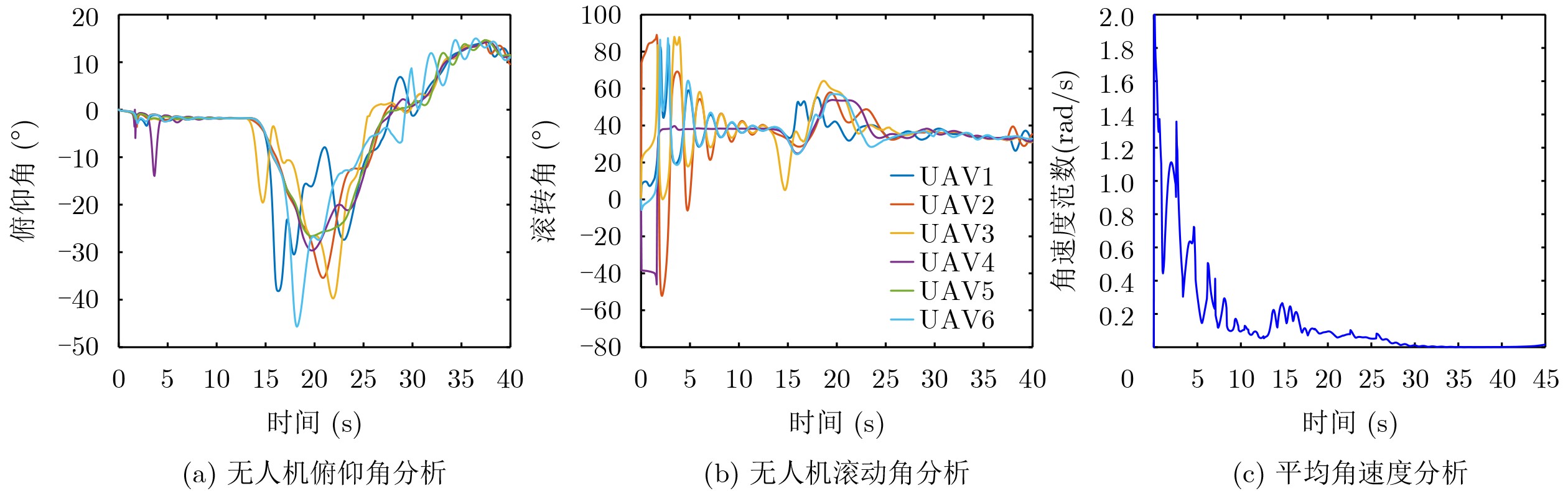
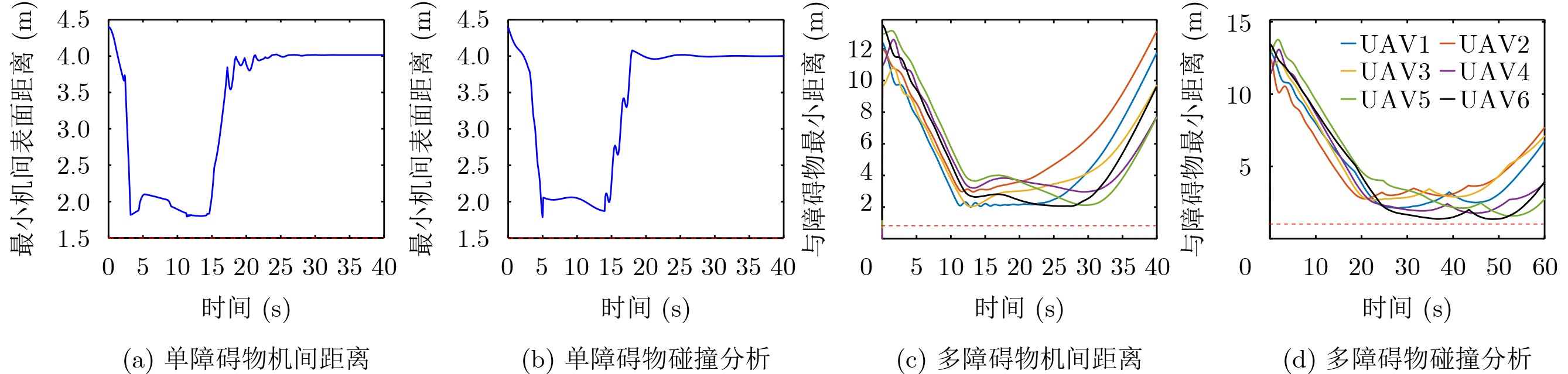
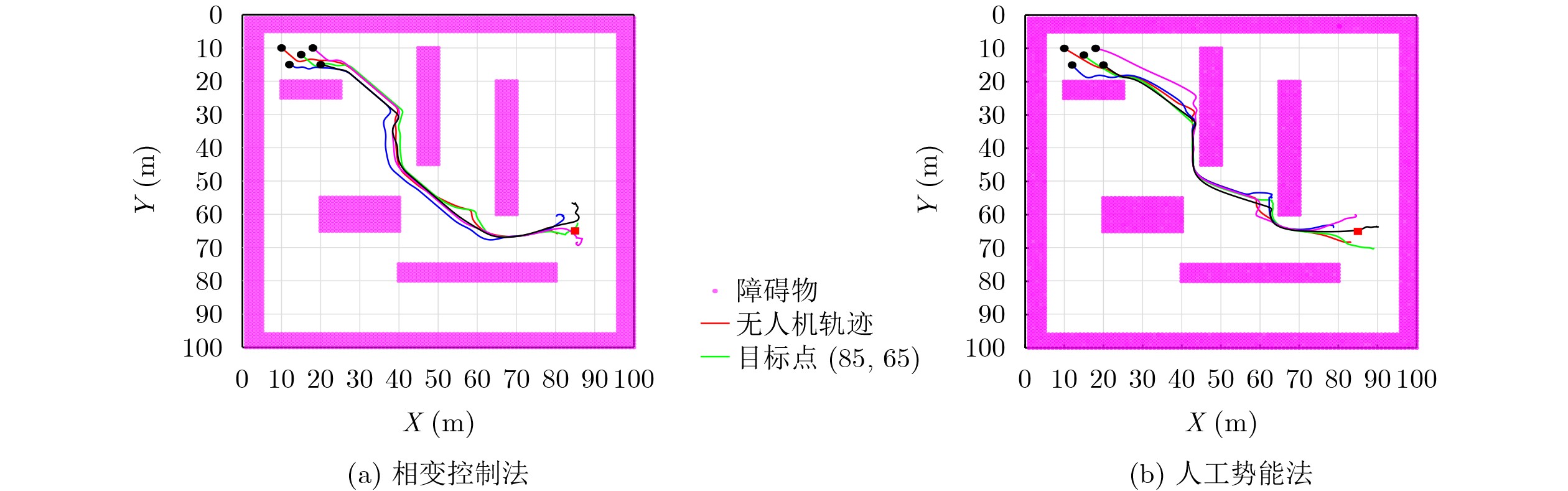
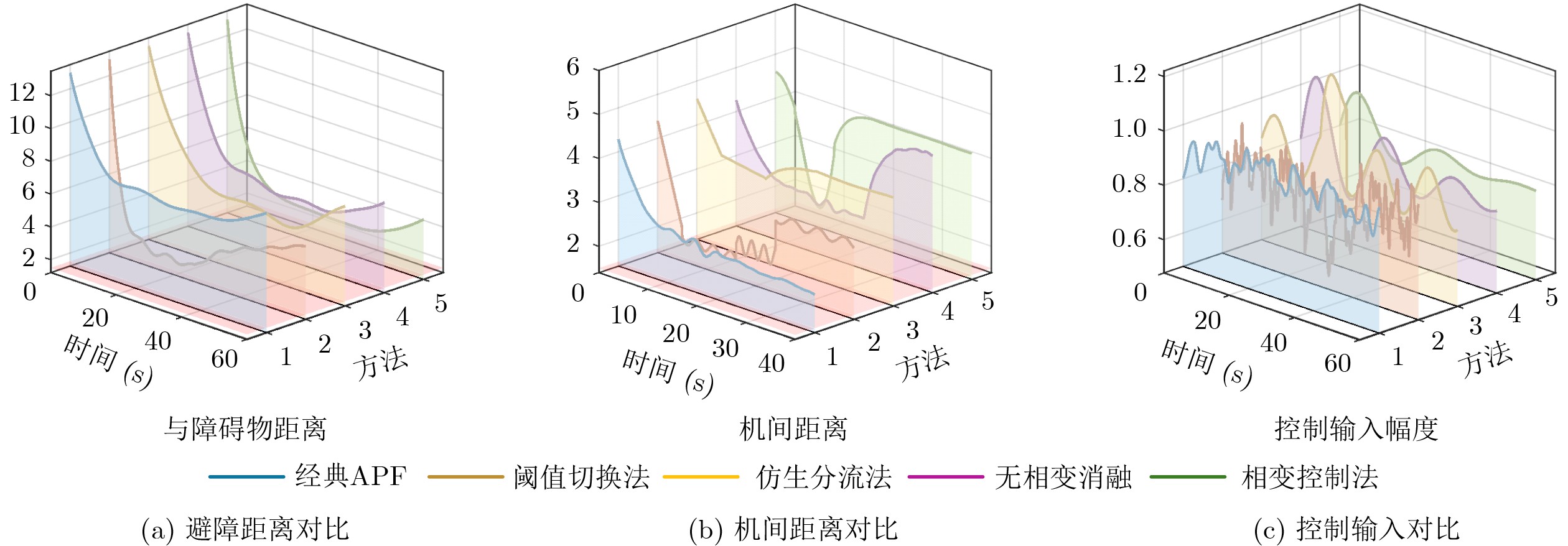
Objective Unmanned Aerial Vehicle (UAV) swarms have demonstrated considerable potential for complex missions, such as search, surveillance, and disaster response, because of their distributed coordination and robustness. However, in dynamic environments with dense obstacles and rapidly changing risks, conventional swarm control methods often exhibit discontinuous behavior switching and control chattering, which reduce system stability and coordination efficiency. Existing approaches, including threshold-based switching and Artificial Potential Field (APF) methods with fixed potential weights, rely on abrupt transitions between behavioral modes, leading to oscillatory responses. To address these limitations, a phase transition obstacle avoidance method for UAV swarms driven by multistable potential fields is proposed. Swarm behavior evolution is modeled as a continuous phase transition process within a unified potential field framework, enabling smooth and adaptive transitions between formation flight and obstacle avoidance. Methods An environmental risk assessment model is first established by integrating static obstacle risk, dynamic obstacle risk, and inter-agent proximity risk. A distributed consensus protocol is then employed to establish global risk consensus. Subsequently, a morphology factor is generated through nonlinear mapping of the global risk consensus and is used as an order parameter to characterize the macroscopic swarm state. A unified time-varying potential field, comprising formation, obstacle avoidance, and navigation potentials, is constructed, and the relative weights of these potentials are continuously adjusted by the morphology factor. When the risk level is low, the system exhibits a monostable structure dominated by the formation and navigation potentials. As the risk increases, the potential field continuously evolves into a multistable structure dominated by the obstacle avoidance potential, thereby enabling distributed obstacle avoidance. A distributed consensus control law based on the negative gradient of the unified potential field is further developed. A damping term is incorporated to dissipate system energy and improve stability, while a dynamic compensation term addresses nonlinear dynamics. The control law depends only on local information, ensuring good scalability. The global uniform ultimate boundedness of the closed-loop system is established using Lyapunov theory. Results and Discussions Simulation results demonstrate that the proposed method enables the swarm to maintain a compact solid-phase swarm formation in low-risk regions and to transition smoothly to a dispersed liquid-phase swarm configuration when obstacles are encountered, followed by rapid formation recovery after obstacle avoidance. The pitch and roll angles of each UAV vary smoothly without abrupt changes, and both the UAV-to-obstacle distance and the inter-UAV separation remain above the prescribed safety threshold throughout the flight, ensuring collision-free operation. Statistical results obtained from 20 independent simulation runs show that, compared with the threshold-switching method, the proposed method reduces the rate of control input variation by approximately 26% and decreases the peak control input by approximately 18%. Compared with the bio-inspired diversion method, the average formation recovery time after obstacle avoidance is reduced by approximately 16%. Ablation experiments further demonstrate that removing the morphology-driven phase transition mechanism significantly increases trajectory oscillation and control oscillation, confirming the critical role of the multistable continuous phase transition mechanism in maintaining smooth swarm motion. In complex narrow-channel environments, the proposed method effectively avoids the local minimum problem encountered by conventional APF methods and generates smoother flight trajectories with substantially reduced oscillation. Conclusions A phase transition obstacle avoidance method for UAV swarms driven by multistable potential fields is proposed. By introducing a morphology factor and constructing a unified potential field framework, swarm behavior evolution is represented as a continuous phase transition process. The distributed control law enables smooth behavioral transitions while maintaining system stability and scalability. Simulation results demonstrate that the proposed method achieves better safety, smoother control, and higher coordination efficiency than conventional methods. -
1 多稳态势能场驱动的集群相变避障算法
输入:无人机$ i $状态,邻居无人机集合$ {N}_{i} $,风险权重$ \kappa $,系统参
数(安全距离$ {d}_{\mathrm{safe}} $,探测半径$ {R}_{\mathrm{S}} $,通信半径$ {R}_{\mathrm{C}} $)输出:无人机控制输入$ \boldsymbol{u}_i $ 1.初始化参数:编队势,避障势,导航势函数,局部风险值,全
局共识风险值,形态因子$ {\varPhi } $;2.while 未到达目标点: // 局部环境风险计算 3.计算无人机与障碍物距离,与邻居距离; 4.计算静态障碍风险,动态障碍风险,机间风险; // 全局风险共识与形态因子生成 5.执行一致性迭代,获得全局风险共识$ \overline{R}(t) $; 6.通过对全局风险公式进行非线性映射得到形态因子$ {\varPhi } $; //统一时变势能场构建 7.通过公式(16)得到编队势$ U_{\mathrm{f}},U_{\mathrm{obs}},U_{\mathrm{nav}} $; 8.结合势能权重计算得到$ U(\boldsymbol{X},{\varPhi }) $; // 负梯度一致性控制律 9.计算总势能对无人机位置$ {\boldsymbol{p}}_{i} $的负梯度方向; 10.计算无人机控制输入$ {\boldsymbol{u}}_{i} $; // 状态更新 执行控制输入$ {\boldsymbol{u}}_{i} $更新位置$ {\boldsymbol{p}}_{i} $、速度$ {\boldsymbol{v}}_{i} $; End While  下载: 导出CSV
表 1 参数设置
参数符号 物理含义 取值 $ N $ 无人机数量(个) 15 $ {r}_{\mathrm{v}} $ 包络半径($ \mathrm{m} $) 1 $ {d}_{\mathrm{saf}e} $ 安全距离($ \mathrm{m} $) 1.2 $ {R}_{\mathrm{S}} $ 探测半径($ \mathrm{m} $) 8 $ {R}_{\mathrm{C}} $ 通信半径($ \mathrm{m} $) 6 $ {\kappa }_{1} $ 静态障碍风险权重 0.5 $ {\kappa }_{2} $ 动态障碍风险权重 0.3 $ {\kappa }_{3} $ 邻居风险权重 0.2
下载: 导出CSV
-
[1] 张欣睿, 时晨光, 吴志锋, 等. 动态威胁下基于改进APF-RRT*算法的无人机集群隐身航迹规划算法[J]. 电子与信息学报, 2025, 47(12): 5178–5191. doi: 10.11999/JEIT250554.ZHANG Xinrui, SHI Chenguang, WU Zhifeng, et al. Stealthy path planning algorithm for UAV swarm based on improved APF-RRT* under dynamic threat[J]. Journal of Electronics & Information Technology, 2025, 47(12): 5178–5191. doi: 10.11999/JEIT250554. [2] JING Xu. Research on key technologies of UAV cluster cooperative system for Internet of Things applications[J]. Journal of Control and Decision, 2024, 11(1): 26–35. doi: 10.1080/23307706.2022.2089749. [3] 薛健, 赵琳, 向贤财, 等. 非完全信息下无人机集群对抗研究综述[J]. 电子与信息学报, 2024, 46(4): 1157–1172. doi: 10.11999/JEIT230544.XUE Jian, ZHAO Lin, XIANG Xiancai, et al. A review of the research on UAV swarm confrontation under incomplete information[J]. Journal of Electronics & Information Technology, 2024, 46(4): 1157–1172. doi: 10.11999/JEIT230544. [4] ZHANG Jie, LI Fengyun, LI Jiacheng, et al. A pseudo-exponential-based artificial potential field method for UAV cluster control under static and dynamical obstacles[J]. Drones, 2024, 8(9): 506. doi: 10.3390/drones8090506. [5] 王傲, 李大鹏, 徐逸凡, 等. 先验引导的时序融合多无人机协同避障航路规划方法[J]. 电子与信息学报, 2026, 48(5): 2089–2101. doi: 10.11999/JEIT251231.WANG Ao, LI Dapeng, XU Yifan, et al. Prior-guided temporal fusion method for multi-UAV cooperative obstacle-avoidance route planning[J]. Journal of Electronics & Information Technology, 2026, 48(5): 2089–2101. doi: 10.11999/JEIT251231. [6] HE Yunfeng, SHI Xianjun, LU Jianhua, et al. Grouping formation and obstacle avoidance control of UAV swarm based on synchronous DMPC[J]. International Journal of Aerospace Engineering, 2024, 2024(1): 4934194. doi: 10.1155/2024/4934194. [7] QIU Zhenyue, ZHANG Lei, CHI Yuan, et al. Active obstacle avoidance of multi-rotor UAV swarm based on stress matrix formation method[J]. Mathematics, 2025, 13(1): 86. doi: 10.3390/math13010086. [8] ANWAR M A, JAVED M M, AHMAD R, et al. A digital twin approach to dynamic obstacle avoidance in UAV swarm operations[C]. 2024 5th International Conference on Emerging Trends in Electrical, Electronic and Communications Engineering (ELECOM), Balaclava, Mauritius, 2024: 1–6. doi: 10.1109/ELECOM63163.2024.10892180. [9] WUBBEN J, HERNÁNDEZ D, CECILIA J M, et al. Assignment and take-off approaches for large-scale autonomous UAV swarms[J]. IEEE Transactions on Intelligent Transportation Systems, 2023, 24(5): 4836–4847. doi: 10.1109/TITS.2023.3242765. [10] FAN Ruitao, WANG Jintao, HAN Weixin, et al. UAV swarm control based on hybrid bionic swarm intelligence[J]. Guidance, Navigation and Control, 2023, 3(2): 2350008. doi: 10.1142/S2737480723500085. [11] 梅宇, 段海滨, 魏晨. 仿欧椋鸟分岔–聚集自适应控制在复杂多障碍环境中的无人机集群协同[J]. 中国科学: 信息科学, 2025, 55(12): 3114–3128. doi: 10.1360/SSI-2025-0275.MEI Yu, DUAN Haibin, and WEI Chen. Starling-inspired bifurcation-aggregation adaptive control for UAV swarms in complex multi-obstacle environments[J]. Scientia Sinica Informationis, 2025, 55(12): 3114–3128. doi: 10.1360/SSI-2025-0275. [12] 何明, 陈浩天, 韩伟, 等. 无人机仿鸟群协同控制发展现状及关键技术[J]. 航空学报, 2024, 45(20): 29946. doi: 10.7527/S1000-6893.2024.29946.HE Ming, CHEN Haotian, HAN Wei, et al. Development status and key technologies of cooperative control of bird-inspired UAV swarms[J]. Acta Aeronautica et Astronautica Sinica, 2024, 45(20): 29946. doi: 10.7527/S1000-6893.2024.29946. [13] BIDEAU P, PHAM D, DHELLEMMES F, et al. Watching swarm dynamics from above: A framework for advanced object tracking in drone videos[J]. International Journal of Computer Vision, 2026, 134(4): 146. doi: 10.1007/s11263-025-02713-y. [14] HUANG Jialei, ZHU Bo, and HU Tianjiang. ATI: Assemble topological interaction overcomes consistency–cohesion trade‐off in bird flocking[J]. IET Cyber-Systems and Robotics, 2024, 6(2): e12114. doi: 10.1049/csy2.12114. [15] ZHU Xiaoyuan, LI Yuxue, WANG He, et al. Integrated physics-data based LPV attitude control of quadrotor UAV system[J]. IEEE Transactions on Industrial Electronics, 2025, 72(9): 9635–9644. doi: 10.1109/TIE.2025.3544211. [16] CUI Yukang, LIANG Yiwen, LUO Qianyue, et al. Resilient consensus control of heterogeneous multi-UAV systems with leader of unknown input against Byzantine attacks[J]. IEEE Transactions on Automation Science and Engineering, 2025, 22: 5388–5399. doi: 10.1109/tase.2024.3420697. [17] 刘航, 袁洋, 段海滨, 等. 基于变权重改进鸽群优化的无人机集群围捕控制[J]. 机器人, 2025, 47(3): 438–447. doi: 10.13973/j.cnki.robot.250003.LIU Hang, YUAN Yang, DUAN Haibin, et al. Enclosing control of UAV swarm based on the improved pigeon inspired optimization with variable weights[J]. Robot, 2025, 47(3): 438–447. doi: 10.13973/j.cnki.robot.250003. [18] MOUY H. Murmurations as extended strategic negotiations over roost hierarchy and safe roost positions, particularly in starlings (Sturnus vulgaris)[J]. Behavioral Ecology and Sociobiology, 2025, 79(12): 127. doi: 10.1007/s00265-025-03668-3. [19] POGHOSYAN S, POGHOSYAN V, ABRAHAMYAN S, et al. Cloud-based mathematical models for self-organizing swarms of UAVs: Design and analysis[J]. Drone Systems and Applications, 2024, 12: 1–12. doi: 10.1139/dsa-2023-0039. [20] LIAO Jian, CHENG Jun, XIN Bin, et al. UAV swarm formation reconfiguration control based on variable-stepsize MPC-APCMPIO algorithm[J]. Science China Information Sciences, 2023, 66(11): 212207. doi: 10.1007/s11432-022-3735-5. [21] VAIBHAV PAVLE N, RAJNEESH S, SAHOO R K, et al. Obstacle avoidance of UAV in dynamic environments using direction and velocity-adaptive artificial potential field[J]. arXiv preprint arXiv: 2512.07609. doi: 10.48550/arXiv.2512.07609. [22] WEI Jingwen. Real-time obstacle avoidance algorithms for unmanned aerial and ground vehicles[D]. [Master dissertation], The University of New South Wales, 2024. doi: 10.26190/unsworks/30514. -

 下载:
下载:

图(10) / 表(2)
计量
- 文章访问数: 757
- HTML全文浏览量: 324
- PDF下载量: 30
- 被引次数: 0
