




FedFACO: Personalized Federated Learning Method Based on Fisher Information Matrix for Adaptive Aggregation and Client Collaborative Optimization
-
摘要: 联邦学习(FL)通过分布式协同训练保护数据隐私,但数据统计异构性、本地数据集动态更新及客户端参与异步性,导致现有方法在非独立同分布(Non-IID)场景下难以兼顾全局泛化与本地个性化需求。为此,本文提出了一种基于Fisher信息矩阵的自适应聚合与客户端协同优化的个性化联邦学习(FedFACO)方法,该方法通过自适应聚合(AA)机制与协同优化(CO)机制,增强了模型对异构数据的适应能力。首先,AA机制动态调整全局模型与本地模型的融合权重,有效缓解分布不匹配的问题并增强个性化能力;其次,CO机制执行双阶段协同优化,客户端采用参数对齐策略通过特征对齐与全局正则化约束实现全局知识与历史特征的平衡融合;服务器端采用基于Fisher信息矩阵(FIM)与数据量加权的复合客户端同步策略,有效抑制训练不足客户端的负面影响,提升了算法在极端异步环境和动态客户端场景下的适应性。实验结果表明,FedFACO在处理数据异构性时不仅可以显著提高模型在各客户端上的泛化性能,同时也保证了通信效率和模型鲁棒性。在多个非独立同分布数据集(MNIST、CIFAR-10/100、Tiny-ImageNet)上的实验表明,FedFACO相较于现有主流方法在准确率上提升了约3.1%,并在更具挑战性的Tiny-ImageNet数据集上,相较于最优基线,达到收敛所需的总训练时间降低了约4.8%。Abstract:
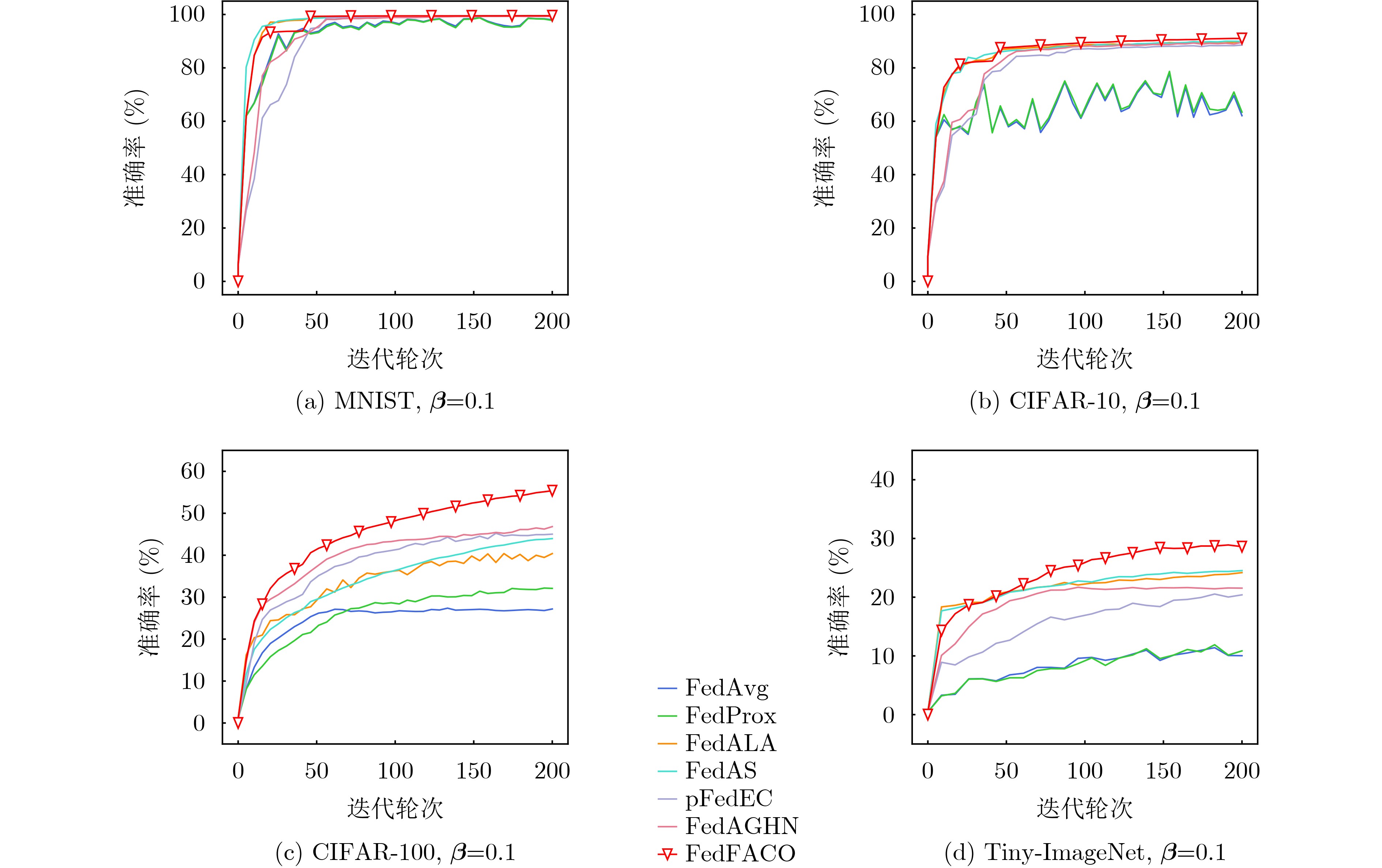
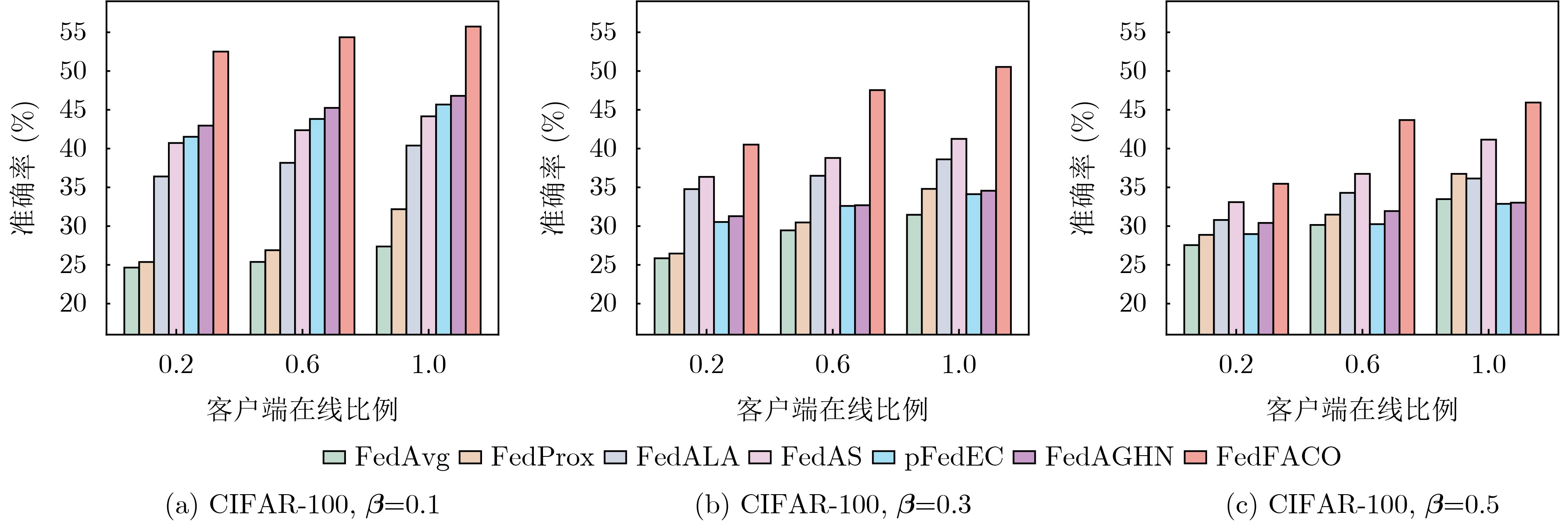
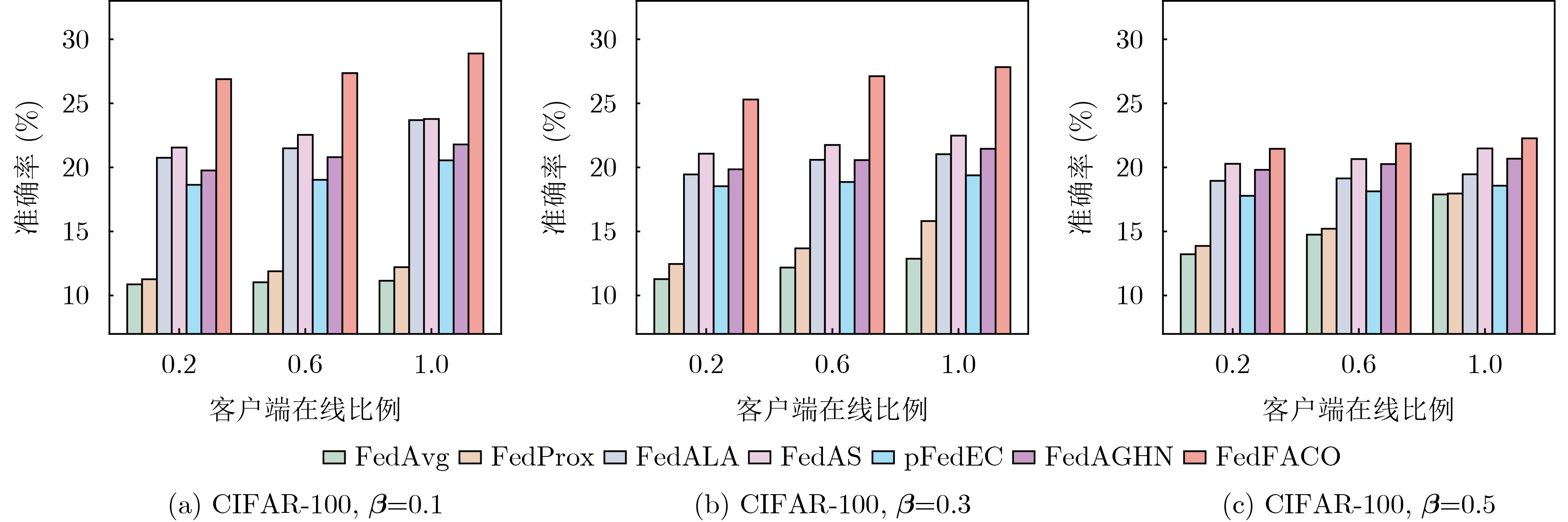
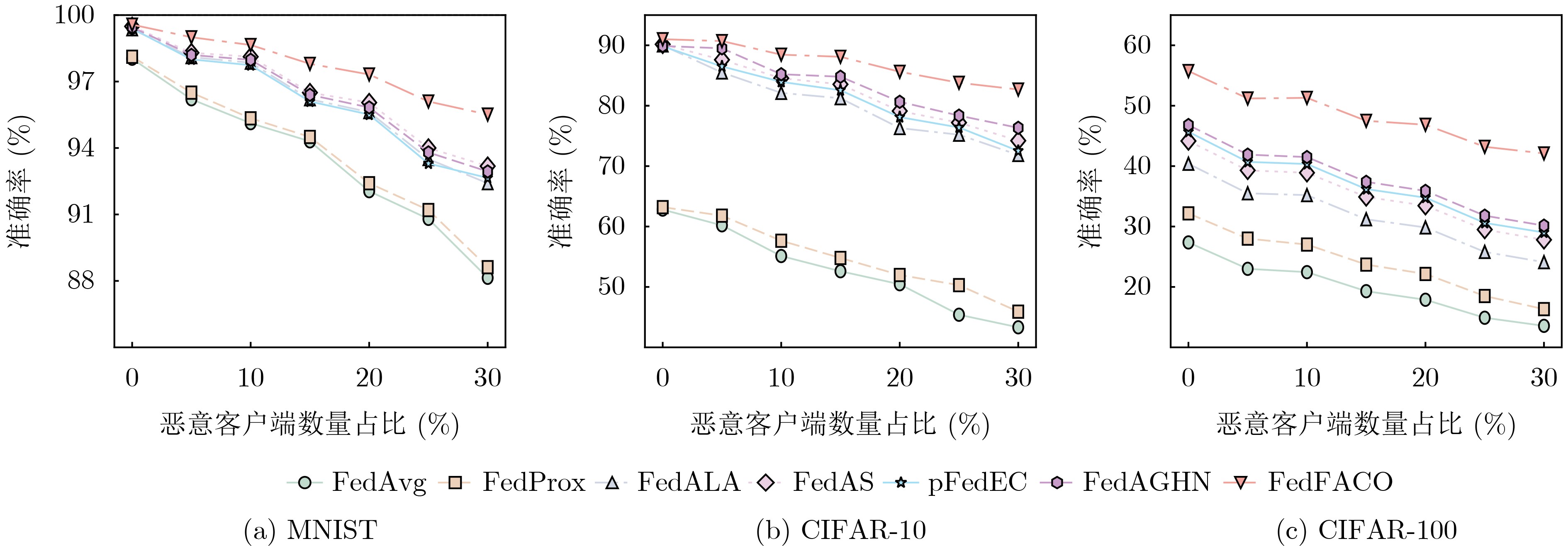
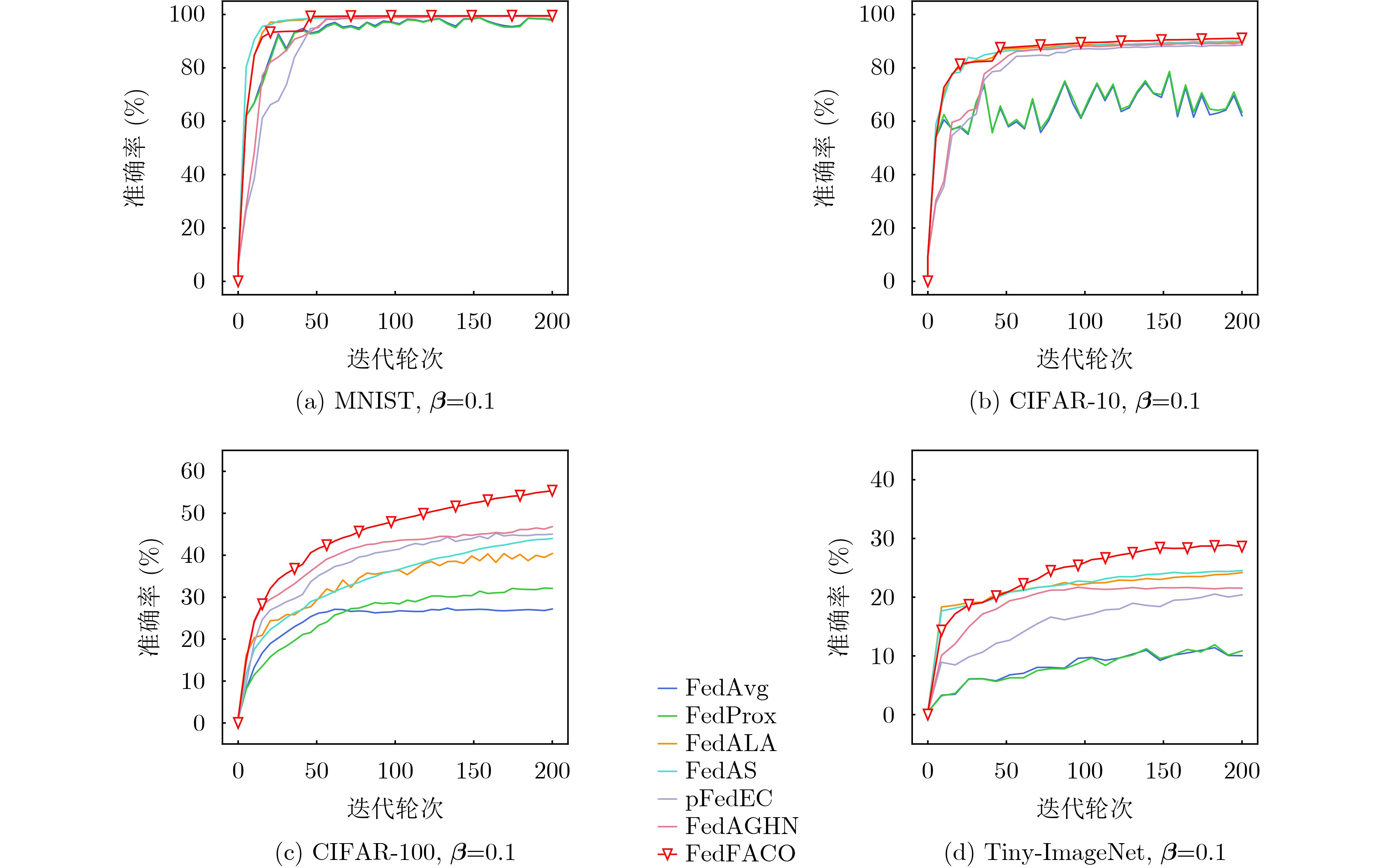
Objective Non-IID data heterogeneity remains one of the major challenges in personalized federated learning, as it often leads to inconsistent local optimization directions, insufficient global knowledge transfer, and degraded model personalization performance. To address these issues, this paper proposes FedFACO, a personalized federated learning method based on Fisher information matrix-guided adaptive aggregation and client collaborative optimization. The proposed method aims to improve the adaptability of federated models to heterogeneous client distributions while maintaining effective knowledge sharing across clients. By introducing an adaptive aggregation mechanism and a collaborative optimization strategy, FedFACO provides a more principled way to balance global generalization and local personalization, which is particularly important in complex Non-IID federated environments. Methods FedFACO consists of two key components. First, an adaptive aggregation (AA) mechanism is employed to dynamically adjust fusion weights between global and local models based on client-specific states, generating personalized initializations aligned with local data. Second, a collaborative optimization (CO) mechanism is introduced, combining feature alignment with FIM-based client weighting. This enhances useful global knowledge transfer and suppresses low-quality updates. The FIM is utilized to quantify the information contribution of each update, ensuring reliable aggregation. The method is evaluated on MNIST, CIFAR-10, CIFAR-100, and Tiny-ImageNet under Non-IID settings, and compared with representative baselines. Convergence behavior, dropout robustness, and sensitivity to low-quality updates are also examined. Results and Discussions Experimental results demonstrate that FedFACO consistently outperforms competitive baseline methods across all four benchmark datasets, achieving an average accuracy improvement of approximately 3.1% over mainstream approaches ( Fig. 1 ,Table 2 ). On the more challenging Tiny-ImageNet dataset, FedFACO reduces the total training time required to reach convergence by approximately 4.8% compared with the best baseline (Table 3 ). Ablation studies confirm that performance is substantially improved by both AA and CO mechanisms, with their joint application yielding optimal accuracy (Table 6 ). Furthermore, FIM-guided weighting is shown to accurately quantify contribution quality in client dropout and asynchronous scenarios, significantly enhancing aggregation reliability (Fig. 2 –Fig. 3 ). Superior robustness is also demonstrated in malicious client scenarios (Fig. 4 ).Conclusions This paper presents FedFACO, a personalized federated learning method for Non-IID environments via Fisher information matrix-guided adaptive aggregation and client collaborative optimization. The method effectively balances global knowledge sharing and local personalization while enhancing training stability and robustness under heterogeneous client participation. Experimental results validate its effectiveness and superiority in accuracy, convergence efficiency, and robustness. Future work will focus on lightweight Fisher information approximations and adaptive triggering strategies to reduce computational overhead, as well as integration with privacy-preserving and security-defense mechanisms for deployment in resource-constrained and high-security environments. -
1 基于Fisher信息矩阵的自适应聚合与客户端协同优化的个性化联邦学习方法
输入:全局模型参数$ { \varTheta }^{0} $,客户端集合$ \left\{{C}_{1},{C}_{2},\cdots ,{C}_{N}\right\}, $每轮
参与训练的客户端在线比例$ P, $全局通信轮数$ T, $本地训练轮数
$ E, $客户端本地数据集$ {D}_{k}\left(k=1{,}2,\cdots ,N\right) $,高层聚合范围$ p $,
自适应权重矩阵$ {\boldsymbol{A}}_{k}, $本地模型$ {W}_{k}=\left({ \varTheta }_{k},{\omega }_{k}\right), $本地学习率$ \eta $输出:全局模型参数$ { \varTheta }^{T}, $各客户端个性化模型{$ W_{k}^{T} $} 1. 服务器初始化全局模型参数$ { \varTheta }^{0}, $同步$ \varTheta _{k}^{0} \leftarrow { \varTheta }^{0} $ 2. 客户端将$ \boldsymbol{A}_{k}^{p}, \forall k\in \left[1{,}2,\cdots ,N\right], $初始化为全1 3. FOR t = 1 TO T DO 4. 服务器从$ N $个客户端中随机选择$ \left\lceil P\cdot N\right\rceil $个客户端
$ {S}_{k}\in\left\{{C}_{1},{C}_{2},\cdots ,{C}_{N}\right\} $5. //$ \text{客户端本地训练} $ 6. FOR ALL 客户端$ k\epsilon {S}_{k} $ DO 7. 从服务器接收全局共享参数$ { \varTheta }^{t-1} $ 8. 读取上一轮训练后的本地共享参数$ \varTheta _{k}^{t-1} $和个性化头部
$ \omega _{k}^{t-1} $9. // 自适应聚合(AA) 10. $ \Delta \leftarrow { \varTheta }^{t-1}{-\Theta}_{k}^{t-1} $ 11. $ \tilde{ \varTheta }_{k}^{t}{=\Theta}_{k}^{t-1}+ \Delta \odot\left[{1}^{L-p};\sigma \left(\boldsymbol{A}_{k}^{p}\right)\right] $ 12. $ \boldsymbol{A}_{k}^{p} \leftarrow \boldsymbol{A}_{k}^{p}-{\eta }_{AA}{\nabla}_{{\boldsymbol{A}_{k}^{p}}}{\text{L}}_{\text{task}}\left(\tilde{ \varTheta }_{k}^{t},{D}_{k},{ \varTheta }^{t-1}\right) $ 13. // 协同优化—参数对齐(CO—PA) 14. $ E_{k}^{t-1}=f\left( \varTheta _{k}^{t-1},{D}_{k}\right),E_{k}^{t} $=$ f\left(\tilde{ \varTheta }_{k}^{t},{D}_{k}\right) $ 15. $ \text{L}_{\text{align}}^{\text{feat}} \leftarrow \left|\left|E_{k}^{t}-E_{k}^{t-1}\right|\right|_{2}^{2} $ 16. $ \text{L}_{\text{align}}^{\text{reg}} \leftarrow \left|\left|\tilde{ \varTheta }_{k}^{t}-{ \varTheta }^{t-1}\right|\right|_{2}^{2} $ 17. $ {\mathcal{L}}_{\text{align}}\leftarrow \mathcal{L}_{\text{align}}^{\text{feat}}+\mathcal{L}_{\text{align}}^{\text{reg}} $ 18. $ \varTheta _{k}^{t}=\tilde{ \varTheta }_{k}^{t}-\eta {\nabla}_{{\tilde{ \varTheta }_{k}^{t}}}{\text{L}}_{\text{align}}, \omega _{k}^{t}= \omega _{k}^{t-1} $ 19. FOR e = 1 TO $ E $ DO 20. $ {\text{L}}_{\text{task}} \leftarrow {\text{L}}_{\text{task}}\left({\varTheta }_{k}^{t}{, \omega }_{k}^{t};{D}_{k}\right) $ 21. $ \varTheta _{k}^{t}{ \leftarrow \varTheta }_{k}^{t}-\eta {\nabla}_{{ \varTheta _{k}^{t}}}{\text{L}}_{\text{task}} $ 22. $ \omega _{k}^{t}{ \leftarrow \omega }_{k}^{t}-\eta {\nabla}_{{ \omega _{k}^{t}}}{\text{L}}_{\text{task}} $ 23. END FOR 24. // 协同优化—客户端同步(CO—CS) 25. $ {\boldsymbol{F}\boldsymbol{I}\boldsymbol{M}}_{\boldsymbol{k}} \leftarrow {\nabla}_{{{W}_{k}}}\ln p\left({D}_{k}|{W}_{k}\right)\cdot{{{\nabla}_{{{W}_{k}}}}\ln p\left({D}_{k}|{W}_{k}\right)}^{T} $ 26. $ \overline{N}=\dfrac{1}{\left| {S}_{k}\right| }\displaystyle\sum\nolimits_{\text{j}\in{S}_{k}}{n}_{j} $ 27. $ {\alpha }_{k} \leftarrow \displaystyle\sum\nolimits_{i=1}^{{d}_{w}}{\text{diag}\left({\text{FIM}}_{k}\right)}_{i}\cdot\ln \left(1+\dfrac{{n}_{k}}{\overline{N}}\right) $ 28. $ \Delta {\varTheta }_{k}^{t}={\varTheta }_{k}^{t}-{{\varTheta }}^{t-1} $ 29. 客户端上传$ \left\{ \Delta {\varTheta }_{k}^{t},{\alpha }_{k}\right\} $ 30. END FOR 31. // 服务器聚合 32. $ \alpha _{k}^{\prime}=\dfrac{{\alpha }_{k}}{\displaystyle\sum\limits_{\text{j}\in{S}_{k}}{\alpha }_{j}} $ 33. $ {{\varTheta }}^{t}={{\varTheta }}^{t-1}+\displaystyle\sum\nolimits_{k\in {S}_{k}}\alpha _{k}^{\prime} \Delta {\varTheta }_{k}^{t} $ 34. END FOR 35. RETURN $ {{\varTheta }}^{T} $, {$ W_{k}^{T} $}  下载: 导出CSV
表 1 联邦数据集统计信息
数据集 分类 类别数 样本数 分辨率 MNIST Image 10 70,000 28x28 CIFAR-10 Image 10 60,000 32×32 CIFAR-100 Image 100 60,000 32×32 Tiny-ImageNet Image 200 110,000 64×64
下载: 导出CSV
表 2 不同数据集下,各方法不同狄利克雷参数$ \beta $的准确率比较
算法 MNIST CIFAR-10 CIFAR-100 Tiny-ImageNet $ \beta $=0.1 $ \beta $=0.3 $ \beta $=0.5 $ \beta $=0.1 $ \beta $=0.3 $ \beta $=0.5 $ \beta $=0.1 $ \beta $=0.3 $ \beta $=0.5 $ \beta $=0.1 $ \beta $=0.3 $ \beta $=0.5 FedAvg 98.03 98.28 98.92 62.80 66.97 72.47 27.37 31.46 33.48 11.15 12.87 17.89 FedProx 98.12 98.47 98.96 63.21 67.49 72.58 32.18 34.80 36.74 12.21 15.81 17.96 FedALA 99.36 99.04 98.76 89.98 78.76 73.62 40.39 38.61 36.14 23.69 21.03 19.46 FedAS 99.49 99.12 99.06 90.16 81.45 77.01 44.16 41.25 41.15 23.78 22.48 21.48 pFedEC 99.39 99.02 98.92 89.83 79.57 73.60 45.68 34.12 32.87 20.55 19.38 18.57 FedAGHN 99.45 99.16 99.07 89.89 79.94 75.88 46.80 34.56 33.02 21.79 21.45 20.68 FedFACO 99.57 99.22 99.18 91.01 82.08 78.37 55.74 50.53 45.94 28.89 27.83 22.27
下载: 导出CSV
表 3 不同方法的计算开销和通信开销
方法 总训练时间(h) 每轮平均时间(min) 通信开销 FedAvg 13.32 6.15 $ 2\cdot \sum $ FedProx 11.86 6.53 $ 2\cdot \sum $ FedALA 7.98 6.30 $ 2\cdot \sum $ FedAS 8.46 6.93 $ 2\cdot {\alpha }_{\mathrm{f}}\cdot \sum $ pFedEC 8.58 7.39 $ 2\cdot {\alpha }_{\mathrm{f}}\cdot \sum $ FedAGHN 9.17 8.18 $ 2\cdot \sum $ FedFACO 7.60 7.24 $ 2\cdot {\alpha }_{\mathrm{f}}\cdot \sum $
下载: 导出CSV
表 4 不同在线比例下FIM对FedFACO收敛性能的影响
客户端在线比例 评估指标 FIM w/o FIM 差异 $ P=0.2 $ 准确率(%) 89.99 80.97 +9.02 收敛轮次 96 128 –32 $ P=0.6 $ 准确率(%) 90.84 83.43 +7.41 收敛轮次 89 112 –23 $ P=1.0 $ 准确率(%) 91.01 85.22 +5.79 收敛轮次 83 91 –8
下载: 导出CSV
表 5 默认实际设置下CIFAR-100的PSNR($ \mathrm{dB},\downarrow $)值
方法 FedAvg FedAS pFedEC FedAGHN FedFACO PSNR值 7.30 7.84 6.92 7.41 6.55
下载: 导出CSV
表 6 FedFACO各模块在不同数据集上的准确率比较(%)
方法 AA模块 CO模块 MNIST CIFAR-
10CIFAR-
100Tiny-
ImageNetBaseline
(w/o AA&CO)- - 97.81 60.17 25.38 11.03 FedFACO
w/o CO√ - 98.61 81.74 38.41 20.56 FedFACO
w/o AA- √ 99.07 85.68 46.35 23.12 FedFACO √ √ 99.52 90.84 54.36 27.36
下载: 导出CSV
-
[1] 宁博, 宁一鸣, 杨超, 等. 自适应聚类中心个数选择: 一种联邦学习的隐私效用平衡方法[J]. 电子与信息学报, 2025, 47(2): 519–529. doi: 10.11999/JEIT240414.NING Bo, NING Yiming, YANG Chao, et al. Adaptive clustering center selection: A privacy utility balancing method for federated learning[J]. Journal of Electronics & Information Technology, 2025, 47(2): 519–529. doi: 10.11999/JEIT240414. [2] MCMAHAN B, MOORE E, RAMAGE D, et al. Communication-efficient learning of deep networks from decentralized data[C]. 20th International Conference on Artificial Intelligence and Statistics, Fort Lauderdale, USA, 2017: 1273–1282. [3] QUAN M K, PATHIRANA P N, WIJAYASUNDARA M, et al. Federated learning for cyber physical systems: A comprehensive survey[J]. IEEE Communications Surveys & Tutorials, 2026, 28: 3751–3790. doi: 10.1109/COMST.2025.3570288. [4] 蒋伟进, 崔新雨, 刘志华, 等. 基于可学习聚合权重的解析性联邦学习方法[J]. 计算机学报, 2026, 49(1): 84–108. doi: 10.11897/SP.J.1016.2026.00084.JIANG Weijin, CUI Xinyu, LIU Zhihua, et al. Analytical federated learning method based on learnable aggregation weights[J]. Chinese Journal of Computers, 2026, 49(1): 84–108. doi: 10.11897/SP.J.1016.2026.00084. [5] LI Tian, SAHU A K, ZAHEER M, et al. Federated optimization in heterogeneous networks[C]. 3rd Conference on Machine Learning and Systems, Austin, USA, 2020: 429–450. [6] WANG Kaidi, DING Zhiguo, SO D K C, et al. Age-of-information minimization in federated learning based networks with non-IID dataset[J]. IEEE Transactions on Wireless Communications, 2024, 23(8): 8939–8953. doi: 10.1109/TWC.2024.3357208. [7] LANG N, COHEN A, and SHLEZINGER N. Stragglers-aware low-latency synchronous federated learning via layer-wise model updates[J]. IEEE Transactions on Communications, 2025, 73(5): 3333–3346. doi: 10.1109/TCOMM.2024.3486979. [8] 陈晓, 仇洪冰, 李燕龙. 边缘辅助的自适应稀疏联邦学习优化算法[J]. 电子与信息学报, 2025, 47(3): 645–656. doi: 10.11999/JEIT240741.CHEN Xiao, QIU Hongbing, and LI Yanlong. Adaptively sparse federated learning optimization algorithm based on edge-assisted server[J]. Journal of Electronics & Information Technology, 2025, 47(3): 645–656. doi: 10.11999/JEIT240741. [9] ZHANG Jianqing, HUA Yang, WANG Hao, et al. FedALA: Adaptive local aggregation for personalized federated learning[C]. 37th AAAI Conference on Artificial Intelligence, Washington, USA, 2023: 11237–11244. doi: 10.1609/aaai.v37i9.26330. [10] YANG Xiyuan, HUANG Wenke, and YE Mang. FedAS: Bridging inconsistency in personalized federated learning[C]. 2024 IEEE/CVF Conference on Computer Vision and Pattern Recognition, Seattle, USA, 2024: 11986–11995. doi: 10.1109/CVPR52733.2024.01139. [11] XU Dawei, LU Chentao, CHEN Tianxin, et al. Model layered optimization with contrastive learning for personalized federated learning[J]. Digital Communications and Networks, 2025, 11(6): 1973–1982. doi: 10.1016/j.dcan.2025.08.011. [12] SONG Jiarui, SHEN Yunheng, HOU Chengbin, et al. FedAGHN: Personalized federated learning with attentive graph hypernetworks[J]. Knowledge-Based Systems, 2025, 329: 114355. doi: 10.1016/j.knosys.2025.114355. [13] BINDER A, MONTAVON G, LAPUSCHKIN S, et al. Layer-wise relevance propagation for neural networks with local renormalization layers[C]. 25th International Conference on Artificial Neural Networks, Barcelona, Spain, 2016: 63–71. doi: 10.1007/978-3-319-44781-0_8. [14] KIRKPATRICK J, PASCANU R, RABINOWITZ N, et al. Overcoming catastrophic forgetting in neural networks[J]. Proceedings of the National Academy of Sciences of the United States of America, 2017, 114(13): 3521–3526. doi: 10.1073/pnas.1611835114. [15] MARTENS J and GROSSE R. Optimizing neural networks with Kronecker-factored approximate curvature[C]. 32nd International Conference on Machine Learning, Lille, France, 2015: 2408–2417. [16] HONARMAND M, MUTLU O C, AZIZIAN P, et al. Selective test-time domain adaptation using fisher information for robust facial expression recognition in-the-wild[C]. 2025 IEEE/CVF Conference on Computer Vision and Pattern Recognition Workshops, Nashville, USA, 2025: 5800–5810. doi: 10.1109/CVPRW67362.2025.00579. [17] ROMANDINI N, MORA A, MAZZOCCA C, et al. Federated unlearning: A survey on methods, design guidelines, and evaluation metrics[J]. IEEE Transactions on Neural Networks and Learning Systems, 2025, 36(7): 11697–11717. doi: 10.1109/TNNLS.2024.3478334. [18] 孙钰, 严宇, 崔剑, 等. 联邦学习深度梯度反演攻防研究进展[J]. 电子与信息学报, 2024, 46(2): 428–442. doi: 10.11999/JEIT230541.SUN Yu, YAN Yu, CUI Jian, et al. Review of deep gradient inversion attacks and defenses in federated learning[J]. Journal of Electronics & Information Technology, 2024, 46(2): 428–442. doi: 10.11999/JEIT230541. [19] WANG Ke, DIMITRIADIS N, FAVERO A, et al. LiNeS: Post-training layer scaling prevents forgetting and enhances model merging[C]. 13th International Conference on Learning Representations, Singapore, Singapore, 2025: 27100–27133. [20] ALLOUAH Y, GUERRAOUI R, GUPTA N, et al. Adaptive gradient clipping for robust federated learning[C]. 13th International Conference on Learning Representations, Singapore, Singapore, 2025: 84251–84295. [21] LECUN Y, BOTTOU L, BENGIO Y, et al. Gradient-based learning applied to document recognition[J]. Proceedings of the IEEE, 1998, 86(11): 2278–2324. doi: 10.1109/5.726791. [22] KRIZHEVSKY A and HINTON G. Learning multiple layers of features from tiny images[R]. 2009. (查阅网上资料, 未找到报告编号信息, 请补充). [23] LE Ya and YANG Xuan. Tiny imagenet visual recognition challenge[R]. CS 231N, 2015. (查阅网上资料, 未找到报告编号信息, 请确认). [24] HE Kaiming, ZHANG Xiangyu, REN Shaoqing, et al. Deep residual learning for image recognition[C]. 2016 IEEE Conference on Computer Vision and Pattern Recognition, Las Vegas, USA, 2016: 770–778. doi: 10.1109/CVPR.2016.90. [25] LIN Tao, KONG Lingjing, STICH S U, et al. Ensemble distillation for robust model fusion in federated learning[C]. 34th International Conference on Neural Information Processing System, Vancouver, Canada, 2020: 198. -

 下载:
下载:

图(4) / 表(7)
计量
- 文章访问数: 442
- HTML全文浏览量: 147
- PDF下载量: 9
- 被引次数: 0
