




Construction and Performance Analysis of Optimal Low-Hit-Zone Frequency Hopping Sequence Sets
-
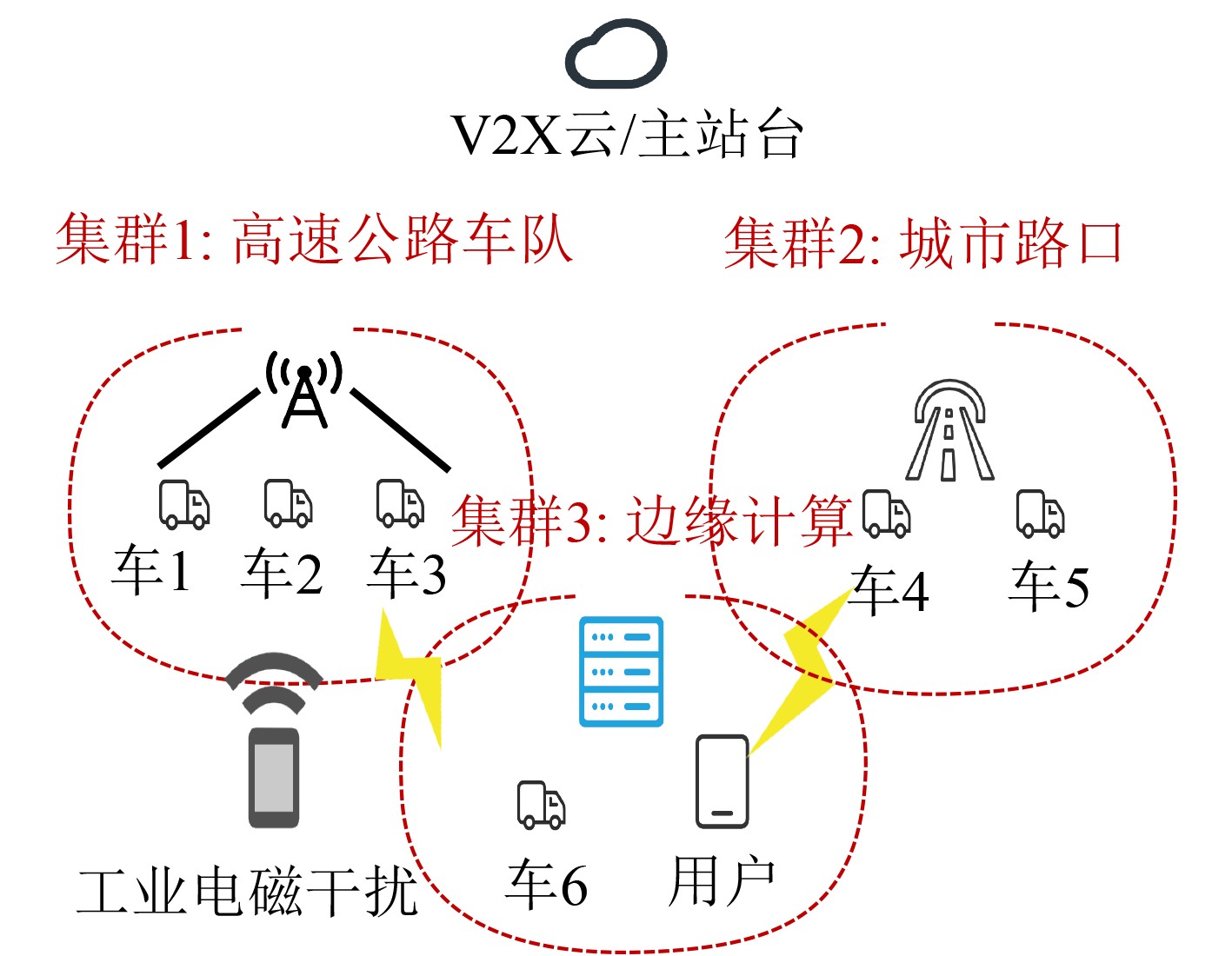
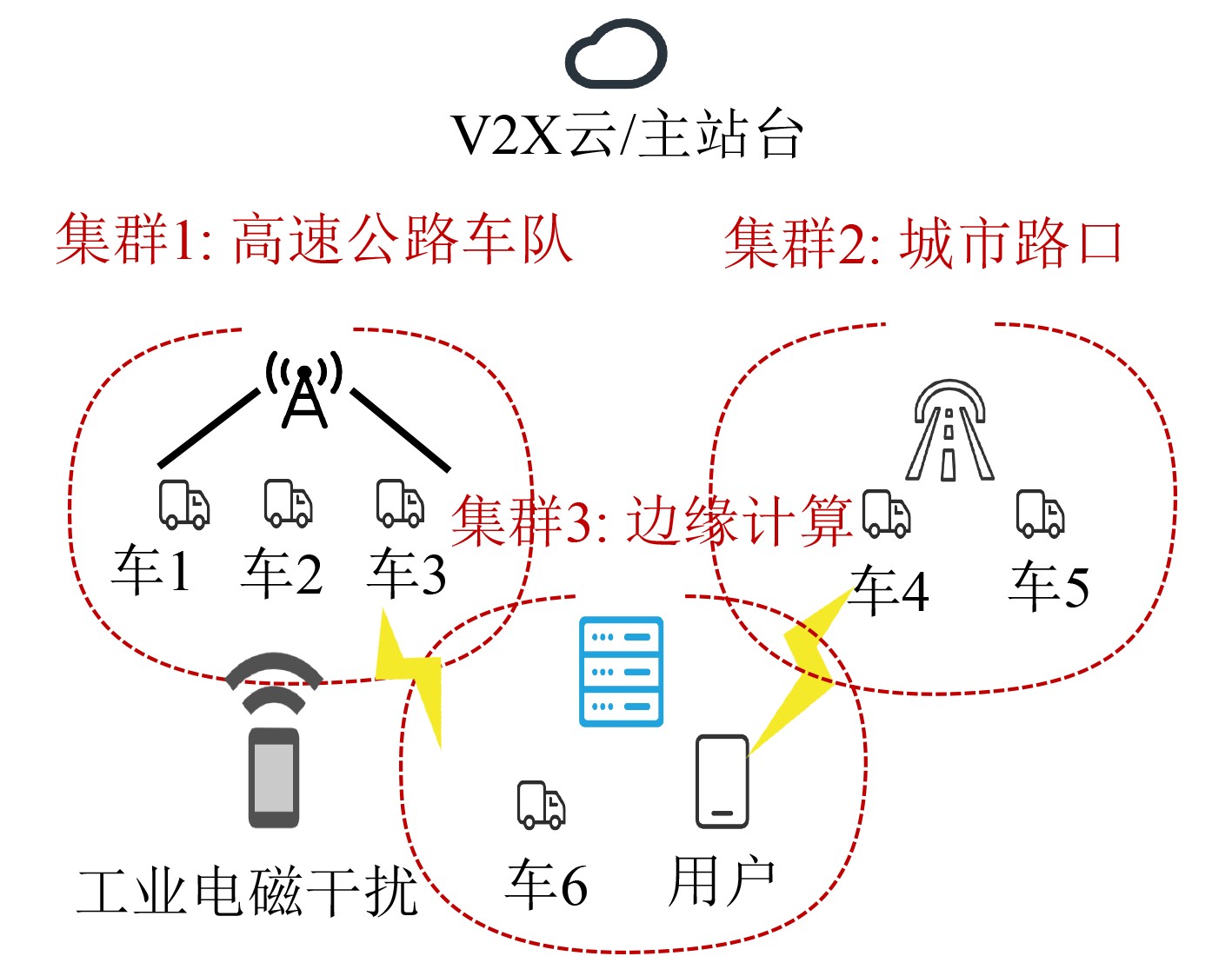
摘要: 电磁干扰(EMI)严重影响同步系统可靠性。现有5G方案采用全频带Zadoff-Chu(ZC)序列,在高密度接入场景下受限于正交码资源,面临明显的容量瓶颈。针对此挑战,该文提出一种跳频(FH)与ZC序列结合的方案。通过构造关于Peng-Fan-Lee界最优的多子集低碰撞区(LHZ)跳频序列集,利用其多子集结构为车联网局部簇同步资源划分提供序列支撑。仿真结果表明,在子带选择性阻塞干扰环境下,所提FH-ZC同步方案相较于全频带ZC基准方案具有更高的同步检测概率,同时,所提多子集按簇分配方式能够更好地适配局部簇同步场景的竞争结构,并在多用户并发条件下表现出更优的同步检测鲁棒性。
-
关键词:
- 跳频序列 /
- Peng-Fan-Lee界 /
- 汉明相关 /
- 低碰撞区 /
- 电磁干扰
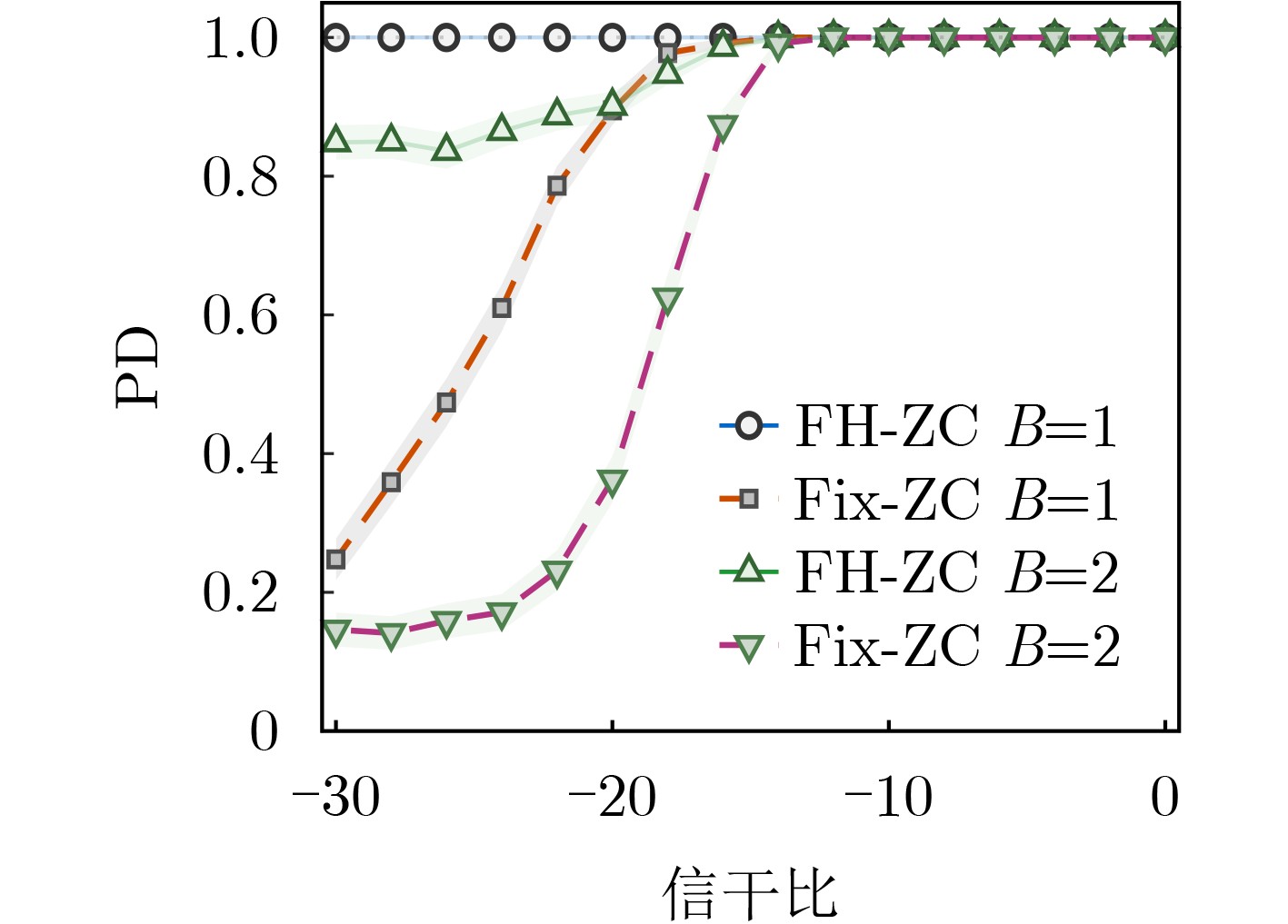
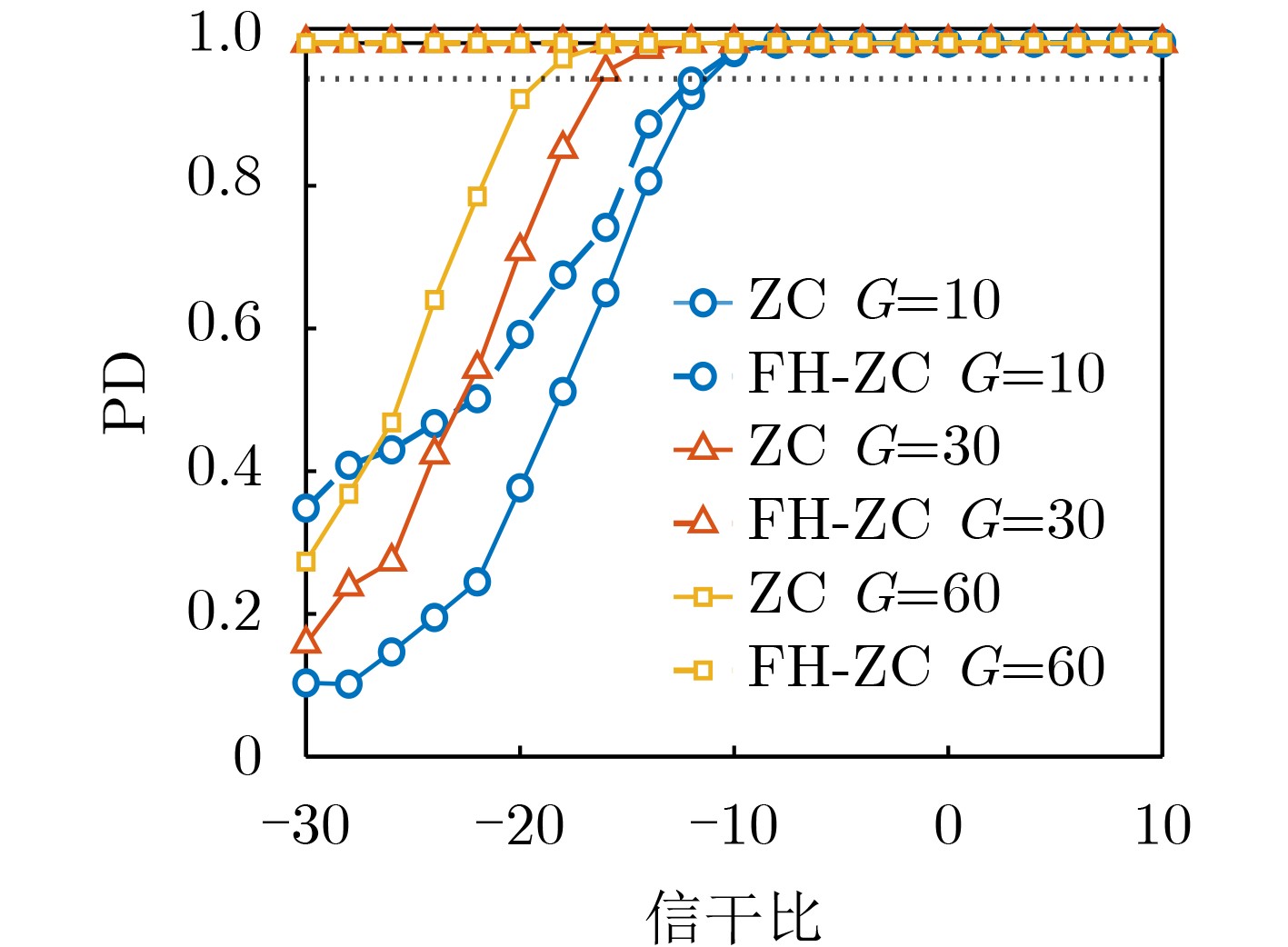
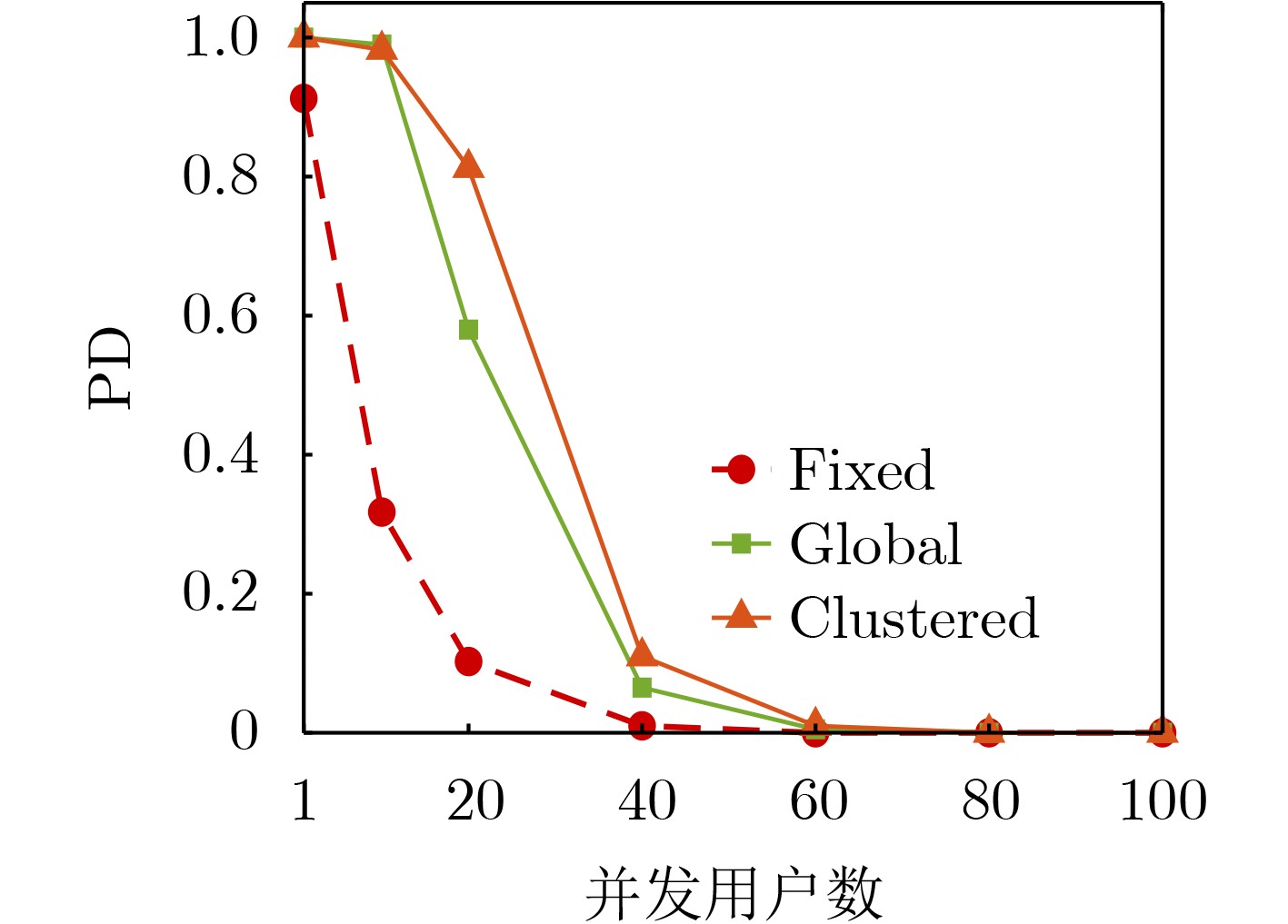
Abstract:Objective ElectroMagnetic Interference (EMI) is a critical factor limiting the reliability of synchronization systems. Existing Fifth-Generation (5G) synchronization schemes extensively employ Zadoff-Chu (ZC) sequences to distinguish users through cyclic shifts. However, finite sequence lengths and limited orthogonal resources create substantial capacity bottlenecks in high-density access scenarios. To address these challenges, this paper investigates the problem from two perspectives. At the system level, a synchronization framework is developed by integrating Frequency Hopping (FH) with ZC sequences. By jointly exploiting code, time, and frequency-domain resources, the proposed framework improves concurrent access capability for local clusters while enhancing robustness against complex EMI through frequency diversity. At the sequence-design level, a class of multi-subset Low-Hit-Zone (LHZ) Frequency Hopping Sequence (FHS) sets is constructed to provide an efficient sequence allocation scheme for local-cluster synchronization. Methods Based on the theoretical framework proposed by Cai et al., the sequence mapping mechanism is reconstructed, and a disjoint Cyclic Perfect Mendelsohn Difference Family (CPMDF) is introduced to construct FHS sets that are optimal with respect to the Peng-Fan bound. The generating units are further expanded through Cartesian products, and a column-incoherent partitioning strategy is proposed to construct multi-subset LHZ FHS sets. It is proved that every nonempty subset satisfies the Peng-Fan-Lee bound with equality. Compared with Global-LHZ-FH-ZC, Clustered-LHZ-FH-ZC provides higher synchronization detection robustness by better matching the local-cluster competition structure. At the system level, an FH-ZC synchronization architecture is developed by combining predefined FH patterns with the frequency-domain correlation properties of ZC sequences for subband signal detection. A Peak-to-SideLobe Ratio (PSLR) decision metric and an early-termination strategy are adopted to evaluate synchronization preamble detection under interference. Furthermore, a multi-user simulation model is established to evaluate synchronization detection performance under accumulated co-channel collisions and EMI. Results and Discussions The proposed construction generates an FHS set that is optimal with respect to the Peng-Fan bound and a class of multi-subset LHZ FHS sets in which every nonempty subset is optimal with respect to the Peng-Fan-Lee bound. Example 2 demonstrates the construction procedure and the intra-subset and inter-subset Hamming correlation properties of the proposed multi-subset LHZ FHS sets. Table 1 shows that, under the same frequency-resource constraints, the proposed construction generates more sequences than existing methods under the compared parameter settings, indicating higher sequence-resource utilization. Table 2 compares the parameters of the proposed sequence sets with representative constructions reported previously and demonstrates that the proposed multi-subset optimal sequence family provides a new parameter combination. To the best of our knowledge, an optimal sequence family with a multi-subset structure has not been reported previously.Figs. 2 and3 demonstrate that the proposed FH-ZC synchronization architecture achieves a higher synchronization detection probability than the conventional full-band Fixed-ZC baseline under subband-selective blocking interference caused by EMI. Figure 4 shows that the synchronization detection probability decreases as the number of active users increases because accumulated co-channel collisions degrade synchronization performance. Compared with Global-LHZ-FH-ZC, Clustered-LHZ-FH-ZC provides higher synchronization detection robustness by better matching the local-cluster competition structure characterized by strong intra-cluster competition and weak inter-cluster coupling.Conclusions To satisfy the sequence-capacity requirements of massive-access scenarios, this paper proposes a class of multi-subset LHZ FHS sets. By expanding the generating sequence sets through Cartesian products and partitioning subsets using a column-incoherent strategy, the proposed construction achieves both a large family size and optimal LHZ performance. The proposed multi-subset structure is well suited to local-cluster synchronization and substantially improves sequence family size and sequence-resource utilization, thereby providing a richer sequence resource pool for high-density multi-user systems. Simulation results under the considered physical-layer model demonstrate that the proposed LHZ FHS subsets reduce the effect of frequency collisions during multi-user synchronization detection. Furthermore, the FH-ZC synchronization scheme achieves a higher synchronization preamble detection probability than the conventional full-band Fixed-ZC baseline under subband-selective blocking interference caused by EMI. -
表 2 现有最优LHZ FHS集与本文的参数对比
参数$ (L,N,\ell,{L}_{\text{z}},{H}_{\text{m}}({S})) $ 子集个数 限制 文献 $ \left(q^n-1,q^k\left\lfloor\dfrac{q^n-1}{L_{\mathrm{z}}+1}\right\rfloor,q^k,L\mathrm{_z},q^{n-k}\right) $ 1 $ 2\leq {L}_{{\mathrm{z}}}\leq \left\lfloor \dfrac{{q}^{n}-1}{2}\right\rfloor -1 $ [8] $ \left(\dfrac{{v}^{n}-1}{l},T,{v}^{n-1},{L}_{\mathrm{z}},\left\lceil \dfrac{W}{N}\right\rceil \right) $ 1 $ l|v-1 $, $ n\geq 2 $, $ \gcd (l,n)=1 $, $ k=n-1 $ [9] $ \left(\dfrac{q^n-1}{d},\left\lfloor\dfrac{q^n-1}{d(L\mathrm{_z}+1)}\right\rfloor d,q^{n-1},L\mathrm{_z},\dfrac{q-1}{d}\right) $ 1 $ 2\leq {L}_{{\mathrm{z}}}\leq \left\lfloor \dfrac{{q}^{n}-1}{2d}\right\rfloor -1 $ [10] $ (qL,qM,qv,1,L-1) $ 1 $ q\geq 1 $ [11] $ (p({p}^{r}-1),{p}^{r-1},{p}^{r},p({p}^{r}-1),\left\lceil \dfrac{L}{{p}^{r}-1}\right\rceil ) $ 1 $ r\geq 2 $ [15] $ (p({p}^{r}-1),{p}^{r},{p}^{r},{p}^{r}-2,p) $ $ {p}^{(k-1)r} $ $ r\geq 2 $, $ p\geq 2 $ $ k\geq 1 $, $ \ell\equiv 1 \left(\mathrm{mod}k\right) $, $ \gcd (\ell,k)=1 $ 本文  下载: 导出CSV
-
[1] 王诗雨, 汪西明, 可臻怡, 等. 无人机通信多模抗干扰: 融合二维迁移强化学习的协同决策方法[J]. 电子与信息学报, 2025, 47(11): 4200–4210. doi: 10.11999/JEIT250566.WANG Shiyu, WANG Ximing, KE Zhenyi, et al. Multi-mode anti-jamming for UAV communications: A cooperative mode-based decision-making approach via two-dimensional transfer reinforcement learning[J]. Journal of Electronics & Information Technology, 2025, 47(11): 4200–4210. doi: 10.11999/JEIT250566. [2] 应宗辰, 桂琳, 杨佳翰, 等. TTSPD: 一种融合轮胎数据的多模态交通场景感知数据集[J]. 电子与信息学报, 2026, 48(7): 2792–2804. doi: 10.11999/JEIT260022.YING Zongchen, GUI Lin, YANG Jiahan, et al. TTSPD: A multimodal traffic scene perception dataset integrating tire data[J]. Journal of Electronics & Information Technology, 2026, 48(7): 2792–2804. doi: 10.11999/JEIT260022. [3] 齐子森, 张梓轩, 许华, 等. 利用无线电极化特征的跳频网台分选方法[J]. 电子与信息学报, 2024, 46(4): 1286–1295. doi: 10.11999/JEIT230315.QI Zisen, ZHANG Zixuan, XU Hua, et al. Frequency-hopping network station sorting method using radio polarization characteristics[J]. Journal of Electronics & Information Technology, 2024, 46(4): 1286–1295. doi: 10.11999/JEIT230315. [4] CHEN Miling, CHAI Rong, HU Hang, et al. Performance evaluation of C-V2X mode 4 communications[C]. 2021 IEEE Wireless Communications and Networking Conference, Nanjing, China, 2021: 1–6. doi: 10.1109/WCNC49053.2021.9417517. [5] GROW J, OGLESBY N, HATCHER G, et al. Wireless interference and regulatory frameworks for frequency allocation in V2X communication systems[C]. 8th International Conference on Intelligent Transport Systems, Pisa, Italy, 2024: 265–278. doi: 10.1007/978-3-031-86370-7_16. [6] PAUL C R, SCULLY R C, and STEFFKA M A. Introduction to Electromagnetic Compatibility[M]. 3rd ed. Hoboken: Wiley, 2022. [7] IEC. IEC 61000-4-3: 2020 Electromagnetic compatibility (EMC) - Part 4-3: Testing and measurement techniques - Radiated, radio-frequency, electromagnetic field immunity test[S]. Geneva: International Electrotechnical Commission, 2020. [8] XIE Chun and WANG Changyuan. Constructions of low-hit-zone frequency-hopping sequence set with strictly optimal periodic partial Hamming correlation[J]. IEEE Access, 2025, 13: 105394–105400. doi: 10.1109/ACCESS.2025.3580293. [9] ZHOU Limengnan, PENG Daiyuan, LIANG Hongbin, et al. Constructions of optimal low-hit-zone frequency hopping sequence sets[J]. Designs, Codes and Cryptography, 2017, 85(2): 219–232. doi: 10.1007/s10623-016-0299-z. [10] WANG Changyuan, ZHANG Yi, YANG Wanan, et al. Optimal constructions of low-hit zone frequency-hopping sequence set based on m-sequence[J]. Mathematics, 2025, 13(14): 2228. doi: 10.3390/math13142228. [11] TIAN Xinyu, HAN Hongyu, and PARAMPALLI U. Construction of low-hit-zone frequency-hopping sequence sets with strictly optimal partial Hamming correlation based on Chinese Remainder Theorem[J]. Cryptography and Communications, 2025, 17(1): 15–25. doi: 10.1007/s12095-024-00738-7. [12] ZEYDAN E, TURK Y, and DEV K. Driving cluster-level trust for artificial intelligence in V2X communications[J]. IEEE Internet of Things Magazine, 2026, 9(1): 88–95. doi: 10.1109/MIOT.2025.3582670. [13] AMER A A, TALKHAN I E, ABUTARBOUSH H F, et al. Joint vehicle clustering and dynamic power allocation optimization in sectorized 6G networks for V2X communication[J]. Vehicular Communications, 2026, 57: 100983. doi: 10.1016/j.vehcom.2025.100983. [14] WU Weihua, HUANG Yanxiu, TENG Wei, et al. Robust beamforming and resource allocation for multiantenna cellular vehicle-to-everything (C-V2X) networks[J]. IEEE Internet of Things Journal, 2026, 13(2): 2731–2747. doi: 10.1109/JIOT.2025.3631632. [15] CAI Han, YANG Yang, ZHOU Zhengchun, et al. Strictly optimal frequency-hopping sequence sets with optimal family sizes[J]. IEEE Transactions on Information Theory, 2016, 62(2): 1087–1093. doi: 10.1109/TIT.2015.2512859. [16] PENG Daiyuan and FAN Pingzhi. Lower bounds on the Hamming auto- and cross correlations of frequency-hopping sequences[J]. IEEE Transactions on Information Theory, 2004, 50(9): 2149–2154. doi: 10.1109/TIT.2004.833362. [17] PENG Daiyuan, FAN Pingzhi, and LEE M H. Lower bounds on the periodic Hamming correlations of frequency hopping sequences with low hit zone[J]. Science in China Series F: Information Sciences, 2006, 49(2): 208–218. doi: 10.1007/s11432-006-0208-6. [18] LIU Xing, SHU Qin, and ZENG Qi. Low-hit-zone frequency/time hopping sequence sets with large family size[J]. IEEE Access, 2019, 7: 181733–181739. doi: 10.1109/ACCESS.2019.2959718. [19] ZHENG Jingze, SHI Zhiguo, GUO Xiuzhen, et al. A tutorial on SDR-based NB-IoT PHY: Synchronization, demodulation, and validation[J]. IEEE Communications Surveys & Tutorials, 2026, 28: 4458–4484. doi: 10.1109/COMST.2026.3654924. -

 下载:
下载:

图(4) / 表(2)
计量
- 文章访问数: 581
- HTML全文浏览量: 284
- PDF下载量: 25
- 被引次数: 0
