




Customized Preparation of Single Crystal Tungsten Tips and Surface Reconstruction Mechanism
-
摘要: 单晶钨针尖是常用的场致发射阴极材料,其尖端形貌直接影响场发射性能。然而,传统电化学腐蚀法制备的针尖呈现尖锥形貌,涂覆氧化锆涂层后很难获得有效发射。为此,本文提出电化学腐蚀与高温通氧处理相结合的工艺路线,系统研究了氧分压、温度及通氧时间对针尖形貌演化的影响。研究发现,氧分压决定重构方向:富氧条件下发生钝化重构,针尖形貌演变为“圆柱段+半球冠”结构,适用于热场发射阴极;欠氧条件下发生锐化重构,尖端曲率半径可缩减至28 nm,适用于冷场发射阴极。基于上述机制,本研究实现了对不同曲率半径针尖形貌尺寸的精确调控,突破了传统电化学腐蚀工艺的局限,实现了钨针尖的定制化制备与缺陷修正,为高性能场发射阴极的可控制备提供了新的技术路径。Abstract:
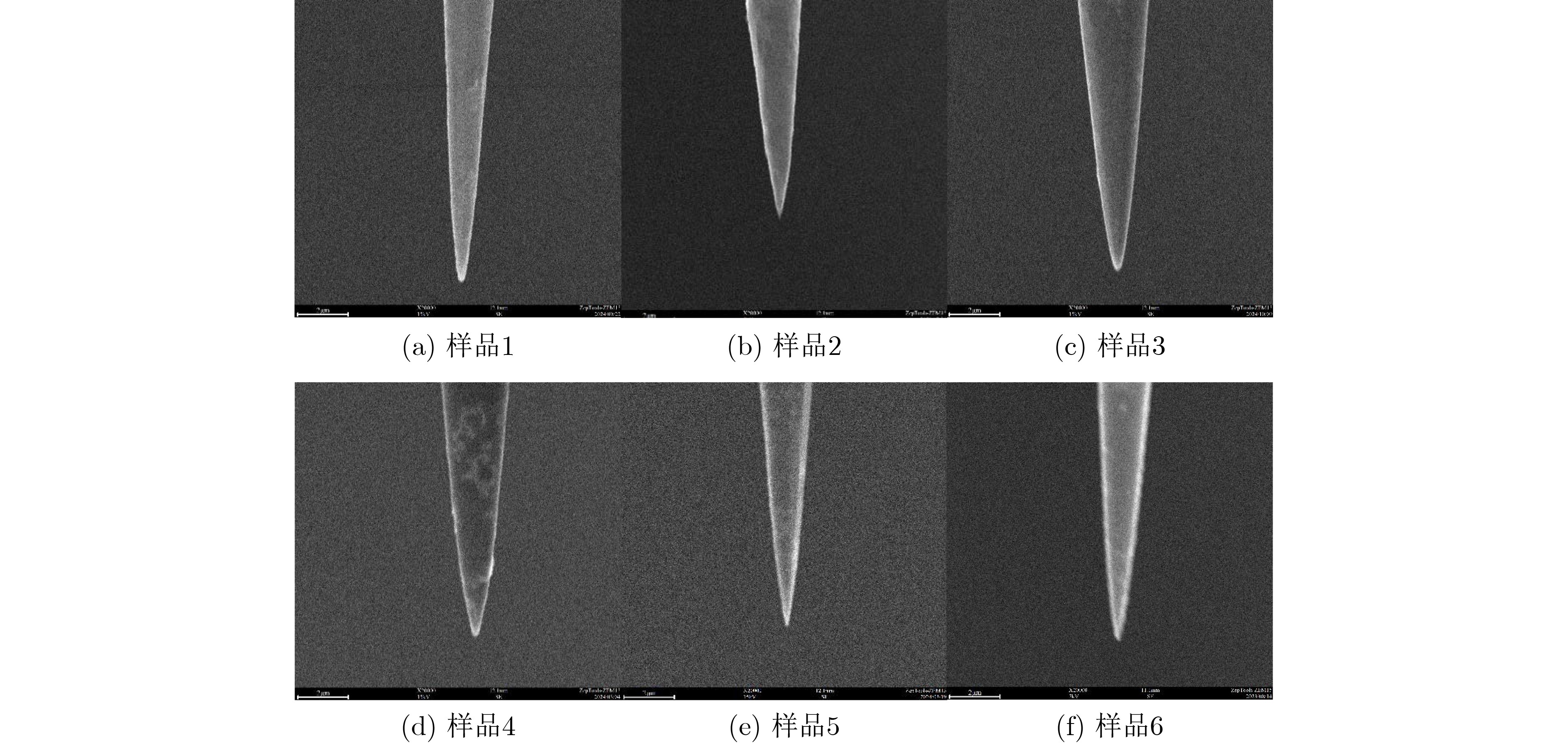
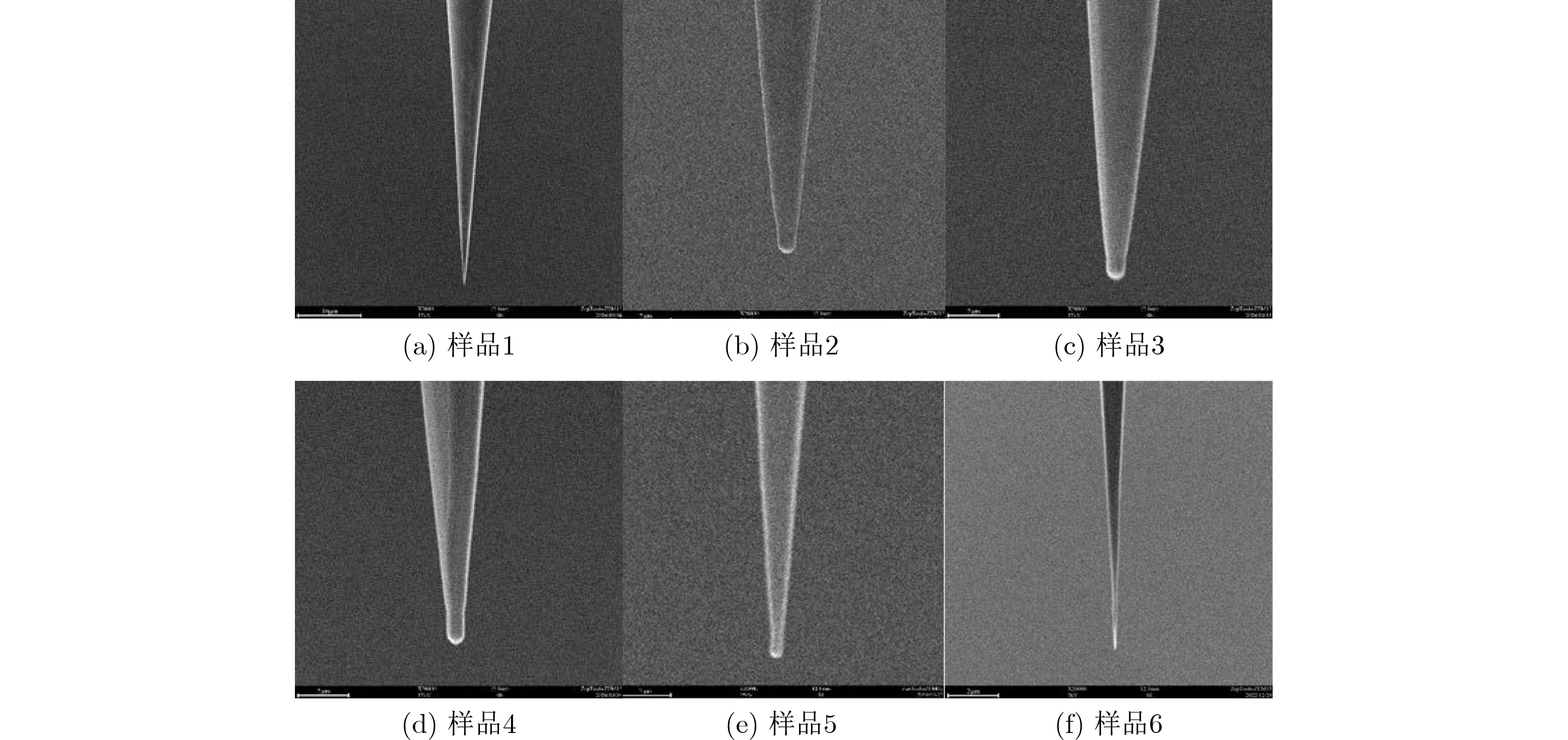
Objective Refractory metal tungsten, particularly single crystal tungsten, serves as a critical material for high-performance field emission cathodes, which are core components in advanced electron microscopes and electron beam lithography systems. The fabrication of single crystal tungsten microtips with precisely controlled geometry and surface cleanliness remains a significant challenge, especially for applications requiring tip radii ranging from sub-100nm for cold field emission to 0.3–1.0 μm for Schottky-type thermal field emission. Currently, the domestic development of high-end electron microscopes in China faces a major bottleneck due to heavy reliance on imported field emission cathodes. Electrochemical corrosion, the mainstream method for tip preparation, suffers from limitations such as difficulty in cutoff timing control, susceptibility to tip bending or passivation, residual surface impurities, and low yield rates. Moreover, the anisotropic nature of single crystal tungsten introduces additional complexity in morphology control. This study aims to establish a controllable fabrication method for single crystal tungsten tips, enabling tailored geometry and surface quality to meet demanding requirements of different field emission applications while significantly improving fabrication yield. Methods Single crystal tungsten wires (diameter 0.12 mm, purity 99.95%, (100) orientation) were used as the starting material. The tips were first pre-shaped by electrochemical corrosion in 1 mol/L NaOH solution under a 10 V DC voltage with pulsed control (6 kHz, 100 μs pulse width) for 10 min. Following corrosion, the tips underwent surface cleaning by sequential immersion in ultrapure water and anhydrous ethanol, followed by drying with high-purity nitrogen. Subsequently, the samples were placed in an ultra-high vacuum system (base pressure < 1 × 10⁻⁶ Pa) and subjected to high-temperature oxygen treatment. Process parameters were systematically varied, including temperature ( 1500 –1600 °C), oxygen flow rate (0.015–1.0 sccm), and treatment duration (5–1440 min). During treatment, high-purity oxygen was introduced while maintaining vacuum levels better than 10–4 Pa. Tip morphologies were characterized by scanning electron microscopy, and surface compositions were analyzed by energy dispersive X-ray spectroscopy. Geometric parameters, including half-cone angle and tip radius, were measured following standardized protocols.Results and Discussions The combination of electrochemical corrosion and high-temperature oxygen treatment enabled both effective surface purification and controlled morphological reconstruction. Scanning electron microscopy characterization revealed distinct evolutionary pathways depending on oxygen partial pressure (Fig. 3, Fig. 4). Under oxygen-rich conditions (1.0 sccm, 1500 –1600 °C), the tips underwent “blunting reconstruction,” evolving from an initial inverted cone into a characteristic “cylindrical segment + hemispherical cap” structure (Samples 2–5,Table 2 ). For Sample 3 treated at1500 °C for 10 min, the tip radius increased to 327 nm with a half-cone angle reduction of 21%; for Sample 4 treated for 15 min, further evolution occurred with tip radius decreasing to 275 nm and cylindrical segment height increasing substantially. With increasing temperature from1500 °C (Sample 2) to1600 °C (Sample 5), the half-cone angle change rate increased from 11% to 25%, while tip radius decreased from 380 nm to 172 nm, indicating accelerated kinetics. This anisotropic behavior is attributed to orientation-dependent surface energies of tungsten and preferential oxidation along specific crystallographic planes. Under oxygen-lean conditions (0.015 sccm,1500 °C,1440 min), “sharpening reconstruction” occurred, with tip radius decreasing dramatically from 143 nm to 28 nm and half-cone angle reducing from 8° to 1° (Sample 6). In contrast, treatment in vacuum at1500 °C primarily removed surface contaminants without altering tip geometry (Sample 1). EDS analysis confirmed that treated surfaces were free from impurities other than trace carbon contamination (Table 3 ), demonstrating the dual functionality of the process in achieving both purification and reconstruction. The findings reveal that oxygen partial pressure serves as the key determinant of reconstruction direction, with oxygen-rich conditions favoring blunting and oxygen-lean conditions promoting sharpening.Conclusions A combined process of electrochemical corrosion followed by high-temperature oxygen treatment was successfully developed for the controllable fabrication of single crystal tungsten field emitter tips. The process achieves dual functionality: effective surface purification through high-temperature vacuum treatment, which removes residual surface contaminants from electrochemical corrosion, and controlled morphological reconstruction enabled by the introduction of oxygen under precisely regulated conditions. By systematically adjusting process parameters including treatment temperature, oxygen flow rate, and treatment duration, tip morphology and dimensions can be tailored to meet specific application requirements. The oxygen partial pressure plays a decisive role in determining the reconstruction pathway. Under oxygen-rich conditions (e.g., 1500 °C, 1.0 sccm), blunting reconstruction yields a “cylindrical segment + hemispherical cap” structure ideally suited for Schottky-type thermal field emission cathodes requiring tip radii between 0.3 μm and 1.0 μm. Under oxygen-lean conditions (e.g.,1500 °C, 0.015 sccm), sharpening reconstruction produces nanoscale sharp tips with tip radius as low as 28 nm, suitable for cold field emission cathodes and scanning tunneling microscope probes. This anisotropic reconstruction mechanism is explained by the selective reaction of oxygen atoms with different tungsten crystal planes under high-temperature conditions, where the formation of volatile oxides modifies local surface energy distribution and promotes the exposure of specific crystallographic planes. Control experiments confirmed that such morphological reconstruction does not occur under oxygen-lean or oxygen-free conditions at the same temperatures, further demonstrating the critical role of oxygen in triggering this process. Importantly, this approach provides an effective method to correct imperfections from the initial electrochemical corrosion step, significantly improving fabrication yield and process robustness, thereby offering a viable technical pathway for the domestic fabrication of high-performance field emission cathodes. -
表 1 高温通氧工艺参数及处理前后数据对比表
编号 温度(°C) 氧流速(sccm) 通氧时长(min) 1 1500 0 0 2 1500 1.0 5 3 1500 1.0 10 4 1500 1.0 15 5 1600 1.0 5 6 1500 0.015 1440  下载: 导出CSV
表 2 高温通氧处理前后针尖尺寸数据对比表
编号 重构处理前 重构处理后 变化率 尖端曲率半径r0(nm) 半锥角α(°) 尖端曲率半径r1(nm) 半锥角α(°) Δr(%) Δα(%) 1 144 8 138 8 –4 0 2 146 9 380 8 160 –11 3 244 14 327 11 34 –21 4 229 14 275 10 20 –27 5 137 8 172 6 26 –25 6 143 8 28 1 –80 –88 注:Δr=(r1–r0)/r0⋅100%;Δα=(α1–α0)/ α0⋅100%。
下载: 导出CSV
表 3 重构处理后针尖表面元素组成
编号 W(wt%) O(wt%) C(wt%) 1 96.86 0 3.14 2 97.47 0.23 2.30 3 98.39 0 1.61 4 97.63 0.19 2.18 5 97.18 0 2.82 6 98.45 0 1.55
下载: 导出CSV
-
[1] MATĚJÍČEK J, VILÉMOVÁ M, REDNYK A, et al. Characteristics of tungsten prepared by hot pressing at high pressure[J]. Materials, 2025, 18(23): 5265. doi: 10.3390/ma18235265. [2] LI Duo, ZHU Zhuoyuan, ZHANG Zixin, et al. Position-dependent nanoindentation edge effect in single crystal tungsten via molecular dynamics simulations[J]. Journal of Materials Science, 2026, 61(13): 8626–8643. doi: 10.1007/s10853-026-12422-7. [3] 赵伟霞, 张利新, 刘俊标, 等. 磁浸没热场发射电子枪[J]. 光学精密工程, 2025, 33(11): 1700–1712. doi: 10.37188/OPE.20253311.1700.ZHAO Weixia, ZHANG Lixin, LIU Junbiao, et al. Thermal field electron gun immersed in magnetic lens field[J]. Optics and Precision Engineering, 2025, 33(11): 1700–1712. doi: 10.37188/OPE.20253311.1700. [4] 郭家美, 阴生毅, 张永清, 等. 电子显微镜阴极发展综述[J]. 电子显微学报, 2022, 41(6): 664–672. doi: 10.3969/j.issn.1000-6281.2022.06.013.GUO Jiamei, YIN Shengyi, ZHANG Yongqing, et al. A review of the development of electron microscope cathode[J]. Journal of Chinese Electron Microscopy Society, 2022, 41(6): 664–672. doi: 10.3969/j.issn.1000-6281.2022.06.013. [5] ZHANG Ruoqi, WANG Xiaoxia, and DING Shixian. Investigation on the impact of scandate-doped impregnant phase composition on cathode emission property[J]. Materials Chemistry and Physics, 2025, 345: 131145. doi: 10.1016/j.matchemphys.2025.131145. [6] 郭家美, 阴生毅, 孙万众, 等. 单晶钨针尖场发射体的制备及氧化特性分析[C]. 第二十二届真空电子学学术年会, 广州, 中国, 2024: 414–417. doi: 10.26914/c.cnkihy.2024.047653.GUO Jiamei, YIN Shengyi, SUN Wanzhong, et al. Preparation and oxidation characteristics analysis of single crystal tungsten tip field emitter[C]. The 22nd Annual Conference on Vacuum Electronics, Guangzhou, China, 2024: 414–417. doi:10.26914/c.cnkihy.2024.047653. (查阅网上资料,未找到本条文献英文翻译信息,请确认) [7] GUO Xiaoguang, GOU Yongjun, DONG Zhigang, et al. Study on subsurface layer of nano-cutting single crystal tungsten in different crystal orientations[J]. Applied Surface Science, 2020, 526: 146608. doi: 10.1016/j.apsusc.2020.146608. [8] STUPIAN G W and LEUNG M S. A scanning tunneling microscope based on a motorized micrometer[J]. Review of Scientific Instruments, 1989, 60(2): 181–185. doi: 10.1063/1.1140458. [9] MORIKAWA H and GOTO K. Reproducible sharp-pointed tip preparation for field ion microscopy by controlled AC polishing[J]. Review of Scientific Instruments, 1988, 59(10): 2195–2197. doi: 10.1063/1.1139985. [10] BINNIG G, ROHRER H, GERBER C, et al. Surface studies by scanning tunneling microscopy[J]. Physical Review Letters, 1982, 49(1): 57–61. doi: 10.1103/PhysRevLett.49.57. [11] SUN Wanzhong, YIN Shengyi, GUO Jiamei, et al. Real-time image-based control technique of single crystal tungsten microtips in electrochemical corrosion[J]. e-Journal of Surface Science and Nanotechnology, 2024, 22(3): 266–272. doi: 10.1380/ejssnt.2024-018. [12] 郭家美, 阴生毅, 孙万众, 等. Zr/O/W肖特基式热场发射阴极界面发射性能研究[J]. 物理学报, 2026, 75(1): 010805. doi: 10.7498/aps.75.20251100.GUO Jiamei, YIN Shengyi, SUN Wanzhong, et al. Emission performance at the interface of Zr/O/W Schottky thermal field emission cathodes[J]. Acta Physica Sinica, 2026, 75(1): 010805. doi: 10.7498/aps.75.20251100. [13] DYKE W P and DOLAN W W. Field emission[M]. MARTON L. Advances in Electronics and Electron Physics. New York: Academic Press, 1956: 89–185. (查阅网上资料, 未找到本条文献信息, 请确认). [14] HABAINY J, IYENGAR S, SURREDDI K B, et al. Formation of oxide layers on tungsten at low oxygen partial pressures[J]. Journal of Nuclear Materials, 2018, 506: 26–34. doi: 10.1016/j.jnucmat.2017.12.018. [15] NAGY D and HUMPHRY-BAKER S A. An oxidation mechanism map for tungsten[J]. Scripta Materialia, 2022, 209: 114373. doi: 10.1016/j.scriptamat.2021.114373. [16] CIFUENTES S C, MONGE M A, and PÉREZ P. On the oxidation mechanism of pure tungsten in the temperature range 600-800 °C[J]. Corrosion Science, 2012, 57: 114–121. doi: 10.1016/j.corsci.2011.12.027. [17] VITOS L, RUBAN A V, SKRIVER H L, et al. The surface energy of metals[J]. Surface Science, 1998, 411(1/2): 186–202. doi: 10.1016/S0039-6028(98)00363-X. [18] LAMBERT-MAURIAT C and OISON V. Density-functional study of oxygen vacancies in monoclinic tungsten oxide[J]. Journal of Physics: Condensed Matter, 2006, 18(31): 7361–7371. doi: 10.1088/0953-8984/18/31/028. [19] VADDIRAJU S, CHANDRASEKARAN H, and SUNKARA M K. Vapor phase synthesis of tungsten nanowires[J]. Journal of the American Chemical Society, 2003, 125(36): 10792–10793. doi: 10.1021/ja035868e. [20] 程旭. 密度泛函理论与实验结合的WO3表面与气体相互作用研究[D]. [博士论文], 兰州大学, 2024.CHENG Xu. Investigation of the interaction between WO3 surface and gases through the combination of density functional theory and experimental approaches[D]. [Ph. D. dissertation], Lanzhou University, 2024. [21] 徐季, 张建, 李孟杰, 等. 场发射冷阴极的技术现状及其应用研究进展[J]. 真空电子技术, 2020(3): 1–14. doi: 10.16540/j.cnki.cn11-2485/tn.2020.03.01.XU Ji, ZHANG Jian, LI Mengjie, et al. Technology status and application research progress of field emission cold cathodes[J]. Vacuum Electronics, 2020(3): 1–14. doi: 10.16540/j.cnki.cn11-2485/tn.2020.03.01. -

 下载:
下载:


图(6) / 表(3)
计量
- 文章访问数: 334
- HTML全文浏览量: 192
- PDF下载量: 33
- 被引次数: 0
