




Cross-Domain Collaborative Enhancement for Tiny Object Detection in Remote Sensing Images
-
摘要: 面对遥感影像中广泛分布的小目标,现有遥感影像目标检测方法仍面临严峻挑战,检测精度尚显不足。遥感影像小目标检测核心瓶颈在于小目标正样本匮乏与特征表示弱两大问题。因此,该文提出一种跨域协同增强的遥感影像小目标检测方法(CDCEDet),通过在空间域优化小目标标签分配,在频域提高小目标特征表示,以提升小目标检测性能。具体而言,该文首先设计尺度自适应锚框生成器,依据目标空间分布与几何尺度特性动态生成匹配锚框集合,有效缓解了锚框与小目标之间的尺度失配问题,显著提升了小目标正样本数量。在此基础上,提出分位数自适应标签分配机制,通过建模每个目标与其对应锚框的交并比统计分布动态调整标签分配阈值,有效缓解了固定阈值标签分配下的尺度偏差问题。此外,针对小目标特征表示弱的问题,从频域视角出发,构建频率自适应融合模块,利用自适应高通滤波器以增强小目标细节信息,并结合自适应低通滤波器维持上采样后小目标内部特征的语义一致性,从而提升小目标的特征表示能力。实验结果表明,在AI-TODv2数据集上,所提方法在AP50和AP50-95指标上较现有最优方法提升1.8%和0.7%;在AI-TOD-R数据集上,两项指标分别提升2.6%和0.7%,展现出良好的小目标检测能力和泛化能力。Abstract:
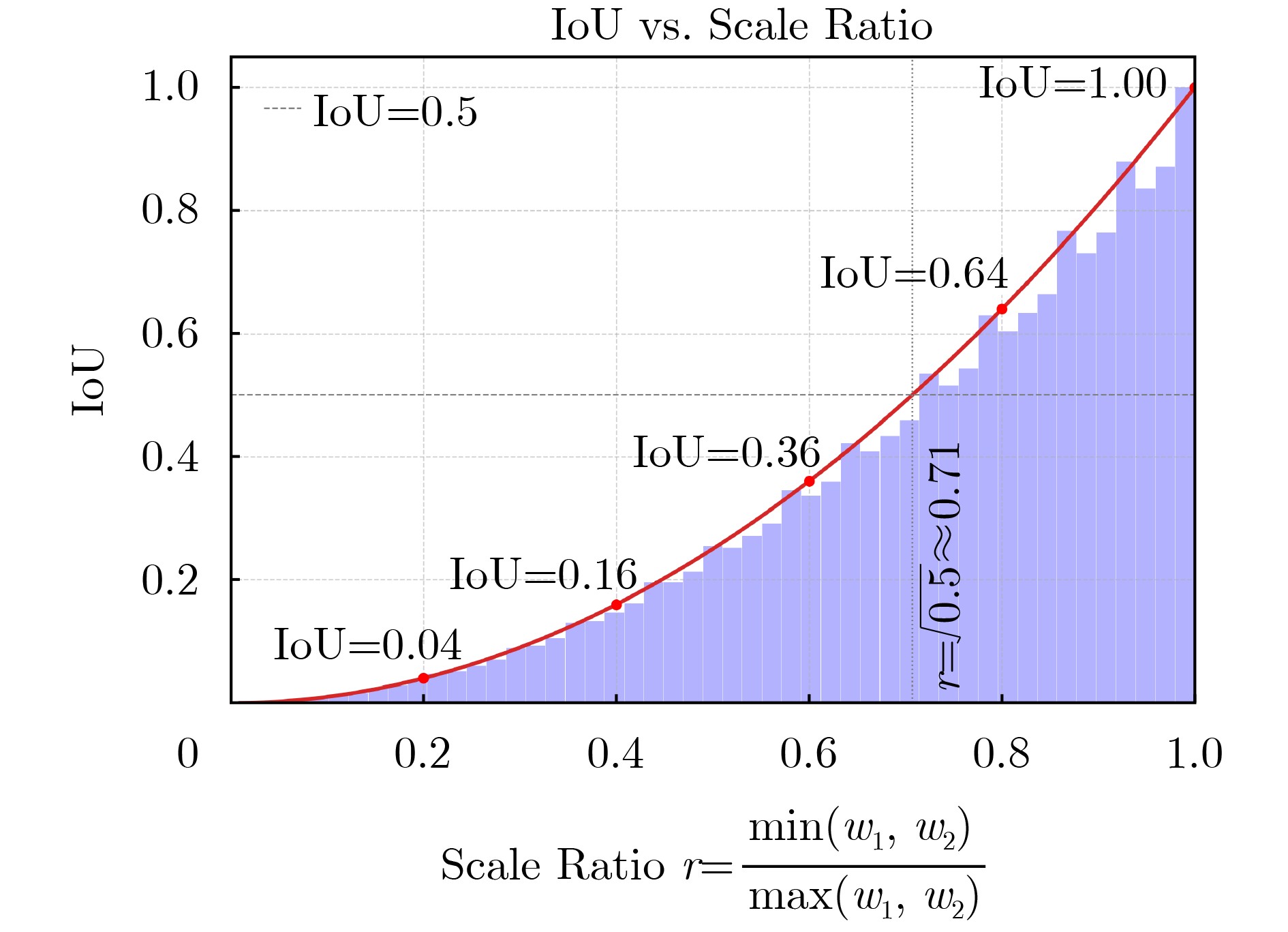
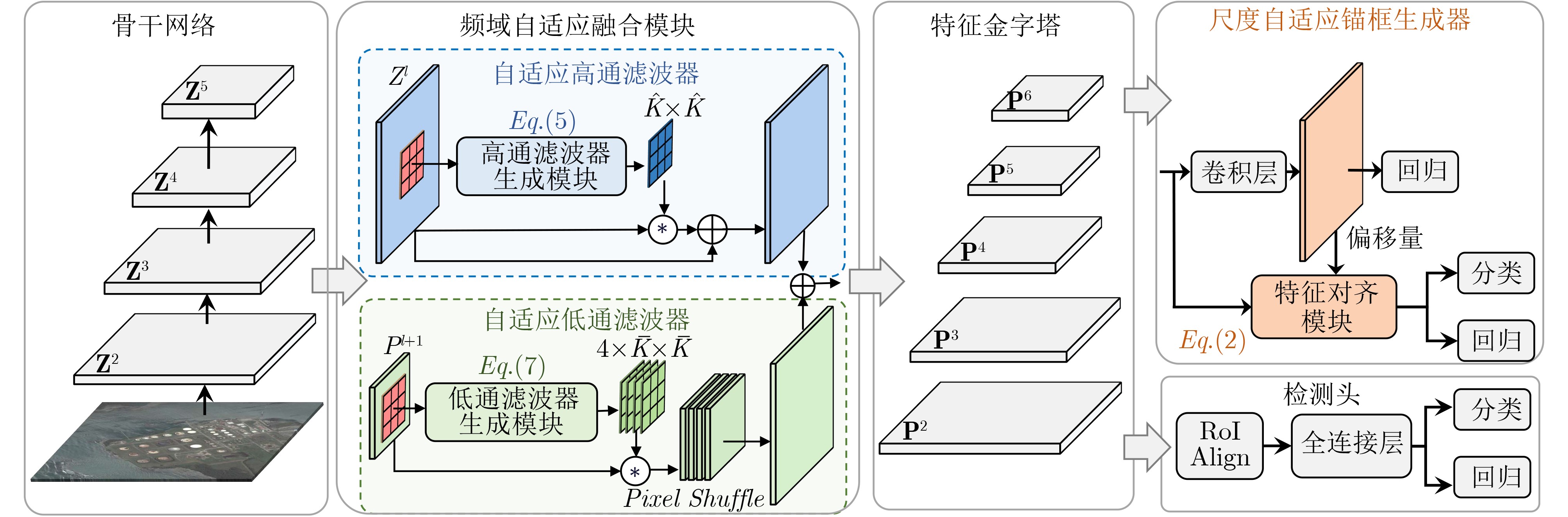
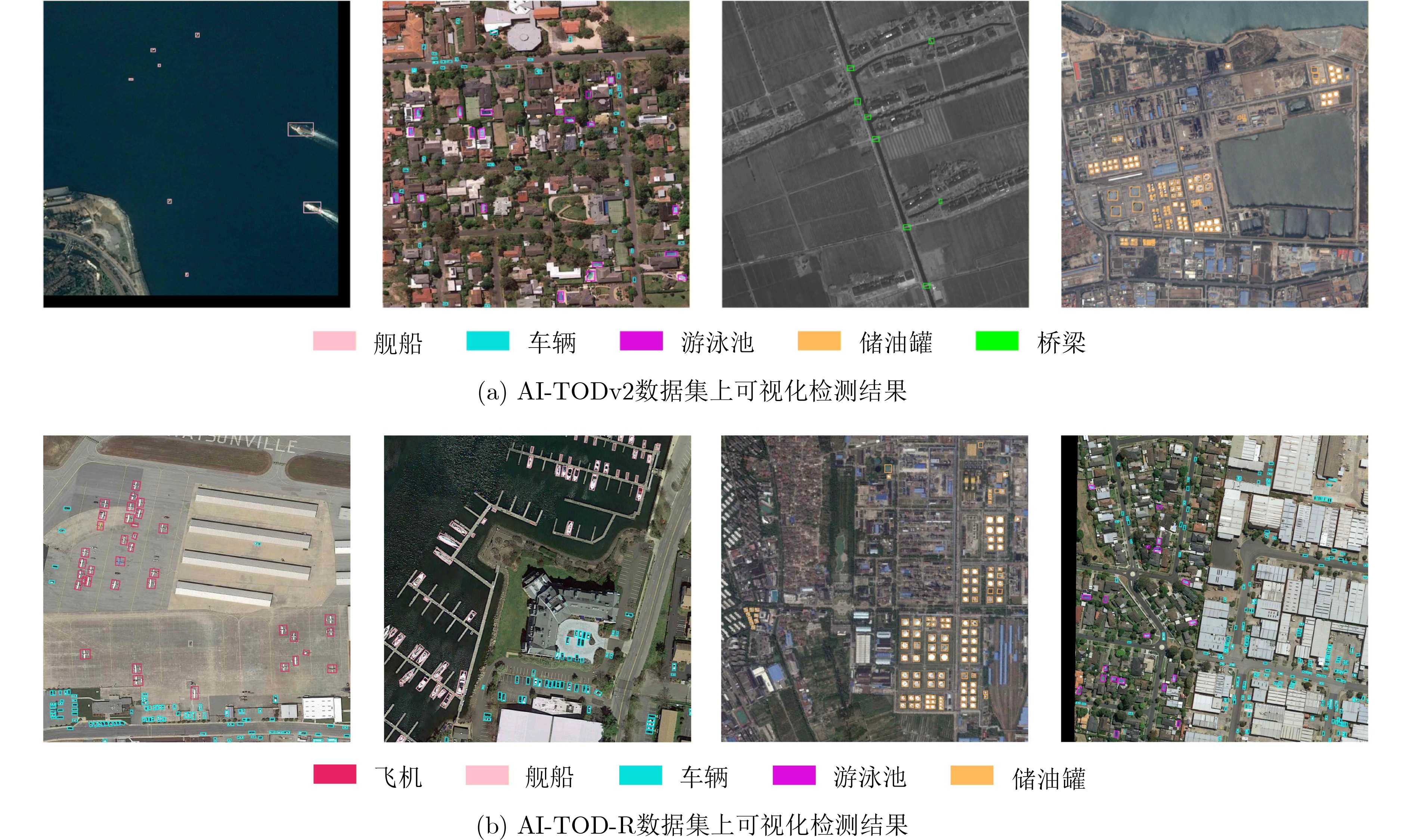
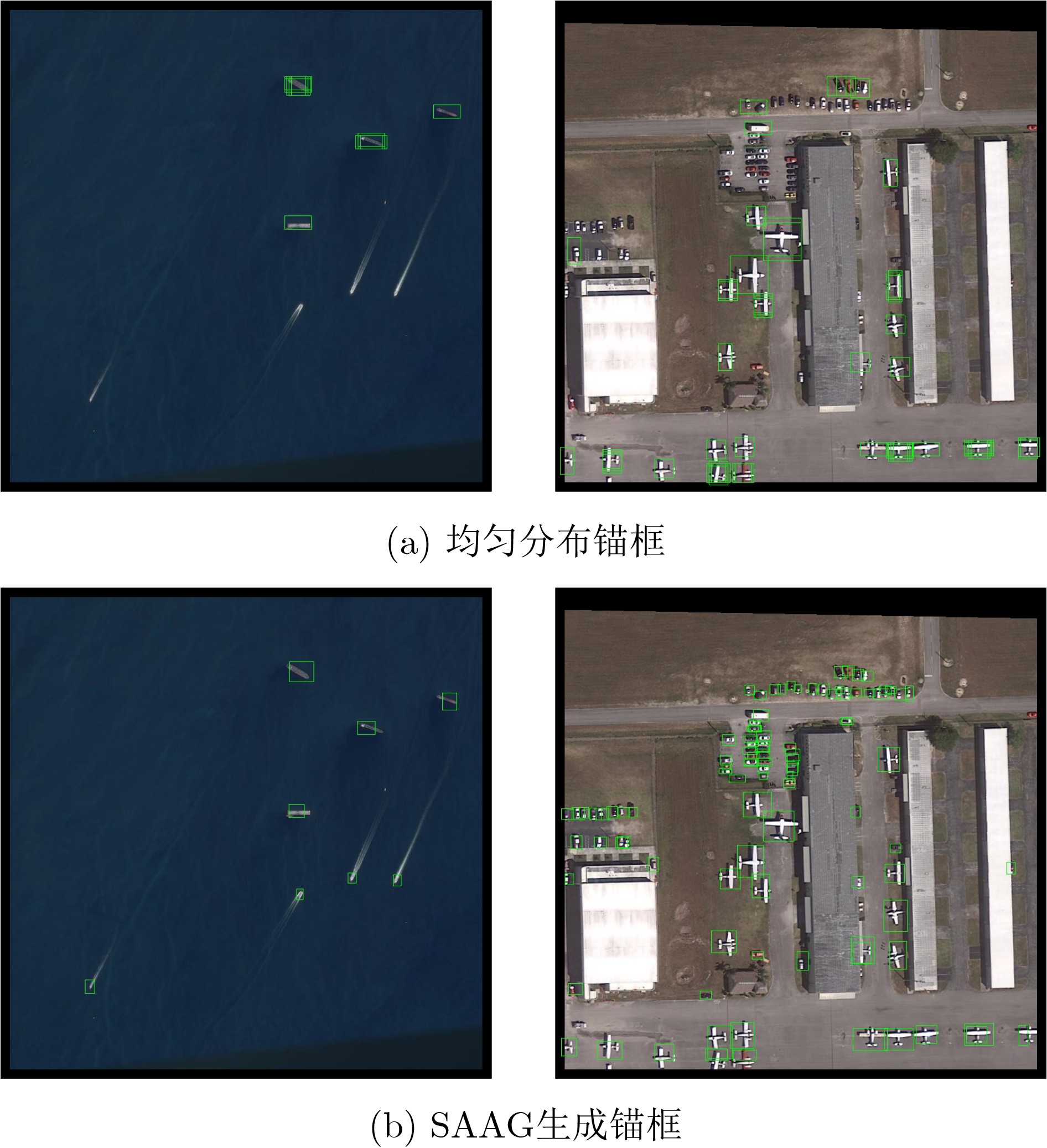
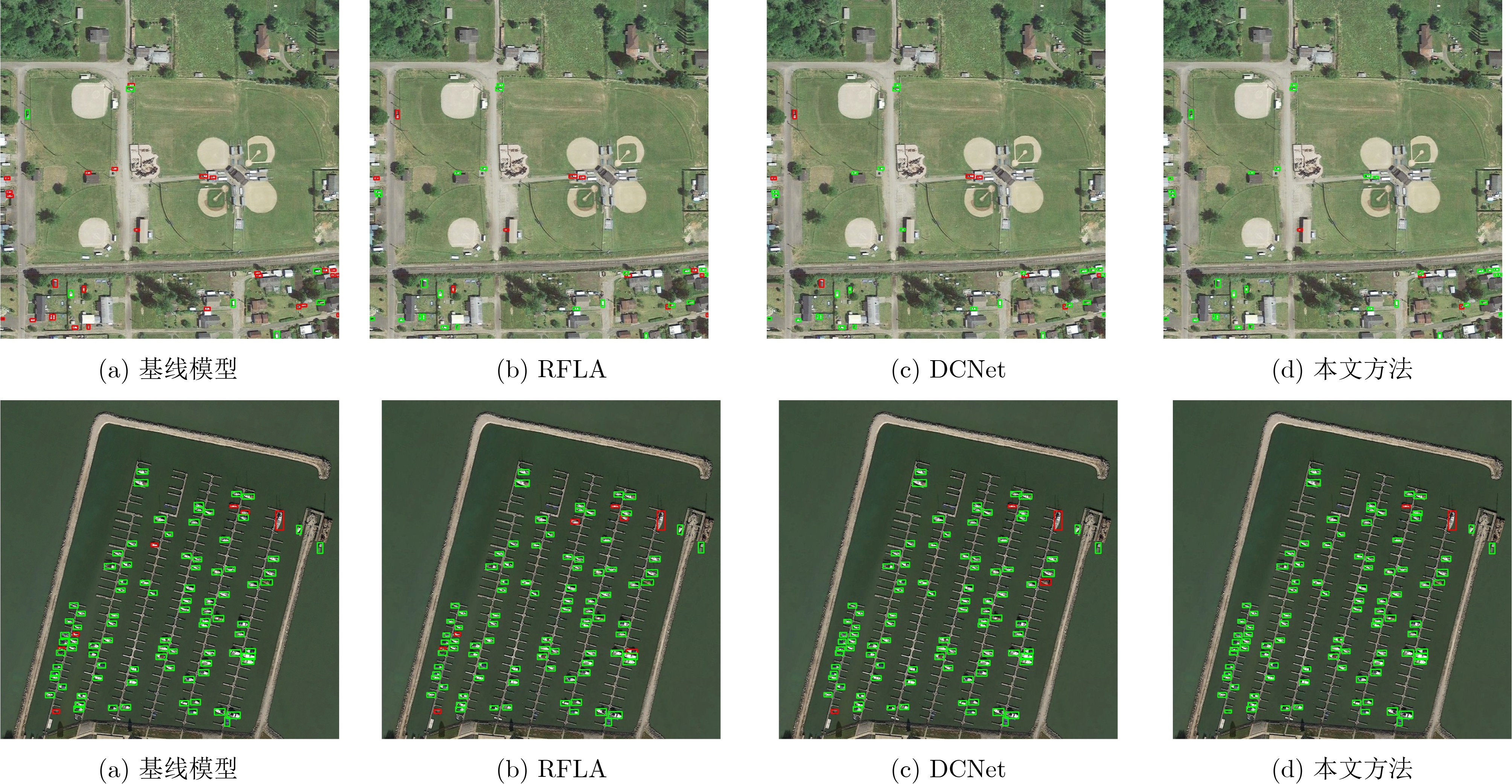
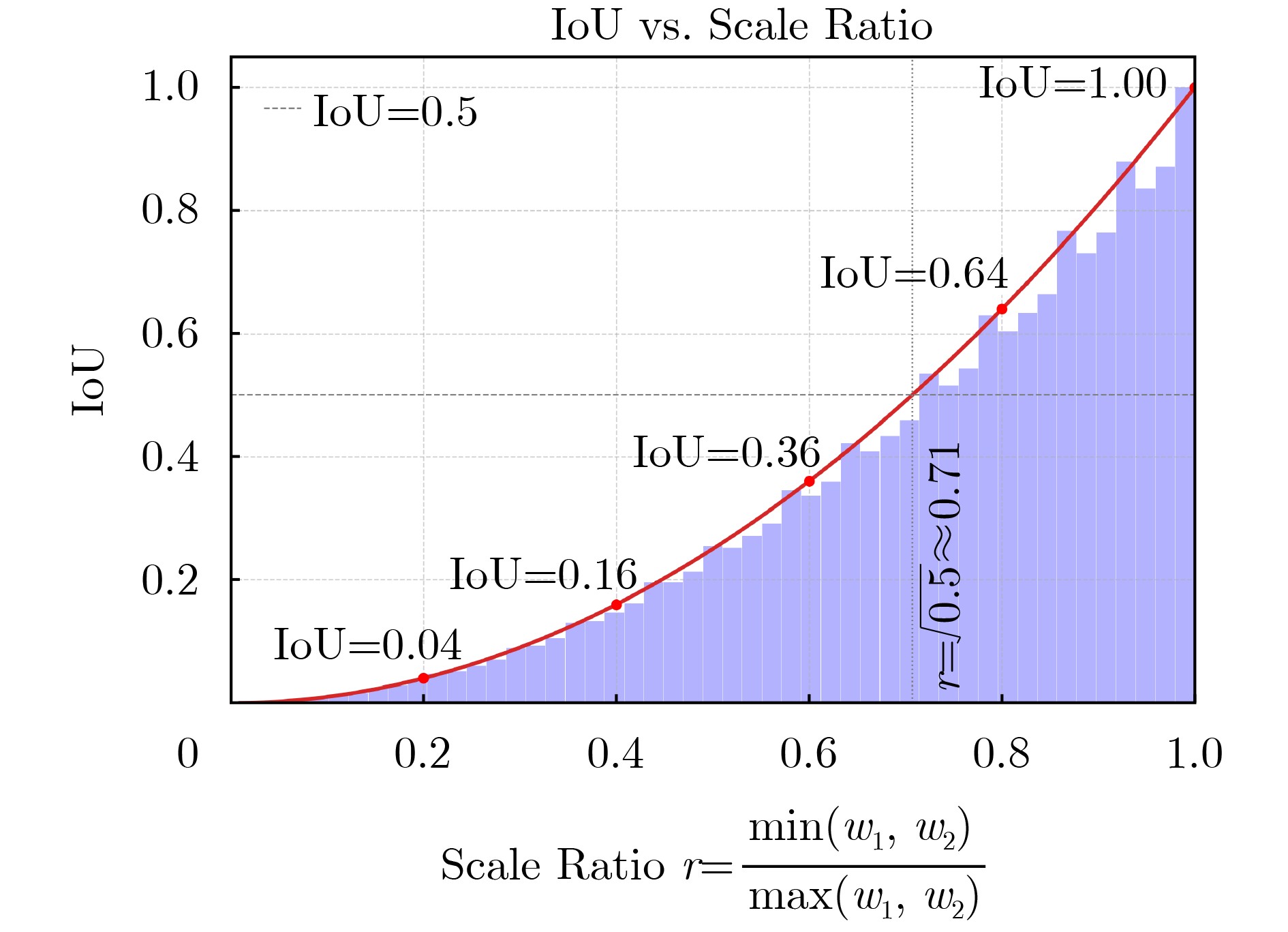
Objective Deep learning has substantially advanced object detection in Remote Sensing Images (RSIs). However, because of imaging conditions and the inherently small size of many objects, a large proportion of targets in RSIs occupy fewer than 16 × 16 pixels. Therefore, current object detection methods achieve substantially lower detection accuracy for tiny objects than for normal-scale objects. This limitation primarily arises from two critical factors: insufficient positive sample assignment and weak feature representation. To address these challenges, a Cross-Domain Collaborative Enhancement Detector (CDCEDet) is proposed. CDCEDet jointly optimizes label assignment in the spatial domain and enhances feature representation in the frequency domain, thereby improving the accuracy and robustness of tiny object detection in RSIs. Methods The overall framework of CDCEDet is illustrated in Fig. 2 and consists of three major components. First, a Scale-Adaptive Anchor Generator (SAAG) is designed to dynamically generate anchors that match the scales of ground-truth (GT) objects, thereby effectively alleviating the scale mismatch between anchors and tiny objects that has been largely overlooked in previous studies. Compared with conventional uniformly distributed anchor generators, SAAG substantially increases the number of positive samples assigned to tiny objects, even under Intersection over Union (IoU)-based label assignment. Second, a Quantile-based Adaptive Label Assignment (QALA) mechanism is developed to replace the conventional fixed IoU threshold-based label assignment. QALA models the IoU distribution between each GT object and its matched anchors to generate an adaptive label assignment threshold for each object, thereby further increasing the number of positive samples assigned to tiny objects. Third, a Frequency-Adaptive Fusion (FAF) module is developed to enhance feature representation from a frequency-domain perspective. An adaptive high-pass filter is used to strengthen high-frequency details and compensate for information loss caused by channel compression, whereas an adaptive low-pass filter preserves semantic consistency during feature upsampling, thereby reducing semantic inconsistency within upsampled objects.Results and Discussions Extensive experiments are conducted on two public remote sensing tiny object detection datasets, AI-TODv2 and AI-TOD-R. The proposed method is compared with several state-of-the-art methods, including RFLA, DCNet, and DCFL. On the AI-TODv2 dataset ( Table 1 ), CDCEDet improves AP50 and AP50–95 by 1.8% and 0.7%, respectively, compared with the best existing method. On the AI-TOD-R dataset (Table 2 ), AP50 and AP50–95 are improved by 2.6% and 0.7%, respectively. These results demonstrate that CDCEDet achieves superior detection performance and strong generalization capability for tiny object detection in RSIs. Ablation studies and parameter analyses of the proposed modules (Tables 3 –6 ) further verify the effectiveness of each component and their complementary contributions. Qualitative results on both datasets (Fig. 3 ) show that the proposed method accurately detects tiny objects in both sparse and dense scenes. As illustrated in Fig. 4, SAAG generates scale-matched anchors for individual objects and assigns substantially more positive samples to tiny objects than the conventional uniformly distributed anchor generator. Furthermore, visual comparisons with RFLA and DCNet (Fig. 5 ) demonstrate that CDCEDet achieves higher detection accuracy while substantially reducing missed detections.Conclusions A CDCEDet is proposed to address insufficient positive sample assignment and weak feature representation in remote sensing tiny object detection. Specifically, SAAG dynamically generates anchors that match the scales of GT objects, substantially increasing the number of positive samples assigned to tiny objects. QALA further improves label assignment by modeling the IoU distribution between GT objects and their matched anchors to adaptively determine the label assignment threshold, thereby effectively reducing the scale bias introduced by fixed IoU thresholds. In addition, FAF enhances feature representation from a frequency-domain perspective through an adaptive high-pass filter and an adaptive low-pass filter. Experimental results on two benchmark datasets demonstrate the superior detection performance and strong generalization capability of CDCEDet. Future work will focus on improving model efficiency and real-time performance to facilitate practical deployment in remote sensing applications. -
表 1 AI-TODv2数据集上不同算法的对比实验结果
方法 AP50-95 AP50 AP75 APvt APt APs APm Faster R-CNN*[11] 12.8 29.9 9.4 0 9.2 24.6 37.0 FSANet*[9] 17.6 45.0 10.5 5.4 15.8 22.9 33.8 LTDNet[16] 18.9 46.7 12.1 5.3 17.7 24.2 34.3 NWD[3] 21.4 53.2 12.5 7.7 20.7 26.8 35.2 MENet*[17] 21.5 52.7 13.6 8.4 21.6 25.4 33.4 ADAS-GPM[3] 22.3 53.7 13.5 7.1 21.9 27.5 35.1 RFLA*[4] 22.9 55.7 14.7 8.5 22.4 28.7 36.4 DCEDet[18] 23.5 53.9 16.8 8.5 24.1 28.2 37.1 DCNet[19] 23.6 56.3 15.7 7.6 23.6 28.6 36.4 PGDP[20] 23.9 55.8 16.6 7.3 23.5 29.0 - CDCEDet(本文方法) 24.6 58.1 16.4 10.5 24.3 29.4 38.1 注:*表示基于官方代码复现结果,粗体表示最优结果,下划线表示次优结果  下载: 导出CSV
表 2 AI-TOD-R数据集上不同算法的对比实验结果
方法 AP50-95 AP50 AP75 APvt APt APs APm RoI Transformer*[21] 12.3 35.3 5.5 1.3 10.6 19.7 24.5 Oriented R-CNN[22] 11.2 33.2 4.3 0.6 9.1 19.5 23.2 ReDet[23] 11.6 32.8 4.8 1.4 9.5 19.4 23.2 Oriented RepPoints[24] 13.0 40.3 4.2 5.2 12.2 16.8 21.4 ARS-DETR[25] 14.3 41.1 5.8 6.3 14.5 17.6 18.7 NWD*[3] 15.4 46.9 5.4 5.9 14.2 20.4 24.4 RFLA* [4] 16.0 48.2 5.6 5.9 14.8 20.1 24.1 DCFL[13] 15.7 47.0 5.8 6.3 14.8 19.6 22.4 CDCEDet(本文方法) 16.7 50.8 5.7 6.8 15.7 21.6 25.3 注:*表示基于官方代码复现结果,粗体表示最优结果,下划线表示次优结果
下载: 导出CSV
表 3 本文提出各个模块的消融实验结果
SAAG QALA FAF AP50-95 AP50 AP75 APvt APt APs APm 参数量 GFLOPs FPS 12.6 29.5 8.8 0.0 8.4 25.6 37.1 41.16M 144.09 54.8 √ 22.6 53.9 15.3 7.4 22.3 28.1 37.7 41.75M 144.18 45.0 √ √ 23.6 56.1 15.8 9.3 23.1 29.0 37.0 41.75M 144.18 44.6 √ 14.0 32.5 9.8 0.0 10.6 26.4 37.8 47.31M 155.34 48.4 √ √ √ 24.6 58.1 16.4 10.5 24.3 29.4 38.1 47.90M 155.43 40.5
下载: 导出CSV
表 4 QALA机制中初始分位数阈值参数$ {a}_{0} $敏感性分析
$ {a}_{0} $ AP50-95 APvt APt APs APm - 22.6 7.4 22.3 28.1 37.7 0.95 23.0 8.9 22.9 28.3 36.9 0.85 23.2 8.9 22.6 28.7 36.7 0.75 23.1 8.8 22.5 28.4 36.9 0.5 22.8 8.3 22.6 28.0 36.3 0.3 22.5 7.3 22.5 28.1 35.9 0.1 22.1 6.9 22.1 27.2 35.4
下载: 导出CSV
表 5 QALA机制中分位数变化范围参数$ {a}_{1} $敏感性分析
$ {a}_{1} $ AP50-95 APvt APt APs APm 0 23.2 8.9 22.6 28.7 36.7 0.1 23.6 9.3 23.1 29.0 37.0 0.3 23.0 8.4 22.9 27.9 36.6 0.5 22.8 8.3 22.8 28.8 36.0 0.7 22.8 8.5 22.4 28.4 35.6
下载: 导出CSV
表 6 不同滤波器核尺寸配置下的FAF模块消融实验结果
滤波器核尺寸 AP50-95 APvt APt APs APm 高通 低通 $ \hat{K}=3 $ $ \overline{K}=3 $ 24.3 9.1 24.1 29.2 37.6 $ \hat{K}=5 $ $ \overline{K}=3 $ 24.4 9.5 24.6 29.1 37.7 $ \hat{K}=5 $ $ \overline{K}=5 $ 24.2 9.0 24.6 28.7 37.3 $ \hat{K}=3 $ $ \overline{K}=5 $ 24.6 10.5 24.3 29.4 38.1
下载: 导出CSV
-
[1] 邹旻瑞, 李宇轩, 戴一冕, 等. UMM-Det: 面向异构多模态遥感影像的一体化目标检测框架[J]. 电子与信息学报, 2025, 47(12): 4704–4713. doi: 10.11999/JEIT250933.ZOU Minrui, LI Yuxuan, DAI Yimian, et al. UMM-Det: A unified object detection framework for heterogeneous multimodal remote sensing imagery[J]. Journal of Electronics & Information Technology, 2025, 47(12): 4704–4713. doi: 10.11999/JEIT250933. [2] ZHANG Xiangrong, ZHANG Tianyang, WANG Guanchun, et al. Remote sensing object detection meets deep learning: A metareview of challenges and advances[J]. IEEE Geoscience and Remote Sensing Magazine, 2023, 11(4): 8–44. doi: 10.1109/MGRS.2023.3312347. [3] XU Chang, WANG Jinwang, YANG Wen, et al. Detecting tiny objects in aerial images: A normalized Wasserstein distance and a new benchmark[J]. ISPRS Journal of Photogrammetry and Remote Sensing, 2022, 190: 79–93. doi: 10.1016/j.isprsjprs.2022.06.002. [4] FU Ronghao, CHEN Chengcheng, YAN Shuang, et al. Gaussian similarity-based adaptive dynamic label assignment for tiny object detection[J]. Neurocomputing, 2023, 543: 126285. doi: 10.1016/J.NEUCOM.2023.126285. [5] XU Chang, WANG Jinwang, YANG Wen, et al. RFLA: Gaussian receptive field based label assignment for tiny object detection[C]. The 17th European Conference on Computer Vision-ECCV 2022, Tel Aviv, Israel, 2022: 526–543. [6] LIN T Y, DOLLÁR P, GIRSHICK R B, et al. Feature pyramid networks for object detection[C]. 2017 IEEE Conference on Computer Vision and Pattern Recognition (CVPR), Honolulu, USA, 2017: 936–944. [7] 刘杰, 刘书豪, 田明, 等. 复杂环境下无人机航拍小目标检测算法[J]. 电子与信息学报, 2026, 48(4): 1763–1773. doi: 10.11999/JEIT251126.LIU Jie, LIU Shuhao, TIAN Ming, et al. Small object detection algorithm for UAV aerial images in complex environments[J]. Journal of Electronics & Information Technology, 2026, 48(4): 1763–1773. doi: 10.11999/JEIT251126. [8] 王坤, 丁麒龙. 利用自适应融合和混合锚检测器的遥感图像小目标检测算法[J]. 电子与信息学报, 2024, 46(7): 2942–2951. doi: 10.11999/JEIT230966.WANG Kun and DING Qilong. Remote sensing images small object detection algorithm with adaptive fusion and hybrid anchor detector[J]. Journal of Electronics & Information Technology, 2024, 46(7): 2942–2951. doi: 10.11999/JEIT230966. [9] WU Jixiang, PAN Zongxu, LEI Bin, et al. FSANet: Feature-and-spatial-aligned network for tiny object detection in remote sensing images[J]. IEEE Transactions on Geoscience and Remote Sensing, 2022, 60: 5630717. doi: 10.1109/TGRS.2022.3205052. [10] CHEN Linwei, FU Ying, GU Lin, et al. Frequency-aware feature fusion for dense image prediction[J]. IEEE Transactions on Pattern Analysis and Machine Intelligence, 2024, 46(12): 10763–10780. doi: 10.1109/TPAMI.2024.3449959. [11] REN Shaoqing, HE Kaiming, GIRSHICK R, et al. Faster R-CNN: Towards real-time object detection with region proposal networks[J]. IEEE Transactions on Pattern Analysis and Machine Intelligence, 2017, 39(6): 1137–1149. doi: 10.1109/TPAMI.2016.2577031. [12] WANG Jiaqi, CHEN Kai, YANG Shuo, et al. Region proposal by guided anchoring[C]. 2019 IEEE/CVF Conference on Computer Vision and Pattern Recognition (CVPR), Long Beach, USA, 2019: 2960–2969. doi: 10.1109/CVPR.2019.00308. [13] MAGID S A, ZHANG Yulun, WEI Donglai, et al. Dynamic high-pass filtering and multi-spectral attention for image super-resolution[C]. 2021 IEEE/CVF International Conference on Computer Vision (ICCV), Montreal, Canada, 2021: 4288–4297. doi: 10.1109/ICCV48922.2021.00425. [14] XU Chang, ZHANG Ruixiang, YANG Wen, et al. Oriented tiny object detection: A dataset, benchmark, and dynamic unbiased learning[J]. IEEE Transactions on Pattern Analysis and Machine Intelligence, 2026, 48(3): 3167–3184. doi: 10.1109/TPAMI.2025.3634161. [15] HE Kaiming, ZHANG Xiangyu, REN Shaoqing, et al. Deep residual learning for image recognition[C]. 2016 IEEE Conference on Computer Vision and Pattern Recognition (CVPR), Las Vegas, USA, 2016: 770–778. doi: 10.1109/CVPR.2016.90. [16] LIU Dongyang, ZHANG Junping, QI Yunxiao, et al. Exploring lightweight structures for tiny object detection in remote sensing images[J]. IEEE Transactions on Geoscience and Remote Sensing, 2025, 63: 5623215. doi: 10.1109/TGRS.2025.3567345. [17] ZHANG Tianyang, ZHANG Xiangrong, ZHU Xiaoqian, et al. Multistage enhancement network for tiny object detection in remote sensing images[J]. IEEE Transactions on Geoscience and Remote Sensing, 2024, 62: 5611512. doi: 10.1109/TGRS.2024.3363614. [18] HU Xinkai, REN Zhida, BHATTI U A, et al. DCEDet: Tiny object detection in remote sensing images based on dual-contrast feature enhancement and dynamic distance measurement[J]. Remote Sensing, 2025, 17(16): 2876. doi: 10.3390/rs17162876. [19] ZHANG Tianyang, ZHANG Xiangrong, HUA Chaozhuo, et al. Tiny object detection based on dynamic scale-awareness label assignment and contextual enhancement[J]. Pattern Recognition, 2026, 172: 112449. doi: 10.1016/j.patcog.2025.112449. [20] BIAN Jinghao, FENG Mingtao, DONG Weisheng, et al. Feature information driven position Gaussian distribution estimation for tiny object detection[C]. 2025 IEEE/CVF Conference on Computer Vision and Pattern Recognition (CVPR), Nashville, USA, 2025: 30376–30386. doi: 10.1109/CVPR52734.2025.02828. [21] DING Jian, XUE Nan, LONG Yang, et al. Learning RoI transformer for oriented object Detection in aerial images[C]. 2019 IEEE/CVF Conference on Computer Vision and Pattern Recognition (CVPR), Long Beach, USA, 2019: 2849–2858. doi: 10.1109/CVPR.2019.00296. [22] XIE Xingxing, CHENG Gong, WANG Jiabao, et al. Oriented R-CNN for object detection[C]. 2021 IEEE/CVF International Conference on Computer Vision (ICCV), Montreal, Canada, 2021: 3520–3529. doi: 10.1109/ICCV48922.2021.00350. [23] HAN Jiaming, DING Jian, XUE Nan, et al. ReDet: A rotation-equivariant detector for aerial object detection[C]. 2021 IEEE/CVF Conference on Computer Vision and Pattern Recognition (CVPR), Nashville, USA, 2021: 2785–2794. doi: 10.1109/CVPR46437.2021.00281. [24] LI Wenting, CHEN Yijie, HU Xuankai, et al. Oriented RepPoints for aerial object detection[C]. 2022 IEEE/CVF Conference on Computer Vision and Pattern Recognition (CVPR), New Orleans, USA, 2022: 1819–1828. doi: 10.1109/CVPR52688.2022.00187. [25] ZENG Ying, CHEN Yushi, YANG Xue, et al. ARS-DETR: Aspect ratio-sensitive detection transformer for aerial oriented object detection[J]. IEEE Transactions on Geoscience and Remote Sensing, 2024, 62: 5610315. doi: 10.1109/TGRS.2024.3364713. -

 下载:
下载:

图(5) / 表(6)
计量
- 文章访问数: 246
- HTML全文浏览量: 121
- PDF下载量: 13
- 被引次数: 0
