




Spatial-domain Anti-jamming for Unmanned Systems Under Limited Prior Information
-
摘要: 无人智能系统在复杂电磁环境下的可靠通信是保障其自主任务能力的关键。尤其对于无人机这类典型的空中通信节点,其通信链路直接暴露于开放电磁空间,面临的干扰威胁尤为突出。然而,在实际应用中,由于对干扰特征、期望信号来向及多径传播等信息认知不足,导致传统空域抗干扰方法的性能严重下降。针对先验信息缺失场景,该文研究了一种面向无人系统空域抗干扰方法。具体而言,首先采用空间平滑算法对接收信号进行解相干处理,随后进行空间谱估计以检测出潜在入射信号的来向。然后,遍历估计的谱峰,采用协方差矩阵重构波束形成算法依次提取该方向的信号,实现混合信号的分离。最后,设计了一种基于频谱相似度和时延的信号类型识别方法,将分离的信号分别归类为干扰、直射和多径信号,并根据信号类型,在保留直射信号、抑制干扰的前提下,对多径信号进行选择性合并或抑制等灵活处理。仿真实验验证了所提算法的可行性与有效性。结果表明,所提算法能够在先验信息缺失的条件下有效抑制干扰并灵活处理多径,改善了通信性能。Abstract:
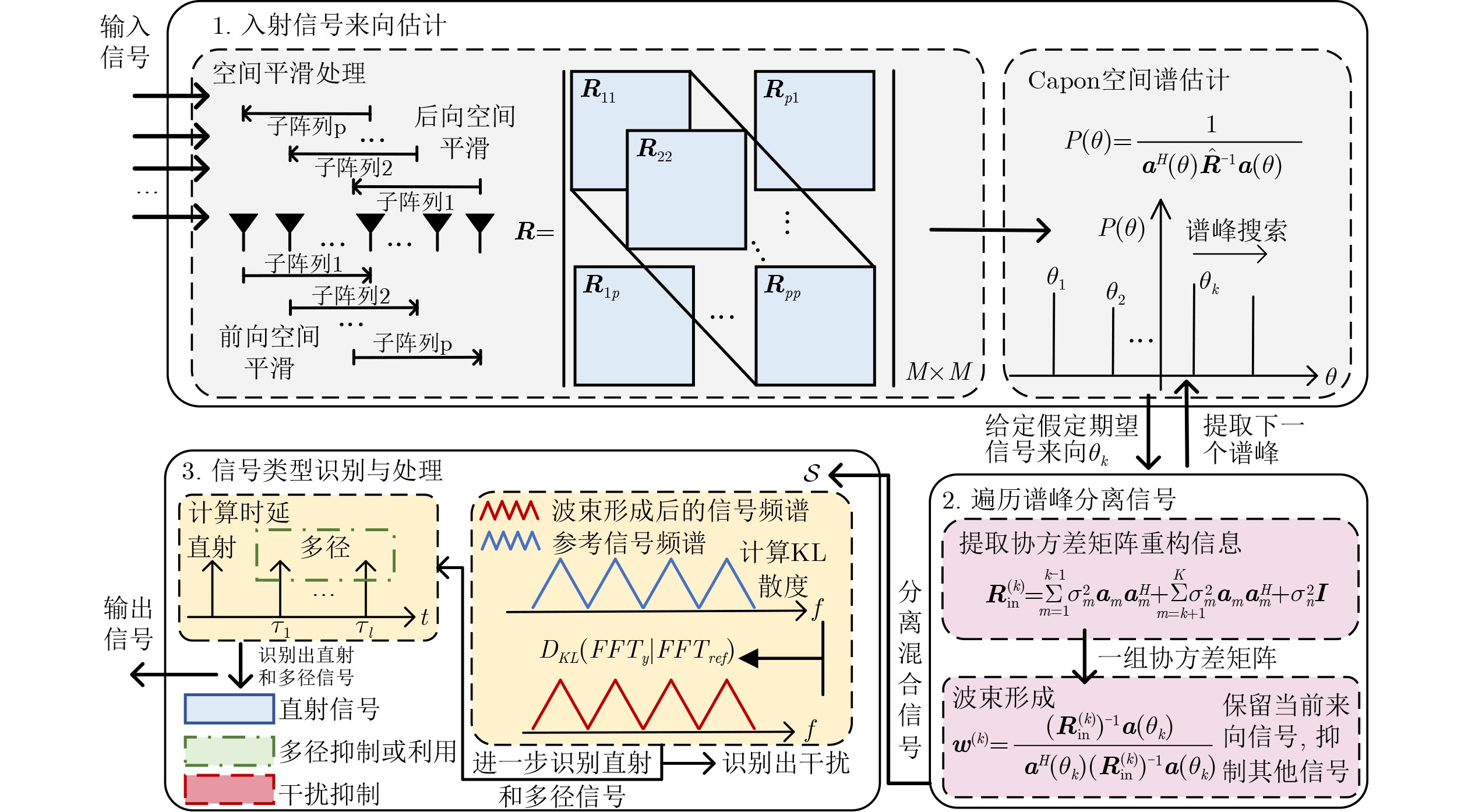
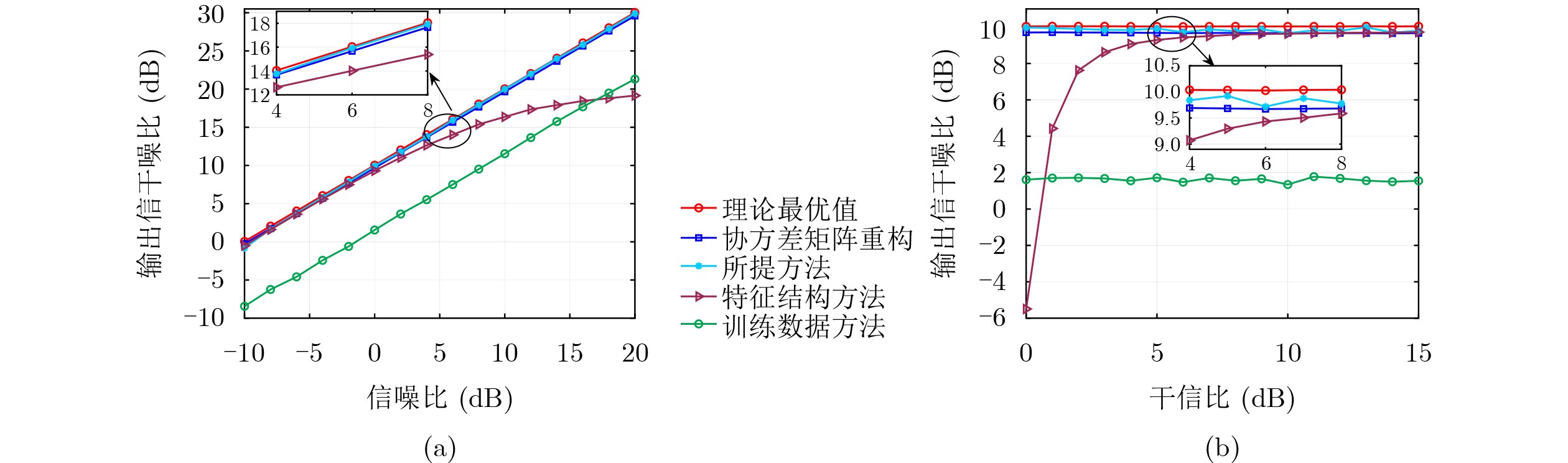
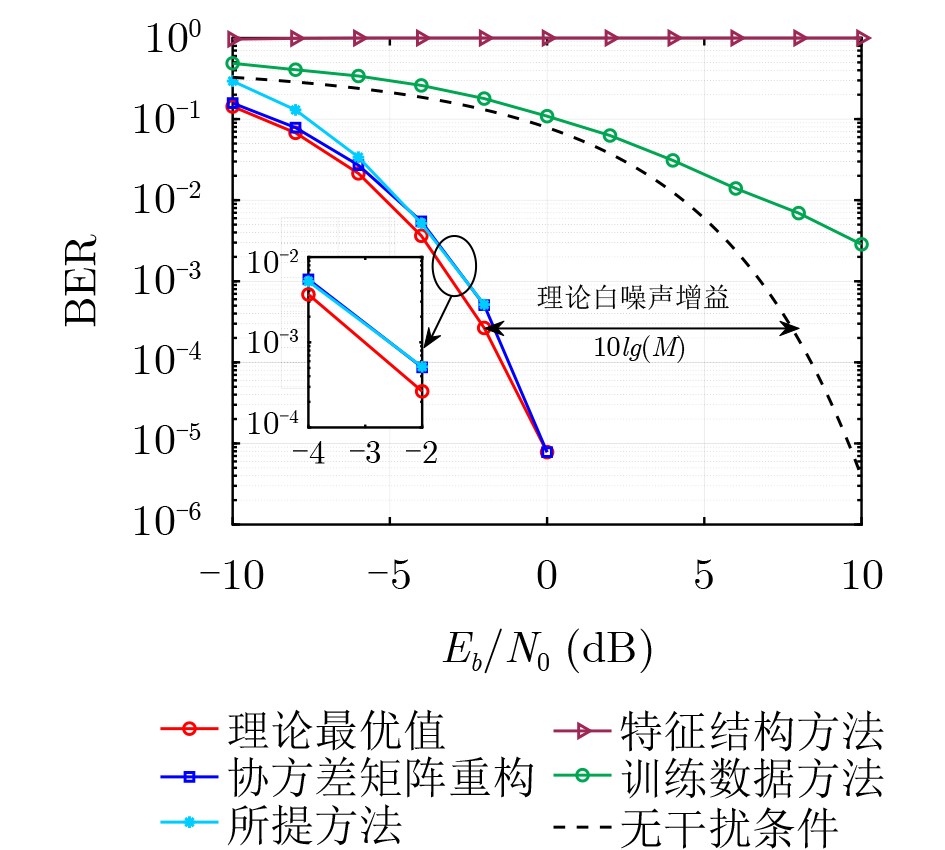
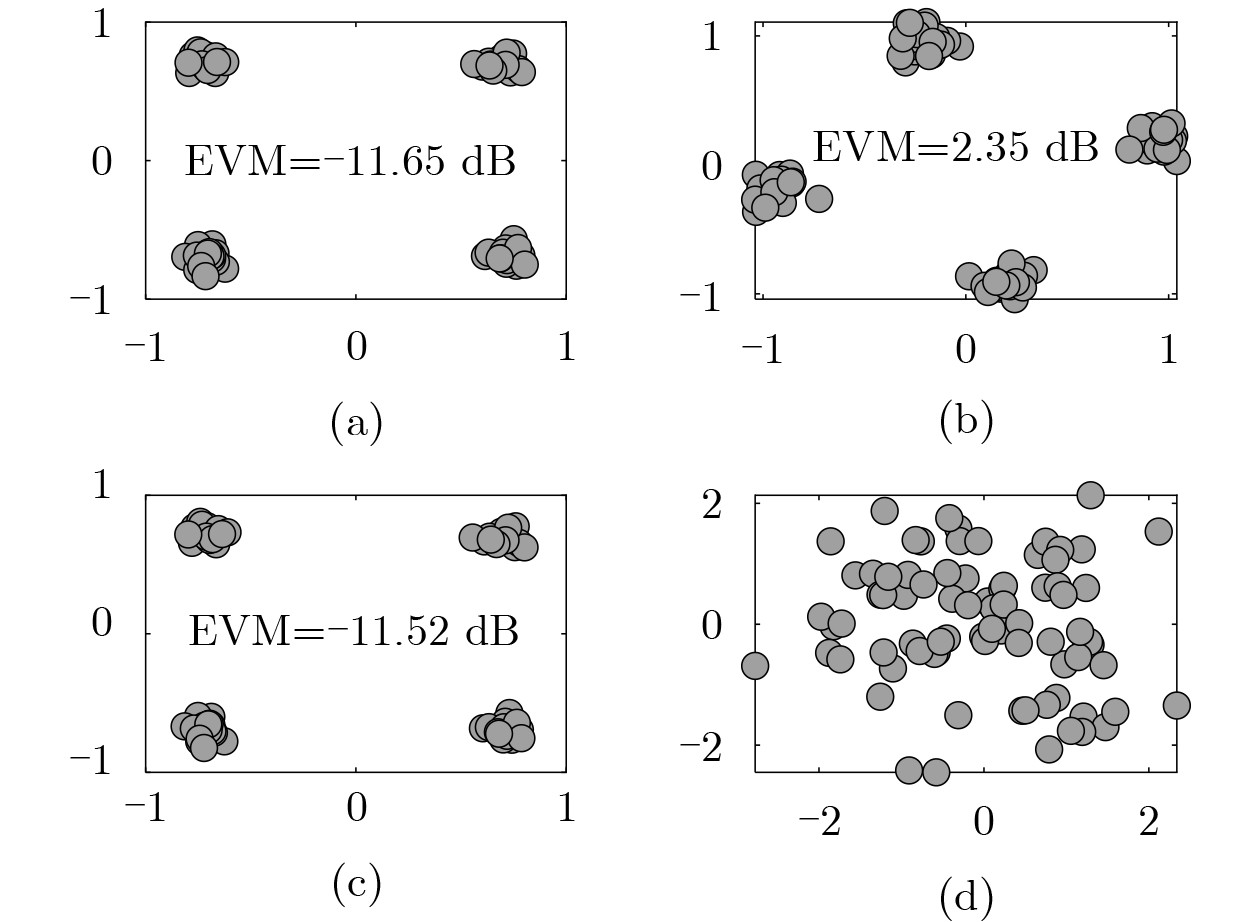
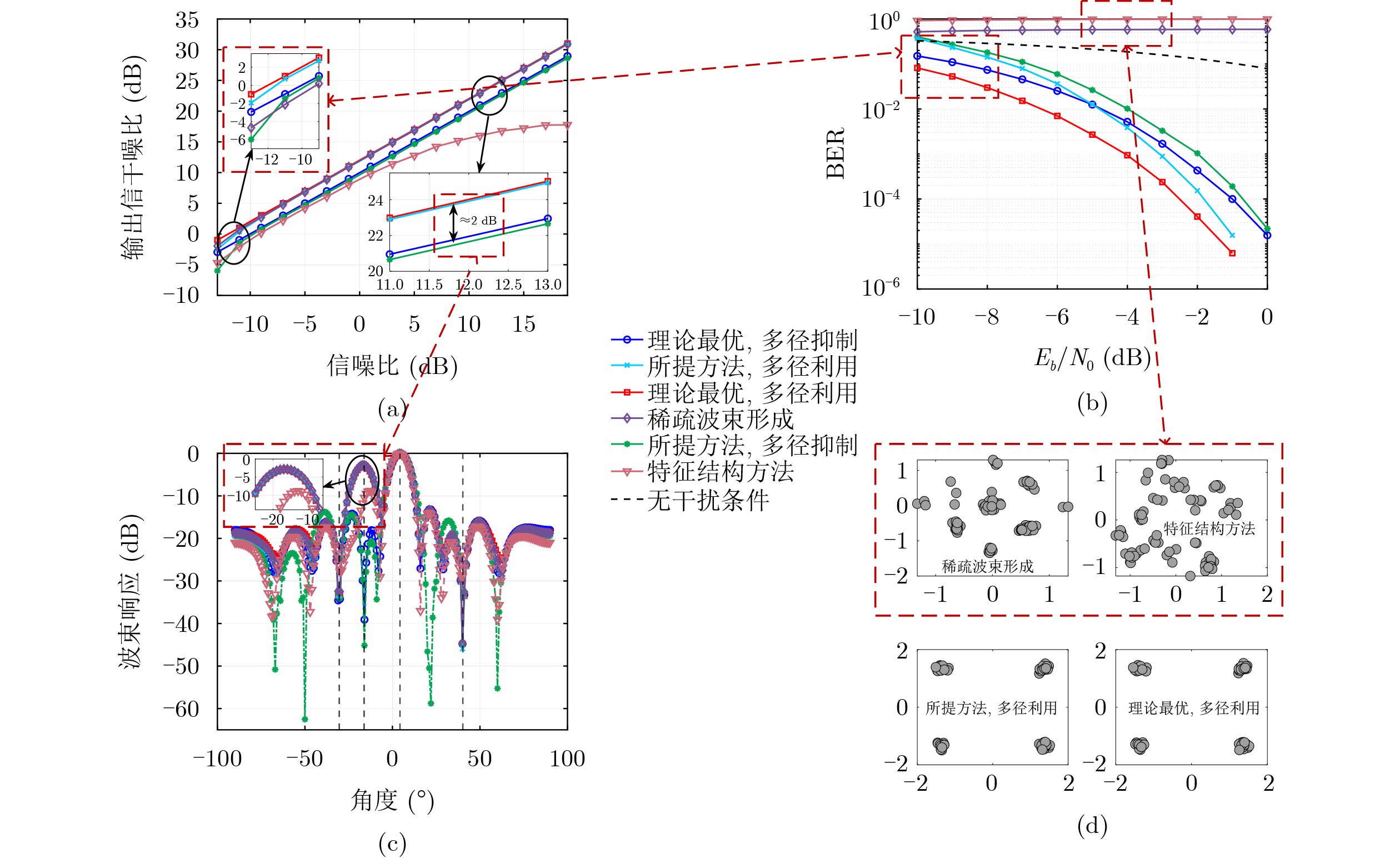
Objective Unmanned systems play an increasingly important role in emergency response, public safety, intelligent transportation, and other mission-critical applications. Reliable communications in complex electromagnetic environments are essential for autonomous operation. However, communication links are directly exposed to open, non-cooperative electromagnetic environments and are therefore vulnerable to intentional jamming and unintentional interference. In practical scenarios, prior information regarding the desired signal, jamming sources, and multipath propagation is often unavailable, substantially degrading the performance of conventional spatial-domain anti-jamming methods. To address this challenge, this paper proposes a spatial-domain anti-jamming framework for unmanned systems operating under limited prior information. Methods The proposed method first applies a spatial smoothing algorithm to the received signals to decorrelate coherent multipath components. Capon spatial spectrum estimation is then performed to detect the Direction Of Arrival (DOA) of potential incident signals. Spectrum peaks corresponding to individual incident signals are subsequently identified. A Covariance Matrix Reconstruction (CMR)-based beamforming algorithm is then applied by traversing all detected spectrum peaks to sequentially extract the signal associated with each peak, thereby separating the mixed signals. After signal separation, a signal classification method based on spectral similarity and time delay is employed. Kullback-Leibler (KL) divergence between the spectrum of each separated signal and the reference spectrum is calculated to identify jamming signals. The remaining communication signals are further classified into direct-path and multipath signals according to their relative time delays. Finally, different processing strategies are applied according to the identified signal type. Specifically, multipath signals are either suppressed as interference or coherently combined with the direct-path signal after time-delay and phase alignment. Results and Discussions Two simulation scenarios, including jamming only and combined jamming and multipath, are designed to evaluate the proposed method in terms of the output Signal-to-Interference-plus-Noise Ratio (SINR), beam pattern, Bit Error Rate (BER), and Error Vector Magnitude (EVM). Simulation results demonstrate that, under the jamming-only scenario, the proposed method achieves performance close to the theoretical optimum. The output SINR increases with the input Signal-to-Noise Ratio (SNR) at a fixed Jamming-to-Signal Ratio (JSR) ( Fig. 3(a) ) and remains nearly unchanged as JSR increases at a fixed SNR (Fig. 3(b) ), indicating stable jamming suppression capability. The recovered time-domain waveform and spectrum remain highly consistent with the transmitted signal (Fig. 4 ). The BER curve nearly overlaps that of the optimal beamformer (Fig. 5 ). At $ {E}_{\rm b}/{N}_{0}=10\;{\mathrm{dB}} $, the recovered Quadrature Phase-Shift Keying (QPSK) constellation closely matches the ideal constellation, achieving an EVM of –11.52 dB (Fig. 6 ). Under simultaneous jamming and multipath conditions, the proposed framework flexibly suppresses or exploits multipath signals. Compared with multipath suppression, multipath utilization further improves both the output SINR and BER (Fig. 7(a) andFig. 7(b) ). The corresponding beam pattern forms a beam toward the multipath direction rather than a null, demonstrating effective multipath exploitation (Fig. 7(c) ).Conclusions This paper proposes a spatial-domain anti-jamming framework for unmanned systems operating under limited prior information. Using only the received mixed signals, the proposed framework estimates the directions of arrival, separates incident signals, and classifies them as direct-path, multipath, or jamming signals. Appropriate suppression or preservation strategies are then applied according to the identified signal type. Therefore, the framework flexibly suppresses or exploits multipath signals while preserving the direct-path signal and mitigating jamming. Simulation results demonstrate the effectiveness of the proposed method in terms of output SINR and demodulation accuracy, confirming reliable jamming suppression and communication performance even when prior information regarding the desired signal, jamming sources, and multipath propagation is unavailable. Future work will investigate the effects of array perturbations, intelligent jamming, and heterogeneous communication modes on the proposed framework and extend it to more complex unmanned-system communication environments. -
Key words:
- Unmanned systems /
- Spatial-domain anti-jamming /
- Adaptive beamforming /
- Spatial smoothing
-
1 所提自适应波束形成算法
输入:接收序列$ \boldsymbol{x}(l),l=1,2,\cdots ,L $ 1 利用式(5)计算前向后向平滑协方差矩阵$ \hat{\boldsymbol{R}} $ 2 利用式(6)计算Capon空间谱,得到一组DOA估计值$ \hat{\boldsymbol{\theta }}=\left[{\hat{\theta }}_{1},{\hat{\theta }}_{2},\cdots ,{\hat{\theta }}_{Q}\right] $ 3 for $ q=1\colon Q $ 4 挑选$ {\hat{\theta }}_{q} $并利用式(7)重构JNCM$ \hat{\boldsymbol{R}}_{\mathrm{jn}}^{(q)} $和式(2)计算加权矢量$ {\boldsymbol{w}}_{q} $ 5 将加权系数$ {\boldsymbol{w}}_{q} $用于接收信号,得到分离信号$ {\hat{s}}_{q}(l)=\boldsymbol{w}_{q}^{\rm H}\boldsymbol{x}(l),l=1,2,\cdots ,L $ 6 end 7 完成步骤3~6输出一组分离信号$ \left\{{\hat{\boldsymbol{s}}}_{1},{\hat{\boldsymbol{s}}}_{2},\cdots ,{\hat{\boldsymbol{s}}}_{Q}\right\} $,随后利用频谱相似度和信号间时延,筛选出直射信号$ {\hat{\boldsymbol{s}}}_{\rm{LOS}} $、多径$ \left\{{\hat{\boldsymbol{s}}}_{l}\right\}_{l=1}^{\overline{L}-1} $和干扰
$ \left\{{\hat{\boldsymbol{s}}}_{j}\right\}_{j=1}^{\overline{J}} $8 if 执行多径抑制策略 $ {\boldsymbol{s}}_{{\mathrm{out}}}={\hat{\boldsymbol{s}}}_{\rm{LOS}} $ 9 else 估计多径时延$ {\hat{\tau }}_{l} $和相位差$ {\hat{\varphi }}_{l} $ $ {\boldsymbol{s}}_{{\mathrm{out}}}={\hat{\boldsymbol{s}}}_{\rm{LOS}}+\displaystyle\sum \nolimits_{l=1}^{\overline{L}-1}{\mathrm{e}}^{-{\mathrm{j}}{{\hat{\varphi }}_{l}}}{\hat{\boldsymbol{s}}}_{l}(t-{\hat{\tau }}_{l}) $ 10 end 输出:输出信号$ {\boldsymbol{s}}_{{\mathrm{out}}} $  下载: 导出CSV
表 1 仿真参数
类型 参数 值 阵列天线 阵型 ULA 阵元数目 10 阵元间隔 半波长 直射信号 调制方式 QPSK 每符号采样点数 4 符号速率 1000 符号/s入射角 4.3° 多径信号 幅度 $ U\left(0.5,1\right) $ 相位 $ U\left(0,2\text{π} \right) $ 时延 2符号 入射角 –16.2° 干扰信号 类型 类噪声高斯干扰 入射角 –30.4°和40.2°
下载: 导出CSV
-
[1] 孙长银, 袁心, 王远大, 等. 具身智能自主无人系统技术[J]. 自动化学报, 2025, 51(4): 762–777. doi: 10.16383/j.aas.c240456.SUN Changyin, YUAN Xin, WANG Yuanda, et al. Embodied intelligence autonomous unmanned systems technology[J]. Acta Automatica Sinica, 2025, 51(4): 762–777. doi: 10.16383/j.aas.c240456. [2] CHEN Xinyan, HU Peng, ZHU Zhongpan, et al. Virtual–real integration in unmanned systems: Emerging technologies, applications, and future trends[J]. IEEE Transactions on Automation Science and Engineering, 2026, 23: 1231–1257. doi: 10.1109/TASE.2025.3644374. [3] KIM G S, PARK S, and JUNG S, et al. Integrated control, communication, and computing for mission-critical embedded unmanned aerial vehicles[J]. IEEE Transactions on Aerospace and Electronic Systems, 2026, 62: 682–703. doi: 10.1109/TAES.2025.3622092. [4] WEI Xiaomin, MA Jianfeng, and SUN Cong. A survey on security of unmanned aerial vehicle systems: Attacks and countermeasures[J]. IEEE Internet of Things Journal, 2024, 11(21): 34826–34847. doi: 10.1109/JIOT.2024.3429111. [5] CAI Lingyi, WANG Jiacheng, ZHANG Ruichen, et al. Secure physical layer communications for low-altitude economy networking: A survey[J]. IEEE Communications Surveys & Tutorials, 2026, 28: 2497–2530. doi: 10.1109/COMST.2025.3634768. [6] 王诗雨, 汪西明, 可臻怡, 等. 无人机通信多模抗干扰: 融合二维迁移强化学习的协同决策方法[J]. 电子与信息学报, 2025, 47(11): 4200–4210. doi: 10.11999/JEIT250566.WANG Shiyu, WANG Ximing, KE Zhenyi, et al. Multi-Mode Anti-Jamming for UAV Communications: A Cooperative Mode-Based Decision-Making Approach via Two-Dimensional Transfer Reinforcement Learning[J]. Journal of Electronics & Information Technology, 2025, 47(11): 4200–4210. doi: 10.11999/JEIT250566. [7] ZHOU Jianwei, WANG Wenjie, and ZHANG Chenhao. A GNSS anti-jamming method in multi-UAV cooperative system[J]. IEEE Transactions on Vehicular Technology, 2026, 75(1): 535–547. doi: 10.1109/TVT.2025.3590138. [8] ELBIR A M, MISHRA K V, VOROBYOV S A, et al. Twenty-five years of advances in beamforming: From convex and nonconvex optimization to learning techniques[J]. IEEE Signal Processing Magazine, 2023, 40(4): 118–131. doi: 10.1109/MSP.2023.3262366. [9] LIU Wei, HAARDT M, GRECO M S, et al. Twenty-five years of sensor array and multichannel signal processing: A review of progress to date and potential research directions[J]. IEEE Signal Processing Magazine, 2023, 40(4): 80–91. doi: 10.1109/MSP.2023.3258060. [10] CAPON J. High-resolution frequency-wavenumber spectrum analysis[J]. Proceedings of the IEEE, 1969, 57(8): 1408–1418. doi: 10.1109/PROC.1969.7278. [11] CARLSON B D. Covariance matrix estimation errors and diagonal loading in adaptive arrays[J]. IEEE Transactions on Aerospace and Electronic Systems, 1988, 24(4): 397–401. doi: 10.1109/7.7181. [12] HOSSAIN M S, MILFORD G N, REED M C, et al. Efficient robust broadband antenna array processor in the presence of look direction errors[J]. IEEE Transactions on Antennas and Propagation, 2013, 61(2): 718–727. doi: 10.1109/TAP.2012.2225014. [13] ZHANG Ming, CHEN Xiaoming, and ZHANG Anxue. A simple tridiagonal loading method for robust adaptive beamforming[J]. Signal Processing, 2019, 157: 103–107. doi: 10.1016/j.sigpro.2018.11.019. [14] LI Jian, STOICA P, and WANG Zhisong. Doubly constrained robust capon beamformer[J]. IEEE Transactions on Signal Processing, 2004, 52(9): 2407–2423. doi: 10.1109/TSP.2004.831998. [15] HUANG Yongwei, ZHOU Mingkang, and VOROBYOV S A. New designs on MVDR robust adaptive beamforming based on optimal steering vector estimation[J]. IEEE Transactions on Signal Processing, 2019, 67(14): 3624–3638. doi: 10.1109/TSP.2019.2918997. [16] ZHANG Xinyu, JIANG Weidong, HUO Kai, et al. Robust adaptive beamforming based on linearly modified atomic-norm minimization with target contaminated data[J]. IEEE Transactions on Signal Processing, 2020, 68: 5138–5151. doi: 10.1109/TSP.2020.3021257. [17] HUANG Yongwei, FU Hao, VOROBYOV S A, et al. Robust adaptive beamforming via worst-case SINR maximization with nonconvex uncertainty sets[J]. IEEE Transactions on Signal Processing, 2023, 71: 218–232. doi: 10.1109/TSP.2023.3240312. [18] HUANG Fei, SHENG Weixing, and MA Xiaofeng. Modified projection approach for robust adaptive array beamforming[J]. Signal Processing, 2012, 92(7): 1758–1763. doi: 10.1016/j.sigpro.2012.01.015. [19] GU Yujie and LESHEM A. Robust adaptive beamforming based on interference covariance matrix reconstruction and steering vector estimation[J]. IEEE Transactions on Signal Processing, 2012, 60(7): 3881–3885. doi: 10.1109/TSP.2012.2194289. [20] 周成伟, 郑航, 顾宇杰, 等. 互质阵列信号处理研究进展: 波达方向估计与自适应波束成形[J]. 雷达学报, 2019, 8(5): 558–577. doi: 10.12000/JR19068.ZHOU Chengwei, ZHENG Hang, GU Yujie, et al. Research progress on coprime array signal processing: Direction-of-arrival estimation and adaptive beamforming[J]. Journal of Radars, 2019, 8(5): 558–577. doi: 10.12000/JR19068. [21] MOHAMMADZADEH S, NASCIMENTO V H, DE LAMARE R C, et al. Maximum entropy-based interference-plus-noise covariance matrix reconstruction for robust adaptive beamforming[J]. IEEE Signal Processing Letters, 2020, 27: 845–849. doi: 10.1109/LSP.2020.2994527. [22] CHEN Peng, GAO Jingjie, and WANG Wei. Linear prediction-based covariance matrix reconstruction for robust adaptive beamforming[J]. IEEE Signal Processing Letters, 2021, 28: 1848–1852. doi: 10.1109/LSP.2021.3111582. [23] LUO Tao, CHEN Peng, CAO Zhenxin, et al. URGLQ: An efficient covariance matrix reconstruction method for robust adaptive beamforming[J]. IEEE Transactions on Aerospace and Electronic Systems, 2023, 59(5): 5634–5645. doi: 10.1109/TAES.2023.3263386. [24] MOHAMMADZADEH S, NASCIMENTO V H, DE LAMARE R C, et al. Jammer tracking based on efficient covariance matrix reconstruction with iterative spatial spectrum sampling[J]. IEEE Transactions on Aerospace and Electronic Systems, 2023, 59(6): 8681–8695. doi: 10.1109/TAES.2023.3307507. [25] ZHENG Zhi, ZHENG Yan, WANG Wenqin, et al. Covariance matrix reconstruction with interference steering vector and power estimation for robust adaptive beamforming[J]. IEEE Transactions on Vehicular Technology, 2018, 67(9): 8495–8503. doi: 10.1109/TVT.2018.2849646. [26] ZHENG Zhi, YANG Tong, WANG Wenqin, et al. Robust adaptive beamforming via simplified interference power estimation[J]. IEEE Transactions on Aerospace and Electronic Systems, 2019, 55(6): 3139–3152. doi: 10.1109/TAES.2019.2899796. [27] YANG Huichao, WANG Pengyu, and YE Zhongfu. Robust adaptive beamforming via covariance matrix reconstruction and interference power estimation[J]. IEEE Communications Letters, 2021, 25(10): 3394–3397. doi: 10.1109/LCOMM.2021.3103208. [28] RUAN Hang and DE LAMARE R C. Robust adaptive beamforming using a low-complexity shrinkage-based mismatch estimation algorithm[J]. IEEE Signal Processing Letters, 2014, 21(1): 60–64. doi: 10.1109/LSP.2013.2290948. [29] RUAN Hang and DE LAMARE R C. Robust adaptive beamforming based on low-rank and cross-correlation techniques[J]. IEEE Transactions on Signal Processing, 2016, 64(15): 3919–3932. doi: 10.1109/TSP.2016.2550006. [30] WAX M and ANU Y. A least squares approach to blind beamforming[J]. IEEE Transactions on Signal Processing, 1999, 47(1): 231–234. doi: 10.1109/78.738261. [31] NAPOLITANO A. Generalizations of cyclostationarity: A new paradigm for signal processing for mobile communications, radar, and sonar[J]. IEEE Signal Processing Magazine, 2013, 30(6): 53–63. doi: 10.1109/MSP.2013.2265101. [32] BHOTTO M Z A and BAJIĆ I V. Constant modulus blind adaptive beamforming based on unscented Kalman filtering[J]. IEEE Signal Processing Letters, 2015, 22(4): 474–478. doi: 10.1109/LSP.2014.2362932. [33] WENTZ M, CAPPER J, KURIEN B, et al. Blind beamforming via deep learning-based signal classification and transfer learning[J]. IEEE Transactions on Cognitive Communications and Networking, 2026, 12: 1834–1847. doi: 10.1109/TCCN.2025.3598069. [34] XIE Zhuang, XU Zhou, HAN Sudan, et al. Max-min beamforming for multipath exploitation[J]. IEEE Communications Letters, 2022, 26(9): 2116–2120. doi: 10.1109/LCOMM.2022.3188754. [35] CHENG Yun, LIU Tianpeng, SHI Junpeng, et al. Sparsity-based adaptive beamforming for non-uniform linear arrays in multipath environment[J]. IEEE Transactions on Vehicular Technology, 2024, 73(5): 6687–6699. doi: 10.1109/TVT.2023.3341417. [36] WANG Cheng and TANG Jun. Blind beamforming technique for reception of multipath coherent signals[J]. IEEE Communications Letters, 2016, 20(7): 1453–1456. doi: 10.1109/LCOMM.2016.2547873. [37] ZHANG Liang, LIAO Bin, HUANG Lei, et al. An eigendecomposition-based approach to blind beamforming in a multipath environment[J]. IEEE Communications Letters, 2017, 21(2): 322–325. doi: 10.1109/LCOMM.2016.2626365. -

 下载:
下载:

图(8) / 表(2)
计量
- 文章访问数: 511
- HTML全文浏览量: 215
- PDF下载量: 25
- 被引次数: 0
