




A Review of APT Attack Detection Research Based on Provenance Graph
-
摘要: 高级持续性威胁(APT)具有长期潜伏、多阶段演进和高度隐蔽性等特点,对关键信息基础设施安全构成严峻威胁。传统检测方法难以有效关联跨阶段攻击行为,而基于系统审计日志构建的溯源图能够刻画系统实体间的因果依赖关系,为APT攻击检测提供上下文信息。然而,现有综述对不同检测粒度方法及其相互关系的系统性比较仍显不足。为此,该文以检测粒度为主线,对基于溯源图的APT攻击检测方法进行系统综述。首先,依据主要检测对象及直接输出结果,将现有方法划分为图级、子图级、路径级、节点级和边级五类,梳理其建模思想与技术路线,比较各类方法的优势、局限性及适用场景,并分析不同粒度之间的互补关系。其次,归纳主流公开数据集的数据规模、攻击场景及适用检测任务。最后,总结当前研究在对抗鲁棒性、数据质量及工程部署等方面面临的主要挑战,并展望标准化评测及多粒度协同检测等未来研究方向。Abstract:
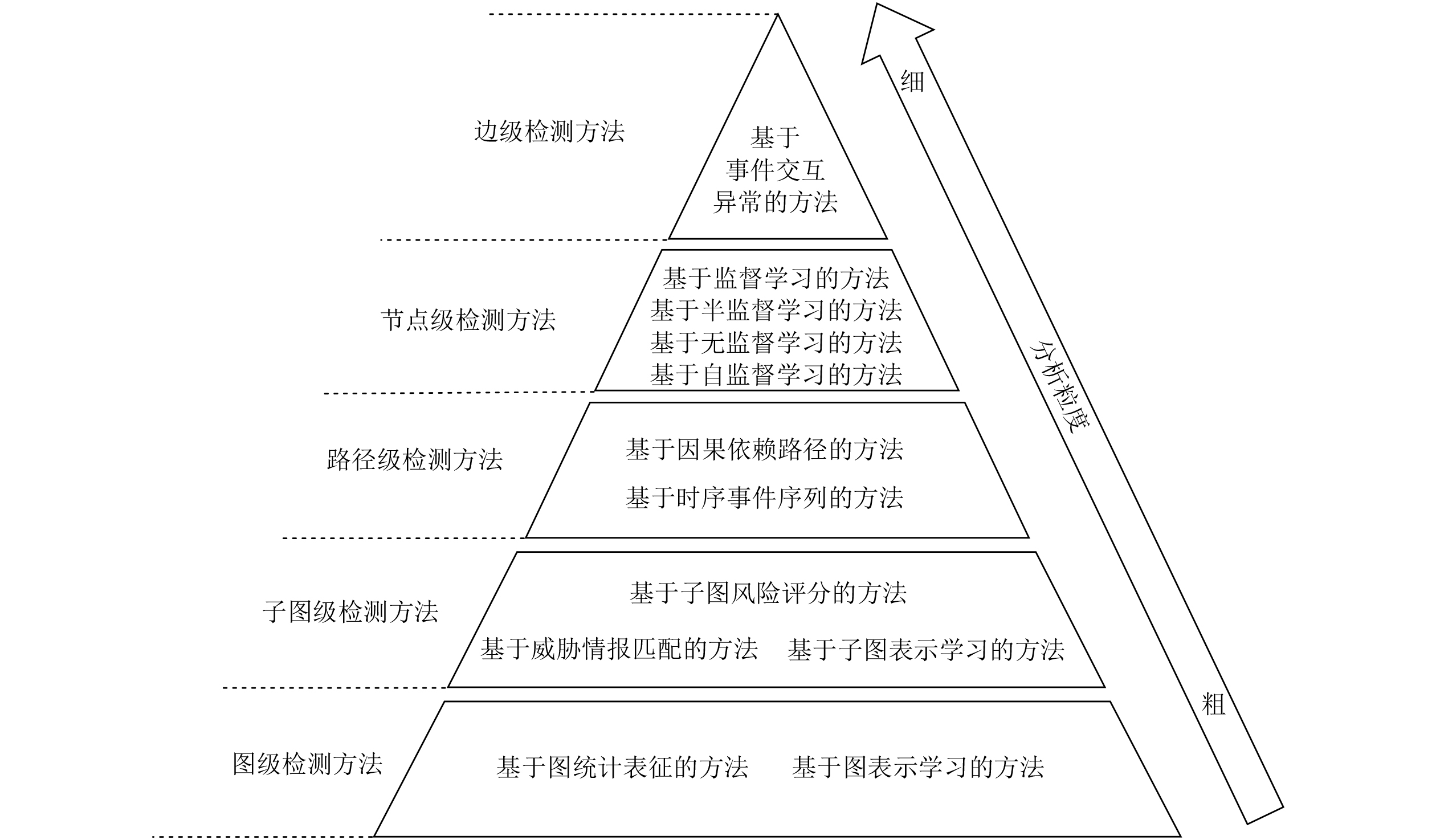
Significance Advanced Persistent Threat (APT), characterized by long-term persistence, multi-stage evolution, and a high degree of stealth, poses serious security threats to critical information infrastructure. Conventional detection approaches based on network traffic or isolated host events often have difficulty correlating attack behaviors distributed across different stages and time periods. Provenance graphs represent system entities and their interactions extracted from operating-system audit logs as nodes and edges, respectively, thereby capturing causal dependencies among system activities. These graphs also provide rich contextual information for analyzing attack behaviors over extended periods. Consequently, provenance-graph-based APT detection has become an important research direction in this field. However, existing approaches differ substantially in their primary detection objects and granularities, leading to distinct characteristics in attack localization, semantic representation, interpretability, and computational overhead. A systematic comparison of these methods remains lacking. Therefore, a review from the perspective of detection granularity is needed to clarify the technical characteristics, relationships, and applicable scenarios of existing methods. Progress Existing provenance-graph-based APT detection methods are classified into five categories according to their primary detection objects and direct outputs during the threat detection stage: graph-level, subgraph-level, path-level, node-level, and edge-level detection. Their modeling principles, technical approaches, advantages, limitations, and applicable scenarios are systematically reviewed. Graph-level methods focus on identifying anomalies in overall system behavior and provide strong global association capabilities. Subgraph-level methods associate suspicious entities and their interactions through local graph structures to characterize local attack scenarios. Path-level methods correlate attack behaviors through causal paths or event sequences, emphasizing temporal and causal relationships among attack activities. Node-level and edge-level methods target system entities and their interaction events, respectively, enabling fine-grained anomaly localization. On this basis, the characteristics and relationships among different detection granularities are analyzed in terms of attack localization, global association, interpretability, and computational overhead. Relevant studies on multi-granularity collaborative detection are also discussed. In addition, mainstream public datasets are summarized in terms of collection environments, data scales, attack scenarios, annotation information, and applicable detection tasks. Conclusions Different detection granularities correspond to different analysis scales and detection objectives, and therefore exhibit distinct characteristics in APT detection. Graph-level methods identify anomalous system behavior from overall graph structures and behavioral evolution, but their outputs are relatively coarse and provide limited localization of specific malicious entities and actions. Node-level and edge-level methods can directly identify anomalous entities or interaction events and provide fine-grained attack localization. However, local anomaly detection results alone are generally insufficient to reconstruct complete attack processes. Path-level methods emphasize temporal and causal relationships among attack behaviors, while subgraph-level methods organize suspicious entities and their interactions into local structures that preserve richer attack context. Overall, as the analysis object moves from complete graph structures toward local entities and interaction events, attack localization capability generally increases, whereas global contextual association capability tends to decrease. Therefore, these detection methods exhibit complementary advantages in global risk assessment, fine-grained anomaly localization, and attack process analysis. Multi-granularity collaborative analysis may provide more comprehensive support for APT detection and investigation. Prospects Despite substantial progress, provenance-graph-based APT detection still faces several challenges, including adversarial evasion, insufficient attack samples and annotations, limited interpretability, high processing and deployment costs for large-scale provenance graphs, limited cross-environment generalization and concept drift, incomplete audit logs, and difficulties in cross-host causal correlation. Future research should investigate robust detection methods that integrate graph structural features, behavioral semantics, and causal dependencies to improve resistance to behavioral camouflage and structural perturbations. High-quality datasets and standardized evaluation protocols should also be established for different detection granularities. Meanwhile, domain adaptation, continual learning, and incremental updating can be further explored to improve model adaptability to dynamic environments. To improve interpretability, detection results should be more closely associated with attack stages, behavioral patterns, and verifiable causal evidence. Large language models supported by evidence grounding and traceable outputs may assist alert correlation, semantic interpretation, and security investigation. In practical deployment, incremental graph processing, lightweight models, efficient indexing, and graph reduction can improve the efficiency of real-time processing for large-scale provenance graphs. Furthermore, multi-source log fusion and cross-host causal correlation can help integrate distributed attack evidence. Multi-granularity collaborative analysis may further support a hierarchical detection and investigation process ranging from fine-grained anomaly localization and local attack behavior correlation to overall risk assessment. -
表 1 基于溯源图的图级APT攻击检测方法总结
类别 方法 年份 检测方法/模型 优势 局限性 检测模式 基于图统计表征 STREAMSPOT[57] 2016 Shingling+StreamHash 流式处理,存储开销低 长期行为演化建模不足 在线 UNICORN[58] 2020 WL+HistoSketch 长期状态演化建模 正常行为变化易引发误报 在线 SeqNet[59] 2022 GRU+局部注意力 增强长期时序表征 低占比异常易被掩盖 在线 基于图表示学习 PROV-GEM[60] 2021 关系感知GNN+注意力 融合多类型关系语义 小样本下训练可能不稳 离线 Li等人[61] 2021 元路径聚合GNN+AE 主机内异构语义建模 依赖预设元路径 离线 Akbar等人[62] 2023 node2vec+OAML 在线更新,识别新型攻击 训练依赖已知攻击样本 在线 PROGRAPHER[46] 2023 graph2vec+TextRCNN 时序快照建模,检测高效 事件属性利用有限 在线 MAGIC[63] 2024 掩码图自编码器+KNN 无需攻击样本,计算高效 大规模近邻检索开销较高 在线 CGL-AD[64] 2025 TGN+Bi-RCNN 建模动态时序与局部结构 分布偏移下鲁棒性不足 在线  下载: 导出CSV
表 2 基于溯源图的子图级APT攻击检测方法总结
类别 方法 年份 检测方法/模型 优势 局限性 检测模式 基于子图风险评分 HOLMES[65] 2019 TTP匹配+HSG关联 多阶段关联,解释性强 预设TTP规则覆盖有限 在线 SteinerLog[67] 2022 告警关联+PCST 跨主机关联,子图紧凑 初始告警影响关联效果 在线 DISTDET[68] 2023 HST+ASG+全局模型 分布式检测,资源开销低 未见正常行为易触发误报 在线 NODLINK[69] 2024 VAE+在线斯坦纳树 在线构建紧凑子图 依赖异常进程识别质量 在线 OCR-APT[70] 2025 R-GCN+单类支持向量机 多阶段攻击过程重建 多攻击可能合并同一子图 离线 基于威胁情报匹配 POIROT[72] 2019 图对齐+相似度评分 利用行为关联定位威胁 查询图构建依赖人工 离线 DeepHunter[73] 2021 属性注意力+GNN+NTN 不完整攻击行为鲁棒性强 候选子图易引入冗余 离线 ProvG-Searcher[74] 2023 GNN+偏序嵌入 子图匹配效率高 图抽象可能导致误匹配 离线 APTHunter[75] 2023 ATT&CK+ProvQuery 支持早期攻击检测 行为变化需更新规则 在线 MEGR-APT[76] 2024 图数据库+R-GCN+NTN 内存占用低,匹配高效 候选提取依赖已知IoC 离线 ProHunter[77] 2026 分层编码+采样+GIN 低内存,支持无明确IoC 依赖日志与CTI质量 在线 基于子图表示学习 TREC[78] 2024 HAN+孪生网络 小样本识别细粒度攻击 受子图采样质量影响 离线 TAPAS[48] 2025 任务分割+GraphSAGE 存储开销低,检测高效 细粒度恶意交互定位不足 在线 ZOOMER[79] 2026 Deep&Wide+原型网络 小样本细粒度TTP识别 难识别全新TTP模式 在线
下载: 导出CSV
表 3 基于溯源图的路径级APT攻击检测方法总结
类别 方法 年份 检测方法/模型 优势 局限性 检测模式 基于因果依赖路径 Pagoda[80] 2020 规则匹配+路径评分 路径与整图联合检测 剪枝可能遗漏传播线索 在线 P-Gaussian[81] 2021 高斯分布相似度匹配 适应顺序与长度变化 其他类型变体识别有限 在线 ANUBIS[82] 2022 泊松编码+LSTM+BNN 支持预测不确定性评估 训练数据覆盖有限 在线 PathWatcher[83] 2025 word2vec+Seq2Vec 增强路径语义表达 跨主机攻击关联有限 离线 基于时序事件序列 AISL[84] 2024 攻击意图标签+LSTM 缓解攻击正样本不足 图结构特征利用不足 离线 ConGraph[85] 2024 CNN+BiLSTM 融合进程上下文与时序 上下文采集增加开销 离线 DACGN[86] 2024 深度可分离卷积+注意力 融合局部行为与时序特征 训练依赖标注序列 离线
下载: 导出CSV
表 4 基于溯源图的节点级APT攻击检测方法总结
类别 方法 年份 检测方法/模型 优势 局限性 检测模式 基于监督学习 APT-KGL[87] 2022 HAN+R-GCN 知识增强,缓解样本稀缺 完整攻击链检测有限 在线 He等人[88] 2025 边缩减采样+改进GAT 图缩减,增强边语义建模 部分节点恶意属性难判定 离线 基于半监督学习 FLASH[89] 2024 GraphSAGE+XGBoost 嵌入复用,在线检测高效 行为漂移易引发误报 在线 Slot[90] 2025 图强化学习+MLP 兼顾已知攻击与未知异常 未知异常检测易误报 离线 Vodka[91] 2025 GNN蒸馏+标签传播 模型轻量,推理开销低 标签数量影响性能 离线 基于无监督学习 Berrada等人[92] 2019 AVF+OC3+排名聚合 融合多维行为上下文 复杂依赖关系建模不足 离线 Paradise[93] 2023 进程频次特征+KNN 分布式检测,实时高效 不同环境需调整检测阈值 在线 P3GNN[94] 2024 GCN+联邦学习 隐私保护协同训练 加密计算与训练开销高 离线 基于自监督学习 THREATRACE[95] 2022 GraphSAGE+多模型 早期检测与异常追踪 复杂场景下易误报 在线 R-CAID[96] 2024 根因关联+GAT+聚类 增强抗规避能力 根因关联存储开销高 离线 MAGIC[63] 2024 掩码图自编码器+KNN 多粒度检测与模型适应 大规模近邻检索开销高 离线 ORTHRUS[97] 2025 时序GNN+K-means 归因质量高,摘要图紧凑 攻击重建可能增加误报 离线 TraceCluster[98] 2026 图划分+SAN 缓解邻域扩张,降低开销 动态更新需重新划分 离线
下载: 导出CSV
表 6 不同粒度APT攻击检测方法的特点比较
检测粒度 分析对象 优势 局限性 适用场景 图级 完整溯源图或时序图快照 刻画整体行为变化,便于全局
异常筛查局部异常易被掩盖,
具体攻击定位有限整体异常检测、全局风险评估 子图级 局部关联子图 关联可疑实体与交互行为,
保留局部攻击上下文依赖子图构建与匹配策略,
跨子图关联可能不完整局部攻击检测、威胁模式匹配、告警关联 路径级 因果路径或事件序列 刻画事件因果关系与时序演化,便于关联攻击行为 路径构建与分析开销较高,
难以完整覆盖分支及并发行为攻击序列识别、异常路径检测、关键行为链分析 节点级 系统实体节点 直接识别可疑实体,
异常定位粒度细易受邻域噪声与正常行为变化
影响,难以独立还原攻击过程异常实体检测、风险定位、
可疑实体筛查边级 实体交互事件 识别细粒度异常操作,提供具体交互行为线索 交互事件数量庞大,正常与恶意操作相似易引发误报 可疑操作定位、异常事件检测、早期威胁感知
下载: 导出CSV
表 7 APT攻击检测公开数据集总结
数据集名称 平台 数据规模 标注与真值 攻击场景 主要局限 适用检测粒度 StreamSpot[57] Linux 600个图;良性图平均约8千个节点、17万条边 图级场景标签 5类良性行为及1类驱动式下载攻击 攻击场景较为单一,缺少完整的多阶段APT攻击过程 图级 UNICORN[58] Linux 300个图;单图平均约25万个节点、95万条边;原始数据约147GiB 图级良性/
攻击标签SC-1、SC-2两类供应链APT攻击 攻击场景数量有限、
标注粒度较粗图级 ATLAS[107] Windows 约6.7GB审计日志;超过19.6万个实体、250万条事件,覆盖24小时 攻击实体真值及攻击步骤信息 10类APT攻击,包括4种单主机和6种多主机攻击 单次攻击持续时间较短、
攻击场景数量有限路径级
节点级DARPA TC[108,109] FreeBSD
Linux
Windows
AndroidE3、E5包含多个子数据集,覆盖多平台大规模系统审计数据 攻击时间线、IoC及攻击真值报告 多阶段红蓝对抗APT攻击 数据格式复杂、不同子数据集的采集及预处理方式
存在差异子图级
路径级
节点级
边级DARPA OpTC[110] Windows 超过170亿条事件;压缩数据约1TB,涉及约500台主机 红队攻击真值报告,可用于恶意事件标注 PowerShell Empire及恶意软件升级等多阶段攻击 数据规模大、处理开销高,恶意事件占比极低 子图级
路径级
节点级
边级
下载: 导出CSV
-
[1] ALSHAMRANI A, MYNENI S, CHOWDHARY A, et al. A survey on advanced persistent threats: Techniques, solutions, challenges, and research opportunities[J]. IEEE Communications Surveys & Tutorials, 2019, 21(2): 1851–1877. doi: 10.1109/COMST.2019.2891891. [2] SHARMA A, GUPTA B B, SINGH A K, et al. Advanced persistent threats (APT): Evolution, anatomy, attribution and countermeasures[J]. Journal of Ambient Intelligence and Humanized Computing, 2023, 14(7): 9355–9381. doi: 10.1007/s12652-023-04603-y. [3] 王郅伟, 何睎杰, 易鑫, 等. 基于APT活动全生命周期的攻击与检测综述[J]. 通信学报, 2024, 45(9): 206–228. doi: 10.11959/j.issn.1000-436x.2024128.WANG Zhiwei, HE Xijie, YI Xin, et al. Survey of attack and detection based on the full life cycle of APT[J]. Journal on Communications, 2024, 45(9): 206–228. doi: 10.11959/j.issn.1000-436x.2024128. [4] 杨秀璋, 彭国军, 刘思德, 等. 面向APT攻击的溯源和推理研究综述[J]. 软件学报, 2025, 36(1): 203–252. doi: 10.13328/j.cnki.jos.007162.YANG Xiuzhang, PENG Guojun, LI Side, et al. Survey on attribution and inference research for APT attacks[J]. Journal of Software, 2025, 36(1): 203–252. doi: 10.13328/j.cnki.jos.007162. [5] 谢丽霞, 李雪鸥, 杨宏宇, 等. 基于样本特征强化的APT攻击多阶段检测方法[J]. 通信学报, 2022, 43(12): 66–76. doi: 10.11959/j.issn.1000-436x.2022238.XIE Lixia, LI Xueou, YANG Hongyu, et al. Multi-stage detection method for APT attack based on sample feature reinforcement[J]. Journal on Communications, 2022, 43(12): 66–76. doi: 10.11959/j.issn.1000-436x.2022238. [6] 绿盟科技伏影实验室. APT高级威胁研究报告(2026版)[R]. 2026. (查阅网上资料, 未找到对应的报告号信息, 请确认).NSFOCUS Fuying Laboratory. APT landscape report (2026)[R]. 2026. (查阅网上资料, 未找到对应的英文翻译, 请确认). [7] 付钰, 李洪成, 吴晓平, 等. 基于大数据分析的APT攻击检测研究综述[J]. 通信学报, 2015, 36(11): 1–14. doi: 10.11959/j.issn.1000-436x.2015184.FU Yu, LI Hongcheng, WU Xiaoping, et al. Detecting APT attacks: A survey from the perspective of big data analysis[J]. Journal on Communications, 2015, 36(11): 1–14. doi: 10.11959/j.issn.1000-436x.2015184. [8] FRIEDBERG I, SKOPIK F, SETTANNI G, et al. Combating advanced persistent threats: From network event correlation to incident detection[J]. Computers & Security, 2015, 48: 35–57. doi: 10.1016/j.cose.2014.09.006. [9] MARCHETTI M, PIERAZZI F, COLAJANNI M, et al. Analysis of high volumes of network traffic for Advanced Persistent Threat detection[J]. Computer Networks, 2016, 109: 127–141. doi: 10.1016/j.comnet.2016.05.018. [10] GIURA P and WANG Wei. A context-based detection framework for advanced persistent threats[C]. 2012 International Conference on Cyber Security, Alexandria, USA, 2012: 69–74. doi: 10.1109/CyberSecurity.2012.16. [11] BHATT P, YANO E T, and GUSTAVSSON P. Towards a framework to detect multi-stage advanced persistent threats attacks[C]. 2014 IEEE 8th International Symposium on Service Oriented System Engineering, Oxford, UK, 2014: 390–395. doi: 10.1109/SOSE.2014.53. [12] MARCHETTI M, PIERAZZI F, GUIDO A, et al. Countering advanced persistent threats through security intelligence and big data analytics[C]. 2016 8th International Conference on Cyber Conflict, Tallinn, Estonia, 2016: 243–261. doi: 10.1109/CYCON.2016.7529438. [13] BARRE M, GEHANI A, and YEGNESWARAN V. Mining data provenance to detect advanced persistent threats[C]. The 11th USENIX Conference on Theory and Practice of Provenance, Philadelphia, USA, 2019. [14] ZIPPERLE M, GOTTWALT F, CHANG E, et al. Provenance-based intrusion detection systems: A survey[J]. ACM Computing Surveys, 2023, 55(7): 135. doi: 10.1145/3539605. [15] LI Zhenyuan, CHEN Q A, YANG Runqing, et al. Threat detection and investigation with system-level provenance graphs: A survey[J]. Computers & Security, 2021, 106: 102282. doi: 10.1016/j.cose.2021.102282. [16] BUCHTA R, GKOKTSIS G, HEINE F, et al. Advanced persistent threat attack detection systems: A review of approaches, challenges, and trends[J]. Digital Threats: Research and Practice, 2024, 5(4): 39. doi: 10.1145/3696014. [17] MAT N I C, JAMIL N, YUSOFF Y, et al. A systematic literature review on advanced persistent threat behaviors and its detection strategy[J]. Journal of Cybersecurity, 2024, 10(1): tyad023. doi: 10.1093/cybsec/tyad023. [18] 季一木, 张嘉铭, 杨倩, 等. 高级持续性威胁检测与分析方法研究进展[J]. 南京邮电大学学报: 自然科学版, 2025, 45(1): 1–11. doi: 10.14132/j.cnki.1673-5439.2025.01.001.JI Yimu, ZHANG Jiaming, YANG Qian, et al. Review on Advanced Persistent Threats detection and analysis methods[J]. Journal of Nanjing University of Posts and Telecommunications: Natural Science Edition, 2025, 45(1): 1–11. doi: 10.14132/j.cnki.1673-5439.2025.01.001. [19] YANG Xiuzhang, PENG Guojun, LIU Side, et al. A survey on intelligent detection for APT attacks[J]. China Communications, 2025, 22(11): 103–131. doi: 10.23919/JCC.fa.2023-0667.202511. [20] ZHANG Bo, GAO Yansong, KUANG Boyu, et al. A survey on advanced persistent threat detection: A unified framework, challenges, and countermeasures[J]. ACM Computing Surveys, 2025, 57(3): 62. doi: 10.1145/3700749. [21] 李振源, 韦洋洋, 王征凯, 等. 智能溯源分析与入侵检测: 洞察、挑战与展望[J]. 计算机学报, 2025, 48(10): 2406–2429. doi: 10.11897/SP.J.1016.2025.02406.LI Zhenyuan, WEI Yangyang, WANG Zhengkai, et al. Learning in provenance-based intrusion detection: A survey[J]. Chinese Journal of Computers, 2025, 48(10): 2406–2429. doi: 10.11897/SP.J.1016.2025.02406. [22] 冷涛, 蔡利君, 于爱民, 等. 基于系统溯源图的威胁发现与取证分析综述[J]. 通信学报, 2022, 43(7): 172–188. doi: 10.11959/j.issn.1000-436x.2022105.LENG Tao, CAI Lijun, YU Aimin, et al. Review of threat discovery and forensic analysis based on system provenance graph[J]. Journal on Communications, 2022, 43(7): 172–188. doi: 10.11959/j.issn.1000-436x.2022105. [23] 仇晶, 陈荣融, 朱浩瑾, 等. 基于溯源图的网络攻击调查研究综述[J]. 电子学报, 2024, 52(7): 2529–2556. doi: 10.12263/DZXB.20231057.QIU Jing, CHEN Rongrong, ZHU Haojin, et al. A survey of network attack investigation based on provenance graph[J]. Acta Electronica Sinica, 2024, 52(7): 2529–2556. doi: 10.12263/DZXB.20231057. [24] BEJTLICH R. What APT is (and what it isn’t)[J]. Information Security, 2010, 12(6): 20–24. (查阅网上资料, 未找到本条文献信息, 请确认). [25] 中国信息安全测评中心. 全球高级持续性威胁(APT)研究报告[R]. 2023. (查阅网上资料, 未找到对应的报告编号信息, 请确认).China Information Technology Security Evaluation Center. Global advanced persistent threat (APT) research report[R]. 2023. (查阅网上资料, 未找到对应的英文翻译, 请确认). [26] HUTCHINS E M, CLOPPERT M J, and AMIN R M. Intelligence-driven computer network defense informed by analysis of adversary campaigns and intrusion kill chains[J]. Leading Issues in Information Warfare & Security Research, 2011, 1(1): 80. (查阅网上资料, 未找到对应的页码信息, 请确认). [27] ROY S, SHARMIN N, ACOSTA J C, et al. Survey and taxonomy of adversarial reconnaissance techniques[J]. ACM Computing Surveys, 2023, 55(6): 112. doi: 10.1145/3538704. [28] 何威振, 谭晶磊, 张帅, 等. 利用深度强化学习的多阶段博弈网络拓扑欺骗防御方法[J]. 电子与信息学报, 2024, 46(12): 4422–4431. doi: 10.11999/JEIT240029.HE Weizhen, TAN Jinglei, ZHANG Shuai, et al. Multi-stage game-based topology deception method using deep reinforcement learning[J]. Journal of Electronics & Information Technology, 2024, 46(12): 4422–4431. doi: 10.11999/JEIT240029. [29] MAZURCZYK W and CAVIGLIONE L. Cyber reconnaissance techniques[J]. Communications of the ACM, 2021, 64(3): 86–95. doi: 10.1145/3418293. [30] KROMBHOLZ K, HOBEL H, HUBER M, et al. Advanced social engineering attacks[J]. Journal of Information Security and Applications, 2015, 22: 113–122. doi: 10.1016/j.jisa.2014.09.005. [31] 赵毅强, 闫明凯, 张启智, 等. 基于多阶段相关功耗分析的SM4-XTS侧信道分析方法[J]. 电子与信息学报, 2024, 46(11): 4161–4169. doi: 10.11999/JEIT240183.ZHAO Yiqiang, YAN Mingkai, ZHANG Qizhi, et al. SM4-XTS side channel analysis method based on multi-stage CPA[J]. Journal of Electronics & Information Technology, 2024, 46(11): 4161–4169. doi: 10.11999/JEIT240183. [32] BIRTHRIYA S K, AHLAWAT P, and JAIN A K. Detection and prevention of spear phishing attacks: A comprehensive survey[J]. Computers & Security, 2025, 151: 104317. doi: 10.1016/j.cose.2025.104317. [33] 董庆伟, 付雪廷, 张本奎. MCL-PhishNet: 多模态对比学习的钓鱼网址检测研究[J]. 电子与信息学报, 2026, 48(2): 829–841. doi: 10.11999/JEIT250758.DONG Qingwei, FU Xueting, and ZHANG Benkui. MCL-PhishNet: A multi-modal contrastive learning network for phishing URL detection[J]. Journal of Electronics & Information Technology, 2026, 48(2): 829–841. doi: 10.11999/JEIT250758. [34] ALRWAIS S, YUAN Kan, ALOWAISHEQ E, et al. Catching predators at watering holes: Finding and understanding strategically compromised websites[C]. The 32nd Annual Conference on Computer Security Applications, Los Angeles, USA, 2016: 153–166. doi: 10.1145/2991079.2991112. [35] LIU Qi, SHOAIB M, REHMAN M U, et al. Accurate and scalable detection and investigation of cyber persistence threats[J]. IEEE Transactions on Dependable and Secure Computing, 2026, 23(4): 8967–8984. doi: 10.1109/TDSC.2026.3689905. [36] WANG Xu, ZHENG Kangfeng, NIU Xinxin, et al. Detection of command and control in advanced persistent threat based on independent access[C]. 2016 IEEE International Conference on Communications, Kuala Lumpur, Malaysia, 2016: 1–6. doi: 10.1109/ICC.2016.7511197. [37] 龚碧, 刘建, 唐小妹, 等. 加密流量智能化分析技术: 现状、进展与挑战[J]. 电子与信息学报, 2026, 48(3): 1180–1197. doi: 10.11999/JEIT250416.GONG Bi, LIU Jian, TANG Xiaomei, et al. Intelligent analysis technologies for encrypted traffic: Current status, advances, and challenges[J]. Journal of Electronics & Information Technology, 2026, 48(3): 1180–1197. doi: 10.11999/JEIT250416. [38] ALAGEEL A and MAFFEIS S. Investigation of advanced persistent threats network-based tactics, techniques and procedures[J]. Computer Networks, 2026, 278: 112069. doi: 10.1016/j.comnet.2026.112069. [39] BIAN Haibo, BAI T, SALAHUDDIN M A, et al. Uncovering lateral movement using authentication logs[J]. IEEE Transactions on Network and Service Management, 2021, 18(1): 1049–1063. doi: 10.1109/TNSM.2021.3054356. [40] KHOURY J, KLISURA Đ, ZANDDIZARI H, et al. Jbeil: Temporal graph-based inductive learning to infer lateral movement in evolving enterprise networks[C]. 2024 IEEE Symposium on Security and Privacy, San Francisco, USA, 2024: 3644–3660. doi: 10.1109/SP54263.2024.00009. [41] HO G, DHIMAN M, AKHAWE D, et al. Hopper: Modeling and detecting lateral movement[C]. The 30th USENIX Security Symposium, 2021: 3093–3110. (查阅网上资料, 未找到对应的出版地信息, 请确认). [42] ULLAH F, EDWARDS M, RAMDHANY R, et al. Data exfiltration: A review of external attack vectors and countermeasures[J]. Journal of Network and Computer Applications, 2018, 101: 18–54. doi: 10.1016/j.jnca.2017.10.016. [43] NAR K and SASTRY S S. An analytical framework to address the data exfiltration of advanced persistent threats[C]. 2018 IEEE Conference on Decision and Control, Miami, USA, 2018: 867–873. doi: 10.1109/CDC.2018.8619834. [44] KING J, BENDIAB G, SAVAGE N, et al. Data exfiltration: Methods and detection countermeasures[C]. 2021 IEEE International Conference on Cyber Security and Resilience, Rhodes, Greece, 2021: 442–447. doi: 10.1109/CSR51186.2021.9527962. [45] PAN Bofeng, STAKHANOVA N, and RAY S. Data provenance in security and privacy[J]. ACM Computing Surveys, 2023, 55(S14): 323. doi: 10.1145/3593294. [46] YANG Fan, XU Jiacen, XIONG Chunlin, et al. PROGRAPHER: An anomaly detection system based on provenance graph embedding[C]. The 32nd USENIX Security Symposium, Anaheim, USA, 2023: 4355–4372. [47] SUAREZ-ROMAN M and TAPIADOR J. Attack structure matters: Causality-preserving metrics for provenance-based intrusion detection systems[J]. Computers & Security, 2025, 157: 104578. doi: 10.1016/j.cose.2025.104578. [48] ZHANG Bo, GAO Yansong, YU Changlong, et al. TAPAS: An efficient online APT detection with task-guided process provenance graph segmentation and analysis[C]. The 34th USENIX Security Symposium, Seattle, USA, 2025: 607–624. [49] INAM M A, CHEN Yinfang, GOYAL A, et al. SoK: History is a vast early warning system: Auditing the provenance of system intrusions[C]. 2023 IEEE Symposium on Security and Privacy, San Francisco, USA, 2023: 2620–2638. doi: 10.1109/SP46215.2023.10179405. [50] TrustedBSD Project. OpenBSM: Open source basic security module (BSM) audit implementation[EB/OL]. http://www.trustedbsd.org/openbsm.html, 2026. [51] GRUBB S. Linux audit[EB/OL]. https://people.redhat.com/sgrubb/audit/, 2026. (查阅网上资料,无法确认作者信息是否正确). [52] Microsoft. Event tracing for windows[EB/OL]. https://docs.microsoft.com/en-us/windows/win32/etw/event-tracing-portal, 2026. [53] GEHANI A and TARIQ D. SPADE: Support for provenance auditing in distributed environments[C]. The 13th International Middleware Conference on Middleware 2012, Montreal, Canada, 2012: 101–120. doi: 10.1007/978-3-642-35170-9_6. [54] CHEN Tieming, SONG Qijie, ZHU Tiantian, et al. Kellect: A Kernel-based efficient and lossless event log collector for windows security[J]. Computers & Security, 2025, 150: 104203. doi: 10.1016/j.cose.2024.104203. [55] SEKAR R, KIMM H, and AICH R. eAudit: A fast, scalable and deployable audit data collection system[C]. 2024 IEEE Symposium on Security and Privacy, San Francisco, USA, 2024: 3571–3589. doi: 10.1109/SP54263.2024.00087. [56] CHEN Tieming, ZHENG Chenbin, ZHU Tiantian, et al. System-level data management for endpoint advanced persistent threat detection: Issues, challenges and trends[J]. Computers & Security, 2023, 135: 103485. doi: 10.1016/j.cose.2023.103485. [57] MANZOOR E, MILAJERDI S M, and AKOGLU L. Fast memory-efficient anomaly detection in streaming heterogeneous graphs[C]. The 22nd ACM SIGKDD International Conference on Knowledge Discovery and Data Mining, San Francisco, USA, 2016: 1035–1044. doi: 10.1145/2939672.2939783. [58] HAN Xueyuan, PASQUIER T, BATES A, et al. UNICORN: Runtime provenance-based detector for advanced persistent threats[C]. The 27th Network and Distributed System Security Symposium, San Diego, USA, 2020. doi: 10.14722/ndss.2020.24046. [59] 梁若舟, 高跃, 赵曦滨. 基于序列特征提取的溯源图上APT攻击检测方法[J]. 中国科学: 信息科学, 2022, 52(8): 1463–1480. doi: 10.1360/SSI-2021-0252.LIANG Ruozhou, GAO Yue, and ZHAO Xibin. Sequence feature extraction-based APT attack detection method with provenance graphs[J]. SCIENTIA SINICA Informationis, 2022, 52(8): 1463–1480. doi: 10.1360/SSI-2021-0252. [60] KAPOOR M, MELTON J, RIDENHOUR M, et al. PROV-GEM: Automated provenance analysis framework using graph embeddings[C]. The 20th IEEE International Conference on Machine Learning and Applications, Pasadena, USA, 2021: 1720–1727. doi: 10.1109/ICMLA52953.2021.00273. [61] LI Zitong, CHENG Xiang, SUN Lixiao, et al. A hierarchical approach for advanced persistent threat detection with attention‐based graph neural networks[J]. Security and Communication Networks, 2021, 2021: 9961342. doi: 10.1155/2021/9961342. [62] AKBAR K A, WANG Yigong, AYOADE G, et al. Advanced persistent threat detection using data provenance and metric learning[J]. IEEE Transactions on Dependable and Secure Computing, 2023, 20(5): 3957–3969. doi: 10.1109/TDSC.2022.3221789. [63] JIA Zian, XIONG Yun, NAN Yuhong, et al. MAGIC: Detecting advanced persistent threats via masked graph representation learning[C]. The 33rd USENIX Security Symposium, Philadelphia, USA, 2024: 5197–5214. [64] WANG Lin, FANG Lanting, and HU Yining. A dynamic provenance graph-based detector for advanced persistent threats[J]. Expert Systems with Applications, 2025, 265: 125877. doi: 10.1016/j.eswa.2024.125877. [65] MILAJERDI S M, GJOMEMO R, ESHETE B, et al. HOLMES: Real-time APT detection through correlation of suspicious information flows[C]. 2019 IEEE Symposium on Security and Privacy, San Francisco, USA, 2019: 1137–1152. doi: 10.1109/SP.2019.00026. [66] AL-SADA B, SADIGHIAN A, and OLIGERI G. MITRE ATT&CK: State of the art and way forward[J]. ACM Computing Surveys, 2025, 57(1): 12. doi: 10.1145/3687300. [67] BHATTARAI B and HUANG H. SteinerLog: Prize collecting the audit logs for threat hunting on enterprise network[C]. The 2022 ACM on Asia Conference on Computer and Communications Security, Nagasaki, Japan, 2022: 97–108. doi: 10.1145/3488932.3523261. [68] DONG Feng, WANG Liu, NIE Xu, et al. DISTDET: A cost-effective distributed cyber threat detection system[C]. The 32nd USENIX Security Symposium, Anaheim, USA, 2023: 6575–6592. [69] LI Shaofei, DONG Feng, XIAO Xusheng, et al. NODLINK: An online system for fine-grained APT attack detection and investigation[C]. The 31st Network and Distributed System Security Symposium, San Diego, USA, 2024. doi: 10.14722/ndss.2024.23204. [70] ALY A, MANSOUR E, and YOUSSEF A. OCR-APT: Reconstructing APT stories from audit logs using subgraph anomaly detection and LLMs[C]. The 2025 ACM SIGSAC Conference on Computer and Communications Security, Taipei, China, 2025: 261–275. doi: 10.1145/3719027.3765219. [71] SUN Nan, DING Ming, JIANG Jiaojiao, et al. Cyber threat intelligence mining for proactive cybersecurity defense: A survey and new perspectives[J]. IEEE Communications Surveys & Tutorials, 2023, 25(3): 1748–1774. doi: 10.1109/COMST.2023.3273282. [72] MILAJERDI S M, ESHETE B, GJOMEMO R, et al. POIROT: Aligning attack behavior with kernel audit records for cyber threat hunting[C]. 2019 ACM SIGSAC Conference on Computer and Communications Security, London, United Kingdom, 2019: 1795–1812. doi: 10.1145/3319535.3363217. [73] WEI Renzheng, CAI Lijun, ZHAO Lixin, et al. DeepHunter: A graph neural network based approach for robust cyber threat hunting[C]. Proceedings of the 17th EAI International Conference on Security and Privacy in Communication Networks, 2021: 3–24. doi: 10.1007/978-3-030-90019-9_1. (查阅网上资料,未找到对应的出版地信息,请确认). [74] ALTINISIK E, DENIZ F, and SENCAR H T. ProvG-Searcher: A graph representation learning approach for efficient provenance graph search[C]. 2023 ACM SIGSAC Conference on Computer and Communications Security, Copenhagen, Denmark, 2023: 2247–2261. doi: 10.1145/3576915.3623187. [75] MAHMOUD M, MANNAN M, and YOUSSEF A. APTHunter: Detecting advanced persistent threats in early stages[J]. Digital Threats: Research and Practice, 2023, 4(1): 11. doi: 10.1145/3559768. [76] ALY A, IQBAL S, YOUSSEF A, et al. MEGR-APT: A memory-efficient APT hunting system based on attack representation learning[J]. IEEE Transactions on Information Forensics and Security, 2024, 19: 5257–5271. doi: 10.1109/TIFS.2024.3396390. [77] QIU Xuebo, LV Mingqi, ZHU Tiantian, et al. ProHunter: A comprehensive APT hunting system based on whole-system provenance[J]. Computers & Security, 2026, 167: 104907. doi: 10.1016/j.cose.2026.104907. [78] LV Mingqi, GAO Hongzhe, QIU Xuebo, et al. TREC: APT tactic/technique recognition via few-shot provenance subgraph learning[C]. 2024 on ACM SIGSAC Conference on Computer and Communications Security, Salt Lake City, USA, 2024: 139–152. doi: 10.1145/3658644.3690221. [79] QIU Xuebo, LV Mingqi, CHEN Tieming, et al. ZOOMER: An APT TTP recognition system via deep & wide provenance graph learning[J]. IEEE Transactions on Dependable and Secure Computing, 2026, 23(3): 4893–4909. doi: 10.1109/TDSC.2025.3646355. [80] XIE Yulai, FENG Dan, HU Yuchong, et al. Pagoda: A hybrid approach to enable efficient real-time provenance based intrusion detection in big data environments[J]. IEEE Transactions on Dependable and Secure Computing, 2020, 17(6): 1283–1296. doi: 10.1109/TDSC.2018.2867595. [81] XIE Yulai, WU Yafeng, FENG Dan, et al. P-Gaussian: Provenance-based gaussian distribution for detecting intrusion behavior variants using high efficient and real time memory databases[J]. IEEE Transactions on Dependable and Secure Computing, 2021, 18(6): 2658–2674. doi: 10.1109/TDSC.2019.2960353. [82] ANJUM M, IQBAL S, and HAMELIN B. ANUBIS: A provenance graph-based framework for advanced persistent threat detection[C]. The 37th ACM/SIGAPP Symposium on Applied Computing, 2022: 1684–1693. doi: 10.1145/3477314.3507097. (查阅网上资料,未找到对应的出版地信息,请确认). [83] WANG Zehui, LI Hao, QI Yinhao, et al. PathWatcher: A path-based behavior detection method for attack detection and investigation[J]. Computers & Security, 2025, 157: 104563. doi: 10.1016/j.cose.2025.104563. [84] YUE Hao, LI Tong, WU Di, et al. Detecting APT attacks using an attack intent-driven and sequence-based learning approach[J]. Computers & Security, 2024, 140: 103748. doi: 10.1016/j.cose.2024.103748. [85] LI Linrui and CHEN Wen. ConGraph: Advanced persistent threat detection method based on provenance graph combined with process context in cyber-physical system environment[J]. Electronics, 2024, 13(5): 945. doi: 10.3390/electronics13050945. [86] 李元诚, 罗昊, 王欣煜, 等. 基于溯源图和注意力机制的APT攻击检测模型构建[J]. 通信学报, 2024, 45(3): 117–130. doi: 10.11959/j.issn.1000-436x.2024039.LI Yuancheng, LUO Hao, WANG Xinyu, et al. Construction of advanced persistent threat attack detection model based on provenance graph and attention mechanism[J]. Journal on Communications, 2024, 45(3): 117–130. doi: 10.11959/j.issn.1000-436x.2024039. [87] CHEN Tieming, DONG Chengyu, LV Mingqi, et al. APT-KGL: An intelligent APT detection system based on threat knowledge and heterogeneous provenance graph learning[J]. IEEE Transactions on Dependable and Secure Computing, 2022: 1–15. doi: 10.1109/TDSC.2022.3229472. [88] 何厚翰, 芦天亮, 张岚泽, 等. 多维度边优化溯源图改进的APT攻击检测方法[J]. 计算机科学与探索, 2025, 19(6): 1640–1655. doi: 10.3778/j.issn.1673-9418.2406068.HE Houhan, LU Tianliang, ZHANG Lanze, et al. Improved APT detection with multi-dimensional edge optimization in provenance graph[J]. Journal of Frontiers of Computer Science and Technology, 2025, 19(6): 1640–1655. doi: 10.3778/j.issn.1673-9418.2406068. [89] REHMAN M U, AHMADI H, and HASSAN W U. Flash: A comprehensive approach to intrusion detection via provenance graph representation learning[C]. 2024 IEEE Symposium on Security and Privacy, San Francisco, USA, 2024: 3552–3570. doi: 10.1109/SP54263.2024.00139. [90] QIAO Wei, FENG Yebo, LI Teng, et al. SLOT: Provenance-driven APT detection through graph reinforcement learning[C]. 2025 ACM SIGSAC Conference on Computer and Communications Security, Taipei, China, 2025: 963–977. doi: 10.1145/3719027.3744788. [91] WU Weiheng, QIAO Wei, YAN Wenhao, et al. Brewing VODKA: Distilling pure knowledge for lightweight threat detection in audit logs[C]. The ACM on Web Conference, Sydney, Australia, 2025: 2172–2182. doi: 10.1145/3696410.3714563. [92] BERRADA G and CHENEY J. Aggregating unsupervised provenance anomaly detectors[C]. The 11th International Workshop on the Theory and Practice of Provenance, Philadelphia, USA, 2019. [93] WU Yafeng, XIE Yulai, LIAO Xuelong, et al. Paradise: Real-time, generalized, and distributed provenance-based intrusion detection[J]. IEEE Transactions on Dependable and Secure Computing, 2023, 20(2): 1624–1640. doi: 10.1109/TDSC.2022.3160879. [94] NAZARI H, YAZDINEJAD A, DEHGHANTANHA A, et al. P3GNN: A privacy-preserving provenance graph-based model for autonomous APT detection in software defined networking[C]. The Workshop on Autonomous Cybersecurity, Salt Lake City, USA, 2024: 34–44. doi: 10.1145/3689933.3690836. [95] WANG Su, WANG Zhiliang, ZHOU Tao, et al. THREATRACE: Detecting and tracing host-based threats in node level through provenance graph learning[J]. IEEE Transactions on Information Forensics and Security, 2022, 17: 3972–3987. doi: 10.1109/TIFS.2022.3208815. [96] GOYAL A, WANG Gang, and BATES A. R-CAID: Embedding root cause analysis within provenance-based intrusion detection[C]. 2024 IEEE Symposium on Security and Privacy, San Francisco, USA, 2024: 3515–3532. doi: 10.1109/SP54263.2024.00253. [97] JIANG Baoxiang, BILOT T, EL MADHOUN N, et al. ORTHRUS: Achieving high quality of attribution in provenance-based intrusion detection systems[C]. The 34th USENIX Conference on Security Symposium, Seattle, USA, 2025: 368. [98] XU Lijuan, ZHAO Zicheng, ZHAO Dawei, et al. TraceCluster: A lightweight and adaptive clustering-based subgraph attention network for APT detection in provenance graphs[J]. IEEE Transactions on Information Forensics and Security, 2026, 21: 1065–1080. doi: 10.1109/TIFS.2026.3653175. [99] ZENGY J, WANG Xiang, LIU Jiahao, et al. SHADEWATCHER: Recommendation-guided cyber threat analysis using system audit records[C]. 2022 IEEE Symposium on Security and Privacy, San Francisco, USA, 2022: 489–506. doi: 10.1109/SP46214.2022.9833669. [100] CHENG Zijun, LV Qiujian, LIANG Jinyuan, et al. Kairos: Practical intrusion detection and investigation using whole-system provenance[C]. 2024 IEEE Symposium on Security and Privacy, San Francisco, USA, 2024: 3533–3551. doi: 10.1109/SP54263.2024.00005. [101] BILOT T, JIANG Baoxiang, LI Zefeng, et al. Sometimes simpler is better: A comprehensive analysis of state-of-the-art provenance-based intrusion detection systems[C]. The 34th USENIX Conference on Security Symposium, Seattle, USA, 2025: 369. [102] YANG Nianqi, ZHAO Zhijian, and CHEN Bing. EdgeTrace: A context-aware anomalous edge detection framework for APT traceback[C]. 2025 IEEE 24th International Conference on Trust, Security and Privacy in Computing and Communications, Guiyang, China, 2025: 360–368. doi: 10.1109/Trustcom66490.2025.00047. [103] YANG Fan, XU Binyan, TANG Di, et al. Beyond nodes vs. edges: A multi-view fusion framework for provenance-based intrusion detection[C]. 2026 IEEE Symposium on Security and Privacy, San Francisco, USA, 2026: 3739–3758. doi: 10.1109/SP63933.2026.00242. [104] DIJOUD F, GIMENEZ P F, HURFIN M, et al. GRAAL: GRAph-based analysis of logs for advanced AI-based intrusion detection systems[C]. The 11th European Symposium on Security and Privacy, Lisbon, Portugal, 2026: 949–970. doi: 10.1109/EuroSP68448.2026.00065. [105] JACOB B, LARSON P, LEITAO B H, et al. SystemTap: Instrumenting the Linux kernel for analyzing performance and functional problems[R/OL]. https://www.redbooks.ibm.com/redpapers/pdfs/redp4469.pdf, 2009. [106] PASQUIER T, HAN Xueyuan, GOLDSTEIN M, et al. Practical whole-system provenance capture[C]. 2017 Symposium on Cloud Computing, Santa Clara, USA, 2017: 405–418. doi: 10.1145/3127479.3129249. [107] ALSAHEEL A, NAN Yuhong, MA Shiqing, et al. ATLAS: A sequence-based learning approach for attack investigation[C]. The 30th USENIX Security Symposium, 2021: 3005–3022. (查阅网上资料, 未找到对应的出版地信息, 请确认). [108] DARPA. Transparent computing engagement 3 data release[EB/OL]. https://github.com/darpa-i2o/Transparent-Computing/blob/master/README-E3.md, 2026. [109] OUYANG Guige, HUANG Yongzhong, and ZHANG Chenhao. Analyzing the usefulness of the DARPA transparent computing E5 dataset in APT detection research[C]. Proceedings of SPIE 12288, International Conference on Computer, Artificial Intelligence, and Control Engineering, Zhuhai, China, 2022: 400–409. doi: 10.1117/12.2641011. [110] ANJUM M, IQBAL S, and HAMELIN B. Analyzing the usefulness of the DARPA OpTC dataset in cyber threat detection research[C]. The 26th ACM Symposium on Access Control Models and Technologies, 2021: 27–32. doi: 10.1145/3450569.3463573. (查阅网上资料,未找到对应的出版地信息,请确认). [111] GOYAL A, HAN Xueyuan, WANG Gang, et al. Sometimes, you aren’t what you do: Mimicry attacks against provenance graph host intrusion detection systems[C]. The 30th Network and Distributed System Security Symposium, San Diego, USA, 2023. doi: 10.14722/ndss.2023.24207. [112] 吴涛, 纪琼辉, 先兴平, 等. 信息熵驱动的图神经网络黑盒迁移对抗攻击方法[J]. 电子与信息学报, 2025, 47(10): 3814–3825. doi: 10.11999/JEIT250303.WU Tao, JI Qionghui, XIAN Xingping, et al. Information entropy-driven black-box transferable adversarial attack method for graph neural networks[J]. Journal of Electronics & Information Technology, 2025, 47(10): 3814–3825. doi: 10.11999/JEIT250303. [113] LIU J, INAM M A, GOYAL A, et al. What we talk about when we talk about logs: Understanding the effects of dataset quality on endpoint threat detection research[C]. 2025 IEEE Symposium on Security and Privacy, San Francisco, USA, 2025: 112–129. doi: 10.1109/SP61157.2025.00112. [114] CHENG Wenrui, YUAN Qixuan, ZHU Tiantian, et al. TAGAPT: Toward automatic generation of APT samples with provenance-level granularity[J]. IEEE Transactions on Information Forensics and Security, 2025, 20: 4137–4151. doi: 10.1109/TIFS.2025.3557742. [115] ABRAR T, SHAMAIL A, IQBAL M J, et al. On the reproducibility of provenance-based intrusion detection that uses deep learning[C]. The 3rd ACM Conference on Reproducibility and Replicability, Vancouver, Canada, 2025: 14–28. doi: 10.1145/3736731.3746140. [116] MUTALIB N H A, SABRI A Q M, WAHAB A W A, et al. Explainable deep learning approach for advanced persistent threats (APTs) detection in cybersecurity: A review[J]. Artificial Intelligence Review, 2024, 57(11): 297. doi: 10.1007/s10462-024-10890-4. [117] LI Xiaoxiang, JIANG Xinyu, WAN Hai, et al. TeRed: Normal behavior-based efficient provenance graph reduction for large-scale attack forensics[J]. IEEE Transactions on Information Forensics and Security, 2025, 20: 9463–9476. doi: 10.1109/TIFS.2025.3601381. [118] ZHU Yao, LI Zhenyuan, WEI Yangyang, et al. The case for learned provenance-based system behavior baseline[C]. Proceedings of the 42nd International Conference on Machine Learning, Vancouver, Canada, 2025: 79903–79917. [119] LIU Qi, BAO Kaibin, HASSAN W U, et al. HADES: Detecting and investigating Active Directory attacks via whole network provenance analytics[J]. IEEE Transactions on Dependable and Secure Computing, 2026, 23(1): 936–953. doi: 10.1109/TDSC.2025.3611866. [120] BILOT T, JIANG Baoxiang, and PASQUIER T. PIDSMAKER: Building and evaluating provenance-based intrusion detection systems[C]. The 32nd ACM SIGKDD Conference on Knowledge Discovery and Data Mining, Jeju, Republic of Korea, 2026: 8659–8670. doi: 10.1145/3770855.3817514. -

 下载:


图(4) / 表(7)
计量
- 文章访问数: 16
- HTML全文浏览量: 2
- PDF下载量: 2
- 被引次数: 0
