




Construction of a DNA Strand Displacement Memristor and Its Filter Circuit Characteristics
-
摘要: 随着生物计算与分子电路技术的发展,基于DNA链置换的分子器件因其高度并行性、可编程性及低功耗特性,已成为构建新一代信息处理系统的重要方向。该文以忆阻器及滤波电路现有研究为基础,开展DNA链置换忆阻器及其在滤波电路中的应用研究。首先,通过忆阻器的DNA链置换反应模块,完成多稳态忆阻器的构建,并通过调控忆阻器内部状态变量,验证了该DNA链置换忆阻器的多稳态性能。其次,基于所设计的忆阻器DNA链置换反应模块,设计1阶低通忆阻器滤波电路,选取方波信号与正弦波信号对该电路进行性能测试,结果表明,DNA链置换1阶忆阻器滤波电路的性能与电路结构及内部状态变量密切相关。最后,依托忆阻器DNA链置换反应模块搭建2阶低通忆阻器滤波电路,通过Visual DSD与MATLAB仿真软件验证了该电路设计的合理性与可行性。研究结果表明,相较于传统滤波电路,DNA链置换忆阻器滤波电路在电路参数调节与工作稳定性方面均具备显著优势。Abstract:
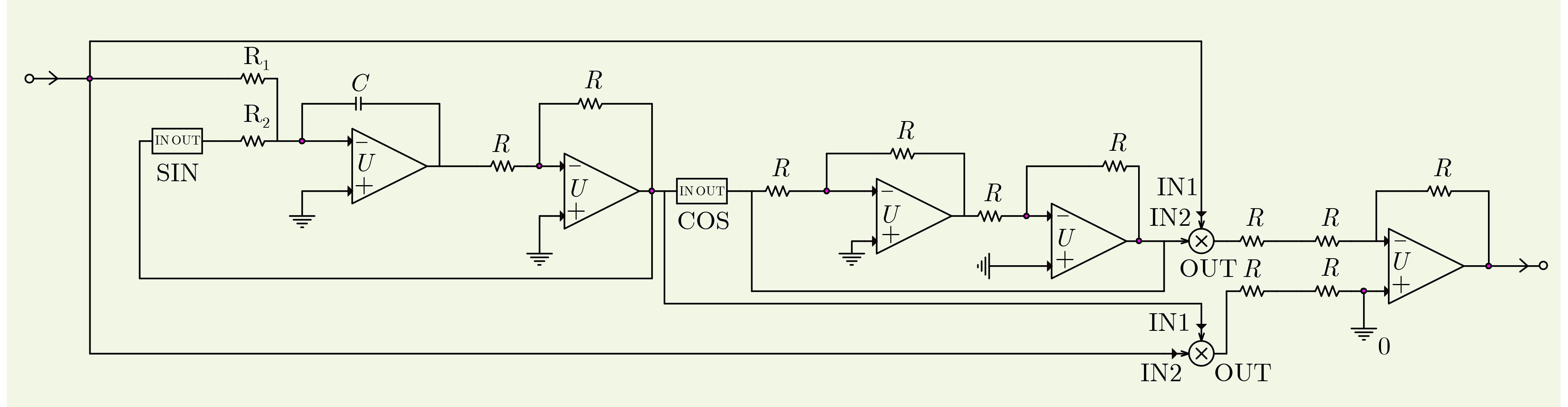
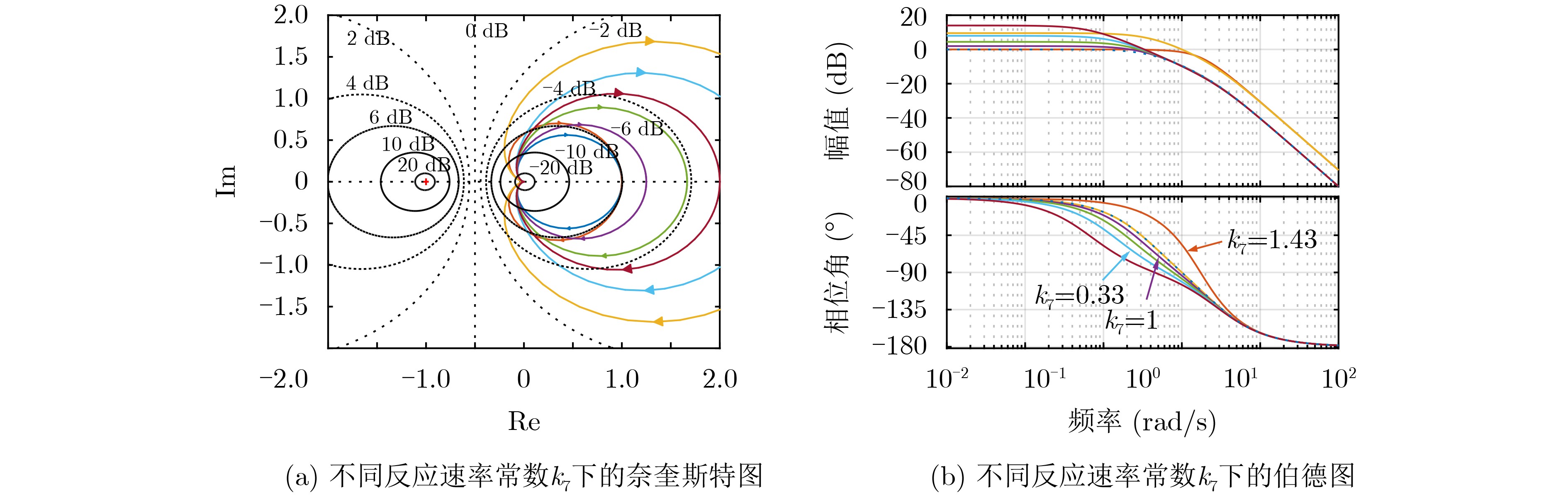
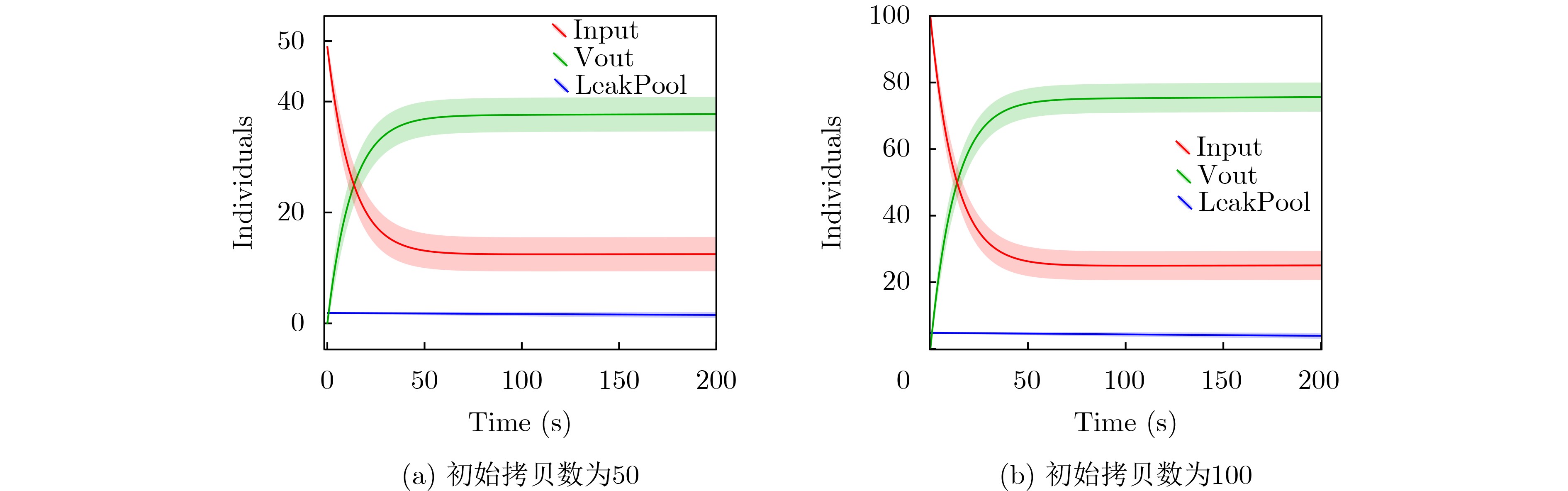
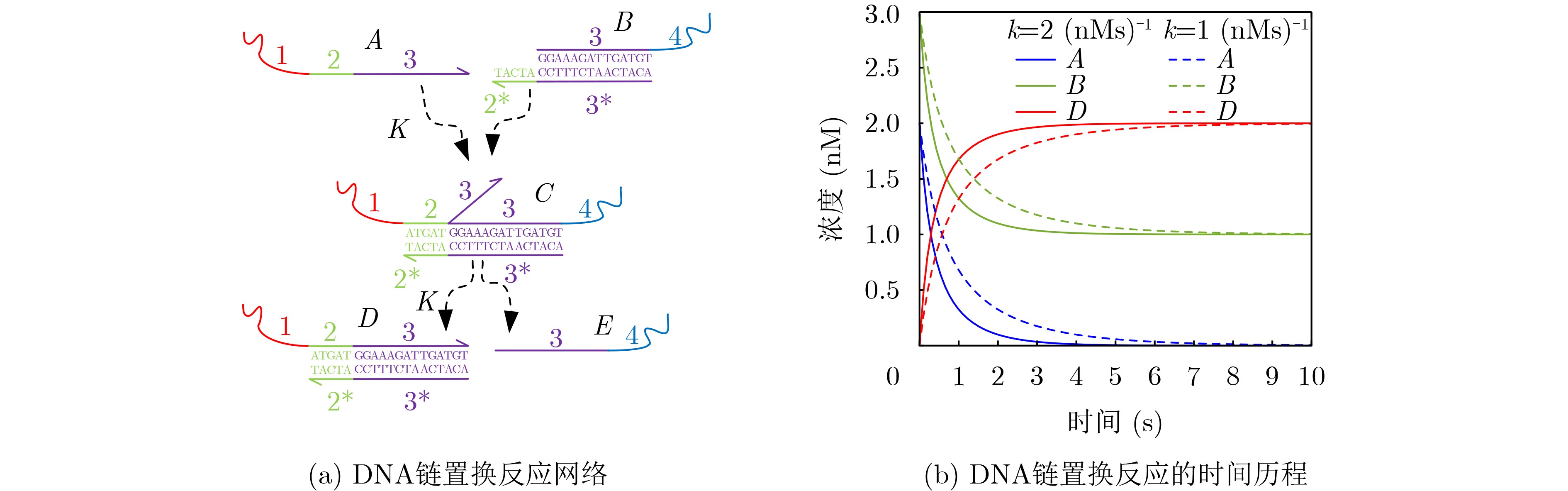
Objective Filter circuits are widely used in modern control and signal-processing systems for noise suppression and signal integrity enhancement. Conventional Resistor-Capacitor (RC) filters are widely applied, but their fixed parameters limit adaptability and miniaturization in emerging molecular and nanoscale computing platforms. To address these limitations, DNA Strand Displacement (DSD) technology is integrated with memristor theory to develop tunable multistable molecular filter circuits. This study aims to design and validate first- and second-order low-pass filter circuits based on the dynamic response and state-dependent behavior of a DSD-based memristor. The proposed filters are designed to improve frequency selectivity, parameter adaptability, and system stability compared with traditional filter architectures. This approach is intended for molecular signal processing, integrated biocircuits, and adaptive filtering systems that require compact size and reconfigurability. Methods The method consists of four stages. First, core DSD reaction modules, including sine, cosine, integration, addition, and multiplication modules, are designed to construct a programmable multistable memristor model. Second, square-wave and sinusoidal input signals are generated through DSD reactions to evaluate the memristor response under different frequencies and amplitudes. Third, the memristor is embedded into low-pass filter structures to construct first- and second-order DSD-based memristor filter circuits. Fourth, simulations are performed using Visual DSD for molecular dynamics analysis and MATLAB for circuit-level analysis. Circuit performance is evaluated using transfer functions, Nyquist plots, Bode diagrams, and time-domain comparisons with classical RC filters. This combined simulation strategy verifies both molecular feasibility and circuit functionality. Results and Discussions The DSD-based memristor exhibits multistable behavior and converges to six stable equilibrium points under different initial conditions ( Fig. 8 ). Its hysteresis characteristics further confirm the state-dependent memory behavior of the designed molecular memristor (Fig. 7 ). The first-order DSD-based memristor filter circuit provides stable attenuation for square-wave and sinusoidal input signals. Its output amplitudes are consistently higher than those of the traditional RC filter across the tested frequencies (Table 3 ). The second-order DSD-based memristor filter circuit further reduces signal delay and improves stability, especially under high-frequency inputs (Table 4 ). Frequency-response analyses show that the cutoff frequency can be dynamically tuned by adjusting DSD reaction rates and initial concentrations (Figs. 9 and11 ). Time-domain simulations further confirm the filtering performance of the first- and second-order circuits (Figs. 10 and12 ). Reliability analysis indicates that lower initial copy numbers increase stochastic molecular noise, whereas higher initial copy numbers make the output distribution closer to the deterministic response and improve the probability of successful filtering. These results verify the feasibility of DSD-memristor integration for adaptive molecular filtering.Conclusions A DSD-based memristor with multistable characteristics and its corresponding first- and second-order low-pass filter circuits are designed and validated. Compared with traditional RC architectures, the proposed filters show improved output stability, parameter tunability, and frequency adaptability. By combining DSD technology with memristor theory, this study provides a reconfigurable molecular-scale filtering framework for signal-processing applications. The results provide a basis for future work on adaptive molecular circuits, intelligent filtering, and nanoelectronic system design. Further studies should focus on experimental validation, real-time tuning strategies, sequence optimization, anti-interference design, signal amplification, and circuit integration. -
Key words:
- DNA Strand Displacement (DSD) /
- Memristor /
- Multistability /
- Low-pass filter circuit
-
表 1 DNA链置换反应的初始值及其对应信号
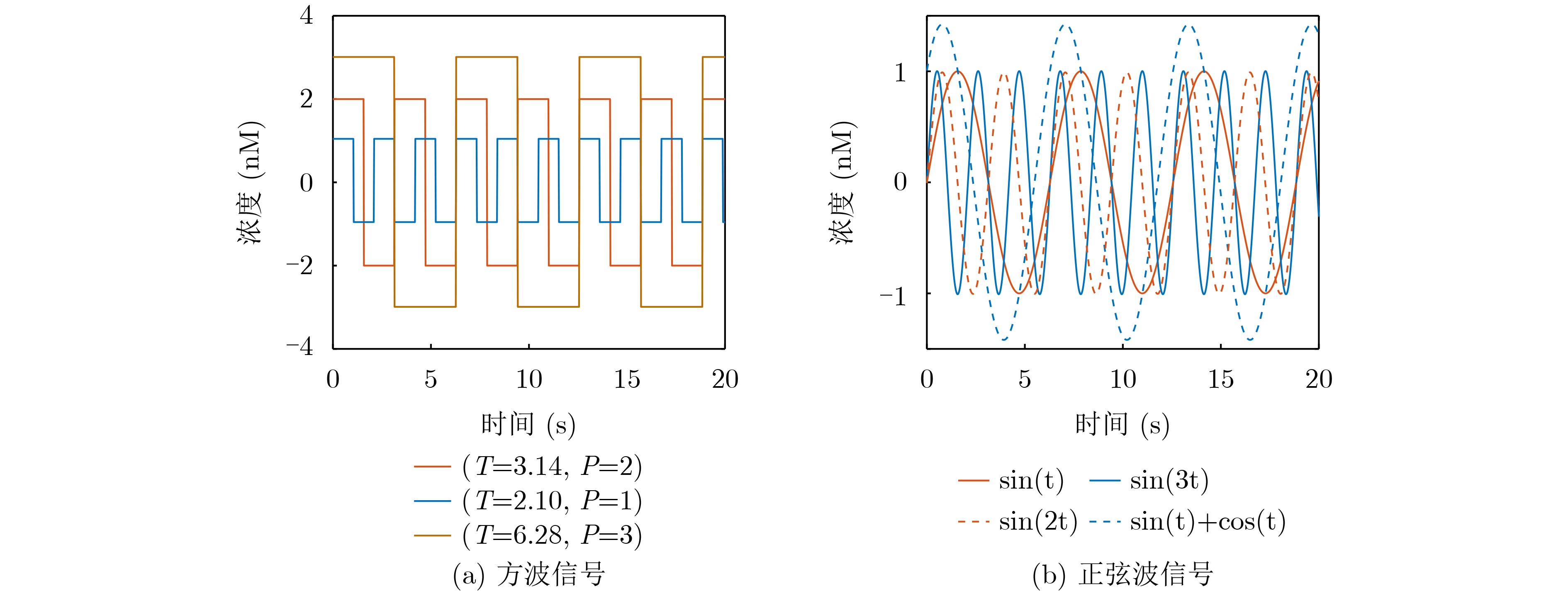
初始值 初始值 反应速率常数 原始信号 $ \begin{aligned}Y_{2}^{+}(0)&=1\\y_{2}^{+}(0)&=2\end{aligned} $ $ \begin{aligned}Y_{2}^{-}(0)&=1\\y_{2}^{-}(0)&=1\end{aligned} $ $ \begin{aligned}{k}_{4}&=1\\{k}_{4}&=1\end{aligned} $ $ \begin{aligned}{Y}_{2}&=\sin (t)\\{y}_{2}&=\cos (t)\end{aligned} $ $ \begin{aligned}Y_{2}^{+}(0)&=1\\y_{2}^{+}(0)&=3\end{aligned} $ $ \begin{aligned}Y_{2}^{-}(0)&=1\\y_{2}^{-}(0)&=1\end{aligned} $ $ \begin{aligned}{k}_{4}&=2\\{k}_{4}&=2\end{aligned} $ $ \begin{aligned}{Y}_{2}&=\sin (2t)\\{y}_{2}&=\cos (2t)\end{aligned} $ $ \begin{aligned}Y_{2}^{+}(0)&=1\\y_{2}^{+}(0)&=4\end{aligned} $ $ \begin{aligned}Y_{2}^{-}(0)&=1\\y_{2}^{-}(0)&=1\end{aligned} $ $ \begin{aligned}{k}_{4}&=3\\{k}_{4}&=3\end{aligned} $ $ \begin{aligned}{Y}_{2}&=\sin (3t)\\{y}_{2}&=\cos (3t)\end{aligned} $  下载: 导出CSV
表 2 DNA链置换忆阻器反应模块的设计
DNA 链置换反应网络 反应速率和初值 反应模块 DSD 仿真 $ \begin{aligned}& Z_{1}^{+}\xrightarrow{{k}_{5}}Z_{1}^{+}+z_{1}^{+};Z_{1}^{-}\xrightarrow{{k}_{5}}Z_{1}^{-}+z_{1}^{-}\\& z_{1}^{+}\xrightarrow{{k}_{5}}Z_{1}^{-}+z_{1}^{+};z_{1}^{-}\xrightarrow{{k}_{5}}Z_{1}^{+}+z_{1}^{-}\\& z_{1}^{+}+z_{1}^{-}\xrightarrow{{k}_{2}}{\mathrm{Waste}};Z_{1}^{+}+Z_{1}^{-}\xrightarrow{{k}_{2}}{\mathrm{Waste}}\end{aligned} $ $ \begin{aligned}{k}_{2}&=10\;({\mathrm{nMs}})^{-1}\\{k}_{5}&=1\;({\mathrm{nMs}})^{-1}\\z_{1}^{+}&=1\;{\mathrm{nM}};z_{1}^{-} =1\;{\mathrm{nM}}\\Z_{1}^{+}&=2\;{\mathrm{nM}};Z_{1}^{-} =1\;{\mathrm{nM}}\end{aligned} $ 

$ \begin{aligned}& Z_{2}^{+}\xrightarrow{{k}_{5}}Z_{2}^{+}+z_{2}^{-};Z_{2}^{-}\xrightarrow{{k}_{5}}Z_{2}^{-}+z_{2}^{+}\\& z_{2}^{+}\xrightarrow{{k}_{5}}Z_{2}^{+}+z_{1}^{+};z_{2}^{-}\xrightarrow{{k}_{5}}Z_{2}^{-}+z_{1}^{-}\\& z_{2}^{+}+z_{2}^{-}\xrightarrow{{k}_{2}}{\mathrm{Waste}};Z_{2}^{+}+Z_{2}^{-}\xrightarrow{{k}_{2}}{\mathrm{Waste}}\end{aligned} $ $ \begin{aligned}z_{2}^{+}&=2\;{\mathrm{nM}};z_{2}^{-} =1\;{\mathrm{nM}}\\Z_{2}^{+}&=1\;{\mathrm{nM}};Z_{2}^{-} =1\;{\mathrm{nM}}\end{aligned} $ 

$ \begin{aligned}& X_{2}^{+}\xrightarrow{{k}_{5}}x_{2}^{+}+X_{2}^{+};X_{2}^{-}\xrightarrow{{k}_{5}}x_{2}^{-}+X_{2}^{-};x_{2}^{+}\xrightarrow{{k}_{5}}x_{2}^{+}+X_{2}^{-}\\& x_{2}^{-}\xrightarrow{{k}_{5}}x_{2}^{-}+X_{2}^{+};{v}^{+}\xrightarrow{{k}_{6}}{V}^{+}+{v}^{+};{v}^{-}\xrightarrow{{k}_{6}}{V}^{-}+{v}^{-}\\& {V}^{+}\xrightarrow{{k}_{6}}{v}^{-}+{V}^{+};{V}^{-}\xrightarrow{{k}_{6}}{v}^{+}+{V}^{-}{V}^{+}\xrightarrow{{k}_{5}}{V}^{+}+{x}^{+};\\& x_{2}^{+}+x_{2}^{-}\xrightarrow{{k}_{2}}{\mathrm{Waste}};x_{2}^{+}\xrightarrow{{k}_{5}}{x}^{+}+x_{2}^{+};X_{2}^{+}+X_{2}^{-}\xrightarrow{{k}_{2}}{\mathrm{Waste}}\\& {V}^{-}\xrightarrow{{k}_{5}}{x}^{-}+x_{2}^{-};{v}^{+}+{v}^{-}\xrightarrow{{k}_{2}}{\mathrm{Waste}};{x}^{+}+{x}^{-}\xrightarrow{{k}_{2}}{\mathrm{Waste}}\end{aligned} $ $ \begin{aligned}{k}_{6}&=2\;({\mathrm{nMs}})^{-1}\\x_{2}^{+}&=1\;{\mathrm{nM}};x_{2}^{-} =1\;{\mathrm{nM}}\\X_{2}^{+}&=2\;{\mathrm{nM}};X_{2}^{-} =1\;{\mathrm{nM}}\\V_{}^{+}&=1\;{\mathrm{nM}};V_{}^{-} =1\;{\mathrm{nM}}\\{v}^{+}&=3\;{\mathrm{nM}};{v}^{-} =2\;{\mathrm{nM}}\end{aligned} $ 
$ \dot{x}=\sin (x)+V $
$ \begin{aligned}& {V}^{+}\xrightarrow{{k}_{5}}W(x)^{+}+{x}^{+};{x}^{-}\xrightarrow{{k}_{5}}W(x)^{-}+{x}^{-}\\& z_{2}^{+}\xrightarrow{{k}_{5}}W(x)^{+}+z_{2}^{+};z_{2}^{-}\xrightarrow{{k}_{5}}W(x)^{-}+z_{2}^{-}\\& W(x)^{+}\xrightarrow{{k}_{5}}W(x)^{-}+W(x)^{+}\\& W(x)^{-}\xrightarrow{{k}_{5}}W(x)^{+}+W(x)^{-}\\& W(x)^{+}+W(x)^{-}\xrightarrow{{k}_{5}}{\mathrm{Waste}}\end{aligned} $ $ \begin{aligned}z_{2}^{+}&=3\;{\mathrm{nM}}\\z_{2}^{-}&=1\;{\mathrm{nM}}\\x_{}^{+}&=2\;{\mathrm{nM}}\\x_{}^{-}&=1\;{\mathrm{nM}}\end{aligned} $ 
$ W(x)=x+{z}_{2} $
$ \begin{aligned}& W(x)^{+}+{V}^{+}\xrightarrow{{k}_{5}}W(x)^{+}+{I}^{+}+{V}^{+};{I}^{+}\xrightarrow{{k}_{5}}{I}^{+}+{I}^{-}\\& W(x)^{+}+{V}^{+}\xrightarrow{{k}_{5}}W(x)^{+}+{I}^{+}+{V}^{+};{I}^{-}\xrightarrow{{k}_{5}}{I}^{+}+{I}^{-}\\& W(x)^{+}+{V}^{+}\xrightarrow{{k}_{5}}W(x)^{+}+{I}^{+}+{V}^{+};{I}^{+}+{I}^{-}\xrightarrow{{k}_{2}}{\mathrm{Waste}}\\& W(x)^{+}+{V}^{+}\xrightarrow{{k}_{5}}W(x)^{+}+{I}^{+}+{V}^{+}\end{aligned} $ $ \begin{aligned}W(x)^{+}&=2\;{\mathrm{nM}}\\W(x)^{-}&=1\;{\mathrm{nM}}\\{V}^{+}&=3\;{\mathrm{nM}}\\{V}^{-}&=0.5\;{\mathrm{nM}}\end{aligned} $ 
 下载: 导出CSV
表 3 1阶忆阻器滤波电路与1阶RC滤波电路的性能对比
$ {V}_{31}({V}_{{\mathrm{in}}}) $ $ {k}_{7} $ $ {V}_{{\mathrm{in}}}({\mathrm{time}},{\mathrm{peak}}) $ $ {V}_{{\mathrm{M}}{{{\mathrm{C}}}_{1}}{\mathrm{out}}}({\mathrm{time}},{\mathrm{peak}}) $ $ {H}_{1}(s)({V}_{{\mathrm{M}}{{{\mathrm{C}}}_{1}}{\mathrm{out}}}/{V}_{{\mathrm{in}}}) $ $ {V}_{{\mathrm{R}}{{{\mathrm{C}}}_{1}}{\mathrm{out}}}({\mathrm{time}},{\mathrm{peak}}) $ $ H_{1}^{\prime}(s)({V}_{{\mathrm{R}}{{{\mathrm{C}}}_{1}}{\mathrm{out}}}/{V}_{{\mathrm{in}}}) $ $ T=3.14,P=2 $ 1 (10.99, 2) (10.99, 1.943) 0.9715 (10.99, 2.0000 )0.6565 $ T=2.1,P=1 $ 1 (11.52, 1) (11.52, 0.8385 )0.8385 (11.52, 0.4689 )0.4689 $ T=6.28,P=3 $ 1 (9.24, 3) (9.42, 3) 1.0000 (9.24, 2.7490 )0.9163 $ T=3.14,P=2 $ 1.5 (10.99, 2) (10.99, 1.933) 0.9965 (10.99, 1.654) 0.827 $ T=3.14,P=2 $ 0.8 (10.99, 2) (10.99, 1.8721 )0.9361 (10.99, 1.116) 0.558 $ T=3.14,P=2 $ 0.4 (10.99, 2) (10.99, 1.462) 0.7130 (10.99, 0.6218 )0.3109 $ \sin (t) $ 2 (14.13, 1) (14.33, 0.9816 )0.9816 (14.61, 0.8941 )0.9841 $ \sin (t)+\cos (t) $ 2 (13.35, 1.414) (13.53, 1.392) 0.9844 (13.81, 1.265) 0.8946 $ \sin (3t) $ 2 (13.09, 1) (13.29, 0.8176 )0.8176 (13.42, 0.554) 0.5540 $ \sin (2t) $ 1 (10.21, 1) (10.57, 0.7404 )0.7404 (10.77, 0.4467 )0.4467 $ \sin (2t) $ 1.5 (10.21, 1) (10.49, 0.8543 )0.8543 (10.67, 0.5995 )0.5995 $ \sin (2t) $ 0.5 (10.21, 1) (10.73, 0.4924 )0.4924 (10.87, 0.2433 )0.2433
下载: 导出CSV
表 4 2阶忆阻器滤波电路与2阶RC滤波电路的性能对比
$ {V}_{41}({V}_{{\mathrm{in}}}) $ $ {k}_{7} $ $ {V}_{{\mathrm{in}}}({\mathrm{time}},{\mathrm{peak}}) $ $ {V}_{{\mathrm{M}}{{{\mathrm{C}}}_{2}}{\mathrm{out}}}({\mathrm{time}},{\mathrm{peak}}) $ $ {H}_{1}(s)({V}_{{\mathrm{M}}{{{\mathrm{C}}}_{2}}{\mathrm{out}}}/{V}_{{\mathrm{in}}}) $ $ {V}_{{\mathrm{R}}{{{\mathrm{C}}}_{2}}{\mathrm{out}}}({\mathrm{time}},{\mathrm{peak}}) $ $ H_{2}^{\prime}(s)({V}_{{\mathrm{R}}{{{\mathrm{C}}}_{2}}{\mathrm{out}}}/{V}_{{\mathrm{in}}}) $ $ T=3.14,P=2 $ 1 (10.99, 2) (10.99, 2) 1 (11.19, 0.4282 )0.2141 $ T=2.1,P=1 $ 1 (11.52, 1) (11.53, 0.9964 )0.9964 (11.73, 0.1075 )0.1075 $ T=6.28,P=3 $ 1 (9.42, 3) (9.42, 3) 1 (9.55, 1.465) 0.4833 $ T=3.14,P=2 $ 1.5 (10.99, 2) (11.01, 2) 1 (11.11, 0.7047 )0.3524 $ T=3.14,P=2 $ 0.8 (10.99, 2) (11.01, 1.998) 0.9990 (10.25, 0.3216 )0.1068 $ T=3.14,P=2 $ 0.4 (10.99, 2) (11.01, 1.906) 0.9530 (10.43, 0.1482 )0.0741 $ \sin (t) $ 2 (14.13, 1) (14.23, 0.9957 )0.9957 (12.26, 0.6013 )0.6013 $ \sin (t)+\cos (t) $ 2 (13.35, 1.414) (13.45, 1.408) 0.9958 (14.45, 0.8504 )0.6014 $ \sin (3t) $ 2 (13.09, 1) (13.19, 0.9628 )0.9628 (13.71, 0.217) 0.2170 $ \sin (2t) $ 1 (10.21, 1) (10.41, 0.9488 )0.9488 (11.23, 0.1529 )0.1529 $ \sin (2t) $ 1.5 (10.21, 1) (10.35, 0.9756 )0.9756 (11.09, 0.2482 )0.2482 $ \sin (2t) $ 0.5 (10.21, 1) (10.57, 0.8241 )0.8241 (11.45, 0.0646 )0.0646
下载: 导出CSV
-
[1] DING Yuzhe, HENG Yicheng, WONG K Y, et al. Enriching higher affinity aptamers by addressing the kinetic aspect of the DNA strand-displacement reaction[J]. Angewandte Chemie International Edition, 2026, 65(5): e14445. doi: 10.1002/anie.202514445. [2] JURINOVIĆ K, MITRA M, MUKHERJEE R, et al. Design of DNA strand displacement reactions[J]. Current Opinion in Biotechnology, 2026, 97: 103396. doi: 10.1016/j.copbio.2025.103396. [3] HU Mengyang, SANG Yidan, YAN Xuemei, et al. Isolation strand displacement: Multi directional regulation and control strand displacement to enrich the DNA toolbox[J]. Chemical Engineering Journal, 2025, 516: 164074. doi: 10.1016/j.cej.2025.164074. [4] PIRANEJ S, ZHANG L, BAZRAFSHAN A, et al. Programming DNA machines to move[J]. Nature Reviews Chemistry, 2026, 10(3): 158–178. doi: 10.1038/s41570-025-00791-7. [5] CHEN Yanju, DELGADO R N, XU E, et al. Scaling up sequential stepwise DNA displacement-based signal exchange for rapid ultraplex fluorescent imaging in cells and tissues[J]. Journal of the American Chemical Society, 2026, 148(4): 4438–4449. doi: 10.1021/jacs.5c18687. [6] FENG Xinyu, XU Li, ZHANG Yunhan, et al. Functionalizing 3D DNA crystals by replacing non-framework strands[J]. Chemical Engineering Journal, 2026, 533: 174835. doi: 10.1016/j.cej.2026.174835. [7] ZHANG Tianqing, QIAN Xinmin, ZHANG Jiayi, et al. Light-Up nanostructures with allosterically controlled fluorogenic DNA aptamers[J]. Advanced Materials, 2026, 38(7): e14306. doi: 10.1002/adma.202514306. [8] DI PEDE A C, BAGHERI N, BELFORTE E, et al. Triplex DNA clamp regulates Cas12a activation for ssDNA and RNA sensing[J]. Nucleic Acids Research, 2026, 54(1): gkaf1392. doi: 10.1093/nar/gkaf1392. [9] ZHONG Xingyu, XIE Tianci, GONG Xi, et al. Stimulus-responsive not gate for single-rail DNA logic circuits and biosensing[J]. ACS Nano, 2026, 20(4): 3653–3666. doi: 10.1021/acsnano.5c17487. [10] DOU Baoting, WANG Keming, WANG Qianyu, et al. DNA-fueled molecule machine-mediated atom transfer radical polymerization amplification for 17β-estradiol assay in clinical samples[J]. Analytical Chemistry, 2026, 98(10): 7366–7373. doi: 10.1021/acs.analchem.5c06651. [11] YANG Fengrui, JIANG Xiaorou, LEI Lingling, et al. DNA molecular subtraction controlled hybridization chain reaction for high contrast detecting and selective killing of cancer cells[J]. Biosensors and Bioelectronics, 2026, 302: 118562. doi: 10.1016/j.bios.2026.118562. [12] PENG Yonglin, LIU Xinhua, WU Jun, et al. EpiXFormer: A cross-attention neural network for predicting cell type-specific transcription factor binding sites[J]. Briefings in Bioinformatics, 2026, 27(1): bbaf721. doi: 10.1093/bib/bbaf721. [13] AGUILLON R, HARDUF A, SAGI D, et al. DNA damage modulates sleep drive in basal cnidarians with divergent chronotypes[J]. Nature Communications, 2026, 17(1): 3. doi: 10.1038/s41467-025-67400-5. [14] LI Lei, YE Qi, MA Jinlu, et al. Ubiquitination-directed cytosolic DNA degradation governs cGAS-STING-mediated immune response to DNA damage[J]. Cancer Cell, 2026, 44(2): 306–320. e7. doi: 10.1016/j.ccell.2025.12.013. [15] CHEN Yonghuan, YUE Xinru, LING Yixin, et al. Nanofluidic confined DNA aptamers for neuromorphic Multiplex Discrimination[J]. ACS Nano, 2026, 20(6): 4855–4865. doi: 10.1021/acsnano.5c16862. [16] LIU Junlan and ZHANG Qing. DNA logic circuit based on a toehold-Independent strand displacement reaction network[J]. Nano Letters, 2025, 25(9): 3464–3470. doi: 10.1021/acs.nanolett.4c05735. [17] 李付鹏, 王光义, 刘敬彪, 等. 局部有源忆阻器电路的类生物神经网络存算研究[J]. 电子与信息学报, 2026, 48(2): 866–872. doi: 10.11999/JEIT250631.LI Fupeng, WANG Guangyi, LIU Jingbiao, et al. The storage and calculation of biological-like neural networks for locally active memristor circuits[J]. Journal of Electronics & Information Technology, 2026, 48(2): 866–872. doi: 10.11999/JEIT250631. [18] SUN Junwei, CHEN Yu, WANG Zicheng, et al. Memristor-based context-dependent sensitization and system desensitization neural circuit for the emotional regulation of industrial robots[J]. IEEE Transactions on Industrial Informatics, 2025, 21(12): 9909–9920. doi: 10.1109/TII.2025.3609174. [19] 柯榕杰, 王洪斌, 程钰间. 小型化宽阻带折叠基片集成波导滤波器研究[J]. 电子与信息学报, 2026, 48(3): 1301–1310. doi: 10.11999/JEIT250869.KE Rongjie, WANG Hongbin, and CHENG Yujian. Research on a miniaturized wide stopband folded substrate integrated waveguide filter[J]. Journal of Electronics & Information Technology, 2026, 48(3): 1301–1310. doi: 10.11999/JEIT250869. [20] SUN Junwei, ZHOU Haotong, WANG Zicheng, et al. Memcapacitor-based operant conditioning neural network with deprivation and its application in inspection robots[J]. IEEE Transactions on Industrial Informatics, 2025, 21(10): 7587–7597. doi: 10.1109/TII.2025.3575121. [21] LI Jiabo, NIU Yuan, TIAN Di, et al. Intra-short circuit fault detection and quantitative analysis of lithium-ion series battery packs based on multi-model fusion[J]. Journal of Energy Storage, 2026, 147: 120053. doi: 10.1016/j.est.2025.120053. [22] 李源堃, 王泽, 张清天, 等. NAS4CIM: 面向忆阻器存算一体芯片的神经网络结构搜索框架[J]. 电子与信息学报, 2025, 47(12): 4948–4958. doi: 10.11999/JEIT250978.LI Yuankun, WANG Ze, ZHANG Qingtian, et al. NAS4CIM: Tailored neural network architecture search for RRAM-based compute-in-memory chips[J]. Journal of Electronics & Information Technology, 2025, 47(12): 4948–4958. doi: 10.11999/JEIT250978. [23] 华惊宇, 杨乐, 闻建刚, 等. 通用滤波多载波系统原型滤波器的连续凸近似优化设计方法[J]. 电子与信息学报, 2025, 47(10): 3793–3803. doi: 10.11999/JEIT250278.HUA Jingyu. YANG Le, WEN Jiangang, et al. A successive convex approximation optimization based prototype filter design method for universal filtered multi-carrier systems[J]. Journal of Electronics & Information Technology, 2025, 47(10): 3793–3803. doi: 10.11999/JEIT250278. [24] SUN Junwei, SUN Ce, WANG Zicheng, et al. Biosignals secure communication scheme with filtering of active control projection synchronization of biological chaotic circuits with different orders based on DNA strand displacement[J]. IEEE Transactions on Biomedical Circuits and Systems, 2023, 17(3): 470–482. doi: 10.1109/TBCAS.2023.3270323. [25] CHEN Si, SHU Weijun, WANG Shan, et al. Bioinspired nucleic acid-based bandpass filters and their concentration-adaptive functions[J]. Journal of the American Chemical Society, 2025, 147(15): 12786–12799. doi: 10.1021/jacs.5c01331. [26] SONG Tianqi and QIAN Lulu. Heat-rechargeable computation in DNA logic circuits and neural networks[J]. Nature, 2025, 646(8084): 315–322. doi: 10.1038/s41586-025-09570-2. -

 下载:
下载:





图(13) / 表(4)
计量
- 文章访问数: 731
- HTML全文浏览量: 296
- PDF下载量: 34
- 被引次数: 0
