




Distributed Resilient Invariant Extended Kalman Fusion Filter Method for Target Tracking
-
摘要: 针对移动传感器网络目标跟踪面临运动非线性、无线链路拓扑时变且易受恶意攻击等问题,设计了一种分布式弹性不变扩展卡尔曼融合滤波状态估计算法。首先,为应对扩展卡尔曼滤波直接泰勒展开破坏旋转矩阵正交性,本文在该滤波框架下引入李群李代数映射机制定义估计误差,并在李代数空间中进行线性化处理。其次,设计一种相异性降维k-means攻击检测机制,将高维状态估计偏差映射为标量相异性度量计算,降低计算复杂度同时保留攻击引起的偏差信息,无需预知攻击模型便可识别并隔离受攻击节点及其局部后验估计。最后,构建时变拓扑协方差交集共识融合策略,融合经k-means识别的可信邻居节点后验估计与不可信邻居节点先验估计,仅依赖当前网络拓扑和节点连接关系,无需全局信息。仿真结果表明,该方法在时变拓扑结构及多种恶意攻击场景下均表现出良好的鲁棒性和较高的估计精度。Abstract:
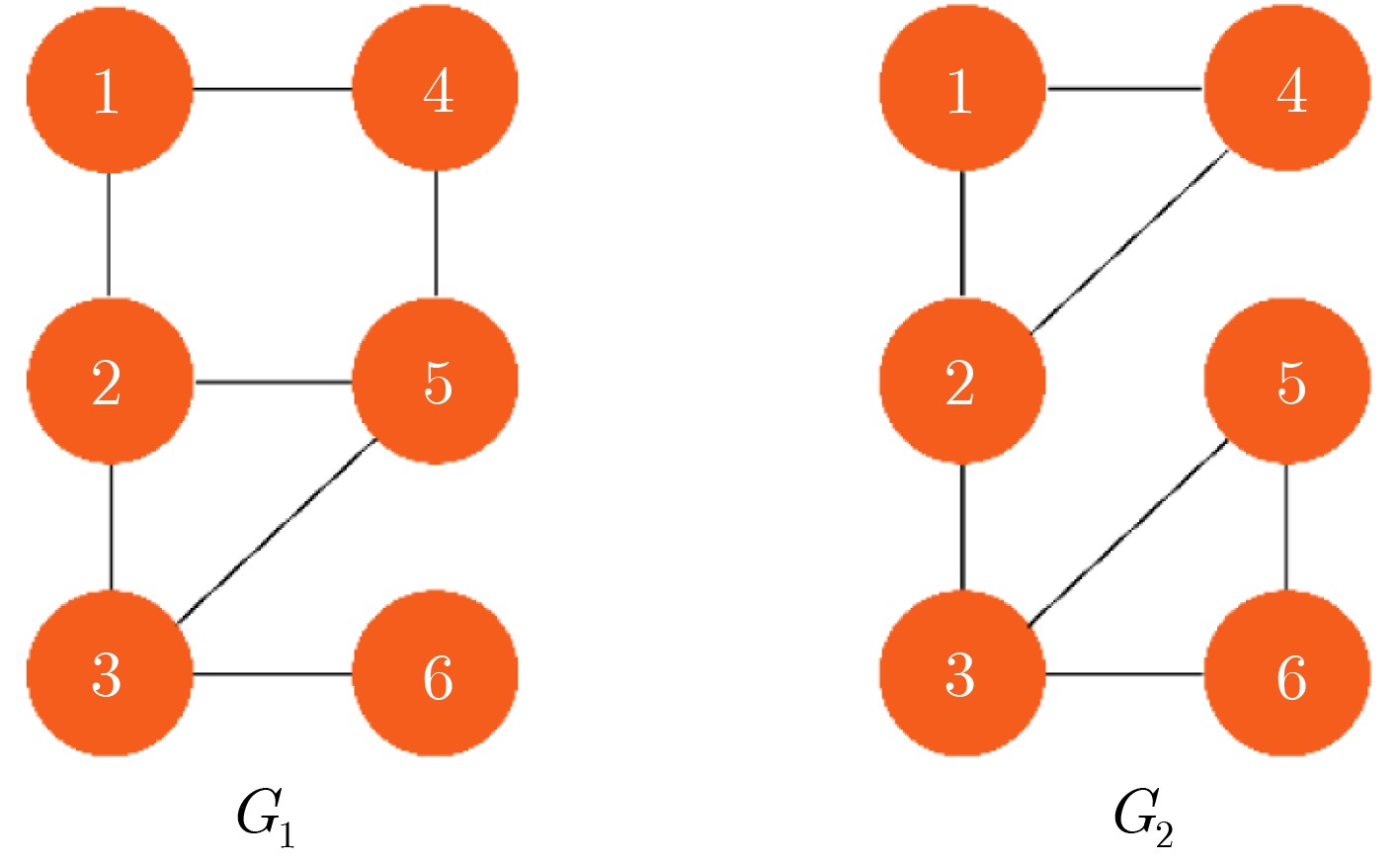
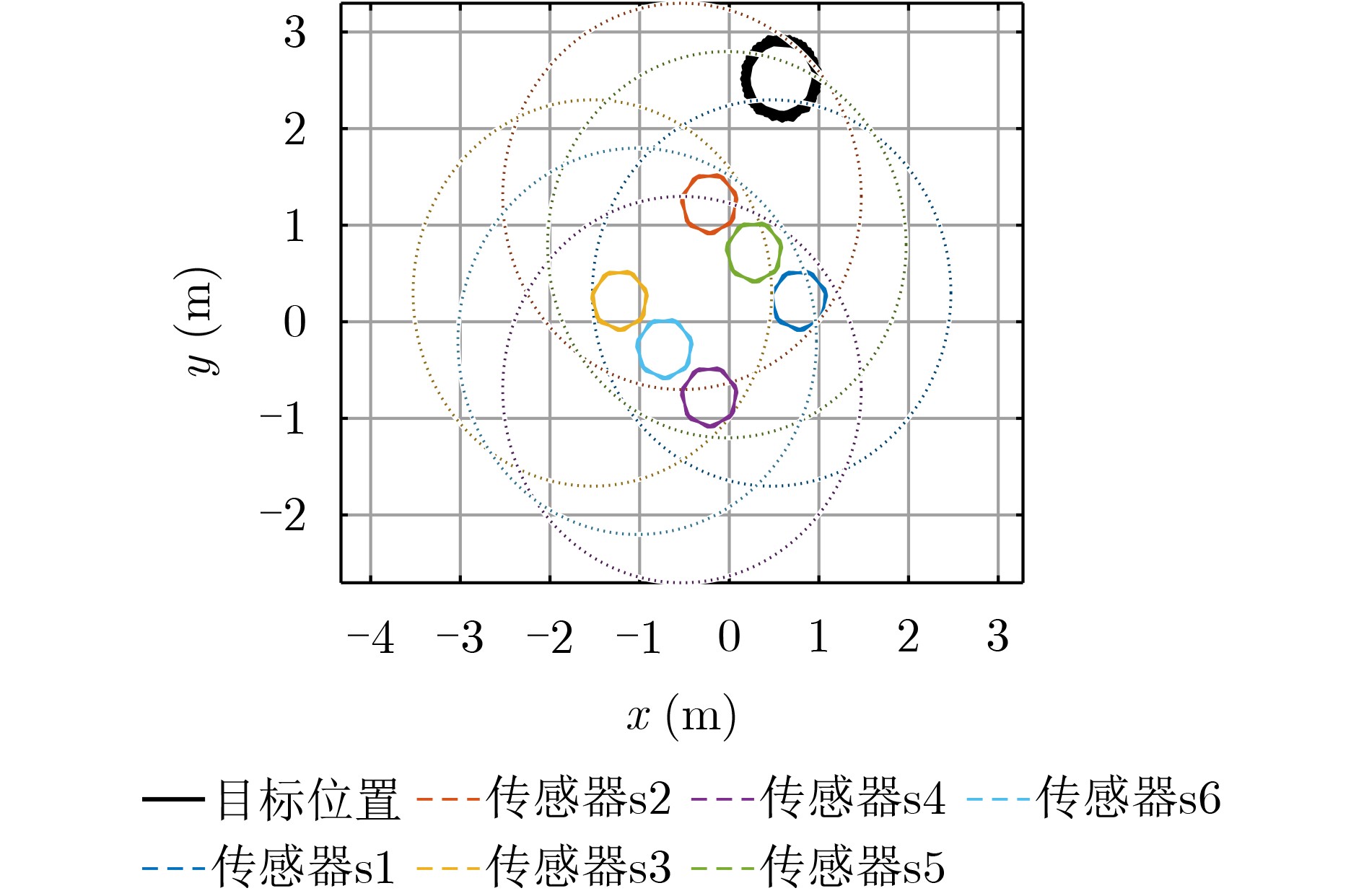
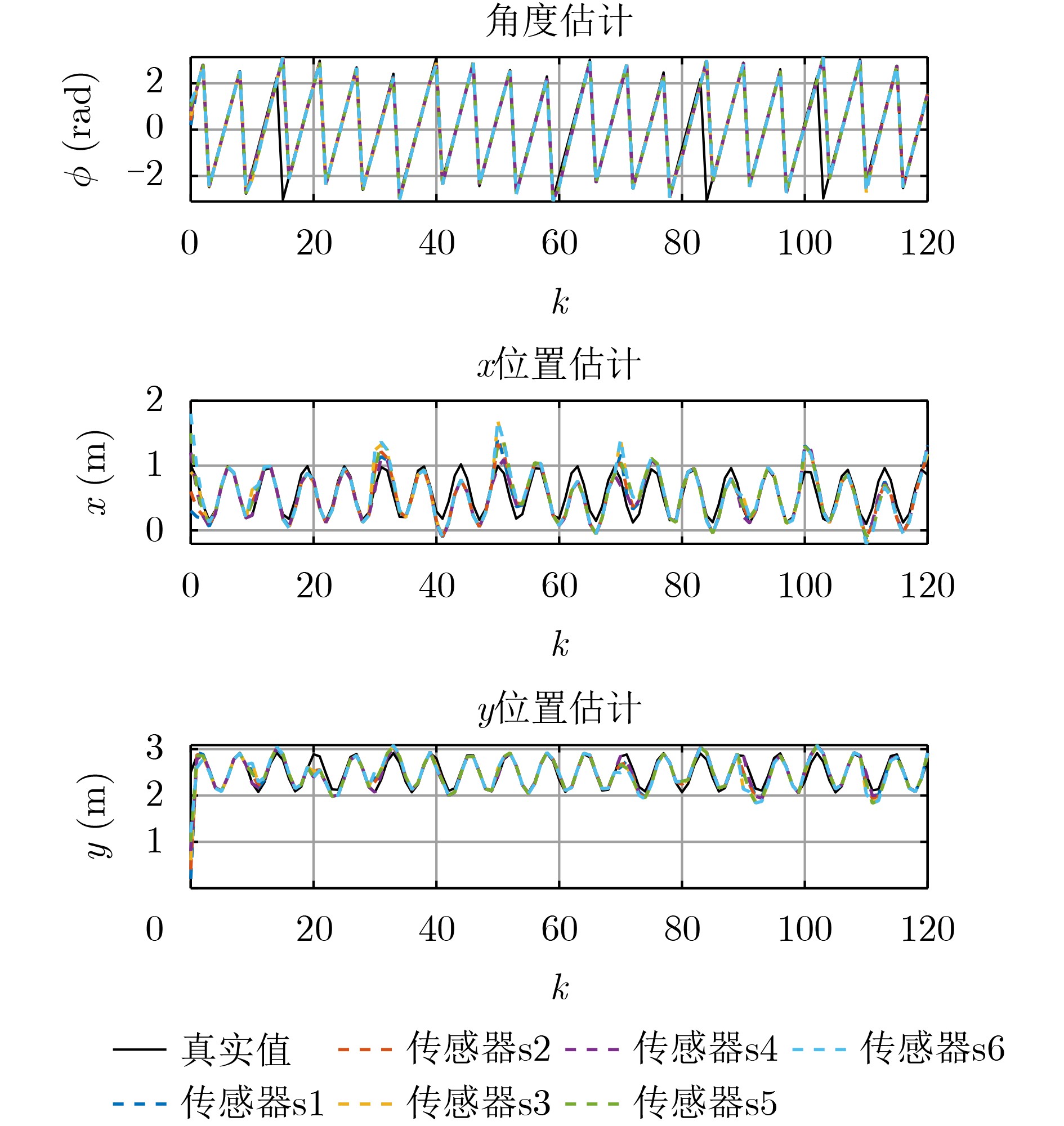
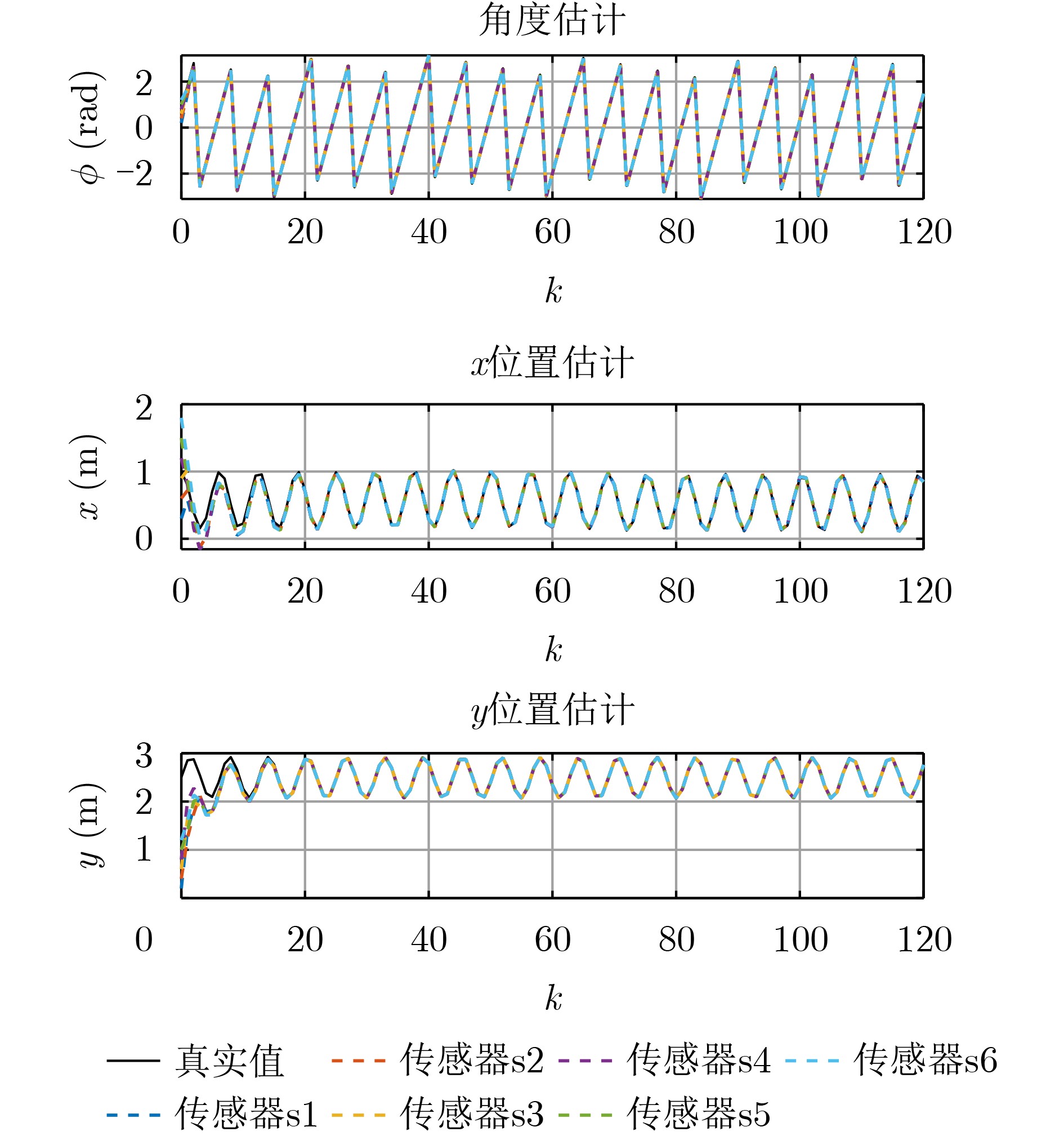
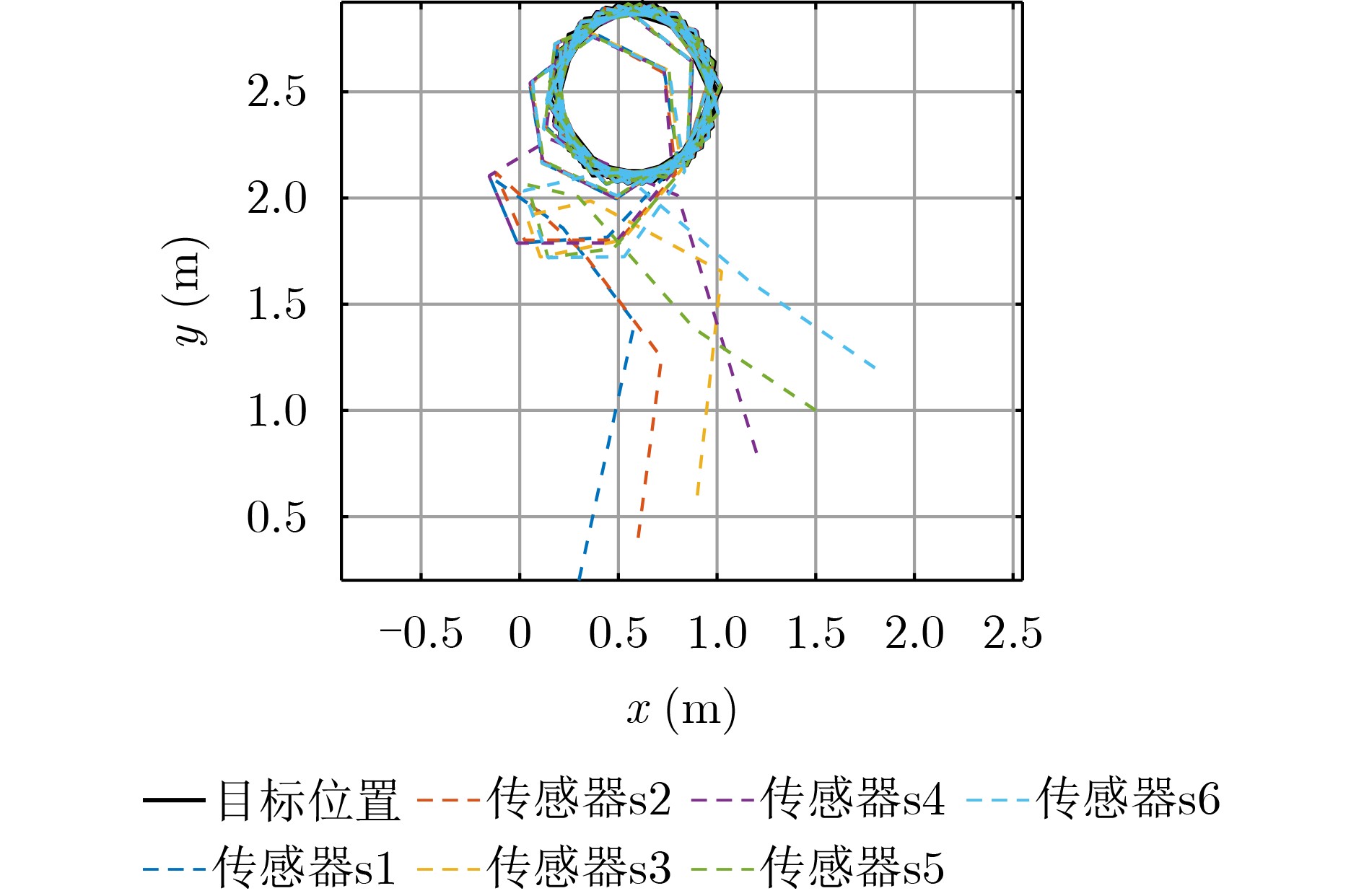
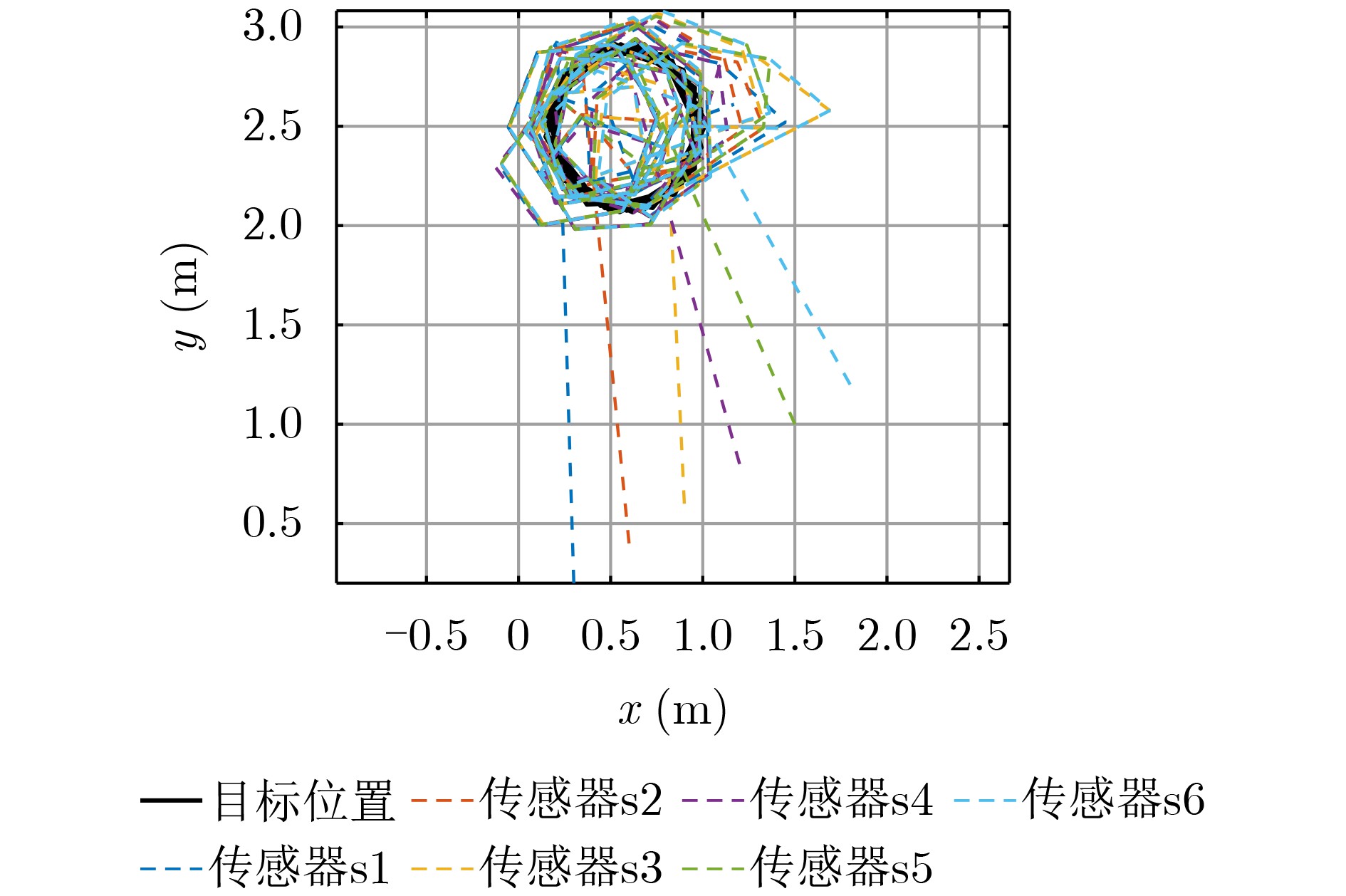
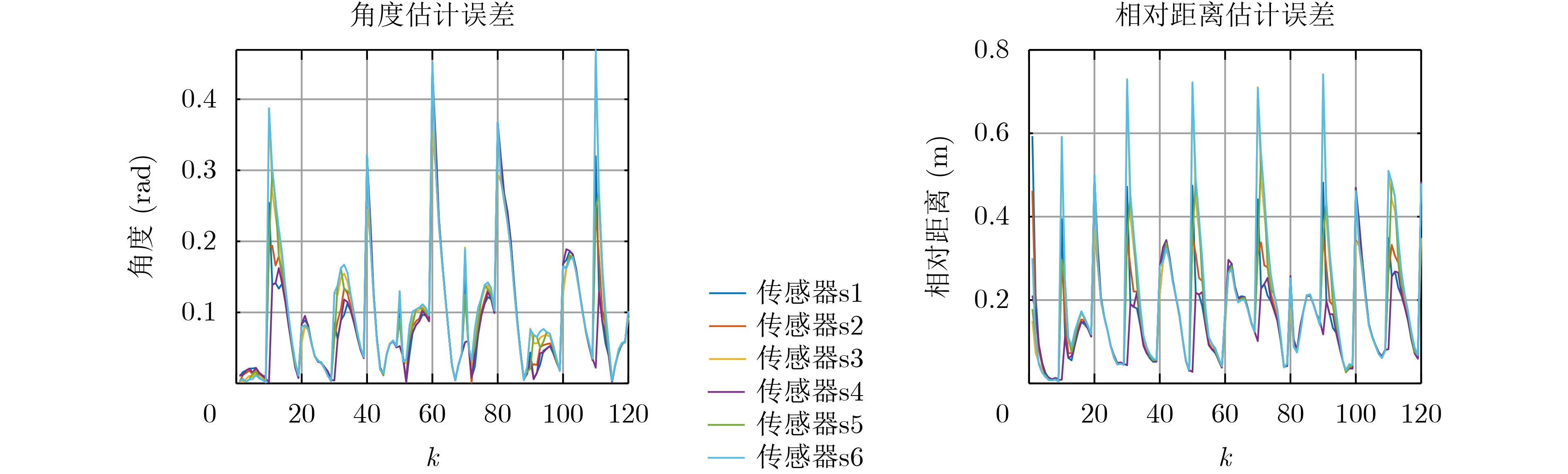
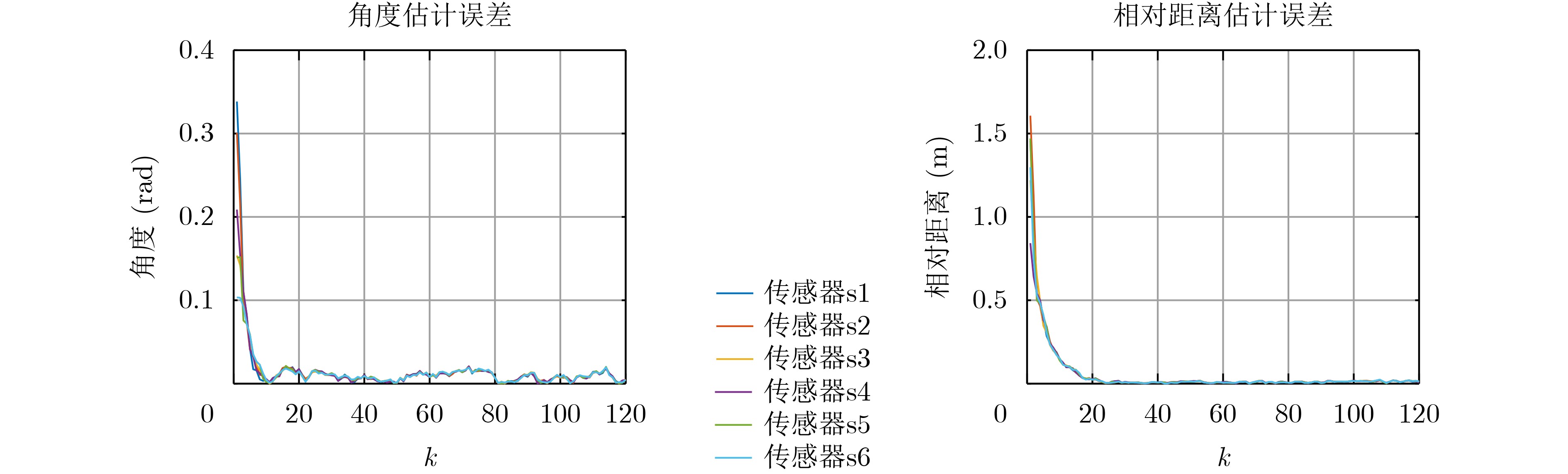
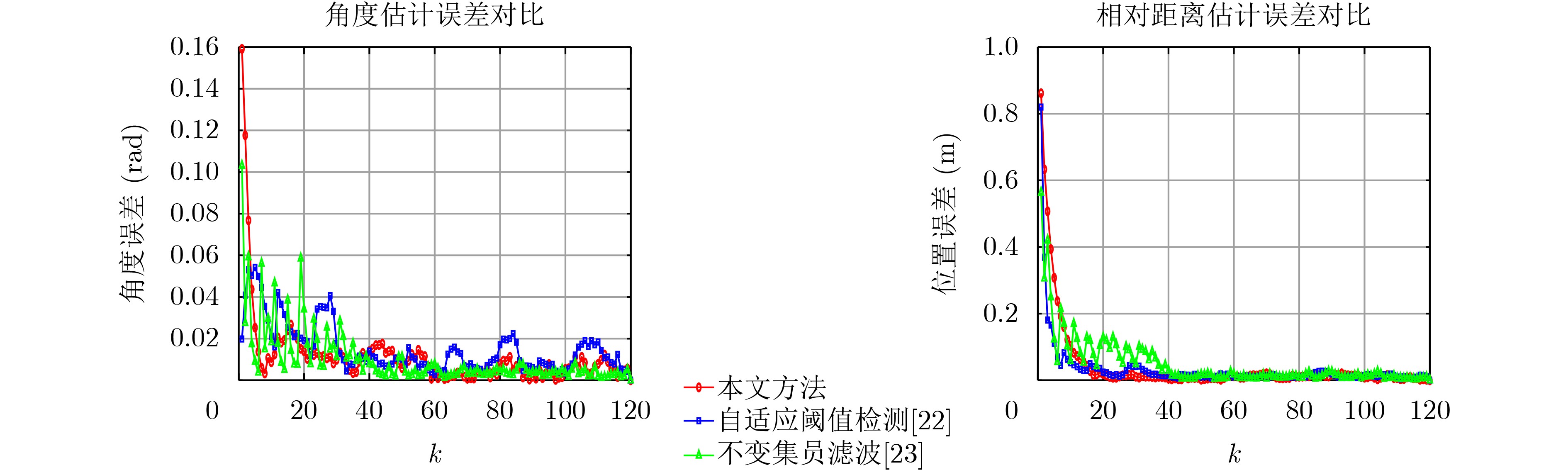
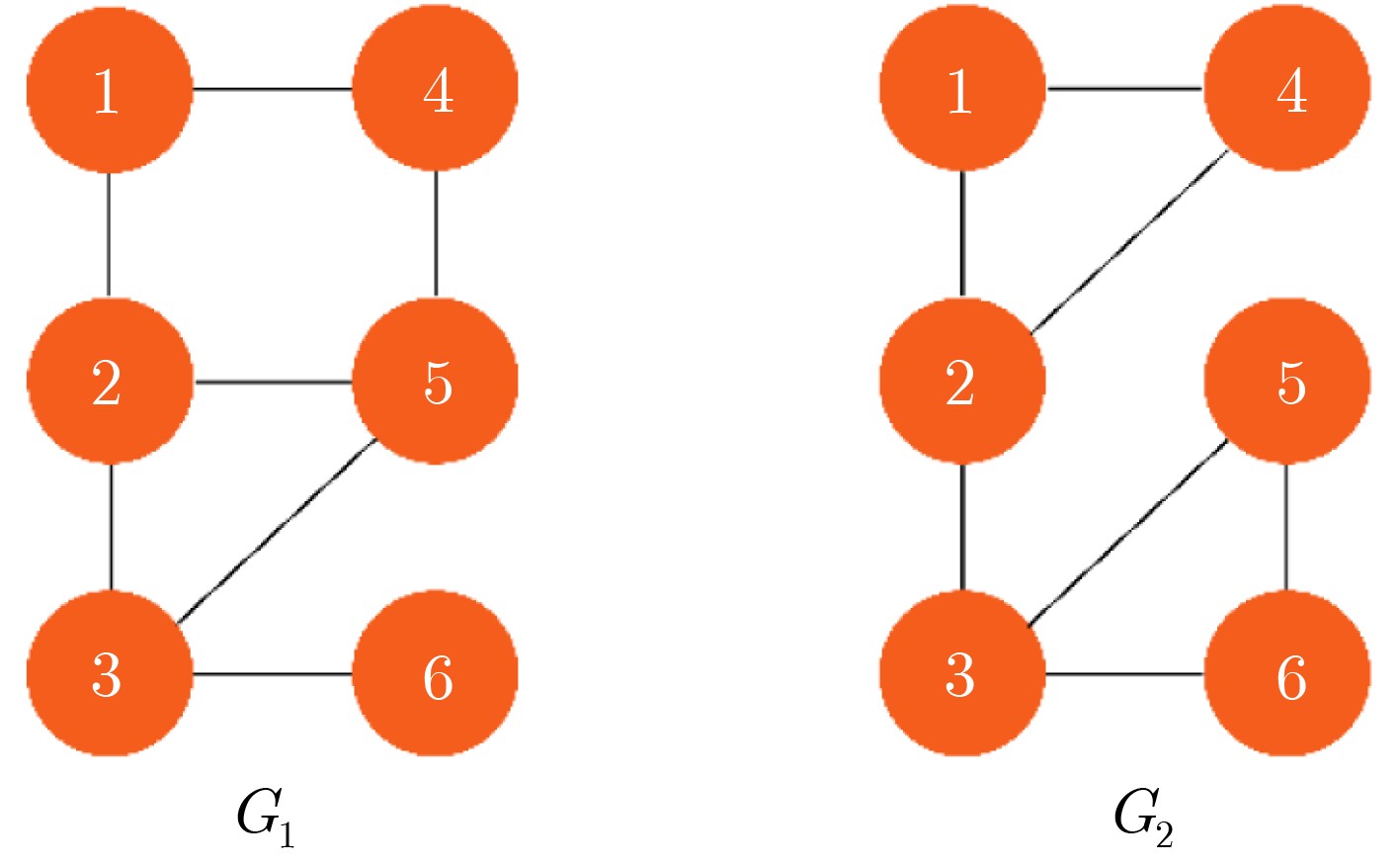
Objective Mobile Sensor Networks (MSNs) provide flexible deployment, dynamic sensing coverage, and cooperative observation capabilities for target tracking. However, target tracking in MSNs is affected simultaneously by nonlinear target motion, time-varying wireless communication topology, intermittent measurements, and malicious attacks. In an open wireless communication environment, false data injection, denial-of-service, and replay attacks may corrupt measurement information and cause abnormal state estimates to propagate among neighboring nodes, thereby degrading estimation accuracy and even threatening filter consistency and stability. In addition, the target state considered in this study contains orientation and position variables, whose evolution has an intrinsic non-Euclidean geometric structure. Conventional Extended Kalman Filtering (EKF) generally performs linearization directly in Euclidean coordinates, which may introduce approximation errors and may violate the orthogonality of the rotation matrix. Existing resilient distributed estimation methods also commonly rely on static sensor networks or restrictive linear-motion assumptions, making them difficult to apply directly to nonlinear target tracking with dynamically switching network topologies. Therefore, a distributed state estimation method that simultaneously considers geometric consistency, attack resilience, and dynamic network connectivity is required for reliable target tracking in MSNs. Methods A distributed resilient invariant extended Kalman fusion filtering method is developed for nonlinear target tracking under network attacks. First, a Lie group–Lie algebra mapping is introduced into the EKF framework. The target pose is represented on the two-dimensional special Euclidean group SE(2), and the estimation error is defined through group multiplication. The error is subsequently transformed into the corresponding Lie algebra, where linearization is performed. This geometric error representation preserves the structural properties of the rotation matrix during state propagation and avoids the loss of orthogonality caused by direct Taylor-expansion linearization. Based on the invariant error representation, prediction and measurement updates are constructed to obtain the prior and posterior state estimates and their covariance matrices. Second, a dimensionality-reduced k-means attack detection mechanism is designed for local credibility discrimination. The deviation between a node's posterior estimate and its local fused prior estimate is mapped from a high-dimensional state deviation into a scalar dissimilarity measure. The scalar measure is then clustered into two groups by k-means, and the cluster with the smaller similarity-center value is regarded as the normal-node group. In this way, attacked or untrusted nodes can be identified without requiring prior knowledge of the attack model, while the computational burden of high-dimensional clustering is reduced. The posterior estimates of identified attacked nodes are excluded from the trusted information set. Third, a covariance-intersection-based consensus fusion strategy is constructed for time-varying network topologies. At each time step, a sensor node fuses its own posterior estimate, the posterior estimates of trusted neighbors identified by k-means, and the prior estimates of untrusted neighbors. The fusion weights are determined according to the current network topology and node connection relationships, so that the proposed method only requires local neighborhood information and does not rely on global network information. The resulting four-stage procedure consists of prediction, measurement update, attack detection, and consensus fusion. Results and Discussions MATLAB simulations are conducted to evaluate the estimation accuracy, stability, computational efficiency, and attack resilience of the proposed method. A mobile sensor network with six sensors is used to track a nonlinear moving target. The communication topology switches every two time steps, as shown in Fig. 1 , and the target and sensor trajectories are presented inFig. 2 . Each sensor obtains a valid measurement only when the target is within its sensing range. Two estimation cases, namely estimation without attack detection and estimation with the proposed attack detection mechanism, are first considered. The corresponding state estimation results are shown inFig. 3 andFig. 4 . When attack detection is not employed, the estimated states of several sensors exhibit obvious deviations from the true target state after malicious measurements occur. After the proposed detection mechanism is introduced, the corrupted information is effectively screened, and the state estimates of the six sensors gradually converge to the true target state, demonstrating improved estimation stability and tracking accuracy. A grouped false data injection attack is then applied to the network. Sensors 1 and 5 are attacked simultaneously, and sensors 2 and 6 are attacked simultaneously every ten time steps, while the remaining sensors operate normally. The tracking trajectories without and with attack detection are shown inFig. 5 andFig. 6 , respectively. The results show that the proposed detection mechanism can identify compromised information and prevent abnormal measurements from directly dominating the distributed fusion process. The corresponding angular and relative-position estimation errors are presented inFig. 7 andFig. 8 . Without attack detection, the estimation errors exhibit evident disturbances when attacks occur. With attack detection and resilient fusion, the errors remain bounded and become more stable, indicating that the proposed method can suppress the propagation of malicious information under dynamic topology switching. To further evaluate estimation performance, the root mean squared error (RMSE) of the angle and position estimates is compared with those of an adaptive-threshold detection method and an invariant set-membership filtering method under the same target motion, topology, noise, and attack conditions. As shown inFig. 9 , the proposed method maintains lower estimation errors and achieves faster convergence than the two comparison methods. The improved performance is attributed to the Lie group–Lie algebra-based IEKF, which provides a geometry-consistent representation of the nonlinear state, together with attack detection and covariance-intersection consensus fusion, which reduce the influence of abnormal information. Computational efficiency is also evaluated by independently running each method 100 times under identical conditions. As reported inTable 1 , the average running time of the proposed method is0.0340 s, compared with0.0809 s for the adaptive-threshold detection method,0.0816 s for the invariant set-membership filtering method, and0.0357 s for the high-dimensional k-means method. The corresponding computation-time reductions are approximately 57.9%, 58.3%, and 4.7%, respectively. These results indicate that mapping the high-dimensional state deviation to a scalar dissimilarity measure can reduce the computational cost of attack detection while retaining the deviation information associated with malicious measurements.Conclusions A distributed resilient invariant extended Kalman fusion filtering method is developed for target tracking in mobile sensor networks with nonlinear motion, time-varying communication topology, and malicious measurement attacks. The Lie group–Lie algebra representation provides a geometry-consistent error definition and linearization procedure, thereby improving the consistency of nonlinear state estimation. The dimensionality-reduced k-means mechanism converts high-dimensional estimation deviations into scalar dissimilarities, enabling attack identification without a predefined attack model and reducing the computational burden. The covariance-intersection-based consensus fusion strategy further integrates trusted posterior information and untrusted prior information according to the current local topology, thereby limiting the influence of compromised nodes while maintaining distributed operation. Simulation results show that the proposed method achieves lower estimation errors, more stable tracking performance, and lower computational cost than the considered comparison methods under the tested attack and dynamic-topology conditions. The proposed framework therefore provides an effective distributed solution for resilient target state estimation in attack-prone mobile sensor networks. -
[1] YOKOYAMA T, NARIEDA S, and NARUSE H. Optimization of sensor node placement for CO2 concentration monitoring based on wireless sensor networks in an indoor environment[J]. IEEE Sensors Letters, 2024, 8(4): 7001904. doi: 10.1109/LSENS.2024.3373369. [2] 王恩良, 章祯, 孙知信. 复杂约束下应急救援无人机路径的熵增强量子涟漪协同算法[J]. 电子与信息学报, 2026, 48(4): 1708–1718. doi: 10.11999/JEIT250694.WANG Enliang, ZHANG Zhen, and SUN Zhixin. Entropy-enhanced quantum ripple synergy planning method for emergency path of unmanned aerial vehicles driven by survival probability[J]. Journal of Electronics & Information Technology, 2026, 48(4): 1708–1718. doi: 10.11999/JEIT250694. [3] 陈喜群, 朱奕璋, 谢宁珂, 等. 基于异构多智能体自注意力网络的路网信号协调顺序优化方法[J]. 交通运输系统工程与信息, 2024, 24(3): 114–126. doi: 10.16097/j.cnki.1009-6744.2024.03.012.CHEN Xiqun, ZHU Yizhang, XIE Ningke, et al. Coordinated sequential optimization for network-wide traffic signal control based on heterogeneous multi-agent transformer[J]. Journal of Transportation Systems Engineering and Information Technology, 2024, 24(3): 114–126. doi: 10.16097/j.cnki.1009-6744.2024.03.012. [4] 王文博, 苏琳惠, 程振乾, 等. 无线传感器技术在战场环境的应用及发展趋势[J]. 环境技术, 2025, 43(6): 86–89. doi: 10.3969/j.issn.1004-7204.2025.06.015.WANG Wenbo, SU Linhui, CHENG Zhenqian, et al. The application and development trends of wireless sensor technology in the battlefield environment[J]. Environmental Technology, 2025, 43(6): 86–89. doi: 10.3969/j.issn.1004-7204.2025.06.015. [5] 韩乔妮, 马建国, 李鹏, 等. 混合网络攻击下车辆队列的无模型自适应弹性控制[J]. 电子与信息学报, 2026, 48(5): 2066–2076. doi: 10.11999/JEIT251135.HAN Qiaoni, MA Jianguo, LI Peng, et al. Model-free adaptive resilient control of vehicle platoons against hybrid cyberattacks[J]. Journal of Electronics & Information Technology, 2026, 48(5): 2066–2076. doi: 10.11999/JEIT251135. [6] 孙同晶, 朱庆煜, 王治撰. 基于主动波导不变量分布的改进扩展卡尔曼滤波跟踪方法[J]. 电子与信息学报, 2025, 47(1): 167–177. doi: 10.11999/JEIT240595.SUN Tongjing, ZHU Qingyu, and WANG Zhizhuan. Improved extended Kalman filter tracking method based on active waveguide invariant distribution[J]. Journal of Electronics & Information Technology, 2025, 47(1): 167–177. doi: 10.11999/JEIT240595. [7] PENG Hua, WANG Yongxin, CHEN Zhiyong, et al. Dynamic sensor speed measurement algorithm and influencing factors of traffic safety with wireless sensor network nodes and RFID[J]. IEEE Sensors Journal, 2021, 21(14): 15679–15686. doi: 10.1109/JSEN.2020.3020643. [8] CHEN Wei, WANG Zidong, DING Derui, et al. Distributed state estimation over wireless sensor networks with energy harvesting sensors[J]. IEEE Transactions on Cybernetics, 2023, 53(5): 3311–3324. doi: 10.1109/TCYB.2022.3179280. [9] AGARWAL A and JAGANNATHAM A K. Distributed estimation in homogenous Poisson wireless sensor networks[J]. IEEE Wireless Communications Letters, 2014, 3(1): 90–93. doi: 10.1109/WCL.2013.112313.130696. [10] BASIT A, TUFAIL A, and REHAN M. Event-triggered distributed state estimation under unknown parameters and sensor saturations over wireless sensor networks[J]. IEEE Transactions on Circuits and Systems II: Express Briefs, 2022, 69(3): 1772–1776. doi: 10.1109/TCSII.2021.3109884. [11] LIANG Chaoyang, HE Defeng, and CHEN Yun. Improving distributed moving horizon estimation over wireless sensor networks with application to mobile robot localization[J]. IEEE Sensors Journal, 2025, 25(13): 26032–26041. doi: 10.1109/JSEN.2025.3573283. [12] YU Yingrong, REN Jie, DONG Xiwang, et al. Distributed state estimation for heterogeneous mobile sensor networks with varying nodes[C]. 2020 39th Chinese Control Conference (CCC), Shenyang, China, 2020: 3129–3134. doi: 10.23919/CCC50068.2020.9189451. [13] 周雪, 张皓, 王祝萍. 扩展卡尔曼滤波在受到恶意攻击系统中的状态估计[J]. 自动化学报, 2020, 46(1): 38–46. doi: 10.16383/j.aas.c170609.ZHOU Xue, ZHANG Hao, and WANG Zhuping. Extended Kalman filtering in state estimation systems with malicious attacks[J]. Acta Automatica Sinica, 2020, 46(1): 38–46. doi: 10.16383/j.aas.c170609. [14] LA H M, SHENG Weihua, and CHEN Jiming. Cooperative and active sensing in mobile sensor networks for scalar field mapping[J]. IEEE Transactions on Systems, Man, and Cybernetics: Systems, 2015, 45(1): 1–12. doi: 10.1109/TSMC.2014.2318282. [15] YANG Feng, SHI Lihong, and ZHENG Litao. Event-triggered globally sequential fusion estimation for clustered wireless sensor networks with variational Bayesian[J]. IEEE Sensors Journal, 2021, 21(18): 20273–20282. doi: 10.1109/JSEN.2021.3092888. [16] GAO Ming, NIU Yichun, and SHENG Li. Distributed fault-tolerant state estimation for a class of nonlinear systems over sensor networks with sensor faults and random link failures[J]. IEEE Systems Journal, 2022, 16(4): 6328–6337. doi: 10.1109/JSYST.2022.3142183. [17] MUSTAFA A, MAZOUCHI M, and MODARES H. Secure event-triggered distributed Kalman filters for state estimation over wireless sensor networks[J]. IEEE Transactions on Systems, Man, and Cybernetics: Systems, 2023, 53(2): 1268–1283. doi: 10.1109/TSMC.2022.3195121. [18] MA Yinping, LI Yinya, WANG Ning, et al. Covariance intersection-based Kalman consensus filtering with sequential replay attack detection over sensor networks[J]. IEEE Sensors Journal, 2024, 24(15): 24880–24891. doi: 10.1109/JSEN.2024.3417511. [19] ZHU Hongbo, AMURI M J V, SHEN Jinzhong, et al. Mean-shift-based robust distributed set-membership fusion filtering for sensor network systems with outliers[J]. Automatica, 2025, 177: 112345. doi: 10.1016/j.automatica.2025.112345. [20] ZHU Hongbo, AMURI M J V, LI Xueyang, et al. Mean-shift-based outliers-robust distributed Kalman filter for wireless sensor network systems[J]. IEEE Transactions on Instrumentation and Measurement, 2025, 74: 9500312. doi: 10.1109/TIM.2024.3497172. [21] ZHU Hongbo, LUO Jingxian, LUO Minzhou, et al. A recursive robust set-membership estimator for WSN-assisted moving targets tracking with UBB anchor location uncertainty[J]. IEEE Transactions on Vehicular Technology, 2023, 72(5): 6547–6557. doi: 10.1109/TVT.2022.3231598. [22] ZHANG Cong, QIN Jiahu, YAN Chengzhen, et al. Towards invariant extended Kalman filter-based resilient distributed state estimation for moving robots over mobile sensor networks under deception attacks[J]. Automatica, 2024, 159: 111408. doi: 10.1016/j.automatica.2023.111408. [23] 朱洪波, 朱旭. 双通道欺骗攻击下分布式弹性不变集员融合滤波的目标跟踪[J/OL]. 控制与决策, https://doi.org/10.13195/j.kzyjc.2026.0124, 2026.ZHU Hongbo and ZHU Xu. Distributed resilient invariant set-membership fusion filtering for target tracking under dual-channel deception attacks[J/OL]. Control and Decision, https://doi.org/10.13195/j.kzyjc.2026.0124, 2026. doi: 10.13195/j.kzyjc.2026.0124,2026. -

 下载:
下载:

图(9) / 表(1)
计量
- 文章访问数: 24
- HTML全文浏览量: 5
- PDF下载量: 7
- 被引次数: 0
