




A WiFi Multi-link Collaborative Human Tracking Method for Smart Home
-
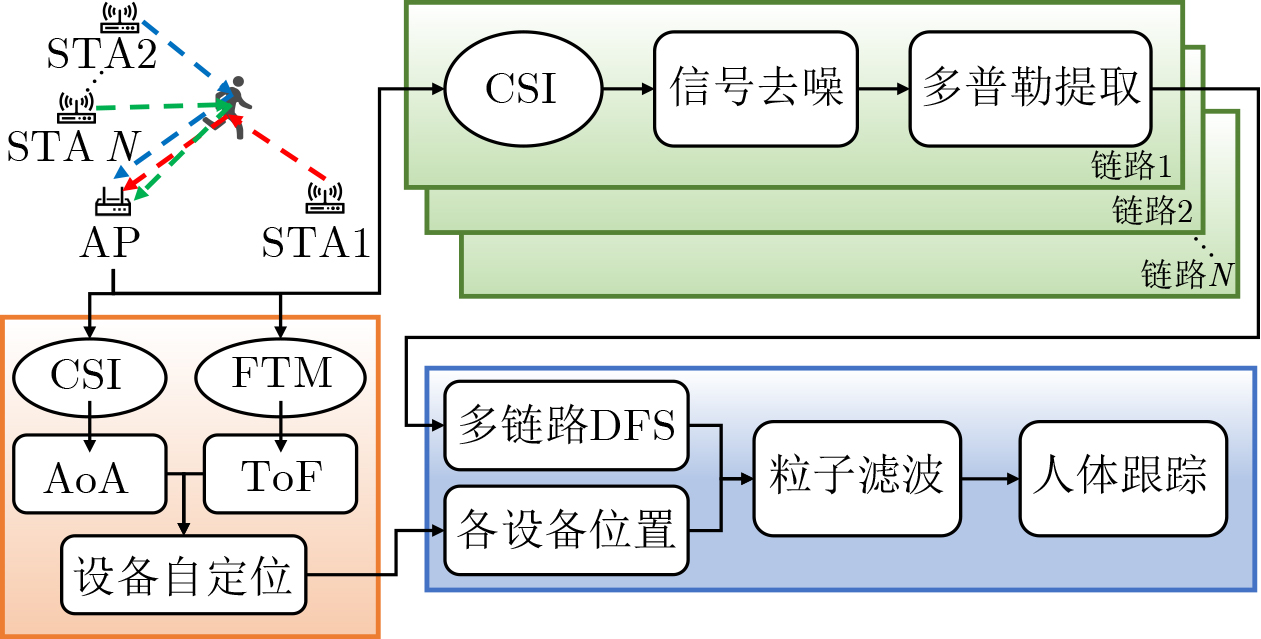
摘要: 在智能家居场景中,WiFi网络将多个物联网(IoT)设备相连,为实现室内被动人体跟踪提供了新路径。然而,多链路跟踪需要考虑信号融合、设备自定位等问题。为此,该文提出一种适用于商用WiFi的多链路协同跟踪方法。针对商用网卡的测量信号噪声,该方法首先进行信号预处理,从高维的原始信道状态信息(CSI)数据中提取多普勒频移(DFS)。随后,对多链路DFS进行融合,以实现协同跟踪。该方法在没有WiFi设备位置先验知识的条件下也能实现设备自定位,为跟踪算法提供输入。最后,该文搭建了一个多发单收网络结构的原型验证系统,在未知设备位置的情况下实现了小于50 cm的中位跟踪误差,相比传统方法提升了约70%。在复杂场景的测试中表明,该系统能达到亚米级的跟踪精度,对设备位置误差具有鲁棒性,并显示出一定实时运行潜力。Abstract:
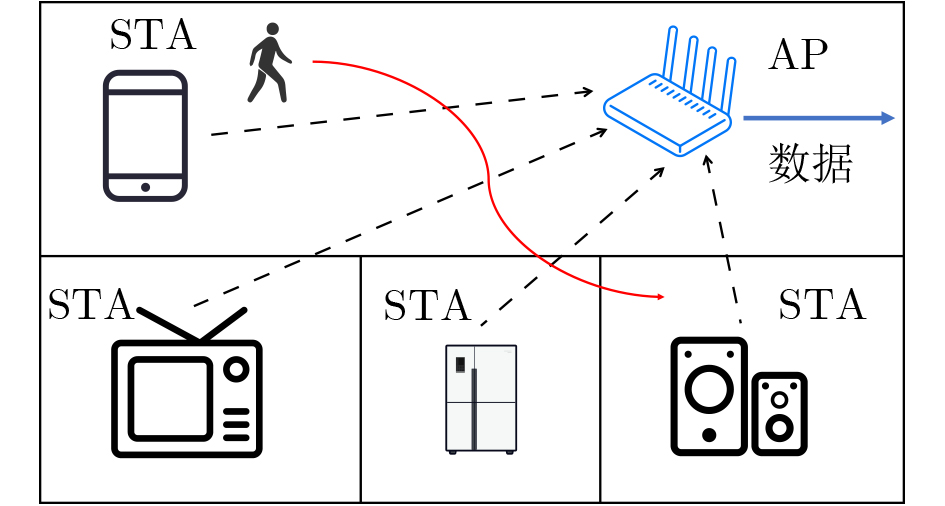
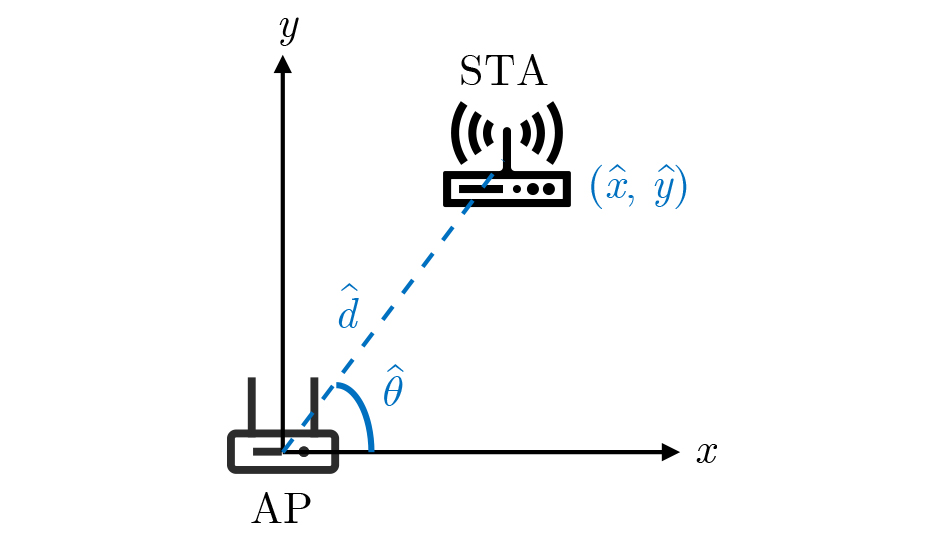
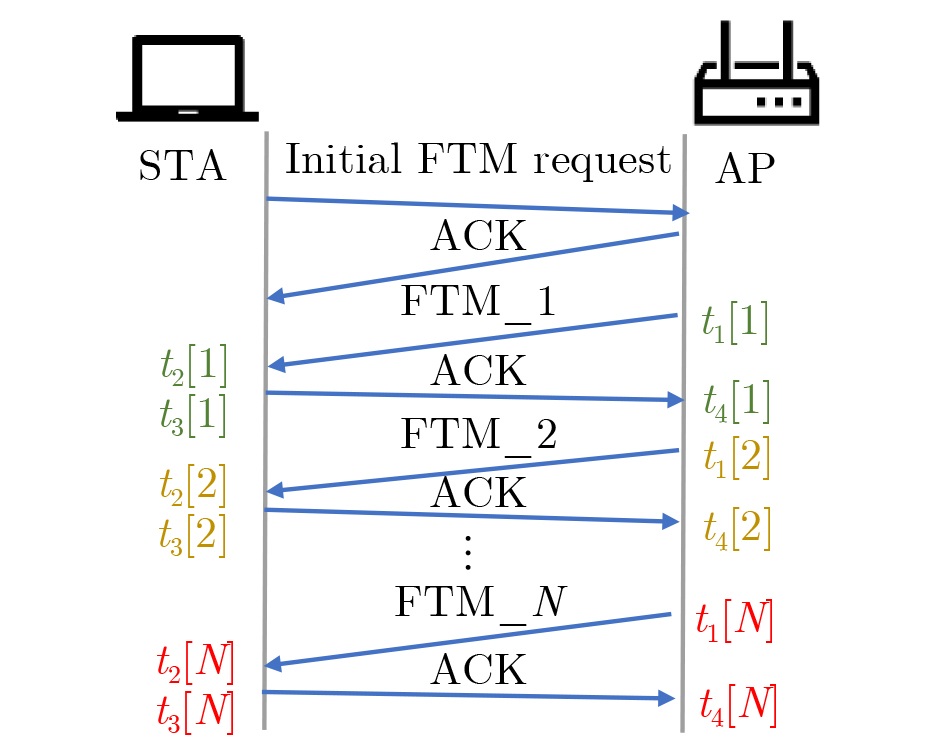
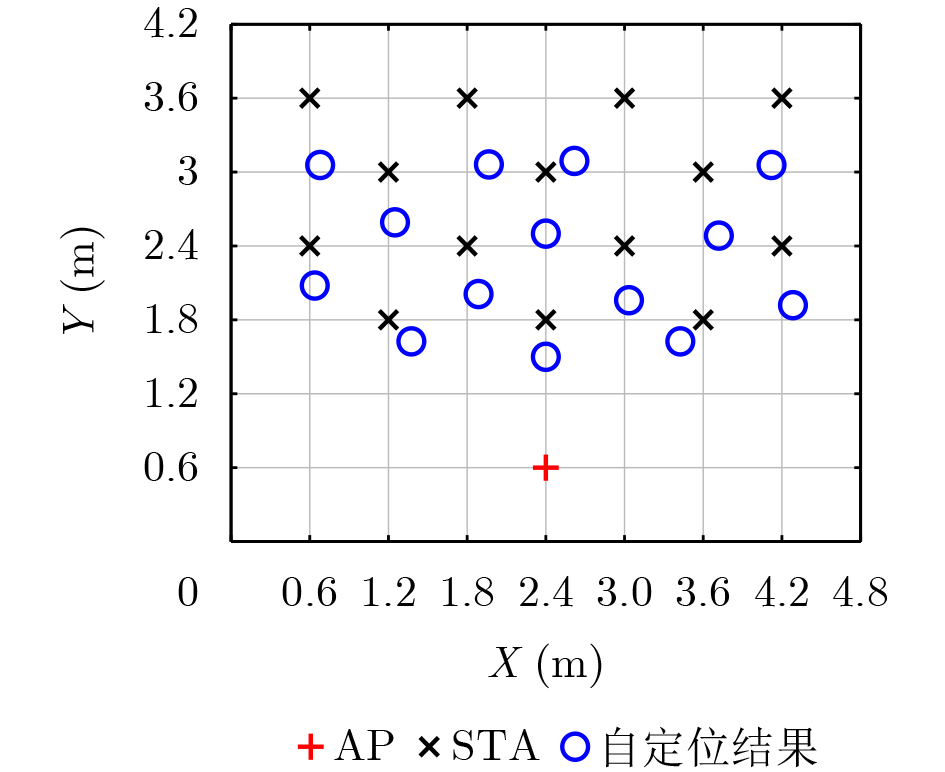
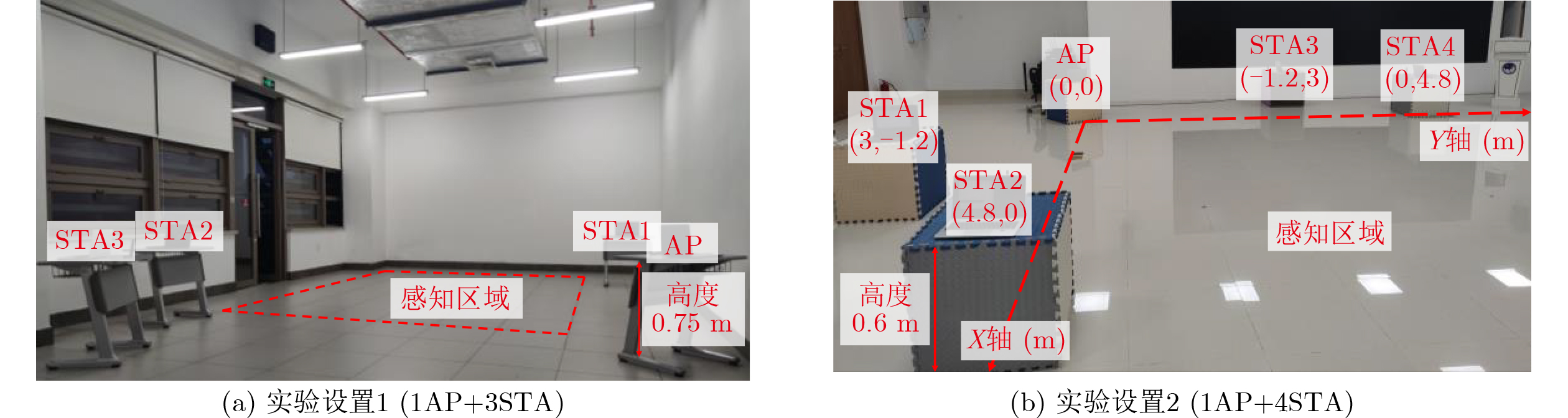
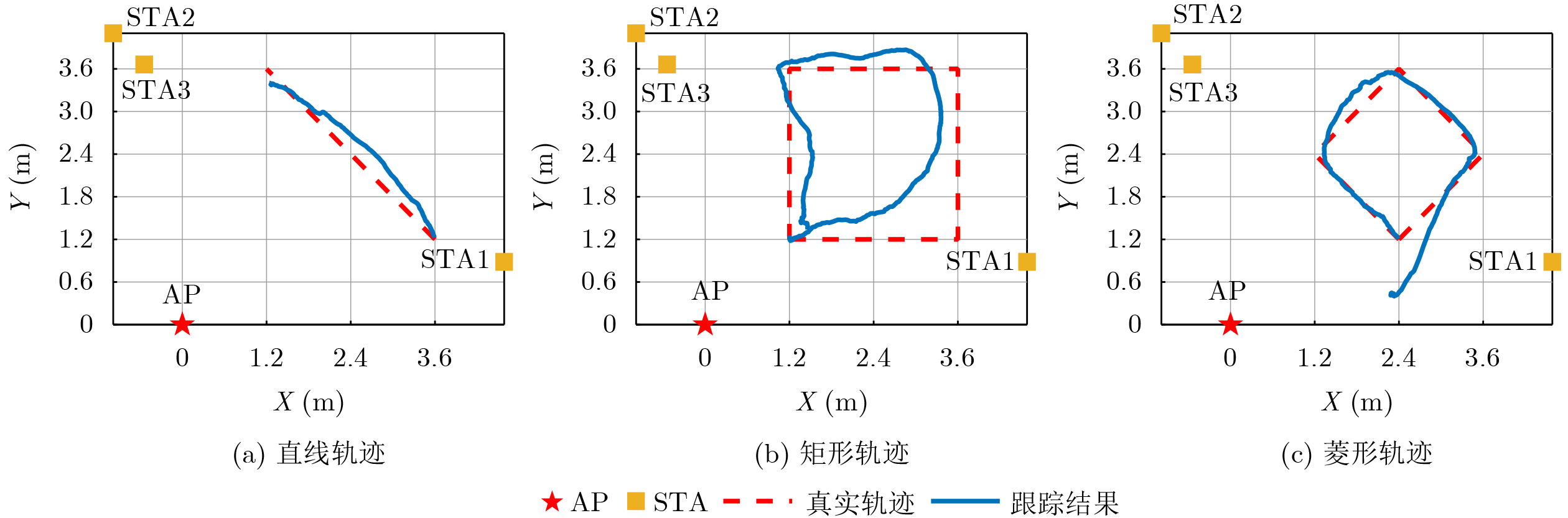
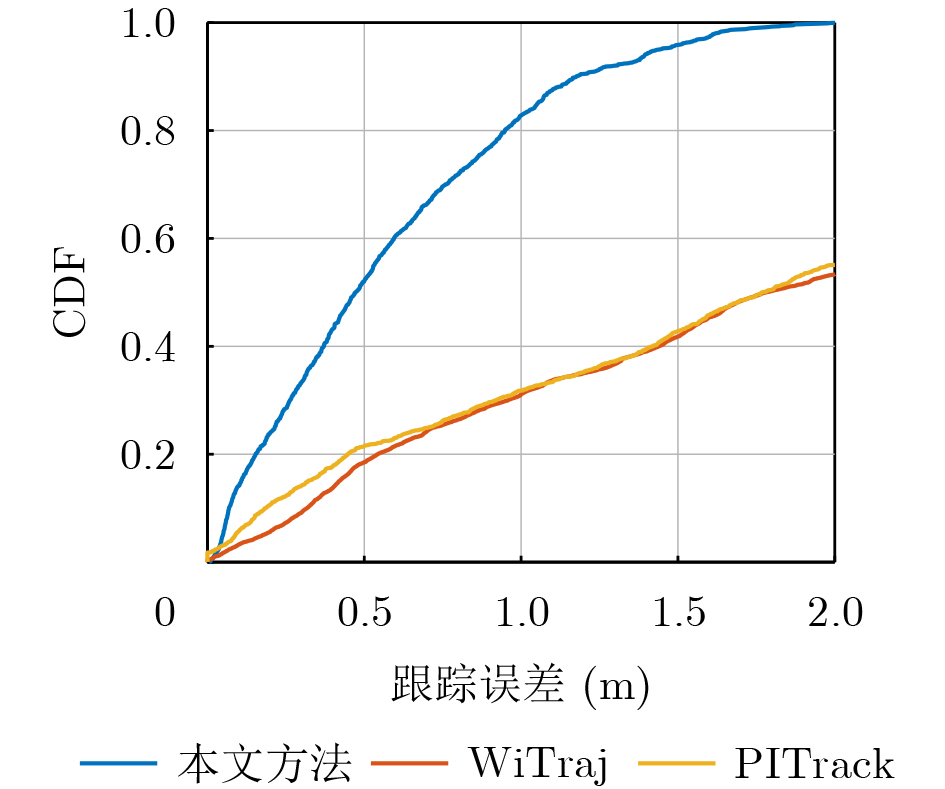
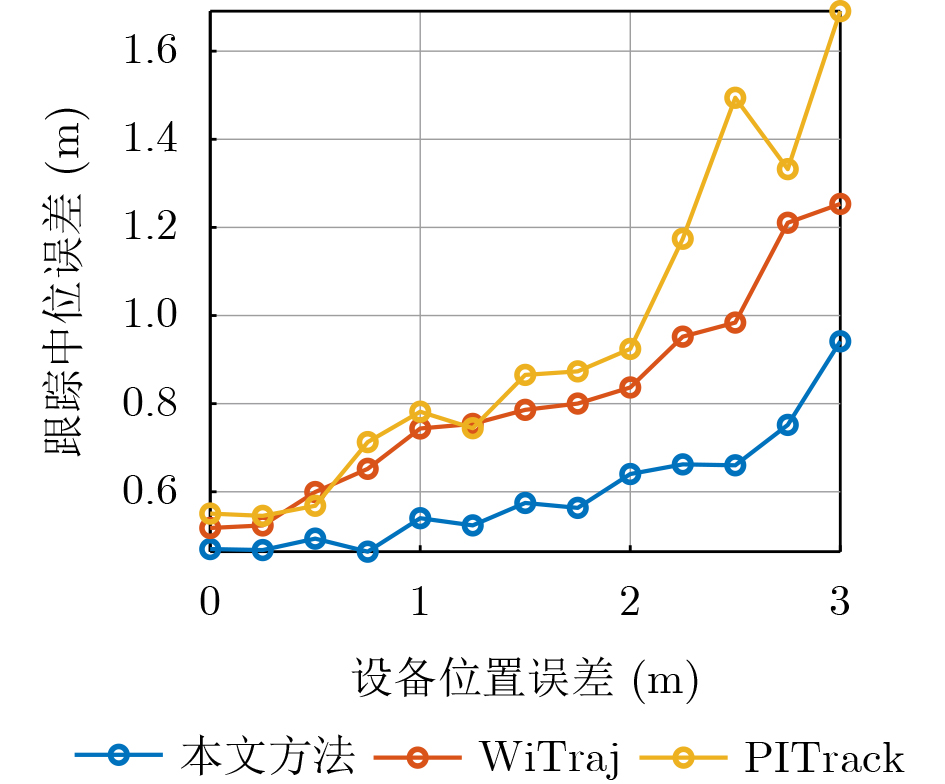
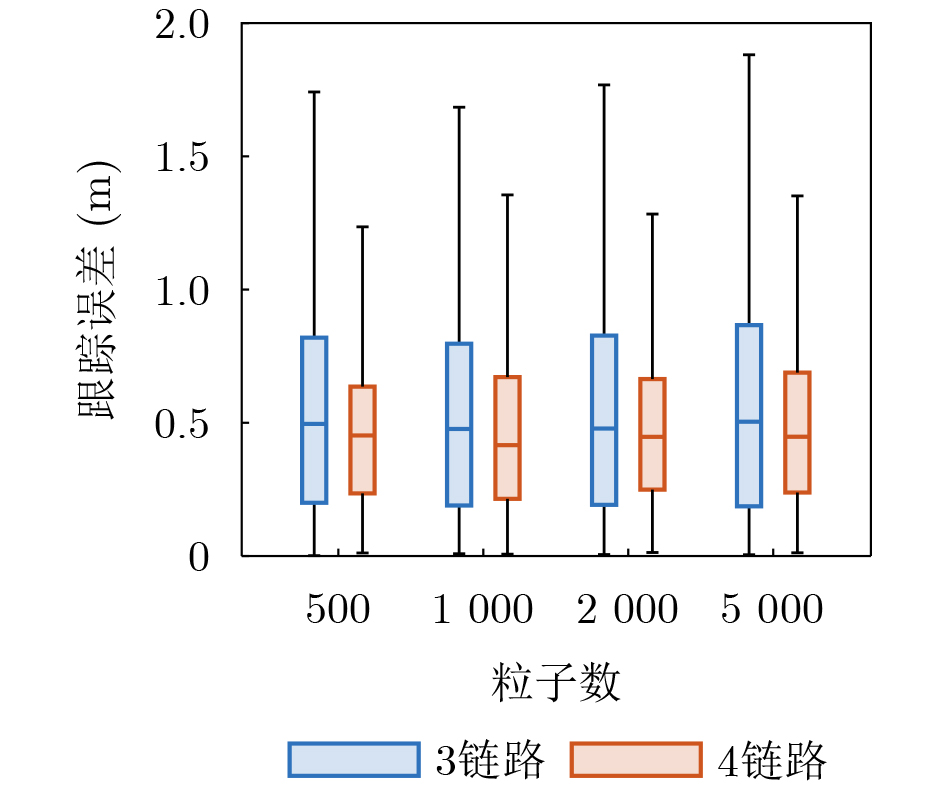
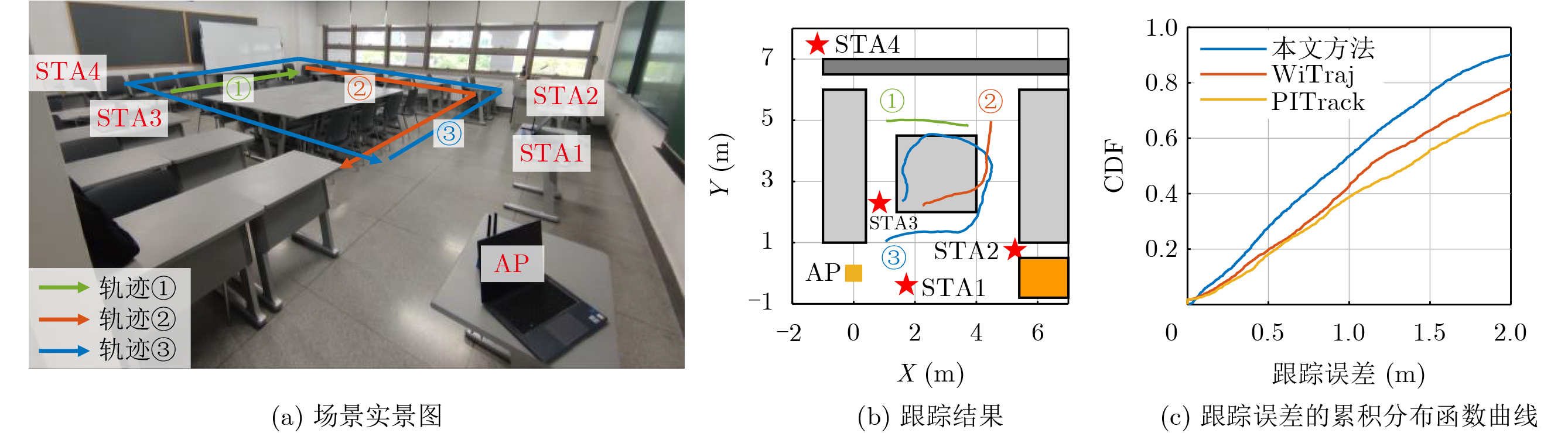
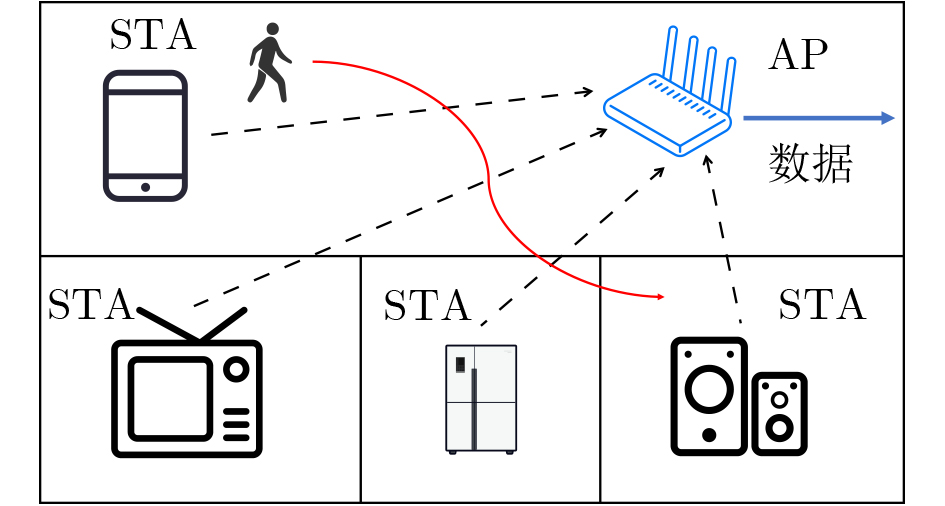
Objective WiFi-based indoor passive human tracking has attracted increasing attention for smart home applications because Internet of Things (IoT) devices are widely interconnected through existing WiFi infrastructures. Existing approaches estimate the Angle of Arrival (AoA) or Time of Flight (ToF) of the target-reflected path to achieve tracking. However, these methods are fundamentally limited by the difficulty of separating weak target-reflected signals from dense multipath propagation when commercial WiFi devices provide only a small antenna array and limited bandwidth under existing communication protocols. Therefore, Doppler Frequency Shift (DFS)-based approaches that exploit multiple links have become more practical. Dead Reckoning (DR) is widely adopted in these methods, but dynamic link selection for signal fusion remains challenging. Furthermore, the performance of DR-based methods degrades substantially when device-location errors are present. Existing methods also generally employ a single-transmitter-multi-receiver architecture, in which Access Point (AP) broadcasts downlink WiFi signals to STAtions (STA). It complicates data aggregation and limits the use of multiple receive antennas of AP’s. To address the challenges of multi-link signal fusion and device-location uncertainty, a Particle Filter (PF)-based method is proposed. Furthermore, a multi-transmitter-single-receiver architecture is adopted, in which multiple STAs transmit uplink packets to a single AP. This architecture simplifies data aggregation while exploiting the AP’s multi-antenna capability. Methods In the IEEE 802.11 standard, the wireless channel is estimated at the receiver using pilot signals embedded in WiFi packets, and Channel State Information (CSI) is continuously obtained. Human motion perturbs multipath propagation and produces time-varying changes in CSI. Therefore, CSI serves as the primary sensing signal because it implicitly captures target motion. In practice, raw CSI is affected by amplitude and phase impairments. Accordingly, signal preprocessing is first performed before Doppler extraction. Subsequently, multi-link DFS measurements are fused using PF, in which the target state is sequentially propagated and updated according to likelihoods derived from DFS measurements. This probabilistic framework naturally enables dynamic multi-link fusion because unreliable links receive lower weights rather than being deterministically discarded. Moreover, the effects of device-location errors are incorporated into the measurement-noise model, improving robustness to device-location uncertainty. When prior knowledge of device locations is unavailable, device self-localization is first performed by jointly estimating the Line-of-Sight (LoS) AoA and ToF between the AP and each STA. Preliminary device self-localization experiments ( Fig. 5 ) demonstrate a median STA localization error of approximately 0.56 m (Table 1 ), providing reliable initialization for the subsequent tracking algorithm.Results and Discussions A prototype system is implemented using a multi-transmitter-single-receiver architecture with commercial Intel AX200/AX201 WiFi cards. CSI is collected over a 20 MHz channel centered at 5.24 GHz using PicoScenes, with IEEE 802.11ac packets transmitted at 100 or 200 Hz. Each CSI sample contains measurements from 57 subcarriers. Meanwhile, Fine Time Measurement (FTM) is performed on Channel 11 at 2.4 GHz using iw and hostapd. In the prototype system, each STA transmitter is equipped with a single antenna, while the AP receiver employs two antennas. Experiments are conducted using one AP and three or four STAs ( Fig. 7 ). WiTraj and PITrack, both based on DR, are used as baseline methods. When device self-localization is required, the proposed method achieves a median tracking error of 0.47 m, compared with 1.78 m for WiTraj and 1.77 m for PITrack (Fig. 9 ), representing an accuracy improvement of approximately 70% over conventional DR-based methods. Error-injection experiments with random device-location perturbations show that, unlike conventional DR-based methods, which are highly sensitive to device-location errors, the proposed method remains robust to device-location uncertainty (Fig. 10 ). Additionally, computational complexity analysis shows that, although execution time increases with the particle count (Table 3 ), tracking performance reaches a stable level beyond a moderate particle count (Fig. 11 ). Therefore, real-time operation can be achieved by selecting an appropriate particle count. Finally, experiments in complex environments demonstrate that the proposed method consistently achieves higher tracking accuracy than the baseline methods (Fig. 12 ).Conclusions A PF-based method is proposed for multi-link collaborative passive human tracking using commercial WiFi devices. By probabilistically fusing measurements from multiple links, robust tracking is achieved even when device-location errors are present. When device locations are unavailable, device self-localization is achieved by combining CSI-based estimation with FTM measurements, providing the geometric information required for tracking. A prototype system based on a multi-transmitter-single-receiver architecture is developed to simplify data aggregation while exploiting the AP’s multi-antenna capability. Experimental results demonstrate that the proposed method achieves sub-0.5 m median tracking error when device-location errors are present, representing an improvement of approximately 70% over conventional DR-based methods. The proposed method also exhibits strong robustness to device-location uncertainty and supports real-time implementation when an appropriate particle count is selected. Future work will extend the framework to multi-person tracking and evaluate its performance under more realistic deployment conditions. -
Key words:
- WiFi sensing /
- Multi-link /
- Passive human tracking /
- Doppler Frequency Shift (DFS)
-
表 1 设备自定位测试结果
位置编号 1 2 3 4 5 6 7 8 9 10 11 12 13 14 AoA估计误差 (°) 6.2 8.2 5.0 11.6 13.4 0.0 3.0 10.4 2.0 16.0 22.6 5.4 1.8 5.4 FTM测距误差 (m) 0.07 0.00 0.35 0.17 0.11 0.21 0.08 0.33 0.54 0.42 0.29 0.82 0.68 0.59 STA定位误差 (m) 0.33 0.36 0.42 0.65 0.56 0.21 0.14 0.56 0.54 0.63 1.00 0.84 0.68 0.62  下载: 导出CSV
1 基于粒子滤波的多链路跟踪
输入:每条链路$ n $的DFS序列$ \left\{{\boldsymbol{f}_{\text{D}}^n}\right\} $,每个STA $ n $的位置$ \left(x_{\text{STA}}^{n},y_{\text{STA}}^{n}\right) $,链路数$ N $,粒子数$ {N}_{\text{S}} $,初始状态分布$ \boldsymbol{P} $,过程噪声协方差矩阵
$ \boldsymbol{Q} $,测量噪声方差$ {\sigma }^{2} $,时间间隔$ \Delta T $输出:目标的估计状态$ {\left\{{\hat{\boldsymbol{x}}}[t]\right\}}_{t=1,2,\cdots ,T} $ 1 for $ i $ = 1 to $ {N}_{\text{S}} $ do 2 从初始状态分布中采样第$ i $个粒子:$ {\boldsymbol{x}}_{i}[1]\sim \boldsymbol{P} $;设置第$ i $个粒子的初始权重:$ {w}_{i}[1]=1/{N}_{\text{S}} $ 3 end for 4 获取粒子初始状态:$ {\hat{\boldsymbol{x}}}[1]=\displaystyle\sum \nolimits_{i=1}^{{N}_{\text{S}}}{w}_{i}[1]{\boldsymbol{x}}_{i}[1] $ 5 for $ t $ = 2 to $ T $ do 6 for $ i $ = 1 to $ {N}_{\text{S}} $ do 7 通过式(15)传播粒子$ {\boldsymbol{x}}_{i}[t] $ 8 for $ n $ = 1 to $ N $ do 9 通过式(16)估计第$ i $个粒子的DFS $ \hat{f}_{\text{D}i}^{n}[t] $;通过式(17)计算第$ i $个粒子的似然度$ {p}_{i} $;计算权重$ {w}_{i}[t]={w}_{i}[t]\times {p}_{i} $ 10 end for 11 end for 12 权重归一化:$ {w}_{i}[t]={w}_{i}[t]/\displaystyle\sum \nolimits_{i=1}^{{N}_{\text{S}}}{w}_{i}[t] $;估计目标状态:$ {\hat{\boldsymbol{x}}}[t]=\displaystyle\sum \nolimits_{i=1}^{{N}_{\text{S}}}{w}_{i}[t]{\boldsymbol{x}}_{i}[t] $ 13 重采样$ {N}_{\text{S}} $个粒子 14 for $ i $ = 1 to $ {N}_{\text{S}} $ do 15 重置权重:$ {w}_{i}[t]=1/{N}_{\text{S}} $ 16 end for 17 end for 18 return $ {\left\{{\hat{\boldsymbol{x}}}[t]\right\}}_{t=1,2,\cdots ,T} $
下载: 导出CSV
表 2 基于粒子滤波的多链路跟踪算法参数设置
$ {N}_{\text{S}} $ $ \boldsymbol{P} $ $ \boldsymbol{Q} $ $ {\sigma }^{2} $ $ \Delta T $ 1000 $ \mathcal{N}\left(\left[\begin{array}{c}{x}_{\text{tar}}[1]\\{y}_{\text{tar}}[1]\\0\\0\end{array}\right],\text{diag}\left[\begin{array}{c}{0}^{2}\\{0}^{2}\\{0.01}^{2}\\{0.01}^{2}\end{array}\right]\right) $ $ \mathcal{N}\left(\left[\begin{array}{c}0\\0\\0\\0\end{array}\right],\text{diag}\left[\begin{array}{c}{0.05}^{2}\\{0.05}^{2}\\{0.25}^{2}\\{0.25}^{2}\end{array}\right]\right) $ 0.42 0.1 s
下载: 导出CSV
表 3 不同参数下的算法复杂度
参数 N 3 4 NS 500 1000 2000 5000 500 1000 2000 5000 运行时间 (s) 平均值 0.0138 0.0275 0.0551 0.1465 0.0137 0.0270 0.0553 0.1521 最大值 0.0454 0.0808 0.1061 0.2952 0.0440 0.0654 0.1110 0.5602
下载: 导出CSV
-
[1] LU Shihang, LIU Fan, LI Yunxin, et al. Integrated sensing and communications: Recent advances and ten open challenges[J]. IEEE Internet of Things Journal, 2024, 11(11): 19094–19120. doi: 10.1109/JIOT.2024.3361173. [2] ZHANG Tingting, MOLISCH A F, SHEN Yuan, et al. Joint power and bandwidth allocation in wireless cooperative localization networks[J]. IEEE Transactions on Wireless Communications, 2016, 15(10): 6527–6540. doi: 10.1109/TWC.2016.2580504. [3] SHI Fangzhan, LI Wenda, TANG Chong, et al. ML-Track: Passive human tracking using WiFi multi-link round-trip CSI and particle filter[J]. IEEE Transactions on Mobile Computing, 2025, 24(6): 5155–5172. doi: 10.1109/TMC.2025.3529897. [4] 赵万龙, 田新元, 陈超, 等. 联合Spline插值的Wi-Fi指纹匹配定位算法[J]. 电子与信息学报, 2024, 46(9): 3563–3570. doi: 10.11999/JEIT230116.ZHAO Wanlong, TIAN Xinyuan, CHEN Chao, et al. Wi-Fi fingerprint localization uniting spline interpolation[J]. Journal of Electronics & Information Technology, 2024, 46(9): 3563–3570. doi: 10.11999/JEIT230116. [5] 杨小龙, 张冰睿, 周牧, 等. 面向通感一体化的三维矩阵束联合参数估计算法[J]. 电子与信息学报, 2025, 47(1): 84–92. doi: 10.11999/JEIT240003.YANG Xiaolong, ZHANG Bingrui, ZHOU Mu, et al. A joint parameter estimation method based on 3D matrix pencil for integration of sensing and communication[J]. Journal of Electronics & Information Technology, 2025, 47(1): 84–92. doi: 10.11999/JEIT240003. [6] QIAN Kun, WU Chenshu, ZHANG Yi, et al. Widar2.0: Passive human tracking with a single Wi-Fi link[C]. The 16th Annual International Conference on Mobile Systems, Applications, and Services, Munich, Germany, 2018: 350–361. doi: 10.1145/3210240.3210314. [7] TONG Xinyu, GE Weiping, TIAN Yichen, et al. NNE-Tracking: A neural network enhanced framework for device-free Wi-Fi tracking[J]. IEEE Transactions on Mobile Computing, 2024, 23(9): 8981–8998. doi: 10.1109/TMC.2024.3357569. [8] LI Wenwei, GAO Ruiyang, XIONG Jie, et al. WiFi-CSI difference paradigm: Achieving efficient Doppler speed estimation for passive tracking[J]. Proceedings of the ACM on Interactive, Mobile, Wearable and Ubiquitous Technologies, 2024, 8(2): 63. doi: 10.1145/3659608. [9] WU Dan, ZENG Youwei, GAO Ruiyang, et al. WiTraj: Robust indoor motion tracking with WiFi signals[J]. IEEE Transactions on Mobile Computing, 2023, 22(5): 3062–3078. doi: 10.1109/TMC.2021.3133114. [10] NIU Kai, WANG Xuanzhi, ZHANG Fusang, et al. Rethinking Doppler effect for accurate velocity estimation with commodity WiFi devices[J]. IEEE Journal on Selected Areas in Communications, 2022, 40(7): 2164–2178. doi: 10.1109/JSAC.2022.3155523. [11] XIE Yaxiong, XIONG Jie, LI Mo, et al. mD-Track: Leveraging multi-dimensionality for passive indoor Wi-Fi tracking[C]. The 25th Annual International Conference on Mobile Computing and Networking, Los Cabos, Mexico, 2019: 8. doi: 10.1145/3300061.3300133. [12] YAO Junmei, LIU Chaoyang, LUO Sheng, et al. Toward integrated sensing and communication: Interference-resistance design for WiFi sensing[J]. IEEE Transactions on Mobile Computing, 2025, 24(10): 10807–10822. doi: 10.1109/TMC.2025.3570752. [13] ZENG Youwei, WU Dan, XIONG Jie, et al. FarSense: Pushing the range limit of WiFi-based respiration sensing with CSI ratio of two antennas[J]. Proceedings of the ACM on Interactive, Mobile, Wearable and Ubiquitous Technologies, 2019, 3(3): 121. doi: 10.1145/3351279. [14] 杨小龙, 张亭亭, 周牧, 等. 面向通感一体化的变分模态分解-希尔伯特-黄变换呼吸频率感知算法[J]. 电子与信息学报, 2025, 47(4): 1014–1025. doi: 10.11999/JEIT240640.YANG Xiaolong, ZHANG Tingting, ZHOU Mu, et al. Variational mode decomposition-Hilbert-Huang transform breathing rate sensing algorithm for integration of sensing and communication[J]. Journal of Electronics & Information Technology, 2025, 47(4): 1014–1025. doi: 10.11999/JEIT240640. [15] KOTARU M, JOSHI K, BHARADIA D, et al. SpotFi: Decimeter level localization using WiFi[C]. The 2015 ACM Conference on Special Interest Group on Data Communication, London, UK, 2015: 269–282. doi: 10.1145/2785956.2787487. [16] ELEFTHERAKIS S, SANTAROMITA G, REA M, et al. SPRING+: Smartphone positioning from a single WiFi access point[J]. IEEE Transactions on Mobile Computing, 2024, 23(10): 9549–9566. doi: 10.1109/TMC.2024.3367241. [17] RATNAM V V, CHEN Hao, CHANG H H, et al. Optimal preprocessing of WiFi CSI for sensing applications[J]. IEEE Transactions on Wireless Communications, 2024, 23(9): 10820–10833. doi: 10.1109/TWC.2024.3376332. [18] WANG Zhongqin, ZHANG J A, ZHANG Haimin, et al. Passive human tracking with WiFi point clouds[J]. IEEE Internet of Things Journal, 2025, 12(5): 5528–5543. doi: 10.1109/JIOT.2024.3487193. [19] KIM Y and LING Hao. Human activity classification based on micro-Doppler signatures using a support vector machine[J]. IEEE Transactions on Geoscience and Remote Sensing, 2009, 47(5): 1328–1337. doi: 10.1109/TGRS.2009.2012849. [20] ELFRING J, TORTA E, and VAN DE MOLENGRAFT R. Particle filters: A hands-on tutorial[J]. Sensors, 2021, 21(2): 438. doi: 10.3390/s21020438. [21] JIANG Zhiping, LUAN T H, REN Xincheng, et al. Eliminating the barriers: Demystifying Wi-Fi baseband design and introducing the PicoScenes Wi-Fi sensing platform[J]. IEEE Internet of Things Journal, 2022, 9(6): 4476–4496. doi: 10.1109/JIOT.2021.3104666. -

 下载:
下载:


图(12) / 表(4)
计量
- 文章访问数: 657
- HTML全文浏览量: 285
- PDF下载量: 51
- 被引次数: 0
