




Co-Frequency Interference Analysis and Dynamic Simulation Validation of Satellite-Direct-to-Device Systems Against Terrestrial IMT Networks in Cross-Border Scenarios
-
摘要: 针对手机直连卫星(SD2D)系统对邻国边境国际移动通信(IMT)网络产生的同频下行干扰,该文推导了保护IMT终端和基站所需的功率通量密度(PFD)和等效功率通量密度(EPFD) 限值,并构建了动态仿真框架进行验证。仿真基于典型低轨星座,并按ITU-R推荐的信道传播、地物遮挡及天线辐射模型建立;综合考虑同频波束隔离、波束调度与建链策略等工程约束,采用分段搜索算法确定满足IMT保护要求的最小隔离距离及其对应的PFD/EPFD统计值。基线仿真及其稳定性验证结果表明,在I/N 门限–6 dB、百分位99.5%的保护准则下,典型系统 Starlink-1满足边境IMT终端/基站保护所需最小隔离距离的基线值为195 km/290 km,稳定性验证范围为195~210 km/290~300 km;Starlink-2对应基线值为272 km/420 km,稳定性验证范围为266~290 km/370~420 km。敏感性测试显示:地物遮挡可显著降低终端侧干扰并压缩所需隔离距离,但对基站侧影响有限;保护百分位仅改变从样本中提取“尾部事件”的统计口径;最低工作仰角、极化复用、同频波束数以及建链策略等参数会改变活跃波束的选择与分布,从而导致隔离距离呈现非线性甚至非单调变化。Abstract:
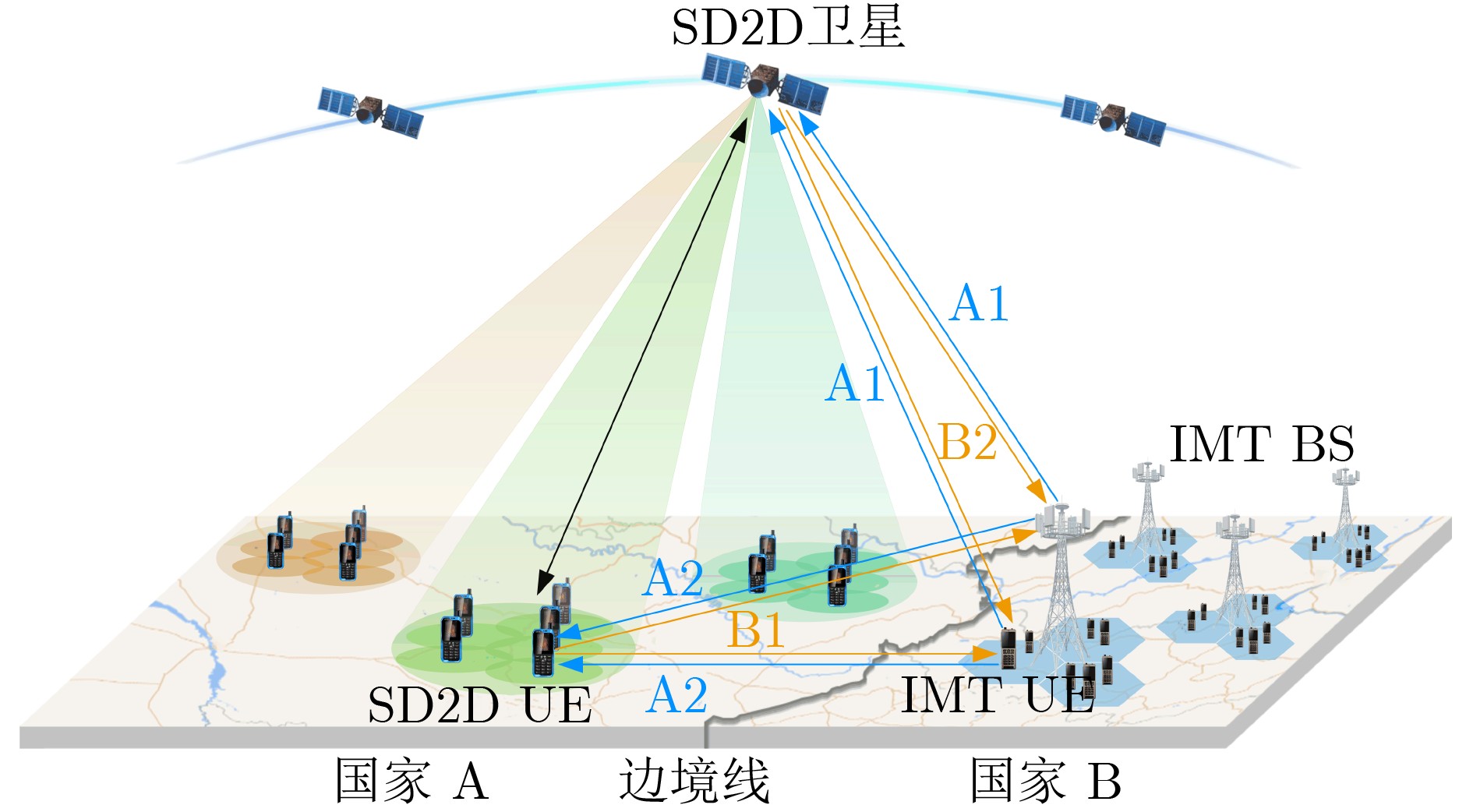
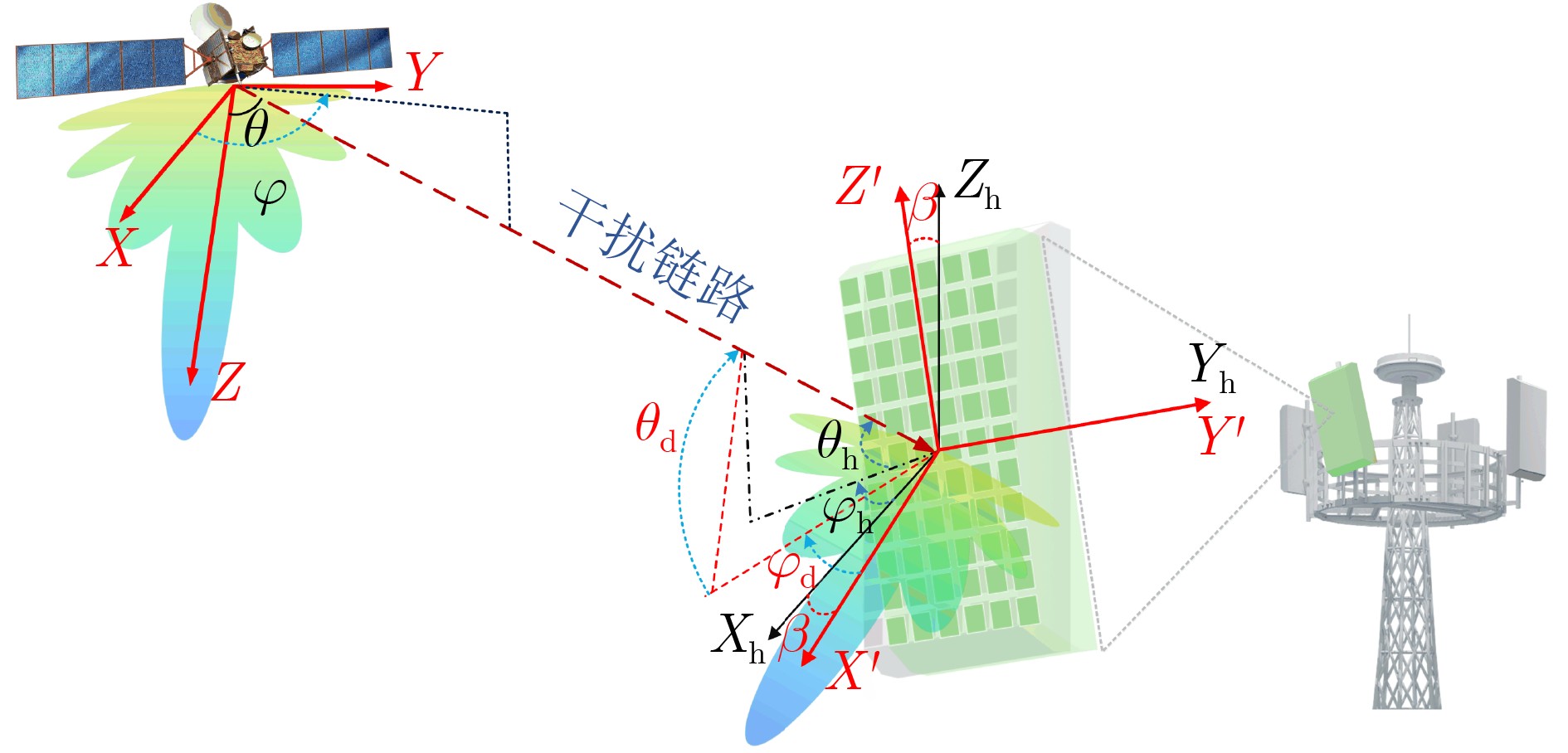
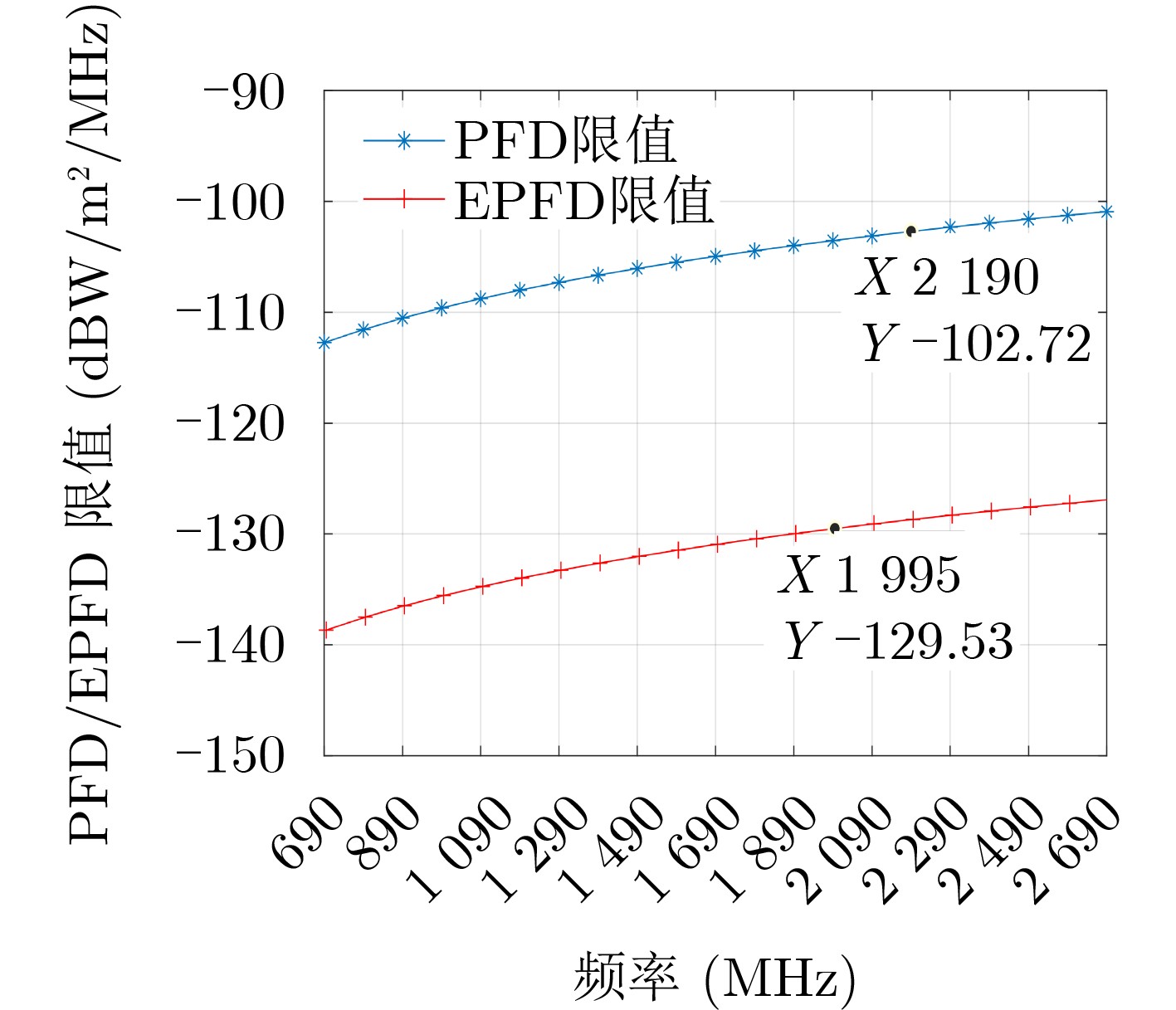
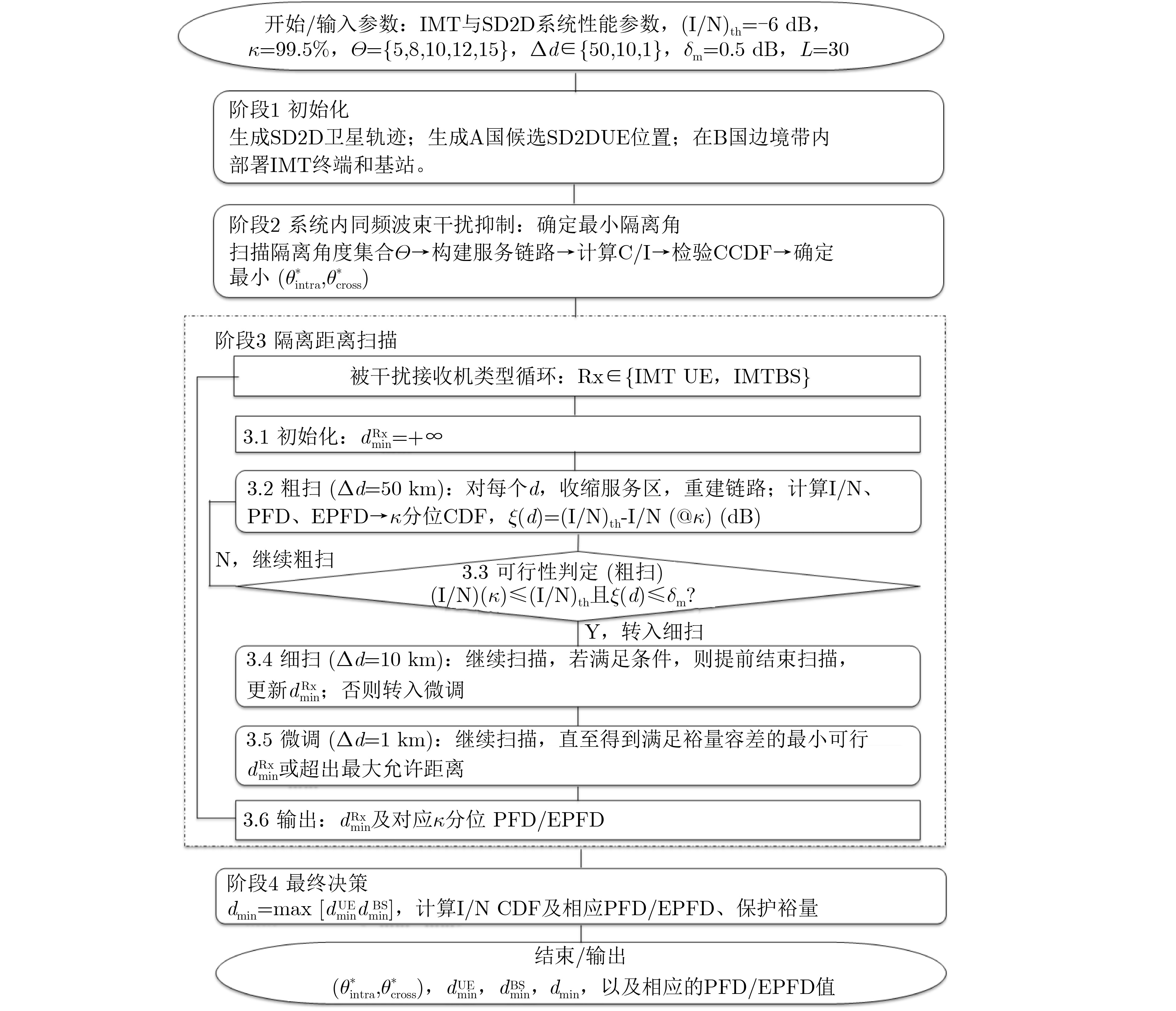
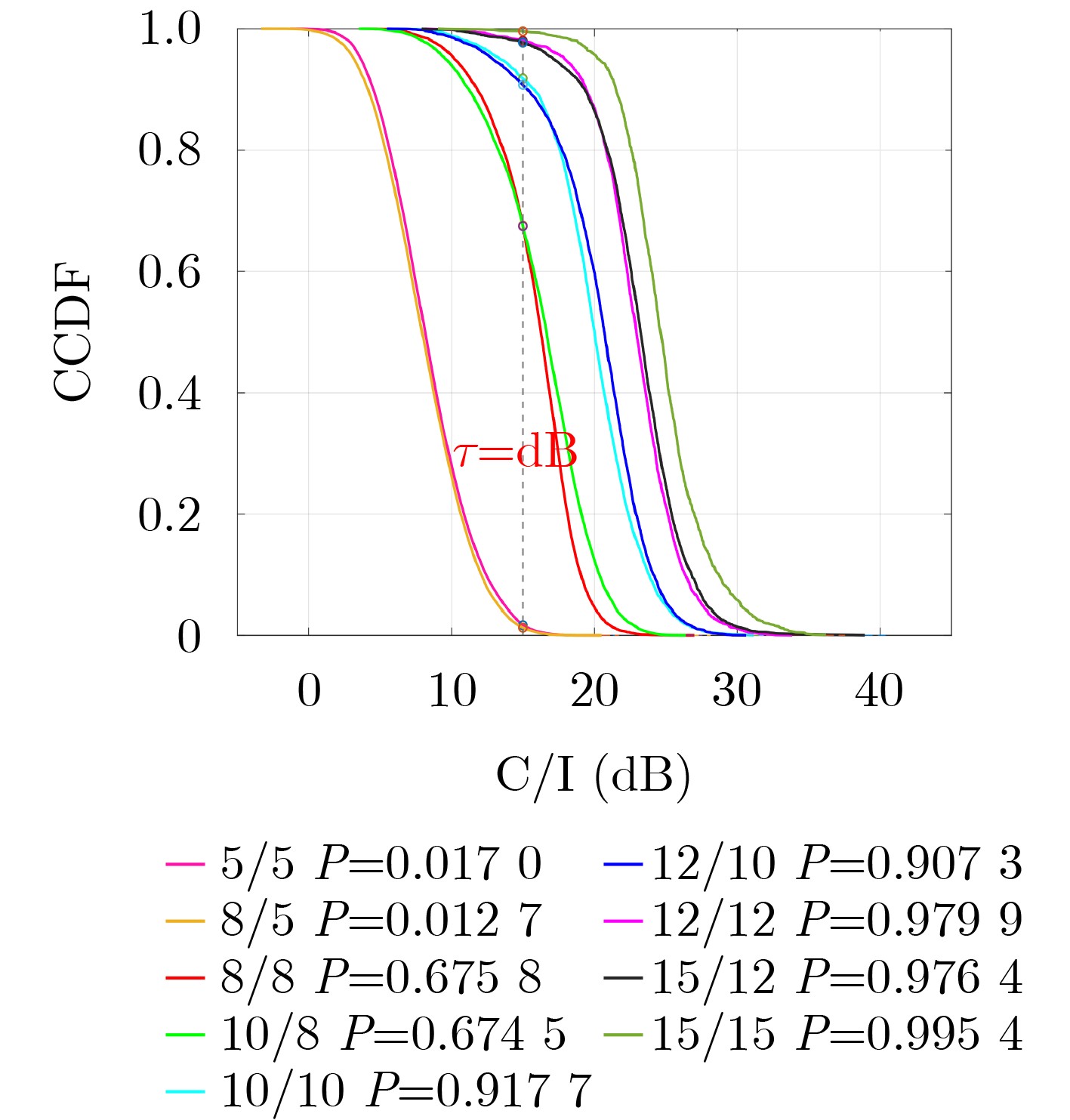
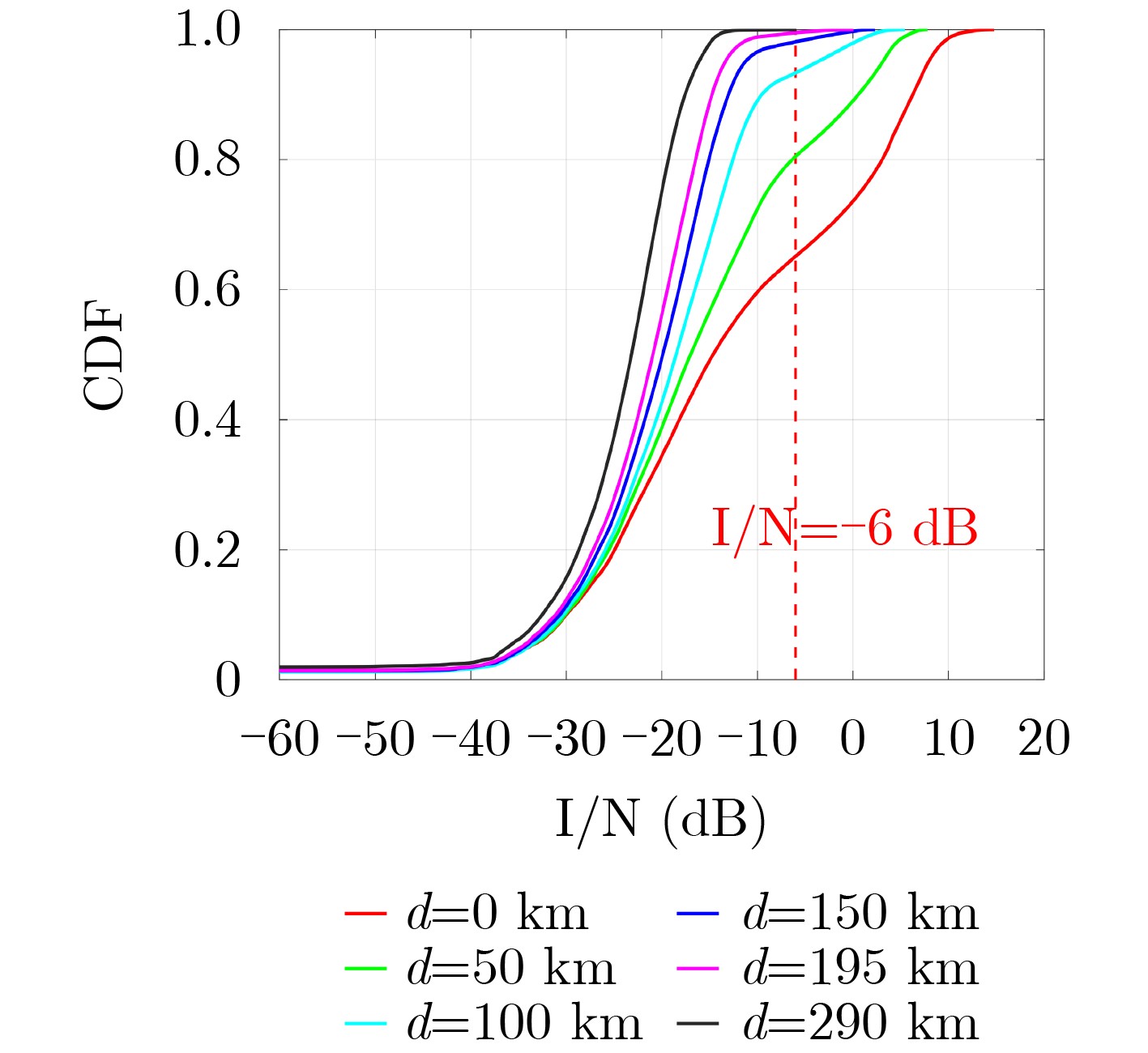
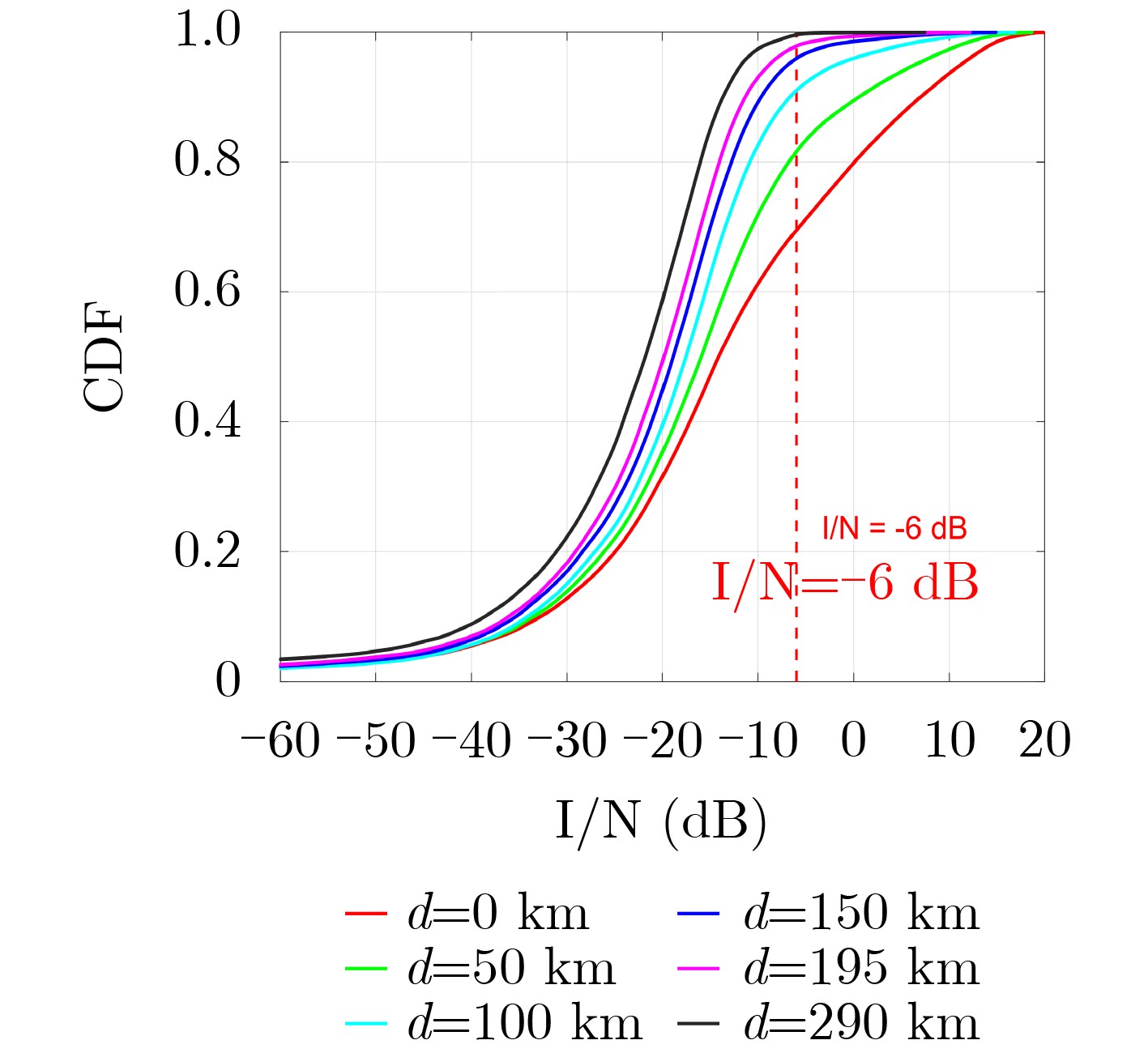
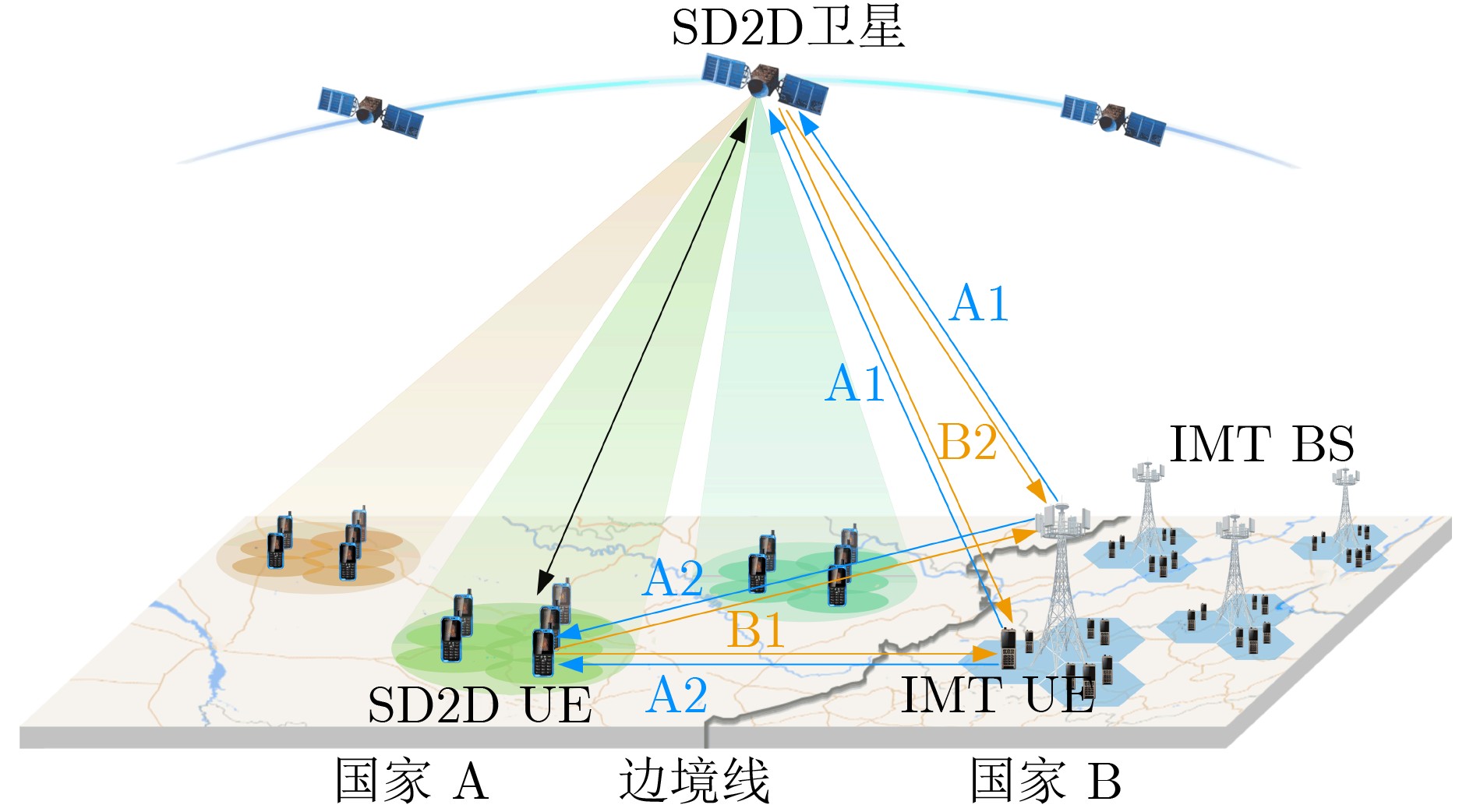
Objective Satellite-Direct-to-Device (SD2D) systems that reuse terrestrial IMT spectrum may generate harmful downlink interference to incumbent IMT networks in neighboring administrations, particularly in cross-border deployments where SD2D downlinks overlap the receive bands of both IMT user equipment (UE) and IMT Base Stations (BSs). A practical coexistence methodology is therefore required to (1) translate IMT receiver protection criteria into explicit Power Flux Density (PFD) and Equivalent Power Flux Density (EPFD) constraints and (2) validate these constraints using a dynamic simulation framework so that they can be converted into enforceable geographic coordination measures, such as minimum isolation distances. This study focuses on the dominant interference path, namely SD2D downlink interference to IMT receivers, and establishes a traceable workflow from deterministic protection limits to dynamic simulation validation and the corresponding minimum isolation distances. Methods A cross-border scenario is modeled in which Country A deploys an SD2D system and Country B operates a terrestrial IMT network. Two representative downlink frequencies, 1 995 MHz and 2 190 MHz, are evaluated for two representative Starlink configurations, Starlink-1 and Starlink-2. The IMT network is modeled using ITU-R- and 3GPP-compliant parameters, with an I/N protection threshold of –6 dB and a target percentile κ (baseline κ=99.5%) for both IMT UEs and BSs. Satellite transmit antennas follow the ITU-R S.1528 reference pattern, IMT BS receive antennas follow the ITU-R F.1336 sector pattern, and IMT UEs are modeled with omnidirectional antennas. A back-lobe blockage model is incorporated into both satellite and BS antenna patterns to account for rear-side shielding. Signal propagation follows the ITU-R P.619 model, using free-space path loss as the conservative baseline, while an optional clutter-loss term is incorporated through a clutter-occurrence probability. Deterministic protection limits are derived by calculating the maximum permissible aggregate PFD for IMT UE protection and the maximum permissible aggregate EPFD for IMT BS protection. A dynamic simulation framework then validates these limits and searches for the required minimum isolation distances ( Fig. 4 ). Co-channel beam isolation angles are optimized using the C/I Complementary Cumulative Distribution Function (CCDF), and a segmented search algorithm determines the minimum UE- and BS-side isolation distances together with the corresponding κ-percentile PFD/EPFD statistics.Results and Discussions The deterministic analysis yields a maximum permissible aggregate PFD of –102.72 dBW/m2/MHz at 2 190 MHz for IMT UEs and a maximum permissible aggregate EPFD of –129.53 dBW/m2/MHz at 1 995 MHz for IMT BSs ( Fig. 3 ). For Starlink-1, the C/I design criterion yields a minimum co-channel beam isolation angle pair of (12°, 12°) (Fig. 5 ). Dynamic simulation shows that, under the representative baseline configuration with an I/N threshold of –6 dB and κ=99.5%, the minimum isolation distances are 195 km for UE protection and 290 km for BS protection (Fig. 6 ,Fig. 7 , andTable 4 ). The resulting coordination isolation distance is therefore 290 km, and the simulated κ-percentile PFD and EPFD agree with the deterministic protection limits, with a residual margin below 0.5 dB. For Starlink-2, the optimized co-channel beam isolation angles increase to (15°, 15°), and the corresponding minimum isolation distances increase to 272 km for UEs and 420 km for BSs under the same baseline configuration (Table 5 ). These baseline distances should be interpreted as representative values for the specified simulation configuration rather than unique, strictly converged results. Stability verification shows that, under different sampling intervals, simulation durations, and random seeds, the UE- and BS-side minimum isolation distances remain within 195~210 km and 290~300 km, respectively, for Starlink-1, and within 266~290 km and 370~420 km, respectively, for Starlink-2 (Table 7 ). Sensitivity analysis for Starlink-1 further indicates that the required minimum isolation distance is governed by the upper tail of the aggregate I/N distribution (Table 6 ). Increasing κ from 99.5% to 100% increases the UE- and BS-side minimum isolation distances from 195/290 km to 304/560 km. Clutter attenuation substantially reduces the UE-side minimum isolation distance, decreasing it to 173 km when the clutter-occurrence probability is 0.5, while producing little change in BS protection. Polarization reuse increases the UE- and BS-side minimum isolation distances to 222 km and 360 km, respectively, whereas increasing the number of co-channel beams to 16 increases the BS-side minimum isolation distance to 330 km. The minimum service elevation angle and the link establishment strategy are identified as the dominant operational factors. Changing the minimum service elevation angle from 10° to 35° changes the required UE- and BS-side minimum isolation distances from 340/460 km to 101/150 km, whereas replacing the Sat-MaxElevation strategy with the UE-MaxElevation strategy reduces them to 80/180 km.Conclusions The proposed workflow converts IMT receiver protection criteria into deterministic protection limits expressed as PFD and EPFD constraints and validates them using a dynamic simulation framework. Under an I/N threshold of –6 dB and κ=99.5%, the baseline and stability analyses jointly indicate representative UE- and BS-side minimum isolation-distance ranges of 195~210 km and 290~300 km for Starlink-1 and 266~290 km and 370~420 km for Starlink-2, rather than unique, strictly converged values. Sensitivity analysis further shows that κ only changes the statistical criterion used to extract tail events from the sample set, whereas clutter attenuation primarily benefits IMT UEs. In contrast, the minimum service elevation angle, polarization reuse, the number of co-channel beams, and the link establishment strategy reshape the worst-case interference geometry and can produce substantial, and sometimes non-monotonic, changes in the required minimum isolation distances. The proposed framework establishes a traceable link between IMT receiver protection criteria and enforceable border coordination measures. -
表 1 SD2D系统轨道参数配置
系统 高度(km) 轨道倾角(°) 轨道面 单面星位① RAAN 间隔(°) 各壳层星位数 星位总数/卫星总数 Starlink-1 525 53.00 28 120 12.90 3360 8640 /8640 340 53.00 48 110 7.50 5280 Starlink-2 335 26.00 96 60 3.75 5760 46800 /15000 ②334 32.00 96 60 3.75 5760 333 38.00 96 60 3.75 5760 332 43.00 96 60 3.75 5760 331 48.00 96 60 3.75 5760 330 53.00 96 60 3.75 5760 329 60.00 48 60 7.50 2880 328 69.00 48 60 7.50 2880 327 76.00 48 60 7.50 2880 326 96.87 60 60 6.00 3600 注:①星位(orbit slots)指每个轨道面内预设的可部署位置。②关于Starlink-2的轨道配置,SpaceX 声明其实际在轨部署卫星总数将不超过 15 000 ,小于预设星位总数46 800 ,以灵活调整星座构型[18]。故本文在仿真时,固定总卫星数15 000 颗,并按各壳层星位数占比进行均匀缩放:335/334/333/332/331 km每壳层1 846 颗;330 km壳层 1 847 颗;329/328/327 km: 每壳层923颗;326 km壳层1 154 颗。 下载: 导出CSV
表 2 SD2D系统主要技术参数
参数 Starlink-1/Starlink-2 频带 698~ 2 690 MHz/1 429~ 2 690 MHz卫星发射带宽 5 MHz 卫星天线发射极化 右旋圆极化 单波束发射功率 4.79~14.79 dBW
(12.79 dBW @2190 /1 995 MHz)单波束EIRP 38.89~48.89 dBW
(46.89 dBW @2190 /1 995 MHz)卫星天线方向图 ITU-R S.1528[19] 单星同频波束数量 ($ J $) 6 最低工作仰角 ($ {\varepsilon }_{\min } $) 20°/10° 建链策略 Sat-MaxElevation 径向和横向尺寸 ($ {L}_{\text{r}},{L}_{\text{t}} $) $ {L}_{\text{r}}={L}_{\text{t}}= $1.6 m 第一旁瓣比值 (SLR) 20 dB 旁瓣级数设计参数 (l) 2
下载: 导出CSV
表 3 IMT系统主要技术参数
参数 取值 基站部署类型 乡村宏基站 (Rural-macro) 小区半径 > 3 km (@ 1~2 GHz,典型值 5 km) 基站天线高度 30 m (@ 1~2 GHz) 基站扇区数量 3 基站接收机噪声系数 5 dB 频率复用系数 1 基站天线类型 Non-AAS, ITU-R F.1336[21] 基站天线设计参数 $ {\varphi }_{3} $=65°, $ \beta $=3°, 线极化±45°, $ {L}_{\text{f}} $=3 dB, $ {G}_{0} $=18 dBi, $ {k}_{\text{p}} $=0.7, $ {k}_{\text{h}} $=0.7, $ {k}_{\text{v}} $=0.3 终端部署密度(单扇区
同频发射终端数量)3 终端天线高度 1.5 m 终端天线类型 全向天线 终端天线设计参数 最大增益–3 dBi,线性极化±45º 终端人体损耗 4 dB 终端噪声系数 9 dB
下载: 导出CSV
表 4 Starlink-1干扰IMT终端和基站的动态仿真数值结果 ($ {\left({I}/{N}\right)}_{\mathrm{th}} $= –6 dB, κ=99.5%)
$ d $ (km) IMT 终端 IMT 基站 I/N (dB) PFD 统计值
(dBW/(m2·MHz))裕量ξ(dB) I/N (dB) EPFD 统计值
(dBW/(m2·MHz))裕量ξ(dB) 0 11.35 –85.37 –17.35 17.25 –106.27 –23.25 100 2.46 –94.26 –8.46 11.25 –112.28 –17.25 195 –6.12 –102.84 0.12 1.47 –122.06 –7.47 290 –13.71 –110.43 7.71 –6.37 –129.90 0.37
下载: 导出CSV
表 5 Starlink-2干扰 IMT 终端和基站的动态仿真数值结果 ($ {\left({I}/{N}\right)}_{\mathrm{th}} $= –6 dB, κ=99.5%)
$ d $ (km) IMT 终端 IMT 基站 I/N (dB) PFD 统计值
(dBW/(m2·MHz))裕量ξ(dB) I/N (dB) EPFD 统计值
(dBW/(m2·MHz))裕量ξ(dB) 0 10.73 –85.99 –16.73 16.74 –106.79 –22.74 100 4.19 –92.53 –10.19 13.81 –109.72 –19.81 272 –6.16 –102.88 0.16 –0.55 –124.07 –5.45 420 –14.15 –110.87 8.15 –6.21 –129.74 0.21
下载: 导出CSV
表 6 关键参数变化对Starlink-1干扰IMT系统仿真结果的敏感性测试
参数 波束隔离角 链路数量 $ {\left({I}/{N}\right)}_{\text{UE}} $
($ @d $=0)$ {\left(\text{PFD}\right)}_{\text{UE}} $
($ @d $=0)$ d_{\min }^{\text{UE}} $ $ {\left({I}/{N}\right)}_{\text{BS}} $
($ @d $=0)$ {\left(\text{EPFD}\right)}_{\text{BS}} $
(@$ d $=0)$ d_{\min }^{\text{BS}} $ 基线(默认配置) (12°, 12°) 9010 11.35 –85.37 195 17.25 –106.27 290 κ=100% (12°, 12°) 9010 14.77 –81.95 304 19.95 –103.58 560 $ {P}_{\text{shield}} $=0.2 (12°, 12°) 9010 11.07 –85.37 193 17.25 –106.27 290 $ {P}_{\text{shield}} $=0.5 (12°, 12°) 9010 10.43 –85.37 173 17.25 –106.27 290 $ {P}_{\text{shield}} $=0.8 (12°, 12°) 9010 9.06 –85.37 141 17.25 –106.27 290 $ {P}_{\text{shield}} $=1.0 (12°, 12°) 9010 –8.35 –85.37 0 17.25 –106.27 290 极化复用 (12°, 12°) 15817 12.41 –84.31 222 18.78 –104.75 360 同频波束数=1 (12°, 12°) 7839 11.68 –85.04 207 17.23 –106.30 270 同频波束数=16 (10°, 10°) 16962 11.75 –84.97 192 17.57 –105.96 330 最低仰角=10° (15°, 15°) 2597 9.75 –86.97 340 16.30 –107.23 460 最低仰角=35° (12°, 12°) 36608 12.92 –83.79 101 15.79 –107.74 150 建链策略 2
(UE-MaxElevation)(10°, 10°) 75836 14.19 –82.53 80 12.83 –110.70 180 建链策略 3
(Sat-Random)(12°, 12°) 6379 9.89 –86.83 180 16.59 –106.94 270 建链策略 4
(UE-Random)(15°, 15°) 4169 8.68 –88.04 192 14.92 –108.61 340
下载: 导出CSV
表 7 采样间隔、仿真时长与随机种子稳定性验证结果
系统 ($\Delta $t, T, Seed) ($ d_{\min }^{\text{UE}} $, $ d_{\min }^{\text{BS}} $) Starlink-1 (10, 1, 1)(基线) (195, 290) Starlink-1 (5, 1, 1) (206, 300) Starlink-1 (1, 1, 1) (200, 300) Starlink-1 (10, 3, 1) (206, 300) Starlink-1 (10, 1, 11) (210, 300) Starlink-1 (10, 1, 21) (202, 290) Starlink-2 (10, 1, 1)(基线) (272, 420) Starlink-2 (5, 1, 1) (266, 370) Starlink-2 (1, 1, 1) (275, 410) Starlink-2 (10, 3, 1) (290, 390) Starlink-2 (10, 1, 11) (290, 390) Starlink-2 (10, 1, 21) (280, 410)
下载: 导出CSV
-
[1] 何元智, 肖永伟, 张世杰, 等. 全球泛在连接新模式: 手机直连卫星关键技术及挑战[J]. 电子与信息学报, 2024, 46(5): 1591–1603. doi: 10.11999/JEIT240032.HE Yuanzhi, XIAO Yongwei, ZHANG Shijie, et al. A novel pattern for global ubiquitous interconnection: Key technologies and challenges of direct-to-smartphone[J]. Journal of Electronics & Information Technology, 2024, 46(5): 1591–1603. doi: 10.11999/JEIT240032. [2] HE Yuanzhi, XIAO Yongwei, ZHANG Shijie, et al. Direct-to-smartphone for 6G NTN: Technical routes, challenges, and key technologies[J]. IEEE Network, 2024, 38(4): 128–135. doi: 10.1109/MNET.2024.3383671. [3] TAHA H, VÁRI P, and LAPSÁNSZKY A. Direct-to-device satellite communications in the European union: Spectrum allocation and regulatory pathways within the ITU framework[J]. IEEE Access, 2025, 13: 190556–190581. doi: 10.1109/ACCESS.2025.3627536. [4] LIU Quan, WANG Lichong, HOU Rui, et al. Co-frequency interference analysis of satellite-direct-to-device system on terrestrial IMT cellular network[C]. 2025 3rd International Conference on Ubiquitous Communication (Ucom), Hangzhou, China, 2025: 294–298. doi: 10.1109/Ucom67224.2025.11336981. [5] ITU-R WP4C Chair. Working document on sharing and compatibility studies under WRC-27 Agenda Item 1.13[R]. Annex 8 to WP4C/528, 2025. [6] ITU-R WP5D Chair. Working document on studies for the regulatory considerations to protect terrestrial IMT Systems under WRC-27 Agenda Item 1.13[R]. Annex 4.38 to R23-WP5D/989, 2025. [7] FCC. Single network future: Supplemental coverage from space[R]. FCC-24-28A1, 2024. [8] Ofcom. Enabling satellite direct to device services in mobile spectrum bands[R]. 2025. [9] 3GPP. 3GPP TR 38.863 V18.5.0 Non-terrestrial networks (NTN) related RF and coexistence aspects[S]. 3GPP, 2025. [10] HEYDARISHAHREZA N, HAN T, and ANSARI N. Spectrum sharing and interference management for 6G LEO satellite-terrestrial network integration[J]. IEEE Communications Surveys & Tutorials, 2025, 27(5): 2794–2825. doi: 10.1109/COMST.2024.3507019. [11] SHANG Bodong, WANG Zheng, LI Xiangyu, et al. Spectrum sharing in satellite-terrestrial integrated networks: Frameworks, approaches, and opportunities[J]. IEEE Network, 2025: 1–11. doi: 10.1109/MNET.2025.3600150. [12] PASTUKH A, TIKHVINSKIY V, and DEVYATKIN E. Exploring interference issues in the case of n25 band implementation for 5G/LTE direct-to-device NTN services[J]. Sensors, 2024, 24(4): 1297. doi: 10.3390/s24041297. [13] PASTUKH A, TIKHVINSKIY V, DYMKOVA S, et al. Challenges of using the L-band and S-band for direct-to-cellular satellite 5G-6G NTN systems[J]. Technologies, 2023, 11(4): 110. doi: 10.3390/technologies11040110. [14] 简晨, 陈媛, 倪文钰. Starlink手机直连卫星系统对地面IMT系统的干扰仿真分析[J]. 中国无线电, 2024(8): 33–38.JIAN Chen, CHEN Yuan, and NI Wenyu. Simulation analysis of interference from starlink satellite direct-to-device systems on terrestrial IMT systems[J]. China Radio, 2024(8): 33–38. [15] ITU-R. Recommendation ITU-R M. 1036–7 Frequency arrangements for implementation of the terrestrial component of International Mobile Telecommunications in the bands identified for IMT in the Radio Regulations[S]. Geneva: ITU-R, 2023. [16] 3GPP. 3GPP TS 38.101–1 V18.9. 0 User Equipment (UE) radio transmission and reception; Part 1: Range 1 Standalone[S]. 3GPP, 2025. [17] FCC. FCC approves next-gen satellite constellation[EB/OL]. https://www.fcc.gov/document/fcc-approves-next-gen-satellite-constellation, 2026. [18] SpaceX. SpaceX MSS system LOA[EB/OL]. https://fccprod.servicenowservices.com/icfs?id=ibfs_application_summary&number=SAT-LOA-20250916-00282, 2026. [19] ITU-R. Recommendation ITU-R S. 1528 Satellite antenna radiation patterns for non-geostationary orbit satellite antennas operating in the fixed-satellite service below 30 GHz[S]. Geneva: ITU-R, 2001. [20] ITU-R WP5D Chair. Characteristics of terrestrial component of IMT for sharing and compatibility studies in preparation for WRC-23[R]. Annex 4.4 to R19-WP5D/716, 2021. [21] ITU-R. Recommendation ITU-R F. 1336 Reference radiation patterns of omnidirectional, sectoral and other antennas for the fixed and mobile service for use in sharing studies in the frequency range from 400 MHz to about 70 GHz[S]. Geneva: ITU-R, 2019. [22] ITU-R. Characteristics of terrestrial IMT-Advanced systems for frequency sharing/interference analyses[R]. Report ITU-R M. 2292, 2013. [23] WU D C F and RUDDUCK R C. Directive gain of circular Taylor patterns[R]. Technical Report 1691–32, 1969. [24] ITU-R. Recommendation ITU-R P. 619–6 Propagation data required for the evaluation of interference between stations in space and those on the surface of the Earth[S]. Geneva: ITU-R, 2025. [25] ITU-R. Recommendation ITU-R P. 618–14 Propagation data and prediction methods required for the design of Earth-space telecommunication systems[S]. Geneva: ITU-R, 2023. [26] ITU-R. Recommendation ITU-R P. 2108–1 Prediction of clutter loss[S]. Geneva: ITU-R, 2021. [27] ITU. Radio Regulations (Edition of 2024)[M]. Geneva: ITU, 2024. -

 下载:
下载:

图(7) / 表(7)
计量
- 文章访问数: 950
- HTML全文浏览量: 451
- PDF下载量: 26
- 被引次数: 0
