




Multi-UAV-Assisted Short-Packet Covert Communications: Joint Trajectory, cooperative jamming and Transmit Power Optimization
-
摘要: 本文研究多无人机辅助的短包隐蔽通信,其中多架无人机为多个随机移动隐蔽用户提供通信服务,同时利用协作干扰机制对抗空中移动恶意检测无人机。提出一种基于多智能体近端策略优化(Multi-Agent Proximal Policy Optimization, MAPPO)的短包隐蔽通信算法,通过联合优化多无人机轨迹、协作干扰用户选择以及隐蔽用户发射功率,最大化检测错误概率约束下的短包隐蔽通信速率。具体而言,利用 MAPPO 训练多智能体在动态环境下的多无人机协同轨迹控制策略,智能体根据轨迹控制策略输出多无人机速度,从而确定无人机轨迹及用户关联关系;随后,利用协作干扰选择方法和凸优化方法分别完成协作干扰用户选择与发射功率优化。仿真结果表明,所提算法具有良好的收敛性和有效性。Abstract:
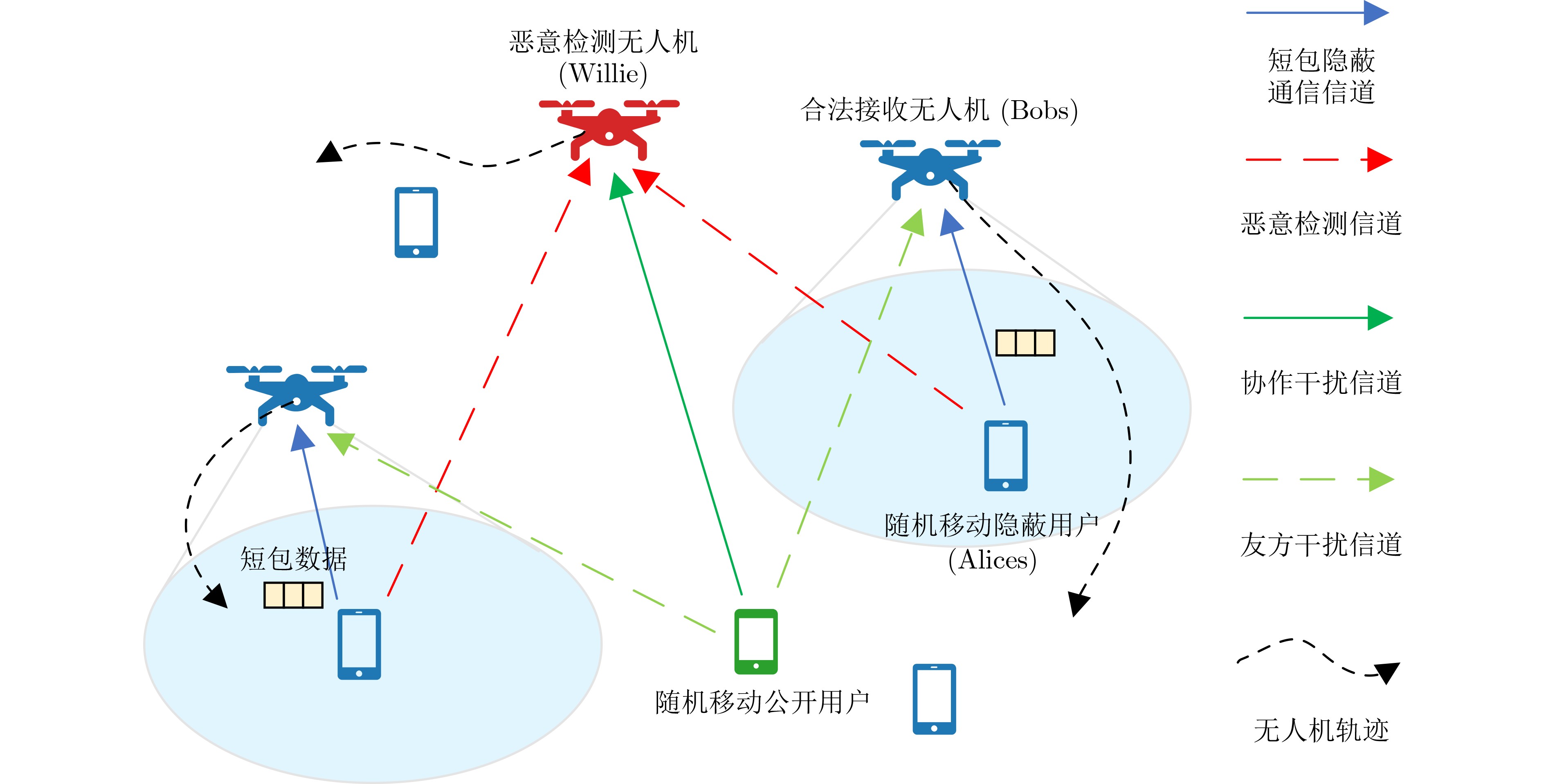
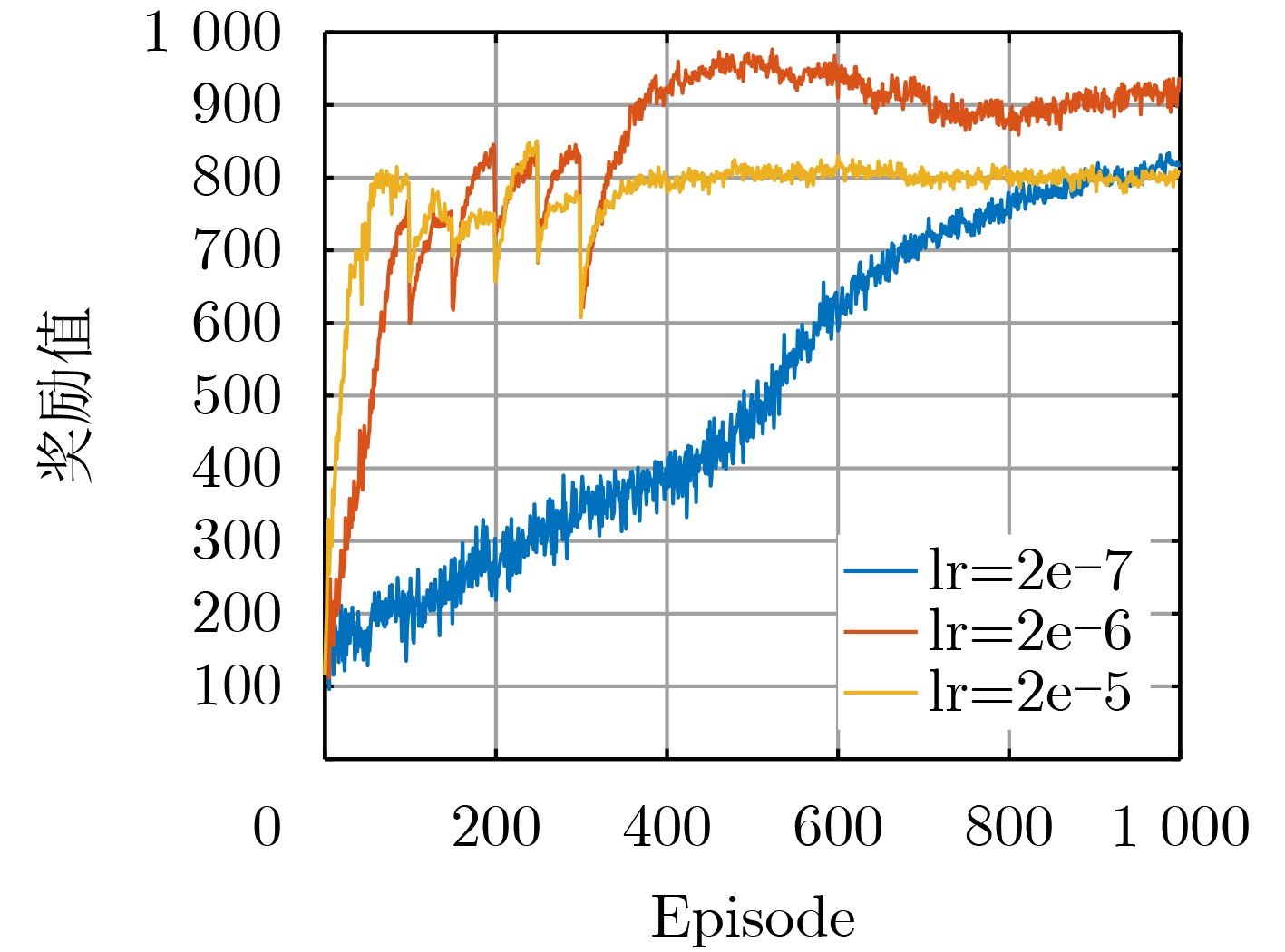
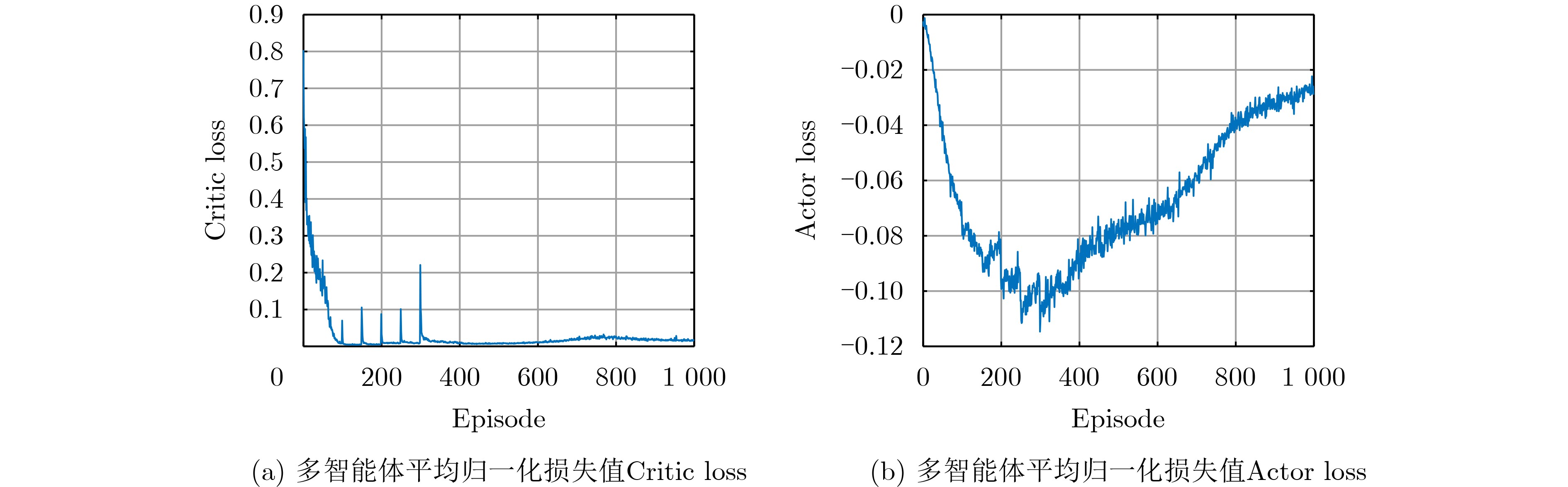
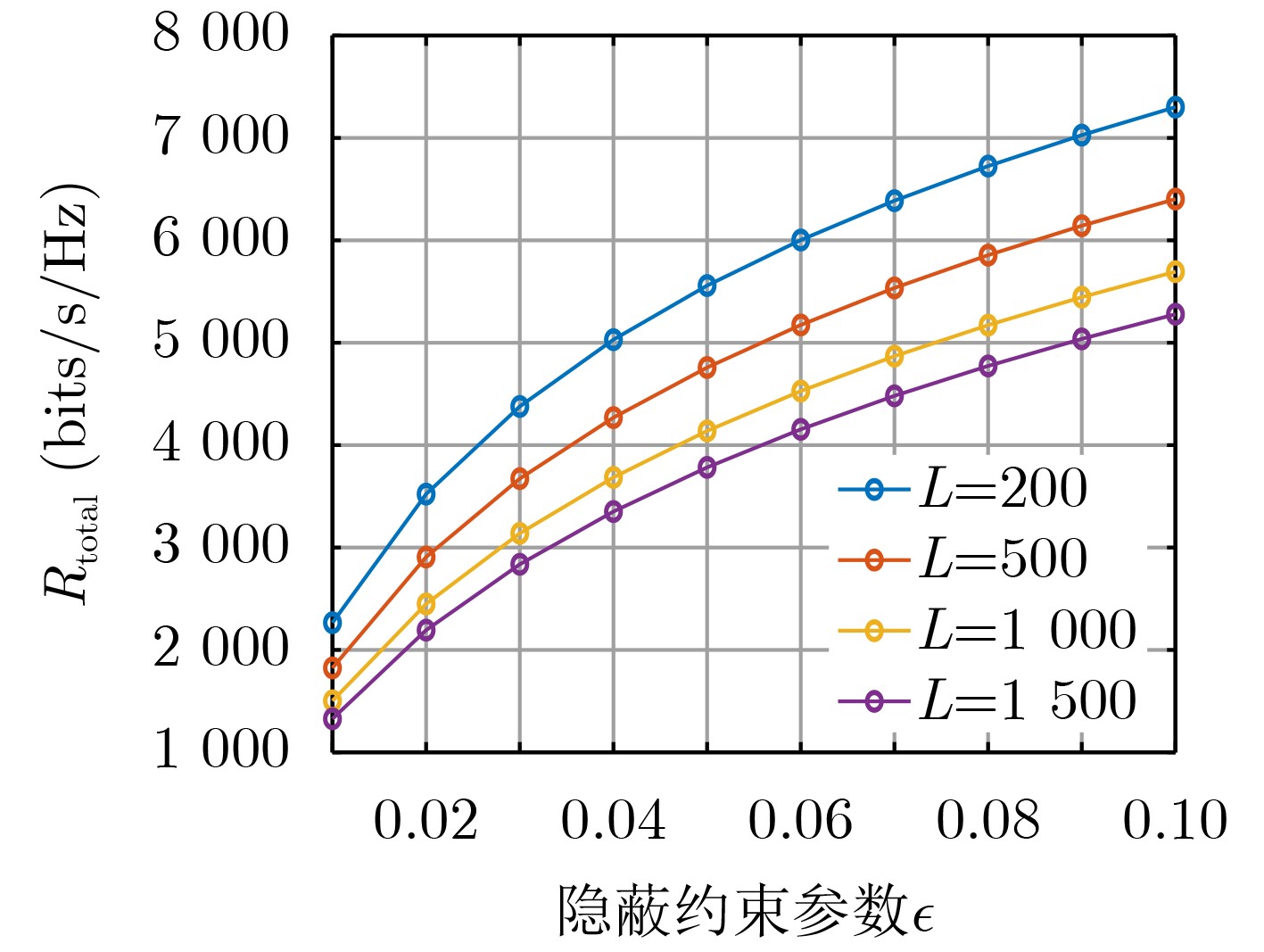
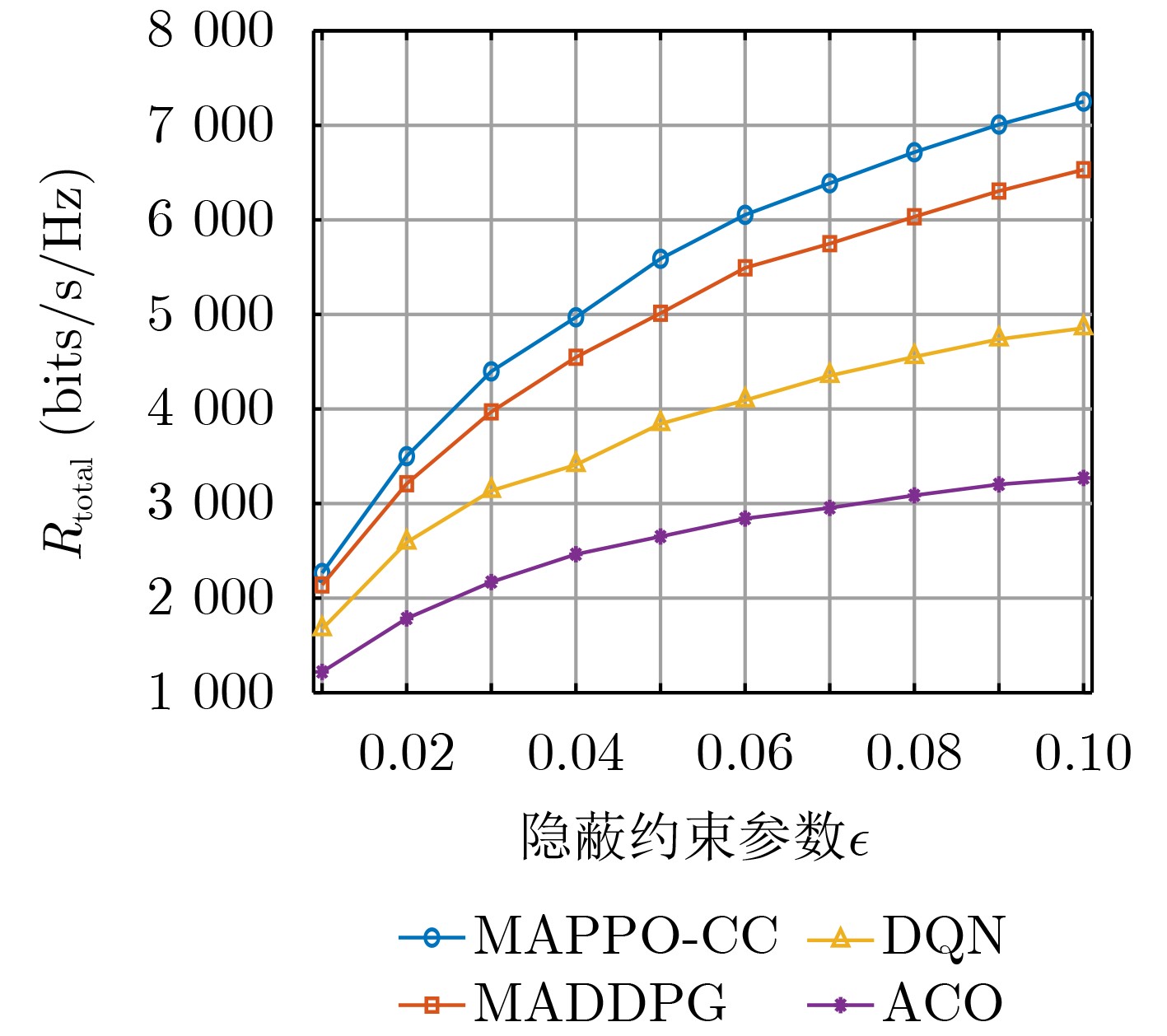
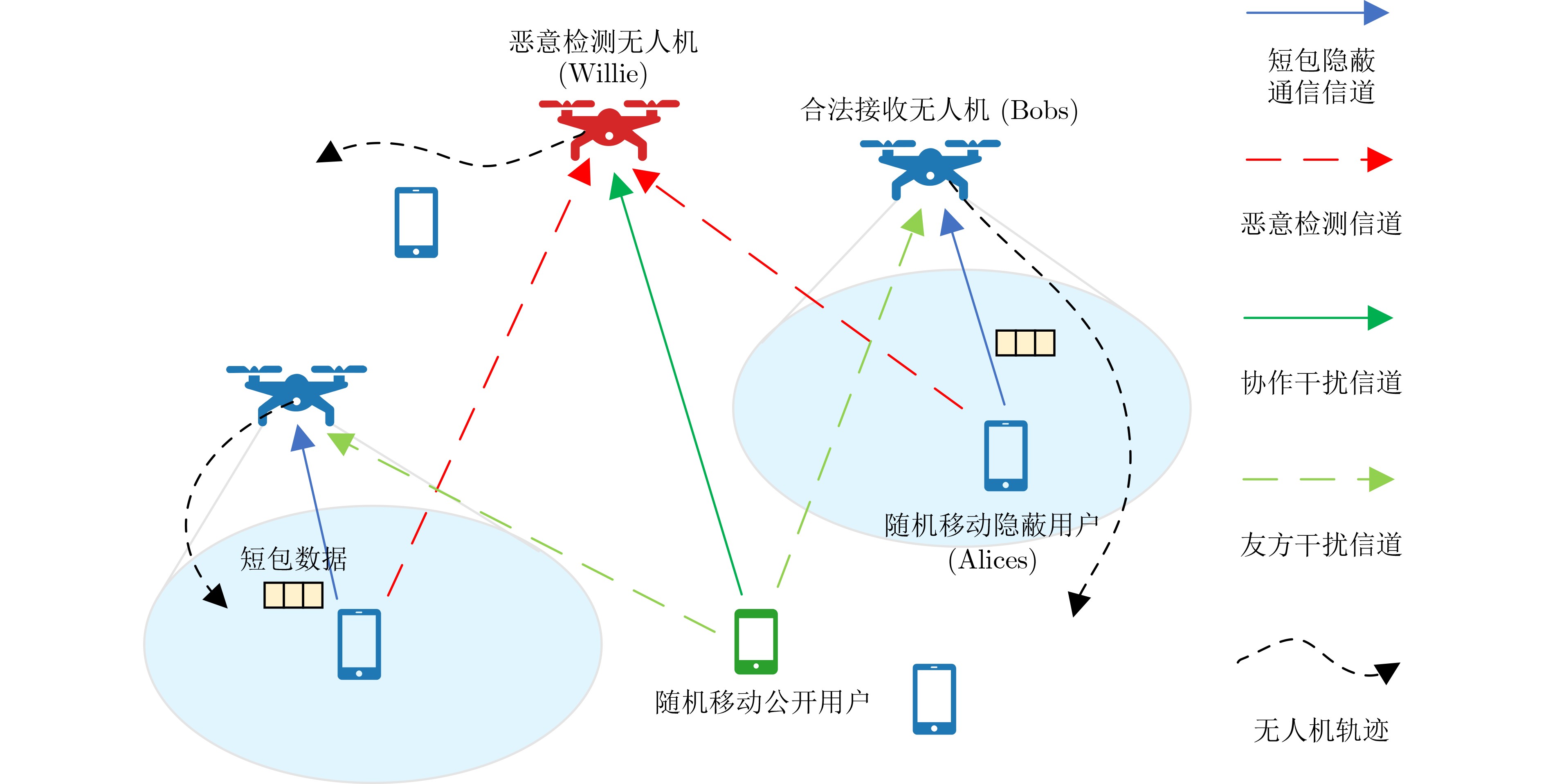
Objective With the advantages of high mobility, flexible deployment and line-of-sight (LoS) links, unmanned aerial vehicles (UAVs) are expected to become an important component of future wireless communication systems. However, due to the broadcast nature of LoS links, UAV communications are exposed to the threat of being detected by malicious wardens. Covert communication technique has therefore emerged to prevent transmission behaviors from being detected. Meanwhile, ultra-reliable and low-latency communication (URLLC) applications require short-packet (finite-blocklength) communications, where decoding errors are non-negligible and the infinite-blocklength assumption is not applicable. Therefore, UAV-assisted short-packet covert communications becomes an important research topic. Nevertheless, most existing studies adopt single UAV and static environment settings, which limit communication service capability and applicability in dynamic environments. To fill this research gap, this paper investigates a multi-UAV-assisted short-packet covert communication system. Methods A multi-UAV-assisted short-packet covert communication system model is established, where multiple UAVs serve multiple random mobile covert users in the presence of a moving aerial warden. Cooperative jammers are introduced to degrade the warden’s detection capability. The Gauss–Markov random mobility model is adopted for mobile users. At the warden, a binary hypothesis testing model is constructed, and the detection error probability (DEP) is derived. A optimization problem is formulated to maximize the short-packet covert throughput by jointly optimizing UAV trajectory, cooperative jammer selection, and covert transmit power. A multi-agent proximal policy optimization (MAPPO)-based algorithm, namely MAPPO-SPCC, is proposed. Specifically, MAPPO is employed to learn multi-agent policies for collaborative multi-UAV trajectory control in dynamic environments. At each time slot, the learned policies output multi-UAV velocities to determine trajectories and user associations, followed by cooperative jammer selection and convex transmit power optimization. Results and Discussions Simulations evaluate the performance of MAPPO-SPCC algorithm. The reward curves demonstrate that the algorithm achieves stable convergence with an appropriate learning rate, and the training process remains robust under gradually increasing user mobility ( Fig. 2 ). The loss curves further validate the stability of the training (Fig. 3 ). The UAV trajectories illustrate that the proposed algorithm enables multi-agents to adaptively adjust multi-UAV trajectories according to the spatial distribution of covert users and the patrol trajectory of the aerial warden (Fig. 4 ). The corresponding covert throughput heatmaps show that high throughput regions coincide with the UAV hovering regions (Fig. 5 ), demonstrating that the agents can capture the spatial distribution of throughput gains based on environment states. The impact of blocklength and covert constraint on the total throughput is further analyzed (Fig. 6 ). It is observed that relaxing the covert constraint allows higher achievable throughput, as a relaxed covert constraint enables higher transmit power. On the other hand, increasing the blocklength tightens the covert constraint, as a larger blocklength allows the warden to collect more detection samples, thereby enhancing its statistical detection capability. Moreover, comparisons with multi-agent deep deterministic policy gradient algorithm (MADDPG), deep Q-network algorithm (DQN), and ant colony optimization algorithm (ACO) show that the proposed MAPPO-SPCC consistently achieves the highest covert throughput (Fig. 7 ). The performance gains are attributed to its multi-agent collaborative trajectory control capability and stable on-policy updates in dynamic environments.Conclusions This paper investigates a multi-UAV-assisted short-packet covert communication system, where multiple UAVs collaboratively serve multiple random mobile covert users in the presence of a moving aerial warden, aided by cooperative jamming. To maximize the short-packet covert throughput, the MAPPO-SPCC algorithm is developed for joint optimization of collaborative multi-UAV trajectory control, cooperative jammer selection and covert users' transmit power. Simulation results demonstrate that MAPPO-SPCC enables effective collaborative multi-UAV trajectory control and achieves superior throughput compared with baselines. Future work may integrate physical layer security (PLS) techniques with covert communication to jointly enhance both transmission covertness and content confidentiality in UAV-assisted short-packet communications. In addition, extending the current work to three-dimensional trajectory design is expected to further improve the flexibility and performance of the covert communication system. -
Key words:
- Multi-UAV /
- short-packet /
- covert communications /
- trajectory control /
- MAPPO
-
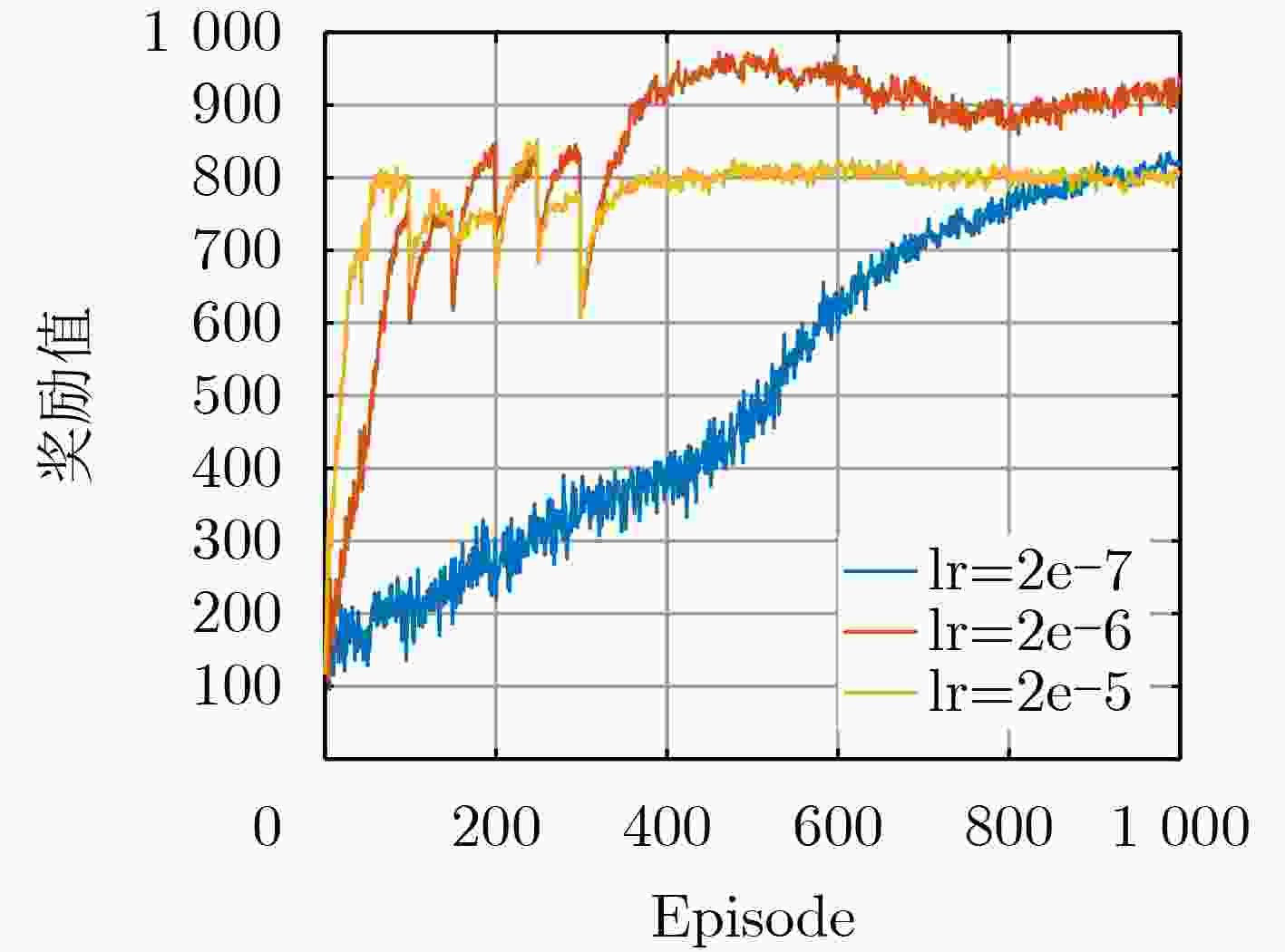
图 2 系统奖励值$ \displaystyle\sum \nolimits_{n=1}^{N}{r}_{n} $,$ \epsilon =0.05 $,$ L=200 $。
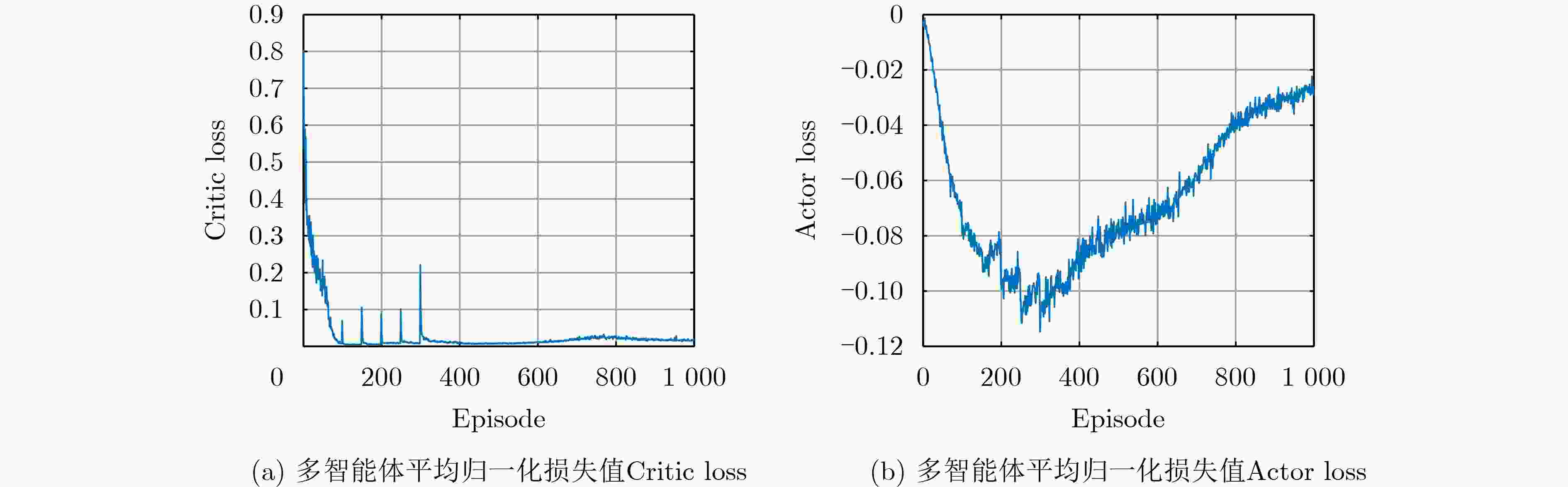
图 3 (a)多智能体平均归一化损失值Critic loss, (b)多智能体平均归一化损失值Actor loss。学习率lr=2e-6,$ \epsilon =0.05 $,$ L=200 $。
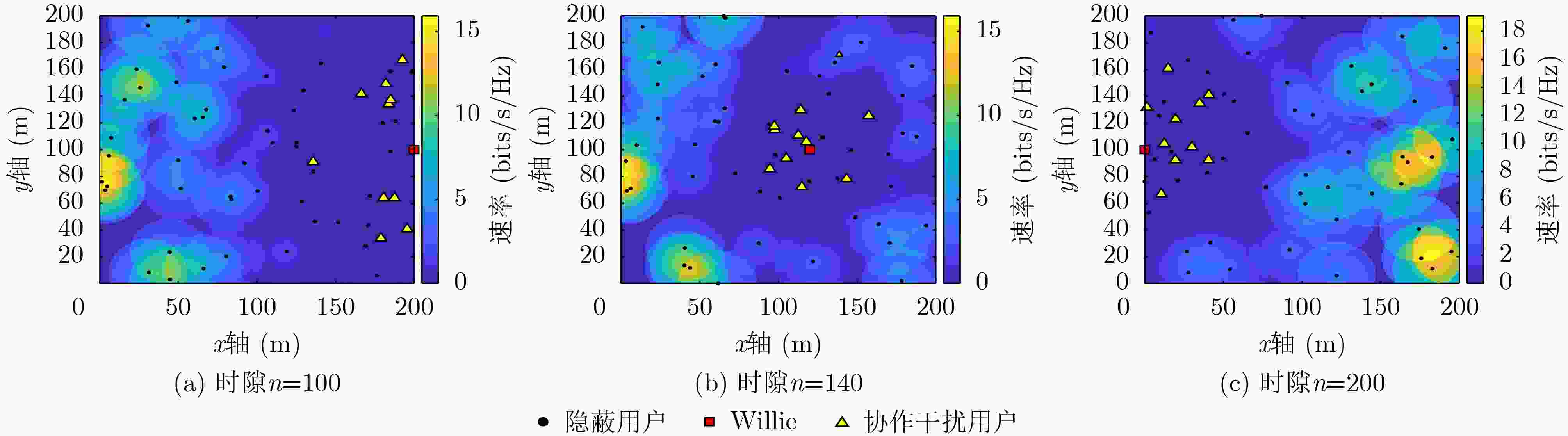
图 5 时隙$ n $时,合法无人机覆盖区域速率$ {R}_{m}[n]=\displaystyle\sum \nolimits_{k=1}^{K}{R}_{k,m}[n] $热力图。$ \epsilon =0.05 $,$ L=200 $。
1 协作干扰用户选择策略伪代码
输入:$ {\{ {h_{j,w}}[n],{h_{j,m}}[n]\} _{j \in \mathcal{J},{\mkern 1mu} m \in \mathcal{M}}} $,$ {\{{{\alpha }_{k,m}}[n]\}}_{k\in \mathcal{K},m\in \mathcal{M}} $以
及$ {J}_{\text{select}} $;输出:$ \{{\beta }_{j}[n]\}_{j=1}^{{J}_{\text{total}}} $。 1: 计算$ \{{\eta }_{j}[n]\}_{j=1}^{{J}_{\text{total}}} $; 2: 将$ {\eta }_{j}[n] $降序排列,得到排序后的索引集合 $ {\mathcal{J}}_{\text{sorted}} $; 3: 选择$ {\mathcal{J}}_{\text{sorted}} $中前$ {J}_{\text{select}} $个用户的索引,构成集合$ {\mathcal{J}}_{\text{sel}} $; 4: 若$ j\in {\mathcal{J}}_{\text{sel}} $,则令$ {\beta }_{j}[n]=1 $;反之,令$ {\beta }_{j}[n]=0 $。  下载: 导出CSV
2 MAPPO-SPCC 算法伪代码
输入:初始化Actor参数$ \{{\theta }_{m}\} $与Critic参数$ \{{\phi }_{m}\} $; 输出:训练后的网络参数$ \{{\theta }_{m}\} $与$ \{{\phi }_{m}\} $。 1:for $ Episode=1,2,\cdots ,N $ do 2: for $ m=1,2,\cdots ,M $ do 3: 观测局部状态信息$ {\mathbf{o}}_{m,n} $,并根据策略$ {\pi }_{{{\theta }_{m}}} $选择并执行动
作$ {a}_{m,n} $;4: end 5: 根据式(3)确定隐蔽用户关联变量$ \{{\alpha }_{k,m}[n]\} $; 6: 通过算法1确定协作干扰用户选择变量$ \{{\beta }_{j}[n]\} $(求解
P2.2);7: 通过 CVX 优化隐蔽用户发射功率$ \{{p}_{k}[n]\} $(求解P2.3); 8: 更新状态$ {\mathbf{s}}_{n+1} $,计算全局奖励$ {r}_{n} $,并将
$ ({\mathbf{s}}_{n},{\mathbf{a}}_{n},{r}_{n},{\mathbf{s}}_{n+1}) $存入$ \mathcal{T} $;9:For 训练轮次$ i=1,2,\cdots $ do 10: 从$ \mathcal{T} $中采样小批量样本$ \mathcal{B} $; 11: for $ m=1,2,\cdots ,M $ do 12: 计算损失函数$ L_{m,n}^{\text{CLIP}}\left({\theta }_{m}\right) $与$ L_{m,n}^{V}\left({\phi }_{m}\right) $,并根据式(25)
更新参数$ {\theta }_{m} $与$ {\phi }_{m} $;13: end 14:end
下载: 导出CSV
-
[1] YANG Fangtao, QIN Xiaoqi, GONG Shiqi, et al. A survey of covert UAV communications[J]. Chinese Journal of Aeronautics, 2025, 38(10): 103493. doi: 10.1016/j.cja.2025.103493. [2] 钱志鸿, 王义君. 低空经济赋能者: 智能无人机技术体系综述与展望[J]. 电子与信息学报, 2026, 48(1): 1–33. doi: 10.11999/JEIT251246.QIAN Zhihong and WANG Yijun. Intelligent unmanned aerial vehicles for low-altitude economy: A review of the technology framework and future prospects[J]. Journal of Electronics & Information Technology, 2026, 48(1): 1–33. doi: 10.11999/JEIT251246. [3] JIANG Xu, CHEN Xinying, TANG Jie, et al. Covert communication in UAV-assisted air-ground networks[J]. IEEE Wireless Communications, 2021, 28(4): 190–197. doi: 10.1109/MWC.001.2000454. [4] 缪晨, 秦雨萱, 马瑞谦, 等. 时间调制阵列感知辅助的无人机隐蔽通信[J]. 电子与信息学报, 2025, 47(4): 1004–1013. doi: 10.11999/JEIT240606.MIAO Chen, QIN Yuxuan, MA Ruiqian, et al. Covert communication of UAV aided by time modulated array perception[J]. Journal of Electronics & Information Technology, 2025, 47(4): 1004–1013. doi: 10.11999/JEIT240606. [5] XU Jinpeng, BAI Lin, XIE Xin, et al. Collaborative secret and covert communications for multi-user multi-antenna uplink UAV systems: Design and optimization[J]. IEEE Transactions on Wireless Communications, 2025, 24(7): 6020–6035. doi: 10.1109/TWC.2025.3550911. [6] ABDALLA A S and MAROJEVIC V. Security threats and cellular network procedures for unmanned aircraft systems: Challenges and opportunities[J]. IEEE Communications Standards Magazine, 2022, 6(4): 104–111. doi: 10.1109/MCOMSTD.0003.2100108. [7] CHEN Xinying, AN Jianping, XIONG Zehui, et al. Covert communications: A comprehensive survey[J]. IEEE Communications Surveys & Tutorials, 2023, 25(2): 1173–1198. doi: 10.1109/COMST.2023.3263921. [8] 朱政宇, 欧阳泽彬, 潘高峰, 等. 低轨卫星通感一体化系统中的隐蔽通信传输方案[J]. 电子与信息学报, 2025, 47(10): 3538–3548. doi: 10.11999/JEIT250208.ZHU Zhengyu, OUYANG Zebin, PAN Gaofeng, et al. Covert communication transmission scheme in low earth orbit satellite integrated sensing and communication systems[J]. Journal of Electronics & Information Technology, 2025, 47(10): 3538–3548. doi: 10.11999/JEIT250208. [9] ZHOU Xiaobo, YAN Shihao, NG D W K, et al. Three-dimensional placement and transmit power design for UAV covert communications[J]. IEEE Transactions on Vehicular Technology, 2021, 70(12): 13424–13429. doi: 10.1109/TVT.2021.3121298. [10] WANG Qunshu, GUO Shaoyong, WU Celimuge, et al. STAR-RIS aided covert communication in UAV air-ground networks[J]. IEEE Journal on Selected Areas in Communications, 2025, 43(1): 245–259. doi: 10.1109/JSAC.2024.3460079. [11] CHEN Xinying, SHENG Min, ZHAO Nan, et al. UAV-relayed covert communication towards a flying warden[J]. IEEE Transactions on Communications, 2021, 69(11): 7659–7672. doi: 10.1109/TCOMM.2021.3106354. [12] FU Shu, WEI Wei, YIN Liuguo, et al. Joint optimization of 3-D placement and transmission power for a relay based covert communication system[J]. IEEE Transactions on Communications, 2025, 73(11): 12637–12651. doi: 10.1109/TCOMM.2025.3585509. [13] MAO Haobin, LIU Yanming, XIAO Zhenyu, et al. Joint resource allocation and 3-D deployment for multi-UAV covert communications[J]. IEEE Internet of Things Journal, 2024, 11(1): 559–572. doi: 10.1109/JIOT.2023.3287838. [14] SEONG H, KIM T, SONG J, et al. Hierarchical multi-agent reinforcement learning-based UAV control for wireless covert communications[C]. 2025 IEEE 22nd Consumer Communications & Networking Conference (CCNC), Las Vegas, USA, 2025: 1–6. doi: 10.1109/CCNC54725.2025.10976044. [15] WU Peng, YUAN Xiaopeng, HU Yulin, et al. Joint power allocation and trajectory design for UAV-enabled covert communication[J]. IEEE Transactions on Wireless Communications, 2024, 23(1): 683–698. doi: 10.1109/TWC.2023.3281730. [16] JIANG Xu, YANG Zhutian, ZHAO Nan, et al. Resource allocation and trajectory optimization for UAV-enabled multi-user covert communications[J]. IEEE Transactions on Vehicular Technology, 2021, 70(2): 1989–1994. doi: 10.1109/TVT.2021.3053936. [17] YANG Fangtao, ZHAO Nan, LIU Mingqian, et al. UAV-aided short-packet covert data collection[J]. IEEE Transactions on Vehicular Technology, 2025, 74(4): 6662–6667. doi: 10.1109/TVT.2024.3518692. [18] WU Peng, YUAN Xiaopeng, HU Yulin, et al. UAV-enabled covert autonomous vehicular communication: Joint trajectory and resource allocation design[J]. IEEE Transactions on Intelligent Transportation Systems, 2025, 26(12): 21769–21783. doi: 10.1109/TITS.2025.3605051. [19] CHEN Yangting, WU Mengru, DING Yu, et al. Covert communication toward an aerial warden in NOMA-based UAV-MEC systems[J]. IEEE Journal on Selected Areas in Communications, 2026, 44: 1618–1632. doi: 10.1109/JSAC.2025.3638297. [20] LEI Hongjiang, JIANG Jiacheng, ANSARI I S, et al. Trajectory and power design for aerial multi-user covert communications[J]. IEEE Transactions on Aerospace and Electronic Systems, 2024, 60(4): 4574–4589. doi: 10.1109/TAES.2024.3378203. [21] LIU Pengpeng, SI Jiangbo, LI Zan, et al. Joint 3-D trajectory and power optimization for dual-UAV-assisted short-packet covert communications[J]. IEEE Internet of Things Journal, 2024, 11(10): 17388–17401. doi: 10.1109/JIOT.2024.3357456. [22] BAI Hengzhi, WANG Haichao, HE Rongrong, et al. Multi-hop UAV relay covert communication: A multi-agent reinforcement learning approach[J]. Chinese Journal of Aeronautics, 2025, 38(10): 103440. doi: 10.1016/j.cja.2025.103440. [23] ZENG Yong, ZHANG Rui, and LIM T J. Wireless communications with unmanned aerial vehicles: Opportunities and challenges[J]. IEEE Communications Magazine, 2016, 54(5): 36–42. doi: 10.1109/MCOM.2016.7470933. [24] WU Qingqing, ZENG Yong, and ZHANG Rui. Joint trajectory and communication design for multi-UAV enabled wireless networks[J]. IEEE Transactions on Wireless Communications, 2018, 17(3): 2109–2121. doi: 10.1109/TWC.2017.2789293. [25] SUN Xiaofang, YAN Shihao, YANG Nan, et al. Short-packet downlink transmission with non-orthogonal multiple access[J]. IEEE Transactions on Wireless Communications, 2018, 17(7): 4550–4564. doi: 10.1109/TWC.2018.2827368. [26] ZHU Yao, YUAN Xiaopeng, HU Yulin, et al. Trade reliability for security: Leakage-failure probability minimization for machine-type communications in URLLC[J]. IEEE Journal on Selected Areas in Communications, 2023, 41(7): 2123–2137. doi: 10.1109/JSAC.2023.3280960. [27] 田波, 杨炜伟, 沙力, 等. 短包安全隐蔽通信设计与优化[J]. 电子与信息学报, 2026, 48(1): 135–144. doi: 10.11999/JEIT250800.TIAN Bo, YANG Weiwei, SHA Li, et al. Short packet secure covert communication design and optimization[J]. Journal of Electronics & Information Technology, 2026, 48(1): 135–144. doi: 10.11999/JEIT250800. [28] BATABYAL S and BHAUMIK P. Mobility models, traces and impact of mobility on opportunistic routing algorithms: A survey[J]. IEEE Communications Surveys & Tutorials, 2015, 17(3): 1679–1707. doi: 10.1109/COMST.2015.2419819. [29] DENG Dan, DANG Shuping, LI Xingwang, et al. Joint optimization for covert communications in UAV-assisted NOMA networks[J]. IEEE Transactions on Vehicular Technology, 2024, 73(1): 1012–1026. doi: 10.1109/TVT.2023.3308718. [30] GUO Shuaiyu, JIANG Xu, YANG Hongjuan, et al. AAV-relayed finite-blocklength covert communication against active wardens[J]. IEEE Wireless Communications Letters, 2025, 14(10): 3134–3138. doi: 10.1109/LWC.2025.3587338. [31] BASH B A, GOECKEL D, and TOWSLEY D. Limits of reliable communication with low probability of detection on AWGN channels[J]. IEEE Journal on Selected Areas in Communications, 2013, 31(9): 1921–1930. doi: 10.1109/JSAC.2013.130923. [32] DURISI G, KOCH T, and POPOVSKI P. Toward massive, ultrareliable, and low-latency wireless communication with short packets[J]. Proceedings of the IEEE, 2016, 104(9): 1711–1726. doi: 10.1109/JPROC.2016.2537298. [33] JAIN R K, CHIU D M W, and HAWE W R. A quantitative measure of fairness and discrimination for resource allocation in shared computer systems[R]. DEC-TR-301, 1984. [34] LIU C H, PIAO Chengzhe, and TANG Jian. Energy-efficient UAV crowdsensing with multiple charging stations by deep learning[C]. IEEE INFOCOM 2020 - IEEE Conference on Computer Communications, Toronto, Canada, 2020: 199–208. doi: 10.1109/INFOCOM41043.2020.9155535. [35] YAN Shihao, HANLY S V, and COLLINGS I B. Optimal transmit power and flying location for UAV covert wireless communications[J]. IEEE Journal on Selected Areas in Communications, 2021, 39(11): 3321–3333. doi: 10.1109/JSAC.2021.3088667. -

 下载:



图(7) / 表(2)
计量
- 文章访问数: 21
- HTML全文浏览量: 6
- PDF下载量: 17
- 被引次数: 0
