




Survey of Satellite Covert Communications: Status, Key Technologies, and Future Challenges
-
摘要: 卫星隐蔽通信具有保护信息内容和隐藏通信行为的双重能力,已成为信息对抗和保障战略通信连续性的关键技术。该文全面综述卫星隐蔽通信的理论基础、关键技术现状及未来发展挑战。首先,基于Alice-Bob-Willie模型,深入分析卫星信道特性对隐蔽容量的影响机制,阐明多普勒频移等因素对隐蔽通信速率的制约关系,并探讨修正型平方根定律下的理论边界。其次,围绕天基、空基、地基3层协同架构,系统梳理信号伪装编码、波束成形、频谱分集、量子加密与人工智能辅助等核心技术,并总结抗监听与抗干扰的多层级防护机制。最后,结合当前典型安全威胁,探讨卫星隐蔽通信面临的主要挑战,展望低轨动态组网、非理想信道鲁棒传输、人工智能与量子技术深度融合等未来发展方向,为构建高安全性、强隐蔽性的空间通信网络提供理论依据和技术支撑。Abstract:
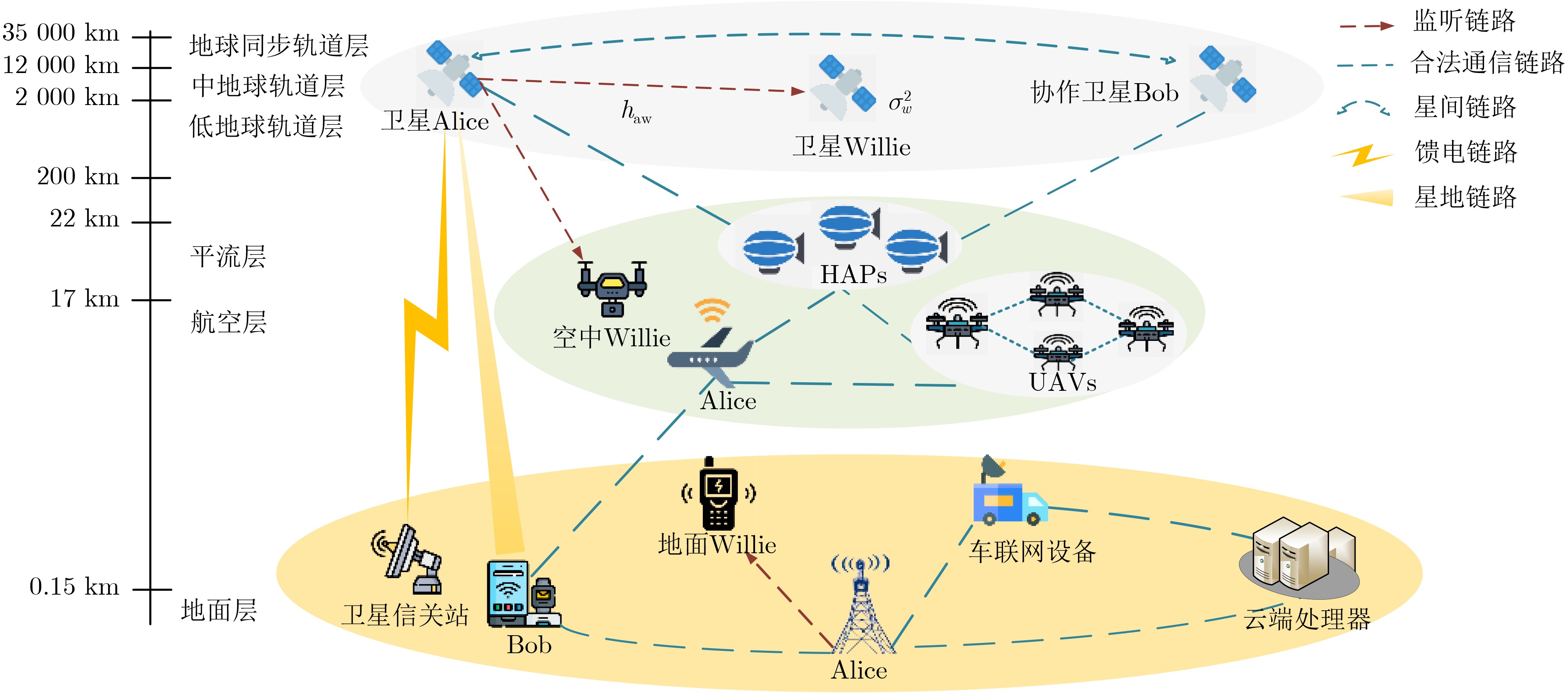
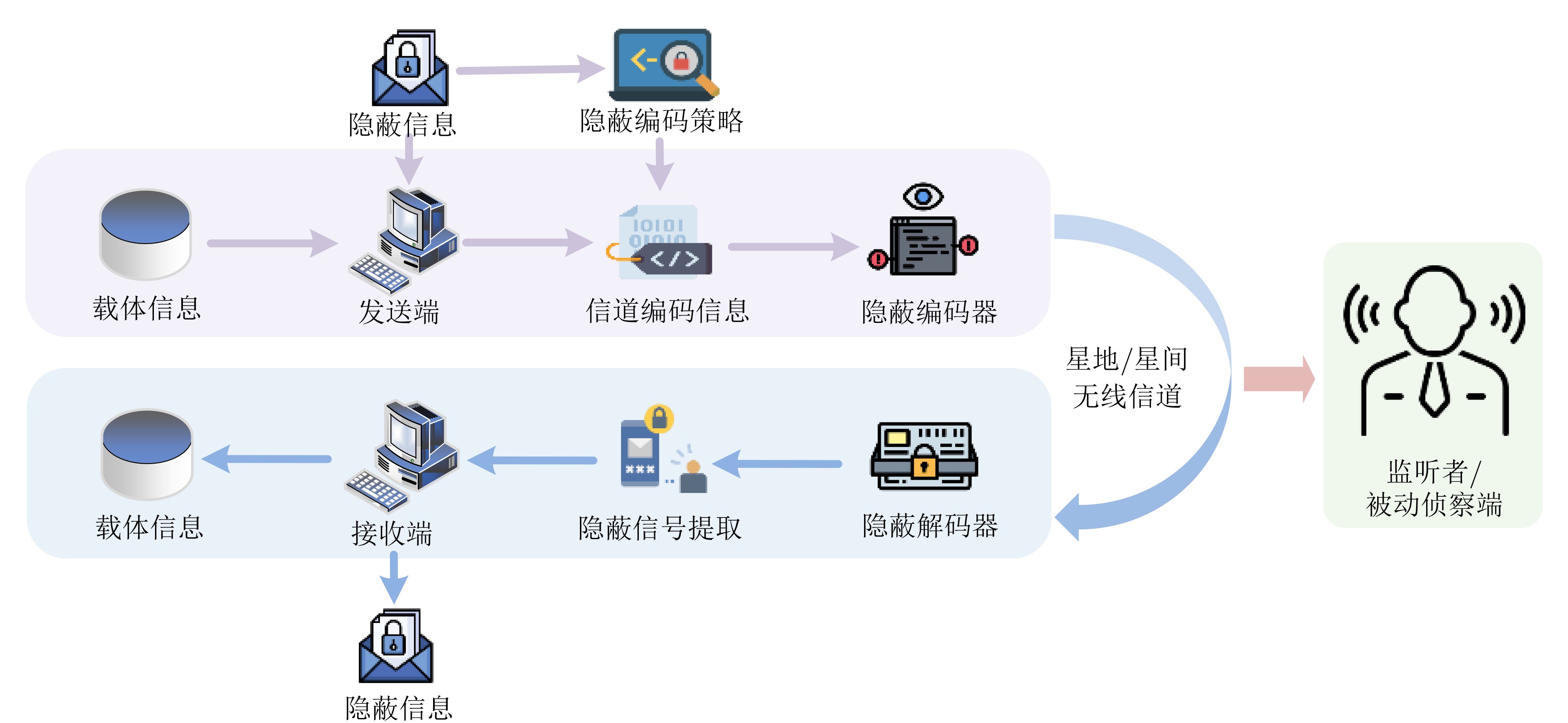
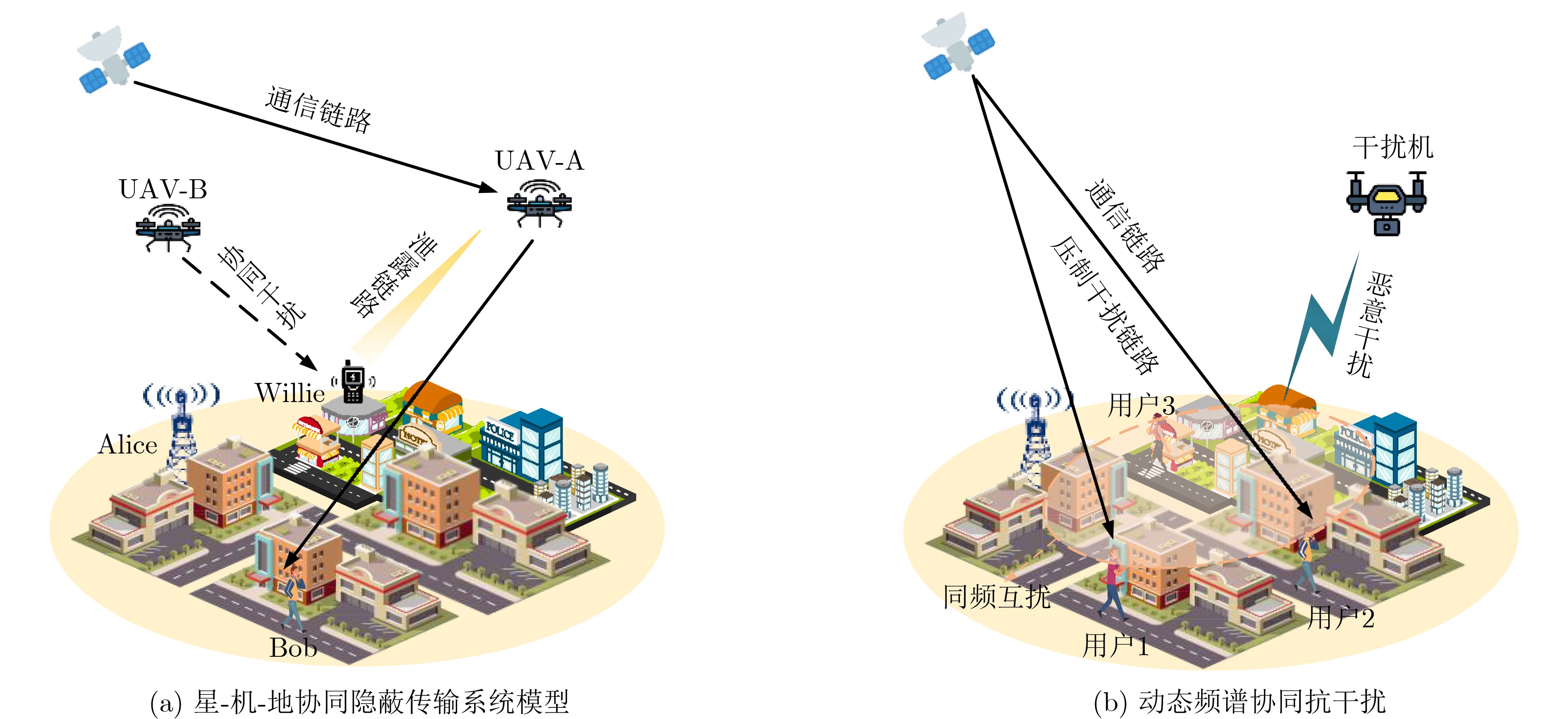
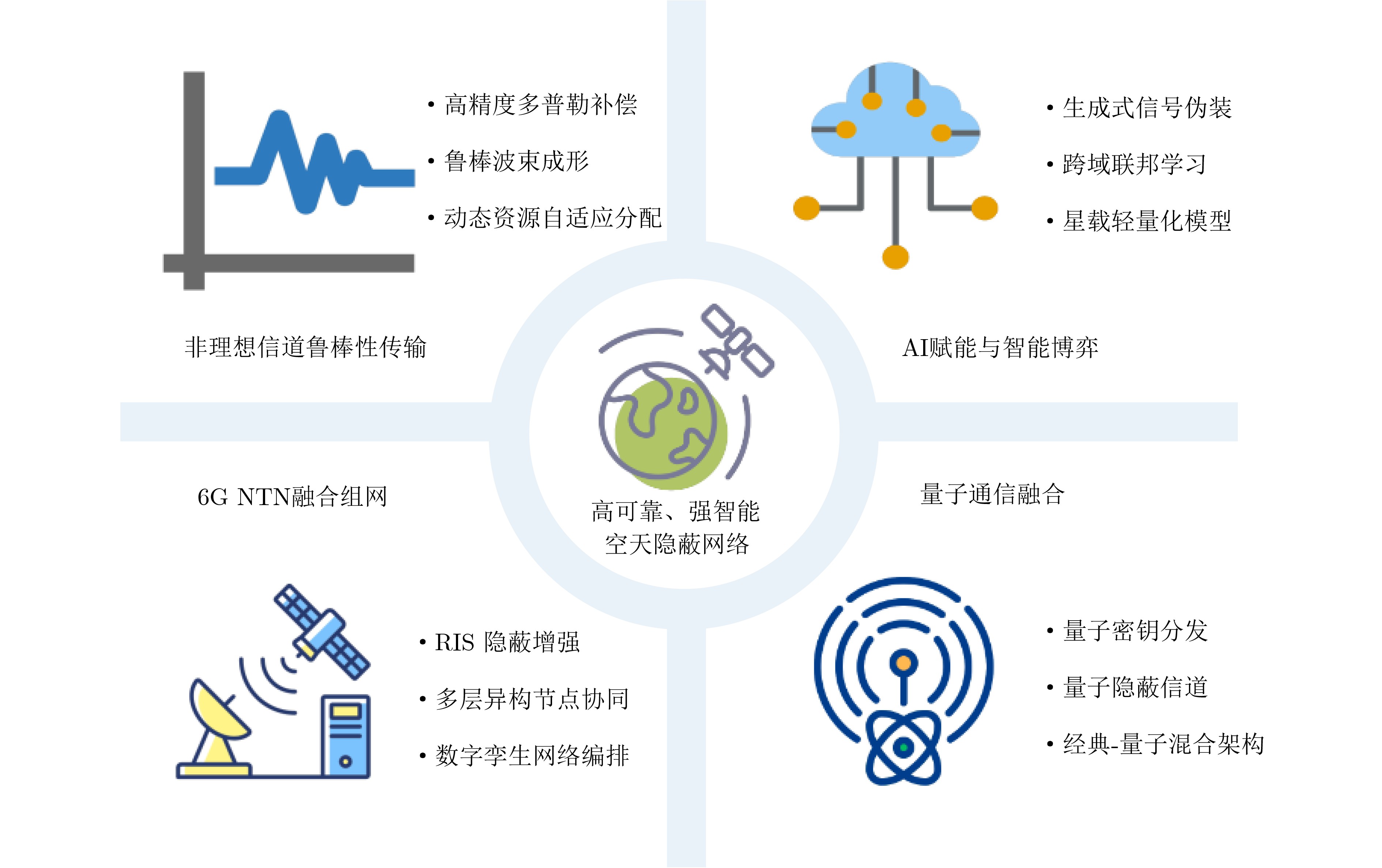
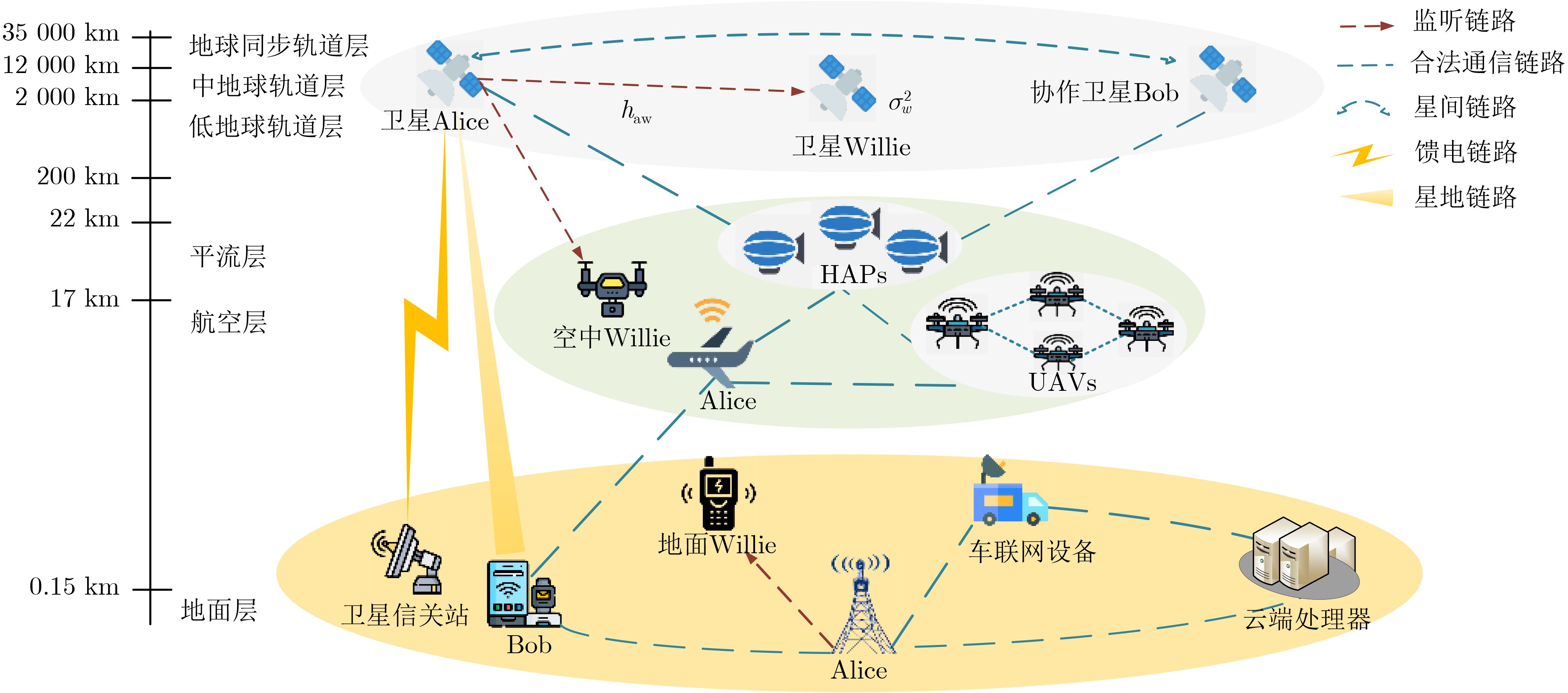
Objective This survey systematically reviews the theoretical foundations, key technologies, and future challenges of Satellite Covert Communications. Based on the classical Alice-Bob-Willie model, the effects of satellite channel characteristics on covert communication capacity are analyzed to establish the theoretical basis. The network architecture of Satellite Covert Communications under the space-air-ground three-layer framework (Fig. 1) is summarized. Core technologies and optimization methods, including signal camouflage coding, beamforming, spectrum agility, Quantum Key Distribution (QKD), and Artificial Intelligence (AI)-assisted techniques, are systematically reviewed. Major security threats and corresponding multi-layer defense strategies, including Physical-Layer Security (PLS) and intelligent collaborative defense, are also summarized. This survey provides a theoretical foundation and technical guidance for developing highly secure and intelligent Satellite Covert Communications systems. Significance The significance of this survey lies in its systematic integration of the theoretical framework and key technologies for Satellite Covert Communications. To address the threats of detection, interference, and eavesdropping in open satellite communication environments, representative space-air-ground integrated architectures reported in the literature are reviewed. These architectures overcome the limitation of conventional encryption techniques, which protect only information content, by reducing statistical distinguishability at the physical layer to achieve a low probability of detection. The constraints imposed by satellite channels on covert communication capacity are clarified through the modified Square Root Law. Enhancement strategies based on adaptive coding, beamforming, spectrum agility, and related techniques are reviewed to establish a comprehensive technical framework for Satellite Covert Communications. These advances provide theoretical support and technical guidance for constructing highly survivable and secure space-air-ground integrated communication networks, with important applications in national defense, emergency communications, and Sixth-Generation (6G) Non-Terrestrial Networks (NTNs). Progress Existing studies demonstrate that Doppler spread has a dual effect on covert communication capacity. It increases the missed detection probability while introducing signal distortion, making adaptive coding necessary to maintain reliable transmission. The differences in detection capability among terrestrial, aerial, and orbital wardens (Willie) are quantified ( Table 1 ), providing a theoretical basis for hierarchical defense design. Existing studies have also proposed multi-level covertness enhancement strategies. AI-assisted dynamic camouflage combined with sparse coding exploits background noise, inter-satellite links, and dynamic beamforming to improve covert throughput. At the network level, cooperative Unmanned Aerial Vehicle (UAV)-assisted transmission and dynamic spectrum coordination are identified as representative enhancement approaches (Fig. 3 ). Furthermore, a hierarchical defense framework is summarized from representative studies. This framework combines Reconfigurable Intelligent Surface (RIS)-assisted signal control, Stackelberg game-based incentives for cooperative jamming, XOR network coding, and federated learning for cross-domain threat feature sharing. These advances provide effective solutions for improving the covertness and security of Satellite Covert Communications.Conclusions This survey systematically reviews the theoretical foundations and recent advances in Satellite Covert Communications. The integration of multi-layer satellite constellations, dynamic aerial relay platforms, and software-defined networks supported by Quantum Key Distribution (QKD) enables resilient global covert communication. Extending the Alice-Bob-Willie model to practical satellite channels with non-ideal propagation characteristics provides guidance for covert throughput optimization and secure transmission. AI-assisted coding and waveform design further enable adaptive transmission strategies that respond to dynamic channel conditions. Future research should focus on robust covert transmission in dynamic Low Earth Orbit (LEO) environments, scalable constellation management, and the deep integration of AI and quantum technologies into 6G NTNs. The convergence of programmable satellites, Reconfigurable Intelligent Surfaces (RIS), and advanced machine learning is expected to further improve secure space communications. Prospects Future research should focus on four major directions: robust covert transmission under non-ideal channels, AI-assisted intelligent decision-making, integrated 6G NTN networking, and the integration of quantum communication technologies ( Fig. 4 ). High-precision Doppler compensation techniques should be developed to mitigate rapid channel variations in LEO satellite systems. Robust covert transmission schemes should also be developed for imperfect Channel State Information (CSI), with deep reinforcement learning providing real-time resource optimization. Future studies should strengthen the integration of AI and quantum technologies by combining cross-layer QKD with covert transmission protocols and exploiting Software-Defined Satellite (SDS) capabilities for adaptive strategy deployment. Additional opportunities include using RIS to enhance spatial-domain signal control and applying blockchain technology to address trust management in multi-node cooperative networks. Efficient lightweight onboard algorithms and coordinated international frameworks for spectrum and orbital resource management should also be developed to support future Satellite Covert Communications systems. -
表 1 Willie在卫星隐蔽通信中的场景分类
场景类型 Willie位置描述 特征与威胁 隐蔽通信挑战 信道特性 地面Willie 地面监听 检测能力强 隐蔽性与可靠性难以兼顾 受限于地面传播的遮挡和多径效应 空中Willie 空中监听 检测范围广 难以应对其移动性 非遮挡时视距传播为主 卫星Willie 轨道监听 全域监听 轨道变化、空间干扰 通常为自由空间传播信道  下载: 导出CSV
表 3 卫星隐蔽通信关键技术横向对比
关键技术 实现复杂度 卫星载荷资源需求 隐蔽增益 主要优势 局限性 隐蔽编码[17,23] 传统易部署,AI交
互状态复杂AI模型算力与
能耗开销极大受限于平方根定律
理论界限射频硬件免改,
协议平滑兼容非平稳信道下
易漏警失配扩频技术[24] 需攻克严苛的收发
时序同步需极大射频带宽及
前端处理降低功率谱密度,
抗窄带侦测抗截获与抗干扰能力强 频带占用极大,频谱效率极低 波束成形[25,26] 需动态拓扑下的高速
波束对准大规模阵列受限体积
与功耗物理压缩三维可截获
空间区域隐蔽与高速率传输
可兼得极度依赖实时CSI,
受老化影响人工噪声[21,27] 需协同节点与干扰
矩阵分发严重挤占星上有效
发射功率主动打破敌方检测
门限收敛性主动防御,对抗强位置先验窃听 耗能高,且需敌方先验
下载: 导出CSV
-
[1] KODHELI O, LAGUNAS E, MATURO N, et al. Satellite communications in the new space era: A survey and future challenges[J]. IEEE Communications Surveys & Tutorials, 2021, 23(1): 70–109. doi: 10.1109/COMST.2020.3028247. [2] 邓娜, 邢成文, 赵楠. 卫星隐蔽通信技术综述[J]. 中兴通讯技术, 2024, 30(5): 55–67. doi: 10.12142/ZTETJ.202405009.DENG Na, XING Chengwen, and ZHAO Nan. A review of satellite covert communication technologies[J]. ZTE Technology Journal, 2024, 30(5): 55–67. doi: 10.12142/ZTETJ.202405009. [3] 陈全. 面向低轨巨型星座的星地一体化网络关键技术研究[D]. [博士论文], 国防科技大学, 2021. doi: 10.27052/d.cnki.gzjgu.2021.000477.CHEN Quan. Towards LEO mega-constellation: Study on integrated satellite-terrestrial networks[D]. [Ph. D. dissertation], National University of Defense Technology, 2021. doi: 10.27052/d.cnki.gzjgu.2021.000477. [4] PAN Gaofeng, YE Jia, AN Jianping, et al. Latency versus reliability in LEO mega-constellations: Terrestrial, aerial, or space relay?[J]. IEEE Transactions on Mobile Computing, 2023, 22(9): 5330–5345. doi: 10.1109/TMC.2022.3168081. [5] YUE Pingyue, AN Jianping, ZHANG Jiankang, et al. Low earth orbit satellite security and reliability: Issues, solutions, and the road ahead[J]. IEEE Communications Surveys & Tutorials, 2023, 25(3): 1604–1652. doi: 10.1109/COMST.2023.3296160. [6] 于季弘, 蔡雨庭, 刘家豪, 等. 空天隐蔽通信技术综述[J]. 重庆邮电大学学报(自然科学版), 2023, 35(5): 775–788. doi: 10.3979/j.issn.1673-825X.202212110360.YU Jihong, CAI Yuting, LIU Jiahao, et al. Space-air covert communication: A survey[J]. Journal of Chongqing University of Posts and Telecommunications (Natural Science Edition), 2023, 35(5): 775–788. doi: 10.3979/j.issn.1673-825X.202212110360. [7] ALIBERTI G, DI PIETRO R, and GUARINO S. Reliable and perfectly secret communication over the generalized Ozarow-Wyner’s wire-tap channel[J]. Computer Networks, 2016, 109: 21–30. doi: 10.1016/j.comnet.2016.06.034. [8] DING Haichuan, WANG Wenjing, MA Ying, et al. Adaptive covert communications in time-varying environments with multi-slot covertness constraints[J]. IEEE Transactions on Wireless Communications, 2025, 24(12): 9978–9988. doi: 10.1109/TWC.2025.3576095. [9] BASH B A, GOECKEL D, and TOWSLEY D. Limits of reliable communication with low probability of detection on AWGN channels[J]. IEEE Journal on Selected Areas in Communications, 2013, 31(9): 1921–1930. doi: 10.1109/JSAC.2013.130923. [10] WANG Zhaoqi, ZHOU Peiyuan, LIU Xiqing, et al. Fractional domain waveform design for covert downlink communication with signal overlay in integrated satellite-terrestrial networks[J]. IEEE Journal on Selected Areas in Communications, 2026, 44: 1751–1764. doi: 10.1109/JSAC.2025.3639194. [11] HE Biao, YAN Shihao, ZHOU Xiangyun, et al. On covert communication with noise uncertainty[J]. IEEE Communications Letters, 2017, 21(4): 941–944. doi: 10.1109/LCOMM.2016.2647716. [12] WANG Shuai, YE Jia, CHEN Chao, et al. Safeguarding inter-satellite transmissions: A viewpoint from covertness[J]. IEEE Wireless Communications, 2025, 32(1): 221–228. doi: 10.1109/MWC.002.2400042. [13] HU Jinsong, GUO Mingqian, YAN Shihao, et al. Deep reinforcement learning enabled covert transmission with UAV[J]. IEEE Wireless Communications Letters, 2023, 12(5): 917–921. doi: 10.1109/LWC.2023.3251357. [14] ZHOU Xiaobo, YAN Shihao, HU Jinsong, et al. Joint optimization of a UAV’s trajectory and transmit power for covert communications[J]. IEEE Transactions on Signal Processing, 2019, 67(16): 4276–4290. doi: 10.1109/TSP.2019.2928949. [15] SONG Zhe, ZHANG Xuyang, WANG Shuai, et al. Adaptive redundancy CRDSA in UAV-LEO satellite covert communication networks[J]. IEEE Transactions on Communications, 2026, 74: 5879–5892. doi: 10.1109/TCOMM.2026.3668167. [16] LI Bin, FEI Zesong, ZHOU Caiqiu, et al. Physical-layer security in space information networks: A survey[J]. IEEE Internet of Things Journal, 2020, 7(1): 33–52. doi: 10.1109/JIOT.2019.2943900. [17] CHEN Xinying, AN Jianping, XIONG Zehui, et al. Covert communications: A comprehensive survey[J]. IEEECommunications Surveys & Tutorials, 2023, 25(2):1173–1198. doi: 10.1109/COMST.2023.3263921. [18] QI Bin, YE Neng, LI Jianguo, et al. Shrinking the insecure area for satellite downlink using multi-beam intersection[J].IEEE Transactions on Communications, 2025, 73(2): 921–937. doi: 10.1109/TCOMM.2024.3445276. [19] AN Jianping, KANG Bichen, OUYANG Qiaolin, et al.Covert communications meet 6G NTN: A comprehensiveenabler for safety-critical IoT[J]. IEEE Network, 2024,38(4): 17–24. doi: 10.1109/MNET.2024.3379864. [20] GUO Zewei, SUN Ranran, SHEN Yulong, et al. Covert communication in satellite-terrestrial systems via beamforming and jamming[J]. IEEE Transactions on Vehicular Technology, 2026, 75(5): 8030–8047. doi: 10.1109/TVT.2025.3630218. [21] XU Yang, LIU Jia, SHEN Yulong, et al. Incentive jamming-based secure routing in decentralized internet of things[J]. IEEE Internet of Things Journal, 2021, 8(4): 3000–3013. doi: 10.1109/JIOT.2020.3025151. [22] WANG Shuai, ZHANG Xiaorui, SONG Zhe, et al. Generative AI empowered covert communications: Autonomy, efficiency, and suitability[J]. IEEE WirelessCommunications, 2026, 33(2): 208–216. doi: 10.1109/MWC.2025.3596961. [23] YU Xinchun, WEI Shuangqing, and LUO Yuan. Finite blocklength analysis of gaussian random coding in AWGN channels under covert constraint[J]. IEEE Transactions onInformation Forensics and Security, 2021, 16: 1261–1274. doi: 10.1109/TIFS.2020.3032292. [24] 安建平, 倪子涵, 王帅, 等. 基于扩维域能量弥散的隐蔽通信[J]. 中国科学:信息科学, 2024, 54(8): 1940-1969. doi: 10.1360/SSI-2024-0012.AN Jianping, NI Zihan, WANG Shuai, et al. Covert communications based on energy dispersion in extended dimensions[J]. Science China Information Sciences, 2024, 54(8): 1940–1969. doi: 10.1360/SSI-2024-0012. [25] 林钰达, 金梁, 周游, 等. 噪声不确定时基于波束成形的隐蔽无线通信性能分析[J]. 通信学报, 2020, 41(7): 49-58. doi: 10.11959/j.issn.1000-436x.2020137.LIN Yuda, JIN Liang, ZHOU You, et al. Performance analysis of covert wireless communication based on beam forming with noise uncertainty[J]. Journal on Communications, 2020, 41(7): 49–58. doi: 10.11959/j.issn.1000-436x.2020137. [26] HUA Zizheng, KE Ying, CHEN Su, et al. Computer vision target detection-aided high-frequency satellite–ground communications[J]. IEEE Internet of Things Journal, 2024,11(18): 29321–29334. doi: 10.1109/JIOT.2024.3385424. [27] MA Yuanyuan, ZHANG Ge, XU Zhan, et al. Secrecy capacity of SWIPT-based cognitive satellite-terrestrial network with artificial noise and noncolluding ERs[J]. IEEE Transactions on Aerospace and Electronic Systems, 2024, 60(6): 9029–9044. doi: 10.1109/TAES.2024.3440270. [28] MAO Haobin, PI Xiangyu, ZHU Lipeng, et al. Sum rate maximization for movable antenna enhanced multiuser covert communications[J]. IEEE Wireless Communications Letters, 2025, 14(3): 611–615. doi: 10.1109/LWC.2024.3514199. [29] LIN Zhi, NIU Hehao, WANG Yong, et al. Refracting RIS-aided hybrid satellite-terrestrial relay networks: Joint beamforming design and optimization[J]. IEEE Transactions on Aerospace and Electronic Systems, 2022, 58(4): 3717-3730. doi: 10.1109/TAES.2022.3155711. [30] ZHENG Gan, ARAPOGLOU P D, OTTERSTEN B. Physical layer security in multibeam satellite systems[J]. IEEE Transactions on Wireless Communications, 2012, 11(2): 852–863. doi: 10.1109/TWC.2011.120911.111460. [31] QING Chaojin, SUN Yu, YANG Yuqiao, et al. Sensing information-assisted CSI feedback for UAV communication Systems[J]. IEEE Sensors Journal, 2025. doi: 10.1109/JSEN.2025.3607326. [32] YU Jihong, CAI Yuting, YAN Shihao, et al. Joint 3D beamforming-and-trajectory design for UAV-satellite uplink covert communication[J]. IEEE Transactions on Communications, 2025, 73(5): 3469–3481. doi: 10.1109/TCOMM.2024.3480979. [33] FANG Xinran, FENG Wei, WEI Te, et al. 5G Embraces satellites for 6G ubiquitous IoT: Basic models for integrated satellite terrestrial networks[J]. IEEE Internet of Things Journal, 2021, 8(18): 14399–14417. doi: 10.1109/JIOT.2021.3068596. [34] LEI Hongjiang, MU Shunkai, ZHENG Shiyu, et al. Achieving covertness in cooperative systems with power allocation[J]. IEEE Internet of Things Journal, 2025, 12(9): 12527–12537. doi: 10.1109/JIOT.2024.3521051. [35] JEON S, KWAK J, and CHOI J P. An integration of cryptography and physical layer security for multibeam satellite systems[J]. IEEE Transactions on Communications, 2025, 73(2): 1087–1099. doi: 10.1109/TCOMM.2024.3440873. [36] ZHANG Yue, HOU Gaopan, LIU Jingmin, et al. Energy-efficient resource allocation for satellite-UAV-ground integrated compute first networking[J]. IEEE Transactions on Consumer Electronics, 2025, 71(4): 10986–11000. doi: 10.1109/TCE.2025.3610868. [37] GUO Hongzhi, LI Jingyi, LIU Jiajia, et al. A survey on space-air-ground-sea integrated network security in 6G[J]. IEEE Communications Surveys & Tutorials, 2022, 24(1): 53–87. doi: 10.1109/COMST.2021.3131332. [38] XU Yang, LIU Jia, SHEN Yulong, et al. QoS-aware secure routing design for wireless networks with selfish jammers[J]. IEEE Transactions on Wireless Communications, 2021, 20(8): 4902–4916. doi: 10.1109/TWC.2021.3062885. [39] LUO Zhangkai, WANG Huali, and ZHOU Kaijie. Polarization filtering based physical-layer secure transmission scheme for dual-polarized satellite communication[J]. IEEE Access, 2017, 5: 24706–24715. doi: 10.1109/ACCESS.2017.2762726. [40] ZHAO Bai, LIN Min, LI Fei, et al. Robust frame-based beamforming scheme to enhance secure multigroup multicast transmission for multibeam satellite systems[J]. IEEE Transactions on Vehicular Technology, 2024, 73(3): 4407–4411. doi: 10.1109/TVT.2023.3324437. [41] KALANTARI A, ZHENG Gan, GAO Zhen, et al. Secrecy analysis on network coding in bidirectional multibeam satellite communications[J]. IEEE Transactions on Information Forensics and Security, 2015, 10(9): 1862–1874. doi: 10.1109/TIFS.2015.2432732. [42] 李德政. 低轨遥感卫星组网关键技术研究[D]. [博士论文], 中国科学技术大学, 2020. doi: 10.27517/d.cnki.gzkju.2020.002097.LI Dezheng. Research on key networking technologies for low earth orbit remote sensing satellites[D]. [Ph. D. dissertation], University of Science and Technology of China, 2020. doi: 10.27517/d.cnki.gzkju.2020.002097. [43] YUAN Shuo, PENG Mugen, and SUN Yaohua. Satellite-terrestrial integrated fog networks: Architecture, technologies, and challenges[J]. IEEE Wireless Communications, 2025, 32(4): 208–215. doi: 10.1109/MWC.011.2400262. [44] 胡杨林, 张天魁, 李博, 等. 无人机使能的通信感知一体化组网与技术研究综述[J]. 电子与信息学报, 2025, 47(4): 859–875. doi: 10.11999/JEIT241116.HU Yanglin, ZHANG Tiankui, LI Bo, et al. A survey on UAV-enabled integrated sensing and communication networking and technologies[J]. Journal of Electronics & Information Technology, 2025, 47(4): 859–875. doi: 10.11999/JEIT241116. [45] YANG Ziyi, NI Zihan, YUE Pingyue, et al. RIS-aided Space-terrestrial secure communication under multieavesdropper and malignant interference[J]. IEEE Transactions on Aerospace and Electronic Systems, 2025, 61(3): 6733–6747. doi: 10.1109/TAES.2025.3528387. [46] 朱政宇, 欧阳泽彬, 潘高峰, 等. 低轨卫星通感一体化系统中的隐蔽通信传输方案[J]. 电子与信息学报, 2025, 47(10): 3538–3548. doi: 10.11999/JEIT250208.ZHU Zhengyu, OUYANG Zebin, PAN Gaofeng, et al. Covert communication transmission scheme in low earth orbit satellite integrated sensing and communication systems[J]. Journal of Electronics & Information Technology, 2025, 47(10): 3538–3548. doi: 10.11999/JEIT250208. [47] WANG Yutao, YANG Weiwei, NI Xue, et al. Covert communication in multi-user ISAC systems: Joint beamforming and jamming optimization[J]. IEEE Transactions on Vehicular Technology, 2026, 75(2): 2927–2938. doi: 10.1109/TVT.2025.3607485. [48] YANG Hanyu, GONG Shiqi, LIU Heng, et al. MA-aided integrated sensing and covert communication systems[J]. IEEE Journal on Selected Areas in Communications, 2026, 44: 3690–3704. doi: 10.1109/JSAC.2026.3669141. [49] 郭李莉, 冯艺萌, 袁沛鸿, 等. 低轨卫星多波束组播预编码及用户分组联合优化算法[J]. 电子与信息学报. doi: 10.11999/JEIT260375.GUO Lili, FENG Yimeng, YUAN Peihong, et al. LEO Satellite multi-beam multicast precoding and user grouping joint optimization algorithm[J]. Journal of Electronics & Information Technology. doi: 10.11999/JEIT260375. [50] 杨孟欣, 张青婷, 曾令昕, 等. 面向低轨卫星的时空特征融合LSTM松弛测量方法[J]. 电子与信息学报, 2025, 47(12): 4995-5004. doi: 10.11999/JEIT251146.YANG Mengxin, ZHANG Qingting, ZENG Lingxin, et al. A Spatio-Temporal Feature Fusion LSTM Relaxation Measurement Method for LEO Satellites[J]. Journal of Electronics & Information Technology, 2025, 47(12): 4995-5004. doi: 10.11999/JEIT251146. [51] JORDAN-PARRA J, GARCIA-ROMERO M, GIL-LOPEZ J, et al. Satellite quantum key distribution: Analysis, modeling, performance evaluation, and validation[J]. IEEE Open Journal of the Communications Society, 2025, 6: 8241–8271. doi: 10.1109/OJCOMS.2025.3614698. [52] 苏昭阳, 刘留, 艾渤, 等. 面向低轨卫星的星地信道模型综述[J]. 电子与信息学报, 2024, 46(5): 1684–1702. doi: 10.11999/JEIT230941.SU Zhaoyang, LIU Liu, AI Bo, et al. Survey of satellite-ground channel models for low earth orbit satellites[J]. Journal of Electronics & Information Technology, 2024, 46(5): 1684–1702. doi: 10.11999/JEIT230941. -

 下载:
下载:

图(4) / 表(3)
计量
- 文章访问数: 675
- HTML全文浏览量: 323
- PDF下载量: 104
- 被引次数: 0
