




Design of LDPC Based on Domestic NPU
-
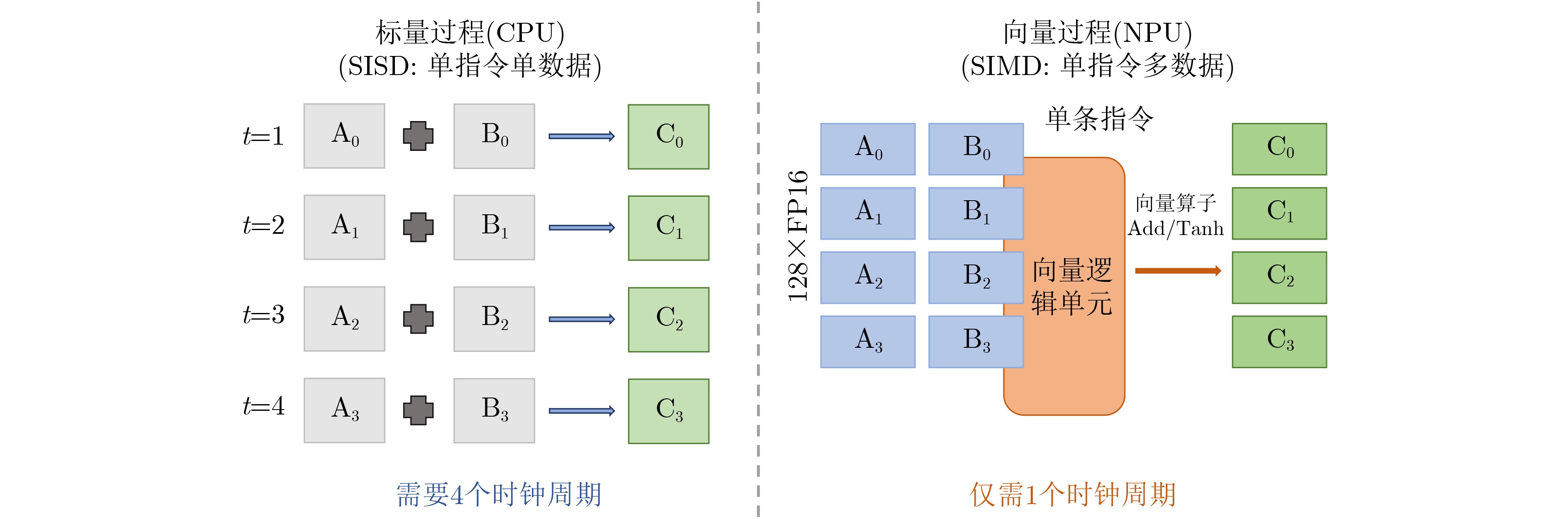
摘要: 6G是新一代智能化综合性数字信息基础设施,将一体化实现通信、感知、计算、智能等功能。基站作为6G无线接入网侧的核心产品形态,正在逐步演变为集通信、计算与AI服务于一体的边缘智能信息服务节点,国产NPU等AI算力芯片正在逐步引入基站侧。利用国产NPU算力实现通信物理层与AI服务的同平台部署,是提升基站算力资源利用率的重要路径。然而,作为物理层关键技术之一的LDPC算法的传统实现通常依赖不规则消息索引访问,其数据组织方式与NPU面向规则张量计算的数据流执行模式存在一定差异,难以直接高效部署。针对上述问题,本文面向昇腾Ascend处理器的达芬奇架构,提出了一种全张量化的并行LDPC译码框架DaVinci-LDPC。首先,针对稀疏矩阵的不规则性,构建了静态图拓扑映射机制,将因子图连接转化为固定的张量索引,大幅减少了运行时的动态分支开销;其次,针对稀疏图随机访存导致的显存带宽瓶颈,提出双重聚合消息传递策略,利用昇腾NPU的向量计算单元高效处理节点间的信息交互;最后,针对算法中双曲函数运算难以向量化以及NPU半精度计算易溢出的问题,设计了向量化双曲正切算子融合方案,在FP16半精度下实现了校验节点更新的高度并行。实验结果表明,DaVinci-LDPC方案在译码精度满足实际通信系统的规范下相较于CPU稀疏实现取得了14.09倍的峰值加速比。Abstract:
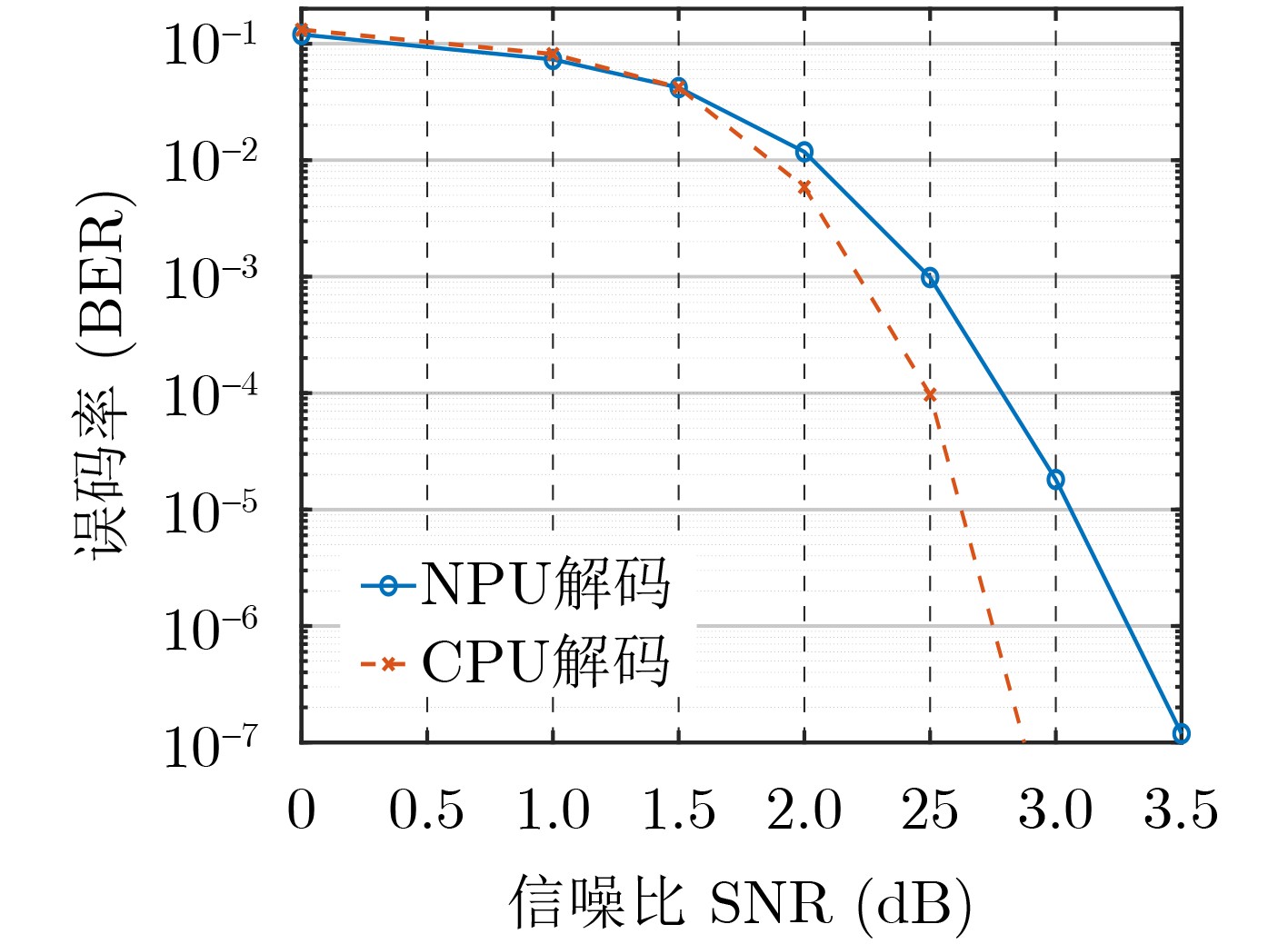
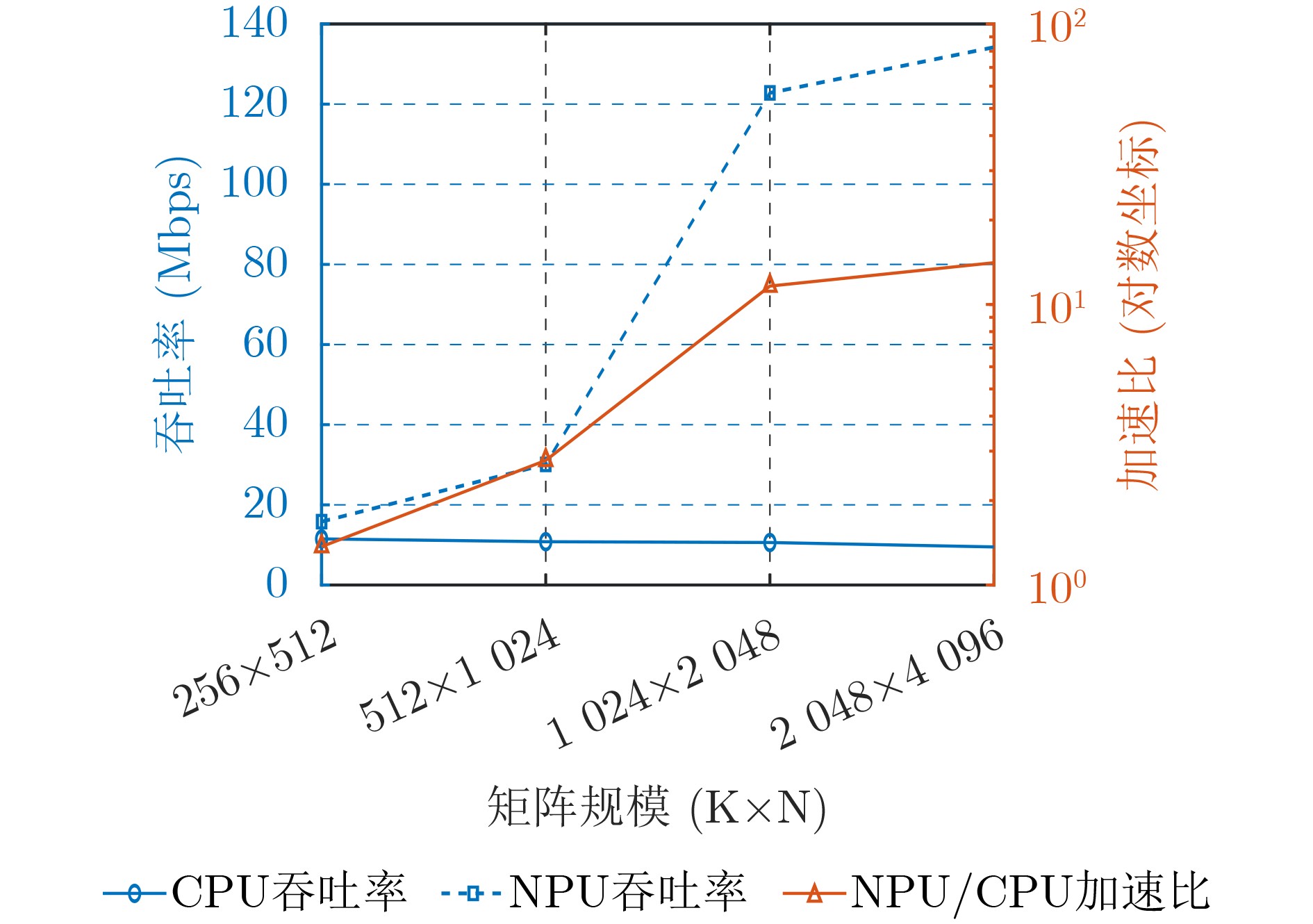
Objective 6G represents a new generation of intelligent, comprehensive digital information infrastructure, integrating communication, sensing, computation, and intelligence. As the core component of the 6G wireless access network, the base station is evolving into an edge-intelligent service node that unifies communication and AI services. Consequently, domestic Artificial Intelligence (AI) accelerators, such as Neural Processing Units (NPUs), are being integrated into base station architectures. Deploying both communication physical layer tasks and AI services on a unified NPU-based platform is essential for maximizing hardware resource utilization. However, Low-Density Parity-Check (LDPC) algorithms, One of the key technologies of physical layer, exhibit non-contiguous memory access patterns due to their sparse graph structures. This creates a fundamental mismatch with the tensor-centric computational architecture of NPUs, hindering efficient deployment. To resolve this, this paper proposes DaVinci-LDPC, an all-tensorized parallel LDPC decoding framework designed specifically for the DaVinci architecture of Huawei Ascend NPUs. Methods To bridge the gap between irregular sparse graphs and rigid tensor hardware, this research implements three key optimization strategies. First, a static graph topology mapping mechanism is constructed to transform factor graph connections into fixed tensor indices, which eliminates dynamic branching during runtime and significantly reduces control-flow overhead. Second, to overcome the memory bandwidth bottlenecks caused by random access, a dual-gather message passing strategy is proposed to efficiently manage information interaction between nodes by utilizing the NPU’s vector calculation units. Finally, a vectorized hyperbolic tangent operator fusion scheme is designed to address the challenges of non-linear function vectorization and potential numerical overflow in FP16 half-precision calculations, enabling highly parallel check node updates while maintaining numerical stability. Results and Discussions The performance of the DaVinci-LDPC framework was evaluated against a highly optimized CPU baseline and strict communication standards. Experimental results demonstrate that while 5G/6G data channels typically require a Bit Error Rate (BER) in the 10–5 range, the NPU-based FP16 implementation maintains a BER in the 10–7 range ( Fig. 4 ), confirming that the precision loss from half-precision computation is well within practical specifications. In terms of throughput, the NPU implementation demonstrates superior scalability as code length increases (Table 2 ,Fig. 5 ), achieving a peak performance speedup of 14.09x compared to the optimized CPU baseline (Table 2 ).Conclusions This study designs and implements an efficient LDPC parallel decoding system on the domestic Huawei Ascend NPU platform, successfully validating the NPU’s acceleration capabilities for 5G/6G physical layer algorithms. By optimizing graph mapping, message passing, and core operators, the DaVinci-LDPC framework resolves the structural mismatch between sparse LDPC factor graphs and the DaVinci tensor architecture. The resulting system achieves high throughput and numerical stability while meeting strict communication accuracy requirements. This work provides a valuable reference for the future deployment of AI-native, software-defined 6G physical layer infrastructures using domestic AI hardware. -
Key words:
- LDPC codes /
- Ascend NPU /
- DaVinci Architecture /
- Parallel computing
-
表 1 实验环境和参数
NPU CPU 处理器 华为Ascend 910AI处理器 Intel Xeon Gold 6248CPU 软件栈 CANN8.1、PyTorch2.5.1 Python3.8、Numba JIT编译器 码字构造 码长N∈{512, 1024 ,2048,4096 },码率固定为1/2同NPU 信道环境 BPSK调制、AWGN信道、信噪比扫描范围0~3.5 dB 同NPU 批大小调优 Batch= 8192 Batch=128  下载: 导出CSV
表 2 不同码长下的吞吐量对比
码长(N) CPU吞吐量(Mbps) NPU吞吐量(Mbps) 加速比(Speedup) 512 11.5 15.8 1.37x 1024 10.8 30.1 2.78x 2048 10.6 122.8 11.63x 4096 9.5 134.2 14.09x
下载: 导出CSV
-
[1] SHAH S D A, HAFEEZ M, SALAMA A, et al. Proactive AI-and-RAN workload orchestration in O-RAN architectures for 6G networks[J]. IEEE Open Journal of the Communications Society, 2025, 6: 7939–7954. doi: 10.1109/OJCOMS.2025.3608700. [2] LIN Xingqin, KUNDU L, CAMMERER S, et al. AI-native 6G: Empowering intelligent RAN with accelerated compute[J]. IEEE Wireless Communications, 2025, 32(6): 11–14. doi: 10.1109/MWC.2025.3620147. [3] DENG Jikang, HASAN S F, ZHOU Hui, et al. AI-native open RAN for non-terrestrial networks: An overview[J]. IEEE Open Journal of the Communications Society, 2026, 7: 1033–1057. doi: 10.1109/OJCOMS.2026.3656366. [4] GOTE P M, KUMAR P, VERMA P, et al. From 5G to 6G: The role of AI, machine learning, and deep learning in wireless systems[C]. 2025 4th International Conference on Sentiment Analysis and Deep Learning, Bhimdatta, Nepal, 2025: 447–452. doi: 10.1109/ICSADL65848.2025.10933016. [5] 朱政宇, 殷梦琳, 姚信威, 等. AI赋能的通感算一体化关键技术研究综述[J]. 电子与信息学报, 2025, 47(10): 3426–3438. doi: 10.11999/JEIT250242.ZHU Zhengyu, YIN Menglin, YAO Xinwei, et al. Overview of the research on key technologies for AI-powered integrated sensing, communication and computing[J]. Journal of Electronics & Information Technology, 2025, 47(10): 3426–3438. doi: 10.11999/JEIT250242. [6] 王新奕, 费泽松, 周一青, 等. 面向物联网的通感算智融合: 关键技术与未来展望[J]. 电子与信息学报, 2025, 47(4): 888–908. doi: 10.11999/JEIT240806.WANG Xinyi, FEI Zesong, ZHOU Yiqing, et al. Integrated sensing, communication, computation, and intelligence towards IoT: Key technologies and future directions[J]. Journal of Electronics & Information Technology, 2025, 47(4): 888–908. doi: 10.11999/JEIT240806. [7] LIAO Heng, TU Jiajin, XIA Jing, et al. Ascend: A scalable and unified architecture for ubiquitous deep neural network computing: Industry track paper[C]. 2021 IEEE International Symposium on High-Performance Computer Architecture, Seoul, Korea, 2021: 789–801. doi: 10.1109/HPCA51647.2021.00071. [8] TANG Yifeng, ZHOU Huaman, JI Zhuoran, et al. Cube-fx: Mapping Taylor expansion onto matrix multiplier-accumulators of Huawei Ascend AI processors[J]. IEEE Transactions on Parallel and Distributed Systems, 2025, 36(6): 1115–1129. doi: 10.1109/TPDS.2025.3557444. [9] HEISLER M L, XING Linzi, SHI Ge, et al. Enhancing learned knowledge in LoRA adapters through efficient contrastive decoding on Ascend NPUs[C]. Proceedings of the 31st ACM SIGKDD Conference on Knowledge Discovery and Data Mining V. 2, Toronto, Canada, 2025: 4499–4510. doi: 10.1145/3711896.3737215. [10] GALLAGER R. Low-density parity-check codes[J]. IRE Transactions on Information Theory, 1962, 8(1): 21–28. doi: 10.1109/TIT.1962.1057683. [11] SHOKROLLAHI A. LDPC codes: An introduction[M]. FENG Keqin, NIEDERREITER H, and XING Chaoping. Coding, Cryptography and Combinatorics. Basel: Birkhäuser, 2004: 85–110. doi: 10.1007/978-3-0348-7865-4_5. [12] FERRAZ O, SUBRAMANIYAN S, CHINTHALA R, et al. A survey on high-throughput non-binary LDPC decoders: ASIC, FPGA, and GPU architectures[J]. IEEE Communications Surveys & Tutorials, 2022, 24(1): 524–556. doi: 10.1109/COMST.2021.3126127. [13] YUN Sangbu, CHOE J, and LEE Y. High-throughput software-defined LDPC encoder and decoder with x86-based data-level parallelism[J]. IEEE Transactions on Vehicular Technology, 2025, 74(1): 50–60. doi: 10.1109/TVT.2024.3452718. [14] SEVER M and ÇAVUS E. Parallelizing LDPC decoding using OpenMP on multicore digital signal processors[C]. 2016 45th International Conference on Parallel Processing Workshops, Philadelphia, USA, 2016: 46–51. doi: 10.1109/ICPPW.2016.22. [15] POURJABAR S and CHOI G S. A high-throughput multi-mode LDPC decoder for 5G NR[J]. arXiv preprint arXiv: 2102.13228, 2021. (查阅网上资料, 不确定本条文献类型及格式是否正确, 请确认) doi: 10.48550/arXiv.2102.13228. [16] ZHANG Yifan, SUN Lei, and CAO Qiang. TLP-LDPC: Three-level parallel FPGA architecture for fast prototyping of LDPC decoder using high-level synthesis[J]. Journal of Computer Science and Technology, 2022, 37(6): 1290–1306. doi: 10.1007/s11390-022-1499-9. [17] 周华, 周鸣, 张立康. 低密度奇偶校验码正则化神经网络归一化最小和译码算法[J]. 电子与信息学报, 2025, 47(5): 1486–1493. doi: 10.11999/JEIT240860.ZHOU Hua, ZHOU Ming, and ZHANG Likang. Regularized neural network-based normalized min-sum decoding for LDPC codes[J]. Journal of Electronics & Information Technology, 2025, 47(5): 1486–1493. doi: 10.11999/JEIT240860. [18] JOUPPI N P, YOUNG C, PATIL N, et al. In-datacenter performance analysis of a tensor processing unit[C]. Proceedings of the 44th Annual International Symposium on Computer Architecture, Toronto, Canada, 2017: 1–12. doi: 10.1145/3079856.3080246. [19] LUGOSCH L and GROSS W J. Neural offset min-sum decoding[C]. 2017 IEEE International Symposium on Information Theory, Aachen, Germany, 2017: 1361–1365. doi: 10.1109/ISIT.2017.8006751. [20] NACHMANI E, MARCIANO E, LUGOSCH L, et al. Deep learning methods for improved decoding of linear codes[J]. IEEE Journal of Selected Topics in Signal Processing, 2018, 12(1): 119–131. doi: 10.1109/JSTSP.2017.2788405. [21] WRIGLEY A, LEE W S, and YE Nan. Tensor belief propagation[C]. Proceedings of the 34th International Conference on Machine Learning, Sydney, Australia, 2017: 3771–3779. [22] DAVE S, BAGHDADI R, NOWATZKI T, et al. Hardware acceleration of sparse and irregular tensor computations of ML models: A survey and insights[J]. Proceedings of the IEEE, 2021, 109(10): 1706–1752. doi: 10.1109/JPROC.2021.3098483. [23] ISAAC-CHASSANDE V, EVANS A, DURAND Y, et al. Dedicated hardware accelerators for processing of sparse matrices and vectors: A survey[J]. ACM Transactions on Architecture and Code Optimization, 2024, 21(2): 27. doi: 10.1145/3640542. [24] ANDRADE J, FALCAO G, SILVA V, et al. A survey on programmable LDPC decoders[J]. IEEE Access, 2016, 4: 6704–6718. doi: 10.1109/ACCESS.2016.2594265. [25] WANG Yinuo, SONG Zeyu, WAN Wubing, et al. Accelerating half-precision seismic simulation on neural processing unit[J]. IEEE Transactions on Parallel and Distributed Systems, 2025, 36(10): 1998–2013. doi: 10.1109/TPDS.2025.3584773. [26] LIAO Heng, TU Jiajin, XIA Jing, et al. DaVinci: A scalable architecture for neural network computing[C]. 2019 IEEE Hot Chips 31 Symposium, Cupertino, USA, 2019: 1–44. doi: 10.1109/HOTCHIPS.2019.8875654. [27] 梁晓峣. 昇腾AI处理器架构与编程: 深入理解CANN技术原理及应用[M]. 北京: 清华大学出版社, 2019.LIANG Xiaoyao. Ascend AI Processor Architecture and Programming: Principles and Applications of CANN[M]. Beijing: Tsinghua University Press, 2019. . [28] AI Xin, ZHANG Bing, WANG Qiange, et al. NeutronAscend: Optimizing GNN training with Ascend AI processors[J]. ACM Transactions on Architecture and Code Optimization, 2025, 22(4): 123. doi: 10.1145/3762662. -


 下载:



图(5) / 表(2)
计量
- 文章访问数: 17
- HTML全文浏览量: 5
- PDF下载量: 0
- 被引次数: 0
