




Resource Allocation Optimization in Dual-RIS Cooperative Rate-Splitting Multiple Access Networks
-
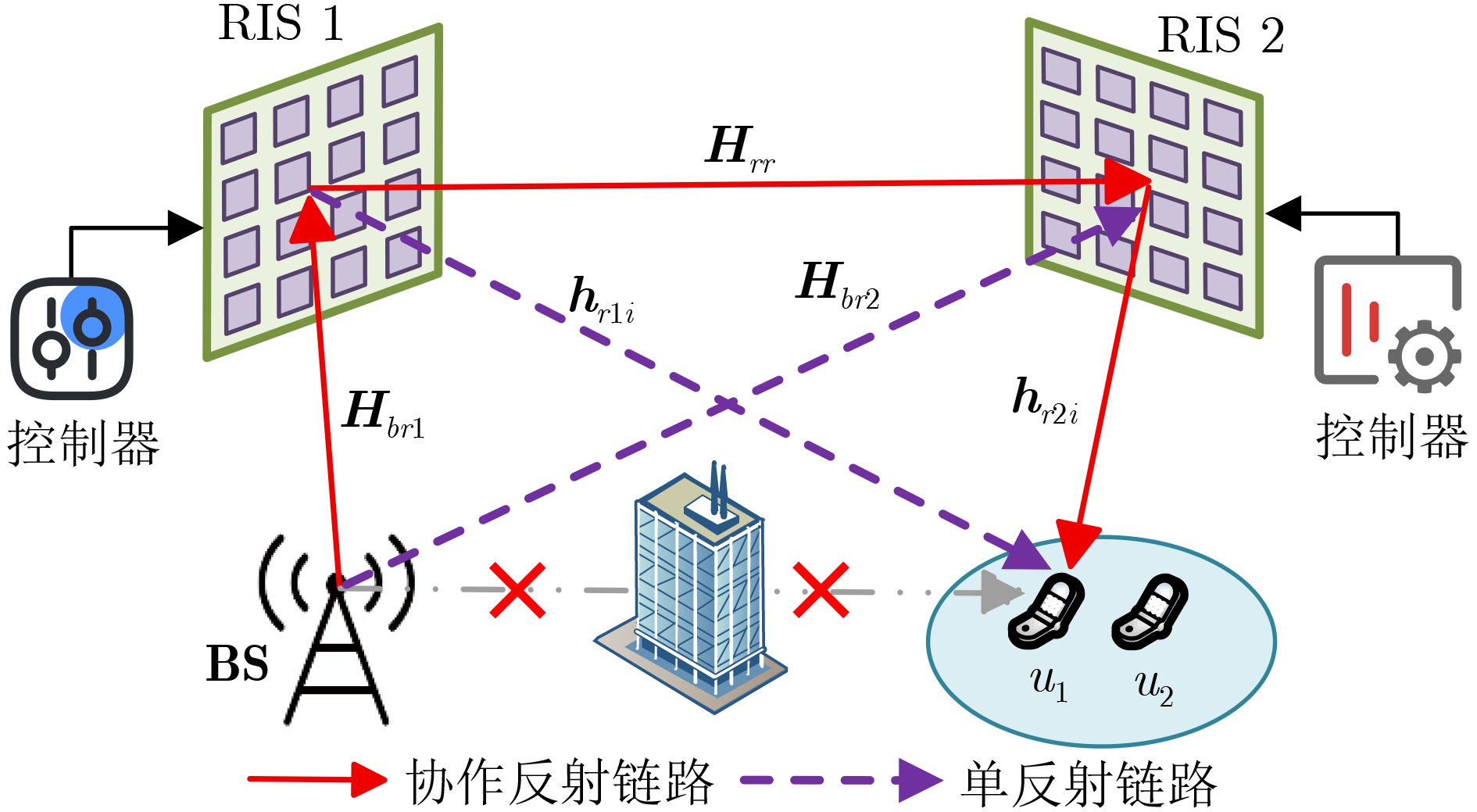
摘要: 速率拆分多址接入技术(RSMA)凭借灵活的干扰管理能力,被视为提升6G网络的频谱效率的关键使能技术。然而,现有RSMA方案仍存在用户公平性不足、可扩展性差及固定信道约束等问题。为此,该文提出双智能反射面(RIS)协作的RSMA通信系统,以充分挖掘RIS的信道重构潜力。系统通过双RIS间的联合反射建立级联视距链路,从而增强公共流解码性能并抑制复杂干扰。在满足用户服务质量(QoS)约束下,该文建立了以系统总传输速率最大化为目标的资源分配方案,对基站侧波束成形(BF)、速率拆分(RS)以及双RIS相位配置进行联合优化。针对变量强耦合与非凸性,该文提出了基于半正定松弛(SDR)和逐次凸逼近(SCA)的低复杂度交替优化算法。仿真结果表明,所提算法能有效收敛至高质量次优解;与现有先进方案相比,双RIS协作的RSMA系统在总传输速率上至少提升11.9%的增益,并显著改善了用户公平性和系统鲁棒性。Abstract:
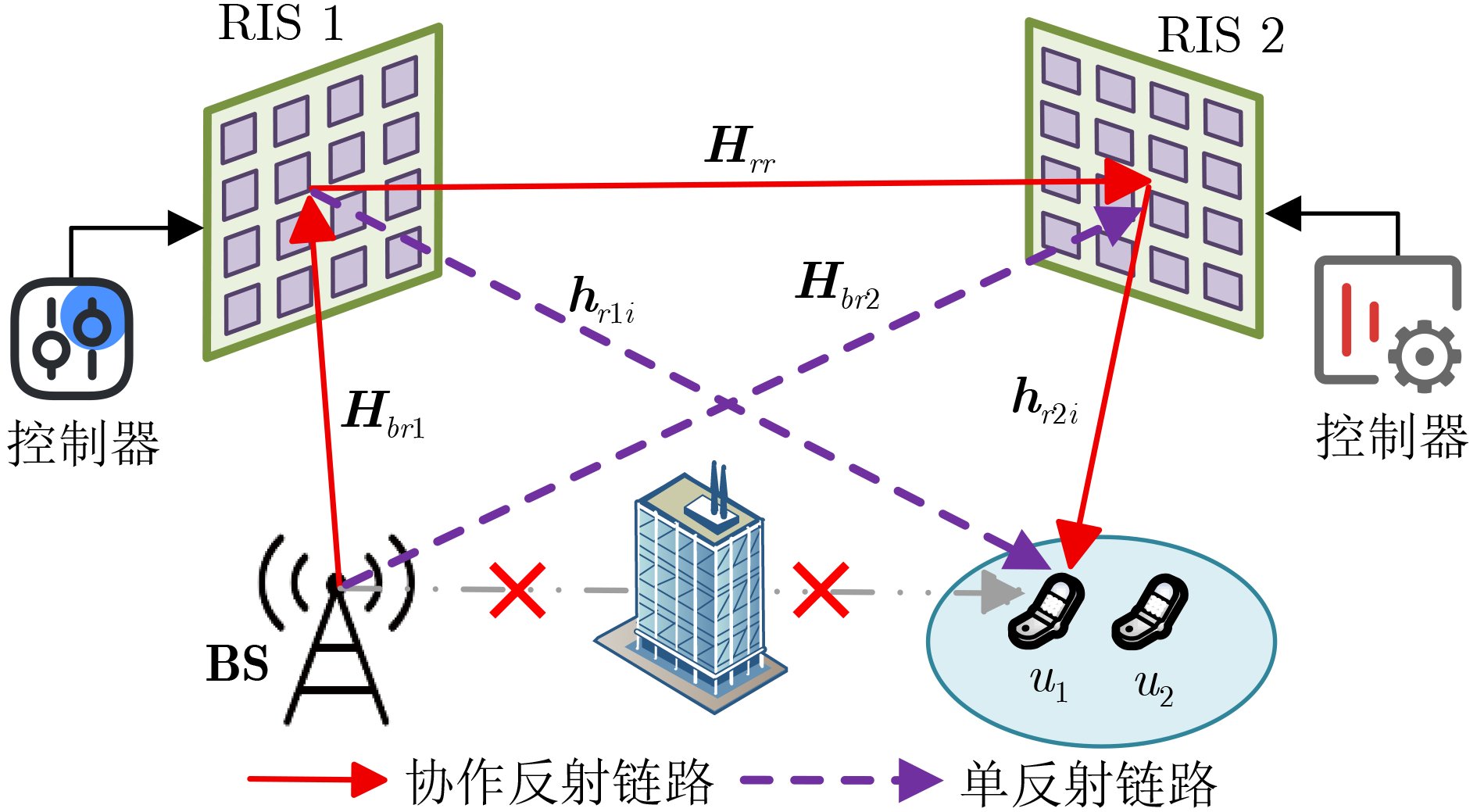
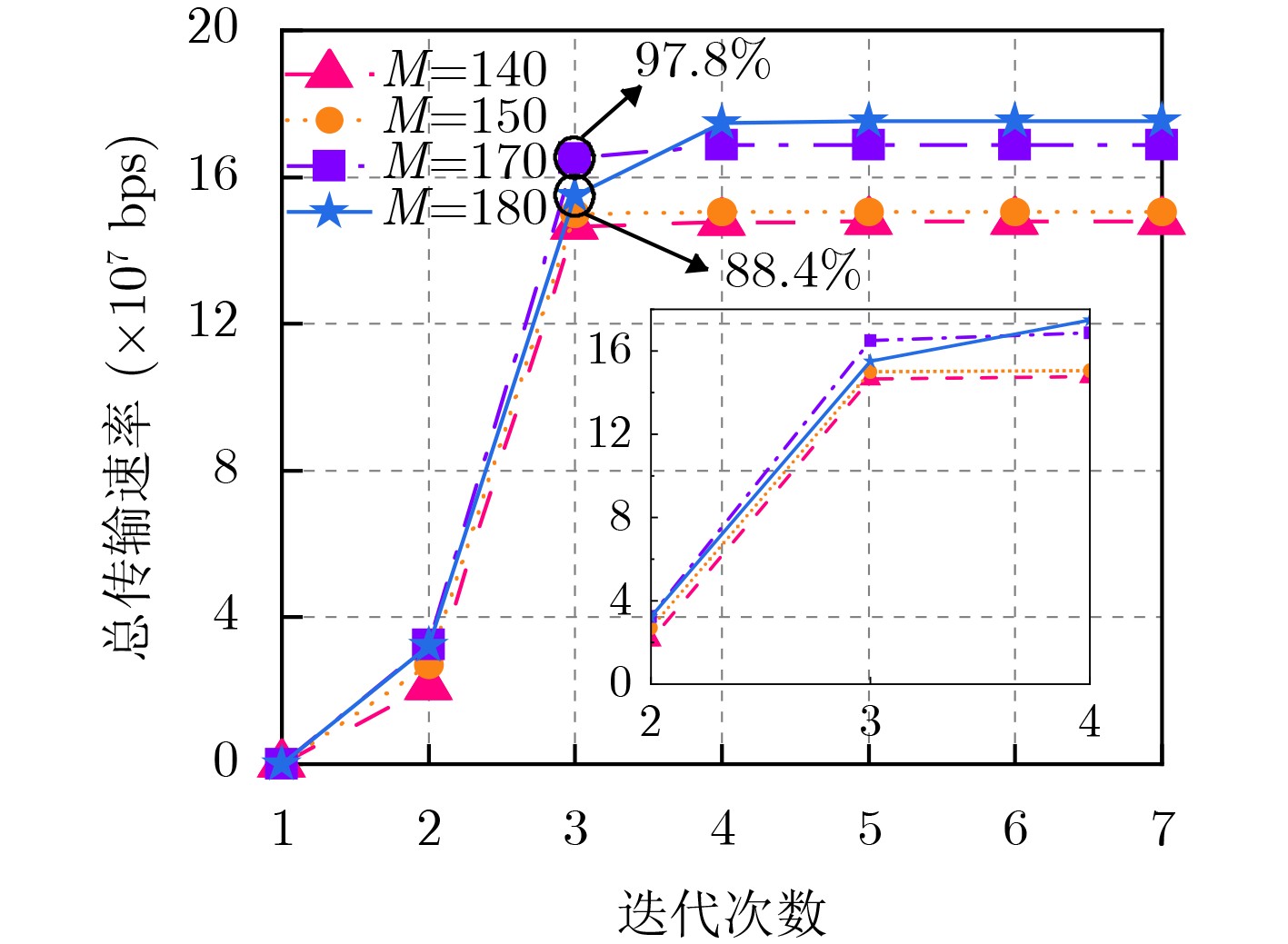
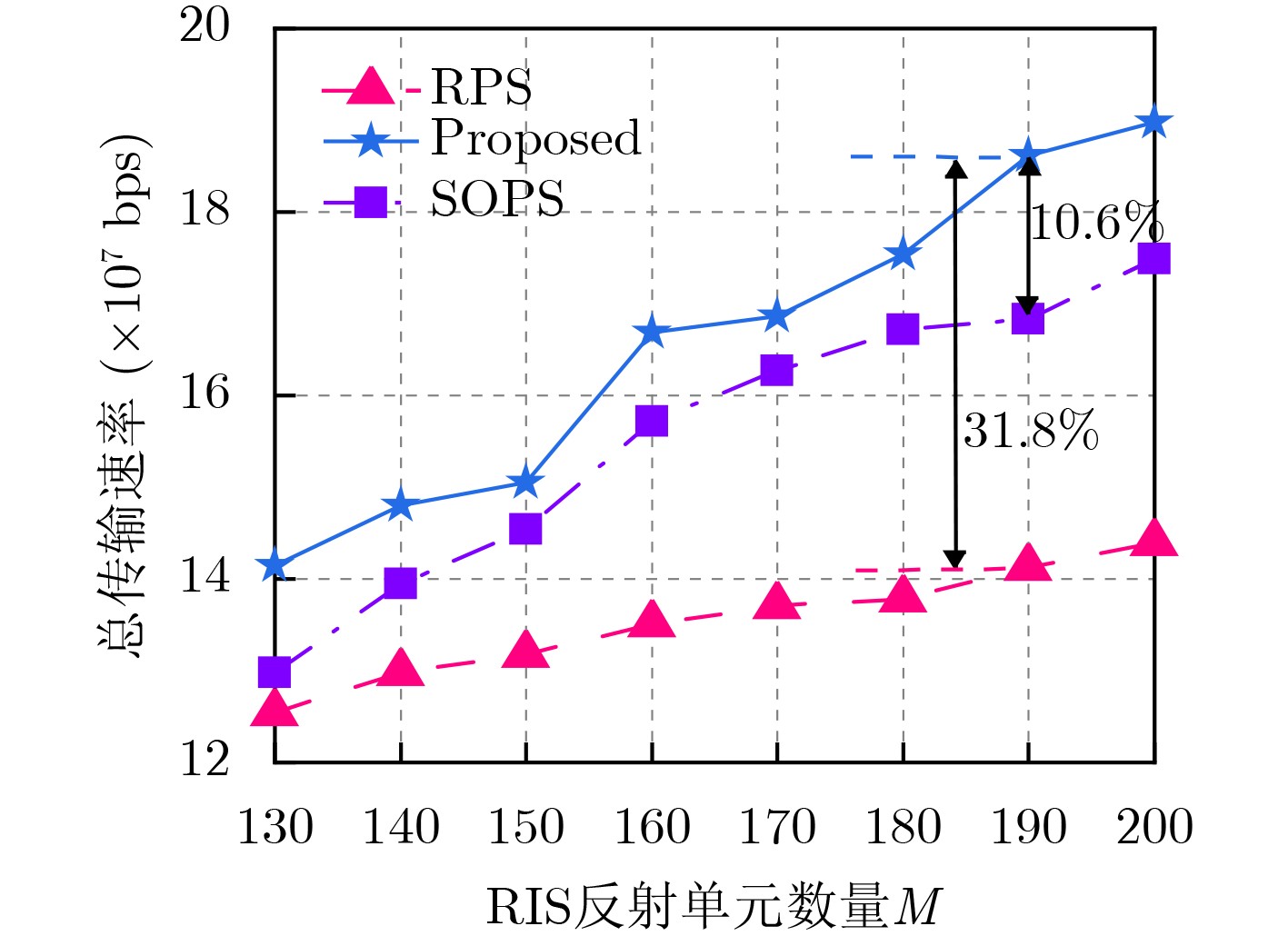
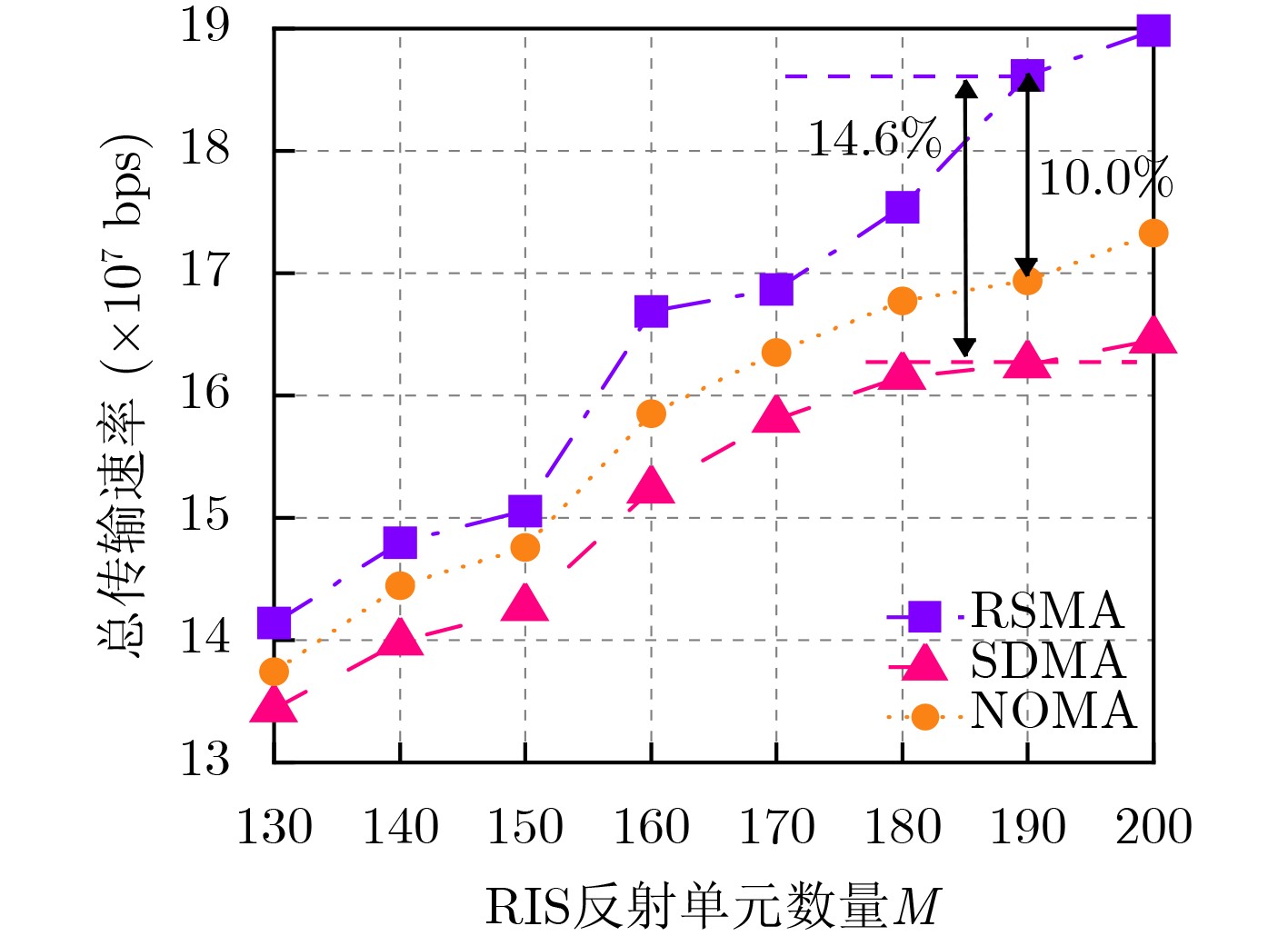
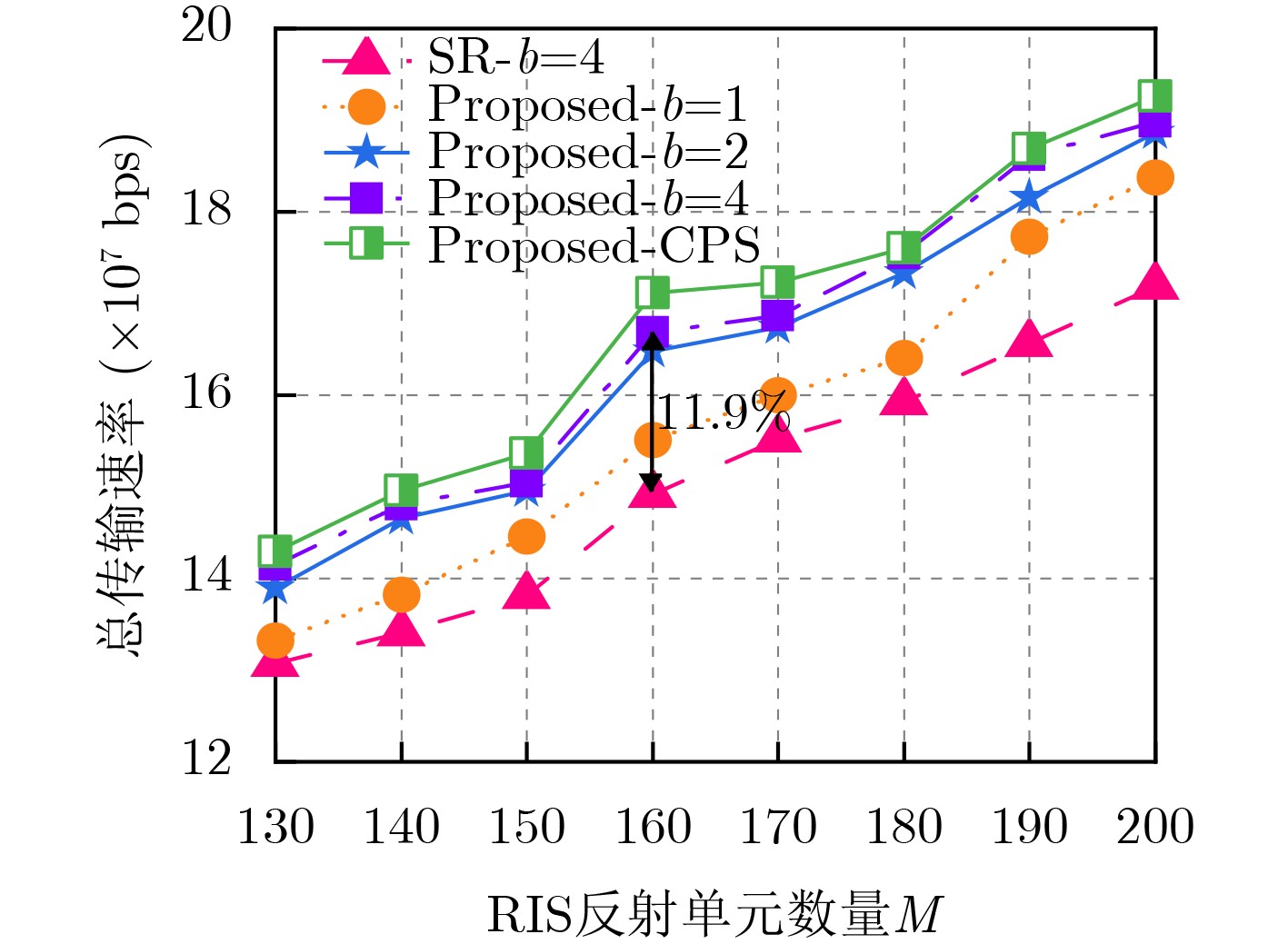
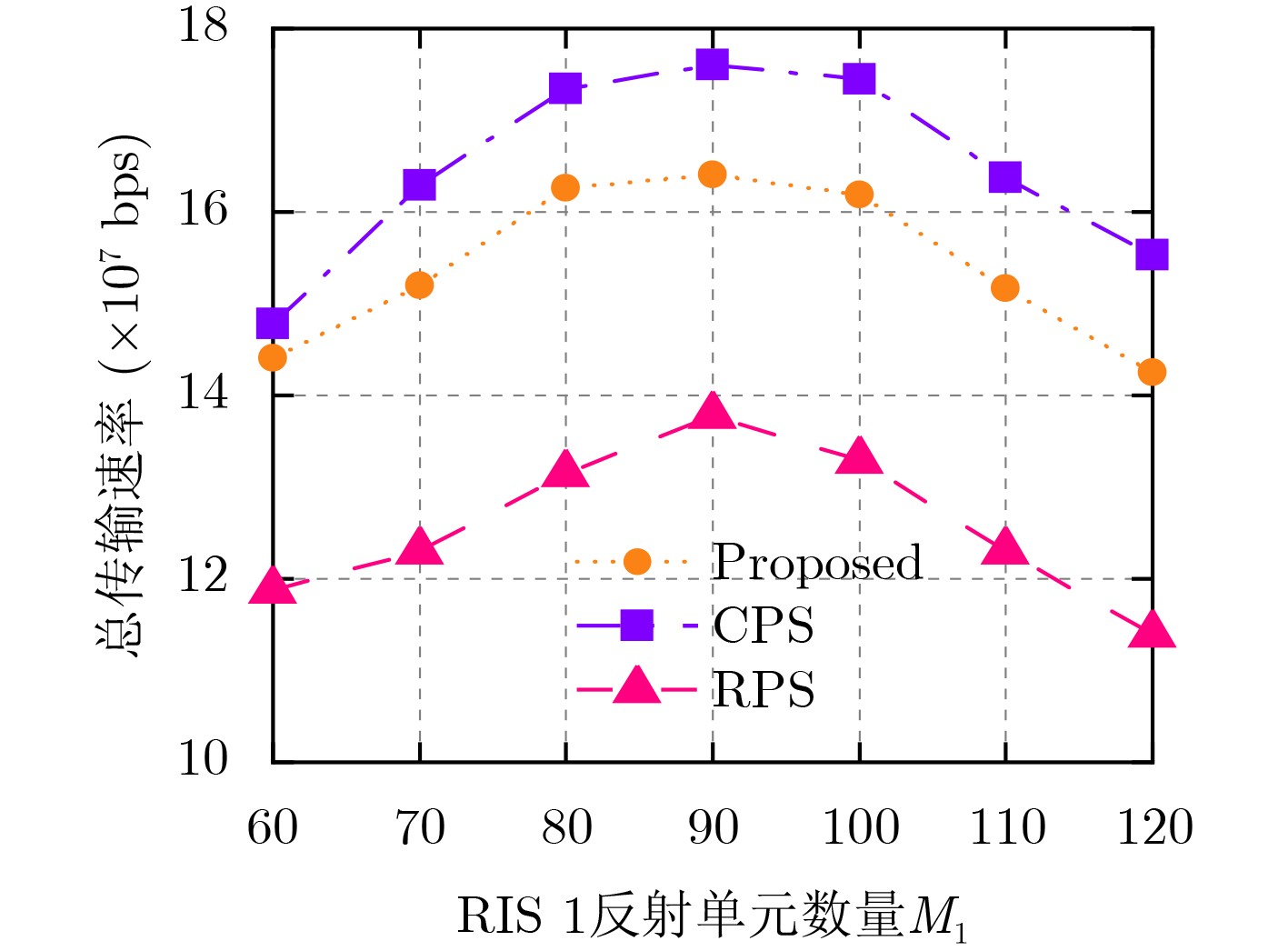
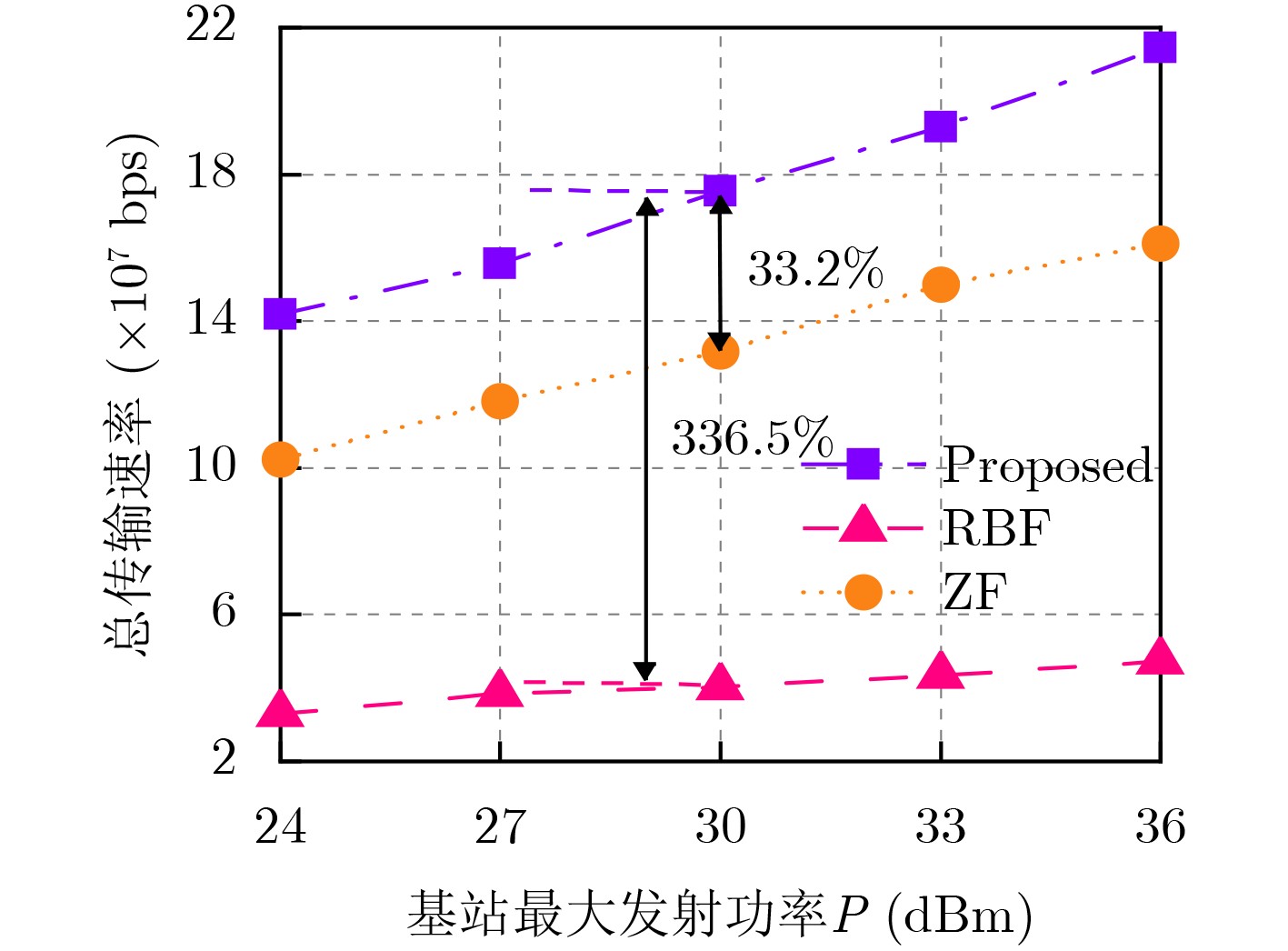
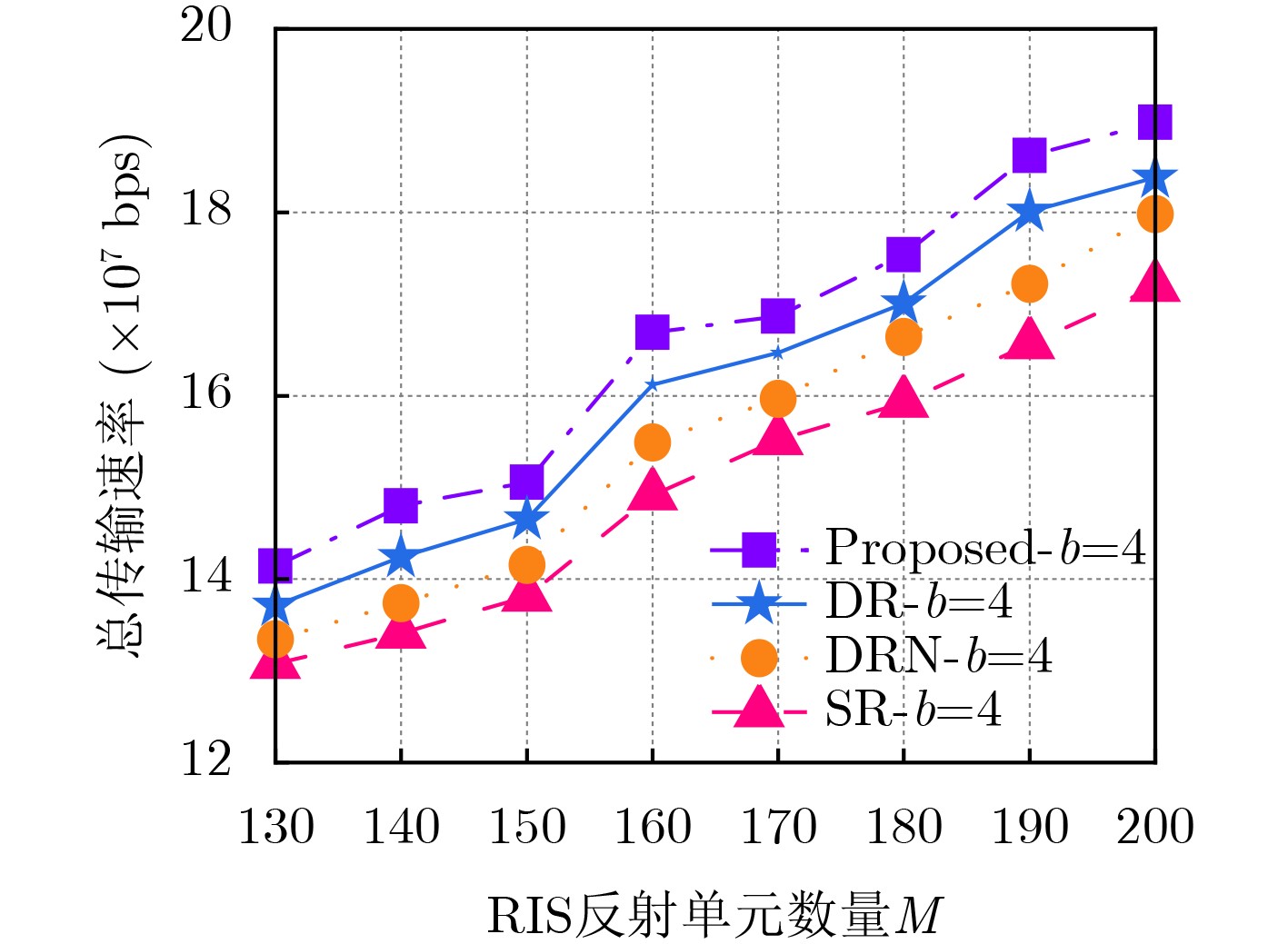
Objective In Rate-Splitting Multiple Access (RSMA) systems, the achievable common-stream rate is limited by the user with the weakest channel quality. This constraint reduces scalability, robustness, and user fairness in dense 6G networks. Existing cooperative RSMA architectures partly reduce this bottleneck, but they remain constrained by fixed channel conditions and limited interference management. To address these issues, this paper proposes a dual Reconfigurable Intelligent Surface (RIS) cooperative RSMA system. Two cooperatively deployed RISs create additional controllable propagation paths through cascaded double reflection. The objective is to maximize the system sum rate by jointly optimizing Base Station (BS) Beamforming (BF), Rate Splitting (RS) strategies, and dual-RIS phase configurations, thereby improving spectral efficiency, robustness, and user fairness under users’ Quality of Service (QoS) constraints. Methods A tractable system model is developed for the dual-RIS cooperative RSMA system. The model captures cascaded multi-link channels, multi-node channel structures, and interference coupling. Based on this model, a joint optimization problem is formulated to maximize the system sum rate by optimizing BS BF, RS strategies, and the discrete phase shifts of both RISs. Because of strong variable coupling and non-convexity, a low-complexity Alternating Optimization (AO) algorithm is designed. The original problem is decomposed into three subproblems: BS-side RIS phase optimization, user-side RIS phase optimization, and BS BF optimization. Semidefinite Relaxation (SDR) and Successive Convex Approximation (SCA) are used to transform these subproblems into tractable convex forms, which are then solved iteratively with fast convergence. Results and Discussions Simulation results verify the effectiveness of the proposed dual-RIS cooperative RSMA system. The proposed AO algorithm converges within six iterations under different numbers of RIS reflecting elements, and it reaches 97.8% of the steady-state sum rate within three iterations when M = 170 ( Fig. 3 ). Compared with SOPS and RPS, the proposed phase-configuration scheme obtains 10.6% and 31.8% sum-rate gains when M = 190, respectively (Fig. 4 ). The proposed RSMA scheme also outperforms NOMA and SDMA by 10.0% and 14.6%, respectively (Fig. 5 ). Under M = 160 and b = 4, dual-RIS cooperation provides an 11.9% sum-rate gain over the single-RIS scheme, and its performance is close to the CPS upper bound (Fig. 6 ). Balanced allocation of reflecting elements between the two RISs further improves the sum rate (Fig. 7 ). The proposed BF strategy also outperforms ZF and RBF, achieving 33.2% and 336.5% gains at a transmit power of 30 dBm, respectively (Fig. 8 ). Under different RIS cooperation modes, the proposed joint optimization scheme achieves the best overall performance (Fig. 9 ). These results show that dual-RIS cooperative RSMA improves common-stream decoding, interference suppression, robustness, and user fairness.Conclusions This paper investigates a dual-RIS cooperative RSMA communication system. The proposed architecture improves common-stream decoding while mitigating complex interference. To maximize the system sum rate, BS BF vectors, RS vectors, and the discrete phase matrices of two RISs are jointly optimized. A low-complexity AO algorithm based on SDR and SCA is developed to solve the strongly coupled non-convex problem. Simulation results show that the proposed dual-RIS cooperative RSMA scheme achieves clear sum-rate gains over advanced benchmark schemes. Compared with the single-RIS mode and SDMA, it obtains 11.9% and 14.6% rate gains, respectively, while improving system robustness and user fairness. -
1 基于SDR和SCA的交替优化迭代算法
Initialize: 迭代次数$ n=1 $,最大迭代次数$ n\mathrm{_{max}} $,求解精度$ \epsilon $,$ {R}^{\left(0\right)}=0 $,初始化$ \boldsymbol{\theta }_{1}^{\left(0\right)} $,$ \boldsymbol{\theta }_{2}^{\left(0\right)} $,$ {\boldsymbol{w}}^{\left(0\right)} $和$ {\boldsymbol{c}}^{\left(0\right)} $。 1: while $ {R}^{\left(n\right)}-{R}^{\left(n-1\right)} \gt \epsilon $并且$ n \lt n\mathrm{_{max}} $do 2: 根据$ \boldsymbol{\theta }_{2}^{\left(n-1\right)} $,$ {\boldsymbol{w}}^{\left(n-1\right)} $和$ {\boldsymbol{c}}^{\left(n-1\right)} $,求解问题$ \mathcal{P}2.1.2 $,得到$ \boldsymbol{\varphi }_{1}^{\left(n\right)} $并重构秩一解,得到$ \boldsymbol{\theta }_{1}^{\left(n\right)} $; 3: 根据$ \boldsymbol{\theta }_{1}^{\left(n\right)} $, $ {\boldsymbol{w}}^{\left(n-1\right)} $和$ {\boldsymbol{c}}^{\left(n-1\right)} $,求解问题$ \mathcal{P}2.2 $,得到$ \boldsymbol{\varphi }_{2}^{\left(n\right)} $并重构秩一解,得到$ \boldsymbol{\theta }_{2}^{\left(n\right)} $; 4: 根据$ \boldsymbol{\theta }_{1}^{\left(n\right)} $和$ \boldsymbol{\theta }_{2}^{\left(n\right)} $,求解问题$ \mathcal{P}2.3.2 $,得到$ {\boldsymbol{W}}^{\left(n\right)} $和$ {\boldsymbol{c}}^{\left(n\right)} $; 5: 更新$ \boldsymbol{\varphi }_{1}^{\left(n-1\right)} $, $ \boldsymbol{\varphi }_{2}^{\left(n-1\right)} $和$ {\boldsymbol{W}}^{\left(n-1\right)} $; 6: 分解$ {\boldsymbol{W}}^{\left(n\right)} $得到$ {\boldsymbol{w}}^{\left(n\right)} $; 7: 根据$ \boldsymbol{\theta }_{1}^{\left(n\right)} $, $ \boldsymbol{\theta }_{2}^{\left(n\right)} $, $ {\boldsymbol{w}}^{\left(n\right)} $和$ {\boldsymbol{c}}^{\left(n\right)} $计算$ {R}^{\left(n+1\right)} $; 8: $ n=n+1 $; 9: end Output:$ R^{*}=R^{(n)} $;  下载: 导出CSV
表 1 仿真参数设置
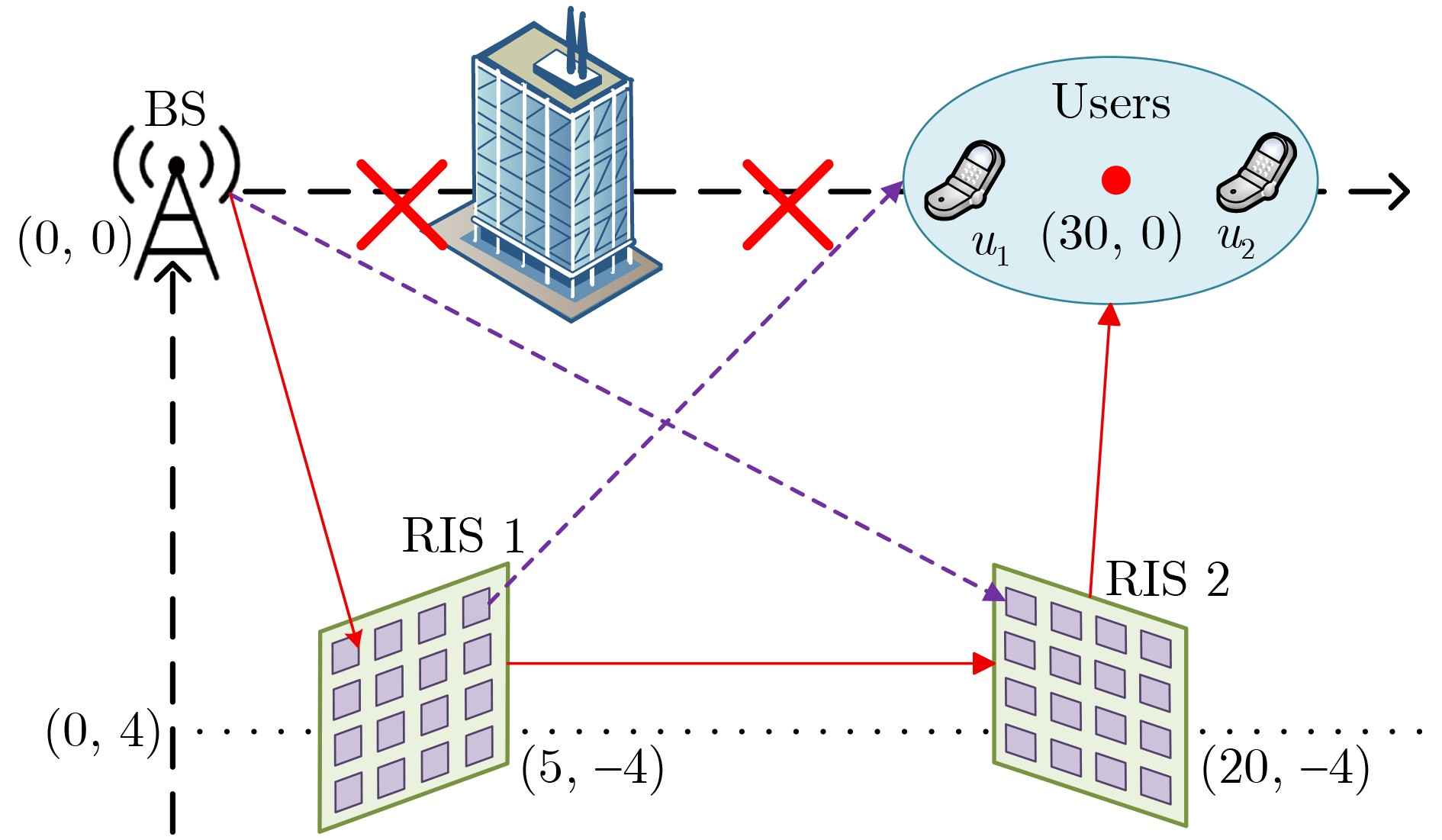
参数 取值 BS天线数 4 系统带宽 1 MHz BS最大发射功率 30 dBm 噪声功率 –80 dBm/Hz RIS相位量化系数 4 用户最小速率阈值 0.5 Mbps
下载: 导出CSV
-
[1] CLERCKX B, MAO Yijie, YANG Zhaohui, et al. Multiple access techniques for intelligent and multifunctional 6G: Tutorial, survey, and outlook[J]. Proceedings of the IEEE, 2024, 112(7): 832–879. doi: 10.1109/JPROC.2024.3409428. [2] ZHANG Yao, ZHU Yongxu, WANG Dongming, et al. A comparison between RSMA, NOMA, and SDMA in cell-free massive MIMO systems: From a secrecy perspective[J]. IEEE Transactions on Communications, 2025, 73(12): 13772–13787. doi: 10.1109/TCOMM.2025.3610223. [3] CHEN Yuang, LU Hancheng, QIN Langtian, et al. When xURLLC Meets NOMA: A stochastic network calculus perspective[J]. IEEE Communications Magazine, 2024, 62(6): 90–96. doi: 10.1109/MCOM.020.2300156. [4] QIN Langtian, LU Hancheng, CHEN Yuang, et al. Joint transmission and resource optimization in NOMA-assisted IoVT with mobile edge computing[J]. IEEE Transactions on Vehicular Technology, 2024, 73(7): 9984–9999. doi: 10.1109/TVT.2024.3364358. [5] MAO Yijie, DIZDAR O, CLERCKX B, et al. Rate-splitting multiple access: Fundamentals, survey, and future research trends[J]. IEEE Communications Surveys & Tutorials, 2022, 24(4): 2073–2126. doi: 10.1109/COMST.2022.3191937. [6] CLERCKX B, MAO Yijie, JORSWIECK E A, et al. A primer on rate-splitting multiple access: Tutorial, myths, and frequently asked questions[J]. IEEE Journal on Selected Areas in Communications, 2023, 41(5): 1265–1308. doi: 10.1109/JSAC.2023.3242718. [7] CHEN Yuang, LU Hancheng, ZHANG Chenwu, et al. Enhancing xURLLC with RSMa-assisted massive-MIMO networks: Performance analysis and optimization[J]. IEEE Transactions on Communications, 2025, 73(10): 8886–8903. doi: 10.1109/TCOMM.2025.3581971. [8] CHEN Yuang, LU Hancheng, WU Chang, et al. Performance optimization in RSMA-assisted uplink xURLLC IIoT networks with statistical QoS provisioning[J]. IEEE Transactions on Wireless Communications, 2025, 24(12): 10100–10115. doi: 10.1109/TWC.2025.3577694. [9] NOSRATINIA A, HUNTER T E, and HEDAYAT A. Cooperative communication in wireless networks[J]. IEEE Communications Magazine, 2004, 42(10): 74–80. doi: 10.1109/MCOM.2004.1341264. [10] KHISA S, ELHATTAB M, ASSI C, et al. Coordinated full-duplex cooperative transmission with RSMA in multi-cell networks[J]. IEEE Communications Letters, 2025, 29(12): 2959–2963. doi: 10.1109/LCOMM.2025.3621135. [11] YANG Junliang, GAO Shaoshuai, LU Yan, et al. Max-min fairness of cooperative RSMA for aggregated VLC/RF systems[J]. IEEE Communications Letters, 2025, 29(3): 552–556. doi: 10.1109/LCOMM.2025.3530139. [12] YAN Jiaqi and JIA Hou. Performance analysis of cooperative RSMA-SWIPT communication system[C]. 2025 International Conference on Computing, Networking and Communications, Honolulu, USA, 2025: 854–858. doi: 10.1109/ICNC64010.2025.10993579. [13] LI Xingwang, WANG Xiaoyao, ZHANG Hui, et al. QoS-aware performance analysis of full-duplex RSMA vehicle road cooperation systems[J]. IEEE Internet of Things Journal, 2024, 11(22): 36053–36065. doi: 10.1109/JIOT.2024.3424559. [14] SANG Xichao, GUI Lin, YING Kai, et al. Cooperative integrated communication and positioning design via rate-splitting multiple access and channel estimation enhancement[J]. IEEE Transactions on Wireless Communications, 2025, 24(3): 1786–1800. doi: 10.1109/TWC.2024.3505875. [15] LIU Yuanwei, LIU Xiao, MU Xidong, et al. Reconfigurable intelligent surfaces: Principles and opportunities[J]. IEEE Communications Surveys & Tutorials, 2021, 23(3): 1546–1577. doi: 10.1109/COMST.2021.3077737. [16] ELMOSSALLAMY M A, ZHANG Hongliang, SONG Lingyang, et al. Reconfigurable intelligent surfaces for wireless communications: Principles, challenges, and opportunities[J]. IEEE Transactions on Cognitive Communications and Networking, 2020, 6(3): 990–1002. doi: 10.1109/TCCN.2020.2992604. [17] KHISA S, ELHATTAB M, ASSI C, et al. Energy consumption optimization in RIS-assisted cooperative RSMA cellular networks[J]. IEEE Transactions on Communications, 2023, 71(7): 4300–4312. doi: 10.1109/TCOMM.2023.3270907. [18] PALA S, KATWE M, SINGH K, et al. Robust transmission design for RIS-aided full-duplex-RSMA V2X communications via multi-agent DRL[J]. IEEE Transactions on Vehicular Technology, 2025, 74(1): 761–775. doi: 10.1109/TVT.2024.3453253. [19] WANG Wenhao, YANG Lei, ZHAN Yueying, et al. Robust resource allocation design for energy-efficient active IRS-aided C-RSMA systems[J]. IEEE Transactions on Communications, 2025, 73(7): 5168–5183. doi: 10.1109/TCOMM.2024.3506933. [20] WANG Dawei, LI Jiawei, LV Qinyi, et al. Integrating reconfigurable intelligent surface and AAV for enhanced secure transmissions in IoT-enabled RSMA networks[J]. IEEE Internet of Things Journal, 2025, 12(8): 9405–9419. doi: 10.1109/JIOT.2024.3523500. [21] ZHANG Yiran, YANG Liang, LI Xingwang, et al. Covert communications for STAR-RIS-assisted industrial networks with a full duplex receiver and RSMA[J]. IEEE Internet of Things Journal, 2024, 11(12): 22483–22493. doi: 10.1109/JIOT.2024.3381166. [22] 李斌, 杨冬东. 同时透射反射可重构智能表面赋能移动边缘计算任务卸载研究[J]. 电子与信息学报, 2025, 47(2): 418–426. doi: 10.11999/JEIT240733.LI Bin and YANG Dongdong. Task offloading for simultaneously transmitting and reflecting reconfigurable intelligent surface-assisted mobile edge computing[J]. Journal of Electronics & Information Technology, 2025, 47(2): 418–426. doi: 10.11999/JEIT240733. [23] 王华华, 孙宸, 朱鹏云. 可重构智能表面辅助双功能雷达通信系统的联合波束优化[J]. 电子与信息学报, 2024, 46(1): 222–228. doi: 10.11999/JEIT221537.WANG Huahua, SUN Chen, and ZHU Pengyun. Joint beamforming optimization for RIS-assisted dual-functional radar-communication systems[J]. Journal of Electronics & Information Technology, 2024, 46(1): 222–228. doi: 10.11999/JEIT221537. [24] 吴昌, 彭铭宇, 陈雨昂, 等. 面向无线虚拟现实传输的生理信号驱动体验质量优化[J]. 电子与信息学报, 2026, 48(7): 2943–2954. doi: 10.11999/JEIT260067.WU Chang, PENG Mingyu, CHEN Yuang, et al. Physiological signal-driven QoE optimization for wireless virtual reality transmission[J]. Journal of Electronics & Information Technology, 2026, 48(7): 2943–2954. doi: 10.11999/JEIT260067. [25] YANG Gang, XU Xinyue, LIANG Yingchang, et al. Reconfigurable intelligent surface-assisted non-orthogonal multiple access[J]. IEEE Transactions on Wireless Communications, 2021, 20(5): 3137–3151. doi: 10.1109/TWC.2020.3047632. [26] ACOSTA M R C, MORETA C E G, and KOO I. Joint power allocation and power splitting for MISO-RSMA cognitive radio systems with SWIPT and information decoder users[J]. IEEE Systems Journal, 2021, 15(4): 5289–5300. doi: 10.1109/JSYST.2020.3032725. -

 下载:
下载:

图(9) / 表(2)
计量
- 文章访问数: 674
- HTML全文浏览量: 320
- PDF下载量: 56
- 被引次数: 0
