




A Two-layer Closed-loop Cooperative Resource Allocation Framework for Improving QoS of MEC Network Slicing
-
摘要: 在5G/6G驱动的多接入边缘计算(MEC)环境中,提高资源利用率的同时,确保异构网络切片的服务质量(QoS)具有重要意义。然而,当前方法在异构环境下缺乏动态适应性,无法协同优化缓存、带宽和计算资源,存在资源利用率下降、服务成功率下降等问题。该文首先形式化定义了网络切片资源分配问题,并通过将多维0-1背包问题归约到该问题来证明其是NP-难问题。然后提出了一种具有缓存感知的双层闭环协同资源分配框架,上层构建一种群体协同的全局搜索机制,通过候选解演化、历史最优引导与自适应参数调整,在复杂约束条件下生成高质量资源候选分配方案,下层构建一个多维权重评估模型以准确将低延迟、高带宽的服务需求指标转化为QoS约束,通过上下双层闭环协同实现缓存、带宽和计算资源的联合优化,进而改善了异构网络切片的QoS。大量实验表明,与基线方法相比,所提方法使资源利用率提升2.29%~24.50%,用户评分提升4.13%~59.34%,为异构MEC环境提供了一种鲁棒的资源分配解决方案。Abstract:
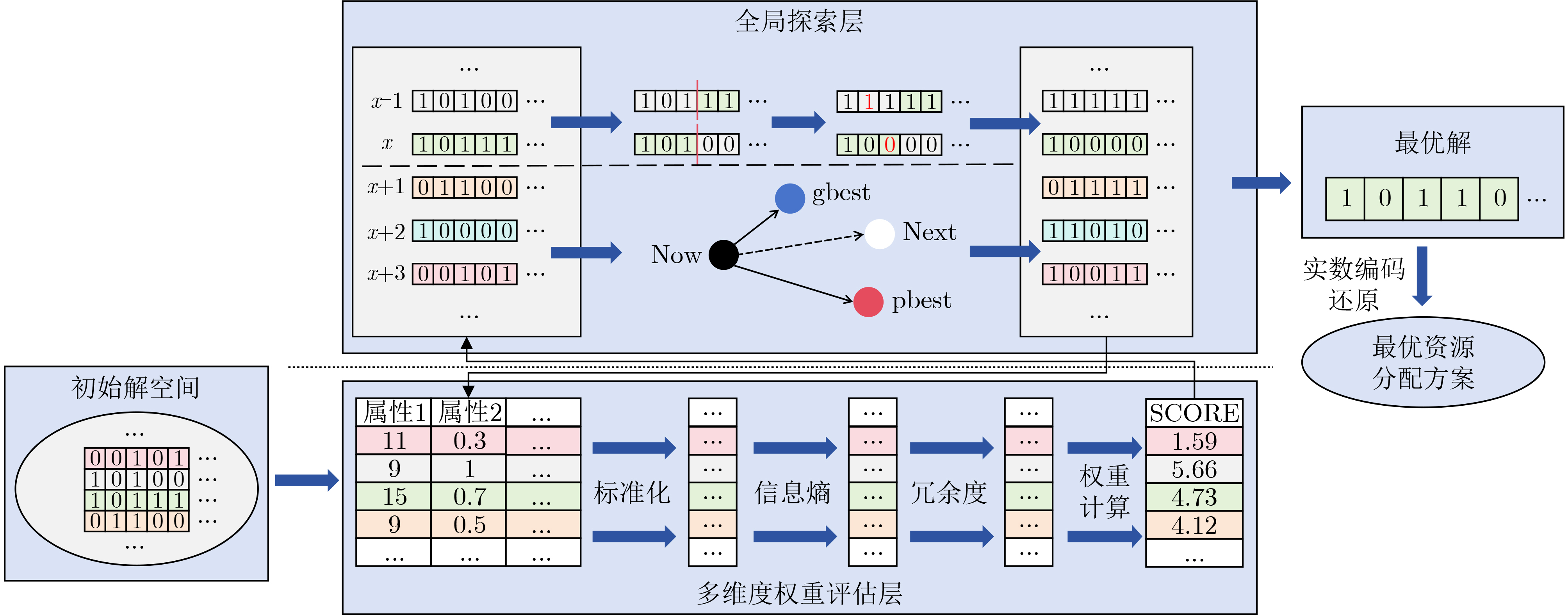
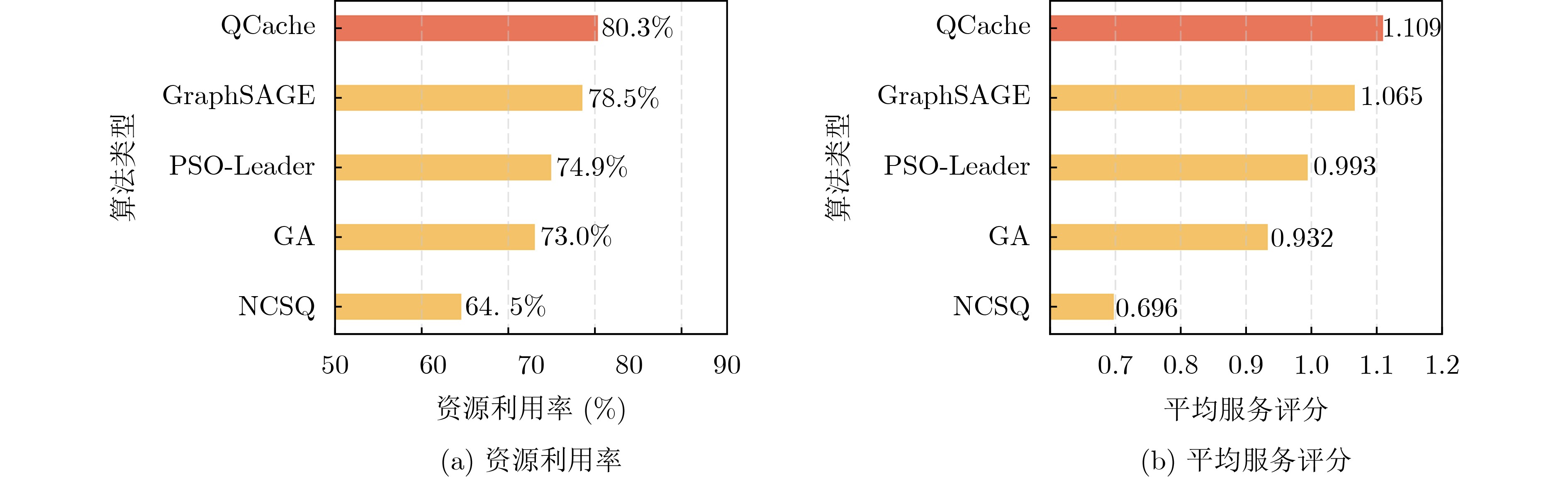
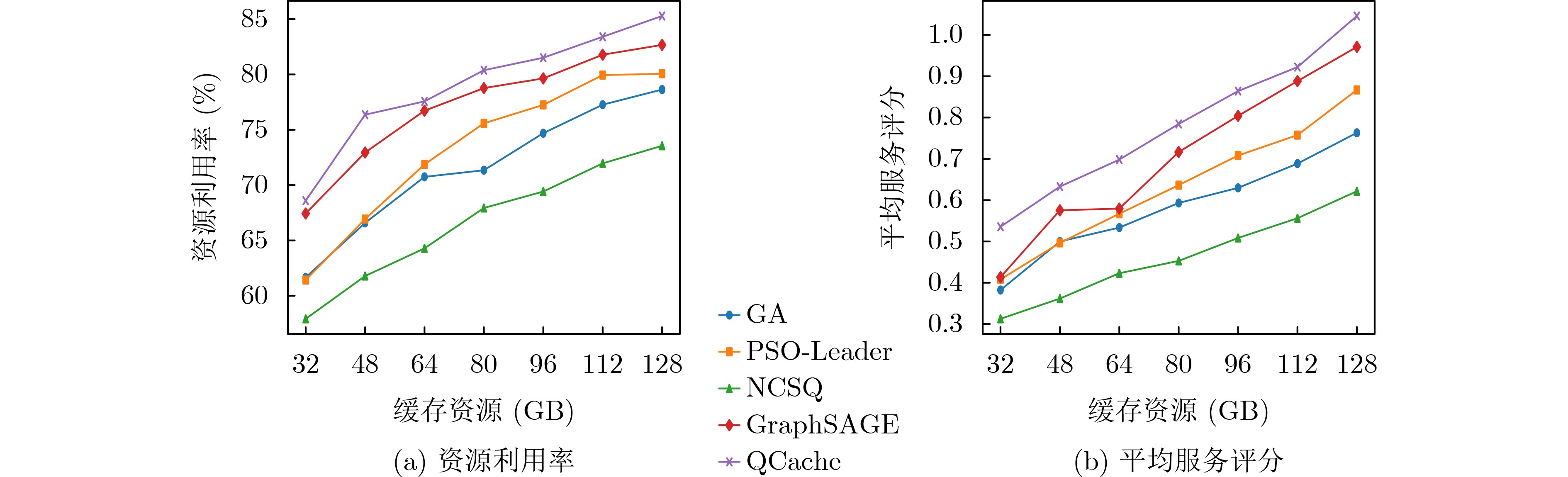
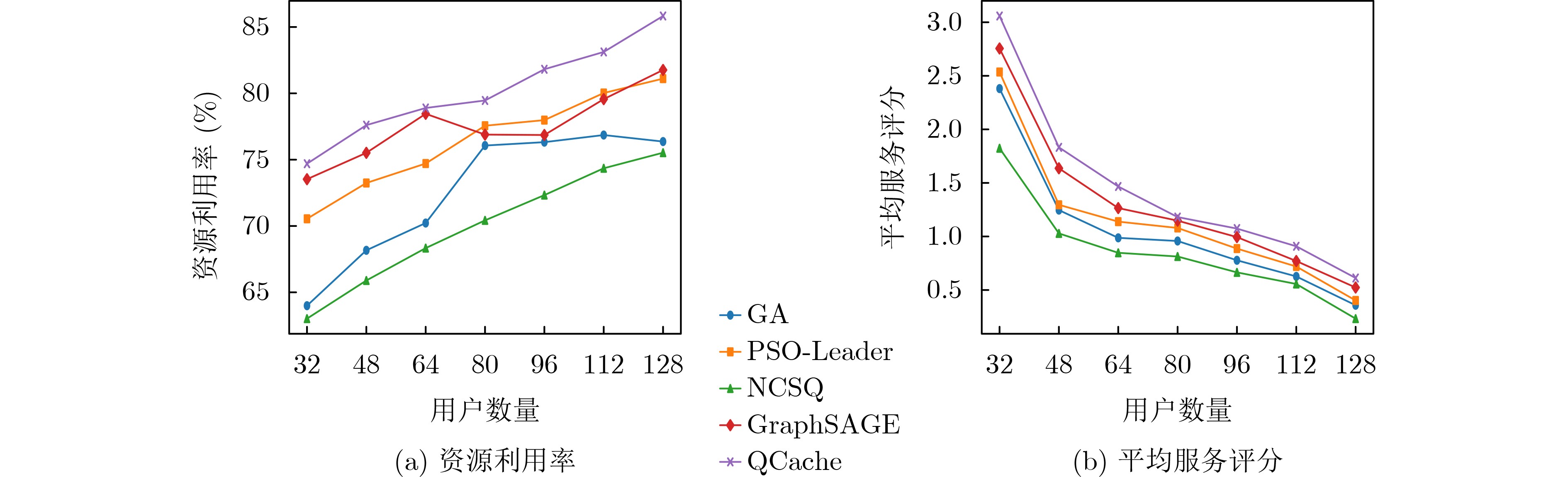
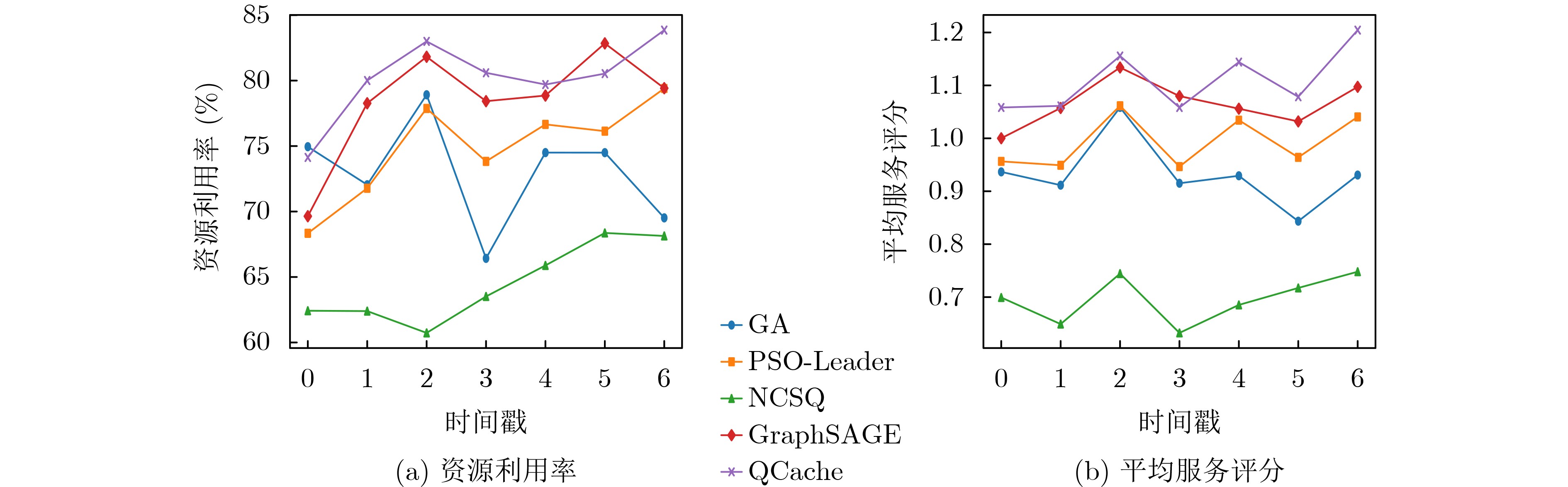
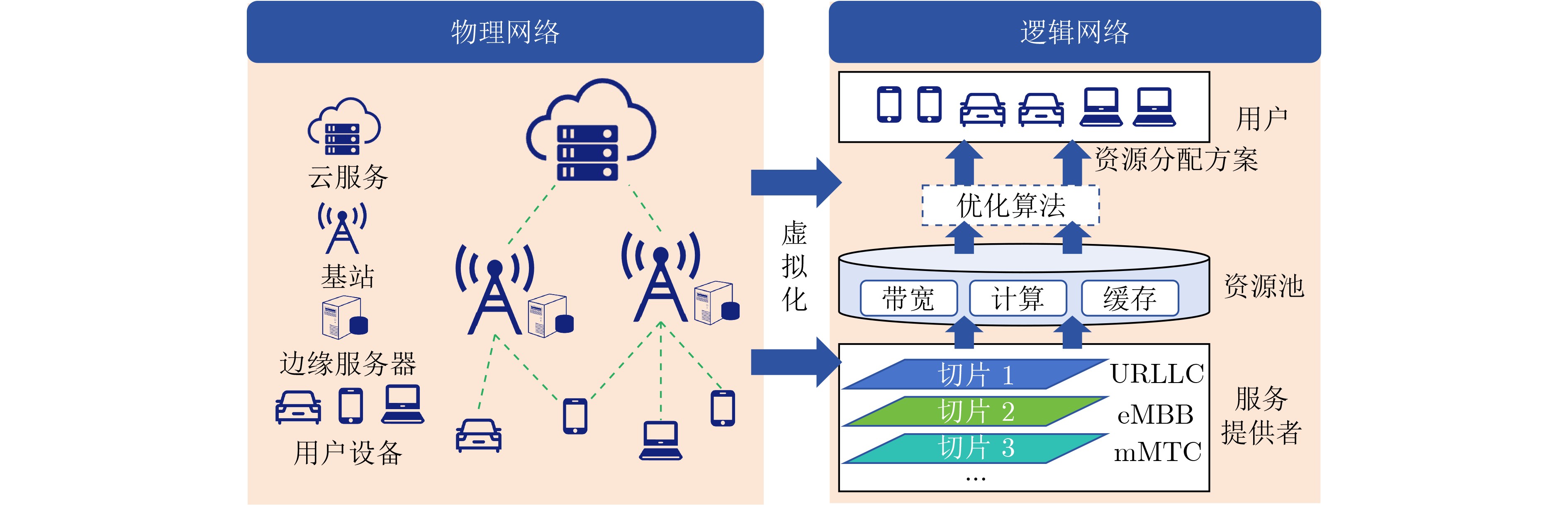
Objective Driven by 5G/6G networks, Multi-access Edge Computing (MEC) environments face major challenges in ensuring Quality of Service (QoS) for heterogeneous network slices while improving resource utilization. Existing resource allocation methods often lack dynamic adaptability in heterogeneous settings. They also fail to jointly optimize caching, bandwidth, and computing resources, which reduces resource utilization and service success rates. This paper addresses these limitations by proposing a robust framework for joint multi-dimensional resource optimization under strict QoS constraints. The framework provides a tailored solution for heterogeneous MEC environments. Methods The network slicing resource allocation problem is first formally defined. Its NP-hardness is proved by reducing the NP-hard multidimensional 0-1 knapsack problem to this problem. To solve this complex optimization problem, a cache-aware two-layer closed-loop cooperative framework, termed QCache, is proposed. The framework uses a synergistic “generate-evaluate-feedback” loop. In the upper Global Exploration Layer, a hybrid heuristic algorithm is designed by combining a population evolution strategy, including selection, crossover, and mutation, with a particle update mechanism guided by historical individual and global best positions. This layer broadly explores the solution space and generates high-quality candidate resource allocation schemes under complex constraints. Adaptive parameter adjustment and elite retention strategies are used to avoid local optima. In the lower Multi-Dimensional Weight Evaluation Layer, a quantitative assessment model is constructed. This model converts low-latency and high-bandwidth service demands into explicit QoS constraints by normalizing key performance indicators, including delay and rate, and by dynamically assigning weights through the entropy weight method. The weighted score reflects different slice priorities. The evaluated score (SCORE) from this layer is fed back to the upper layer as the fitness value, guiding the iterative evolution of candidate solutions until convergence. Results and Discussions Extensive simulations are conducted to validate the effectiveness of QCache against several baseline methods, including Genetic Algorithm (GA), PSO-Leader, GraphSAGE, and the No-Consideration-of-Service-Quality (NCSQ) scheme. Under identical resource and user demand scenarios, the overall comparison ( Fig. 3 ) shows that QCache achieves the highest resource utilization rate of 80.30% and the best average service score of 1.109. Compared with the baseline methods, QCache improves resource utilization by 2.29% to 24.50% and increases user service scores by 4.13% to 59.34%. Experiments with varying total cache resources (Fig. 4 ) show that QCache maintains superior performance across different cache states. It improves resource utilization by 2.43% to 27.53% and service scores by 10.81% to 119.56%, confirming its cache-aware adaptability. Tests with increasing user numbers (Fig. 5 ) show that QCache scales effectively, achieving up to 85.83% resource utilization and a service score of 3.06. These results demonstrate its ability to handle dense access scenarios. Experiments with time-varying user demands (Fig. 6 ) further confirm the dynamic robustness of the framework. In these tests, QCache achieves average improvements of 9.20% in resource utilization and 23.45% in service score over the baselines.Conclusions This paper studies the NP-hard resource allocation problem in dynamic MEC environments with heterogeneous network slices. The proposed cache-aware two-layer closed-loop cooperative framework, QCache, jointly optimizes caching, bandwidth, and computing resources under explicit QoS constraints. The upper-layer hybrid heuristic provides strong global search capability. The lower-layer multi-dimensional weight model supports accurate QoS quantification and dynamic feedback. Comprehensive experimental results show that QCache outperforms existing methods in both resource utilization efficiency and user QoS satisfaction. Future work will explore reinforcement learning and traffic prediction mechanisms to further improve the response of the framework to bursty traffic and anomalous demands. This may support more intelligent and autonomous MEC network slice resource management. -
1 缓存资源分配计算算法
输入:用户需求集REQ,基站缓存集CACHE,切片资源配置集
SLICE;输出:基站缓存资源最优分配集UPDATE。 (1) 使用随机资源分配策略初始化种群$ {\mathrm{pop}} $,初始化种群
$ {\mathrm{fitness}} $、个体最优$ {\mathrm{pbest}} $和种群最优$ {\mathrm{gbest}} $的适应度以及基站的
缓存策略$ {\mathrm{UPDATE}} $;(2) for 种群的每次迭代 do (3) 基于多维权重模型计算个体的$ {\mathrm{fitness}} $; (4) 更新$ {\mathrm{pbest}} $和$ {\mathrm{gbest}} $; (5) 基于$ {\mathrm{fitness}} $从大到小对$ {\mathrm{pop}} $进行排序; (6) 选择$ {\mathrm{pop}} $小于精英比例的部分为$ {\mathrm{pop1}} $,其余部分为$ {\mathrm{pop2}} $; (7) 对$ {\mathrm{pop1}} $执行锦标赛选择、单点交叉和高斯变异操作,对
$ {\mathrm{pop2}} $执行更新位置和速度操作;(8) end for (9) 基于多维权重模型计算每个个体$ {\mathrm{fitness}} $; (10) 输出缓存分配最适合的策略$ {\mathrm{UPDATE}} $。  下载: 导出CSV
2 多维度权重评估计算算法
输入:用户需求UREQ,用户与基站的距离DIS,用户数据包
PACK,基站缓存状态STATE,切片给用户分配的资源配置集
RES;输出:用户的综合评分SCORE。 (1) 根据式(4)计算$ {\mathrm{SINR}} $,根据式(7)和式(8)计算$ {\mathrm{rate}} $,根据
式(11)计算$ {\mathrm{delay}} $;(2) if 所需数据没有在基站中缓存 (3) delay需根据式(14)加上额外的时延; (4) end if (5) 归一化速率$ {\mathrm{rate}} $和时延$ {\mathrm{delay}} $等属性; (6) 计算各属性的信息熵; (7) 计算各属性的冗余度; (8) 输出每个指标加权后的分数SCORE。
下载: 导出CSV
-
[1] ZHUANSUN Chenlu, LI Pengdeng, LIU Yuan, et al. Generative AI-assisted mobile-edge computation offloading in digital-twin-enabled IIoT[J]. IEEE Internet of Things Journal, 2025, 12(10): 13248–13258. doi: 10.1109/JIOT.2025.3547370. [2] ZOU Haodong, GUO Jianxiong, SUN Suping, et al. Adaptive image batching and slicing in edge networks for delay-critical small object detection[J]. IEEE Transactions on Parallel and Distributed Systems, 2026, 37(7): 1657–1670. doi: 10.1109/TPDS.2026.3694562. [3] MALEKI E F, MA Weibin, MASHAYEKHY L, et al. QoS-aware content delivery in 5G-enabled edge computing: Learning-based approaches[J]. IEEE Transactions on Mobile Computing, 2024, 23(10): 9324–9336. doi: 10.1109/TMC.2024.3363143. [4] WANG Tian, LIANG Yuzhu, SHEN Xuewei, et al. Edge computing and sensor-cloud: Overview, solutions, and directions[J]. ACM Computing Surveys, 2023, 55(13s): 1–37. doi: 10.1145/3582270. [5] 林粤伟, 张奇勋, 尉志青, 等. 通信感知一体化硬件设计——现状与展望[J]. 电子与信息学报, 2025, 47(1): 1–21. doi: 10.11999/JEIT240012.LIN Yuewei, ZHANG Qixun, WEI Zhiqing, et al. Status and prospect of hardware design on integrated sensing and communication[J]. Journal of Electronics & Information Technology, 2025, 47(1): 1–21. doi: 10.11999/JEIT240012. [6] LIANG Yuzhu, YIN Mujun, WANG Wenhua, et al. Collaborative edge server placement for maximizing QoS with distributed data cleaning[J]. IEEE Transactions on Services Computing, 2025, 18(3): 1321–1335. doi: 10.1109/TSC.2025.3552337. [7] YANG Hui, YU Ao, ZHANG Jie, et al. Data-driven network slicing from core to RAN for 5G broadcasting services[J]. IEEE Transactions on Broadcasting, 2021, 67(1): 23–32. doi: 10.1109/TBC.2020.3031742. [8] 左琳立, 夏士超, 李云, 等. 车联网的服务缓存和任务迁移机制[J]. 电子与信息学报, 2025, 47(8): 2563–2572. doi: 10.11999/JEIT241097.ZUO Linli, XIA Shichao, LI Yun, et al. Service Caching and Task Migration Mechanism Based on Internet of Vehicles[J]. Journal of Electronics & Information Technology, 2025, 47(8): 2563–2572. doi: 10.11999/JEIT241097. [9] WANG Tian, LIANG Yuzhu, JIA Weijia, et al. Coupling resource management based on fog computing in smart city systems[J]. Journal of Network and Computer Applications, 2019, 135: 11–19. doi: 10.1016/j.jnca.2019.02.021. [10] 徐冬竹, 周安福, 马华东, 等. 基于连续学习的视频物联网任务需求理解与调度方法[J]. 计算机研究与发展, 2024, 61(11): 2793–2805. doi: 10.7544/ISSN1000-1239.202440403.XU Dongzhu, ZHOU Anfu, MA Huadong, et al. Continuous learning-based task demand understanding and scheduling method for video internet of things[J]. Journal of Computer Research and Development, 2024, 61(11): 2793–2805. doi: 10.7544/ISSN1000-1239.202440403. [11] LIANG Yuzhu, XU Changfu, MEI Yaxin, et al. A comprehensive survey on large language model compression for artificial intelligence applications in edge systems[J]. IEEE Internet of Things Journal, 2026, 13(10): 20583–20599. doi: 10.1109/JIOT.2026.3675866. [12] European Telecommunications Standards Institute. ETSI GS MEC 003 V2.1. 1 (2019-01) Multi-access edge computing (MEC); framework and reference architecture[S]. Alpes Maritimes: ETSI, 2019. [13] YUE Yi, CHENG Bo, SUN Shiding, et al. Availability guaranteed and resource efficient VNF placement in SDN/NFV-Enabled network through traffic forecasting[C]. 2025 IEEE International Conference on Web Services, Helsinki, Finland, 2025: 983–992. doi: 10.1109/ICWS67624.2025.00139. [14] MAHDI S S and ABDULLAH A A. Survey on enabling network slicing based on SDN/NFV[C]. International Conference on Information Systems and Intelligent Applications, ICISIA 2022, Cham, Germany, 2022: 733–758. doi: 10.1007/978-3-031-16865-9_59. [15] SINDJOUNG M L F, VELEMPINI M, and BOMGNI A B. A MEC architecture for a better quality of service in an Autonomous Vehicular Network[J]. Computer Networks, 2022, 219: 109454. doi: 10.1016/j.comnet.2022.109454. [16] ZHANG Zhengming, HUANG Yongming, ZHANG Cheng, et al. Digital twin-enhanced deep reinforcement learning for resource management in networks slicing[J]. IEEE Transactions on Communications, 2024, 72(10): 6209–6224. doi: 10.1109/TCOMM.2024.3395698. [17] FAN Wenhao, LI Xuewei, TANG Bihua, et al. MEC network slicing: Stackelberg-game-based slice pricing and resource allocation with QoS guarantee[J]. IEEE Transactions on Network and Service Management, 2024, 21(4): 4494–4509. doi: 10.1109/TNSM.2024.3409277. [18] LIANG Yuzhu, YIN Mujun, ZHANG Yilin, et al. Grouping reduces energy cost in directionally rechargeable wireless vehicular and sensor networks[J]. IEEE Transactions on Vehicular Technology, 2023, 72(8): 10840–10851. doi: 10.1109/TVT.2023.3259683. [19] WANG Shuai and ZHOU Aimin. Leader prediction for multiobjective particle swarm optimization[J]. IEEE Transactions on Evolutionary Computation, 2025, 29(4): 1356–1370. doi: 10.1109/TEVC.2024.3417978. [20] HWANG J, NKENYEREYE L, SUNG N, et al. IoT service slicing and task offloading for edge computing[J]. IEEE Internet of Things Journal, 2021, 8(14): 11526–11547. doi: 10.1109/JIOT.2021.3052498. [21] ZHANG Tiankui, WANG Yi, YI Wenqiang, et al. Joint optimization of caching placement and trajectory for UAV-D2D networks[J]. IEEE Transactions on Communications, 2022, 70(8): 5514–5527. doi: 10.1109/TCOMM.2022.3182033. [22] LIU Xing, LV Jianhui, KIM B G, et al. Cooperative digital healthcare task scheduling and resource management in edge intelligence systems[J]. Tsinghua Science and Technology, 2025, 30(2): 926–945. doi: 10.26599/TST.2024.9010140. [23] HELMY M, ABDELLATIF A A, MHAISEN N, et al. Slicing for AI: An online learning framework for network slicing supporting AI services[J]. IEEE Transactions on Network and Service Management, 2025, 22(6): 5239–5254. doi: 10.1109/TNSM2025.3603391. [24] NASSAR A and YILMAZ Y. Deep reinforcement learning for adaptive network slicing in 5G for intelligent vehicular systems and smart cities[J]. IEEE Internet of Things Journal, 2022, 9(1): 222–235. doi: 10.1109/JIOT.2021.3091674. [25] QIAO Kai, WANG Hongchao, ZHANG Weiting, et al. Resource allocation for network slicing in open RAN: A hierarchical learning approach[J]. IEEE Transactions on Cognitive Communications and Networking, 2025, 11(4): 2584–2600. doi: 10.1109/TCCN.2024.3524641. [26] PEREIRA P M R, DE BAIRROS T A M, DE SOUZA R A A, et al. Mobility, path loss, and composite fading: Performance of a conventional and of a non-conventional system with a robust autoencoder[J]. IEEE Transactions on Vehicular Technology, 2023, 72(12): 16725–16730. doi: 10.1109/TVT.2023.3294756. [27] ANGELELLI E, MANSINI R, and SPERANZA M G. Kernel search: A general heuristic for the multi-dimensional knapsack problem[J]. Computers & Operations Research, 2010, 37(11): 2017–2026. doi: 10.1016/j.cor.2010.02.002. [28] LIU Tao, JIANG Aimin, ZHOU Jia, et al. GraphSAGE-based dynamic spatial-temporal graph convolutional network for traffic prediction[J]. IEEE Transactions on Intelligent Transportation Systems, 2023, 24(10): 11210–11224. doi: 10.1109/TITS.2023.3279929. [29] WANG Zhaoying, WEI Yifei, YU F R, et al. Utility optimization for resource allocation in multi-access edge network slicing: A twin-actor deep deterministic policy gradient approach[J]. IEEE Transactions on Wireless Communications, 2022, 21(8): 5842–5856. doi: 10.1109/TWC.2022.3143949. -

 下载:
下载:

图(6) / 表(3)
计量
- 文章访问数: 468
- HTML全文浏览量: 302
- PDF下载量: 18
- 被引次数: 0
