




Load Optimization of Inverter Air-Conditioning Clusters Driven by Constraint Surface Projection and Spatial-Fitness Synergy
-
摘要: 针对高比例新能源并网加剧电网供需不平衡的问题,聚合大规模变频空调集群作为虚拟储能参与需求响应,是提升电网灵活性的有效途径。然而,现有调度策略常面临高维寻优的维数灾难,且传统基于罚函数的软约束方法难以严格满足聚合功率的等式约束,易产生稳态误差。为此,该文提出一种基于约束面投影的位势协同自适应粒子群算法(SFA-PSO)。首先,基于等效热参数模型构建了兼顾群体热舒适度与响应公平性的多目标优化框架;其次,针对传统算法易出现功率越限的局限性,设计了约束面投影机制,将粒子的搜索路径严格限制在功率守恒超平面内,从而实现对网侧调度指令的精确跟踪;此外,针对高维空间寻优易早熟的难题,提出空间-适应度协同演化策略,通过量化粒子适应度与空间距离的认知偏差动态调节学习因子,以提升算法跳出局部最优的能力。最后,在包含多源热扰动与通信丢包等复杂动态环境下进行了连续调度仿真实验。结果表明,SFA-PSO算法在千节点级高维场景中表现出良好的鲁棒性,能够在严格满足电网侧功率管控要求的前提下,以较低的计算开销实现用户侧舒适度与公平性的有效协同。Abstract:
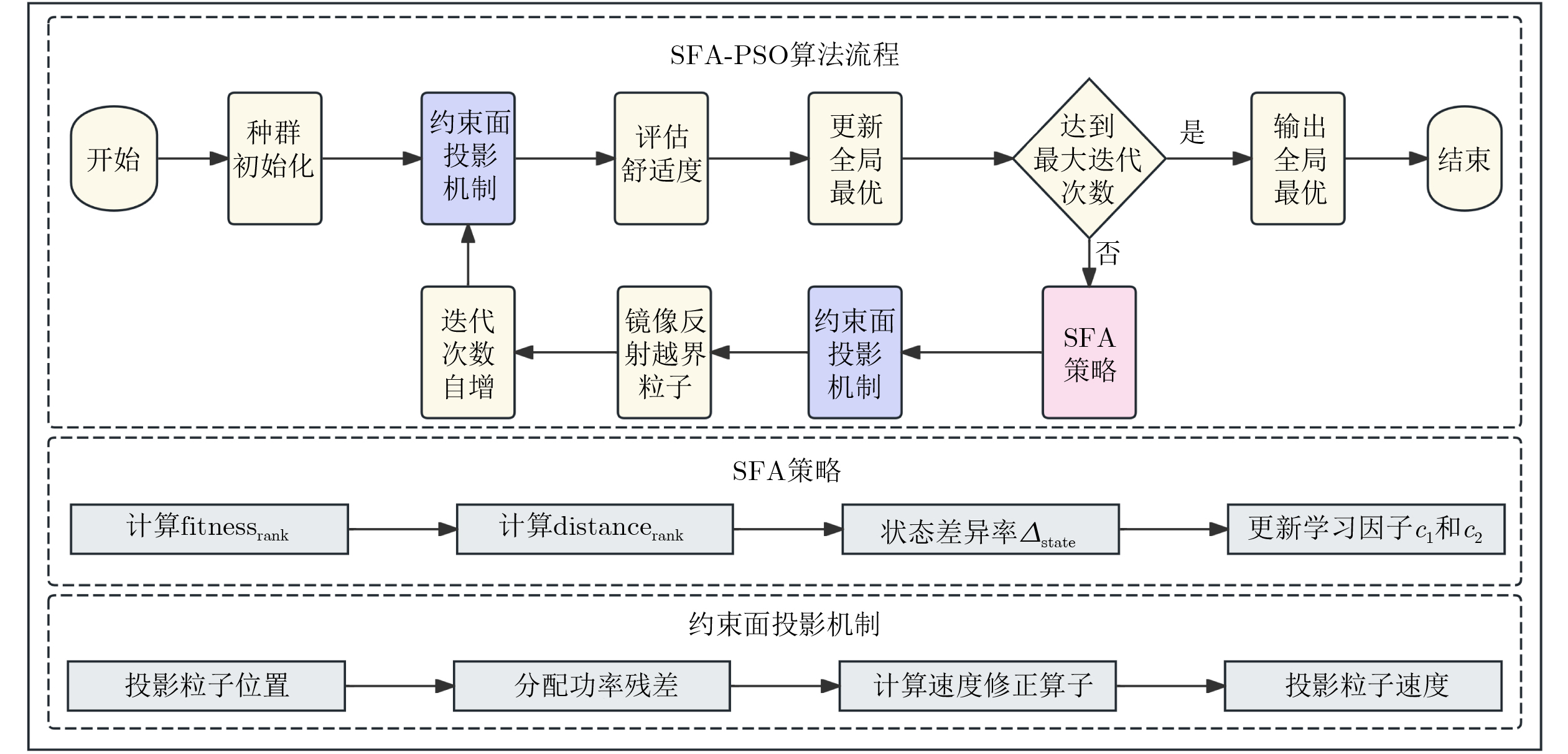
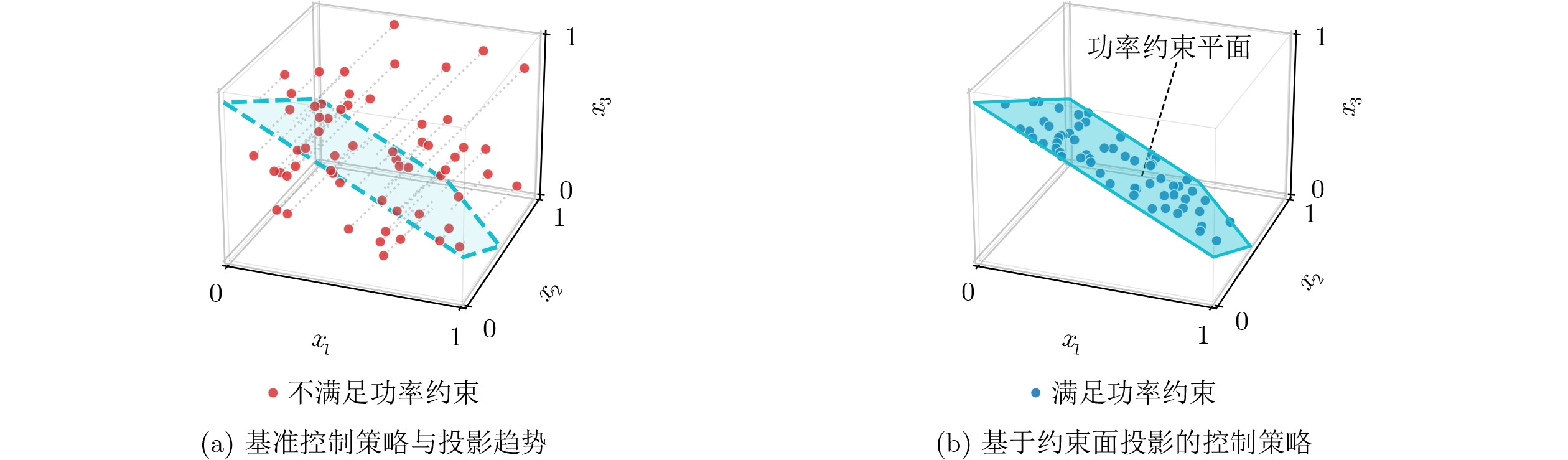
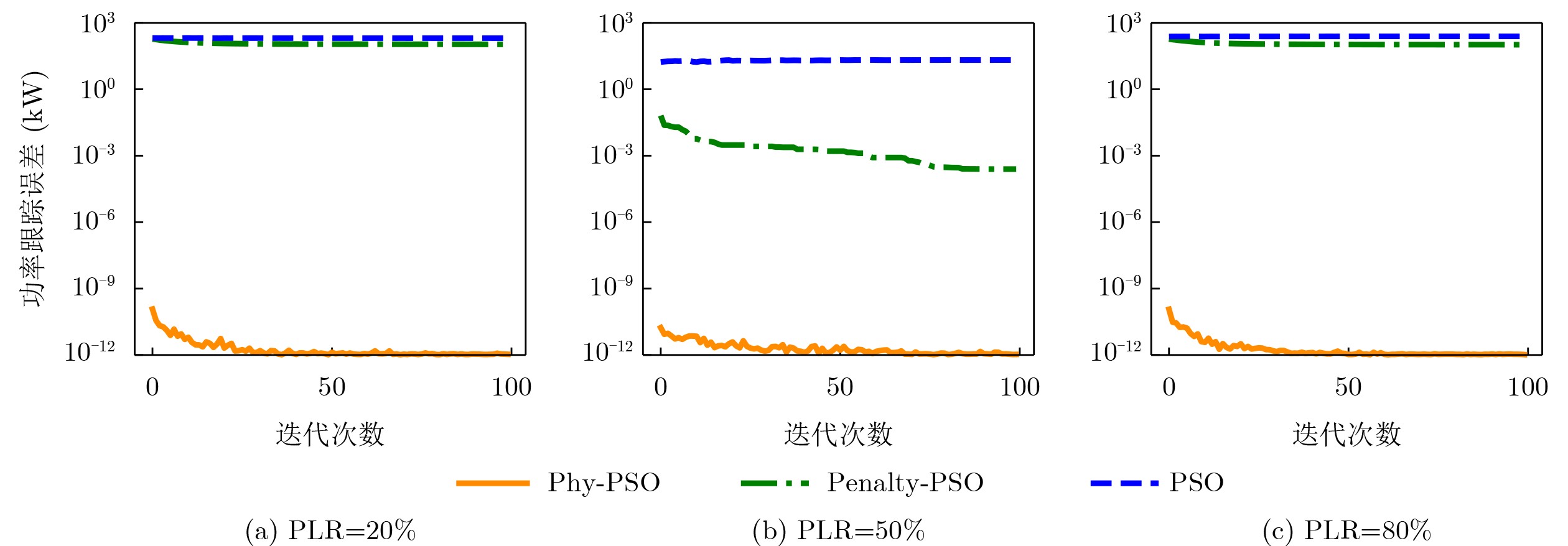
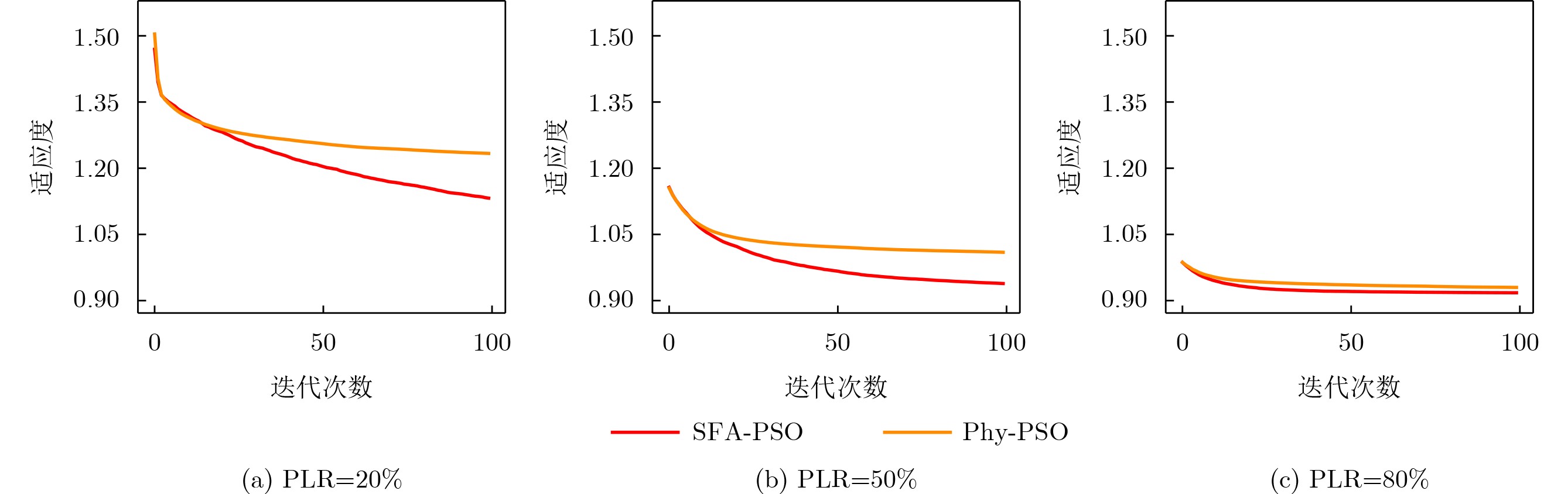
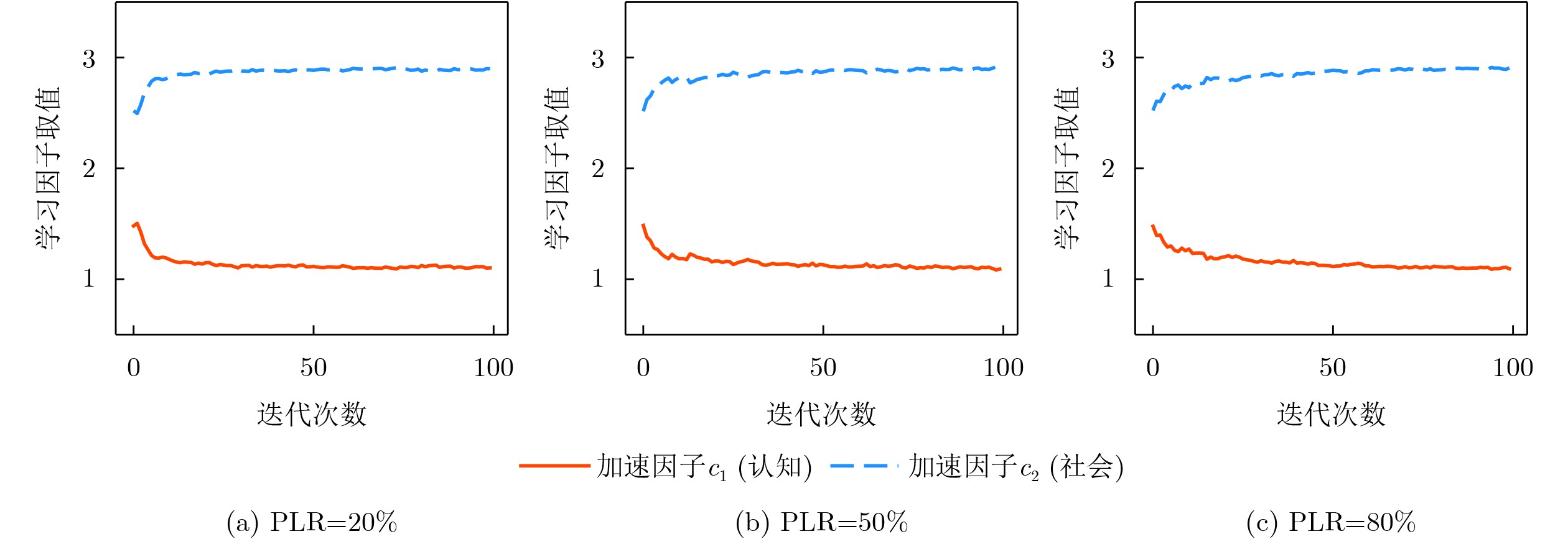
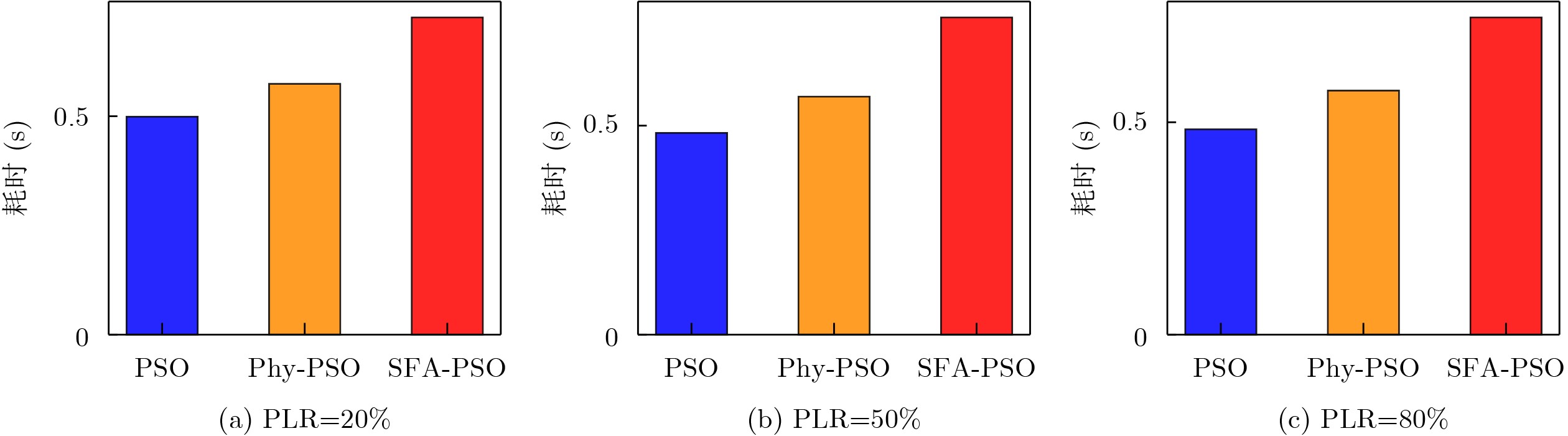
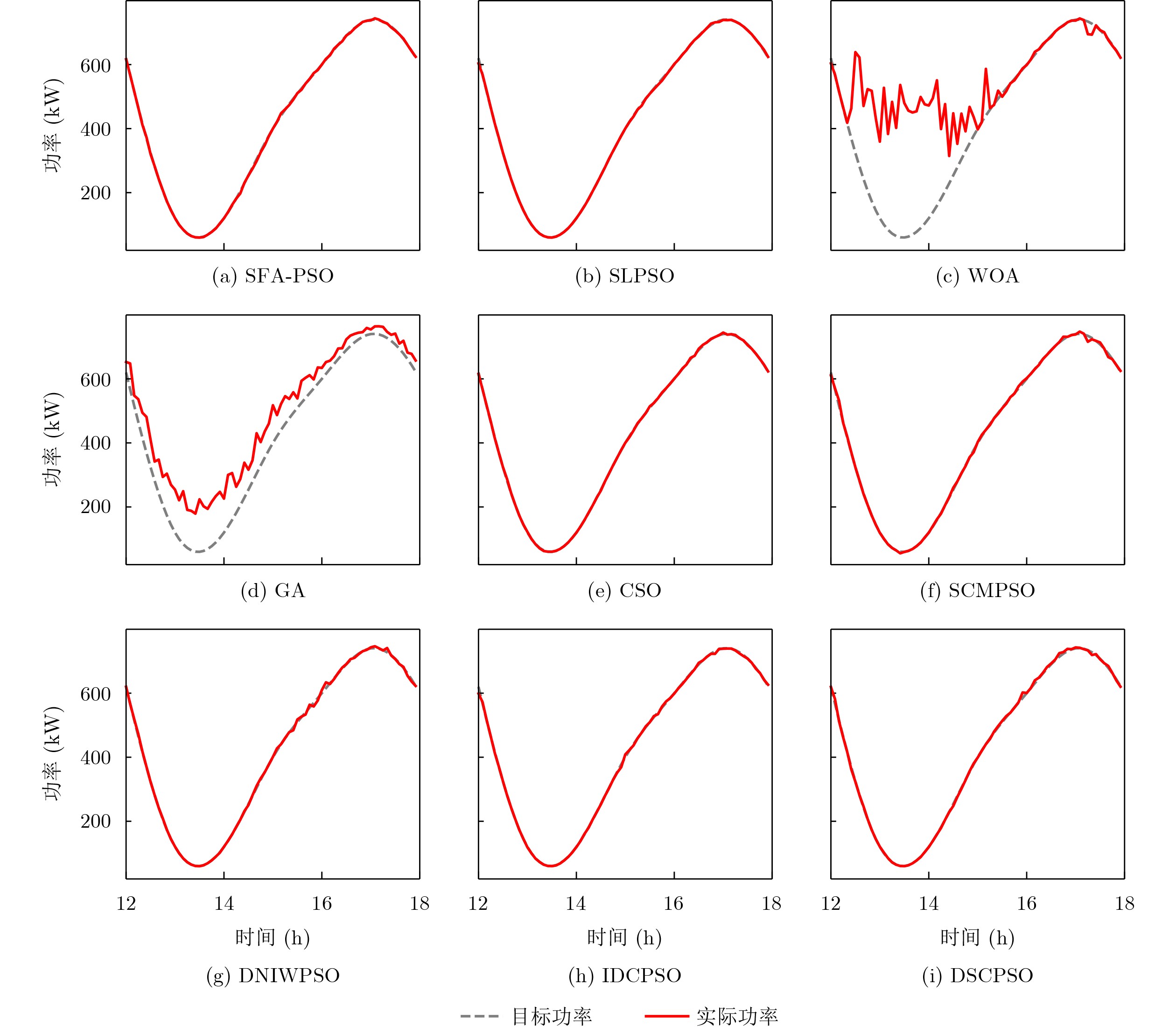
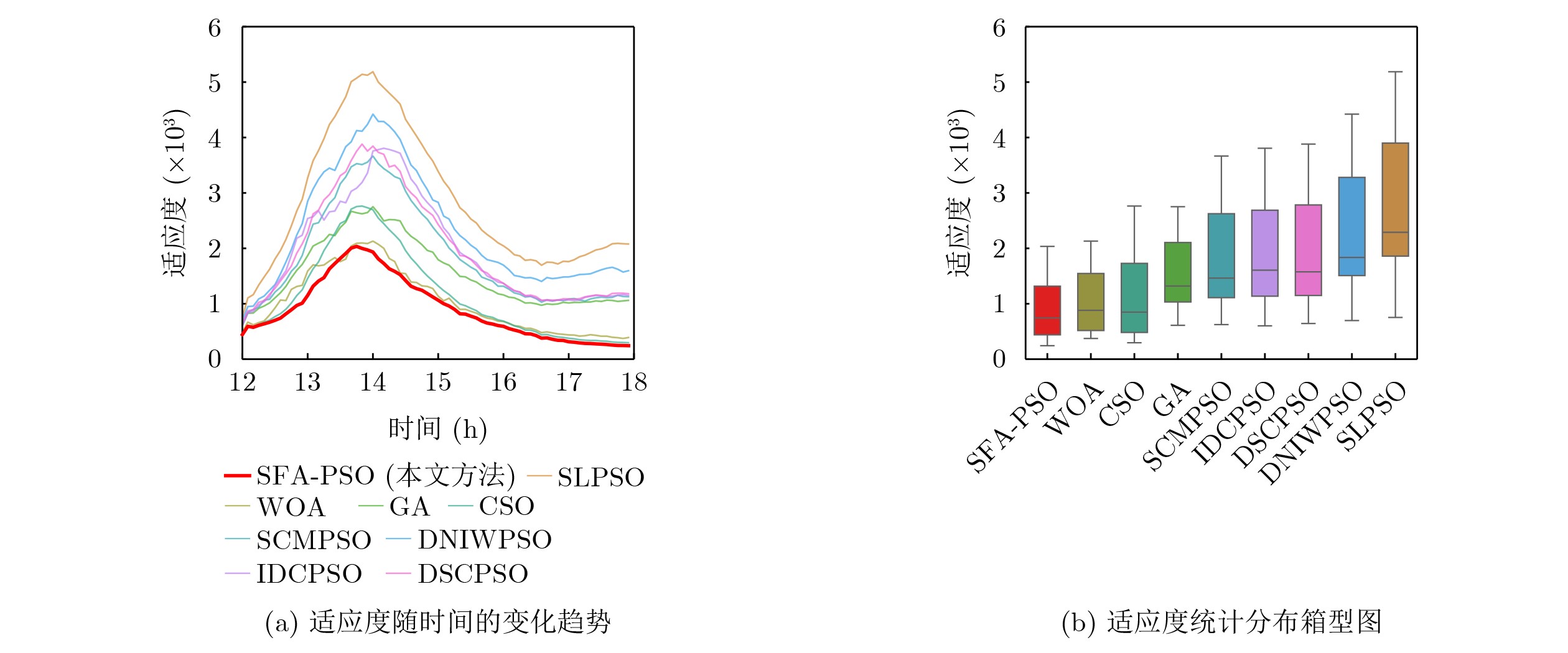
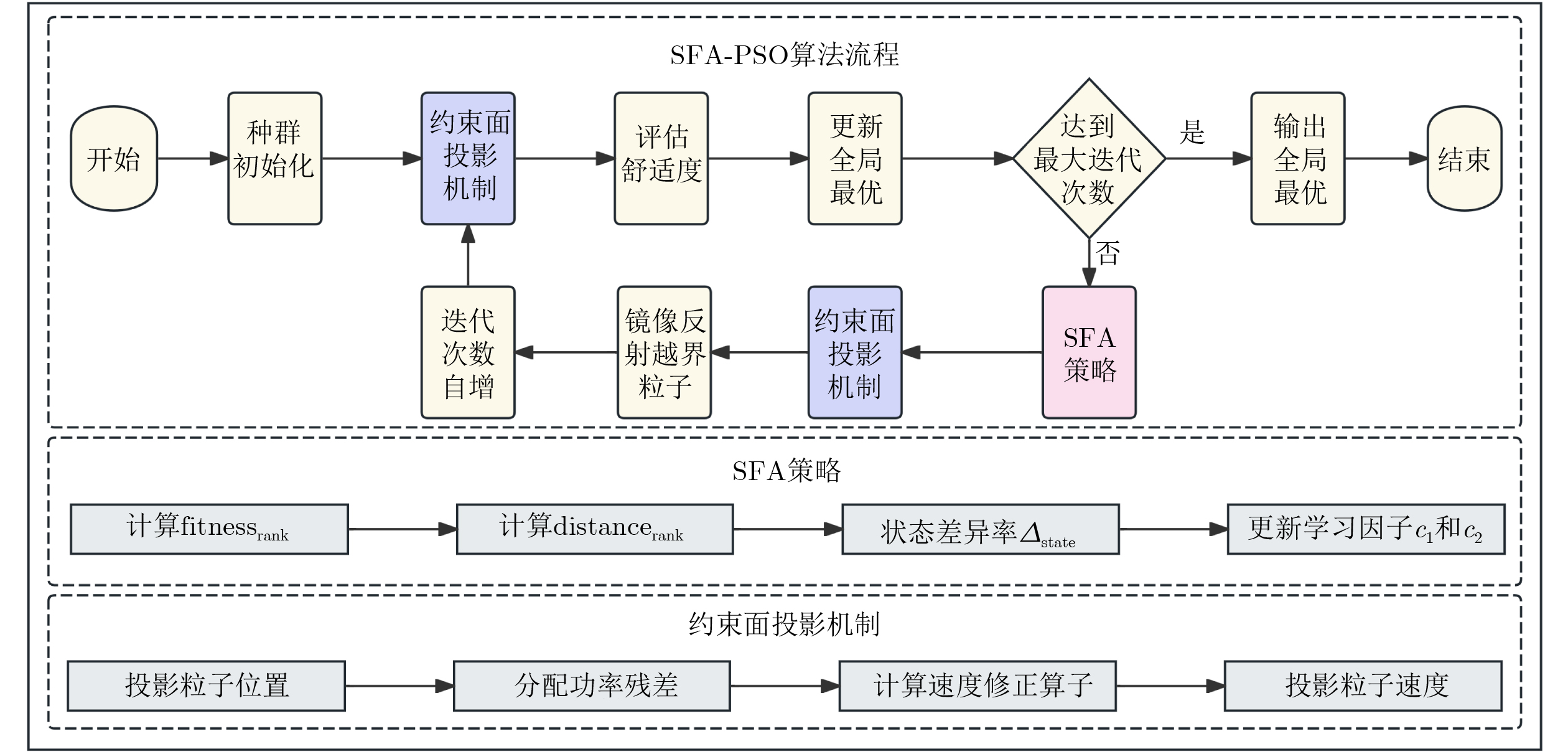
Objective Supply-demand imbalances in modern distribution networks are intensified by the increasing penetration of distributed renewable energy and frequent extreme high-temperature events. Large-scale Inverter Air-Conditioning (IAC) clusters can be aggregated as virtual energy storage resources for Demand Response (DR), providing an effective way to improve grid flexibility. However, existing dispatch strategies are often limited by the curse of dimensionality. Conventional penalty-function-based soft constraints also fail to strictly satisfy aggregate power equality constraints and may introduce steady-state errors. This paper develops an optimization framework in which grid-side power commands are accurately tracked while user thermal discomfort is reduced and fairness among heterogeneous users is maintained. Methods A multi-objective optimization framework based on an Equivalent Thermal Parameter (ETP) model is established to describe the thermodynamic states of heterogeneous buildings. To balance collective comfort and individual fairness, a composite fitness function is designed by integrating a weighted mean-squared error term, a fairness variance term, and a maximum violation suppression term. To eliminate the steady-state errors of traditional penalty-based methods, a Spatial-Fitness Adaptive Particle Swarm Optimization (SFA-PSO) algorithm is proposed. A geometric constraint surface projection mechanism maps particles strictly onto the power-conservation hyperplane, thereby satisfying the aggregate power equality constraint. In addition, the learning factors are dynamically adjusted through a Spatial-Fitness Adaptive (SFA) strategy. This strategy measures the mismatch between a particle’s fitness rank and spatial distance rank, which helps prevent premature convergence in high-dimensional search spaces. Results and Discussions Extensive continuous scheduling simulations are conducted in a complex dynamic environment. The environment includes multi-source thermal disturbances, a bidirectional communication packet loss rate of 1%, and Part Load Ratio (PLR) values of 20%, 50%, and 80%. First, ablation experiments confirm that constraint surface projection guarantees power tracking accuracy. Traditional penalty-based methods, such as Penalty Particle Swarm Optimization (Penalty-PSO), produce steady-state power deviations of approximately 10–1 kW. By contrast, SFA-PSO limits aggregate power tracking errors to within 10–9 kW ( Fig. 3 ). The SFA strategy also prevents the premature convergence observed in Physical Particle Swarm Optimization (Phy-PSO). It enables continuous fitness reduction, especially in low-load scenarios with narrow feasible regions (Fig. 4 ). This improvement is attributed to the dynamic evolution of the learning factors. The cognitive factor remains high at the early stage to promote global exploration. It then decreases as the social factor increases, which strengthens local exploitation and improves convergence precision (Fig. 5 ). Second, continuous dynamic scheduling performance is evaluated through a 6-hour simulation during the peak load period from 12:00 to 18:00. The dispatch interval is 5 min, yielding 72 decision steps. Under tight peak-load constraints, Genetic Algorithm (GA) and Whale Optimization Algorithm (WOA) show severe power-limit violations because their population update rules do not cooperate well with the projection mechanism. By contrast, SFA-PSO maintains strict constraint satisfaction (Fig. 7 ). SFA-PSO remains at the lowest fitness level throughout the real-time evolution curves, indicating strong robustness against environmental thermal noise and uplink and downlink communication packet loss (Fig. 8 ). Quantitatively, compared with eight baseline algorithms, including Social Learning Particle Swarm Optimization (SLPSO), Competitive Swarm Optimizer (CSO), and Dynamic State Cluster-Based Particle Swarm Optimization (DSCPSO), SFA-PSO achieves the best overall performance. It obtains an average fitness of 904, a minimum fitness of 243, and the lowest standard deviation of 551 (Table 2 ). Finally, scalability analyses across cluster sizes from 100 to 1,000 nodes further validate the high-dimensional optimization capability of SFA-PSO. In all scale scenarios, SFA-PSO shows the strongest optimization capacity. It achieves rapid initial descent within the first 20 iterations and maintains continuous exploration in later stages (Fig. 9 ). Although the projection and SFA mechanisms increase computational time by 30% to 50% compared with basic Particle Swarm Optimization (PSO) (Fig. 6 ), the absolute optimization time remains stable at approximately 1.5 seconds even for a 1 000-node cluster (Fig. 9 ). This computational overhead is acceptable for minute-level control cycles and meets the real-time dispatch requirements of modern smart grids.Conclusions The proposed SFA-PSO algorithm effectively addresses the steady-state error of traditional soft-constraint methods in aggregate power control. By ensuring accurate tracking of dispatch commands and mitigating high-dimensional search traps, it provides a robust and scalable solution for flexible scheduling of large-scale IAC loads in smart grids. It also maintains a practical balance between grid-side regulation and user-side comfort. The method still has limitations. The constraint projection mechanism depends on the host algorithm, which restricts cross-algorithm generalization. High-precision tracking also increases computational cost. Future work will focus on adaptive constraint handling and lightweight algorithm design. Coordinated scheduling for heterogeneous loads, such as electric vehicles and energy storage, will also be investigated. -
表 1 算法通用参数
参数名称 用户
数量种群
规模最大迭代
次数独立运行
次数惯性
权重$ {J}_{\text{MSE}} $权重 $ {J}_{\text{VAR}} $权重 $ {J}_{\text{MAX}} $权重 温度
死区热扰动
基准值热扰动
随机值上行丢包
概率下行丢包
概率符号 $ D $ $ M $ $ K $ $ N $ $ \omega $ $ {\alpha }_{\text{mse}} $ $ {\alpha }_{\text{var}} $ $ {\alpha }_{\max } $ $ \delta $ $ Q_{\max }^{\text{dist}} $ $ \varepsilon _{i}^{t} $ $ {P}_{\text{loss}\_\text{up}} $ $ {P}_{\text{loss}\_\text{down}} $ 值 300 50 100 30 0.2 1 10 1 0.5 0.1 $ {\mathrm{N}(,0.02}^{2}) $ 0.01 0.01 单位 - - 次 次 - - - - °C °C °C - -  下载: 导出CSV
表 2 对比实验适应度指标
算法名称 SFA-PSO SLPSO WOA GA CSO SCMPSO DNIWPSO IDCPSO DSCPSO 平均适应度 904 2836 1038 1559 1149 1871 2339 1956 1976 最小适应度 243 752 373 610 296 623 696 601 643 最大适应度 2035 5186 2130 2751 2762 3665 4421 3805 3881 标准差 551 1232 563 609 787 901 1046 935 962
下载: 导出CSV
-
[1] HAO Junhong, FENG Xiaolong, CHEN Xiangru, et al. Optimal scheduling of active distribution network considering symmetric heat and power source-load spatial-temporal characteristics[J]. Applied Energy, 2024, 373: 123974. doi: 10.1016/j.apenergy.2024.123974. [2] 王文婷, 田博彦, 吴法宗, 等. 面向智能电网信息物理融合攻击的建模、检测和防御理论与方法[J]. 电子与信息学报, 2026, 48(4): 1454–1468. doi: 10.11999/JEIT250659.WANG Wenting, TIAN Boyan, WU Fazong, et al. Modeling, detection, and defense theories and methods for cyber-physical fusion attacks in smart grid[J]. Journal of Electronics & Information Technology, 2026, 48(4): 1454–1468. doi: 10.11999/JEIT250659. [3] 王鸿军. 基于需求响应的公共楼宇空调负荷管理策略[J]. 能源与节能, 2024(10): 49–51,63. doi: 10.16643/j.cnki.14-1360/td.2024.10.074.WANG Hongjun. Demand response based air conditioning load management strategies for public buildings[J]. Energy and Energy Conservation, 2024(10): 49–51,63. doi: 10.16643/j.cnki.14-1360/td.2024.10.074. [4] JIANG Hanyu, QIU Shuting, RAN Bin, et al. Energy-saving regulation methods and energy consumption characteristics of office air-conditioning loads in hot summer and cold winter areas[J]. Energy and Built Environment, 2025, 6(6): 1039–1051. doi: 10.1016/j.enbenv.2024.04.009. [5] XU Ruoyu, LIU Xiaochen, LIU Xiaohua, et al. Quantifying the energy flexibility potential of a centralized air-conditioning system: A field test study of hub airports[J]. Energy, 2024, 298: 131313. doi: 10.1016/j.energy.2024.131313. [6] 陈鑫, 王果, 闵永智, 等. 计及低碳与经济的配电网源-网-荷-储协同规划模型[J]. 电力系统保护与控制, 2025, 53(7): 1–15. doi: 10.19783/j.cnki.pspc.240406.CHEN Xin, WANG Guo, MIN Yongzhi, et al. A source-network-load-storage collaborative planning model for a distribution network considering low carbon and economy[J]. Power System Protection and Control, 2025, 53(7): 1–15. doi: 10.19783/j.cnki.pspc.240406. [7] 张运, 丁峰, 束泉言, 等. 针对柔性负荷与碳交易机制的智能楼宇需求响应优化策略[J]. 电力需求侧管理, 2025, 27(6): 92–98. doi: 10.3969/j.issn.1009-1831.2025.06.014.ZHANG Yun, DING Feng, SHU Quanyan, et al. Intelligent building demand response optimization strategy for flexible load and carbon trading mechanism[J]. Power Demand Side Management, 2025, 27(6): 92–98. doi: 10.3969/j.issn.1009-1831.2025.06.014. [8] 周特. 变频温控负荷集群参与电网调峰调频控制策略研究[D]. [博士论文], 电子科技大学, 2024. doi: 10.27005/d.cnki.gdzku.2024.005829.ZHOU Te. Research on control strategy of inverter-based thermostatically controlled load cluster participating in peak load regulation and frequency regulation of power system[D]. [Ph. D. dissertation], University of Electronic Science and Technology of China, 2024. doi: 10.27005/d.cnki.gdzku.2024.005829. [9] IHARA S and SCHWEPPE F C. Physically based modeling of cold load pickup[J]. IEEE Transactions on Power Apparatus and Systems, 1981, PAS-100(9): 4142–4150. doi: 10.1109/TPAS.1981.316965. [10] 宋佳音. 分布式柔性电热负荷多目标控制策略研究[D]. [硕士论文], 沈阳工业大学, 2024. doi: 10.27322/d.cnki.gsgyu.2024.001439.SONG Jiayin. Research on multi-objective control strategy of distributed flexible electric thermal load[D]. [Master dissertation], Shenyang University of Technology, 2024. doi: 10.27322/d.cnki.gsgyu.2024.001439. [11] 张勇, 李宁, 丁昊晖, 等. 基于用户差异化热舒适度的空调负荷聚合调度策略[J]. 电力工程技术, 2023, 42(4): 133–140. doi: 10.12158/j.2096-3203.2023.04.014.ZHANG Yong, LI Ning, DING Haohui, et al. Air-conditioning load aggregation scheduling strategy based on user differentiated thermal comfort[J]. Electric Power Engineering Technology, 2023, 42(4): 133–140. doi: 10.12158/j.2096-3203.2023.04.014. [12] 余洋, 向小平, 李梦璐, 等. 面向电网调峰的聚合温控负荷多目标优化控制方法[J]. 电力自动化设备, 2024, 44(11): 164–170,186. doi: 10.16081/j.epae.202408014.YU Yang, XIANG Xiaoping, LI Menglu, et al. Grid peaking oriented multi-objective optimal control method for aggregated thermostatically controlled load[J]. Electric Power Automation Equipment, 2024, 44(11): 164–170,186. doi: 10.16081/j.epae.202408014. [13] 于冠杰. 电热水器最佳功率多目标遗传算法优化控制[J]. 自动化仪表, 2023, 44(3): 50–53. doi: 10.16086/j.cnki.issn1000-0380.2021080027.YU Guanjie. Optimal power multi-objective genetic algorithm optimal control of electric water heater[J]. Process Automation Instrumentation, 2023, 44(3): 50–53. doi: 10.16086/j.cnki.issn1000-0380.2021080027. [14] DIAO Zhenya, YU Fei, WU Hongrun, et al. A dynamic state cluster-based particle swarm optimization algorithm[J]. International Journal of Computational Intelligence Systems, 2025, 18(1): 202. doi: 10.1007/s44196-025-00902-8. [15] QIN Zhouxi and PAN Dazhi. Improved dual-center particle swarm optimization algorithm[J]. Mathematics, 2024, 12(11): 1698. doi: 10.3390/math12111698. [16] LIU Hualong and TANG Wenyuan. Leveraging an improved particle swarm optimization algorithm to solve combined heat and power economic dispatch problems[C]. IECON 2024 - 50th Annual Conference of the IEEE Industrial Electronics Society, Chicago, USA, 2024: 1–8. doi: 10.1109/IECON55916.2024.10905468. [17] DONG Ang and LEE S K. The study of an improved particle swarm optimization algorithm applied to economic dispatch in microgrids[J]. Electronics, 2024, 13(20): 4086. doi: 10.3390/electronics13204086. [18] 霍雷霆, 王子赟, 王艳. 粒子群约束下的多胞空间滤波及其在锂电池SOC估计中的应用[J]. 电子与信息学报, 2025, 47(9): 3385–3394. doi: 10.11999/JEIT250437.HUO Leiting, WANG Ziyun, and WANG Yan. A particle-swarm-confinement-based zonotopic space filtering algorithm and its application to state of charge estimation for lithium-ion batteries[J]. Journal of Electronics & Information Technology, 2025, 47(9): 3385–3394. doi: 10.11999/JEIT250437. [19] 师芊芊. 计及复杂天气条件的新能源功率预测及优化配置研究[D]. [硕士论文], 北方工业大学, 2024. doi: 10.26926/d.cnki.gbfgu.2024.000732.SHI Qianqian. Research on power prediction and optimization configuration of new energy considering complex weather conditions[D]. [Master dissertation], North China University of Technology, 2024. doi: 10.26926/d.cnki.gbfgu.2024.000732. [20] ZHENG Bowen, TANG Zhuofan, XU Yuting, et al. Improved PSO continuous power control of aggregated air conditioning loads in demand response[C]. 2025 10th Asia Conference on Power and Electrical Engineering (ACPEE), Beijing, China, 2025: 731–735. doi: 10.1109/ACPEE64358.2025.11041491. [21] 周成, 林茜, 马丛珊, 等. 通信干扰信道和功率智能决策算法[J]. 电子与信息学报, 2024, 46(10): 3957–3965. doi: 10.11999/JEIT240100.ZHOU Cheng, LIN Qian, MA Congshan, et al. Intelligent decision-making for selection of communication jamming channel and power[J]. Journal of Electronics & Information Technology, 2024, 46(10): 3957–3965. doi: 10.11999/JEIT240100. [22] KENNEDY J and EBERHART R. Particle swarm optimization[C]. ICNN'95 - International Conference on Neural Networks, Perth, Australia, 1995: 1942–1948. doi: 10.1109/ICNN.1995.488968. [23] CHENG Ran and JIN Yaochu. A social learning particle swarm optimization algorithm for scalable optimization[J]. Information Sciences, 2015, 291: 43–60. doi: 10.1016/j.ins.2014.08.039. [24] MIRJALILI S and LEWIS A. The whale optimization algorithm[J]. Advances in Engineering Software, 2016, 95: 51–67. doi: 10.1016/j.advengsoft.2016.01.008. [25] CHENG Ran and JIN Yaochu. A competitive swarm optimizer for large scale optimization[J]. IEEE Transactions on Cybernetics, 2015, 45(2): 191–204. doi: 10.1109/TCYB.2014.2322602. [26] HOLLAND J H. Adaptation in Natural and Artificial Systems: An Introductory Analysis with Applications to Biology, Control, and Artificial Intelligence[M]. Cambridge: The MIT Press, 1992: 1–20. doi: 10.7551/mitpress/1090.001.0001. -

 下载:
下载:


图(9) / 表(2)
计量
- 文章访问数: 414
- HTML全文浏览量: 243
- PDF下载量: 25
- 被引次数: 0
