




Resilience-Aware Cooperative Mission Planning Algorithm for Multiple UAV Systems in Complex Dynamic Environments
-
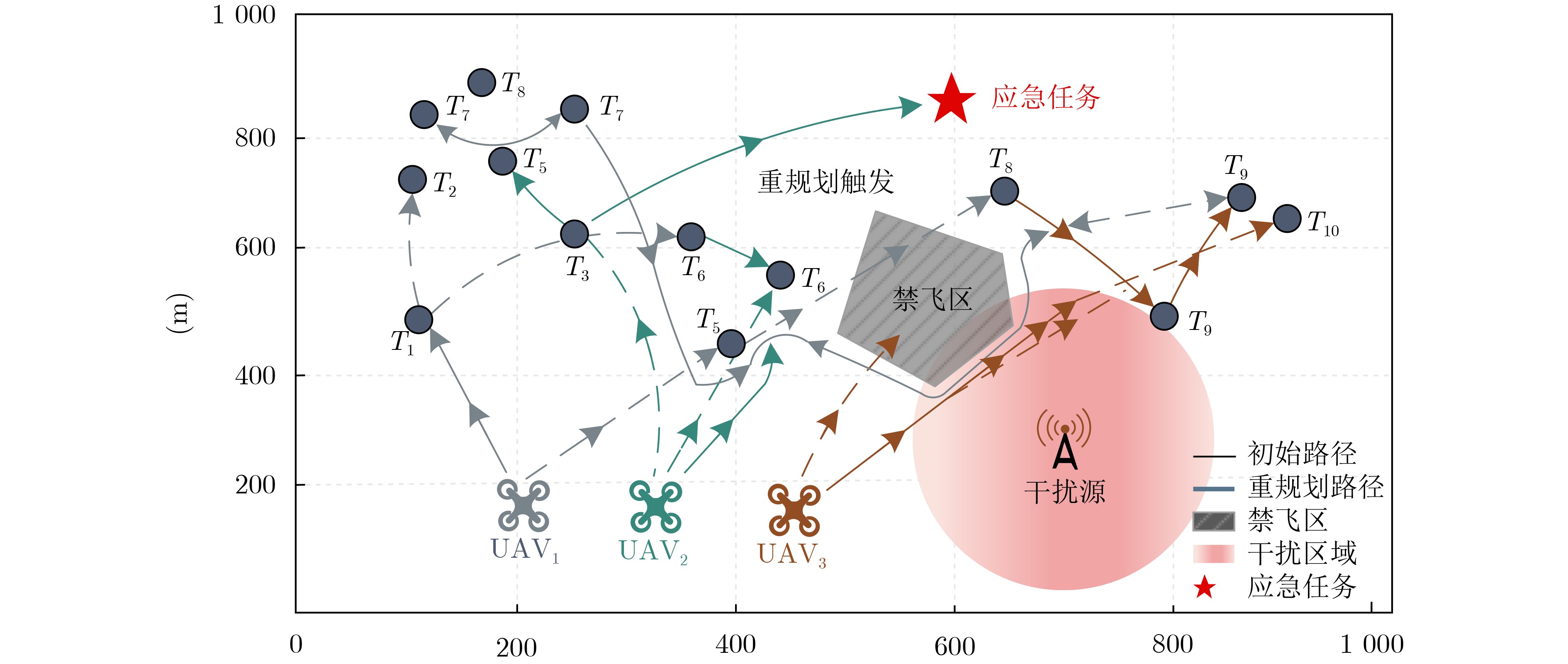
摘要: 针对复杂动态环境下多无人机协同任务规划中任务动态到达、平台故障、禁飞约束与链路质量波动并存所导致的任务分配与航路规划强耦合问题,该文构建动态韧性任务与航路耦合规划模型,将任务价值、航路代价、能耗、干扰惩罚、时间窗、能力约束、冲突消解和链路质量纳入统一优化框架,并以补偿负载与韧性指标刻画中断风险对系统效能的影响。在此基础上提出韧性感知混合群智能优化算法(RAHSO):以聚类与遗传初始化生成高质量初始解,用粪甲虫优化器(DBO)与粒子群优化(PSO)混合搜索结合遗传算法(GA)与变邻域搜索(VNS)实现全局探索与局部精修,引入死锁检测与修复保障分配结果的无环一致性,并设计基于近端策略优化(PPO)的事件驱动在线重规划模块以应对紧急任务插入与无人机故障。在仿真平台上构建静态、规模扩展、动态事件和中断4类场景开展对比与消融实验,结果表明RAHSO在任务完成率、累计任务价值、平均能耗、恢复时间和韧性指数等指标上具备稳定优势,并在保证在线重规划实时性的前提下兼顾任务效率与系统韧性。Abstract:
Objective This paper addresses the strongly coupled problem of task allocation and route planning in cooperative task and route planning for multiple UAV systems operating in complex dynamic environments, where dynamic task arrivals, UAV failures, no-fly-zone constraints, and link quality degradation occur simultaneously. Methods A Resilience-Aware Hybrid Swarm Optimization (RAHSO) algorithm is proposed. First, an integrated task-route planning model is established by jointly considering task value, route cost, energy consumption, interference penalties, time-window constraints, platform capability constraints, conflict resolution, and link quality within a unified optimization framework. High-quality initial solutions are generated through clustering-based and genetic initialization. A hybrid optimization framework that integrates the Dung Beetle Optimizer (DBO), Particle Swarm Optimization (PSO), Genetic Algorithm (GA), and Variable Neighborhood Search (VNS) is then employed to perform global exploration and local refinement. In addition, Tarjan-based deadlock detection and repair are incorporated to guarantee feasible task assignments. Finally, an event-driven Proximal Policy Optimization (PPO) online replanning module is designed to rapidly update affected task subsets in response to emergent tasks, UAV failures, and network topology changes. Results and Discussions Comparative and ablation experiments are conducted under static, large-scale, dynamic-event, and interruption scenarios. The results demonstrate that the proposed method consistently outperforms representative baseline algorithms in task completion rate, accumulated task value, average energy consumption, recovery time, and resilience index while maintaining satisfactory online replanning latency. Conclusions The proposed method provides an effective solution for resilient cooperative task and route planning for multiple UAV systems operating in complex dynamic environments. -
表 1 实验软硬件环境配置
项目 配置 CPU Intel Core i7 - 12700K @ 3.60 GHz(12核) GPU NVIDIA GeForce RTX 3080 10 GB GDDR6X内存 32 GB DDR4 3200 MHz操作系统 Ubuntu 20.04 LTS64位 仿真平台 AirSim 1.8.0+Unreal Engine场景 深度学习框架 PyTorch 2.2(CUDA 12.1) 优化器 Adam,初始学习率$ 1×10^{-4} $ 编程语言 Python 3.10  下载: 导出CSV
表 2 对比算法概览与关键参数
算法 原始文献 方法类别 信息结构 关键参数设置 韧性感知混合群智能优化算法(Resilience-Aware Hybrid Swarm Optimization, RAHSO) 本文 混合启发式+PPO 集中训练,
分布执行粒子数100,最大迭代200;DBO权重线性衰减;PSO惯性权重线性衰减,认知/社会因子1.5;PPO折扣0.99,剪裁0.2,学习率$ 1\times {10}^{-4} $,
批量256自适应精英二进制粒子群算法(Adaptive Elite Binary Particle Swarm Optimization,
AE-BPSO)[22] 群智能优化 集中式 粒子数80,最大迭代200,惯性权重0.9→0.5,自适应精英策略用于局部搜索增强 动态联盟任务分配算法(Dynamic Coalition Task Allocation, DCTA) [23] 分布式协同分配 局部通信 最大协商轮数20,领导节点动态选举,
邻居更新步长0.5,通信半径150 m时序图任务卸载算法(Temporal Graph Task Offloading, TGTO) [24] 中心式图优化 中心式 时序窗口30步,预测视窗50 s,中心优化器步长0.01,最大迭代300 加权遗传算法(Weighted Genetic Algorithm, WGA) [25] 遗传优化 集中式 种群规模100,代数200,交叉概率0.8,变异概率0.1,收益/能耗/延迟按0.5/0.3/0.2加权 分布式回报聚合任务分配算法(Iterative Reward Aggregation Distributed Assignment, IRADA) [26] 分布式优化 局部通信 通信半径150 m,回报折扣0.95,
任务刷新周期10 s,邻域更新次数5改进近端策略优化算法(Improved Proximal Policy Optimization, Improved PPO) [27] 深度强化学习 集中训练 Actor-Critic 3层多层感知机(Multilayer Perceptron, MLP)(64-64-64),折扣0.99,剪裁0.2,学习率 $ 1\times {10}^{-4} $,每轮更新10次 广义一致性捆绑拍卖算法(Generalized Consensus-Based Bundle Algorithm, G-CBBA) [28] 拍卖与捆绑分配 分布式 最大拍卖轮数15,捆绑长度上限10,
收益折扣0.9,冲突解算采用贪心回退
下载: 导出CSV
表 3 评价指标定义与含义
指标 数学定义 含义说明 任务完成率(%) $ \eta =\left(\dfrac{{{N}}_{\text{comp}}}{{M}}\right)\times 100\% $ 成功完成任务数占总任务数的比例 累计任务价值 $ U=\displaystyle\sum\limits_{j}\in{\mathcal{T}_{\text{comp}}}^{ {r}_{j}} $ 已完成任务价值的累计值,
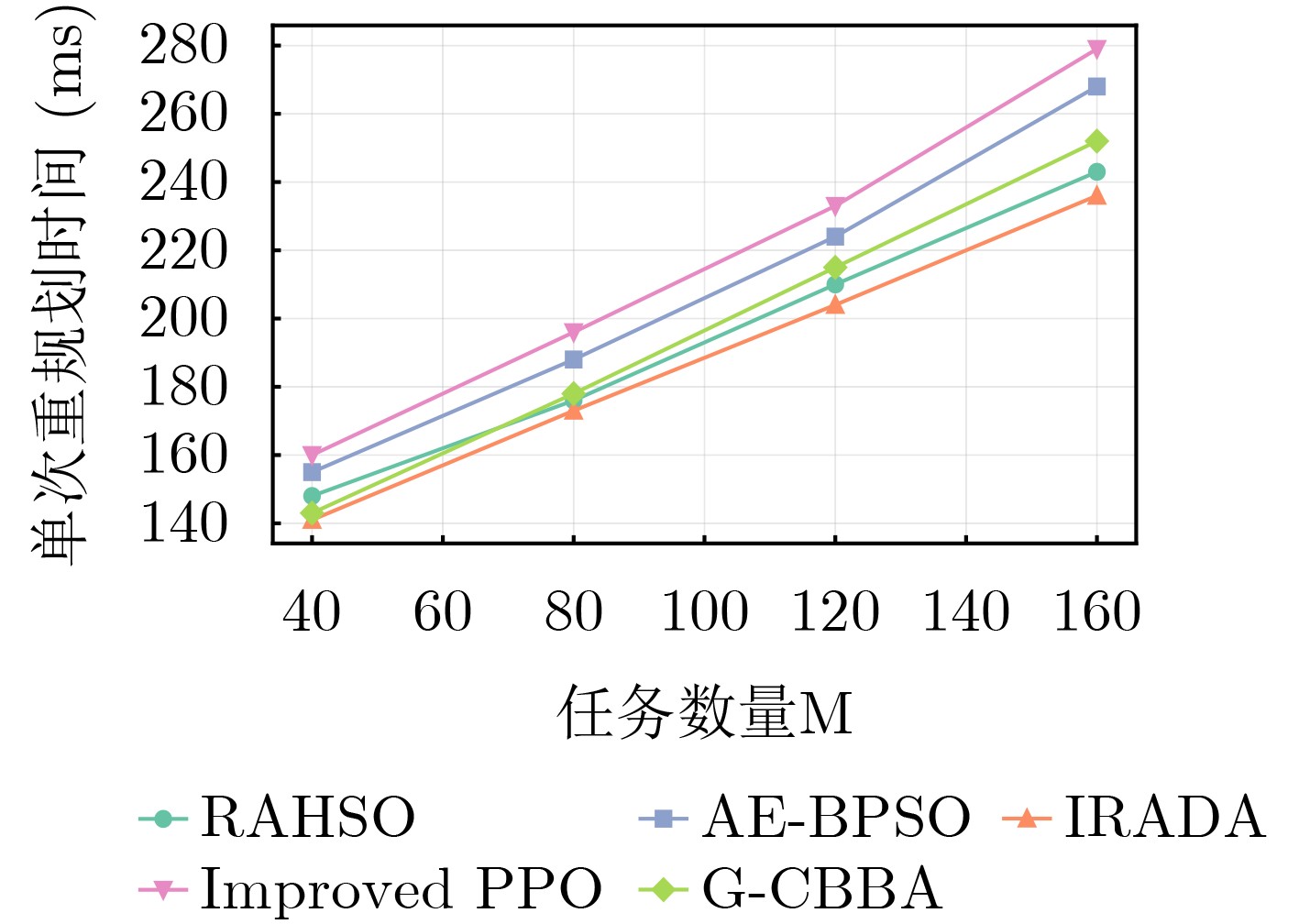
用于刻画任务价值获取能力平均能耗(Wh) $ \overline{{E}}=\dfrac{1}{{N}}\displaystyle\sum\limits_{{i=1}}^{{N}}{{E}}_{{i}} $ 单架无人机平均能量消耗 平均任务延迟(s) $ \overline{{D}}=\dfrac{1}{{{N}}_{\text{comp}}}\displaystyle\sum\limits_{{j}\in {\mathcal{T}}_{\text{comp}}}\left({t}_{{j}}^{\text{finish}}-{t}_{{j}}^{\text{release}}\right) $ 任务从发布到完成的平均时长 韧性指数 $ {R}=\dfrac{{{U}}_{\text{disturbed}}}{{{U}}_{\text{baseline}}} $ 扰动场景下相对于基线场景的性能保持程度 平均求解时间(ms) $ {\overline{{T}}}_{\mathrm{r}}=\dfrac{1}{{{N}}_{\mathrm{r}}}\displaystyle\sum\limits_{{k}=1}^{{{N}}_{\mathrm{r}}}{{T}}_{\mathrm{r},{k}} $ 单次规划过程的平均运行时间,主要用于静态任务
和规模扩展实验平均恢复时间(s) $ \left[{\overline{T}}_{{\mathrm{rec}}}=\dfrac{1}{{N}_{{\mathrm{evt}}}}\displaystyle\sum\limits_{e=1}^{{N}_{{\mathrm{evt}}}}\left(t_{e}^{{\mathrm{stable}}}-t_{e}^{{\mathrm{event}}}\right)\right] $ 动态事件发生后系统恢复到稳定执行状态
所需的平均时间
下载: 导出CSV
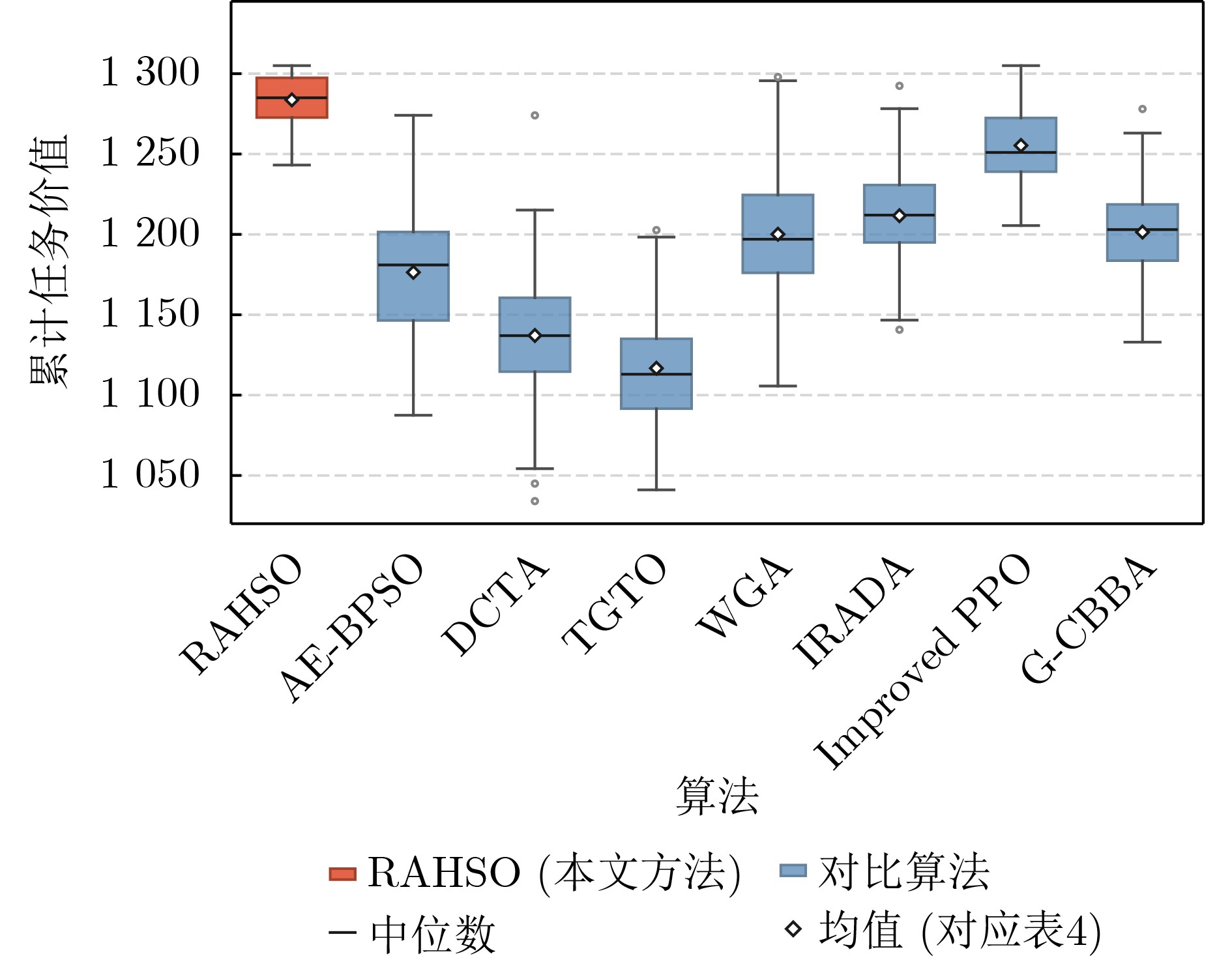
表 4 静态任务场景下各算法性能对比
算法 任务
完成率(%)累计任务
价值平均能耗
(Wh)平均任务
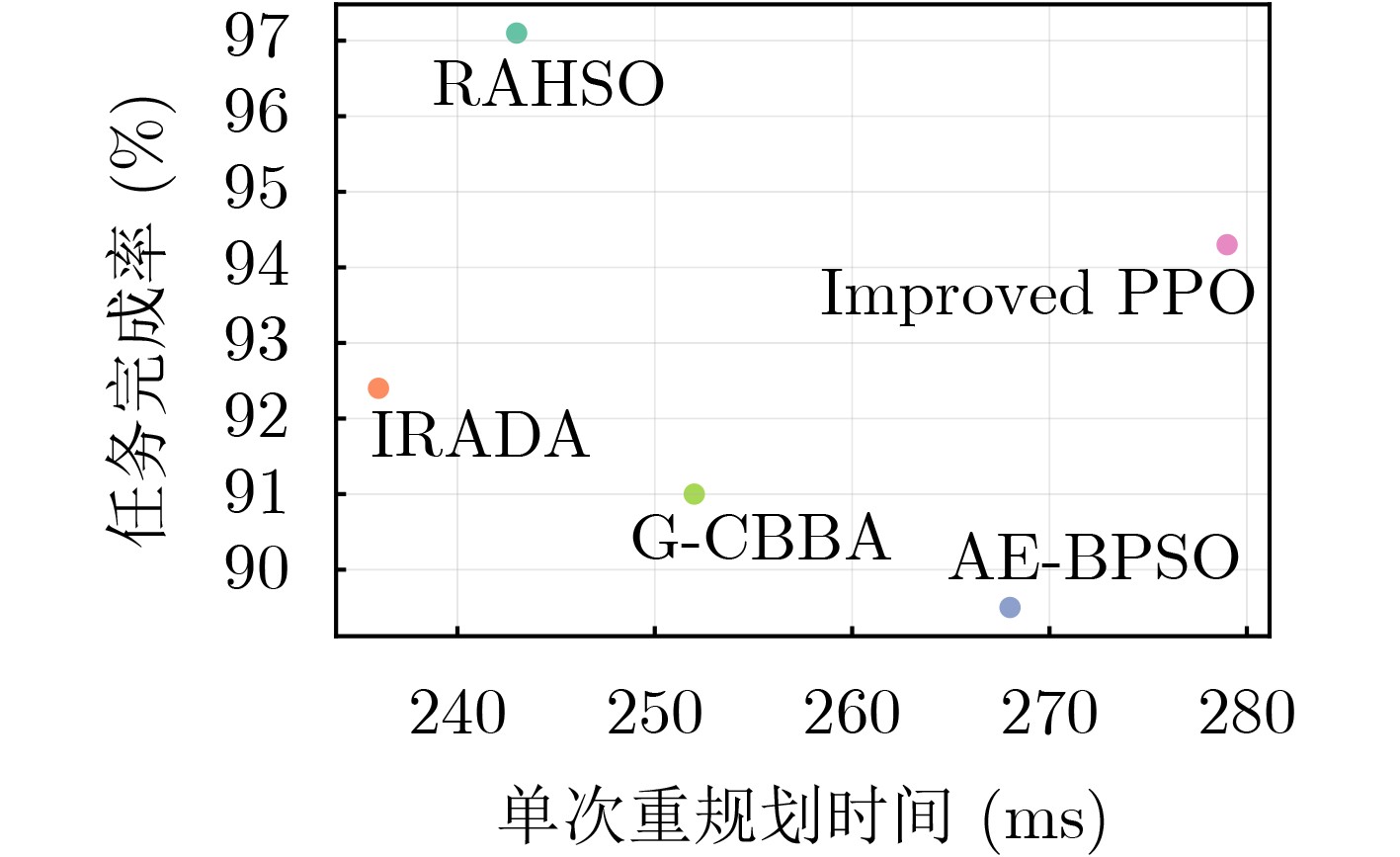
延迟(s)RAHSO 98.5 1285 74.3 38.6 AE-BPSO 91.9 1181 79.7 46.5 DCTA 90.4 1137 82.6 49.2 TGTO 88.7 1113 84.0 51.4 WGA 92.6 1197 77.5 45.0 IRADA 94.3 1212 76.0 43.2 Improved PPO 96.1 1251 75.4 40.1 G-CBBA 93.5 1203 78.3 45.4
下载: 导出CSV
表 5 不同任务规模下任务完成率对比
任务数M 任务完成率(%) RAHSO AE-BPSO IRADA ImprovedPPO G-CBBA 40 99.3 95.6 96.2 97.8 96.1 80 98.8 93.9 95.3 96.9 94.9 120 98.1 92.0 94.5 95.6 93.1 160 97.1 89.5 92.4 94.3 91.0
下载: 导出CSV
表 6 动态事件下累计任务价值与恢复性能对比
算法 静态累计任务
价值动态累计任务
价值任务价值下降
(%)静态任务完成率
(%)动态任务完成率
(%)任务完成率下降
(百分点)平均恢复时间
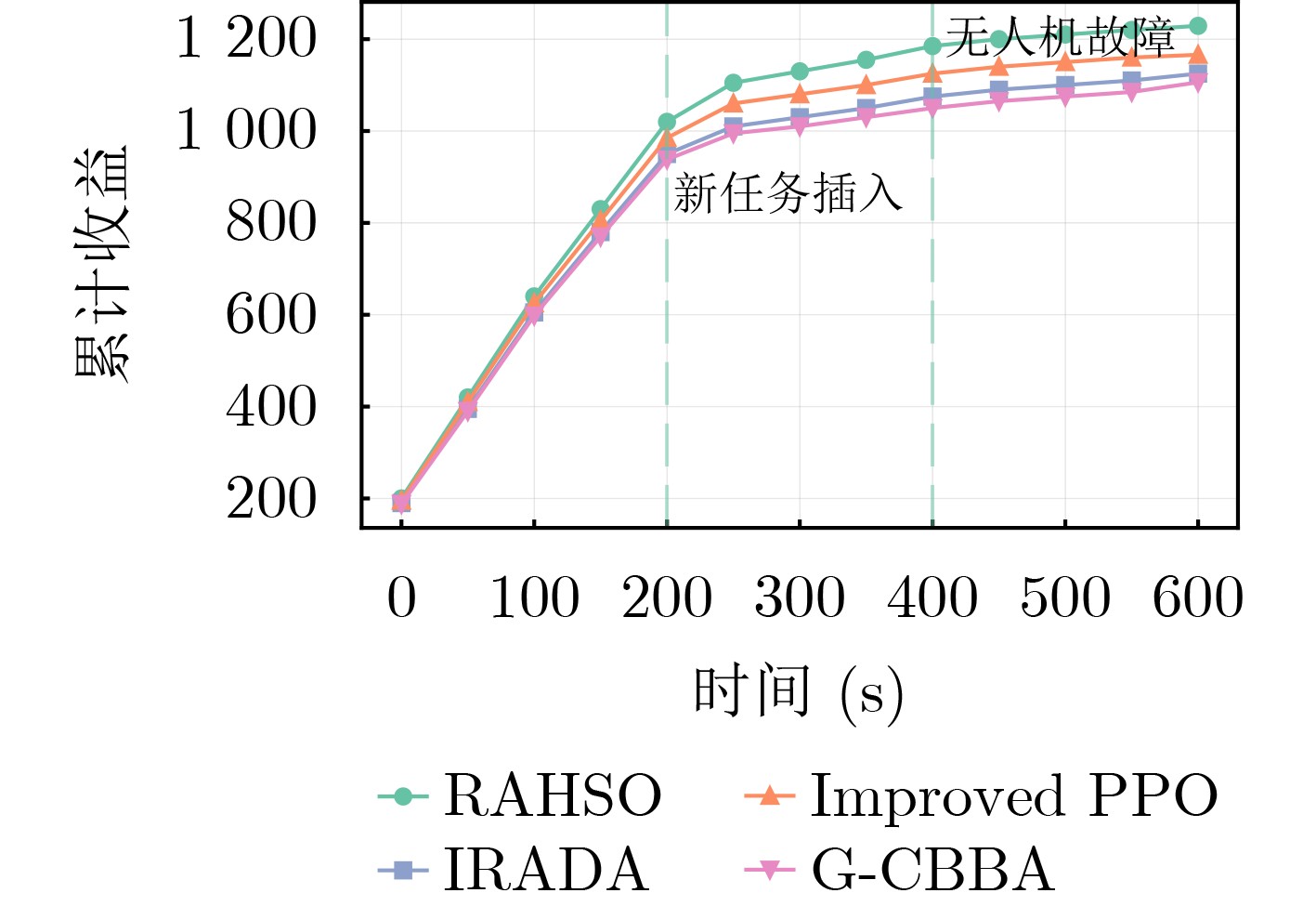
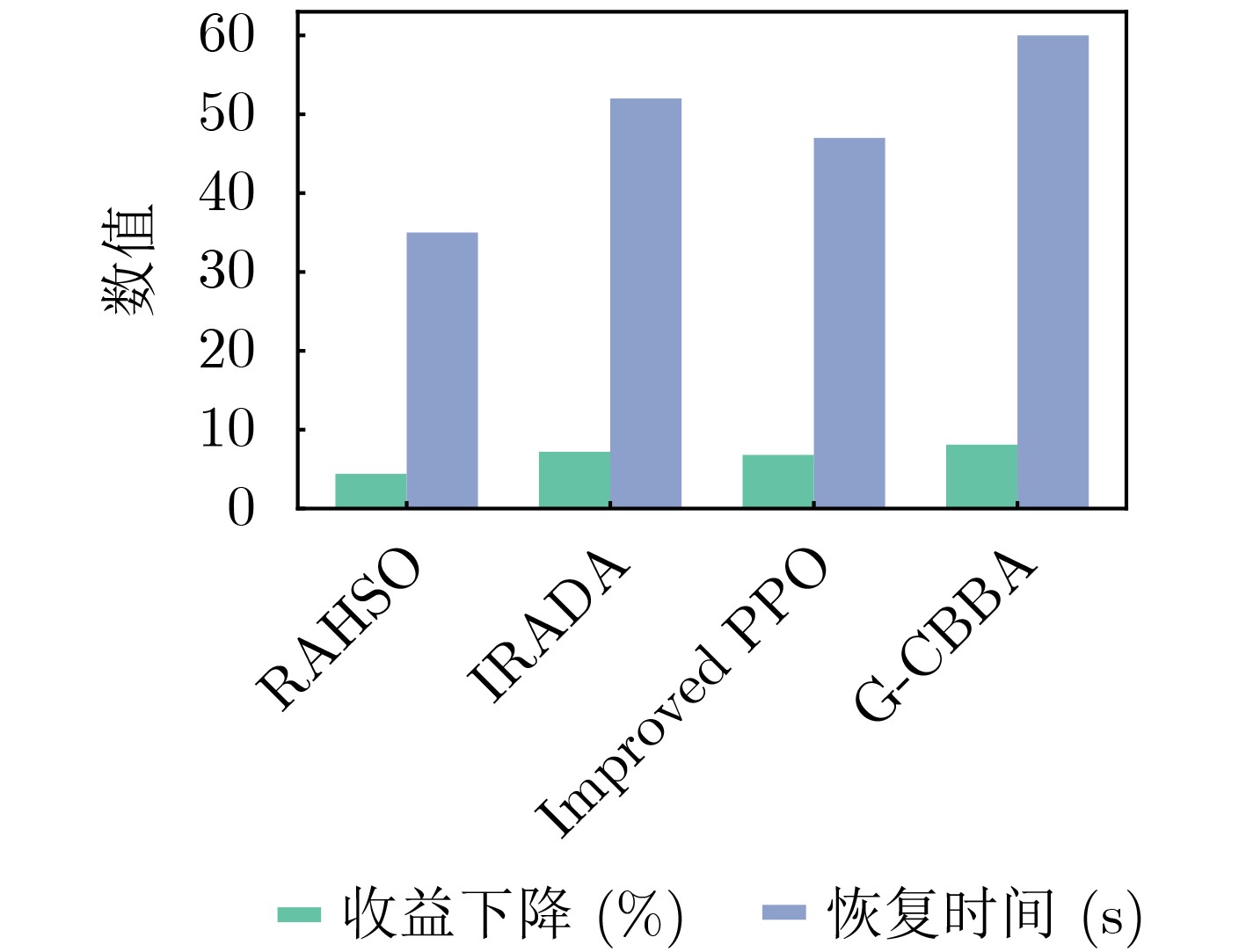
(s)RAHSO 1285 1229 4.4 98.5 95.8 2.7 35 IRADA 1212 1125 7.2 94.3 90.1 4.2 52 Improved PPO 1251 1166 6.8 96.1 92.4 3.7 47 G-CBBA 1203 1106 8.1 93.5 89.3 4.2 61
下载: 导出CSV
A2 AE-BPSO等4种算法在动态事件场景下的恢复性能
算法 静态
累计
任务
价值动态
累计
任务
价值任务价
值下降
(%)静态任务
完成率
(%)动态任务
完成率
(%)任务完成
率下降
(%)平均
恢复
时间(s)AE-BPSO 1181 1053 10.8 91.9 85.4 6.5 78 DCTA 1137 1008 11.3 90.4 83.7 6.7 84 TGTO 1113 972 12.7 88.7 81.1 7.6 95 WGA 1197 1079 9.9 92.6 86.9 5.7 72
下载: 导出CSV
表 7 不同中断概率下韧性指数与归一化任务价值对比
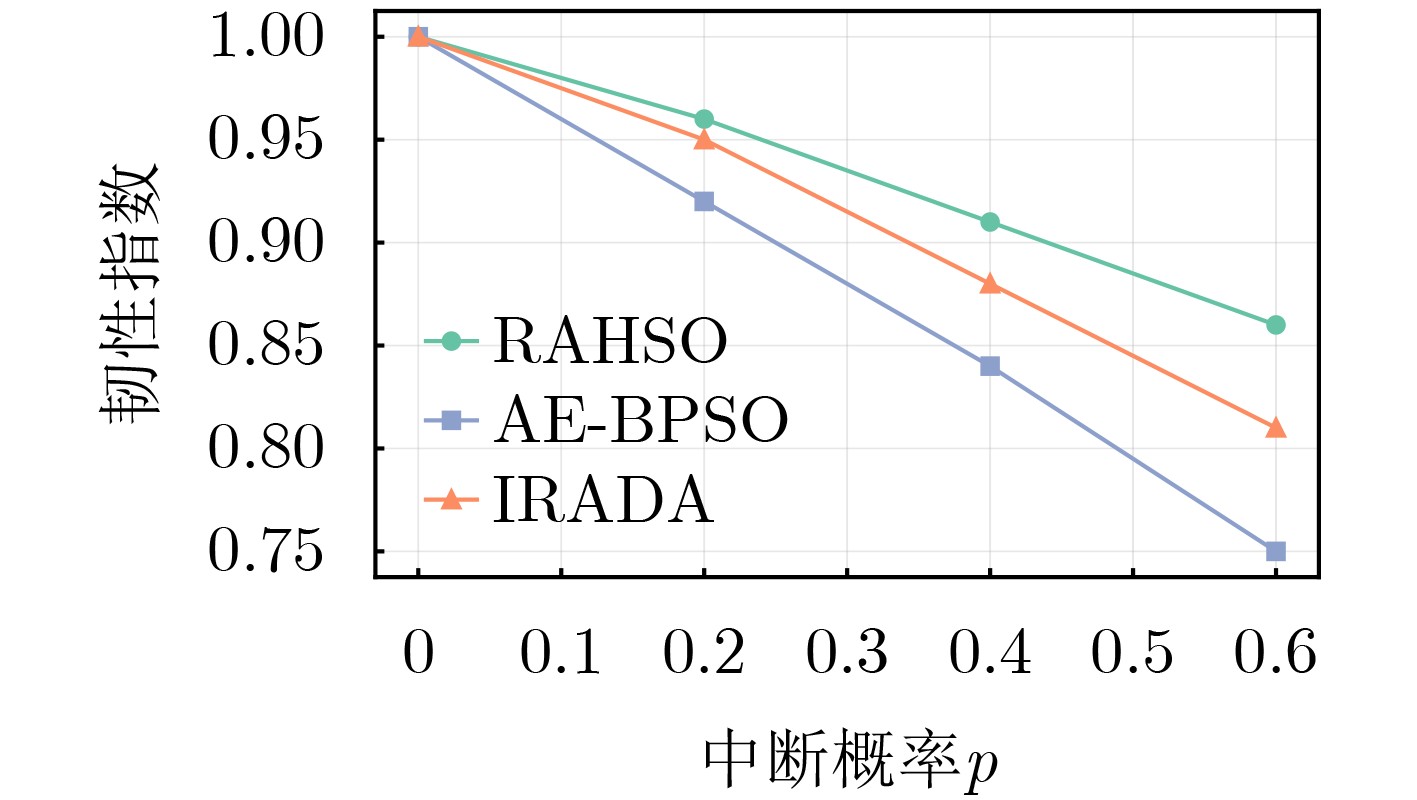
中断概率p RAHSO韧性指数 RAHSO归一化收益 AE-BPSO韧性指数 AE-BPSO归一化收益 IRADA韧性指数 IRADA归一化收益 0 1.00 1.00 1.00 1.00 1.00 1.00 0.2 0.96 0.95 0.92 0.91 0.95 0.94 0.4 0.91 0.89 0.84 0.82 0.88 0.87 0.6 0.86 0.83 0.75 0.73 0.81 0.79
下载: 导出CSV
表 8 不同模块配置下RAHSO的静态性能比较
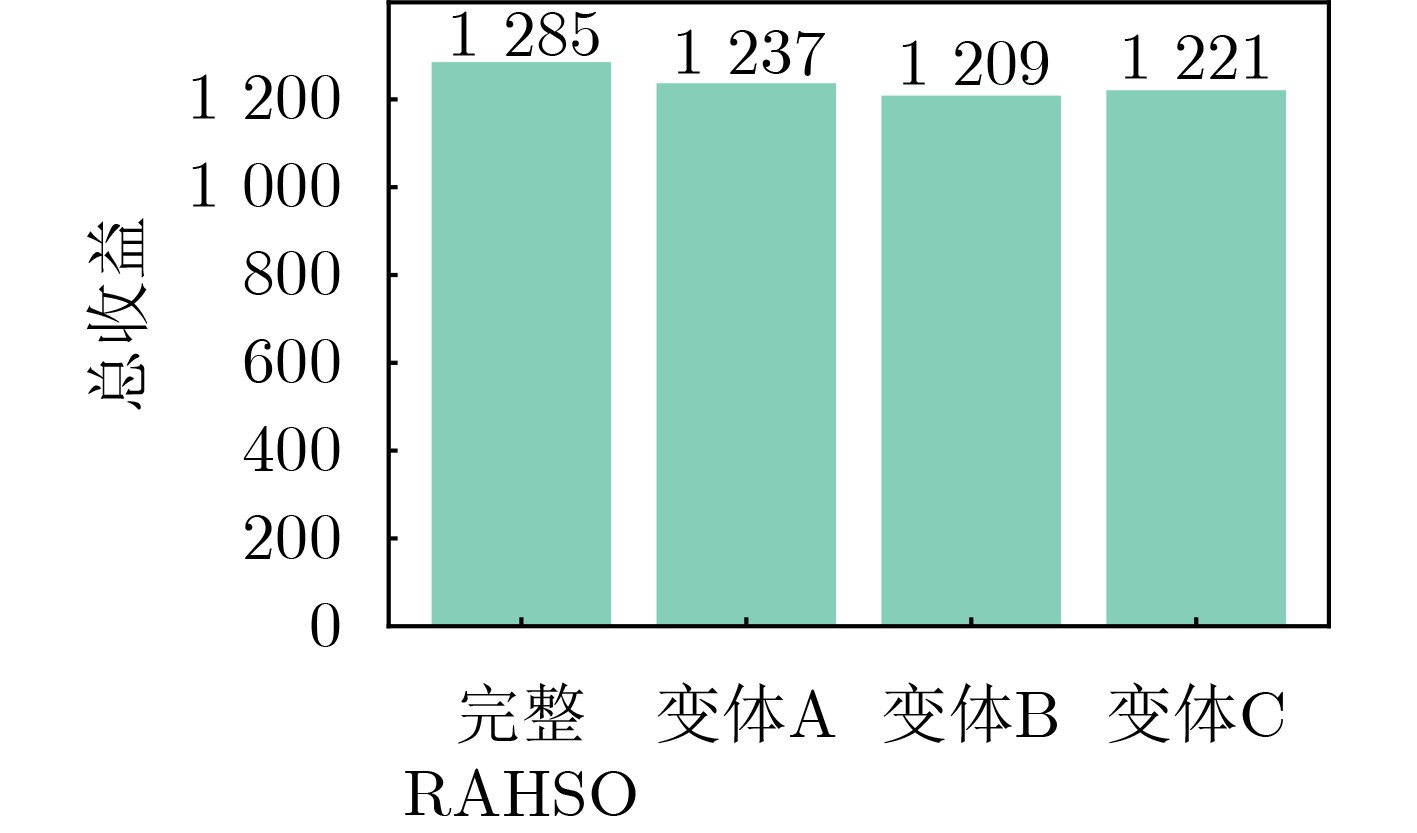
算法变体 任务完
成率(%)累计任务
价值平均能耗
(Wh)平均任务
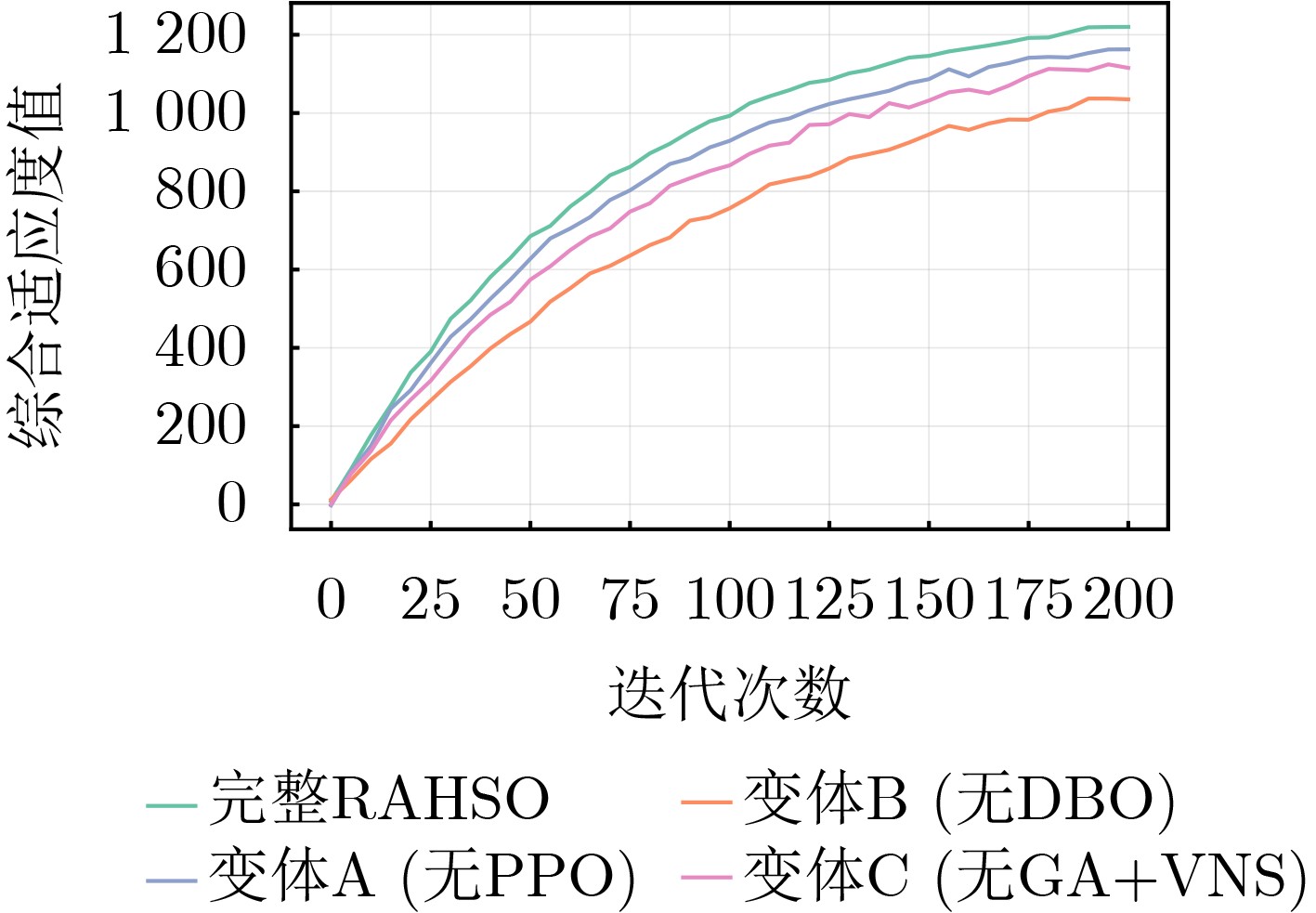
延迟(s)完整RAHSO 98.5 1285 74.3 38.6 变体A(去除PPO) 96.4 1237 76.0 41.0 变体B(去除DBO) 95.3 1209 78.7 44.6 变体C(去除GA+VNS) 95.9 1221 76.1 40.4
下载: 导出CSV
表 9 动态事件场景下不同模块配置的恢复性能比较
算法变体 动态累计任务价值 任务价值下降(%) 动态任务完成率(%) 任务完成率下降(%) 平均恢复时间(s) 完整RAHSO 1229 4.4 95.8 2.7 35 变体A(去除PPO) 1109 10.3 90.2 6.2 58 变体B(去除DBO) 1118 7.5 92.1 3.2 43 变体C(去除GA+VNS) 1144 6.3 92.8 3.1 40
下载: 导出CSV
A1 DCTA,TGTO与WGA在任务规模扩展实验下的完整结果
任务数M 算法 任务完
成率(%)平均求解
时间(ms)40 DCTA 93.8 178 40 TGTO 91.5 241 40 WGA 95.4 162 80 DCTA 90.7 286 80 TGTO 88.2 472 80 WGA 93.5 253 120 DCTA - - 120 TGTO 82.1 918 120 WGA 90.4 371 160 DCTA - - 160 TGTO - - 160 WGA 86.9 528
下载: 导出CSV
A3 DCTA等5种算法在不同中断概率下的韧性指数与归一化任务价值
中断概率 p 算法 韧性指数 归一化任务价值 0 DCTA 1 1 TGTO 1 1 WGA 1 1 Improved PPO 1 1 G-CBBA 1 1 0.2 DCTA 0.9 0.89 TGTO 0.88 0.86 WGA 0.91 0.9 Improved PPO 0.94 0.93 G-CBBA 0.92 0.91 0.4 DCTA 0.8 0.78 TGTO 0.76 0.74 WGA 0.83 0.81 Improved PPO 0.87 0.85 G-CBBA 0.84 0.82 0.6 DCTA 0.71 0.68 TGTO 0.66 0.63 WGA 0.74 0.71 Improved PPO 0.8 0.77 G-CBBA 0.76 0.73
下载: 导出CSV
-
[1] 刘雷, 刘大卫, 王晓光, 等. 无人机集群与反无人机集群发展现状及展望[J]. 航空学报, 2022, 43(S1): 726908. doi: 10.7527/S1000-6893.2022.26908.LIU Lei, LIU Dawei, WANG Xiaoguang, et al. Development status and outlook of UAV clusters and anti-UAV clusters[J]. Acta Aeronautica et Astronautica Sinica, 2022, 43(S1): 726908. doi: 10.7527/S1000-6893.2022.26908. [2] 王侃, 曹铁林, 李旭杰, 等. 无人机辅助边缘计算网络轨迹规划与资源分配研究综述[J]. 电子与信息学报, 2025, 47(5): 1266-1281. doi: 10.11999/JEIT241071.WANG K, CAO T L, LI X J, et al. A survey on trajectory planning and resource allocation in unmanned aerial vehicle-assisted edge computing networks[J]. Journal of Electronics and Information Technology, 2025, 47(5): 1266-1281. doi: 10.11999/JEIT241071. [3] 冯斯梦, 张云弈, 刘凯, 等. 低空混合障碍下无人机协同多智能体航迹规划[J]. 电子与信息学报, 2025, 47(5): 1291-1300. doi: 10.11999/JEIT250012.FENG S M, ZHANG Y Y, LIU K, et al. Collaborative multi-agent trajectory optimization for unmanned aerial vehicles under low-altitude mixed-obstacle airspace[J]. Journal of Electronics and Information Technology, 2025, 47(5): 1291-1300. doi: 10.11999/JEIT250012. [4] 张欣睿, 时晨光, 吴志锋, 等. 动态威胁下基于改进APF-RRT*算法的无人机集群隐身航迹规划算法[J]. 电子与信息学报, 2025, 47(12): 5178-5191. doi: 10.11999/JEIT250554.ZHANG X R, SHI C G, WU Z F, et al. Stealthy path planning algorithm for UAV swarm based on improved APF-RRT* under dynamic threat[J]. Journal of Electronics and Information Technology, 2025, 47(12): 5178-5191. doi: 10.11999/JEIT250554. [5] RAHMAN M, SARKAR N I, and LUTUI R. A survey on Multi-UAV path planning: Classification, algorithms, open research problems, and future directions[J]. Drones, 2025, 9(4): 263. doi: 10.3390/drones9040263. [6] QUADT T, LINDELAUF R, VOSKUIJL M, et al. Dealing with multiple optimization objectives for UAV path planning in hostile environments: A literature review[J]. Drones, 2024, 8(12): 769. doi: 10.3390/drones8120769. [7] GÜVEN İ and YANMAZ E. Multi-objective path planning for multi-UAV connectivity and area coverage[J]. Ad Hoc Networks, 2024, 160: 103520. doi: 10.1016/j.adhoc.2024.103520. [8] MAJEED A and HWANG S O. A multi-objective coverage path planning algorithm for UAVs to cover spatially distributed regions in urban environments[J]. Aerospace, 2021, 8(11): 343. doi: 10.3390/aerospace8110343. [9] CHEN Yang, SHU Yifei, HU Mian, et al. Multi-UAV cooperative path planning with monitoring privacy preservation[J]. Applied Sciences, 2022, 12(23): 12111. doi: 10.3390/app122312111. [10] MAHATO P, SAHA S, SARKAR C, et al. Consensus-based fast and energy-efficient multi-robot task allocation[J]. Robotics and Autonomous Systems, 2023, 159: 104270. doi: 10.1016/j.robot.2022.104270. [11] PENG Qiang, WU Husheng, and XUE Ruisong. Review of dynamic task allocation methods for UAV swarms oriented to ground targets[J]. Complex System Modeling and Simulation, 2021, 1(3): 163–175. doi: 10.23919/CSMS.2021.0022. [12] LI Kun, YAN Xinxin, and HAN Ying. Multi-mechanism swarm optimization for multi-UAV task assignment and path planning in transmission line inspection under multi-wind field[J]. Applied Soft Computing, 2024, 150: 111033. doi: 10.1016/j.asoc.2023.111033. [13] JIANG Hao, LIN Sicheng, CHEN Jing, et al. Fusion of cluster analysis and differential particle swarm optimisation for multi-UAV task assignment on power transmission line[J]. Engineering Computations, 2025, 42(4): 1447–1470. doi: 10.1108/EC-12-2024-1120. [14] WANG Yiquan, CUI Yan, YANG Yu, et al. Multi-UAV path planning for air-ground relay communication based on mix-Greedy MAPPO algorithm[J]. Drones, 2024, 8(12): 706. doi: 10.3390/drones8120706. [15] ZHAO Guodong, WANG Ye, MU Tong, et al. Reinforcement-learning-assisted multi-UAV task allocation and path planning for IIoT[J]. IEEE Internet of Things Journal, 2024, 11(16): 26766–26777. doi: 10.1109/JIOT.2024.3370152. [16] 王孟阳, 张栋, 唐硕, 等. 基于动态联盟策略的无人机集群在线任务规划方法[J]. 兵工学报, 2023, 44(8): 2207–2223. doi: 10.12382/bgxb.2022.0247.WANG Mengyang, ZHANG Dong, TANG Shuo, et al. UAV swarm on-line mission planning method based on dynamic allocation strategy[J]. Acta Armamentarii, 2023, 44(8): 2207–2223. doi: 10.12382/bgxb.2022.0247. [17] 周文惠, 齐瑞云, 姜斌. 面向突发故障的分布式多无人机任务重规划方法[J]. 控制与决策, 2023, 38(5): 1373–1385. doi: 10.13195/j.kzyjc.2022.1022.ZHOU Wenhui, QI Ruiyun, and JIANG Bin. Mission replanning method of distributed multiple unmanned aerial vehicles for pop-up faults[J]. Control and Decision, 2023, 38(5): 1373–1385. doi: 10.13195/j.kzyjc.2022.1022. [18] SHENG Zimao, YANG Hong’an, SONG Peng, et al. Towards resilience optimization: Distributed task replanning of multi-UAV system under complex terrain, individual destruction and constrained communication[J]. Aerospace Science and Technology, 2026, 168: 110791. doi: 10.1016/j.ast.2025.110791. [19] MAYYA S, D’ANTONIO D S, SALDAÑA D, et al. Resilient task allocation in heterogeneous multi-robot systems[J]. IEEE Robotics and Automation Letters, 2021, 6(2): 1327–1334. doi: 10.1109/LRA.2021.3057559. [20] NOTOMISTA G, MAYYA S, EMAM Y, et al. A resilient and energy-aware task allocation framework for heterogeneous multirobot systems[J]. IEEE Transactions on Robotics, 2022, 38(1): 159–179. doi: 10.1109/TRO.2021.3102379. [21] WANG Xinwei, GAO Xiaohua, WANG Lei, et al. Resilient multi-objective mission planning for UAV formation: A unified framework integrating task pre- and re-assignment[J]. Defence Technology, 2025, 45: 203–226. doi: 10.1016/j.dt.2024.08.002. [22] WANG Kehao, GONG Yufeng, LI Changzhen, et al. Joint optimization of task allocation, power optimization and trajectory planning in multi-UAV system[J]. Physical Communication, 2026, 74: 102926. doi: 10.1016/j.phycom.2025.102926. [23] LIU Haixiao, SHAO Zhichao, ZHOU Quanzhi, et al. Task allocation algorithm for heterogeneous UAV swarm with temporal task chains[J]. Drones, 2025, 9(8): 574. doi: 10.3390/drones9080574. [24] ZHAO Lingyu, ZHU Xiaorong, and CAI Jianhong. Task offloading algorithm for multiple unmanned aerial vehicles based on temporal graph[J]. Sensors, 2025, 25(21): 6759. doi: 10.3390/s25216759. [25] CAO Meiling, PENG Jiaying, YANG Liu, et al. Multi-UAV task allocation and path planning in emergency rescue scenarios with uncertain requirements[J]. Journal of Industrial and Management Optimization, 2025, 21(10): 6107–6133. doi: 10.3934/jimo.2025124. [26] ZHANG Changming, XU Caiyue, LI Gang, et al. A distributed task allocation approach for multi-UAV persistent monitoring in dynamic environments[J]. Scientific Reports, 2025, 15(1): 6437. doi: 10.1038/s41598-025-89787-3. [27] ZHAN Guang, ZHANG Xinmiao, LI Zhongchao, et al. Multiple-UAV reinforcement learning algorithm based on improved PPO in ray framework[J]. Drones, 2022, 6(7): 166. doi: 10.3390/drones6070166. [28] KIM K S, KIM H Y, and CHOI H L. A bid-based grouping method for communication-efficient decentralized multi-UAV task allocation[J]. International Journal of Aeronautical and Space Sciences, 2020, 21(1): 290–302. doi: 10.1007/s42405-019-00205-1. -

 下载:
下载:


计量
- 文章访问数: 641
- HTML全文浏览量: 267
- PDF下载量: 64
- 被引次数: 0
