




Joint Channel Estimation and Diagnosis for Blocked RIS-Assisted Multi-User Multipath Millimeter-Wave Systems
-
摘要: 针对受阻塞无源可重构智能表面(RIS)辅助的多用户毫米波(mmWave)上行链路通信系统,该文对信道估计与阻塞诊断问题展开研究。现有研究多聚焦于单用户或单路径场景,该文重点解决多用户多路径共存下的估计难题。通过充分挖掘多用户级联信道的稀疏性与路径间的相关性,提出一种低复杂度的两阶段联合估计与诊断策略。第1阶段选取目标用户,利用高斯-逆伽马先验对阻塞向量的稀疏性进行建模,结合贝叶斯压缩感知技术迭代恢复信道参数与阻塞信息;第2阶段则利用所有用户共享RIS-基站信道且受相同阻塞影响的关键特性,构建公共信道矩阵,以估计其余用户的信道参数。仿真结果表明,所提方法能实现高精度的信道估计与可靠的阻塞诊断。Abstract:
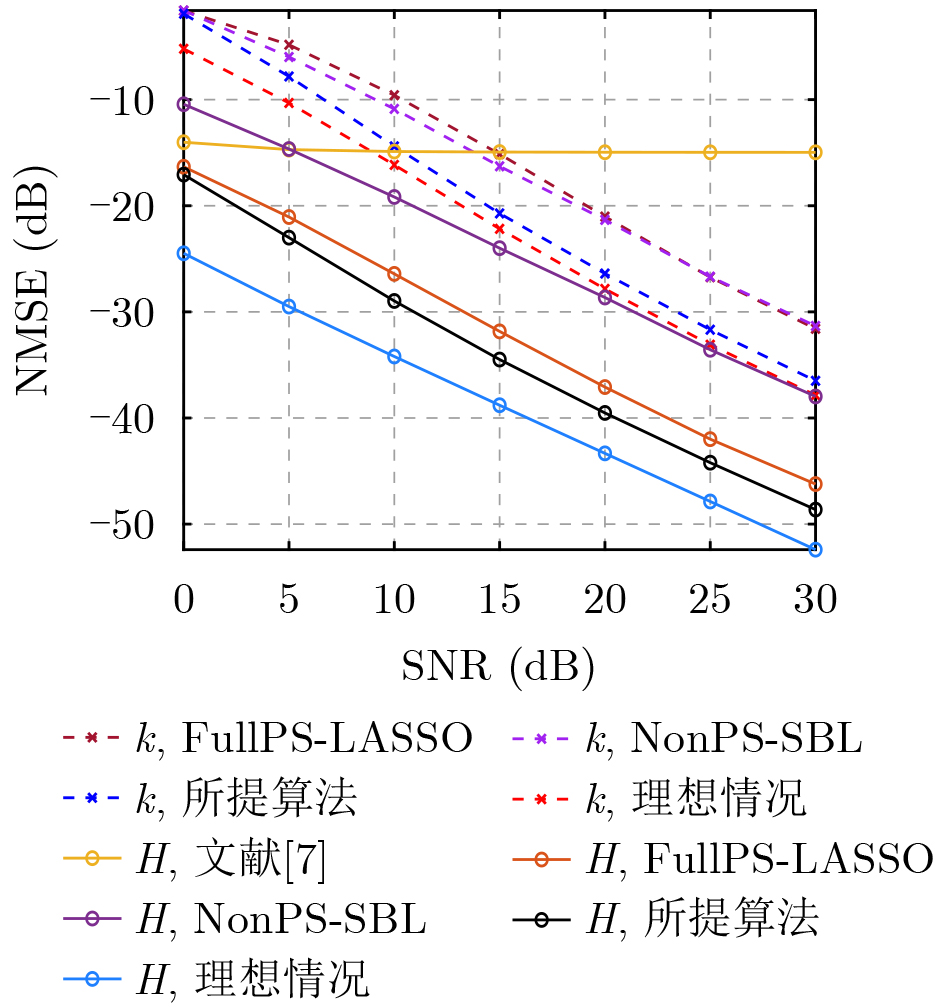
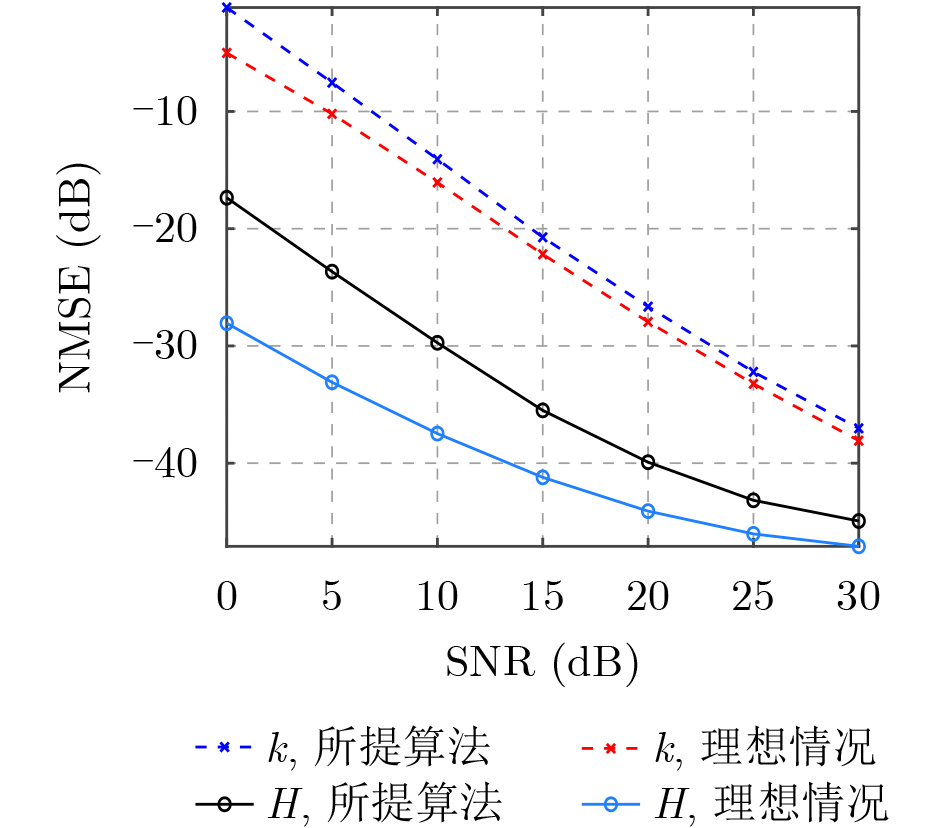
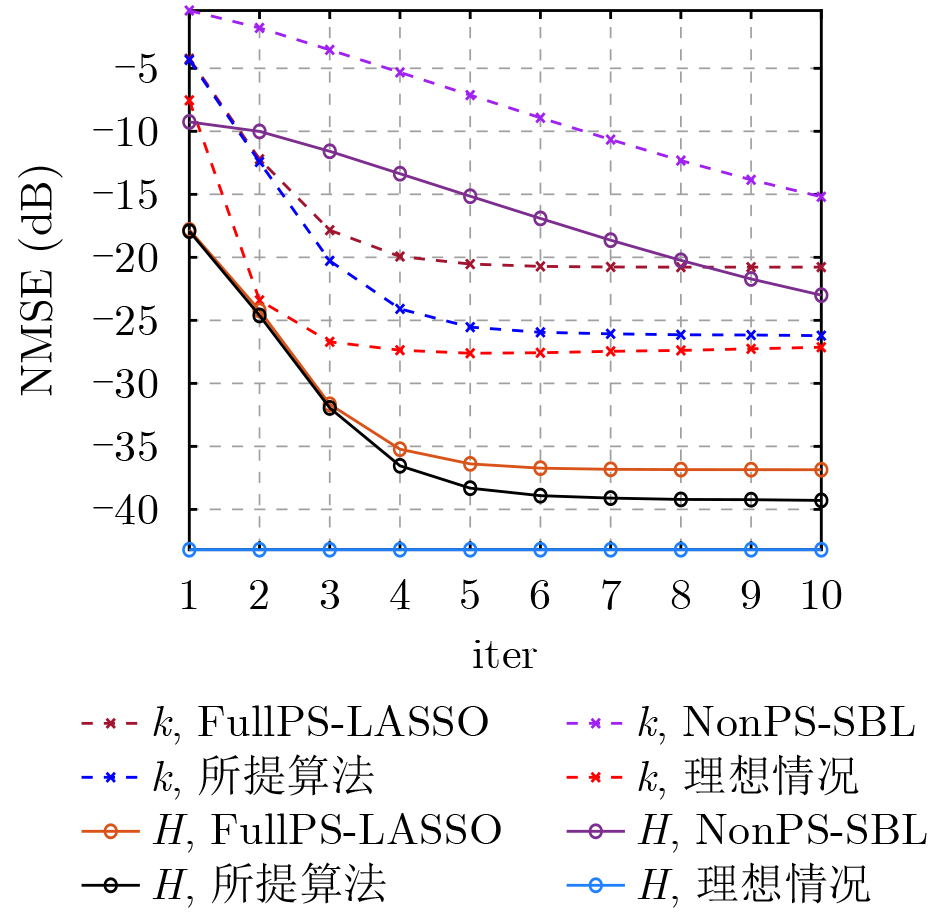
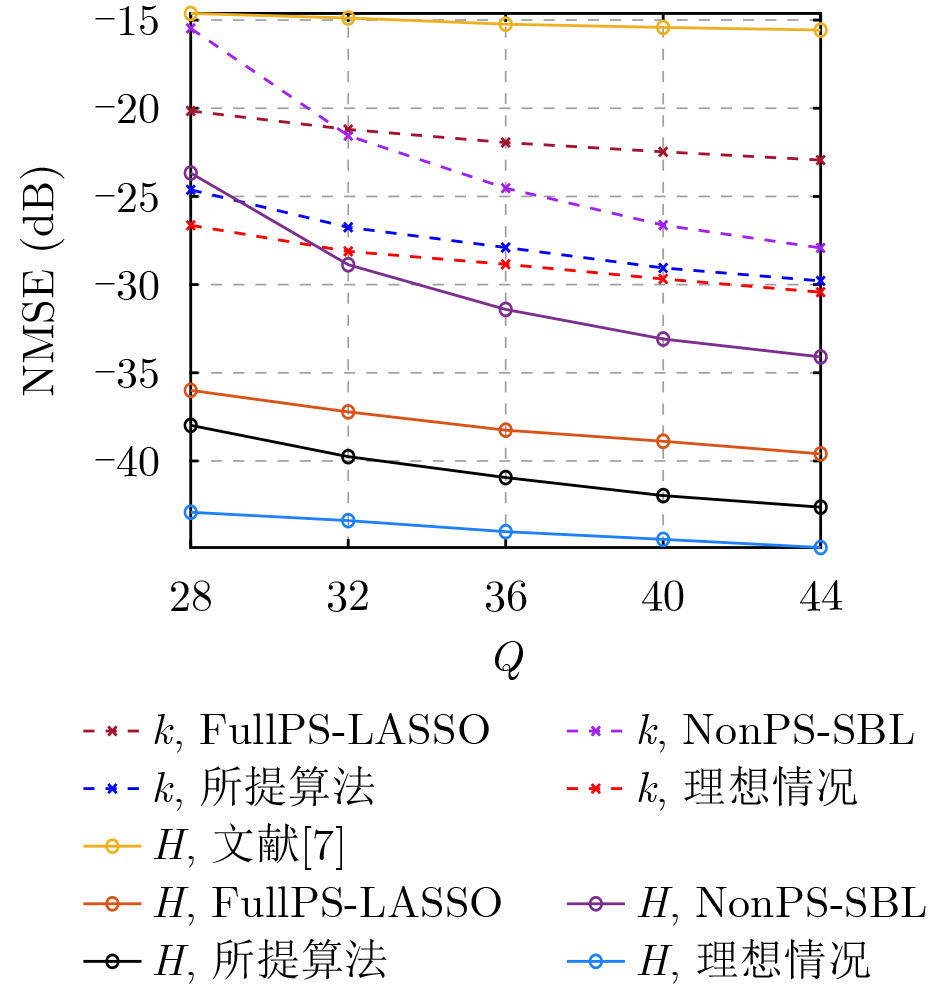
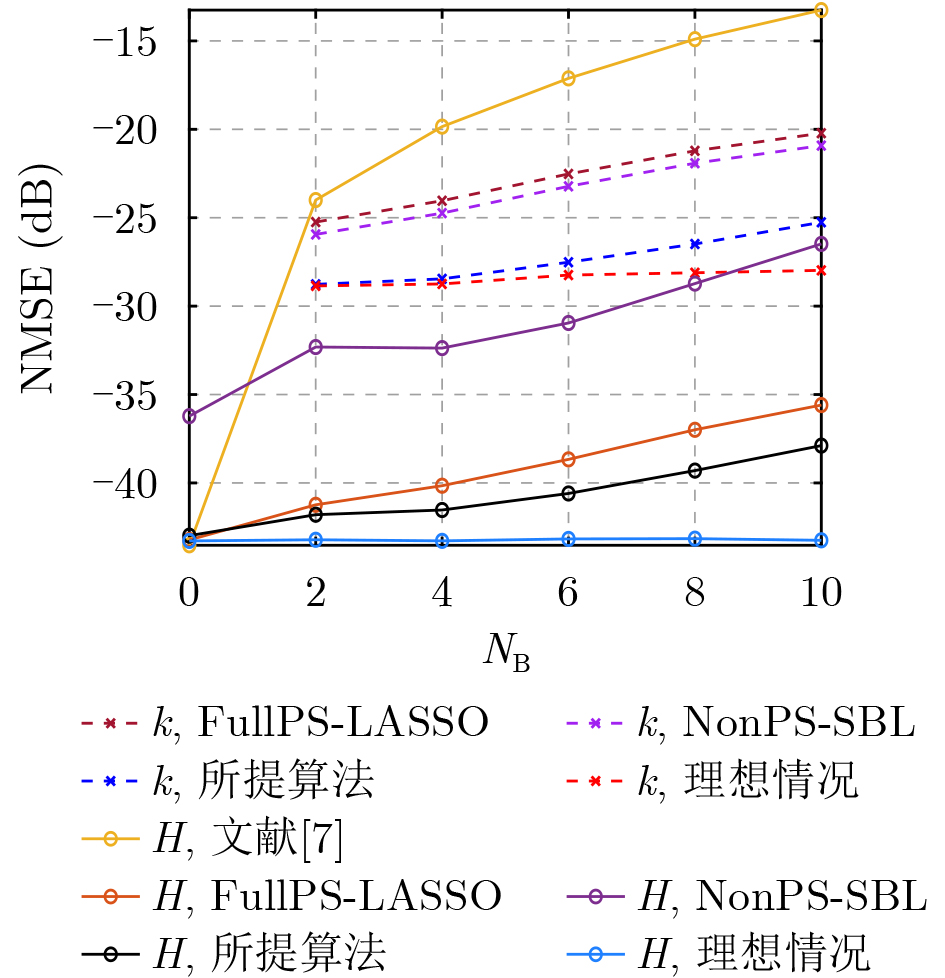
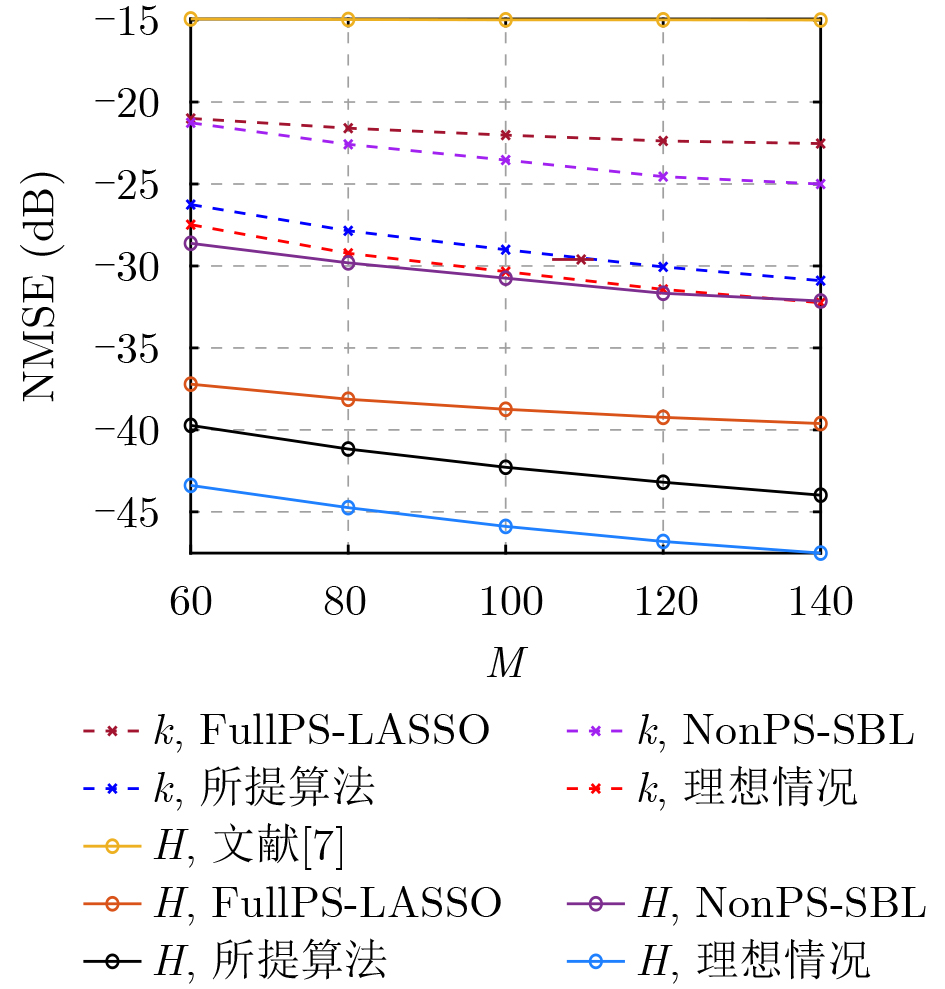
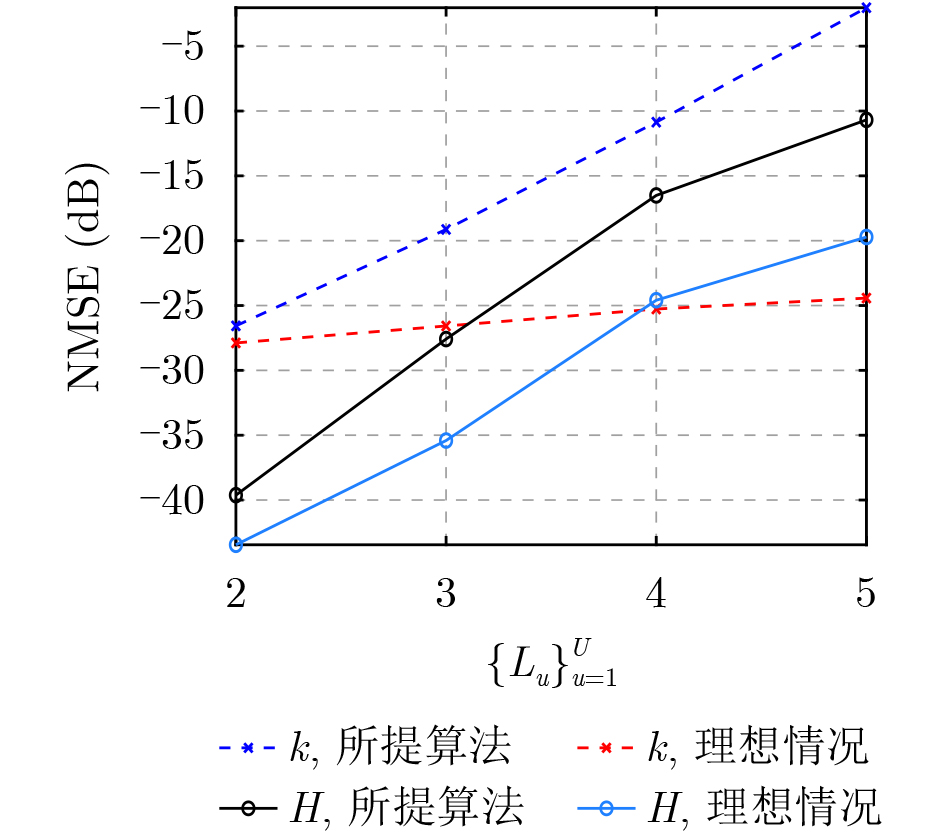
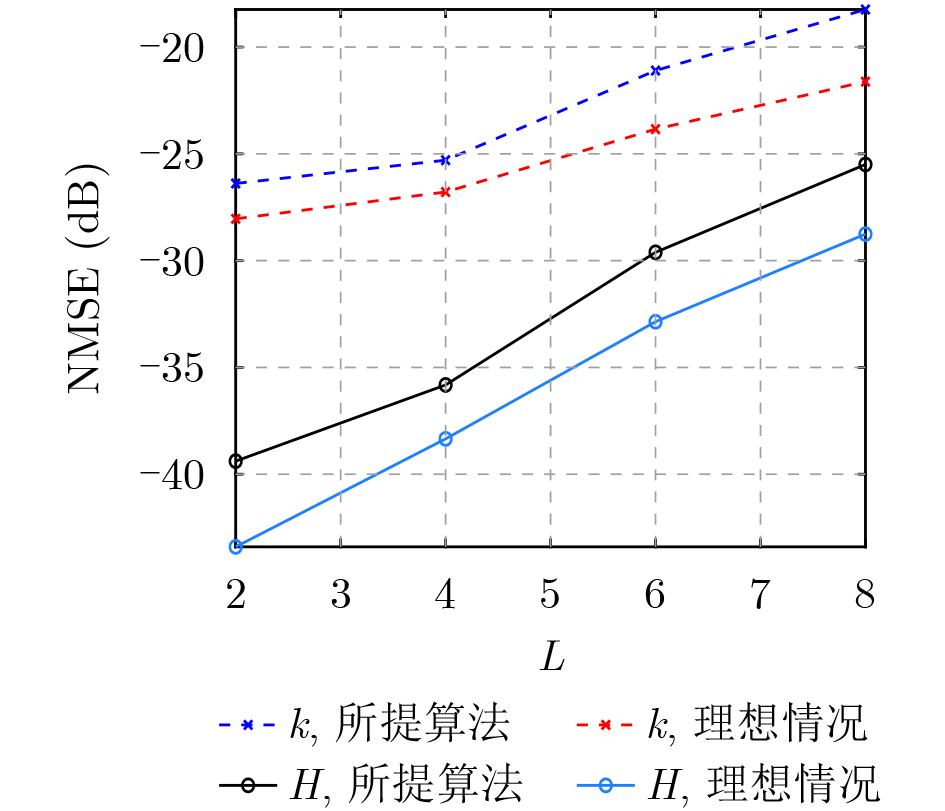
Objective Reconfigurable Intelligent Surface (RIS) can effectively modulate Millimeter-Wave (mmWave) signals and reshape the wireless propagation environment. In practical deployments, however, RIS elements are vulnerable to adverse weather and physical obstructions, which cause unpredictable distortion and motivate joint channel estimation and blockage diagnosis. Most existing studies focus on single-user systems, whereas multi-user scenarios remain insufficiently studied. This gap creates an opportunity to exploit the common RIS blockage vector and the shared RIS-Base Station (BS) channel across users. This paper therefore proposes a low-complexity framework for joint channel estimation and blockage diagnosis by exploiting the sparsity and correlation of multi-user cascaded channels. Methods Under the assumption that all User Equipment (UE) shares the same RIS-BS channel and is affected by a common RIS blockage vector, the problem is divided into two stages. First, a target UE is selected. The sparsity of the mmWave channel and blockage vector, together with the linear dependence among RIS-BS paths, is used to formulate a sparse recovery problem. A hierarchical Bayesian model is then adopted, and an efficient Sparse Bayesian Learning (SBL) algorithm is used for joint recovery. Second, partial Channel State Information (CSI) obtained from the target UE is used to construct a common channel matrix that combines the RIS-BS channel and blockage information. Channel estimation for the remaining UEs is then reformulated as another sparse recovery problem. Results and Discussions A low-complexity strategy for cascaded channel estimation and blockage diagnosis is developed by exploiting the sparsity and correlation of multi-user cascaded channels and the commonality of the RIS blockage vector. Ideal estimation results are used as a theoretical lower bound, and the proposed algorithm is compared with two benchmark schemes. Simulation results show that the proposed algorithm consistently outperforms the benchmark schemes ( Fig. 1 ). Specifically, a higher target-user Signal-to-Noise Ratio (SNR) improves the Normalized Mean Square Error (NMSE), which confirms the importance of target-user selection (Fig. 2 ). The algorithm also shows good convergence as the number of iterations increases (Fig. 3 ), and its performance approaches the ideal case more closely as the number of time frames increases (Fig. 4 ). In addition, the method remains robust as the number of blocked elements increases (Fig. 5 ). More BS antennas further improve performance by enhancing array orthogonality (Fig. 6 ). By exploiting path correlation, the proposed method achieves better estimation accuracy with slightly lower runtime (Table 1 ). However, estimation accuracy decreases as the number of paths increases because the model becomes more complex (Figs. 7 and8 ).Conclusions This paper proposes a joint channel estimation and blockage diagnosis framework for blocked RIS-assisted multi-user multipath mmWave systems. Simulation results show that the method approaches the theoretical performance bound in complex multipath environments. It also maintains clear performance advantages under high blockage rates while reducing computational complexity through the use of common channel structures. This study provides a practical solution to performance degradation in RIS deployment, clarifies the effects of key parameters, and offers guidance for system design. Because practical blockages often exhibit block-sparse or structured-sparse characteristics, future work may incorporate structured priors, such as group sparsity and Markov random fields, into the SBL framework to capture spatial correlation and improve diagnostic accuracy and robustness. -

图 1 所提算法与对比算法在信道估计与阻塞诊断性能上随SNR的变化($ M=64 $, $ Q=32 $, $ {N}_{\text{B}}=8 $, $ L=2 $, $ \{{L}_{u}\}_{u=1}^{U}=2 $)

图 2 信道估计与阻塞诊断性能随目标用户SNR的变化(剩余用户$ \text{SNR}=20\text{ dB} $, $ M=64 $, $ Q=32 $, $ {N}_{\text{B}}=8 $, $ L=2 $, $ \{{L}_{u}\}_{u=1}^{U}=2 $)

图 3 信道估计与阻塞诊断性能随迭代次数$ \text{iter} $的变化($ \text{SNR}= $20 dB, $ Q=32 $, $ M=64 $, $ {N}_{\text{B}}=8 $, $ L=2 $, $ \{{L}_{u}\}_{u=1}^{U}=2 $)

图 4 信道估计与阻塞诊断性能随时间帧数$ Q $的变化($ \text{SNR}= $20 dB, $ M=64 $, $ {N}_{\text{B}}=8 $, $ L=2 $, $ \{{L}_{u}\}_{u=1}^{U}=2 $)

图 5 信道估计与阻塞诊断性能随阻塞数$ {N}_{\text{B}} $的变化 ($ \text{SNR}= $20 dBs, $ M=64 $, $ Q=32 $, $ L=2 $, $ \{{L}_{u}\}_{u=1}^{U}=2 $)

图 6 信道估计与阻塞诊断性能随BS天线数$ M $的变化($ \text{SNR}= $20 dB, $ Q=32 $, $ {N}_{\text{B}}=8 $, $ L=2 $, $ \{{L}_{u}\}_{u=1}^{U}=2 $)

图 7 信道估计与阻塞诊断性能随UE-RIS路径数$ \{{L}_{u}\}_{u=1}^{U} $的变化($ \text{SNR}=20 $,$ M=64 $,$ Q=32 $,$ {N}_{\text{B}}=8 $,$ L=2 $)

图 8 信道估计与阻塞诊断性能随RIS-BS路径数$ L $的变化($ \text{SNR}=20 $,$ M=64 $,$ Q=32 $,$ {N}_{\text{B}}=8 $,$ \{{L}_{u}\}_{u=1}^{U}=2 $)
1 目标UE信道估计与阻塞诊断
(1) 输入:选定目标UE发送到BS的信号$ {\boldsymbol{Y}}_{1} $, 设置迭代更新精度$ \mathrm{tol}=10^{-6} $,最大迭代次数$ {T}_{\max }=100 $ (2) 根据式(7)求出$ \boldsymbol{T}({\hat{\mathbf{a}}}) $ (3) 根据求根MUSIC算法得到$ \{{\hat{\varphi }}_{l}\}_{l=1}^{L} $ (4) 通过式(8)构造$ {{\overline{\boldsymbol{Y}}}}_{1} $ (5) while $ ||{{\tilde{\boldsymbol{Y}}}}_{\text{last}}-{{\tilde{\boldsymbol{Y}}}}_{1}||_{\text{F}}^{2}/||{{\tilde{\boldsymbol{Y}}}}_{1}||_{\text{F}}^{2} \lt {\mathrm{tol}} $或迭代次数达到$ {T}_{\max } $ (6) 更新$ \mathrm{iter}=\mathrm{iter}+1 $ (7) 更新$ {{\tilde{\boldsymbol{Y}}}}_{\text{last}}={{\tilde{\boldsymbol{Y}}}}_{1} $ (8) 通过式(11)利用OMP求解第$ r $条路径的CSI (9) for $ l=1\colon L(l\neq r) $ (10) 根据式(13)求出$ \Delta {\hat{\theta }}_{l} $与$ \Delta {\hat{\alpha }}_{l} $ (11) end for (12) while $ ||{\boldsymbol{\mu }}_{\text{last}}-\boldsymbol{\mu }||_{2}^{2}/||\boldsymbol{\mu }||_{2}^{2} \lt {\mathrm{tol}} $或迭代次数达到$ {T}_{\max } $ (13) 更新$ {\boldsymbol{\mu }}_{\text{last}}=\boldsymbol{\mu } $ (14) 根据式(16)求出阻塞的估计值$ {\hat{\boldsymbol{k}}}=\boldsymbol{\mu } $ (15) 根据式(17)更新超参数$ \{\boldsymbol{\alpha },\beta \} $ (16) end while (17) 根据式(16)更新$ {\hat{\mathbf{k}}} $,其中$ \delta =1/\text{iter} $ (18) 更新$ {{\tilde{\boldsymbol{Y}}}}_{1}={\boldsymbol{S}}^{\text{T}}\text{diag}(\boldsymbol{b})[{{\hat{\mathbf{h}}}}_{\text{RIS,1}},\cdots ,{{\hat{\boldsymbol{h}}}}_{\text{RIS,}L}] $ (19) end while (20) 通过式(11)利用OMP求解第$ r $条路径的CSI (21) 根据式(13)求出$ \Delta {\hat{\theta }}_{l} $与$ \Delta {\hat{\alpha }}_{l} $ (22) 输出:$ \{{\hat{\varphi }}_{l}\}_{l=1}^{L} $, $ \{\Delta {\hat{\theta }}_{l}\}_{l=1}^{L} $, $ \{\Delta {\hat{\alpha }}_{l}\}_{l=1}^{L} $和$ {\hat{\mathbf{k}}} $  下载: 导出CSV
2 剩余UE的CSI估计
(1) 输入:$ \{{\hat{\varphi }}_{l}\}_{l=1}^{L} $, $ \{\Delta {\hat{\theta }}_{l}\}_{l=1}^{L} $, $ \{\Delta {\hat{\alpha }}_{l}\}_{l=1}^{L} $, 剩余$ U-1 $个
UE发送到BS的信号$ {\boldsymbol{Y}}_{u} $。(2) 根据式(20)和式(21)构造$ {{\boldsymbol{\varLambda }}}_{\text{c}} $和$ {\boldsymbol{A}}_{\text{c}} $ (3) 通过$ {{\overline{\boldsymbol{G}}}}_{\text{c}}={\boldsymbol{A}}_{\text{N}}{{\boldsymbol{\varLambda }}}_{\text{c}}\boldsymbol{A}_{\text{c}}^{\text{T}}\text{diag}(\boldsymbol{b}) $构造公共信道$ {{\overline{\boldsymbol{G}}}}_{\text{c}} $ (4) for $ u=2\colon U $ (5) 根据式(24)利用OMP算法求出剩余UE的CSI (6) end for (7) 输出:$ \{{{\hat{\boldsymbol{h}}}}_{\text{c},u}\}_{u=2}^{U} $
下载: 导出CSV
-
[1] TANG Wankai, CHEN Mingzheng, CHEN Xiangyu, et al. Wireless communications with reconfigurable intelligent surface: Path loss modeling and experimental measurement[J]. IEEE Transactions on Wireless Communications, 2021, 20(1): 421–439. doi: 10.1109/TWC.2020.3024887. [2] 郭甜, 张旭辉, 吴雨佳, 等. 可重构智能表面辅助的毫米波信道估计算法[J]. 电子与信息学报, 2023, 45(10): 3612–3621. doi: 10.11999/JEIT221232.GUO Tian, ZHANG Xuhui, WU Yujia, et al. Channel estimation algorithm for reconfigurable intelligent surface aided millimeter wave systems[J]. Journal of Electronics & Information Technology, 2023, 45(10): 3612–3621. doi: 10.11999/JEIT221232. [3] PAN Cunhua, ZHOU Gui, ZHI Kangda, et al. An overview of signal processing techniques for RIS/IRS-aided wireless systems[J]. IEEE Journal of Selected Topics in Signal Processing, 2022, 16(5): 883–917. doi: 10.1109/JSTSP.2022.3195671. [4] 李双志, 杨睿棋, 郭新, 等. 低导频开销RIS辅助毫米波MIMO系统参数化信道估计方案[J]. 通信学报, 2024, 45(9): 82–91. doi: 10.11959/j.issn.1000-436x.2024157.LI Shuangzhi, YANG Ruiqi, GUO Xin, et al. Low pilot overhead parametric channel estimation scheme for RIS-assisted mmWave MIMO systems[J]. Journal on Communications, 2024, 45(9): 82–91. doi: 10.11959/j.issn.1000-436x.2024157. [5] 蒲旭敏, 孙致南, 李静洁, 等. 可重构智能表面中低复杂度毫米波信道估计算法[J]. 电子与信息学报, 2022, 44(7): 2281–2288. doi: 10.11999/JEIT211602.PU Xumin, SUN Zhinan, LI Jingjie, et al. A low complexity millimeter wave channel estimation algorithm in reconfigurable intelligent surface[J]. Journal of Electronics & Information Technology, 2022, 44(7): 2281–2288. doi: 10.11999/JEIT211602. [6] ZHENG Xi, FANG Jun, WANG Hongwei, et al. Compressed CPD-based channel estimation and joint beamforming for RIS-assisted millimeter wave communications[J]. IEEE Transactions on Vehicular Technology, 2024, 73(10): 15214–15226. doi: 10.1109/TVT.2024.3411069. [7] ZHOU Gui, PAN Cunhua, REN Hong, et al. Channel estimation for RIS-aided multiuser millimeter-wave systems[J]. IEEE Transactions on Signal Processing, 2022, 70: 1478–1492. doi: 10.1109/TSP.2022.3158024. [8] PENG Zhendong, PAN Cunhua, ZHOU Gui, et al. Error propagation and overhead reduced channel estimation for RIS-aided multi-user mmWave systems: Invited paper[C]. 2022 International Symposium on Wireless Communication Systems (ISWCS), Hangzhou, China, 2022: 1–6. doi: 10.1109/ISWCS56560.2022.9940350. [9] CHEN Jie, LIANG Yingchang, CHENG H V, et al. Channel estimation for reconfigurable intelligent surface aided multi-user mmWave MIMO systems[J]. IEEE Transactions on Wireless Communications, 2023, 22(10): 6853–6869. doi: 10.1109/TWC.2023.3246264. [10] MEDINA G, JIDA A S, PULIPALI S, et al. Millimeter-wave antenna array diagnosis with partial channel state information[C]. ICC 2021-IEEE International Conference on Communications, Montreal, Canada, 2021: 1–5. doi: 10.1109/ICC42927.2021.9500527. [11] 李双志, 刘聪, 郭新. RIS辅助多用户毫米波系统的联合信道估计和阻塞诊断[J]. 通信学报, 2025, 46(11): 244–253. doi: 10.11959/j.issn.1000-436x.2025222.LI Shuangzhi, LIU Cong, and GUO Xin. Joint channel estimation and blockage diagnosis in RIS-assisted multi-user millimeter-wave systems[J]. Journal on Communications, 2025, 46(11): 244–253. doi: 10.11959/j.issn.1000-436x.2025222. [12] LI Shuangzhi, LEI Haojie, DONG Zheng, et al. Two-stage channel estimation in mmWave MIMO systems with RIS blockage[J]. IEEE Wireless Communications Letters, 2024, 13(12): 3548–3552. doi: 10.1109/LWC.2024.3477504. [13] LI Shuangzhi, LIU Cong, LEI Haojie, et al. Joint channel estimation and blockage diagnosis in RIS-assisted mmWave MIMO-OFDM systems[J]. IEEE Transactions on Vehicular Technology, 2025. doi: 10.1109/TVT.2025.3630168. [14] LI Liping, YING Run, LI Yingsong, et al. RIS array diagnosis for mmWave communication systems[J]. IEEE Signal Processing Letters, 2024, 31: 1980–1984. doi: 10.1109/LSP.2024.3427663. [15] BIAN Xuechun, XU Wenbo, WANG Yue, et al. Sparse signal recovery and RIS diagnosis: Double-sparsity based algorithms[C]. GLOBECOM 2023–2023 IEEE Global Communications Conference, Kuala Lumpur, Malaysia, 2023: 4062–4067. doi: 10.1109/GLOBECOM54140.2023.10437574. [16] GOMES P R B, DE ARAÚJO G T, SOKAL B, et al. Channel estimation in RIS-assisted MIMO systems operating under imperfections[J]. IEEE Transactions on Vehicular Technology, 2023, 72(11): 14200–14213. doi: 10.1109/TVT.2023.3279805. [17] 李双志, 雷豪杰, 郭新. 非理想RIS辅助MIMO系统稀疏信道估计与阵列阻塞诊断[J]. 电子与信息学报, 2025, 47(8): 2573–2583. doi: 10.11999/JEIT241108.LI Shuangzhi, LEI Haojie, and GUO Xin. Sparse channel estimation and array blockage diagnosis for non-ideal RIS-assisted MIMO systems[J]. Journal of Electronics & Information Technology, 2025, 47(8): 2573–2583. doi: 10.11999/JEIT241108. [18] ALKHATEEB A and HEATH R W. Frequency selective hybrid precoding for limited feedback millimeter wave systems[J]. IEEE Transactions on Communications, 2016, 64(5): 1801–1818. doi: 10.1109/TCOMM.2016.2549517. [19] NOH S, SEO K, SUNG Y, et al. Joint direct and indirect channel estimation for RIS-assisted millimeter-wave systems based on array signal processing[J]. IEEE Transactions on Wireless Communications, 2023, 22(11): 8378–8391. doi: 10.1109/TWC.2023.3262492. [20] HE Jiguang, WYMEERSCH H, and JUNTTI M. Channel estimation for RIS-aided mmWave MIMO systems via atomic norm minimization[J]. IEEE Transactions on Wireless Communications, 2021, 20(9): 5786–5797. doi: 10.1109/TWC.2021.3070064. [21] TROPP J A and GILBERT A C. Signal recovery from random measurements via orthogonal matching pursuit[J]. IEEE Transactions on Information Theory, 2007, 53(12): 4655–4666. doi: 10.1109/TIT.2007.909108. [22] ZHOU Zhou, FANG Jun, YANG Linxiao, et al. Low-rank tensor decomposition-aided channel estimation for millimeter wave MIMO-OFDM systems[J]. IEEE Journal on Selected Areas in Communications, 2017, 35(7): 1524–1538. doi: 10.1109/JSAC.2017.2699338. [23] TIPPING M E. Sparse Bayesian learning and the relevance vector machine[J]. Journal of Machine Learning Research, 2001, 1: 211–244. doi: 10.1162/15324430152748236. -

 下载:
下载:


计量
- 文章访问数: 707
- HTML全文浏览量: 230
- PDF下载量: 37
- 被引次数: 0
