




Energy-Aware and Attention-Driven Edge-End Collaborative Inference and Resource Allocation
-
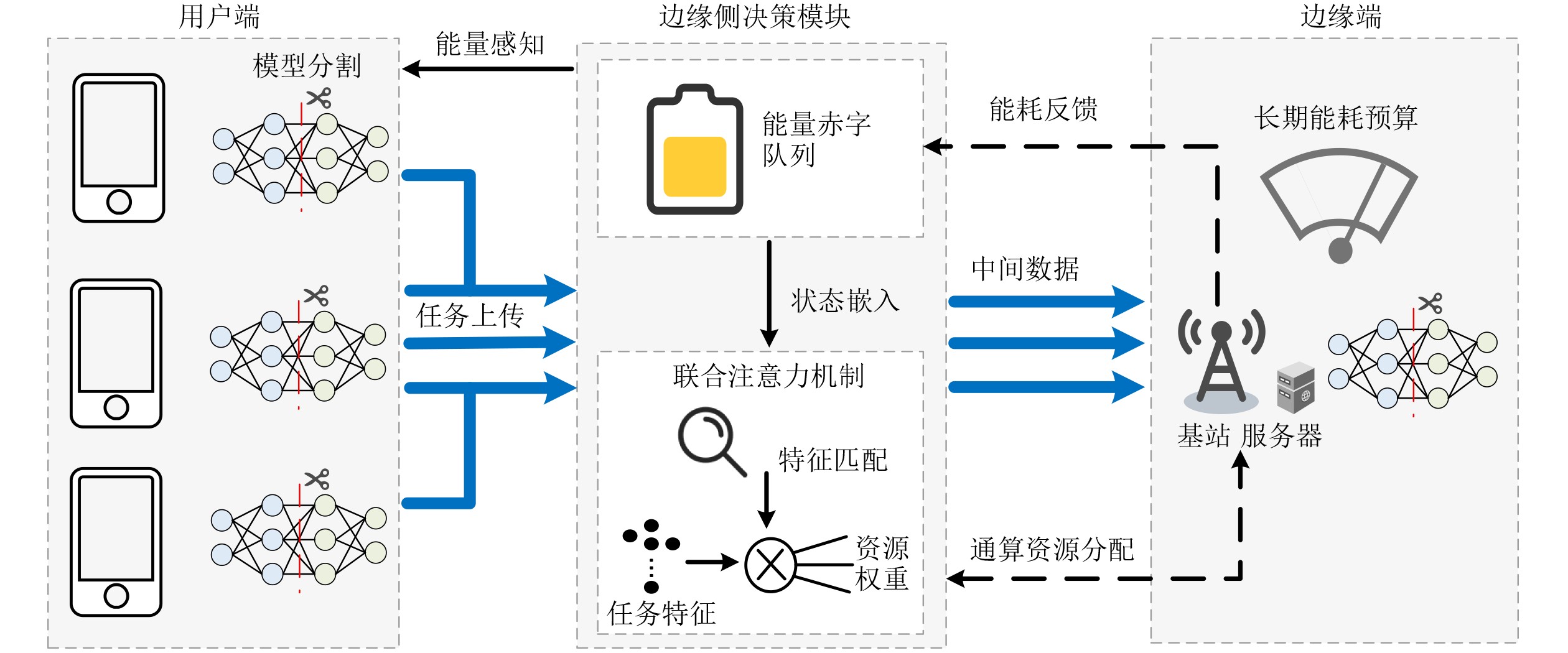
摘要: 针对移动边缘计算环境中计算密集型深度神经网络推理任务面临的通算资源受限与边缘服务器长期能耗约束等挑战,该文提出一种能量感知与注意力驱动的边端协同推理与资源分配方法,旨在最小化多用户推理任务的长期平均端到端处理时延。首先,基于李雅普诺夫优化理论构建边缘端虚拟能量赤字队列,量化能耗预算偏差,将长期能耗硬约束转化为单时隙内的动态惩罚权重,实现对模型分割点的实时能量感知调节。其次,设计基于键-值-查询范式的联合注意力机制,综合考量任务紧急度、剩余计算量及边缘端能量赤字状态,动态生成资源分配权重,实现上行带宽与边缘算力的快速协同分配。仿真实验表明,该方法能够在严格遵守长期能耗预算的前提下,提升通算资源利用效率,在不同负载场景下显著降低多用户推理任务的平均端到端时延。Abstract:
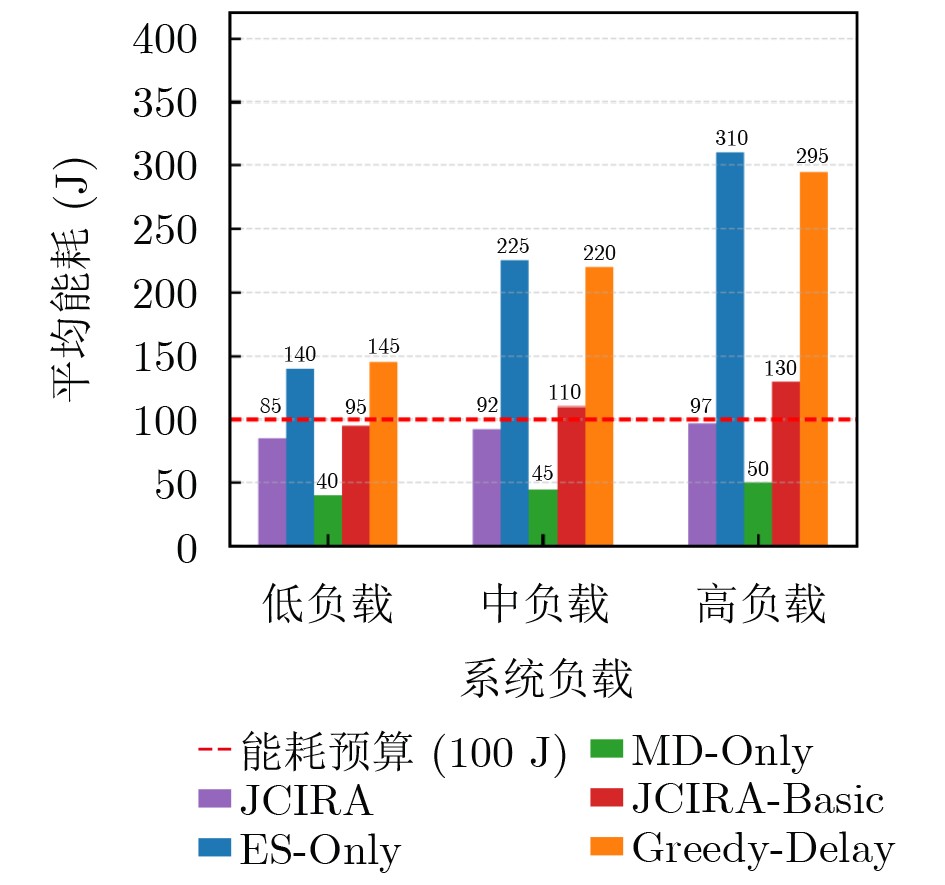
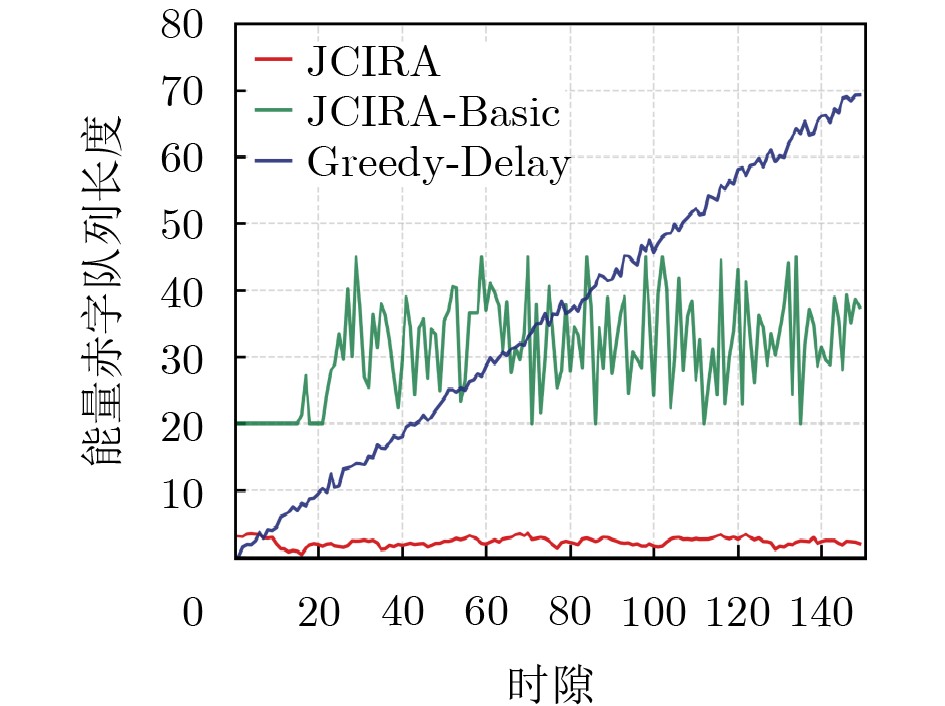
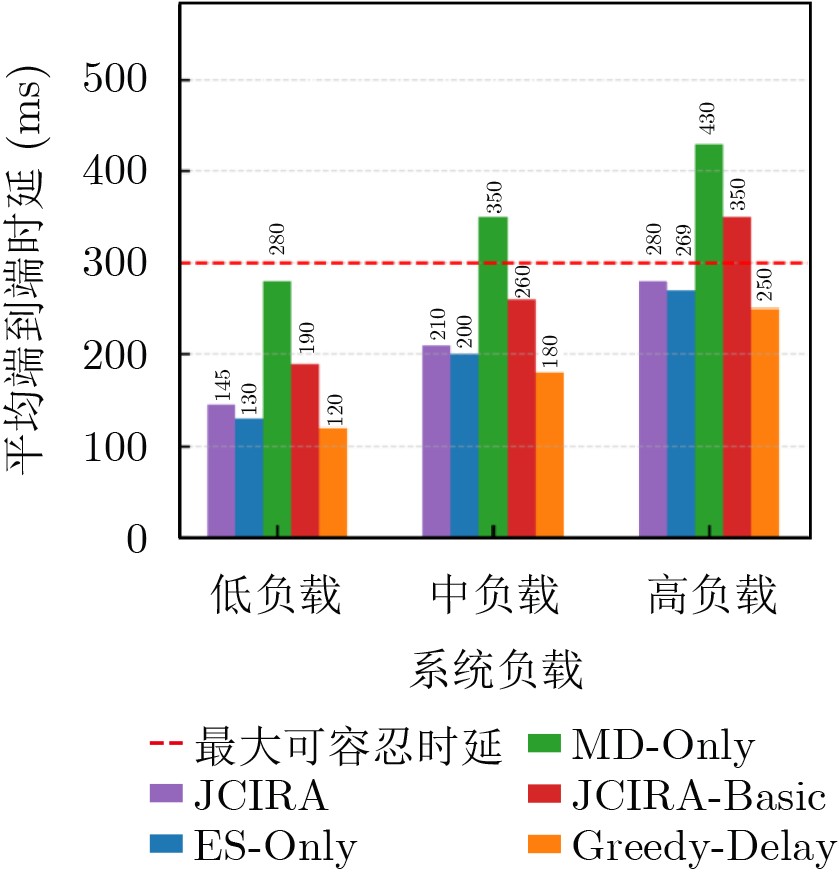
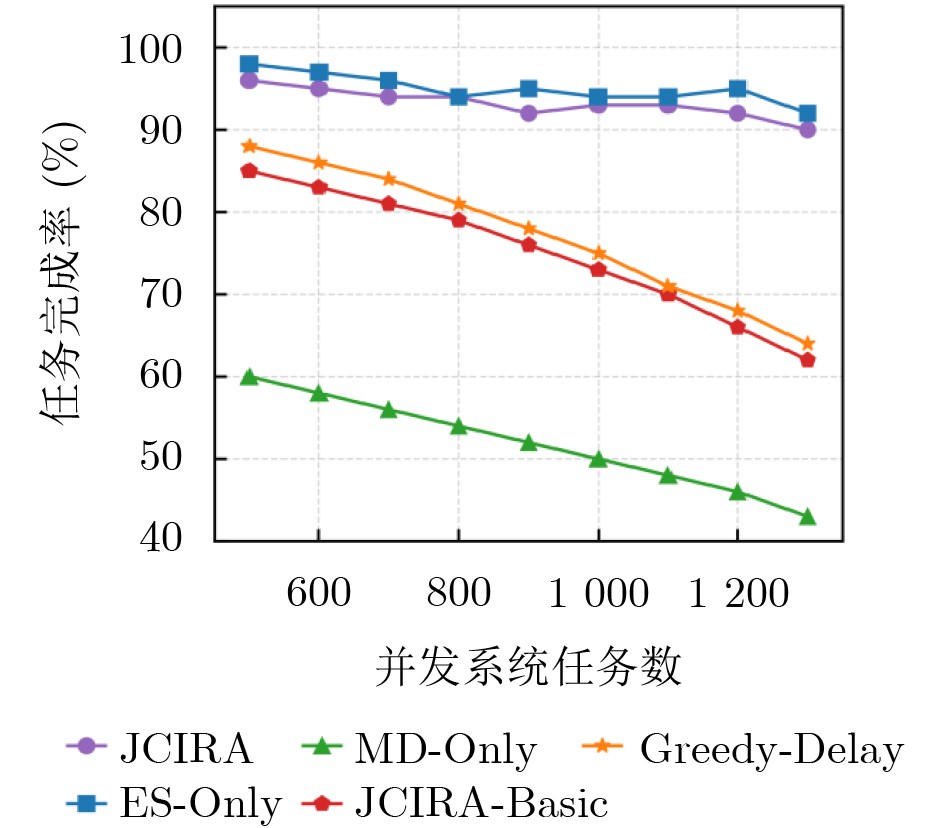
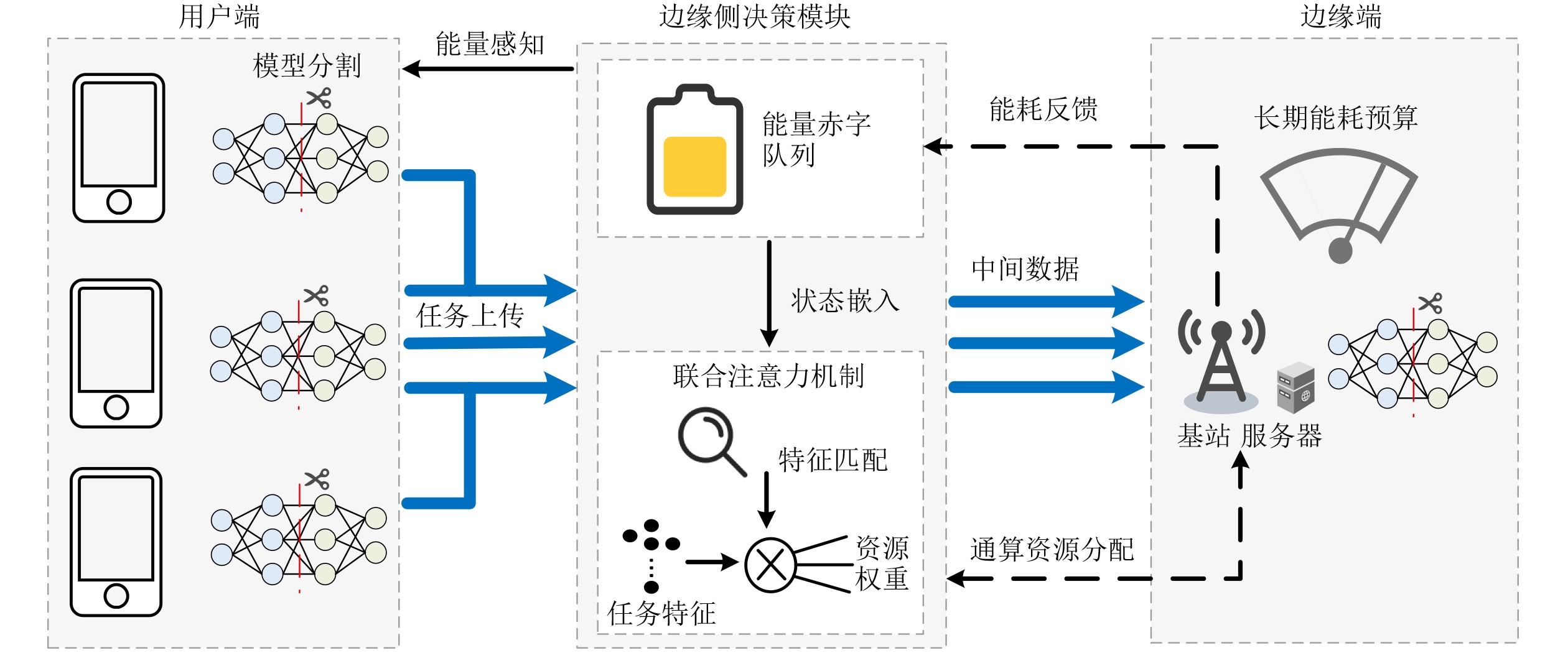
Objective The development of Deep Neural Networks (DNNs) has substantially improved the perception and decision-making capabilities of mobile intelligent applications. However, computationally intensive inference imposes substantial demands on mobile devices with limited computing capacity and battery power. Mobile Edge Computing (MEC) enables computation-intensive tasks to be offloaded to nearby Edge Servers (ESs), thereby reducing inference latency and terminal energy consumption. However, limited wireless bandwidth and edge computing resources can cause severe resource contention under multi-user concurrency. Moreover, the increasing demand for DNN inference services raises the long-term energy consumption of ESs, making an energy budget necessary for controlling operating costs. To address these issues, an energy-aware and attention-driven edge-end collaborative inference and resource allocation method is proposed to minimize the long-term average end-to-end processing latency of multi-user inference tasks while satisfying the long-term ES energy budget. Methods The optimization problem is formulated to minimize the long-term average end-to-end processing latency of all user inference tasks subject to the long-term energy consumption constraint of the ES system, DNN model partitioning constraints, uplink bandwidth constraints, and ES computing resource constraints. Because both the objective and energy constraint contain long-term averages and stochastic variables, DNN model partitioning and communication-computing resource allocation are highly coupled. Lyapunov optimization theory is therefore used to transform the original stochastic optimization problem into a single-slot deterministic optimization problem. An energy deficit queue is constructed to quantify the cumulative deviation of actual ES energy consumption from the long-term energy budget and to convert the long-term energy consumption constraint into a dynamic penalty for each time slot. On this basis, a Joint Collaborative Inference and Resource Allocation Algorithm (JCIRA) is developed to jointly optimize DNN model partitioning and communication-computing resource allocation. JCIRA consists of three stages (Algorithm 1). In the first stage, an energy-aware DNN partitioning strategy selects the DNN partition point by balancing the estimated end-to-end latency against the corresponding energy penalty through a comprehensive cost function. In the second stage, a joint attention mechanism based on the Key-Query-Value paradigm is designed for communication-computing resource allocation. The uploaded data size, remaining computation load, task urgency, and energy deficit state are mapped to task feature vectors. Separate Query vectors are constructed for uplink bandwidth and ES computing resources, and scaled dot-product attention is used to calculate resource allocation weights. Uplink bandwidth and ES computing resources are then allocated according to these weights. In the third stage, task execution progress, remaining workload, ES energy consumption, and the energy deficit queue are updated after each time slot, forming a closed-loop decision-execution-observation-update process. Results and Discussions The task arrival process follows a Poisson distribution, and three DNN models, ResNet18, MobileNetV2, and EfficientNet-B0, are considered in the simulation. Compared with other algorithms, JCIRA maintains its actual energy consumption below the energy budget under different load conditions, demonstrating its ability to satisfy the long-term energy consumption constraint ( Fig. 2 ). The energy deficit queue of JCIRA also remains bounded (Fig. 3 ). Among the schemes that satisfy the energy consumption constraint, JCIRA maintains an average end-to-end latency below the 300-ms QoS threshold (Fig. 4 ). Under high load, JCIRA reduces the average latency from 350 ms with JCIRA-Basic to 280 ms. In addition, JCIRA achieves the highest task completion rate across different load levels and maintains a completion rate close to 90% with 1 300 concurrent tasks (Fig. 5 ).Conclusions An energy-aware and attention-driven edge-end collaborative inference and resource allocation method is proposed for DNN inference in MEC systems with limited communication-computing resources and long-term ES energy consumption constraints. Lyapunov optimization theory converts the time-coupled long-term energy consumption constraint into a low-complexity single-slot deterministic optimization subproblem. JCIRA then jointly coordinates DNN model partitioning, uplink bandwidth allocation, and ES computing resource allocation according to task requirements and the current energy deficit state. Simulation results show that the proposed method strictly satisfies the long-term energy budget while improving communication-computing resource utilization and reducing the average end-to-end latency of multi-user inference tasks under different load conditions. -
1 JCIRA
输入: 任务到达集合$ \{{J}_{k}(t)\} $,系统带宽$ {B}_{\text{total}} $,用户设备与服务器算力参数,能耗预算$ {E}_{\text{budget}} $,控制参数$ V $ 输出: 最优决策变量集$ {\varPi }^{*}=\{{p}_{k}{}^{*}(t),B_{k}^{\text{alloc}}{}^{*}(t),F_{\text{ES,}k}^{\text{alloc}}{}^{*}(t)\} $ (1) 系统初始化能量赤字队列$ {Q}_{\text{e}}(0)\leftarrow 0 $, ES负载$ {L}_{\text{ES}}(0)\leftarrow 0 $; (2) for 时隙$ t=0,1,2,\cdots $do (3) 获取当前时隙的待处理任务集合$ {J}_{\text{pending}}(t) $; (4) if $ {J}_{\text{pending}}(t) $非空 do (5) 阶段一:能量感知的DNN划分决策。对集合中每个未确定划分点的任务$ {J}_{k}(t) $,确定其最优划分点$ p_{k}^{*}(t) $; (6) 阶段二:联合注意力驱动的通算资源分配。针对$ {J}_{\text{pending}}(t) $联合分配上行带宽$ B_{k}^{\mathrm{alloc}}(t) $和ES计算资源$ F_{\text{ES},k}^{\text{alloc}}(t) $; (7) 阶段三:任务执行与状态更新。根据所分配的资源并行执行任务,并更新任务的剩余工作量; (8) 统计当前时隙ES的总能耗$ E_{\text{ES}}^{\text{actual}}(t) $; (9) 根据式(5)更新能量赤字队列$ {Q}_{\text{e}}(t+1) $; (10) 更新下一时隙的ES初始负载$ {L}_{\text{ES}}(t+1) $。  下载: 导出CSV
-
[1] 陈佳美, 孙慧雯, 李玉峰, 等. 基于双深度Q网络算法的无人机辅助密集网络资源优化策略[J]. 电子与信息学报, 2025, 47(8): 2621–2629. doi: 10.11999/JEIT250021.CHEN Jiamei, SUN Huiwen, LI Yufeng, et al. Double deep q network algorithm-based unmanned aerial vehicle-assisted dense network resource optimization strategy[J]. Journal of Electronics & Information Technology, 2025, 47(8): 2621–2629. doi: 10.11999/JEIT250021. [2] MAO Yuyi, YU Xianghao, HUANG Kaibin, et al. Green edge AI: A contemporary survey[J]. Proceedings of the IEEE, 2024, 112(7): 880–911. doi: 10.1109/JPROC.2024.3437365. [3] DAI Penglin, HAN Biao, LI Ke, et al. Joint optimization of device placement and model partitioning for cooperative DNN inference in heterogeneous edge computing[J]. IEEE Transactions on Mobile Computing, 2025, 24(1): 210–226. doi: 10.1109/TMC.2024.3457793. [4] YE Dongmei, SUN Zhengqing, ZHONG Weifeng, et al. Optimal flight speed scheduling and battery swapping in UAV-enabled mobile edge computing[J]. IEEE Transactions on Mobile Computing, 2026, 25(1): 948–960. doi: 10.1109/TMC.2025.3601743. [5] QIU Qijie, LI Lingjie, XIAO Zhijiao, et al. Joint service caching and task allocation in digital twin-enabled mobile edge computing systems: A bilevel optimization approach[J]. IEEE Transactions on Consumer Electronics, 2025, 71(4): 9208–9220. doi: 10.1109/TCE.2025.3622657. [6] RZIG I, JAAFAR W, JEBALIA M, et al. Energy-efficient vehicular task offloading using multi-mode MEC and RIS-equipped aerial platforms[J]. IEEE Open Journal of the Communications Society, 2025, 6: 7604–7619. doi: 10.1109/OJCOMS.2025.3606340. [7] XU Xiaodong, YAN Kaiwen, HAN Shujun, et al. Learning-based edge-device collaborative DNN inference in IoVT networks[J]. IEEE Internet of Things Journal, 2024, 11(5): 7989–8004. doi: 10.1109/JIOT.2023.3317785. [8] FANG Yujie, LI Meng, SI Pengbo, et al. Computational offloading and resource allocation for Internet of vehicles based on UAV-assisted mobile edge computing system[J]. China Communications, 2025, 22(9): 333–351. doi: 10.23919/JCC.ja.2022-0656. [9] 卢先领, 李德康. 面向大规模多接入边缘计算场景的任务卸载算法[J]. 电子与信息学报, 2025, 47(1): 116–127. doi: 10.11999/JEIT240624.LU Xianling and LI Dekang. Task offloading algorithm for large-scale multi-access edge computing scenarios[J]. Journal of Electronics & Information Technology, 2025, 47(1): 116–127. doi: 10.11999/JEIT240624. [10] SUN Yanzan, QIU Jiacheng, PAN Guangjin, et al. Energy optimization of multitask DNN inference in MEC-assisted XR devices: A Lyapunov-guided reinforcement learning approach[J]. IEEE Internet of Things Journal, 2025, 12(11): 17499–17513. doi: 10.1109/JIOT.2025.3536879. [11] LI Jing, LIANG Weifa, LI Yuchen, et al. Throughput maximization of delay-aware DNN inference in edge computing by exploring DNN model partitioning and inference parallelism[J]. IEEE Transactions on Mobile Computing, 2023, 22(5): 3017–3030. doi: 10.1109/TMC.2021.3125949. [12] LIU Xiangzhi, ZHAI Huazhen, ZHOU Xiaotian, et al. Joint resource allocation and computation offloading for DNN inference with model partition and early exit in MEC networks[J]. Chinese Journal of Electronics, 2026, 35(1): 215–232. doi: 10.23919/cje.2024.00.344. [13] HOU Yanzhao, WANG Chengrui, ZHU Min, et al. Joint allocation of wireless resource and computing capability in MEC-enabled vehicular network[J]. China Communications, 2021, 18(6): 64–76. doi: 10.23919/JCC.2021.06.006. [14] ZHANG Rongrong, ZHOU Chen, GUAN Yong, et al. Human mobility-driven offloading and resource allocation in MEC-enabled WBANs[J]. Chinese Journal of Electronics, 2025, 34(4): 1331–1343. doi: 10.23919/cje.2024.00.302. [15] LI Kuixian, FAN Haodong, YANG Yandie, et al. Multi-agent reinforcement learning-based UAV path and resource allocation for ground-to-air communication network[J]. IEEE Internet of Things Journal, 2025, 12(21): 44243–44254. doi: 10.1109/JIOT.2025.3602122. [16] ZHENG Tong, BI Yuanguo, HAN Guangjie, et al. Optimizing multi-DNN parallel inference performance in MEC networks: A resource-aware and dynamic DNN deployment scheme[J]. IEEE Transactions on Computers, 2025, 74(11): 3938–3952. doi: 10.1109/TC.2025.3605749. [17] LIU Zhang, DU Hongyang, LIN Junzhe, et al. DNN partitioning, task offloading, and resource allocation in dynamic vehicular networks: A Lyapunov-guided diffusion-based reinforcement learning approach[J]. IEEE Transactions on Mobile Computing, 2025, 24(3): 1945–1962. doi: 10.1109/TMC.2024.3486728. [18] . LI Yuepeng, ZENG Deze, GUT L, et al. DNN partitioning and assignment for distributed inference in SGX empowered edge cloud[C]. 2024 IEEE 44th International Conference on Distributed Computing Systems, Jersey City, USA, 2024: 635–644. doi: 10.1109/ICDCS60910.2024.00065. [19] KANG Yiping, HAUSWALD J, GAO Cao, et al. Neurosurgeon: Collaborative intelligence between the cloud and mobile edge[C]. Proceedings of the Twenty-Second International Conference on Architectural Support for Programming Languages and Operating Systems, Xi’an, China, 2017: 615–629. doi: 10.1145/3037697.3037698. [20] LI Hui, LI Xiuhua, FAN Qilin, et al. Adaptive model partitioning and pruning for collaborative DNN inference in mobile edge-cloud computing networks[J]. IEEE Transactions on Mobile Computing, 2026, 25(3): 3744–3759. doi: 10.1109/TMC.2025.3620344. [21] ZHANG Wenzhao, HAN Shujun, XU Xiaodong, et al. Joint service placement and model partitioning for accelerating DNN inference in edge intelligence empowered vehicle networks[J]. IEEE Transactions on Vehicular Technology, 2025, 74(9): 14645–14660. doi: 10.1109/TVT.2025.3564471. [22] ZHANG Mengyuan, FANG Juan, TENG Ziyi, et al. Joint DNN partitioning and task offloading based on attention mechanism-aided reinforcement learning[J]. IEEE Transactions on Network and Service Management, 2025, 22(3): 2914–2927. doi: 10.1109/TNSM.2025.3561739. [23] SU Yi, FAN Wenhao, GAO Li, et al. Joint DNN partition and resource allocation optimization for energy-constrained hierarchical edge-cloud systems[J]. IEEE Transactions on Vehicular Technology, 2023, 72(3): 3930–3944. doi: 10.1109/TVT.2022.3219058. [24] 施建锋, 陈忻阳, 李宝龙. 面向物联网的云边端协同计算中任务卸载与资源分配算法研究[J]. 电子与信息学报, 2025, 47(2): 458–469. doi: 10.11999/JEIT240659.SHI Jianfeng, CHEN Xinyang, and LI Baolong. Research on task offloading and resource allocation algorithms in cloud-edge-end collaborative computing for the internet of things[J]. Journal of Electronics & Information Technology, 2025, 47(2): 458–469. doi: 10.11999/JEIT240659. -

 下载:
下载:

图(5) / 表(1)
计量
- 文章访问数: 271
- HTML全文浏览量: 64
- PDF下载量: 21
- 被引次数: 0
