




KE-HNS: Knowledge-Enhanced Personalized Recommender Model with Hierarchical Noise Suppression
-
摘要: 现有的基于知识图谱的推荐模型面临着噪声抑制不足、细粒度用户兴趣捕捉不充分以及信息利用不平衡等挑战,影响推荐的准确性。该文提出一种融合知识增强和多层抑噪的个性化推荐模型(Knowledge-Enhanced personalized recommender model with Hierarchical Noise Suppression, KE-HNS)。首先,KE-HNS提出了一种多层抑噪策略:在输入端构建降噪层,分别以二元掩码矩阵与掩盖低权重三元组的方式,剔除用户历史交互行为及知识图谱中的无关或误导性信息;在主干网络上设置抑噪层,利用实体关系空间隔离消除特征融合过程中的语义污染;同时构造对比学习压噪层,通过正负样本的比较压制无关实体噪声。其次,为更精准建模用户偏好与项目特性,利用图卷积网络、自适应权重层,借助降噪后的外部知识增强用户表征和项目表征。再次,通过构建用户-项目与项目-实体双视图对比学习机制,KE-HNS借助正负样本对自适应地平衡不同信息源的权重,从而缓解信息利用不平衡的问题。在三个公开基准数据集上的实验表明,与CG-KGR、KGIN和KG-DCRec等多种先进方法对比,该文提出的模型KE-HNS在AUC和F1指标上分别提升了0.94%–1.01%和0.43%–0.90%,在降噪性能对比和Recall@K等指标上也优于基准模型。Abstract:
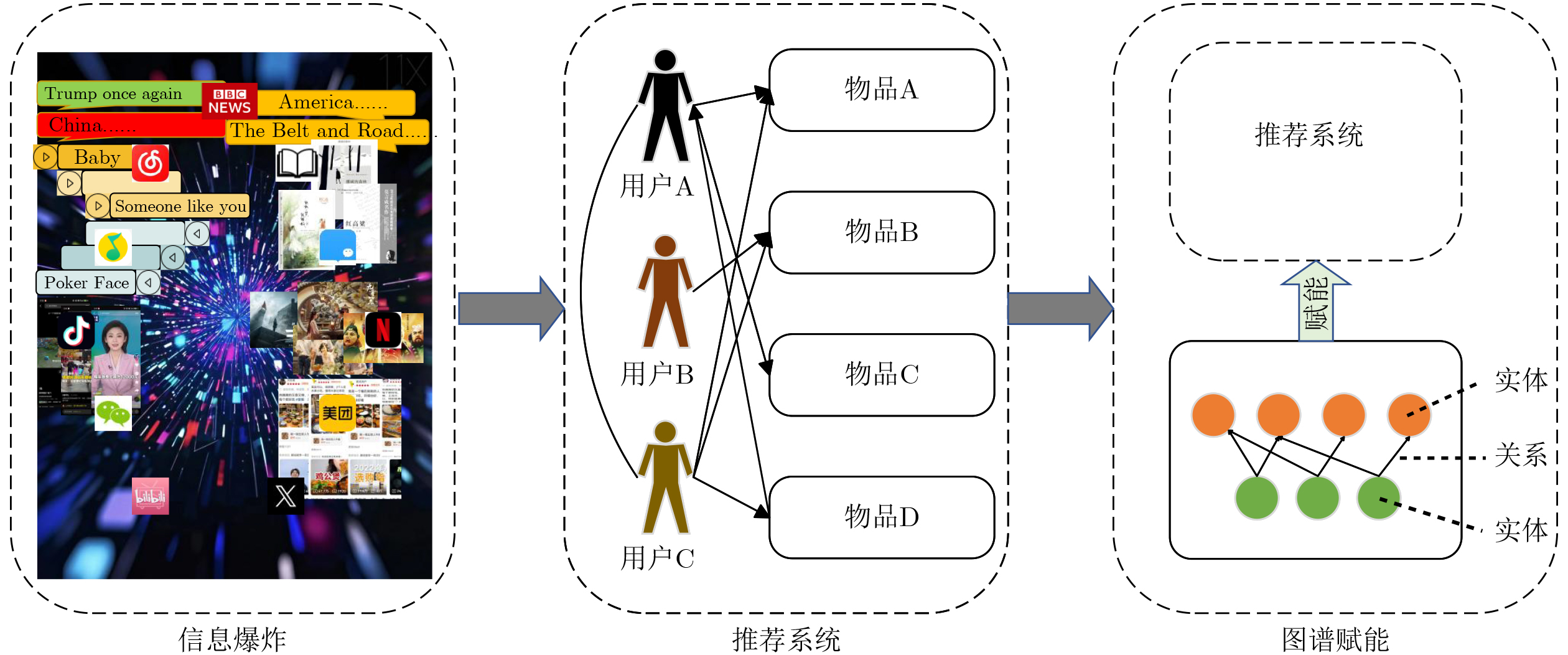
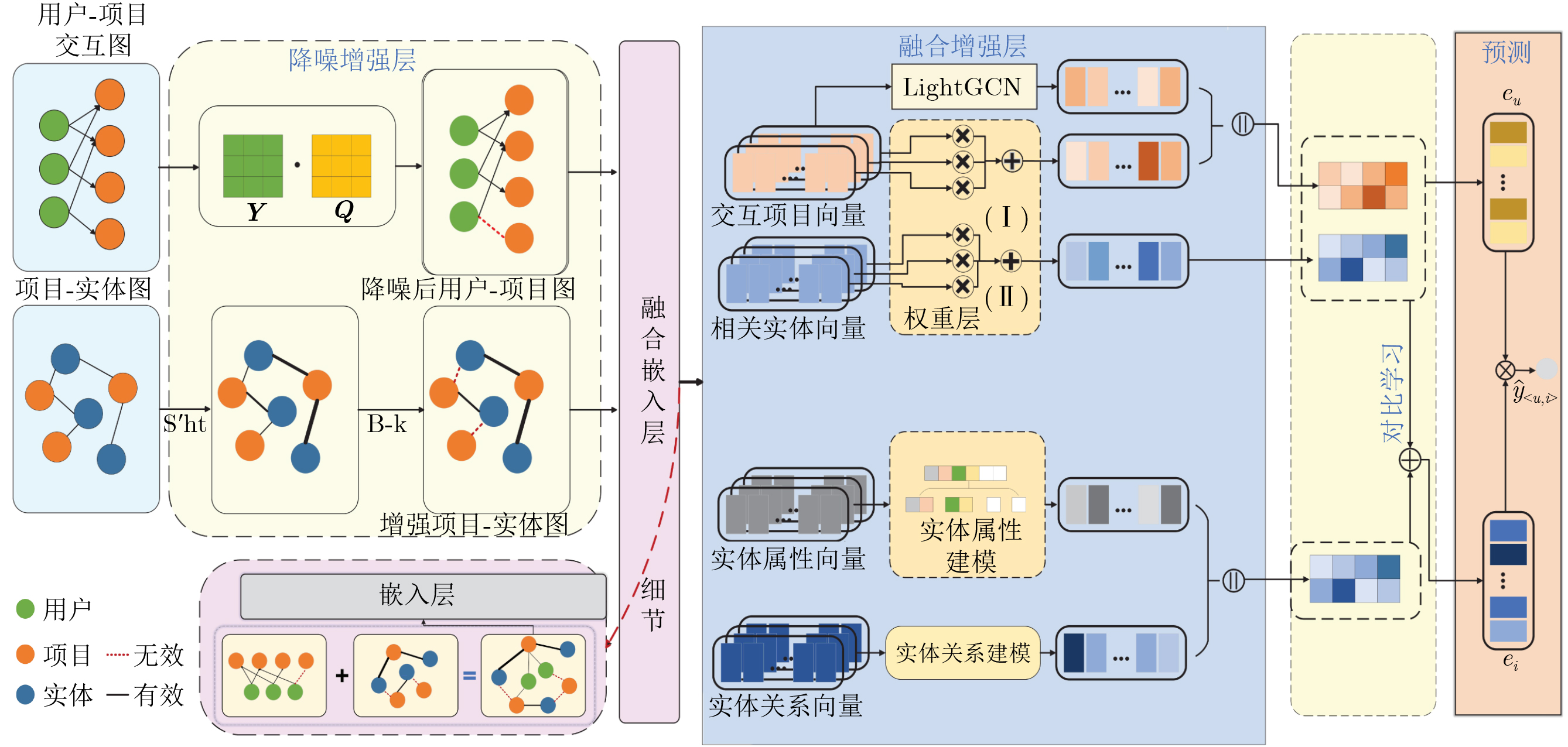
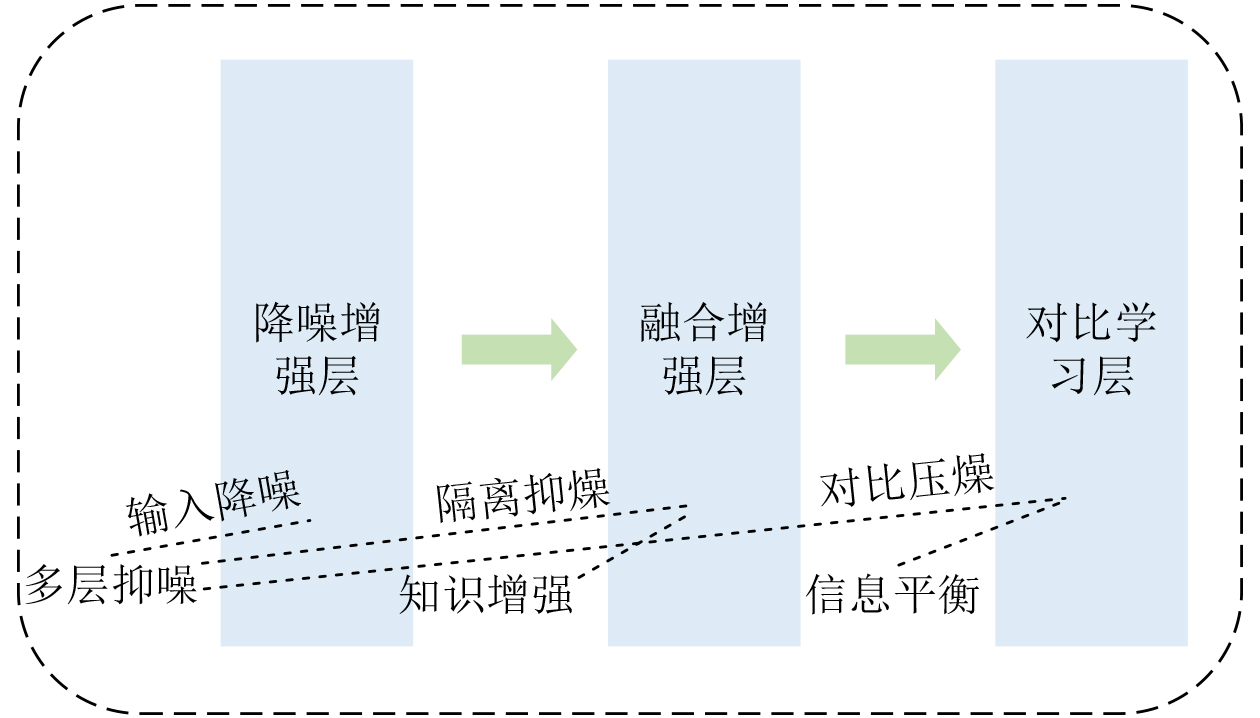
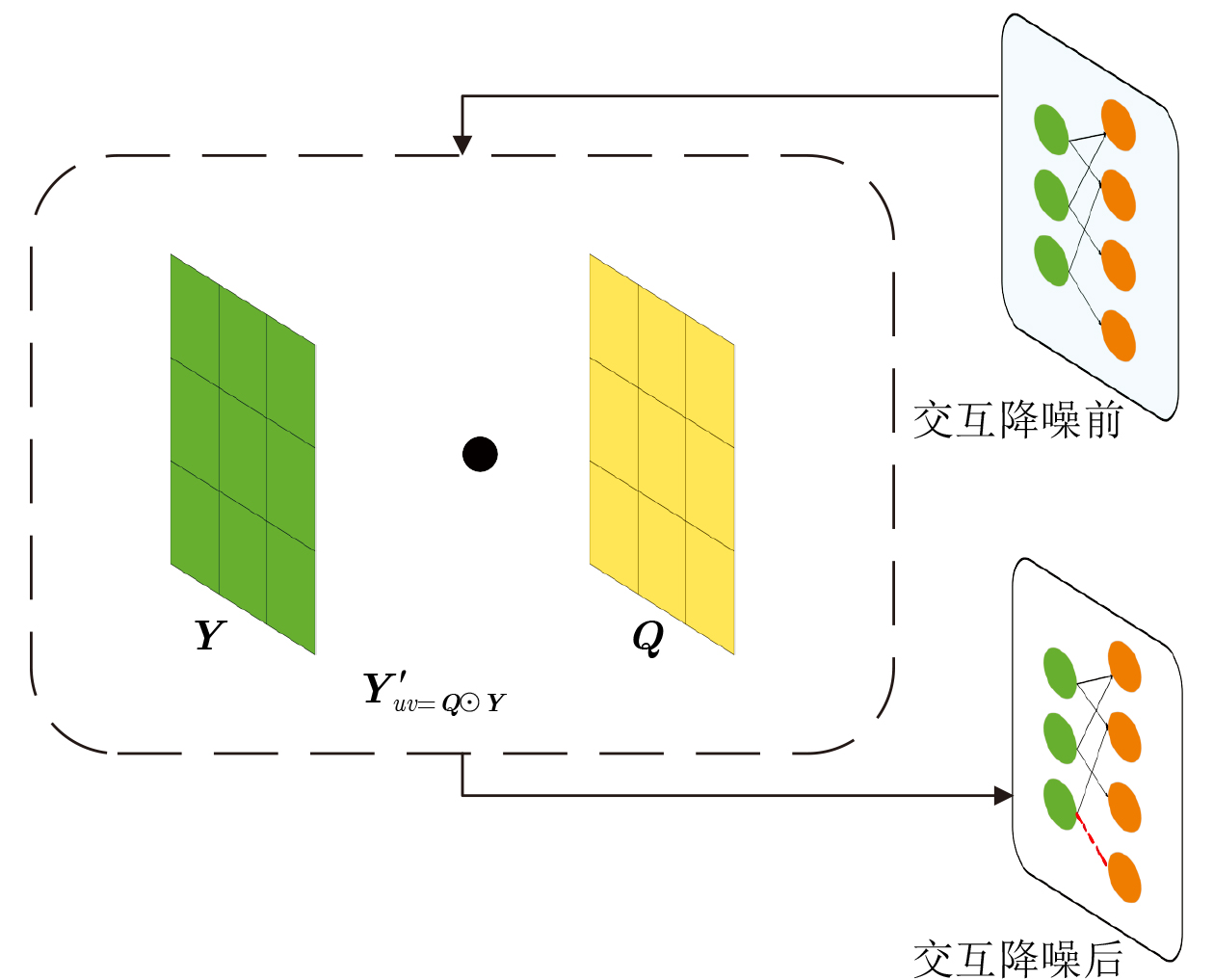
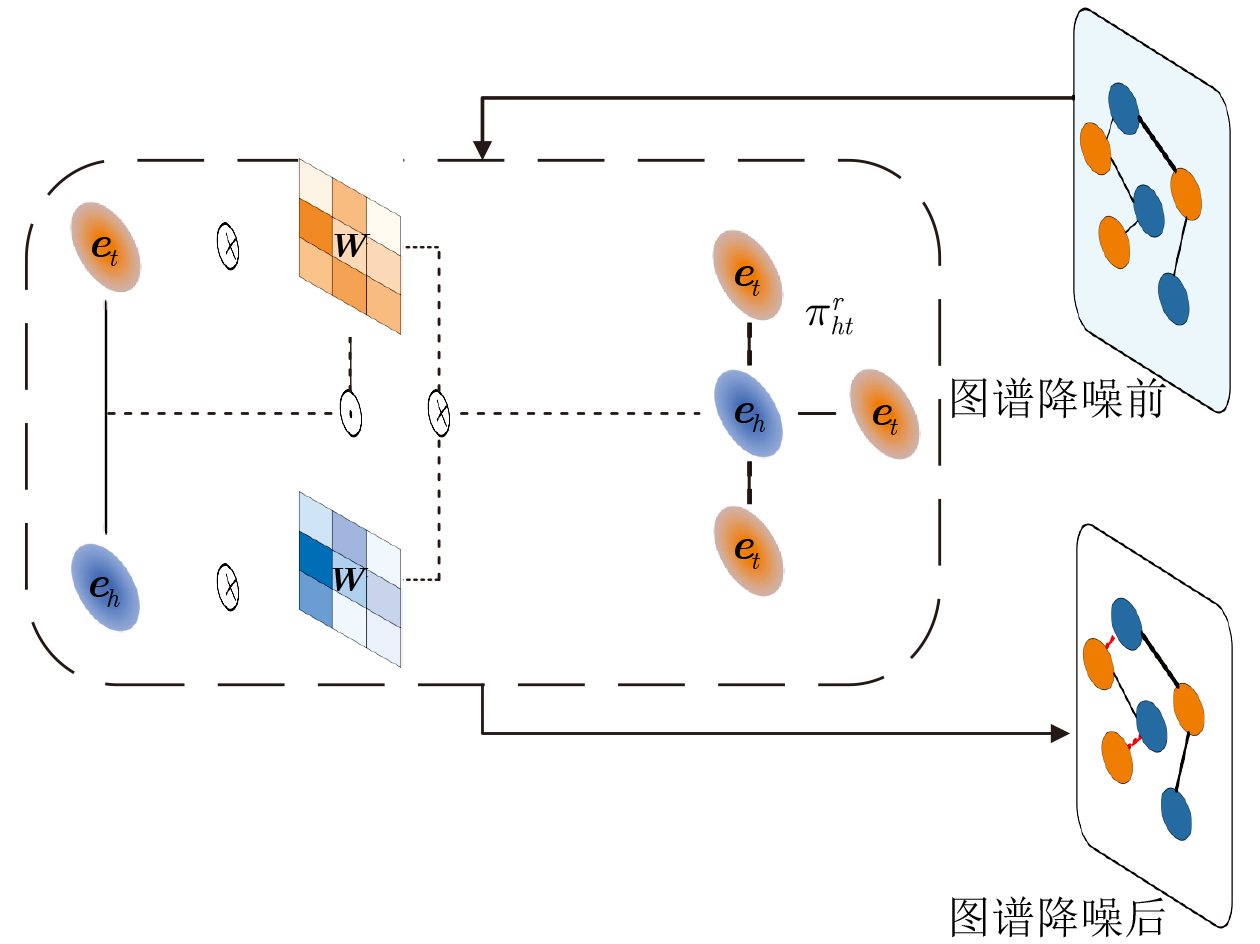
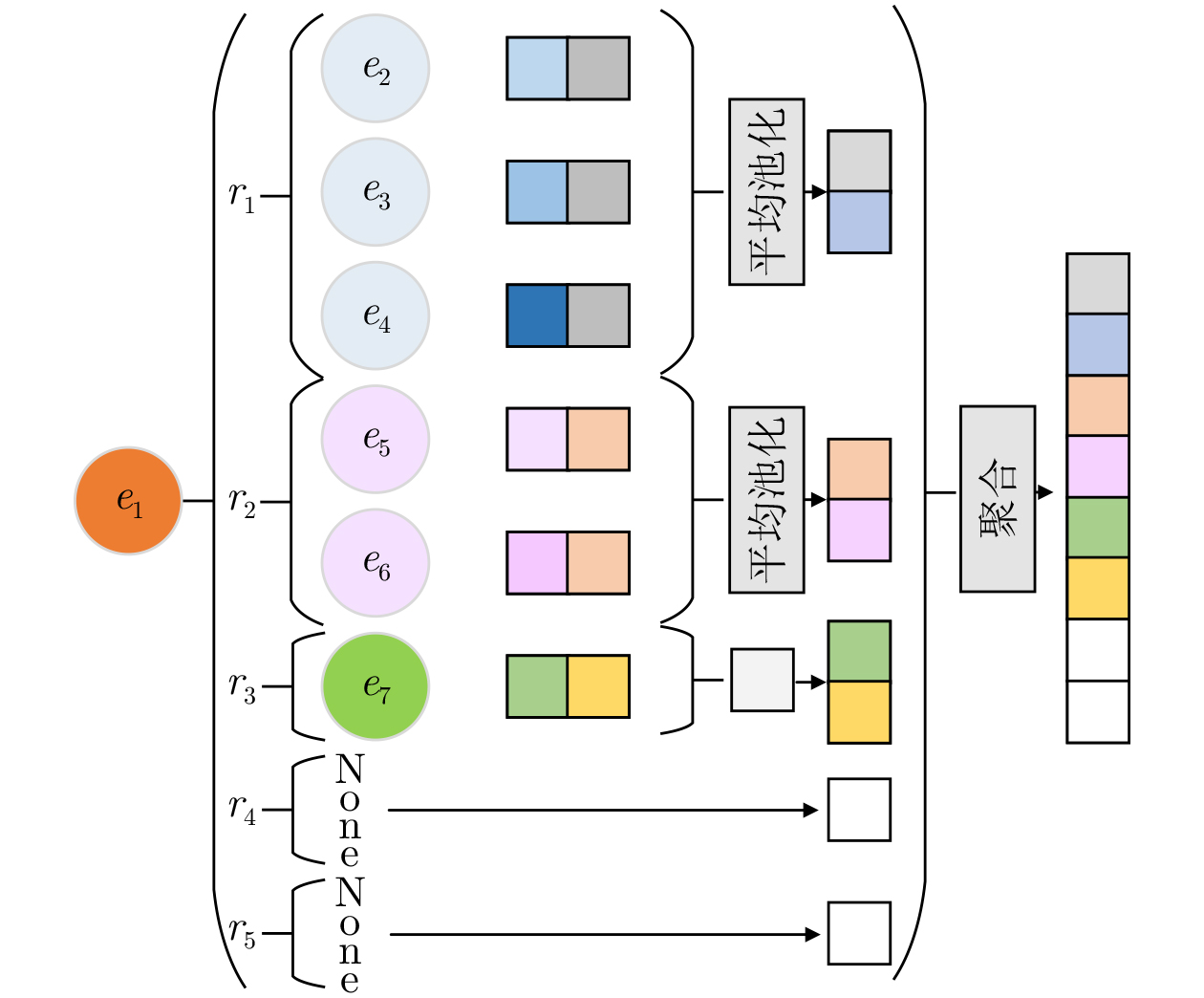
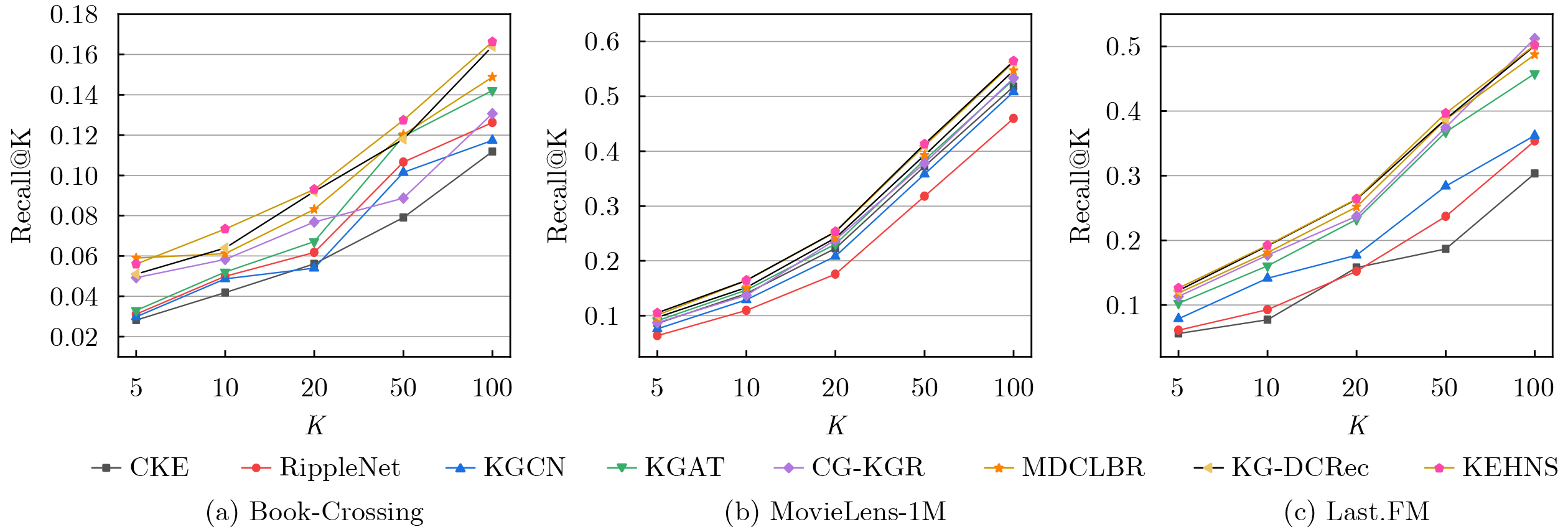
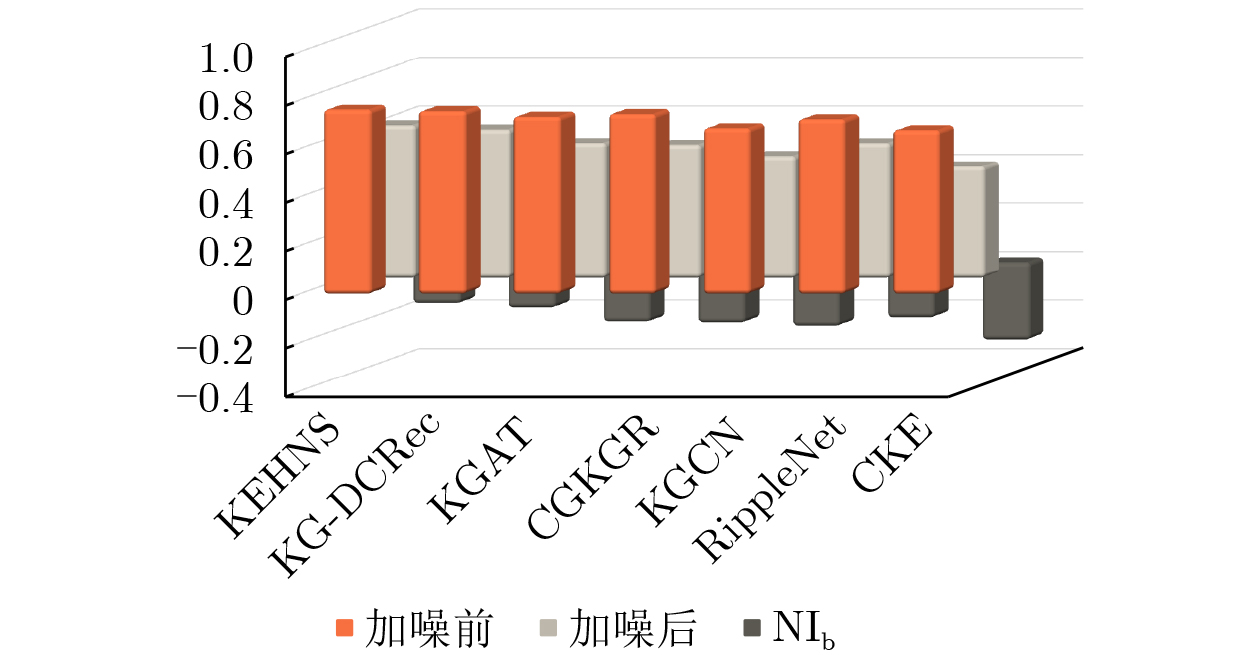
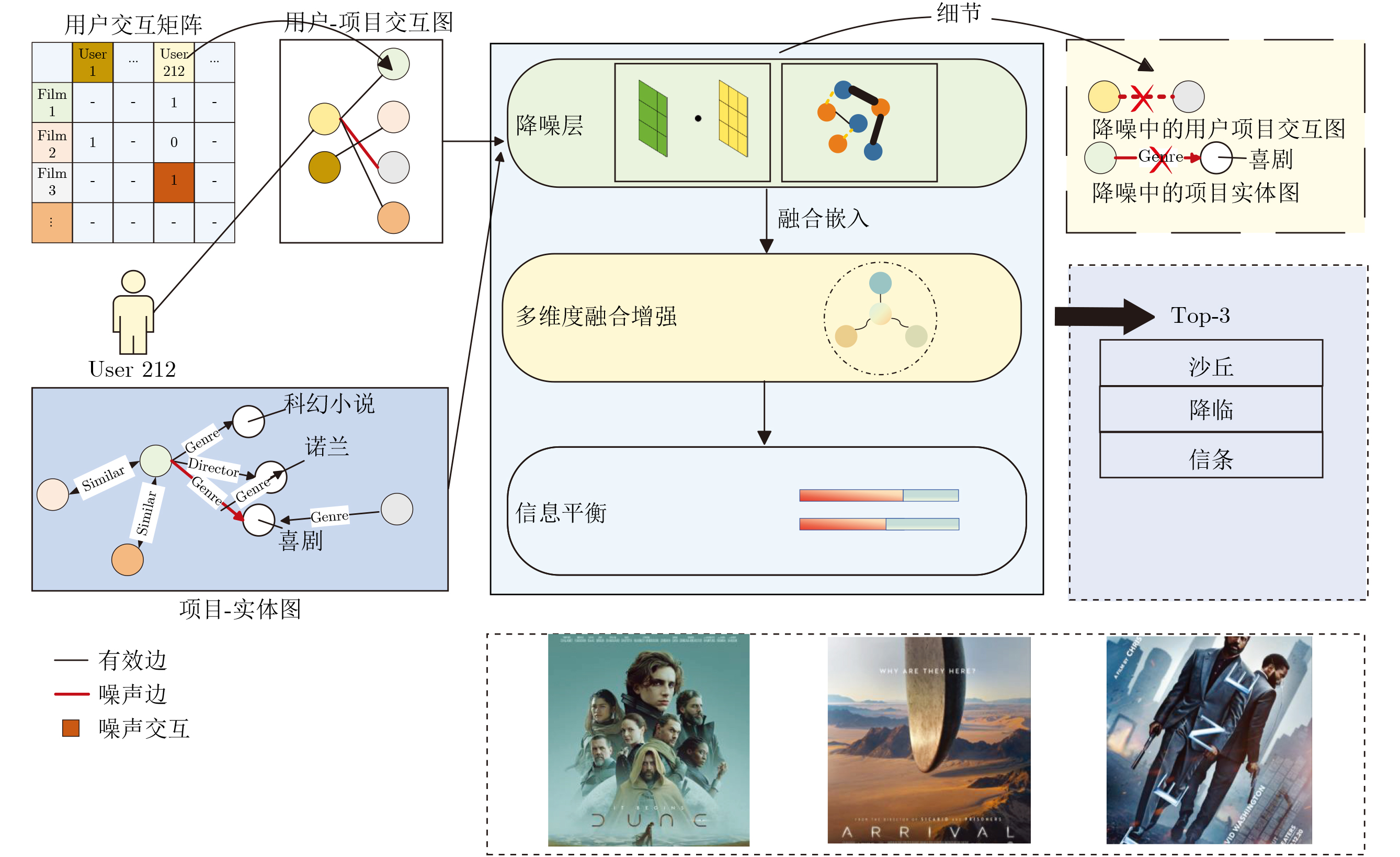
Objective In the big data and AI era, explosive information growth underpins the digital economy, yet filtering value from redundancy remains a key bottleneck. Personalized recommender systems are vital for precise matching and resource optimization. Integrating knowledge graphs enriches user–item representations, but current KG-based models suffer from weak noise suppression, coarse interest capture, and imbalanced information use, impairing performance. This paper proposes KE-HNS, a knowledge-enhanced recommender with a hierarchical multi-layer denoising strategy that fuses graph neural networks and contrastive learning. It systematically tackles noise, fine-grained preferences, and multi-source balance, markedly improving recommendation effectiveness. Methods KE-HNS introduces a multi-layer denoising paradigm. At input, an input denoising layer reduces noise via two sub-modules: user-item interaction denoising, which uses a learnable binary mask to drop noisy edges; and KG denoising enhancement, which scores triples by importance, identifies low-score ones, and masks them. The internal denoising layer preserves spatial independence by partitioning the entity-attribute space per relation, limiting high-order noise propagation. A compression denoising layer applies contrastive learning to further suppress noise and reinforce robust signals. To capture fine-grained interests, GCNs enhance user representations from interacted items and linked entities, while weight layers refine item representations using entity attributes and relations. For balanced information use, contrastive learning aligns user–item and item–entity views via positive/negative sampling, adaptively adjusting source weights. Matching is performed via inner product, producing a TOP-K recommendation list. Results and Discussions KE-HNS was assessed on three public datasets—Book-Crossing, MovieLens-1M, and Last.FM—via performance comparison, ablation studies, denoising evaluation, case analysis, and complexity assessment. For CTR prediction, it outperforms top baselines by 0.94%–1.01% in AUC and 0.43%–0.90% in F1 ( Table 3 ). In Top-K recommendation, its Recall@K exceeds most state-of-the-art methods across nearly all K values, trailing CG-KGR only slightly on Last.FM (Fig. 7 ). Ablation results confirm that every sub-module contributes significantly to performance gains (Table 4 ). Denoising tests show the model filters noise effectively while preserving high prediction accuracy under noisy settings (Fig. 8 ). Complexity analysis indicates practical deployability in real-world scenarios (Table 5 ).Conclusions This paper presents KE-HNS, a personalized recommendation model that combines knowledge enhancement with a multi-layer suppression mechanism. While it delivers strong performance across multiple domains, it has notable limitations: the view contrast operation hampers computational efficiency; it relies heavily on the completeness of knowledge graph coverage; and current evaluations lack testing in emerging multimedia contexts. Experiments on benchmark datasets show that KE-HNS effectively aligns collaborative filtering signals with knowledge-aware semantics while mitigating noise, pointing to promising avenues for future work on computational optimization and dynamic knowledge integration. -
表 1 数据集统计
数据集 知识图谱 用户项目交互 实体 关系 三元组 用户 项目 交互 MovieLens-1M 182011 12 1241996 6036 2445 753772 Last.FM 9366 60 15518 1872 3846 42346 Book-Crossing 77903 25 151500 17860 14976 139746  下载: 导出CSV
表 2 基线模型简介
基线模型 时间 简介 CKE 2016 一种融合知识图谱与协同过滤的推荐系统模型,旨在整合多源异构信息。 RippleNet 2018 一种通过知识图谱语义关联将用户历史兴趣传播至候选项目的推荐系统模型。 KGAT 2019 一种采用协同知识图谱显式捕获交互与图谱间的高阶语义关系的推荐模型。 KGIN 2021 一种融合细粒度用户意图建模与关系路径感知聚合的推荐系统模型。 CG-KGR 2022 一种通过协同引导机制融合用户-项目交互数据与外部知识图谱的推荐模型。 MDCLBR 2024 一种基于用户-项目簇、用户-项目及项目簇-项目三视角多视图对比学习模型。 KG-DCRec 2025 一种融合差异化去噪与双对比学习的图神经网络推荐模型。
下载: 导出CSV
表 3 AUC和F1结果对比
模型 MovieLens-1M Last.FM Book-Crossing AUC F1 AUC F1 AUC F1 CKE 0.9066 0.8032 0.7471 0.6743 0.6762 0.6235 RippleNet 0.9188 0.8420 0.7762 0.7025 0.7217 0.6465 KGAT 0.9110 0.8426 0.8292 0.7424 0.7314 0.6547 CG-KGR 0.9114 0.8422 0.8493 0.7527 0.7419 0.6540 KGIN 0.9190 0.8440 0.8486 0.7602 0.7265 0.6619 MDCLBR 0.9213 0.8438 0.8502 0.7593 0.7506 0.6642 KG-DCRec 0.9261 0.8547 0.8477 0.7706 0.7541 0.6674 KE-HNS 0.9349 0.8624 0.8588 0.7739 0.7612 0.6731 IMPROVE(%) 0.95 0.90 1.01 0.43 0.94 0.85
下载: 导出CSV
表 4 消融实验结果
变体模型 AUC F1 w/o INR&INS&CNS 0.9005 0.8268 w/o INR&INS 0.9058 0.8302 w/o INR&CNS 0.9040 0.8317 w/o INS&CNS 0.9192 0.8465 w/o INR 0.9208 0.8483 w/o CNS 0.9293 0.8598 w/o INS 0.9301 0.8613 KE-HNS 0.9349 0.8624
下载: 导出CSV
表 5 算法复杂度和训练时间对比
模型 计算复杂度 训练
时间/sMDCLBR O(L(2|V|Ed+E|d)+|V|2log|V|
+2|V|2d+k|V|d+|N|d)5.404 CG-KGR O(L(|V|d2+2|N|d)+|V|d2+|N|d) 2.2147 KGIN O(dL+|V|d2+2|E|d
+|V|d+|N|d)506.8 KE-HNS O(L(kd2+|U|||I|)2d+2|E|kd)
+|E|Md+2|V|2d)7.548
下载: 导出CSV
-
[1] 韩一鸣, 魏国辉. 知识图谱与推荐算法任务优化及领域应用发展综述[J]. 计算机工程与应用, 2026, 62(10): 26–53. doi: 10.3778/j.issn.1002-8331.2505-0279.HAN Yiming and WEI Guohui. Overview of task optimization and domain application development of knowledge graph and recommendation algorithm[J]. Computer Engineering and Applications, 2026, 62(10): 26–53. doi: 10.3778/j.issn.1002-8331.2505-0279. [2] IBRAHIM O A S, YOUNIS E M G, MOHAMED E A, et al. Revisiting recommender systems: An investigative survey[J]. Neural Computing and Applications, 2025, 37(4): 2145–2173. doi: 10.1007/s00521-024-10828-5. [3] RAJAL R, KUMAR N, KUMAR S, et al. A comprehensive review of product recommendation systems using deep learning techniques[J]. Knowledge and Information Systems, 2026, 68(1): 8. doi: 10.1007/s10115-025-02667-0. [4] GARAPATI R and CHAKRABORTY M. Recommender systems in the digital age: A comprehensive review of methods, challenges, and applications[J]. Knowledge and Information Systems, 2025, 67(8): 6367–6411. doi: 10.1007/s10115-025-02453-y. [5] 高云君, 葛丛丛, 郭宇翔, 等. 面向关系型数据与知识图谱的数据集成技术综述[J]. 软件学报, 2023, 34(5): 2365–2391. doi: 10.13328/j.cnki.jos.006808.GAO Yunjun, GE Congcong, GUO Yuxiang, et al. Survey on data integration technologies for relational data and knowledge graph[J]. Journal of Software, 2023, 34(5): 2365–2391. doi: 10.13328/j.cnki.jos.006808. [6] 廖涛, 张国畅, 张顺香. 基于双粒度图的文档级关系抽取[J]. 计算机工程, 2024, 50(10): 164–173. doi: 10.19678/j.issn.1000-3428.0068728.LIAO Tao, ZHANG Guochang, and ZHANG Shunxiang. Document-level relation extraction based on dual-granularity graphs[J]. Computer Engineering, 2024, 50(10): 164–173. doi: 10.19678/j.issn.1000-3428.0068728. [7] WANG Binhao, XIAO Yutian, WANG Maolin, et al. SPARK: Adaptive low-rank knowledge graph modeling in hybrid geometric spaces for recommendation[C]. Proceedings of the 34th ACM International Conference on Information and Knowledge Management, Seoul, Republic of Korea, 2025: 2956–2966. doi: 10.1145/3746252.3760999. [8] LI Haobin, LIN Yijie, HU Peng, et al. Learning with dual-level noisy correspondence for multi-modal entity alignment[C]. The 14th International Conference on Learning Representations, Rio de Janeiro, Brazil, 2026. (查阅网上资料, 未找到本条文献页码, 请确认). [9] 刘超, 余岩化. 融合降噪策略与多视图对比学习的知识感知推荐模型[J]. 计算机应用, 2025, 45(9): 2827–2837. doi: 10.11772/j.issn.1001-9081.2024081225.LIU Chao and YU Yanhua. Knowledge-aware recommendation model combining denoising strategy and multi-view contrastive learning[J]. Journal of Computer Applications, 2025, 45(9): 2827–2837. doi: 10.11772/j.issn.1001-9081.2024081225. [10] CHEN Yankai, YANG Yaming, WANG Yujing, et al. Attentive knowledge-aware graph convolutional networks with collaborative guidance for personalized recommendation[C]. IEEE 38th International Conference on Data Engineering, Kuala Lumpur, Malaysia, 2022: 299–311. doi: 10.1109/ICDE53745.2022.00027. [11] SANG Lei, HU Yang, ZHANG Yi, et al. Multi-view denoising contrastive learning for bundle recommendation[J]. Applied Intelligence, 2024, 54(23): 12332–12346. doi: 10.1007/s10489-024-05825-z. [12] WANG Hui, LI Qin, LUO Huilan, et al. The graph attention recommendation method for enhancing user features based on knowledge graphs[J]. Mathematics, 2025, 13(3): 390. doi: 10.3390/math13030390. [13] 吴浩萌. 推荐系统中的深度矩阵分解方法研究及应用[D]. [硕士论文], 吉林大学, 2022. doi: 10.27162/d.cnki.gjlin.2022.006200.WU Haomeng. Research and application of deep matrix factorization method in recommender system[D]. [Master dissertation], Jilin University, 2022. doi: 10.27162/d.cnki.gjlin.2022.006200. [14] HE Xiangnan, LIAO Lizi, ZHANG Hanwang, et al. Neural collaborative filtering[C]. Proceedings of the 26th International Conference on World Wide Web, Perth, Australia, 2017: 173–182. doi: 10.1145/3038912.3052569. [15] LIU Yiqun and ZHANG Min. TikTok recommendation algorithms[J]. Science Foundation in China, 35(3): 415–416. doi: 10.16262/j.cnki.1000-8217.2021.03.021. (查阅网上资料,未找到本条文献信息,请确认). [16] YAO Yuan, ZHAN Hui, NOORIAN A, et al. Enhancing POI recommendations on social media: A sequential approach incorporating LSTM and user feedback[J]. Computing, 2025, 107(1): 21. doi: 10.1007/s00607-024-01385-9. [17] PENG Jinglin and ZHOU Jianfeng. Framework for building knowledge map of ethnic music based on big data[J]. Journal of Electronics and Information Science, 2024, 9(1): 69–79. doi: 10.23977/jeis.2024.090111. [18] 陈玲洪, 潘晓华. 基于知识图谱和读者画像的图书推荐研究[J]. 数据分析与知识发现, 2023, 7(12): 164–171. doi: 10.11925/infotech.2096-3467.2022.1065.CHEN Linghong and PAN Xiaohua. Recommending books based on knowledge graph and reader profiling[J]. Data Analysis and Knowledge Discovery, 2023, 7(12): 164–171. doi: 10.11925/infotech.2096-3467.2022.1065. [19] ZHANG Yiwen, ZHANG Li, DONG Yunchun, et al. A movie recommendation method based on knowledge graph and time series[J]. Journal of Intelligent & Fuzzy Systems, 2023, 45(3): 4715–4724. doi: 10.3233/JIFS-230795. [20] 程开原, 姚俊萍, 李晓军, 等. 时态网络中知识图谱推荐: 关键技术与研究进展[J]. 中国电子科学研究院学报, 2021, 16(2): 174–183,188. doi: 10.3969/j.issn.1673-5692.2021.02.011.CHENG Kaiyuan, YAO Junping, LI Xiaojun, et al. Recommendation based on knowledge graph in temporal networks: Key technologies and progress[J]. Journal of China Academy of Electronics and Information Technology, 2021, 16(2): 174–183,188. doi: 10.3969/j.issn.1673-5692.2021.02.011. [21] ZHANG Fuzheng, YUAN N J, LIAN Defu, et al. Collaborative knowledge base embedding for recommender systems[C]. Proceedings of the 22nd ACM SIGKDD International Conference on Knowledge Discovery and Data Mining, San Francisco, USA, 2016: 353–362. doi: 10.1145/2939672.2939673. [22] WANG Hongwei, ZHANG Fuzheng, WANG Jialin, et al. RippleNet: Propagating user preferences on the knowledge graph for recommender systems[C]. Proceedings of the 27th ACM International Conference on Information and Knowledge Management, Torino, Italy, 2018: 417–426. doi: 10.1145/3269206.3271739. [23] WANG Hongwei, ZHANG Fuzheng, XIE Xing, et al. DKN: Deep knowledge-aware network for news recommendation[C]. Proceedings of the 2018 World Wide Web Conference, Lyon, France, 2018: 1835–1844. doi: 10.1145/3178876.3186175. [24] YU Xiao, REN Xiang, SUN Yizhou, et al. Personalized entity recommendation: A heterogeneous information network approach[C]. Proceedings of the 7th ACM International Conference on Web Search and Data Mining, New York, USA, 2014: 283–292. doi: 10.1145/2556195.2556259. [25] WANG Xiang, WANG Dingxian, XU Canran, et al. Explainable reasoning over knowledge graphs for recommendation[C]. Proceedings of the 33rd AAAI Conference on Artificial Intelligence, Honolulu, USA, 2019: 5329–5336. doi: 10.1609/aaai.v33i01.33015329. [26] ZHAO Huan, YAO Quanming, LI Jianda, et al. Meta-graph based recommendation fusion over heterogeneous information networks[C]. Proceedings of the 23rd ACM SIGKDD International Conference on Knowledge Discovery and Data Mining, Halifax, Canada, 2017: 635–644. doi: 10.1145/3097983.3098063. [27] YANG Yuhao, HUANG Chao, XIA Lianghao, et al. Knowledge graph contrastive learning for recommendation[C]. Proceedings of the 45th International ACM SIGIR Conference on Research and Development in Information Retrieval, Madrid, Spain, 2022: 1434–1443. doi: 10.1145/3477495.3532009. [28] ZHOU Jingyan, SHAN Zhilong, WU Zhengyang, et al. Knowledge graph denoising with dual contrast for recommendation[C]. 21st International Conference on Advanced Intelligent Computing Technology and Applications, Ningbo, China, 2025: 350–361. doi: 10.1007/978-981-95-0009-3_30. [29] SU Jiajie, ZHENG Xiaolin, LIN Zibin, et al. Contrastive hypergraph flows with multifaceted gates for cross-domain sequential recommendation[J]. IEEE Transactions on Services Computing, 2025, 18(6): 3595–3608. doi: 10.1109/TSC.2025.3620425. [30] SUN Shengyin and MA Chen. Hyperbolic contrastive learning with model-augmentation for knowledge-aware recommendation[C]. Joint European Conference on Machine Learning and Knowledge Discovery in Databases, Vilnius, Lithuania, 2024: 199–217. doi: 10.1007/978-3-031-70371-3_12. [31] WANG Xiang, HE Xiangnan, CAO Yixin, et al. KGAT: Knowledge graph attention network for recommendation[C]. Proceedings of the 25th ACM SIGKDD International Conference on Knowledge Discovery & Data Mining, Anchorage, USA, 2019: 950–958. doi: 10.1145/3292500.3330989. [32] WANG Xiang, HUANG Tinglin, WANG Dingxian, et al. Learning intents behind interactions with knowledge graph for recommendation[C]. Proceedings of the Web Conference 2021, Ljubljana, Slovenia, 2021: 878–887. doi: 10.1145/3442381.3450133. [33] ZHAO W X, MU Shanlei, HOU Yupeng, et al. RecBole: Towards a unified, comprehensive and efficient framework for recommendation algorithms[C]. Proceedings of the 30th ACM International Conference on Information & Knowledge Management, 2021: 4653–4664. doi: 10.1145/3459637.3482016. (查阅网上资料,未找到本条文献出版地,请确认). -


图(9) / 表(5)
计量
- 文章访问数: 17
- HTML全文浏览量: 10
- PDF下载量: 0
- 被引次数: 0
 下载:
下载:
