




Review of Non-invasive Brain-Computer Interfaces for Continuous Motor Control
-
摘要: 脑-机接口(BCI)在外部设备运动控制中的应用不断拓展,但以离散指令为主的控制方式难以满足连续控制与自然交互的需求,非侵入式连续运动控制BCI因兼具安全性与可推广性而受到广泛关注。该文系统综述了非侵入式连续运动控制BCI的研究进展,从控制范式、解码方法、应用场景及评价指标等方面进行了综合分析,重点讨论了连续控制实现机制及其对系统性能的影响。综述结果表明,非侵入式连续运动控制BCI已由早期概念验证任务逐步拓展至多类实际应用场景,但在范式优化、解码性能提升、真实场景适配和评价标准完善等方面仍有待进一步发展。基于此,该文对相关研究进行了归纳总结,并对未来发展方向进行了展望,为非侵入式连续运动控制BCI的进一步研究与应用提供参考。Abstract:
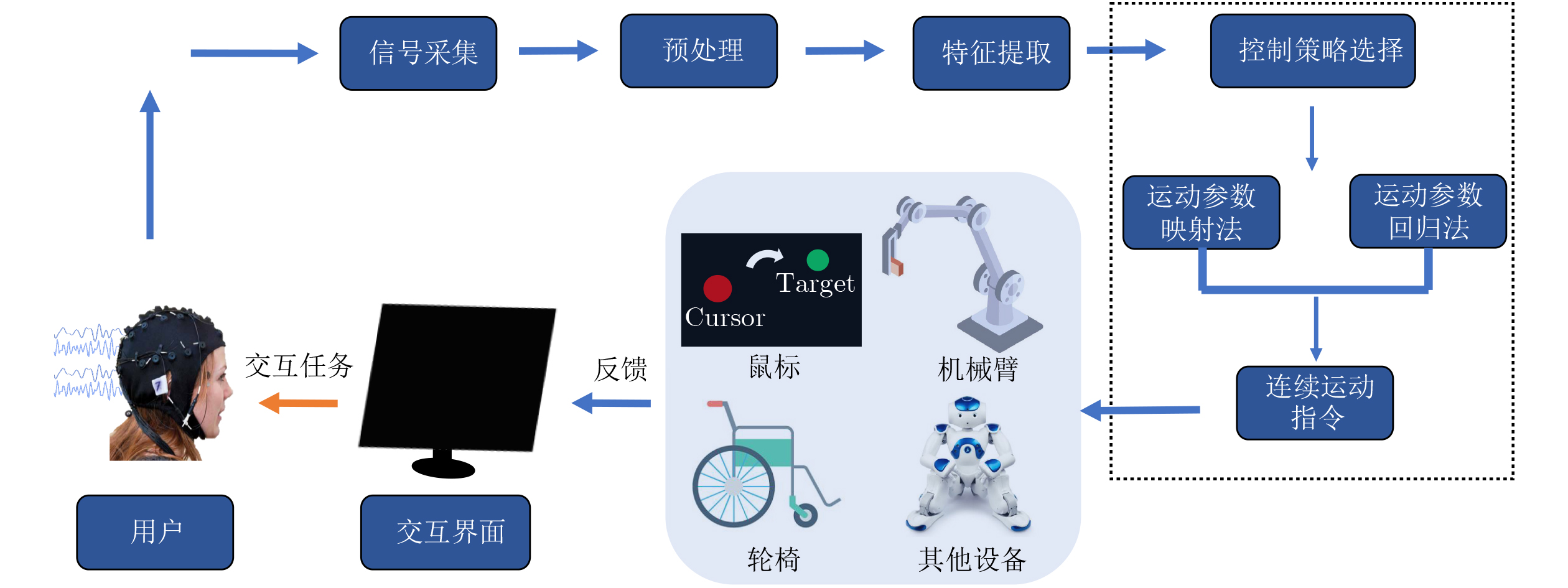
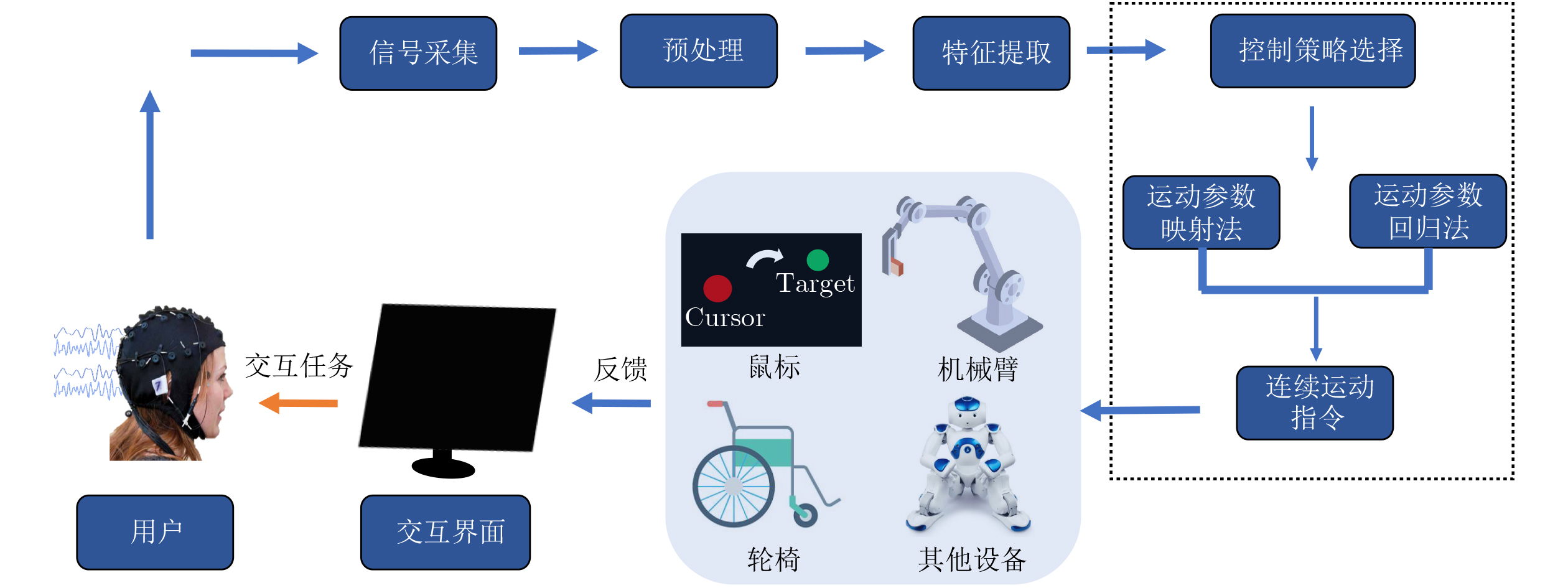
Significance Continuous motor control is a core capability of Brain-Computer Interface (BCI) systems for natural and efficient interaction with external devices. Compared with discrete command-based control, continuous control supports real-time and smooth regulation of motion parameters such as position, velocity, and trajectory. This capability is required for applications in assistive mobility, neurorehabilitation, robotic manipulation, and immersive human-machine interaction. Although invasive BCIs have achieved high-performance continuous control through high-quality neural recordings, their dependence on surgical implantation limits long-term use and large-scale deployment. A systematic review of non-invasive continuous motor control BCI technologies is therefore needed to clarify research progress, methodological features, and remaining challenges. Progress Advances in non-invasive continuous motor control BCIs are reviewed from four closely related aspects: control paradigms, decoding algorithms, applications, and performance evaluation. At the paradigm level, motor imagery, steady-state visual evoked potentials, P300, and hybrid paradigms have been studied to support continuous control through sustained intention modulation, dynamic stimulus encoding, and hierarchical or shared-control strategies. For decoding algorithms, two main frameworks are identified: motion parameter mapping and motion parameter regression. Motion parameter mapping generates continuous output by temporally integrating discrete classification results or mapping them to velocity or state variables, whereas motion parameter regression directly establishes relationships between Electroencephalogram (EEG) features and continuous kinematic parameters. Recent studies increasingly incorporate nonlinear models and deep learning methods to improve robustness under the non-stationary nature of EEG signals. At the application level, non-invasive continuous control has progressed from two-dimensional cursor tasks to more practical scenarios, including wheelchair navigation, robotic arm manipulation, unmanned systems, and virtual or augmented reality environments. Existing studies also assess continuous control performance using both objective and subjective indicators, including trajectory error, task success rate, information transfer rate, workload, and user experience, reflecting varied experimental designs and control aims. Conclusions Existing studies show that non-invasive BCIs can support continuous motor control. However, current research remains at a stage in which multiple methods coexist without a unified framework. At the paradigm level, available approaches differ in their ability to elicit and sustain continuous motor intention reliably. For decoding algorithms, both motion parameter mapping and motion parameter regression are limited by the non-stationary nature of EEG signals, which affects robustness, generalization, and long-term stability. At the application level, many studies remain restricted to specific tasks and controlled environments, and the transfer of continuous control strategies to complex real-world scenarios still requires further validation. Moreover, the lack of standardized evaluation protocols hinders direct comparison and systematic optimization across studies. Prospects Future research should improve the stability and reliability of continuous control paradigms, enhance decoding robustness under realistic EEG conditions, and strengthen the match between control strategies and application requirements. Unified evaluation frameworks that integrate objective and subjective indicators should also be established to support methodological convergence and fair comparison. With continued progress, non-invasive continuous motor control BCIs are expected to play a growing role in assistive technologies, rehabilitation systems, and advanced human-machine interaction. -
[1] ZHANG Jiayan, LI Junshi, HUANG Zhe, et al. Recent progress in wearable Brain-Computer Interface (BCI) devices based on ElectroEncephaloGram (EEG) for medical applications: A review[J]. Health Data Science, 2023, 3: 0096. doi: 10.34133/hds.0096. [2] PERNA A, ANGOTZI G N, BERDONDINI L, et al. Advancing the interfacing performances of chronically implantable neural probes in the era of CMOS neuroelectronics[J]. Frontiers in Neuroscience, 2023, 17: 1275908. doi: 10.3389/fnins.2023.1275908. [3] DREYER A M, MICHALKE L, PERRY A, et al. Grasp-specific high-frequency broadband mirror neuron activity during reach-and-grasp movements in humans[J]. Cerebral Cortex, 2023, 33(10): 6291–6298. doi: 10.1093/cercor/bhac504. [4] VANUTELLI M E, SALVADORE M, and LUCCHIARI C. BCI applications to creativity: Review and future directions, from little-c to C2[J]. Brain Sciences, 2023, 13(4): 665. doi: 10.3390/brainsci13040665. [5] VÄRBU K, MUHAMMAD N, and MUHAMMAD Y. Past, present, and future of EEG-based BCI applications[J]. Sensors (Basel), 2022, 22(9): 3331. doi: 10.3390/s22093331. [6] FARWELL L A and DONCHIN E. Talking off the top of your head: Toward a mental prosthesis utilizing event-related brain potentials[J]. Electroencephalography and Clinical Neurophysiology, 1988, 70(6): 510–523. doi: 10.1016/0013-4694(88)90149-6. [7] NAKANISHI M, WANG Yijun, CHEN Xiaogang, et al. Enhancing detection of SSVEPs for a high-speed brain speller using task-related component analysis[J]. IEEE Transactions on Biomedical Engineering, 2018, 65(1): 104–112. doi: 10.1109/TBME.2017.2694818. [8] CHEN Xiaogang, WANG Yijun, GAO Shangkai, et al. Filter bank canonical correlation analysis for implementing a high-speed SSVEP-based brain-computer interface[J]. Journal of Neural Engineering, 2015, 12(4): 046008. doi: 10.1088/1741-2560/12/4/046008. [9] XU Minpeng, HAN Jin, WANG Yijun, et al. Implementing over 100 command codes for a high-speed hybrid brain-computer interface using concurrent P300 and SSVEP features[J]. IEEE Transactions on Biomedical Engineering, 2020, 67(11): 3073–3082. doi: 10.1109/TBME.2020.2975614. [10] MISTRY K S, PELAYO P, ANIL D G, et al. An SSVEP based brain computer interface system to control electric wheelchairs[C]. The 2018 IEEE International Instrumentation and Measurement Technology Conference (I2MTC), Houston, USA, 2018: 1–6. doi: 10.1109/I2MTC.2018.8409632. [11] DING Yidan, UDOMPANYAWIT C, ZHANG Yisha, et al. EEG-based brain-computer interface enables real-time robotic hand control at individual finger level[J]. Nature Communications, 2025, 16(1): 5401. doi: 10.1038/s41467-025-61064-x. [12] SWARNAKAR R. Brain-computer interfaces in rehabilitation: Implementation models and future perspectives[J]. Cureus, 2025, 17(7): e88873. doi: 10.7759/cureus.88873. [13] TONIN L and MILLÁN J D R. Noninvasive brain-machine interfaces for robotic devices[J]. Annual Review of Control, Robotics, and Autonomous Systems, 2021, 4: 191–214. doi: 10.1146/annurev-control-012720-093904. [14] TAYLOR D M, TILLERY S I H, and SCHWARTZ A B. Direct cortical control of 3D neuroprosthetic devices[J]. Science, 2002, 296(5574): 1829–1832. doi: 10.1126/science.1070291. [15] HOCHBERG L R, BACHER D, JAROSIEWICZ B, et al. Reach and grasp by people with tetraplegia using a neurally controlled robotic arm[J]. Nature, 2012, 485(7398): 372–375. doi: 10.1038/nature11076. [16] COLLINGER J L, WODLINGER B, DOWNEY J E, et al. High-performance neuroprosthetic control by an individual with tetraplegia[J]. The Lancet, 2013, 381(9866): 557–564. doi: 10.1016/S0140-6736(12)61816-9. [17] WILLETT F R, AVANSINO D T, HOCHBERG L R, et al. High-performance brain-to-text communication via handwriting[J]. Nature, 2021, 593(7858): 249–254. doi: 10.1038/s41586-021-03506-2. [18] DEL R MILLAN J, MOURINO J, FRANZE M, et al. A local neural classifier for the recognition of EEG patterns associated to mental tasks[J]. IEEE Transactions on Neural Networks, 2002, 13(3): 678–686. doi: 10.1109/TNN.2002.1000132. [19] WOLPAW J R and MCFARLAND D J. Control of a two-dimensional movement signal by a noninvasive brain-computer interface in humans[J]. The National Academy of Sciences of the United States of America, 2004, 101(51): 17849–17854. doi: 10.1073/pnas.0403504101. [20] KOKORIN K, ZEHRA S R, MU Jing, et al. Semi-autonomous continuous robotic arm control using an augmented reality brain-computer interface[J]. IEEE Transactions on Neural Systems and Rehabilitation Engineering, 2024, 32: 4098–4108. doi: 10.1109/TNSRE.2024.3500217. [21] ZHANG Rui, CHEN Yadi, XU Zongxin, et al. Recognition of single upper limb motor imagery tasks from EEG using multi-branch fusion convolutional neural network[J]. Frontiers in Neuroscience, 2023, 17: 1129049. doi: 10.3389/fnins.2023.1129049. [22] WILLSEY M S, SHAH N P, AVANSINO D T, et al. A high-performance brain-computer interface for finger decoding and quadcopter game control in an individual with paralysis[J]. Nature Medicine, 2025, 31(1): 96–104. doi: 10.1038/s41591-024-03341-8. [23] KIM H, AHN M, and JUN S C. A brain switch for SSVEP-based BCI speller using an RNN-based detection approach[C]. Proceedings of 2025 47th Annual International Conference of the IEEE Engineering in Medicine and Biology Society, Copenhagen, Denmark, 2025: 1–5. doi: 10.1109/EMBC58623.2025.11252734. [24] FRIMAN O, VOLOSYAK I, and GRASER A. Multiple channel detection of steady-state visual evoked potentials for brain-computer interfaces[J]. IEEE Transactions on Biomedical Engineering, 2007, 54(4): 742–750. doi: 10.1109/TBME.2006.889160. [25] XU Minpeng, QI Hongzhi, WAN Baikun, et al. A hybrid BCI speller paradigm combining P300 potential and the SSVEP blocking feature[J]. Journal of Neural Engineering, 2013, 10(2): 026001. doi: 10.1088/1741-2560/10/2/026001. [26] GU Meng, PEI Weihua, GAO Xiaorong, et al. An open dataset for human SSVEPs in the frequency range of 1–60 Hz[J]. Scientific Data, 2024, 11(1): 196. doi: 10.1038/s41597-024-03023-7. [27] AI Jikun, MENG Jianjun, MAI Ximing, et al. BCI control of a robotic arm based on SSVEP with moving stimuli for reach and grasp tasks[J]. IEEE Journal of Biomedical and Health Informatics, 2023, 27(8): 3818–3829. doi: 10.1109/JBHI.2023.3277612. [28] HUANG Changxing, SHI Nanlin, MIAO Yining, et al. Visual tracking brain-computer interface[J]. iScience, 2024, 27(4): 109376. doi: 10.1016/j.isci.2024.109376. [29] SUTTON S, BRAREN M, ZUBIN J, et al. Evoked-potential correlates of stimulus uncertainty[J]. Science, 1965, 150(3700): 1187–1188. doi: 10.1126/science.150.3700.1187. [30] LI Mengfan, LI Wei, ZHAO Jing, et al. A P300 model for cerebot – a mind-controlled humanoid robot[M]//KIM J H, MATSON E T, MYUNG H, et al. Robot Intelligence Technology and Applications 2: Results from the 2nd International Conference on Robot Intelligence Technology and Applications. Cham: Springer, 2014: 495–502. [31] LIU J C, CHOU H C, CHEN C H, et al. Time-shift correlation algorithm for P300 event related potential brain-computer interface implementation[J]. Computational Intelligence and Neuroscience, 2016, 2016(1): 3039454. doi: 10.1155/2016/3039454. [32] BERALDO G, TORTORA S, and MENEGATTI E. Towards a brain-robot interface for children[C]. The 2019 IEEE International Conference on Systems, Man and Cybernetics (SMC), Bari, Italy, 2019: 2799–2805. doi: 10.1109/SMC.2019.8914612. [33] LONG Jinyi, LI Yuanqing, WANG Hongtao, et al. A hybrid brain computer interface to control the direction and speed of a simulated or real wheelchair[J]. IEEE Transactions on Neural Systems and Rehabilitation Engineering, 2012, 20(5): 720–729. doi: 10.1109/TNSRE.2012.2197221. [34] LI Zhaohui, ZHANG Ruoqing, LI Wenjing, et al. Enhancement of hybrid BCI system performance based on motor imagery and SSVEP by transcranial alternating current stimulation[J]. IEEE Transactions on Neural Systems and Rehabilitation Engineering, 2024, 32: 3222–3230. doi: 10.1109/TNSRE.2024.3451015. [35] WOLPAW J R, BIRBAUMER N, MCFARLAND D J, et al. Brain-computer interfaces for communication and control[J]. Clinical Neurophysiology, 2002, 113(6): 767–791. doi: 10.1016/S1388-2457(02)00057-3. [36] MCFARLAND D J and WOLPAW J R. Sensorimotor rhythm-based Brain-Computer Interface (BCI): Feature selection by regression improves performance[J]. IEEE Transactions on Neural Systems and Rehabilitation Engineering, 2005, 13(3): 372–379. doi: 10.1109/TNSRE.2005.848627. [37] PFURTSCHELLER G, BRUNNER C, SCHLÖGL A, et al. Mu rhythm (de)synchronization and EEG single-trial classification of different motor imagery tasks[J]. NeuroImage, 2006, 31(1): 153–159. doi: 10.1016/j.neuroimage.2005.12.003. [38] LAWHERN V J, SOLON A J, WAYTOWICH N R, et al. EEGNet: A compact convolutional neural network for EEG-based brain-computer interfaces[J]. Journal of Neural Engineering, 2018, 15(5): 056013. doi: 10.1088/1741-2552/aace8c. [39] BARACHANT A, BONNET S, CONGEDO M, et al. Multiclass brain-computer interface classification by Riemannian geometry[J]. IEEE Transactions on Biomedical Engineering, 2012, 59(4): 920–928. doi: 10.1109/TBME.2011.2172210. [40] WU Dongrui. Revisiting euclidean alignment for transfer learning in EEG-based brain-computer interfaces[J]. Journal of Neural Engineering, 2025, 22(3): 031005. doi: 10.1088/1741-2552/addd49. [41] GWON D and AHN M. Motor task-to-task transfer learning for motor imagery brain-computer interfaces[J]. NeuroImage, 2024, 302: 120906. doi: 10.1016/j.neuroimage.2024.120906. [42] PADFIELD N, CAMILLERI K, CAMILLERI T, et al. A comprehensive review of endogenous EEG-based BCIs for dynamic device control[J]. Sensors (Basel), 2022, 22(15): 5802. doi: 10.3390/s22155802. [43] ROBINSON N, GUAN Cuntai, and VINOD A P. Adaptive estimation of hand movement trajectory in an EEG based brain - computer interface system[J]. Journal of Neural Engineering, 2015, 12(6): 066019. [44] HOSSEINI S M and SHALCHYAN V. Continuous decoding of hand movement from EEG signals using phase-based connectivity features[J]. Frontiers in Human Neuroscience, 2022, 16: 901285. doi: 10.3389/fnhum.2022.901285. [45] FORENZO D, ZHU Hao, and HE Bin. A continuous pursuit dataset for online deep learning-based EEG brain-computer interface[J]. Scientific Data, 2024, 11(1): 1256. doi: 10.1038/s41597-024-04090-6. [46] ZHANG Shaorong, ZHU Zhibin, ZHANG Benxin, et al. The CSP-based new features plus non-convex log sparse feature selection for motor imagery EEG classification[J]. Sensors (Basel), 2020, 20(17): 4749. doi: 10.3390/s20174749. [47] MENG Jianjun, ZHANG Shuying, BEKYO A, et al. Noninvasive electroencephalogram based control of a robotic arm for reach and grasp tasks[J]. Scientific Reports, 2016, 6(1): 38565. doi: 10.1038/srep38565. [48] REBSAMEN B, GUAN Cuntai, ZHANG Haihong, et al. A brain controlled wheelchair to navigate in familiar environments[J]. IEEE Transactions on Neural Systems and Rehabilitation Engineering, 2010, 18(6): 590–598. doi: 10.1109/TNSRE.2010.2049862. [49] CARLSON T and MILLAN J D R. Brain-controlled wheelchairs: A robotic architecture[J]. IEEE Robotics & Automation Magazine, 2013, 20(1): 65–73. [50] DILLEN A, OMIDI M, GHAFFARI F, et al. A shared robot control system combining augmented reality and motor imagery brain-computer interfaces with eye tracking[J]. Journal of Neural Engineering, 2024, 21(5): 056028. doi: 10.1088/1741-2552/ad7f8d. [51] ZHOU Yajun, YU Tianyou, GAO Wei, et al. Shared three-dimensional robotic arm control based on asynchronous BCI and computer vision[J]. IEEE Transactions on Neural Systems and Rehabilitation Engineering, 2023, 31: 3163–3175. doi: 10.1109/TNSRE.2023.3299350. [52] LAFLEUR K, CASSADY K, DOUD A, et al. Quadcopter control in three-dimensional space using a noninvasive motor imagery-based brain-computer interface[J]. Journal of Neural Engineering, 2013, 10(4): 046003. doi: 10.1088/1741-2560/10/4/046003. [53] LIAN Jinling, GUO Yanli, QIAO Xin, et al. A novel asynchronous brain signals-based driver–vehicle interface for brain-controlled vehicles[J]. Bioengineering, 2023, 10(9): 1105. doi: 10.3390/bioengineering10091105. [54] LIU Xiuyun, WANG Wenlong, LIU Miao, et al. Recent applications of EEG-based brain-computer-interface in the medical field[J]. Military Medical Research, 2025, 12(1): 14. doi: 10.1186/s40779-025-00598-z. [55] LECUYER A, LOTTE F, REILLY R B, et al. Brain-computer interfaces, virtual reality, and videogames[J]. Computer, 2008, 41(10): 66–72. doi: 10.1109/mc.2008.410. [56] DE MAURO A, CARRASCO E, OYARZUN D, et al. Virtual reality system in conjunction with neurorobotics and neuroprosthetics for rehabilitation of motor disorders[M]//WESTWOOD J D, WESTWOOD S W, FELLÄNDER-TSAI L, et al. Medicine Meets Virtual Reality 18. Amsterdam: IOS Press, 2011: 163–165. doi: 10.3233/978-1-60750-706-2-163. [57] SPATARO R, CHELLA A, ALLISON B, et al. Reaching and grasping a glass of water by locked-in ALS patients through a BCI-controlled humanoid robot[J]. Frontiers in Human Neuroscience, 2017, 11: 226067. doi: 10.3389/fnhum.2017.00068. [58] ITURRATE I, CHAVARRIAGA R, MONTESANO L, et al. Teaching brain-machine interfaces as an alternative paradigm to neuroprosthetics control[J]. Scientific Reports, 2015, 5(1): 13893. doi: 10.1038/srep13893. [59] CAO Linfeng, LI Guangye, XU Yang, et al. A brain-actuated robotic arm system using non-invasive hybrid brain-computer interface and shared control strategy[J]. Journal of Neural Engineering, 2021, 18(4): 046045. doi: 10.1088/1741-2552/abf8cb. [60] XU Baoguo, LI Wenlong, HE Xiaohang, et al. Motor imagery based continuous teleoperation robot control with tactile feedback[J]. Electronics, 2020, 9(1): 174. doi: 10.3390/electronics9010174. [61] WANG Hongtao, LI Yuanqing, LONG Jinyi, et al. An asynchronous wheelchair control by hybrid EEG-EOG brain-computer interface[J]. Cognitive Neurodynamics, 2014, 8(5): 399–409. doi: 10.1007/s11571-014-9296-y. [62] XU Yang, ZHANG Heng, CAO Linfeng, et al. A shared control strategy for reach and grasp of multiple objects using robot vision and noninvasive brain–computer interface[J]. IEEE Transactions on Automation Science and Engineering, 2022, 19(1): 360–372. doi: 10.1109/tase.2020.3034826. [63] SHANECHI M M, ORSBORN A L, and CARMENA J M. Robust brain-machine interface design using optimal feedback control modeling and adaptive point process filtering[J]. PLoS Computational Biology, 2016, 12(4): e1004730. doi: 10.1371/journal.pcbi.1004730. [64] EDELMAN B J, MENG J, SUMA D, et al. Noninvasive neuroimaging enhances continuous neural tracking for robotic device control[J]. Science Robotics, 2019, 4(31): eaaw6844. doi: 10.1126/scirobotics.aaw6844. [65] SHPIGELMAN L, LALAZAR H, and VAADIA E. Kernel-ARMA for hand tracking and Brain-Machine Interfacing during 3D motor control[C]. The 22nd International Conference on Neural Information Processing Systems, Vancouver, Canada, 2008: 1489–1496. [66] SUMA D, MENG Jianjun, EDELMAN B J, et al. Spatial-temporal aspects of continuous EEG-based neurorobotic control[J]. Journal of Neural Engineering, 2020, 17(6): 066006. doi: 10.1088/1741-2552/abc0b4. [67] ALLISON B Z, BRUNNER C, ALTSTÄTTER C, et al. A hybrid ERD/SSVEP BCI for continuous simultaneous two dimensional cursor control[J]. Journal of Neuroscience Methods, 2012, 209(2): 299–307. doi: 10.1016/j.jneumeth.2012.06.022. [68] SINGER-CLARK T, HOU Xianda, CARD N S, et al. Speech motor cortex enables BCI cursor control and click[J]. Journal of Neural Engineering, 2025, 22(3): 036015. doi: 10.1088/1741-2552/add0e5. [69] KAYAGIL T A, BAI Ou, HENRIQUEZ C S, et al. A binary method for simple and accurate two-dimensional cursor control from EEG with minimal subject training[J]. Journal of NeuroEngineering and Rehabilitation, 2009, 6(1): 14. doi: 10.1186/1743-0003-6-14. [70] ZEHRA S R, MU Jing, SYIEM B V, et al. Evaluation of optimal stimuli for SSVEP-based augmented reality brain-computer interfaces[J]. IEEE Access, 2023, 11: 87305–87315. -

 下载:
下载:

图(1) / 表(1)
计量
- 文章访问数: 1301
- HTML全文浏览量: 829
- PDF下载量: 95
- 被引次数: 0
