




Tri-Modal Speech Separation Model Driven by Improved Attention and Gating-Augmented Cross-Modal Attention Mechanism
-
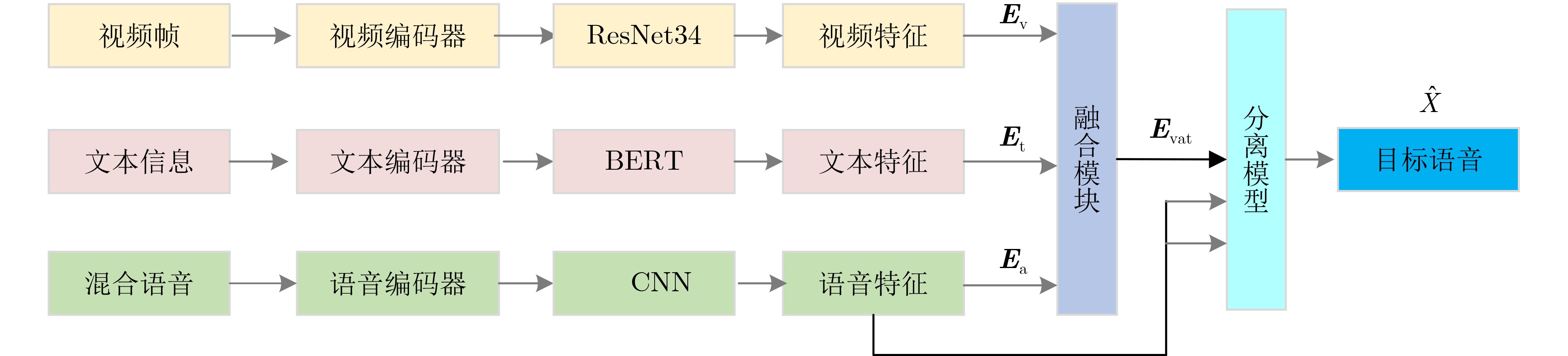
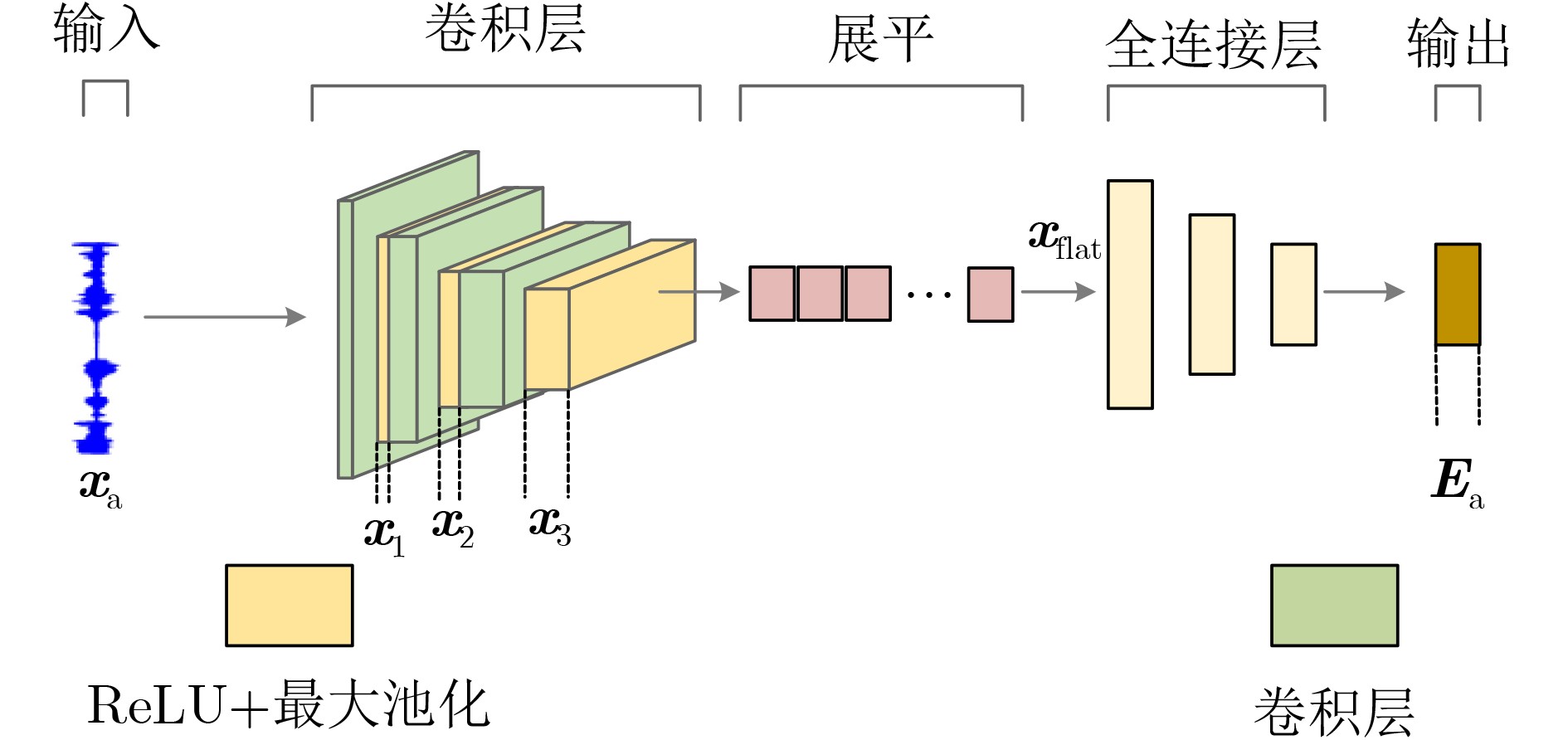
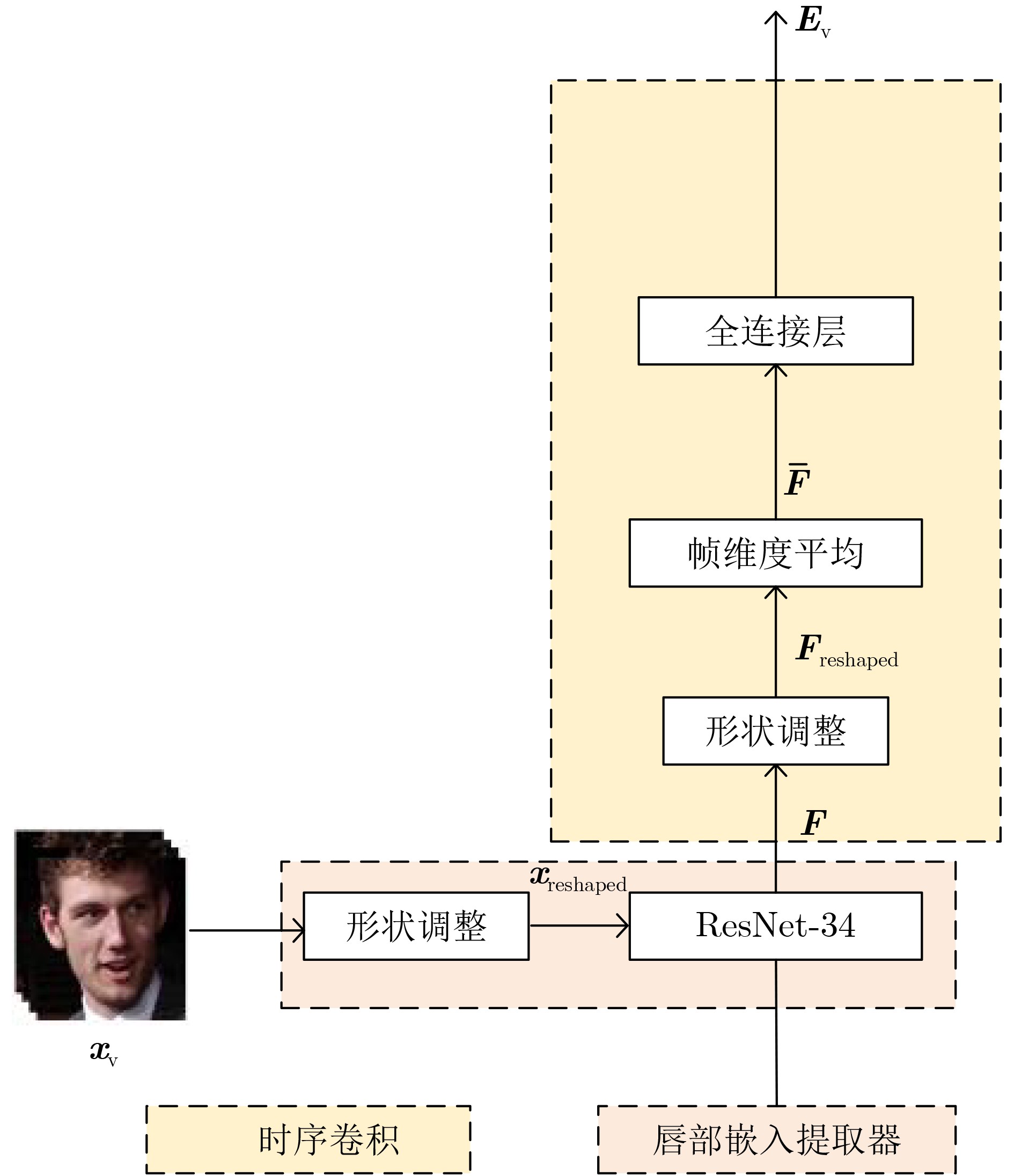
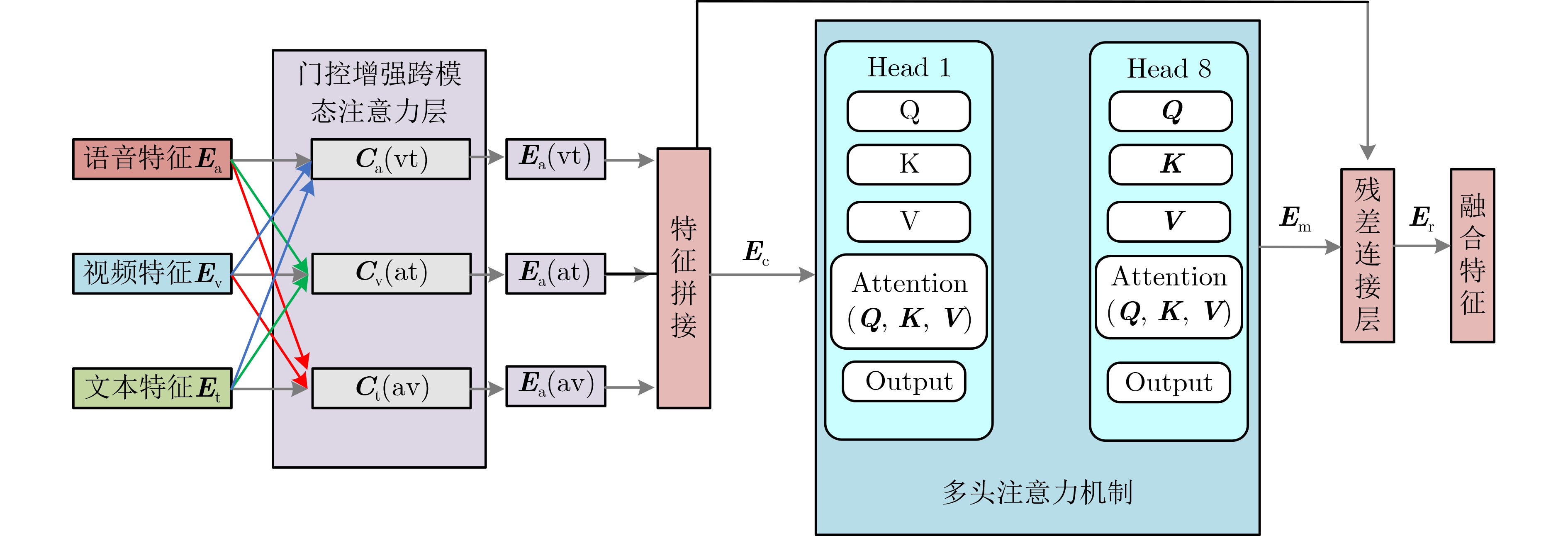
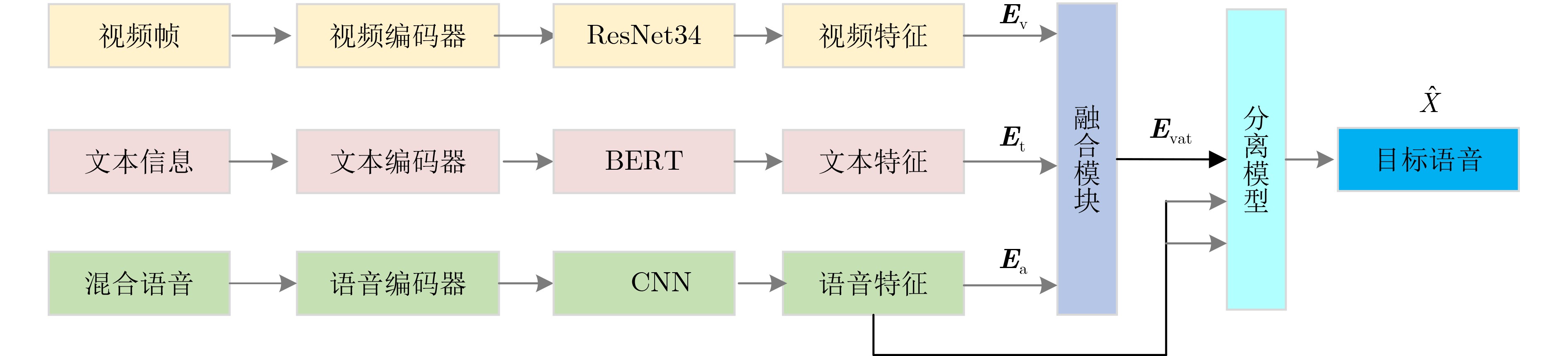
摘要: 为解决传统音频分离方法在动态遮挡、同音异义干扰等复杂场景下存在的模态互补信息挖掘不足、场景适配性差等问题,本文提出一种改进多头注意力与门控注意力机制驱动的三模态语音分离方法。该方法首先构建音频/视频/文本三模态特征提取模块,语音特征由CNN提取,视频特征基于ResNet34优化唇部运动捕捉,文本特征通过BERT模型获取语义信息,随后设计门控增强跨模态注意力层,基于接收模态自身特征动态生成门控向量,筛选模态间关键互补信息,避免简单特征拼接的冗余问题,最后结合改进多头注意力机制完成三模态深度融合与语音分离。基于GRID数据集,以感知语音质量(PESQ)、短时客观可懂度(STOI)、信号失真比(SDR)为指标验证性能:相较于三模态简单融合模型,本文方法的 SDR、PESQ、STOI至少提升4.5 dB、0.47、0.081;最终模型的SDR达7.82 dB、PESQ达2.08、STOI达0.870。研究表明,该方法能有效适配复杂场景下的动态特征需求,为音频分离任务提供更优的多模态融合解决方案。
-
关键词:
- 语音分离 /
- 门控增强跨模态注意力 /
- 多头注意力机制 /
- 三模态融合
Abstract:Objective .Traditional single-modal speech separation fails to fully exploit modal complementarity and performs poorly under dynamic occlusion and homophonic interference. Bimodal audio-visual models suffer severe performance drops when lip visual cues are unavailable. Current tri-modal methods mostly simply concatenate text features, lacking systematic cross-modal alignment and interaction. This work targets a tri-modal speech separation method to fully mine multi-modal complementary information and achieve stable performance in challenging real scenarios. Methods This paper proposes a tri-modal speech separation model (GA-CMA) driven by improved multi-head attention and gating-augmented cross-modal attention. First, a tri-modal feature extraction module is constructed. The convolutional neural network captures acoustic speech features ( Fig. 2 ). Lip-motion visual features are extracted via optimized ResNet34 after lip-region preprocessing (Fig. 3 ). Semantic text features are obtained from the BERT model together with an adaptive semantic correction branch for ASR error tolerance. Second, a gating-augmented cross-modal attention layer is designed. It dynamically generates gating vectors relying on self-characteristics of the receiving modality to filter critical cross-modal complementary information and mitigate redundancy brought by naive feature concatenation. Improved multi-head attention is further adopted to realize deep tri-modal feature fusion (Fig. 1 ). Finally, the separation module guided by fused features completes target speech extraction. Experiments are conducted on the GRID dataset, with PESQ, STOI and SDR adopted as evaluation metrics.Results and Discussions Compared with the baseline tri-modal naive-fusion model, the proposed method achieves minimum improvements of 4.5 dB for SDR, 0.47 for PESQ and 0.081 for STOI. The final implemented model obtains SDR of 7.82 dB, PESQ of 2.08 and STOI of 0.870. The gating-augmented cross-modal attention adaptively suppresses low-quality modal signals instead of adopting fixed fusion weights. Benefiting from the semantic compensation of text modality, the system retains stable separation performance even when visual lip features suffer partial dynamic occlusion. Conclusions The presented GA-CMA method can well satisfy dynamic feature requirements under complex conditions. It provides an alternative multi-modal fusion solution for speech separation tasks. The receiving-modality-driven gating mechanism offers a feasible reference for subsequent tri-modal signal processing research. -
表 3 不同ASR错误率对照实验表
错误率 SDR(dB) PESQ STOI 0% 7.94 2.15 0.893 5% 7.82 2.08 0.870 10% 7.36 1.97 0.763 20% 7.12 1.92 0.701  下载: 导出CSV
表 1 模型消融实验
消融实验 模型配置 SDR(dB) PESQ STOI 纯语音单模态 音频编码器(CNN)+多头注意力分离 4.25 1.70 0.545 语音+视频模态融合 音频编码器+视频编码器(3D卷积+ResNet34)+多头注意力分离 6.72 1.89 0.623 语音+文本模态融合 音频编码器+文本编码器(BERT+全连接网络)+多头注意力分离 6.76 1.91 0.652 语音+视频+文本模态融合 音频编码器+视频编码器+文本编码器+多头注意力分离 7.12 1.93 0.723 GA-CMA 音频编码器+视频编码器+文本编码器+门控增强跨模态注意力层+多头注意力分离 7.82 2.08 0.870
下载: 导出CSV
表 2 采用不同注意力头数的模型性能对比
注意力头数融合模块 注意力头数分离模块 SDR(dB) PESQ STOI 参数量(M) 4 2 6.23 1.94 0.752 2.1 8 4 7.82 2.08 0.870 3.4 16 8 7.23 2.02 0.804 6.2
下载: 导出CSV
-
[1] CHERRY E C. Some experiments on the recognition of speech, with one and with two ears[J]. Journal of the Acoustical Society of America, 1953, 25: 975–979. doi: 10.1121/1.1907229. [2] GABBAY A, EPHRAT A, HALPERIN T, et al. Seeing through noise: Visually driven speaker separation and enhancement[C]. 2018 IEEE International Conference on Acoustics, Speech and Signal Processing (ICASSP), Calgary, Canada, 2018: 3051–3055. doi: 10.1109/ICASSP.2018.8462527. [3] AFOURAS T, OWENS A, CHUNG J S, et al. Self-supervised learning of audio-visual objects from video[C]. 16th European Conference Computer Vision – ECCV 2020, Glasgow, UK, 2020: 208–224. doi: 10.1007/978-3-030-58523-5_13. [4] TAO Ruijie, SHI Zhan, JIANG Yidi, et al. Multi-stage face-voice association learning with keynote speaker diarization[C]. Proceedings of the 32nd ACM International Conference on Multimedia, Melbourne, Australia, 2024: 11342–11347. doi: 10.1145/3664647.3688980. [5] LI Kai, XIE Fenghua, CHEN Hang, et al. An audio-visual speech separation model inspired by cortico-thalamo-cortical circuits[J]. IEEE Transactions on Pattern Analysis and Machine Intelligence, 2024, 46(10): 6637–6651. doi: 10.1109/TPAMI.2024.3384034. [6] LI Kai, YANG Runxuan, SUN Fuchun, et al. IIANet: An intra-and inter-modality attention network for audio-visual speech separation[C]. Proceedings of the 41st International Conference on Machine Learning, Vienna, Austria, 2024: 1174. [7] WU Jian, XU Yong, ZHANG Shixiong, et al. Time domain audio visual speech separation[C]. 2019 IEEE Automatic Speech Recognition and Understanding Workshop (ASRU), Singapore, Singapore, 2019: 667–673. doi: 10.1109/ASRU46091.2019.9003983. [8] LIU Debang, ZHANG Tianqi, CHRISTENSEN M G, et al. Audio-visual fusion with temporal convolutional attention network for speech separation[J]. IEEE/ACM Transactions on Audio, Speech, and Language Processing, 2024, 32: 4647–4660. doi: 10.1109/TASLP.2024.3463411. [9] YEMINI Y, BEN-ARI R, GANNOT S, et al. Diffusion-based unsupervised audio-visual speech separation in noisy environments with noise prior[C]. ICASSP 2026 - 2026 IEEE International Conference on Acoustics, Speech and Signal Processing (ICASSP), Barcelona, Spain, 2026: 22707–22711. doi: 10.1109/ICASSP55912.2026.11464305. [10] SCHULZE-FORSTER K, DOIRE C S J, RICHARD G, et al. Joint phoneme alignment and text-informed speech separation on highly corrupted speech[C]. ICASSP 2020 - 2020 IEEE International Conference on Acoustics, Speech and Signal Processing (ICASSP), Barcelona, Spain, 2020: 7274–7278. doi: 10.1109/ICASSP40776.2020.9053182. [11] KIM M, MIRA R, CHEN Honglie, et al. Contextual speech extraction: Leveraging textual history as an implicit cue for target speech extraction[C]. ICASSP 2025 - 2025 IEEE International Conference on Acoustics, Speech and Signal Processing (ICASSP), Hyderabad, India, 2025: 1–5. doi: 10.1109/ICASSP49660.2025.10887655. [12] OHISHI Y, DELCROIX M, OCHIAI T, et al. ConceptBeam: Concept driven target speech extraction[C]. Proceedings of the 30th ACM International Conference on Multimedia, Lisboa, Portugal, 2022: 4252–4260. doi: 10.1145/3503161.3548397. [13] LI Chenda and QIAN Yanmin. Listen, watch and understand at the cocktail party: Audio-visual-contextual speech separation[C]. 21st Annual Conference of the International Speech Communication Association, Shanghai, China, 2020: 1426–1430. [14] RAHIMI A, AFOURAS T, and ZISSERMAN A. Reading to listen at the cocktail party: Multi-modal speech separation[C]. 2022 IEEE/CVF Conference on Computer Vision and Pattern Recognition (CVPR), New Orleans, USA, 2022: 10493–10502. doi: 10.1109/CVPR52688.2022.01024. [15] LIU Xubo, KONG Qiuqiang, ZHAO Yan, et al. Separate anything you describe[J]. IEEE Transactions on Audio, Speech and Language Processing, 2025, 33: 458–471. doi: 10.1109/TASLP.2024.3520017. [16] YUAN Yuan, LI Zhaojian, and ZHAO Bin. A survey of multimodal learning: Methods, applications, and future[J]. ACM Computing Surveys, 2025, 57(7): 167. doi: 10.1145/3713070. [17] GABBAY A, SHAMIR A, and PELEG S. Visual speech enhancement[C]. Interspeech 2018, Hyderabad, India, 2018: 1170–1174. [18] GOGATE M, DASHTIPOUR K, ADEEL A, et al. CochleaNet: A robust language-independent audio-visual model for real-time speech enhancement[J]. Information Fusion, 2020, 63: 273–285. doi: 10.1016/j.inffus.2020.04.001. [19] 兰朝凤, 蒋朋威, 陈欢, 等. 结合光流算法与注意力机制的U-Net网络跨模态视听语音分离[J]. 电子与信息学报, 2023, 45(10): 3538–3546. doi: 10.11999/JEIT221500.LAN Chaofeng, JIANG Pengwei, CHEN Huan, et al. Cross-modal audiovisual separation based on U-Net network combining optical flow algorithm and attention mechanism[J]. Journal of Electronics & Information Technology, 2023, 45(10): 3538–3546. doi: 10.11999/JEIT221500. [20] SUBAKAN C, RAVANELLI M, CORNELL S, et al. Attention is all you need in speech separation[C]. ICASSP 2021 - 2021 IEEE International Conference on Acoustics, Speech and Signal Processing (ICASSP), Toronto, Canada, 2021: 21–25. doi: 10.1109/ICASSP39728.2021.9413901. [21] WAHAB F E, SALEEM N, HUSSAIN A, et al. Multi-model dual-transformer network for audio-visual speech enhancement[C]. 3rd COG-MHEAR Workshop on Audio-Visual Speech Enhancement, Kos, Greece, 2024: 1–5. doi: 10.21437/AVSEC.2024-1. (查阅网上资料,未找到本条文献出版地信息,请确认). [22] LI Junjie, ZHANG Ke, WANG Shuai, et al. MoMuSE: Momentum multi-modal target speaker extraction for real-time scenarios with impaired visual cues[C]. 2025 IEEE International Conference on Multimedia and Expo (ICME), Nantes, France, 2025: 1–6. doi: 10.1109/ICME59968.2025.11209435. [23] YU Cheng, AHMADI KALKHORANI V, XU Buye, et al. Online AV-CrossNet: A causal and efficient audiovisual system for speech enhancement and target speaker extraction[C]. Interspeech 2025, Rotterdam, The Netherlands, 2025: 2985–2989. [24] 兰朝凤, 蒋朋威, 陈欢, 等. 基于双路径递归网络与Conv-TasNet的多头注意力机制视听语音分离[J]. 电子与信息学报, 2024, 46(3): 1005–1012. doi: 10.11999/JEIT230260.LAN Chaofeng, JIANG Pengwei, CHEN Huan, et al. Multi-head attention time domain audiovisual speech separation based on dual-path recurrent network and Conv-TasNet[J]. Journal of Electronics & Information Technology, 2024, 46(3): 1005–1012. doi: 10.11999/JEIT230260. [25] HOCHREITER S and SCHMIDHUBER J. Long short-term memory[J]. Neural Computation, 1997, 9(8): 1735–1780. doi: 10.1162/neco.1997.9.8.1735. [26] ZHAO Shengkui, MA Yukun, NI Chongjia, et al. MossFormer2: Combining transformer and RNN-free recurrent network for enhanced time-domain monaural speech separation[C]. ICASSP 2024 - 2024 IEEE International Conference on Acoustics, Speech and Signal Processing (ICASSP), Seoul, South Korea, 2024: 10356–10360. doi: 10.1109/ICASSP48485.2024.10445985. [27] YU Yinfeng and SUN Shiyu. DGFNet: End-to-end audio-visual source separation based on dynamic gating fusion[C]. Proceedings of the 2025 International Conference on Multimedia Retrieval, Chicago, USA, 2025: 1730–1738. doi: 10.1145/3731715.3733305. [28] 张天骐, 柏浩钧, 叶绍鹏, 等. 基于注意力门控膨胀卷积网络的单通道语音增强[J]. 电子与信息学报, 2022, 44(9): 3277–3288. doi: 10.11999/JEIT210654.ZHANG Tianqi, BAI Haojun, YE Shaopeng, et al. Monaural speech enhancement based on attention-gate dilated convolution network[J]. Journal of Electronics & Information Technology, 2022, 44(9): 3277–3288. doi: 10.11999/JEIT210654. -

 下载:
下载:

图(4) / 表(4)
计量
- 文章访问数: 21
- HTML全文浏览量: 2
- PDF下载量: 2
- 被引次数: 0
