




A Joint Source-Channel Coding Modulation Scheme for the Transmission of Gaussian Sources
-
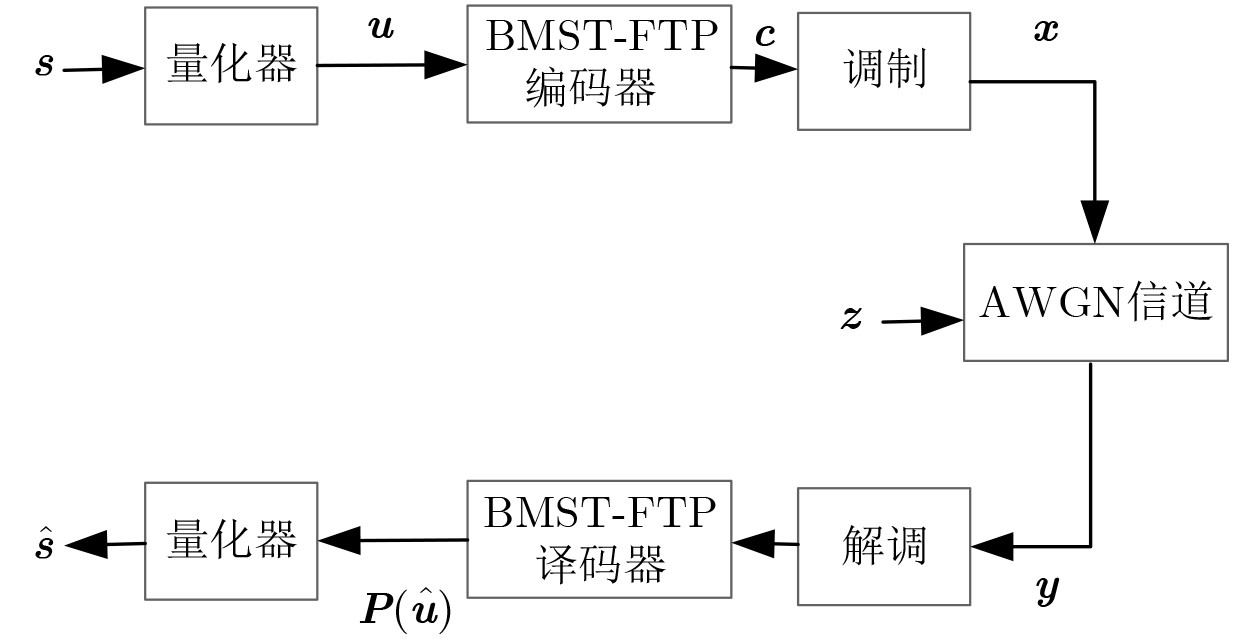
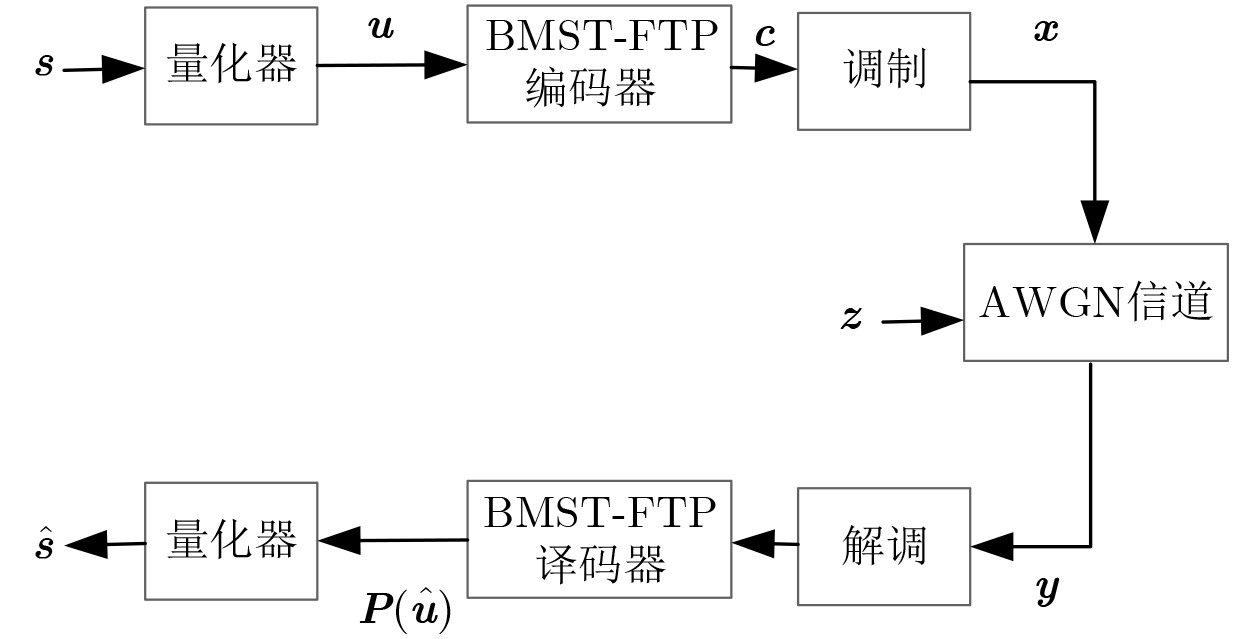
摘要: 该文提出一种面向高斯信源传输的联合信源-信道编码调制方案。在所提方案中,首先采用Lloyd-Max量化器对高斯信源序列进行量化,输出多元符号序列;针对该多元量化符号序列,构造与之匹配的多元傅里叶变换对码,并选取适配的多元脉冲幅度调制完成符号调制。特别地,调制后的多元符号序列采用分组马尔可夫叠加方式实现传输。此外,为进一步获取成形增益,该文提出星座几何成形方案。仿真实验结果表明:(1)可依据目标性能指标选取适配的传输方案;(2)所提几何成形方案能够实现约0.3 dB的误符号性能增益;(3)在高信噪比区域,该几何成形方案具备更优的失真性能。
-
关键词:
- 高斯信源 /
- 傅里叶变换对码 /
- 分组马尔可夫叠加传输 /
- 几何成形
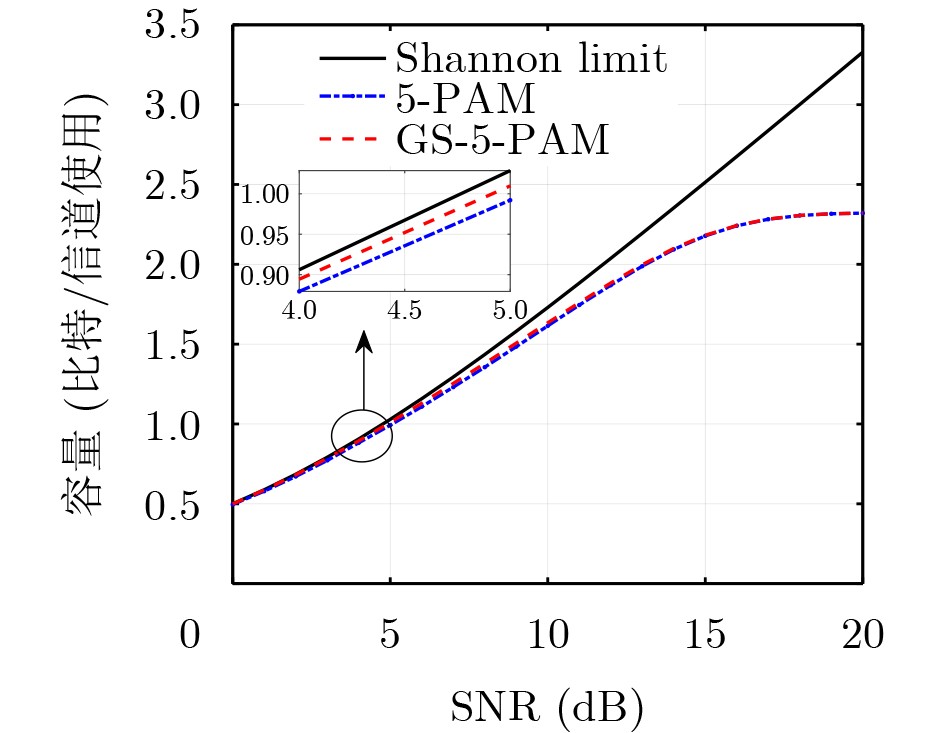
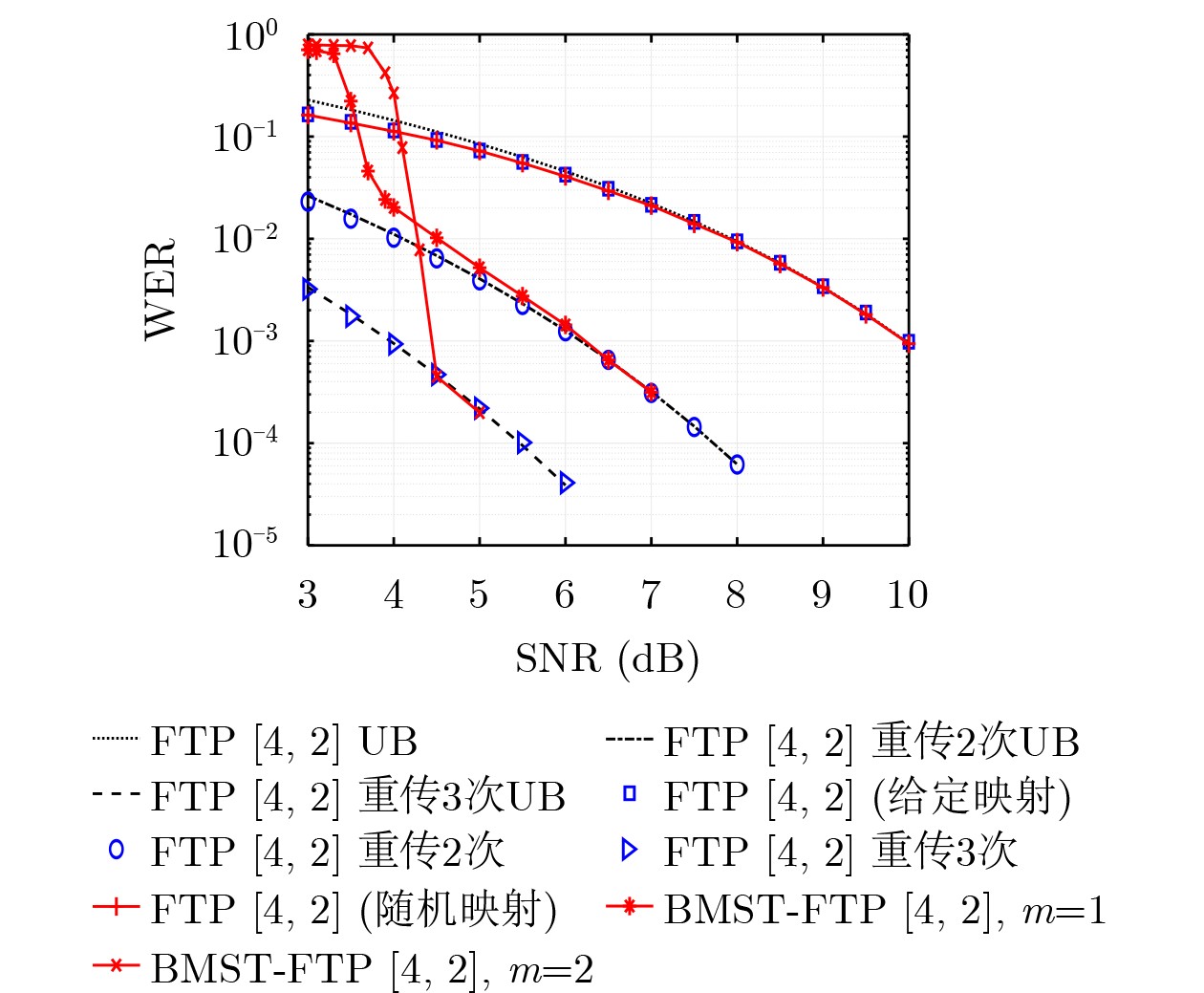
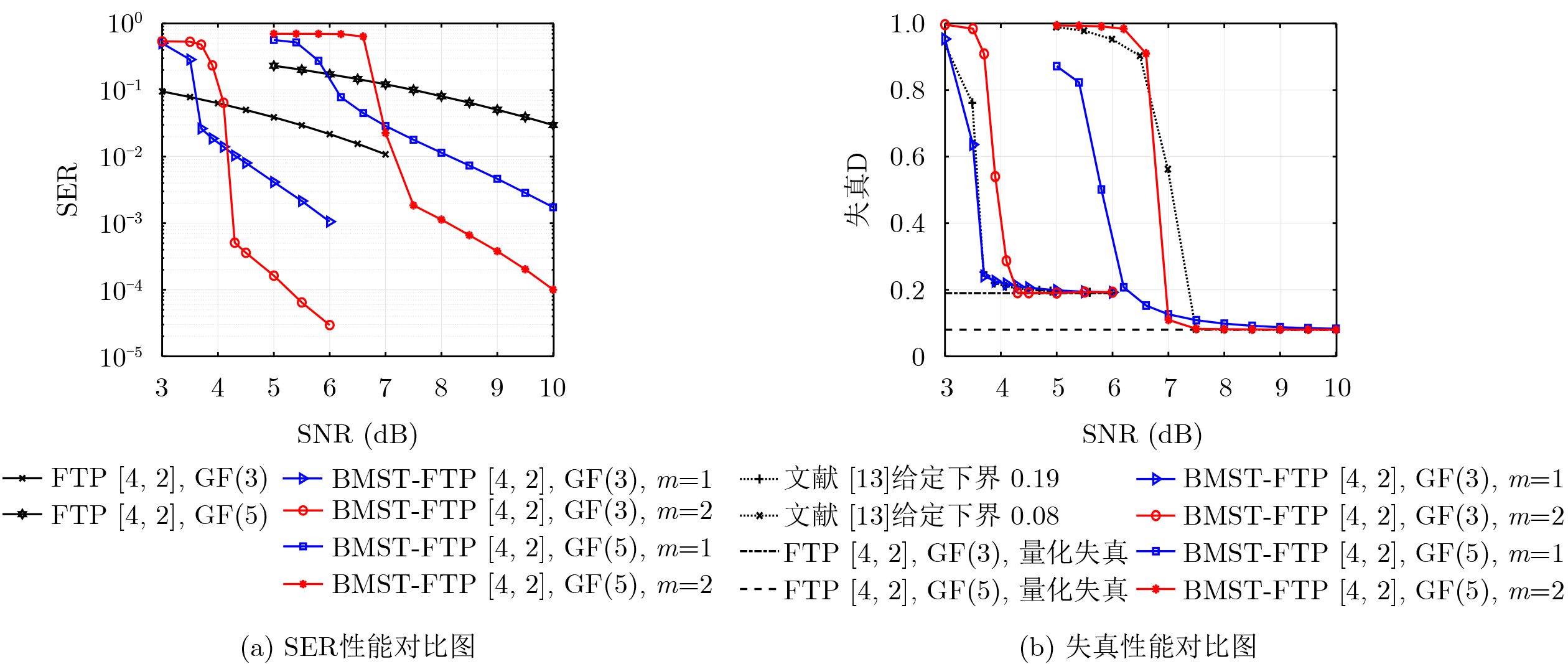
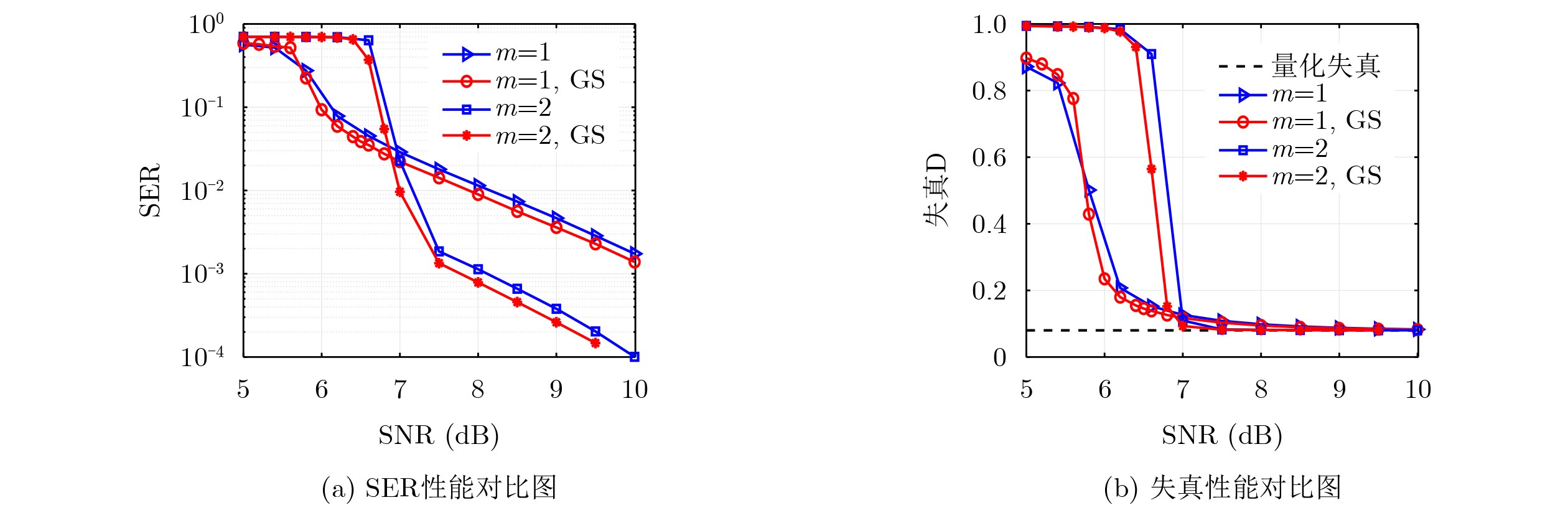
Abstract:Objective The Separated Source-Channel Coding (SSCC) scheme has been proven to incur no performance loss when the source block length tends to infinity. However, SSCC usually requires a large buffer and causes long delay. It may also lead to error propagation when a single symbol error occurs in the communication channel. To alleviate these issues, Joint Source-Channel Coding (JSCC) schemes have been studied for Gaussian source transmission. In this paper, a Joint Source-Channel Coding Modulation (JSCCM) scheme is proposed for Gaussian sources. A Gaussian source reconstruction scheme and its reconstruction expression are also provided. Methods The Gaussian source sequence is quantized into an M-ary symbol sequence by a Lloyd-Max quantizer. For the M-ary quantized symbol sequence, a matching M-ary Fourier Transform Pair (FTP) code is constructed. The corresponding M-ary Pulse Amplitude Modulation (M-PAM) scheme is adopted for modulation. The modulated M-ary symbol sequence is transmitted using Block Markov Superposition Transmission (BMST), forming a BMST-FTP code. In addition, a Geometric Shaping (GS) scheme is proposed to obtain shaping gain. In the proposed source reconstruction scheme, the system output is the weighted average of the representative elements of the Lloyd-Max quantizer, rather than a single representative element. Results and Discussions Simulations are conducted over Additive White Gaussian Noise (AWGN) channels with M-PAM modulation and BMST-FTP codes over Galois Field (GF) orders 3 and 5, denoted GF(3) and GF(5). For FTP codes with random mapping, the Word Error Rate (WER) approaches the Union Bound (UB) at high Signal-to-Noise Ratio (SNR). Similarly, FTP codes with m+1 repeated transmissions show WER performance close to the corresponding UBs. The WER performance of BMST-FTP codes with memory m also approaches the UBs in the high SNR region ( Fig. 6 ). In terms of Symbol Error Rate (SER), the GF(3) BMST-FTP code outperforms the GF(5) BMST-FTP code (Fig. 7(a) ). For the GF(5) BMST-FTP code, GS provides an SER performance gain of approximately 0.3 dB (Fig. 8(a) ). In terms of distortion performance, the GF(3) BMST-FTP code performs better in the low SNR region, whereas the GF(5) BMST-FTP code performs better in the high SNR region (Fig. 7(b) ). Compared with other work, the GF(3) BMST-FTP code with m = 1 achieves similar performance, whereas the GF(5) BMST-FTP code with m = 1 achieves better performance (Fig. 7(b) ).Conclusions This work proposes a JSCCM scheme for Gaussian source transmission. In the proposed scheme, two types of BMST-FTP codes are constructed. Each code is matched with a corresponding Lloyd-Max quantizer and M-PAM modulator. A Gaussian source reconstruction scheme and its reconstruction expression are also provided. Simulation results show that an appropriate transmission scheme can be selected according to the target performance. The proposed GS scheme provides an SER gain of approximately 0.3 dB and improves distortion performance in the waterfall region. -
1 Lloyd-Max量化算法
输入:代表元个数$ M $ 输出:代表元集合$ \boldsymbol{G}$ (1) 初始化:将集合$ \boldsymbol{G} $和大小为$ M $的非空集合$ \boldsymbol{G'} $中的元素随机初始化为不同的数值,初始化$ \varepsilon $。 (2) 迭代:当$ \underset{b\in \mathbf{G}}{\max }\underset{b'\in \mathbf{G}'}{\min }\left|\left|b-b'\right|\right| \gt \varepsilon $时,$ \boldsymbol{G}\rightarrow\boldsymbol{G\mathit{'}} $ (a)根据式(6)计算边界点$ {a}_{i}\left(0\leq i\leq M\right) $; (b)根据式(7)计算代表元$ {b}_{j}\left(0\leq j \lt M\right) $。  下载: 导出CSV
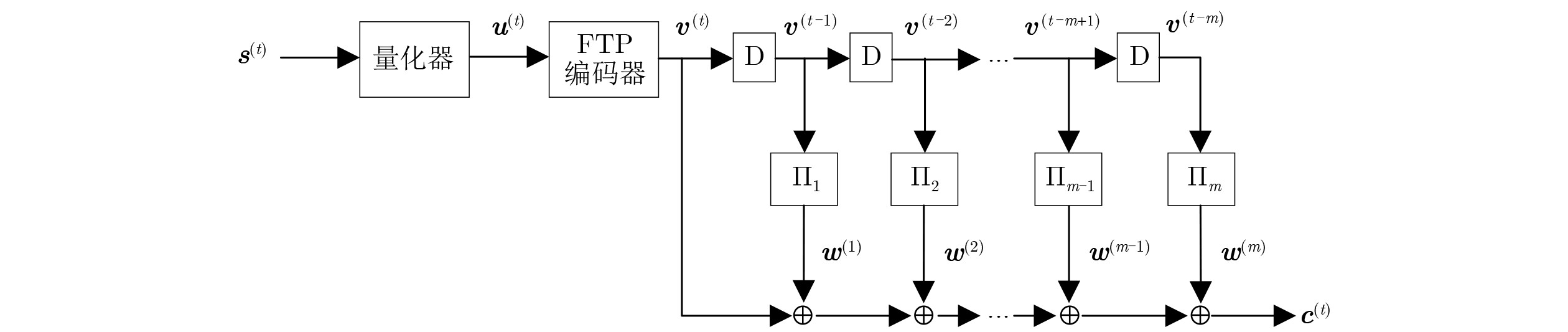
2 多元量化BMST-FTP码的编码算法
输入:$ {\boldsymbol{s}}^{\left(t\right)}\left(0\leq t\leq L-1\right) $ 输出:$ {\boldsymbol{c}}^{\left(t\right)}\left(0\leq t\leq L-1\right) $ (1) 初始化:当$ t \lt 0 $时,令数据块$ {\boldsymbol{u}}^{\left(t\right)}={{\textit{0}}} \in \mathrm{GF}(q) $。 (2) 循环:当$ t=0,1,\cdots ,L-1 $时 (a) 量化高斯信源$ {\boldsymbol{s}}^{\left(t\right)} $得到多元信息序列$ {\boldsymbol{u}}^{\left(t\right)} $; (b) 使用基本码$ {\mathcal{C}}_{\mathrm{FTP}}\left[2n,n\right] $的编码算法对信息序列$ {\boldsymbol{u}}^{\left(t\right)} $编码得到码字$ {\boldsymbol{v}}^{\left(t\right)}\in \mathrm{GF}(q) $; (c) 当$ 1\leq i\leq m $时,码字$ {\boldsymbol{v}}^{\left(t\right)} $经第i个符号交织器$ \displaystyle\prod\nolimits_{i} $交织得到序列$ {\boldsymbol{w}}^{\left(i\right)} $; (d) 计算$ {\boldsymbol{c}}^{\left(t\right)}={\boldsymbol{v}}^{\left(t\right)}+\displaystyle\sum\nolimits_{1\leq i\leq m}{\boldsymbol{w}}^{\left(i\right)} $,得到码字$ {\boldsymbol{c}}^{\left(t\right)} $。 (3) 结尾:当$ t=L,L+1,\cdots ,L+m-1 $时,令$ {\boldsymbol{u}}^{\left(t\right)}={{\textit{0}}} \in \mathrm{GF}(q) $并按照步骤(2)计算$ {\boldsymbol{c}}^{(t)} $。
下载: 导出CSV
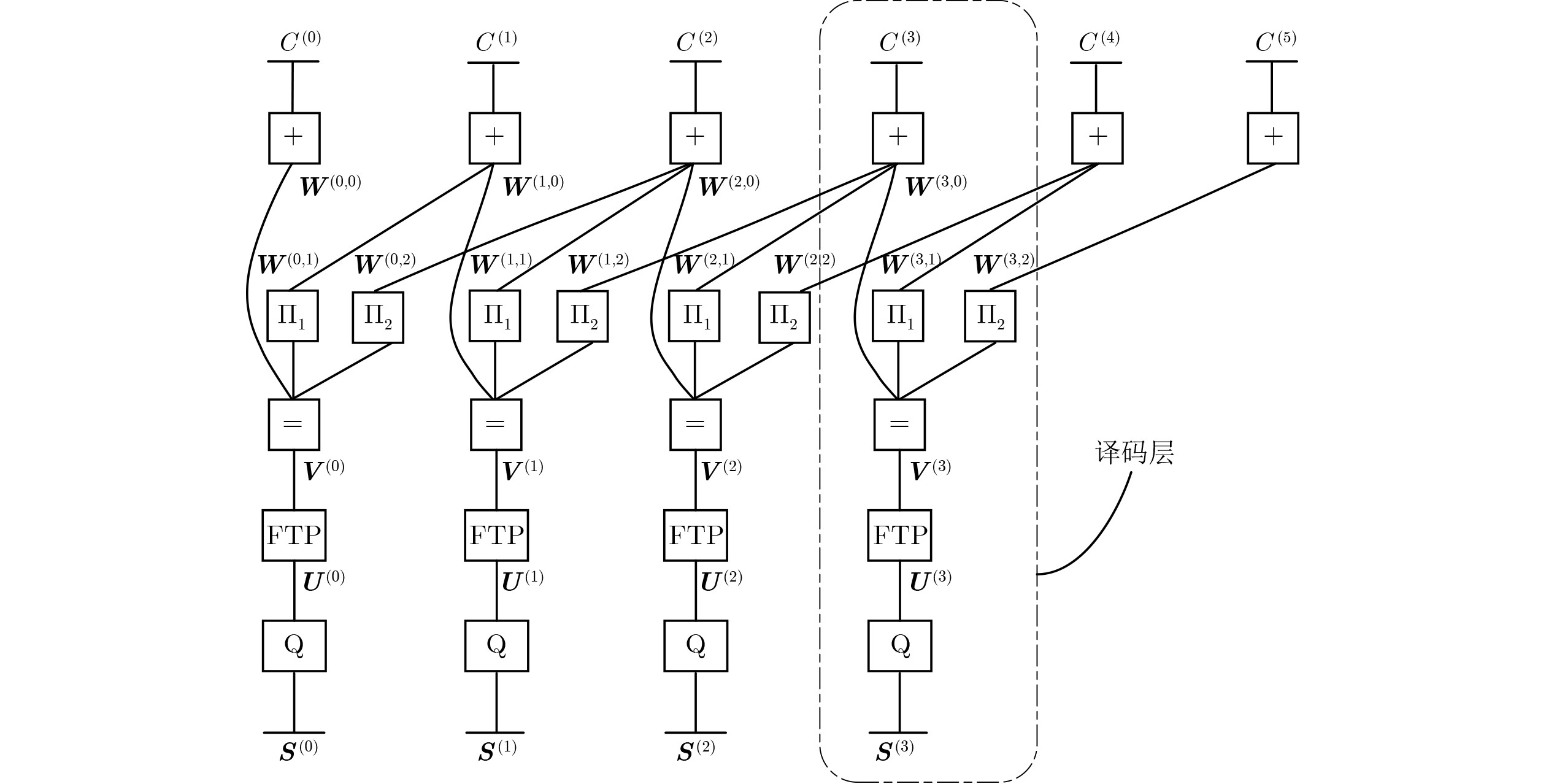
3 多元量化BMST-FTP码的迭代滑窗译码算法
输入:$ {\boldsymbol{y}}^{\left(t\right)}\left(0\leq t\leq L-1\right) $ 输出:$ {\hat{\boldsymbol{s}}}^{(t)}\left(0\leq t\leq L-1\right) $ (1) 全局初始化:假设$ {\boldsymbol{y}}^{\left(t\right)}\left(0\leq t\leq d-1\right) $已接收。只考虑信道约束,对于$ 0\leq t\leq d-1 $,由接收向量$ {\boldsymbol{y}}^{\left(t\right)} $计算后验概率
$ \Pr \left\{C_{j}^{\left(t\right)}=i|{{\boldsymbol{y}}}^{\left(t\right)}\right\}\propto \dfrac{1}{\sqrt{2\text{π} }}\exp \left\{-\dfrac{{\left|\left|y_{j}^{\left(t\right)}-{x}_{i}\right|\right|}^{2}}{2}\right\},i\in \mathrm{GF}(q),{x}_{i}\in \mathcal{X}\left(0\leq j\leq N-1\right) $,与节点$ \boxed{+} $相连的半边上的消息$ P_{C_{j}^{\left(t\right)}}^{\left(|\rightarrow +\right)}\left(k\right) $初
始化为$ \Pr \left\{C_{j}^{\left(t\right)}=k|{{\boldsymbol{y}}}^{\left(t\right)}\right\} $。节点$ \boxed{\text{Q}} $与节点$ \boxed{\text{FTP}} $相连边上的消息初始化为$ P_{u_{j}^{(t)}=i}^{\left(\text{Q}\rightarrow \text{FTP}\right)}=\dfrac{1}{\sqrt{2\text{π} }}\displaystyle\int \nolimits_{{a}_{i}}^{{a}_{i+1}}\exp \left\{-\dfrac{{x}^{2}}{2}\right\}\text{d}x,i\in \mathrm{GF}(q) $。正规图
上连接着第0~$ d-1 $层的其他边上的消息都按照均匀分布进行初始化。设置最大迭代次数$ {I}_{\mathrm{max}} \gt 0 $。(2) 迭代滑窗译码:对于t=0, 1, ···,L–1 (a) 局部初始化:如果$ t+d\leq L+m-1 $,由接收向量$ {\boldsymbol{y}}^{\left(t+d\right)} $计算后验概率$ P_{C_{j}^{\left(t+d\right)}}^{\left(|\rightarrow +\right)}\left(i\right),{x}_{i}\in \mathcal{X},k\in \mathrm{GF}(q) $。与节点$ \boxed{\text{Q}} $与节点$ \boxed{\text{FTP}} $相连
边上的消息初始化为$ P_{u_{j}^{(t)}=i}^{\left(\text{Q}\rightarrow \text{FTP}\right)}=\dfrac{1}{\sqrt{2\text{π} }}\displaystyle\int \nolimits_{{a}_{i}}^{{a}_{i+1}}\exp \left\{-\dfrac{{x}^{2}}{2}\right\}\text{d}x,i\in \mathrm{GF}(q) $。正规图上连接着第$ t+d $层的其他边上的消息都按照均匀分布
进行初始化。
(b) 迭代:对于$ I=1,2,\cdots,I_{\text{max}} $ ① 前向递归:对于$ i=0,1,\cdots ,\min \left(d,L+m-1-t\right) $,在正规图的第$ t+i $层按以下顺序执行消息传递算法。 $ \boxed{+}\rightarrow \boxed{\prod }\rightarrow \boxed{=}\rightarrow \boxed{\text{FTP}}\rightarrow \boxed{=}\rightarrow \boxed{\prod }\rightarrow \boxed{+} $ ② 后向递归:对于$ i=0,1,\cdots ,\min \left(d,L+m-1-t\right) $,在正规图的第$ t+i $层按以下顺序执行消息传递算法。 $ \boxed{+}\rightarrow \boxed{\prod }\rightarrow \boxed{=}\rightarrow \boxed{\text{FTP}}\rightarrow \boxed{=}\rightarrow \boxed{\prod }\rightarrow \boxed{+} $ ③ 硬判决和提前终止:对$ {\boldsymbol{U}}^{\left(t\right)} $的消息进行硬判决,得到高斯信源量化值的估计$ {\hat{\boldsymbol{u}}}^{(t)} $。如果满足熵终止条件[19],则把$ {\hat{\boldsymbol{u}}}^{(t)} $作为高斯信源
量化值的结果并退出迭代。(3) 解量化:根据$ {\boldsymbol{U}}^{\left(t\right)} $的外信息和公式(8)计算高斯信源的重构$ {\hat{\boldsymbol{s}}}^{(t)} $,并把$ {\hat{\boldsymbol{s}}}^{(t)} $作为结果输出。
下载: 导出CSV
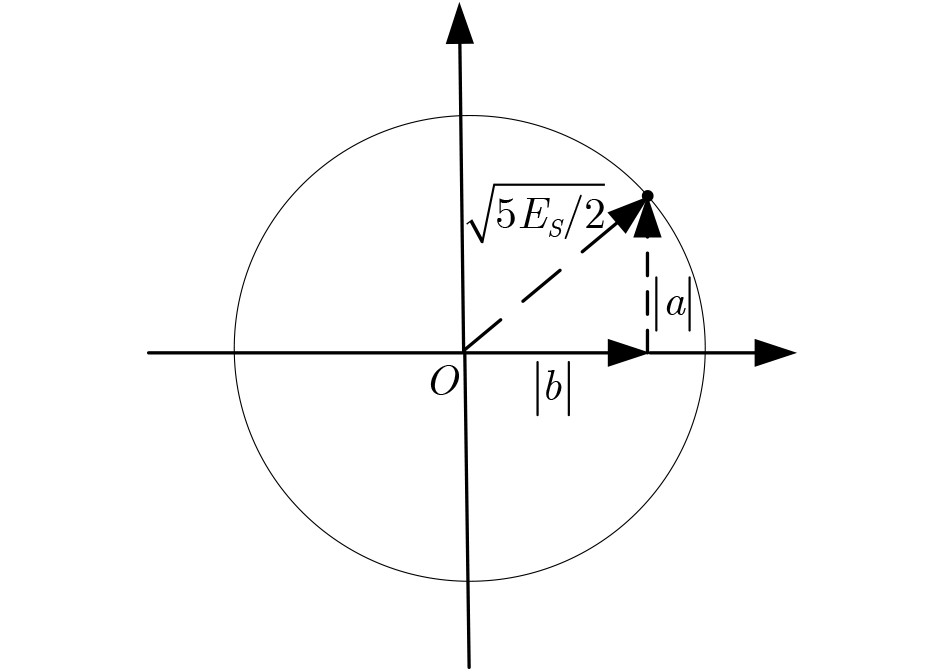
表 1 不同SNR下GS-5-PAM 星座集、归一化星座集和互信息
SNR (dB) 星座能量 星座集${\boldsymbol{\chi}}_{\mathrm{GS}} $ 归一化星座集 互信息 3 2.00 ±2.1762, ±0.5024, 0 ±1.5406, ±0.3557, 0 0.7852 4 2.51 ±2.4206, ±0.6486, 0 ±1.5273, ±0.4092, 0 0.8944 5 3.16 ±2.7028, ±0.7750, 0 ±1.5199, ±0.4358, 0 1.0098 6 3.98 ±2.9829, ±1.0271, 0 ±1.4950, ±0.5148, 0 1.1299 7 5.01 ±3.3469, ±1.1524, 0 ±1.4950, ±0.5148, 0 1.2539 8 6.31 ±3.7079, ±1.4233, 0 ±1.4761, ±0.5666, 0 1.3792 9 7.94 ±4.1603, ±1.5970, 0 ±1.4761, ±0.5666, 0 1.5064 10 10.00 ±4.6359, ±1.8730, 0 ±1.4660, ±0.5923, 0 1.6339
下载: 导出CSV
-
[1] LIU Yi, YUAN Xingliang, XIONG Zehui, et al. Federated learning for 6G communications: Challenges, methods, and future directions[J]. China Communications, 2020, 17(9): 105–118. doi: 10.23919/jcc.2020.09.009. [2] ZHENG Sihui, SHEN Cong, and CHEN Xiang. Design and analysis of uplink and downlink communications for federated learning[J]. IEEE Journal on Selected Areas in Communications, 2021, 39(7): 2150–2167. doi: 10.1109/JSAC.2020.3041388. [3] BURSALIOGLU O Y, CAIRE G, and DIVSALAR D. Joint source-channel coding for deep-space image transmission using rateless codes[J]. IEEE Transactions on Communications, 2013, 61(8): 3448–3461. doi: 10.1109/TCOMM.2013.061913.120747. [4] CHRAITI M and ERCETIN O. Perceptual lossy compression rate for two correlated Gaussian sources[J]. IEEE Communications Letters, 2025, 29(10): 2336–2340. doi: 10.1109/LCOMM.2025.3594598. [5] LI Yishen, CHEN Xuechen, and DENG Xiaoheng. Joint source-channel coding for a multivariate Gaussian over a Gaussian MAC using variational domain adaptation[J]. IEEE Transactions on Cognitive Communications and Networking, 2023, 9(6): 1424–1437. doi: 10.1109/TCCN.2023.3294754. [6] SHANNON C E. A mathematical theory of communication[J]. ACM SIGMOBILE Mobile Computing and Communications Review, 2001, 5(1): 3–55. doi: 10.1145/584091.584093. [7] DAVISSON L. Rate distortion theory: A mathematical basis for data compression[J]. IEEE Transactions on Communications, 1972, 20(6): 1202–1202. doi: 10.1109/tcom.1972.1091311. [8] 段建新, 张天赐, 陈正川, 等. 有限码长信源编码下联合提升无线物联系统信息时效性与保真度[J]. 电子与信息学报, 2026, 48(5): 2102–2112. doi: 10.11999/JEIT251057.DUAN Jianxin, ZHANG Tianci, CHEN Zhengchuan, et al. Jointly improving information timeliness and fidelity under finite-blocklength source coding in a wireless IOT system[J]. Journal of Electronics & Information Technology, 2026, 48(5): 2102–2112. doi: 10.11999/JEIT251057. [9] YEH P S and MILLER W H. Application guide for universal source encoding for space[R]. NASA Technical Paper 3441, 1993. [10] FRESIA M, PERÉZ-CRUZ F, POOR H V, et al. Joint source and channel coding[J]. IEEE Signal Processing Magazine, 2010, 27(6): 104–113. doi: 10.1109/MSP.2010.938080. [11] 包涵, 凃国防, 张灿, 等. 基于可变长纠错码和掺杂调制的联合信源信道编码调制方法[J]. 电子与信息学报, 2023, 45(6): 2045–2053. doi: 10.11999/JEIT220531.BAO Han, TU Guofang, ZHANG Can, et al. Joint source-channel code modulation scheme based on variable-length error-correct code and doping modulation[J]. Journal of Electronics & Information Technology, 2023, 45(6): 2045–2053. doi: 10.11999/JEIT220531. [12] GAO Yang and TUNCEL E. New hybrid digital/analog schemes for transmission of a Gaussian source over a Gaussian channel[J]. IEEE Transactions on Information Theory, 2010, 56(12): 6014–6019. doi: 10.1109/TIT.2010.2081112. [13] ZHAO Shancheng and MA Xiao. Partially block Markov superposition transmission of a Gaussian source with nested lattice codes[J]. IEEE Transactions on Communications, 2016, 64(12): 5217–5226. doi: 10.1109/TCOMM.2016.2611670. [14] YANG Zheng, ZHAO Shancheng, MA Xiao, et al. A new joint source-channel coding scheme based on nested lattice codes[J]. IEEE Communications Letters, 2012, 16(5): 730–733. doi: 10.1109/LCOMM.2012.031912.120151. [15] LIANG Jifan, ZHU Tingting, WEI Baodian, et al. A new JSCC scheme for transmission of Gaussian sources over AWGN channels[C]. 2023 IEEE/CIC International Conference on Communications in China, Dalian, China, 2023: 1–6. doi: 10.1109/ICCC57788.2023.10233613. [16] WU Qiaoqiao, JI Meiying, SUN Jiachen, et al. Transmission of Gaussian source using ternary convolutional low density generator matrix codes[C]. 2018 IEEE International Conference on Communication Systems, Chengdu, China, 2018: 231–235. doi: 10.1109/ICCS.2018.8689170. [17] LLOYD S. Least squares quantization in PCM[J]. IEEE Transactions on Information Theory, 1982, 28(2): 129–137. doi: 10.1109/TIT.1982.1056489. [18] MA Xiao, CHEN Dian, and LV Yaping. Block Markov superposition transmission of Fourier transform pair codes[C]. 2022 14th International Conference on Wireless Communications and Signal Processing, Nanjing, China, 2022: 378–382. doi: 10.1109/WCSP55476.2022.10039295. [19] MA Xiao, LIANG Chulong, HUANG Kechao, et al. Block Markov superposition transmission: Construction of big convolutional codes from short codes[J]. IEEE Transactions on Information Theory, 2015, 61(6): 3150–3163. doi: 10.1109/TIT.2015.2422296. [20] STEINER F and BÖCHERER G. Comparison of geometric and probabilistic shaping with application to ATSC 3.0[C]. 2017 11th International ITG Conference on Systems, Communications and Coding, Hamburg, Germany, 2017: 1–6. [21] BOUTROS J J, EREZ U, VAN WONTERGHEM J, et al. Geometric shaping: Low-density coding of Gaussian-like constellations[C]. 2018 IEEE Information Theory Workshop, Guangzhou, China, 2018: 1–5. doi: 10.1109/ITW.2018.8613506. [22] KÖKEN E, GÜNDÜZ D, and TUNCEL E. Energy-distortion exponents in lossy transmission of Gaussian sources over Gaussian channels[J]. IEEE Transactions on Information Theory, 2017, 63(2): 1227–1236. doi: 10.1109/tit.2016.2634578. [23] WANG Qianfan, CAI Suihua, LIN Wenchao, et al. Spatially coupled LDPC codes via partial superposition and their application to HARQ[J]. IEEE Transactions on Vehicular Technology, 2021, 70(4): 3493–3504. doi: 10.1109/TVT.2021.3065052. [24] WANG Qianfan, CAI Suihua, LIN Wenchao, et al. Spatially coupled LDPC codes via partial superposition[C]. 2019 IEEE International Symposium on Information Theory, Paris, France, 2019: 2614–2618. doi: 10.1109/ISIT.2019.8849384. [25] FORNEY G D. Codes on graphs: Normal realizations[J]. IEEE Transactions on Information Theory, 2001, 47(2): 520–548. doi: 10.1109/18.910573. [26] ZHUANG Qiutao, MA Xiao, and KAVCIC A. Bounds on the ML decoding error probability of RS-coded modulation over AWGN channels[J]. arXiv preprint arXiv: 1401.5305, 2014. -

 下载:
下载:

图(8) / 表(4)
计量
- 文章访问数: 443
- HTML全文浏览量: 172
- PDF下载量: 57
- 被引次数: 0
