




A Spatiotemporal Coupling Traffic Flow Prediction Model with Dynamic Graph Recursion and State Space
-
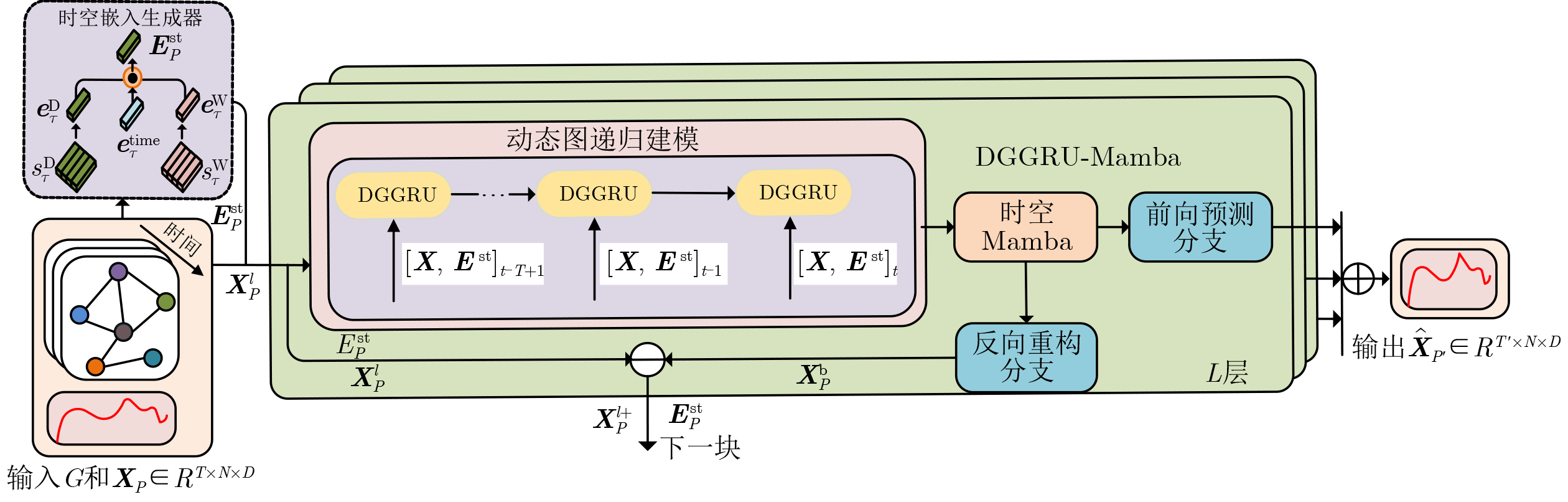
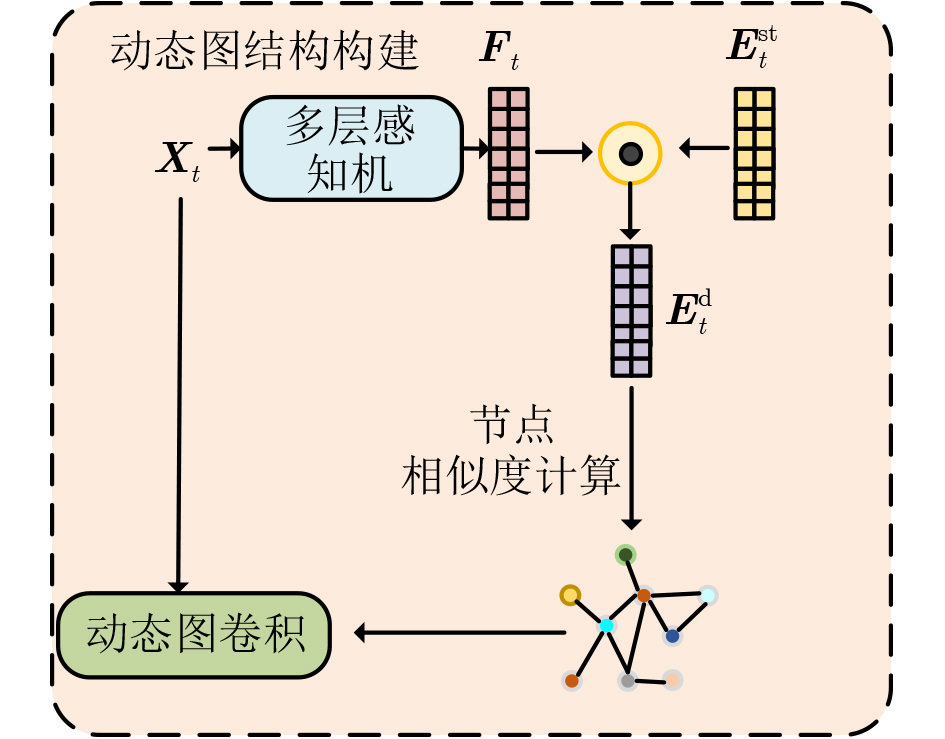
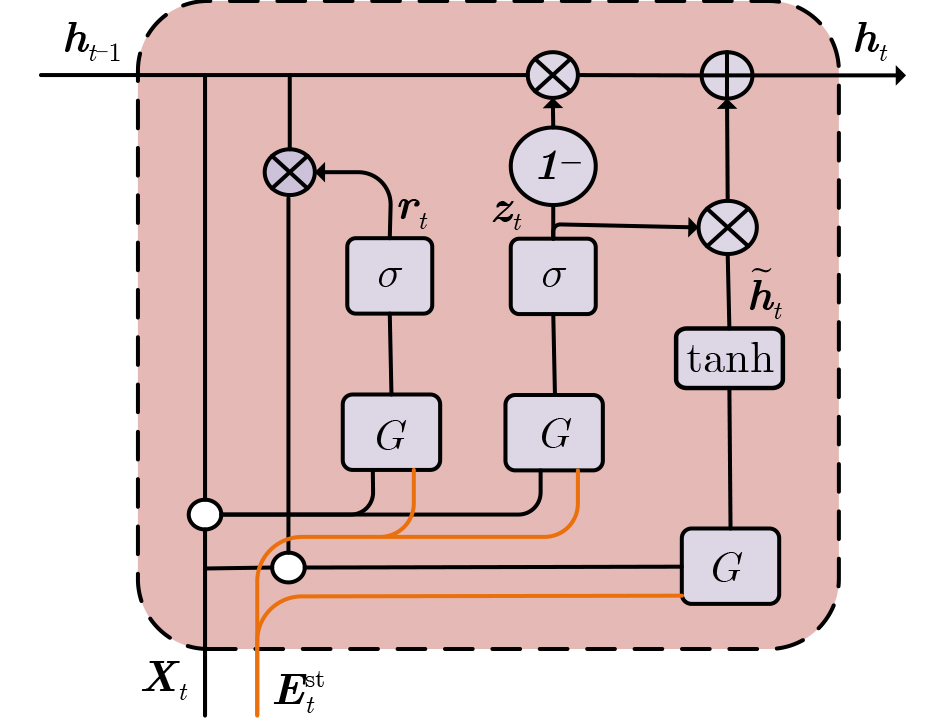
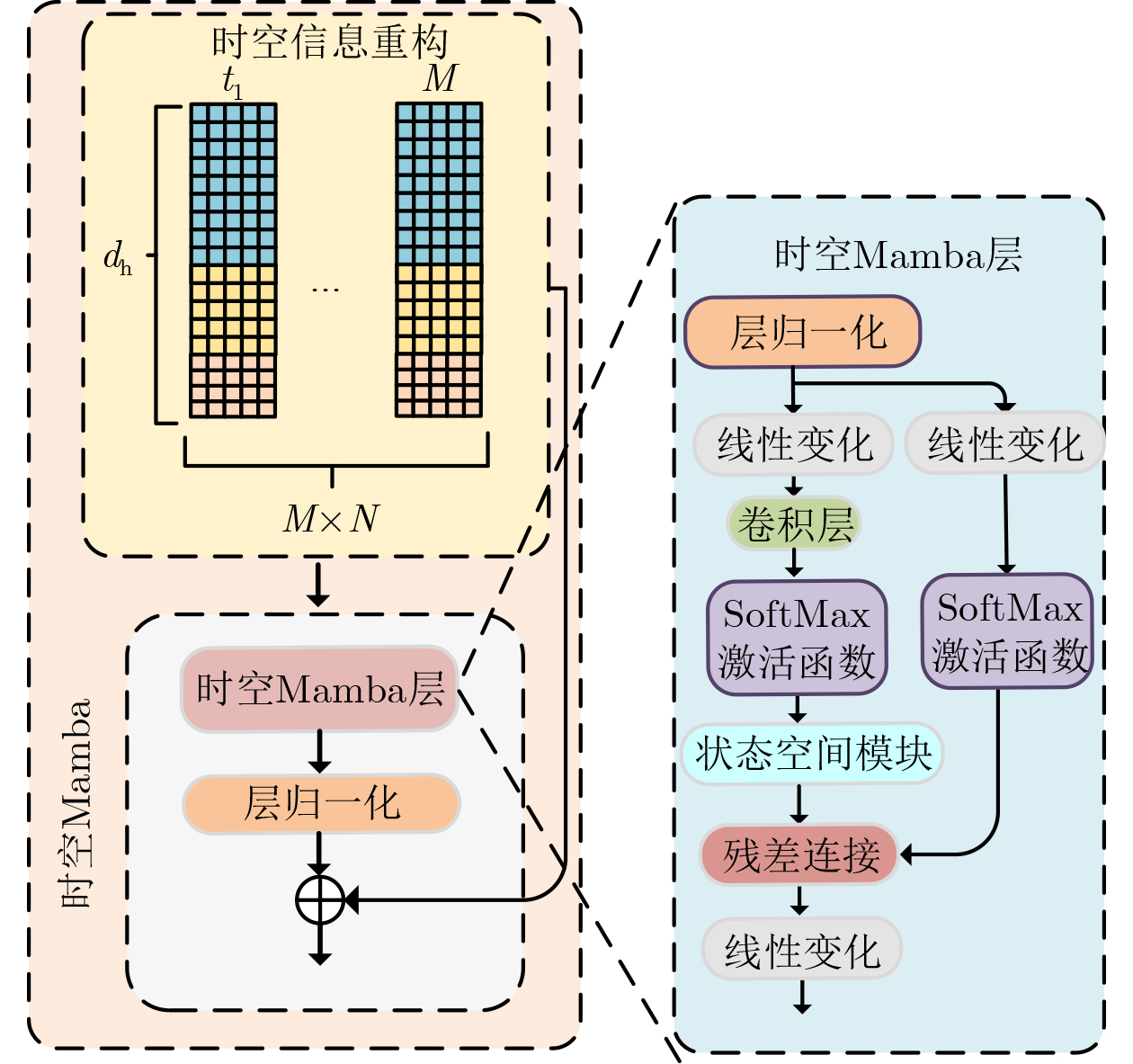
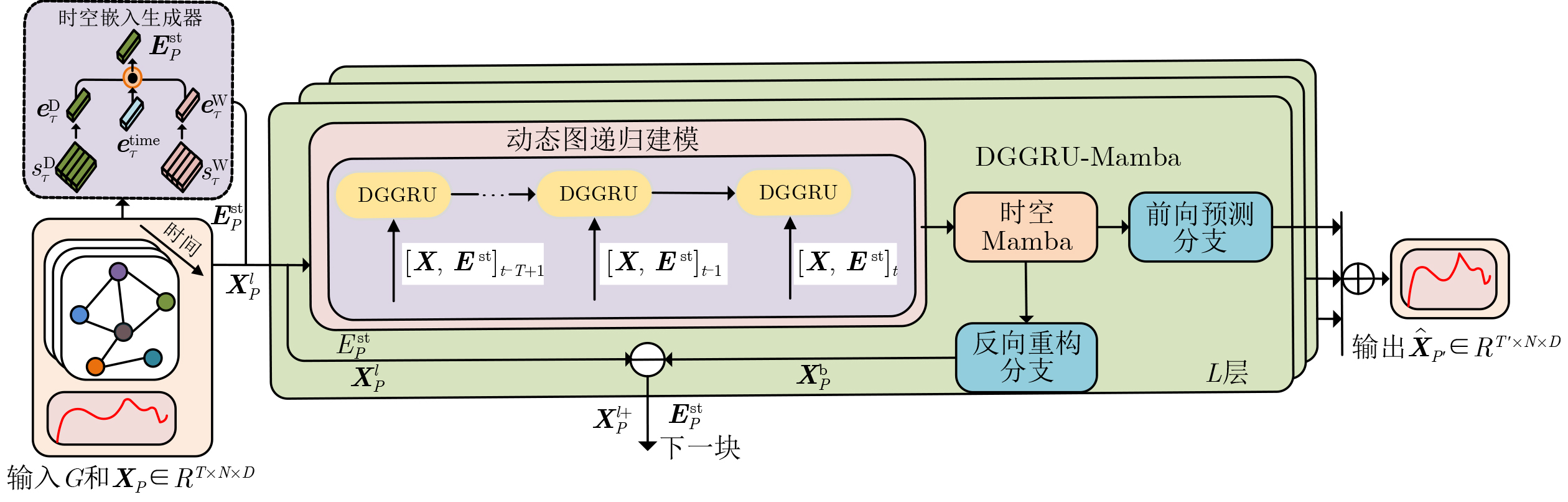
摘要: 准确的交通流预测是智能交通系统中的关键任务,其核心挑战在于如何有效捕捉城市路网中动态演化的空间结构以及复杂的时空相关关系。针对现有方法在建模交通路网的动态关联时难以自适应捕捉路网空间依赖特征,对空间特征表征能力有限且计算效率低等问题,该文提出一种融合动态图递归与状态空间的时空交通流预测模型(DGGRU-Mamba)。该模型构建了时空嵌入生成器,将节点的空间位置信息与周期性时间特征联合编码,以增强图结构对交通流时间特征的感知能力;设计了动态图递归建模(DGRM),通过多层动态图门控递归单元(DGGRU)动态构建邻接关系,捕捉路网交通状态演变引发的空间依赖性;建立了基于结构化状态转移机制的时空Mamba(ST-Mamba),实现交通流的全局时序建模,在提升建模能力的同时降低计算开销。相较主流自注意力模型STAEformer,所提模型在PEMS04数据集上的MAE, RMSE和MAPE分别降低约2.5%, 1.2%和2.1%,同时推理时间缩短约4.84 s,在提升预测精度的同时提高了计算效率。Abstract:
Objective Accurate traffic flow prediction is a key task in intelligent transportation systems. However, it remains challenging to capture dynamically evolving spatial structures and complex spatiotemporal dependencies in urban road networks. To address these issues, this paper proposes DGGRU-Mamba, a spatiotemporal traffic flow prediction framework that integrates dynamic graph recurrent modeling with a structured state space mechanism. The model jointly captures dynamic spatial dependencies and long-range temporal dependencies. Methods DGGRU-Mamba contains two core modules: Dynamic Graph Recurrent Modeling (DGRM) and Spatiotemporal Mamba (ST-Mamba). A spatiotemporal embedding generator is first designed to jointly encode periodic temporal information and node-specific spatial features, thereby supporting adaptive graph construction. DGRM dynamically updates time-varying adjacency structures through Dynamic Graph Gated Recurrent Units (DGGRUs), which enables adaptive modeling of evolving spatial dependencies. ST-Mamba uses structured state transitions to efficiently capture long-range temporal dependencies. In addition, a dual-branch prediction scheme with Forecast and Backcast branches is used to improve multi-step prediction accuracy and reduce cumulative errors. Results and Discussions DGGRU-Mamba is evaluated on four benchmark datasets, namely PEMS03, PEMS04, PEMS07, and PEMS08. Mean Absolute Error (MAE), Root Mean Square Error (RMSE), and Mean Absolute Percentage Error (MAPE) are used as evaluation metrics. Experimental results show that DGGRU-Mamba achieves strong performance on all datasets. On PEMS04, compared with the mainstream attention-based model STAEformer, DGGRU-Mamba reduces MAE, RMSE, and MAPE by approximately 4.2%, 3.8%, and 2.9%, respectively. Its inference time is also shortened by 4.82 s. These results indicate that the proposed framework improves prediction accuracy while maintaining high computational efficiency. The performance gains mainly arise from the complementary effects of DGRM and ST-Mamba, which strengthen dynamic spatial dependency modeling and long-range temporal dependency learning with lower computational cost. Conclusions This paper proposes DGGRU-Mamba, a spatiotemporal traffic flow prediction framework for modeling dynamic spatial structures and long-range temporal dependencies in complex traffic networks. By integrating dynamic graph recurrent modeling with a structured state space mechanism, the framework achieves a favorable balance between prediction accuracy and computational efficiency. Experiments on multiple benchmark datasets verify its effectiveness and scalability in multi-step traffic flow prediction. Future work will consider external factors, such as weather and traffic events, to further improve its applicability in real traffic scenarios. -
表 1 数据集详细信息
数据集 节点 时间跨度 Samples 步长(min) 类型 PEMS03 358 2018.09 ~2018.11 26208 5 流量 PEMS04 307 2018.01 ~2018.02 16992 5 流量 PEMS07 883 2017.05 ~2017.08 28224 5 流量 PEMS08 170 2016.07 ~2016.08 17856 5 流量  下载: 导出CSV
表 2 对比实验
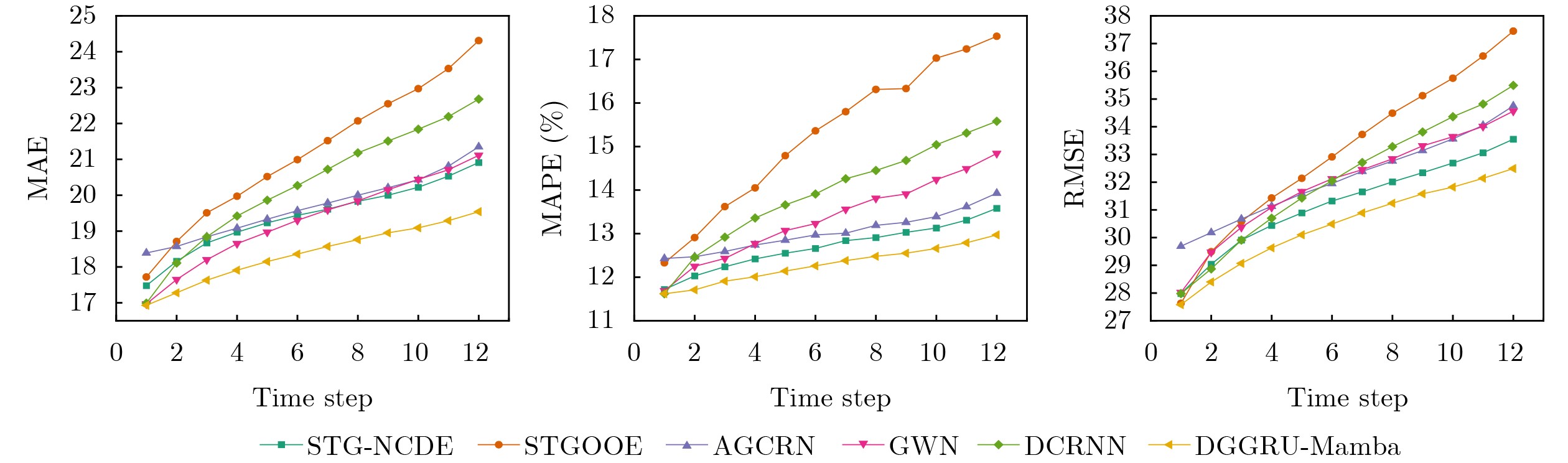
模型 PEMS03 PEMS04 PEMS07 PEMS08 MAE RMSE MAPE(%) MAE RMSE MAPE(%) MAE RMSE MAPE(%) MAE RMSE MAPE(%) STGCN 17.55 30.42 17.34 21.16 34.89 13.83 25.33 39.34 11.21 17.50 27.09 11.29 AGCRN 15.98 28.25 15.23 19.27 32.26 12.92 22.27 36.55 9.12 19.05 25.22 9.54 DCRNN 17.99 30.31 18.34 21.22 33.44 14.17 25.22 38.61 11.82 16.82 26.36 10.92 GWN 19.12 32.77 18.89 24.89 39.66 17.29 26.39 41.50 11.97 18.28 30.05 12.15 STG-NCDE 15.59 26.68 14.99 19.42 31.34 12.98 20.78 35.00 8.95 16.34 25.51 10.26 STGOOE 15.56 26.64 14.96 18.91 30.32 12.91 20.32 35.43 8.90 16.34 25.44 10.58 ASTGCN(r) 17.34 29.56 17.21 22.92 35.22 16.56 24.01 37.87 10.73 18.25 28.06 11.64 STNorm 15.32 25.93 14.37 18.96 30.98 12.69 20.50 34.66 8.75 15.41 24.77 9.76 GMAN 16.87 27.92 18.23 19.14 31.60 13.19 20.97 34.10 9.05 15.31 24.92 10.13 STAEformer 15.05 25.55 14.91 18.85 30.85 12.55 20.25 34.20 8.65 15.10 24.50 9.92 PDFormer 14.85 25.35 14.75 18.65 30.70 12.45 20.05 33.95 8.55 14.91 24.20 9.75 DGGRU-Mamba 14.57 25.06 14.61 18.37 30.49 12.29 19.75 33.40 8.31 14.51 23.86 9.45
下载: 导出CSV
表 3 消融实验
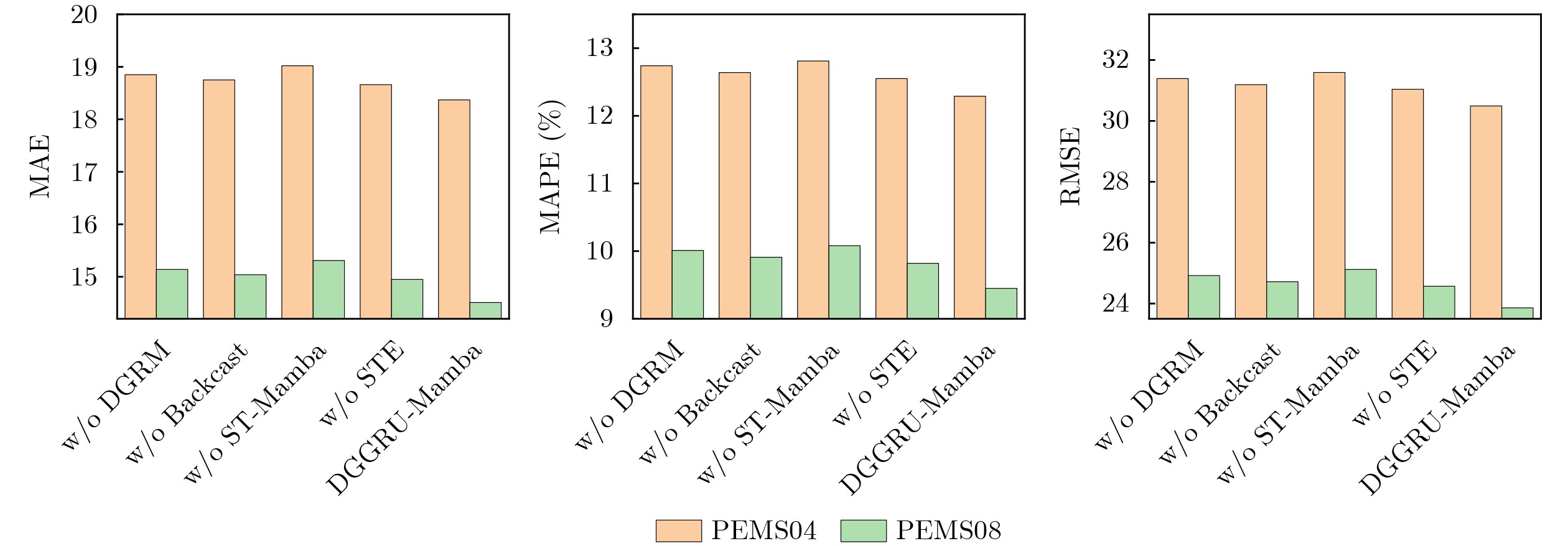
模型 PEMS04 PEMS08 MAE RMSE MAPE(%) MAE RMSE MAPE(%) w/o DGRM 18.85 31.39 12.74 15.14 24.92 10.01 w/o Backcast 18.75 31.19 12.64 15.04 24.72 9.91 w/o ST-Mamba 19.02 31.59 12.81 15.31 25.12 10.08 w/o STE 18.66 31.04 12.55 14.95 24.57 9.82 DGGRU-Mamba 18.37 30.49 12.29 14.51 23.86 9.45
下载: 导出CSV
表 4 训练与推理时间
数据、时间、模型 STG-NCDE STSGCN AGCRN STGODE GWN STAEformer PDFormer DGGRU-Mamba PEMS04 训练时间(s/轮) 118.6 181.9 6.5 35.2 32.18 92.61 108.32 21.37 推理时间(s) 12.28 4.63 1.12 4.08 3.37 6.42 7.08 1.58 PEMS08 训练时间(s/轮) 43.2 61.28 3.9 22.3 10.64 74.22 86.85 17.99 推理时间(s) 4.3 12.4 0.5 2.1 1.2 5.1 5.8 1.7
下载: 导出CSV
-
[1] 张红, 伊敏, 张玺君, 等. 长期Transformer和自适应傅里叶变换的动态图卷积交通流预测研究[J]. 电子与信息学报, 2025, 47(7): 2249–2262. doi: 10.11999/JEIT241076.ZHANG Hong, YI Min, ZHANG Xijun, et al. Long-term Transformer and adaptive Fourier transform for dynamic graph convolutional traffic flow prediction study[J]. Journal of Electronics & Information Technology, 2025, 47(7): 2249–2262. doi: 10.11999/JEIT241076. [2] 智慧, 段苗苗, 杨利霞, 等. 一种基于区块链和联邦学习融合的交通流预测方法[J]. 电子与信息学报, 2024, 46(9): 3777–3787. doi: 10.11999/JEIT240030.ZHI Hui, DUAN Miaomiao, YANG Lixia, et al. A traffic flow prediction method based on the fusion of blockchain and federated learning[J]. Journal of Electronics & Information Technology, 2024, 46(9): 3777–3787. doi: 10.11999/JEIT240030. [3] 殷礼胜, 刘攀, 孙双晨, 等. 基于互补集合经验模态分解和改进麻雀搜索算法优化双向门控循环单元的交通流组合预测模型[J]. 电子与信息学报, 2023, 45(12): 4499–4508. doi: 10.11999/JEIT221172.YIN Lisheng, LIU Pan, SUN Shuangchen, et al. Traffic flow combined prediction model based on complementary ensemble empirical mode decomposition and bidirectional gated recurrent unit optimized by improved sparrow search algorithm[J]. Journal of Electronics & Information Technology, 2023, 45(12): 4499–4508. doi: 10.11999/JEIT221172. [4] ZHANG Qingyong, LI Changwu, SU Fuwen, et al. Spatiotemporal residual graph attention network for traffic flow forecasting[J]. IEEE Internet of Things Journal, 2023, 10(13): 11518–11532. doi: 10.1109/JIOT.2023.3243122. [5] LI Biyue, LI Zhishuai, CHEN Jun, et al. MAST-GNN: A multimodal adaptive spatio-temporal graph neural network for airspace complexity prediction[J]. Transportation Research Part C: Emerging Technologies, 2024, 160: 104521. doi: 10.1016/j.trc.2024.104521. [6] LI Zhuolin, ZHANG Gaowei, YU Jie, et al. Dynamic graph structure learning for multivariate time series forecasting[J]. Pattern Recognition, 2023, 138: 109423. doi: 10.1016/j.patcog.2023.109423. [7] WU Di, PENG Kai, WANG Shangguang, et al. Spatial–temporal graph attention gated recurrent transformer network for traffic flow forecasting[J]. IEEE Internet of Things Journal, 2024, 11(8): 14267–14281. doi: 10.1109/JIOT.2023.3340182. [8] LIU Shipeng and WANG Xingjian. An improved transformer based traffic flow prediction model[J]. Scientific Reports, 2025, 15(1): 8284. doi: 10.1038/s41598-025-92425-7. [9] SHAO Zhiqi, WANG Ze, YAO Xusheng, et al. ST-MambaSync: Complement the power of mamba and transformer fusion for less computational cost in spatial-temporal traffic forecasting[J]. Information Fusion, 2025, 117: 102872. doi: 10.1016/j.inffus.2024.102872. [10] LI Yaguang, YU R, SHAHABI C, et al. Diffusion convolutional recurrent neural network: Data-driven traffic forecasting[C]. The 6th International Conference on Learning Representations, Vancouver, Canada, 2018: 1–16. [11] GUO Shengnan, LIN Youfang, FENG Ning, et al. Attention based spatial-temporal graph convolutional networks for traffic flow forecasting[C]. The 33rd AAAI Conference on Artificial Intelligence, Honolulu, USA, 2019: 922–929. doi: 10.1609/aaai.v33i01.3301922. [12] YE Yaqin, XIAO Yue, ZHOU Yuxuan, et al. Dynamic multi-graph neural network for traffic flow prediction incorporating traffic accidents[J]. Expert Systems with Applications, 2023, 234: 121101. doi: 10.1016/j.eswa.2023.121101. [13] ZHENG Chuanpan, FAN Xiaoliang, WANG Cheng, et al. GMAN: A graph multi-attention network for traffic prediction[C]. The 34th AAAI Conference on Artificial Intelligence, New York, USA, 2020: 1234–1241. doi: 10.1609/aaai.v34i01.5477. [14] DENG Jinliang, CHEN Xiusi, JIANG Renhe, et al. ST-norm: Spatial and temporal normalization for multi-variate time series forecasting[C]. The 27th ACM SIGKDD Conference on Knowledge Discovery & Data Mining, Singapore, 2021: 269–278. doi: 10.1145/3447548.3467330. [15] SHAO Zhiqi, BELL M G H, WANG Ze, et al. St-mamba: Spatial-temporal selective state space model for traffic flow prediction[EB/OL]. https://arxiv.org/abs/2404.13257, 2024. [16] CHOI J, KIM H, AN M, et al. SpoT-mamba: Learning long-range dependency on spatio-temporal graphs with selective state spaces[C]. The 3rd International Workshop on Spatio-Temporal Reasoning and Learning (STRL 2024) co-located with the 33rd International Joint Conference on Artificial Intelligence, Jeju island, Korea, 2024. -

 下载:
下载:

图(8) / 表(4)
计量
- 文章访问数: 902
- HTML全文浏览量: 502
- PDF下载量: 95
- 被引次数: 0
