




Conditional Generative Adversarial Network-Based Channel Estimation for RIS-Assisted ISAC System
-
摘要: 通感一体化(ISAC)技术作为未来无线通信发展的关键趋势,旨在通过频谱资源的高效利用,实现通信与感知功能的融合与协同。当智能反射表面(RIS)被引入ISAC系统后,可重构无线传播环境,从而显著提升通信质量及感知精度。然而,准确的信道估计对于保障可靠运行是至关重要的。尽管传统的深度学习方法在一定程度上能够应对信道估计问题,但在面对多用户复杂信道环境时,其泛化能力和估计精度仍存在不足。针对上述问题,该文对于RIS辅助多用户ISAC系统提出一种基于条件生成对抗网络(CGAN)的两阶段信道估计方法。该方法通过调整RIS的开关状态,分阶段完成对直射信道与反射信道的估计,以提高信道估计的准确性和稳定性。通过生成网络与判别网络的对抗训练,不仅能够学习观测信号与真实信道之间的映射关系,还能根据判别网络的反馈来不断优化输出,从而有效提升训练效率与估计精度。仿真结果表明,与传统深度学习方法相比,所提基于CGAN的方案在信道估计性能上均表现出显著优势。该结果验证了CGAN方法在RIS辅助ISAC系统下信道估计的应用潜力,并为实现更精准和可靠的系统部署奠定了基础。Abstract:
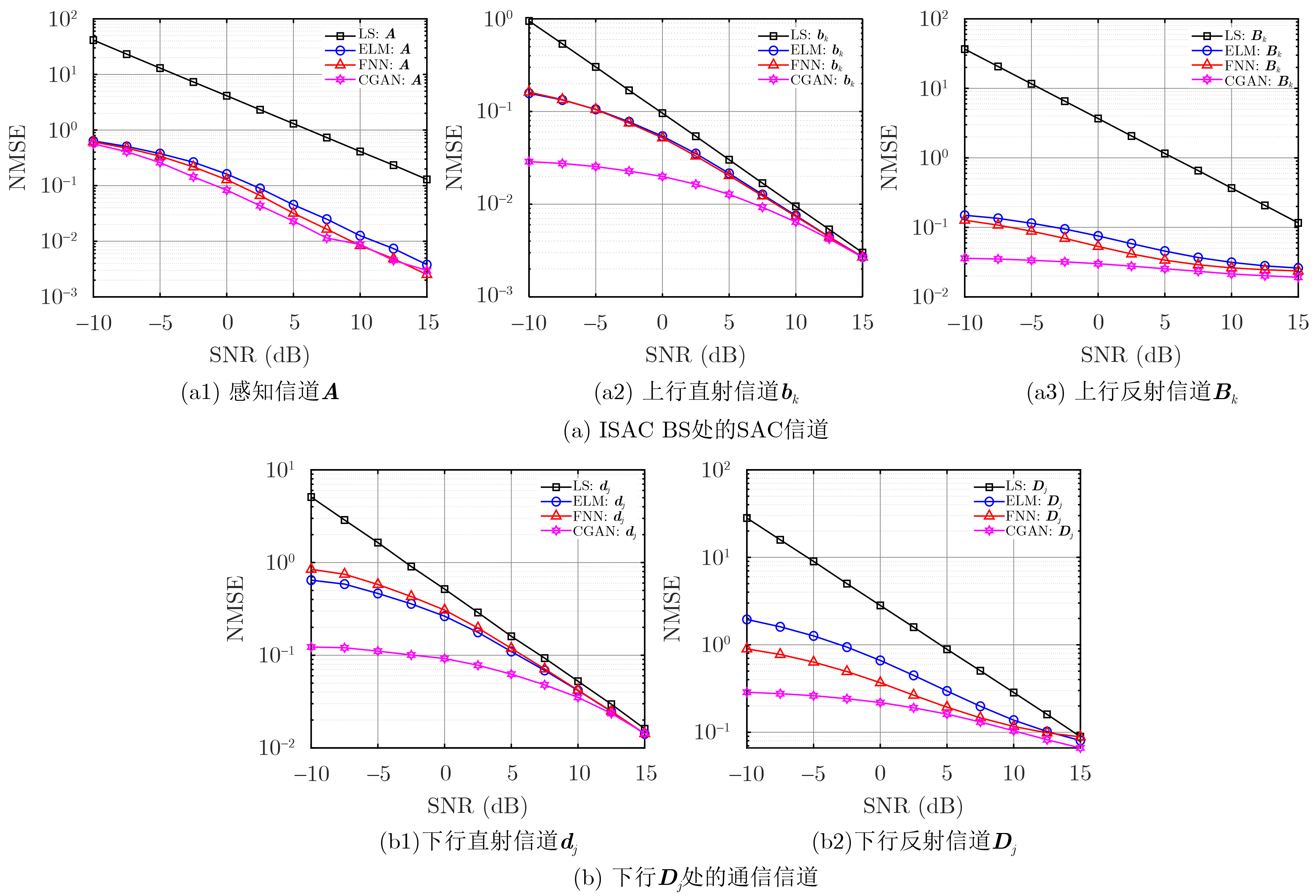
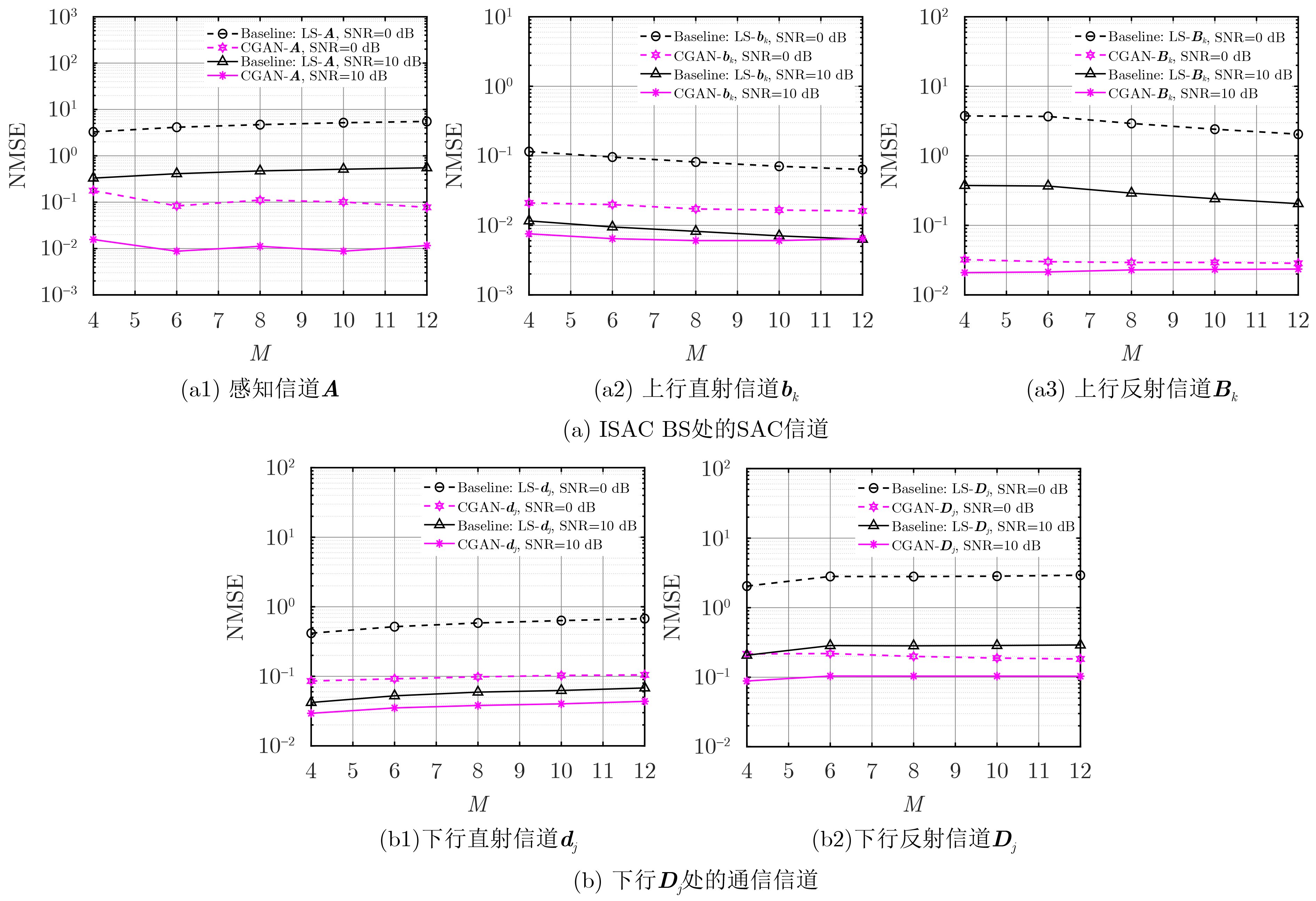
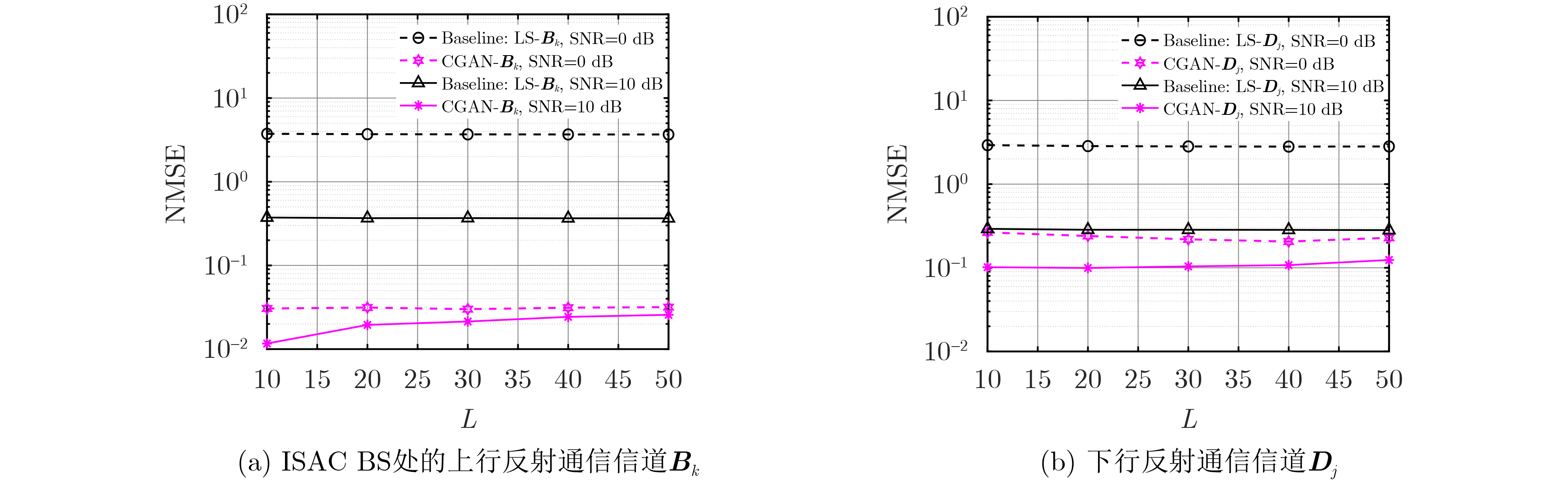
Objective Accurate channel estimation is essential for the reliable operation of RIS-assisted ISAC systems. Traditional deep learning methods provide partial solutions, but their generalization ability and estimation accuracy remain limited in complex multi-user channel environments. To address this issue, this study proposes a two-stage channel estimation method based on Conditional Generative Adversarial Network (CGAN) for RIS-assisted multi-user ISAC systems to improve estimation accuracy and stability. Methods A two-stage CGAN-based method is proposed for channel estimation in RIS-assisted multi-user ISAC systems. By adjusting the RIS switching states, the overall estimation task is divided into subproblems, which enables sequential estimation of the direct and reflected channels. Within the CGAN framework, adversarial training between the generator and discriminator is used to learn the mapping from observed signals to true channels. Feedback from the discriminator is further used to optimize the output, thereby improving training efficiency and estimation accuracy. Results and Discussions Extensive simulations are conducted to evaluate the effectiveness of the proposed method. Channel estimation performance is first assessed under different Signal-to-Noise Ratio (SNR) conditions. The CGAN-based approach achieves substantially better Normalized Mean Square Error (NMSE) performance than the Least Squares (LS) benchmark and conventional models such as FNN and ELM ( Fig. 4 ). The effects of antenna number and RIS element count on channel estimation are then examined. Across different channel sizes and SNR conditions, the CGAN-based method consistently outperforms the LS benchmark (Figs. 5 and6 ).Conclusions This study investigates channel estimation in RIS-assisted multi-user ISAC systems and proposes a two-stage CGAN-based method. By adjusting the RIS switching states and applying adversarial training between the generator and discriminator, accurate estimation of the direct and reflected channels is achieved. Simulation results show that the proposed method has strong generalization ability across different SNR levels and channel dimensions, and achieves substantially higher estimation accuracy than benchmark schemes. This method provides a promising solution for improving the accuracy and stability of channel estimation. -
表 1 CGAN网络的具体参数
模型 网络 层 大小 激活函数 CGAN 生成器 输入层 $ 2M{P}^{{{\mathrm{S}}_{l}}} $ - FFL 100 LeakyReLU FFL 200 LeakyReLU 输出层 $ 2{M}^{2} $ - 判别器 输入层 $ 2{M}^{2} $ - FFL 100 LeakyReLU FFL 200 LeakyReLU 输出层 1 -  下载: 导出CSV
表 2 两个阶段的总子帧持续时间
时隙持续时间($ \mu \text{s} $) 时隙个数 子帧持续时间($ \mu \text{s} $) 子帧个数 两个阶段的总子帧持续时间($ \mu \text{s} $) $ \mathit{\mathrm{\mathit{S}}}_1 $ $ {T}_{\mathrm{P}}=0.52 $ $ {P}^{{{\mathrm{S}}_{1}}}=M+K=12 $ $ \begin{aligned}T_{\mathrm{F}}^{{\mathrm{S}}_{1}}&={T}_{\mathrm{P}}{P}^{{{\mathrm{S}}_{1}}}\\&=6.24\end{aligned} $ $ {C}^{{{\mathrm{S}}_{1}}} $ $ {T}_{\mathrm{E}}={C}^{{{\mathrm{S}}_{1}}}T_{\mathrm{F}}^{{\mathrm{S}}_{1}}+\left({C}^{{{\mathrm{S}}_{2}}}-{C}^{{{\mathrm{S}}_{1}}}\right)T_{\mathrm{F}}^{{\mathrm{S}}_{2}}=99.84 $ $ \mathrm{\mathit{S}}_2 $ $ {T}_{\mathrm{P}}=0.52 $ $ {P}^{{{\mathrm{S}}_{2}}}=\max \left\{M,K\right\}=6 $ $ \begin{aligned}T_{\mathrm{F}}^{{\mathrm{S}}_{2}}&={T}_{\mathrm{P}}{P}^{{{\mathrm{S}}_{2}}}\\&=3.12\end{aligned} $ $ {C}^{{{\mathrm{S}}_{2}}}-{C}^{{{\mathrm{S}}_{1}}} $
下载: 导出CSV
表 3 SAC信道的路径损耗
距离(m) 路径损耗指数 路径损耗 BS-目标-
BS链路$ {d}_{\mathrm{S}} = 150 $ $ {\beta }_{\mathrm{S}} = 3 $ $ {\xi }_{\mathrm{S}} = {\xi }_{0}{\left({d}_{\mathrm{S}}/{d}_{0}\right)}^{-{{\beta }_{\mathrm{S}}}} $ RIS-BS
链路$ {d}_{\mathrm{IB}} = 50 $ $ {\beta }_{\mathrm{IB}} = 2.3 $ $ {\xi }_{\mathrm{IB}} = {\xi }_{0}{\left({d}_{\mathrm{IB}}/{d}_{0}\right)}^{-{{\beta }_{\mathrm{IB}}}} $ $ \mathrm{\mathit{U}}_k $-BS
链路$ {d}_{{{\mathrm{U}}_{k}}\mathrm{B}} = 50 $ $ {\beta }_{{{\mathrm{U}}_{k}}\mathrm{B}} = 3.5 $ $ {\xi }_{{{\mathrm{U}}_{k}}\mathrm{B}} = {\xi }_{0}{\left({d}_{{{\mathrm{U}}_{k}}\mathrm{B}}/{d}_{0}\right)}^{-{{\beta }_{{{\mathrm{U}}_{k}}\mathrm{B}}}} $ BS-$ {D}_{j} $
链路$ {d}_{\mathrm{B}{{\mathrm{D}}_{j}}} = 50 $ $ {\beta }_{\mathrm{B}{{\mathrm{D}}_{j}}} = 3.5 $ $ {\xi }_{\mathrm{B}{{\mathrm{D}}_{j}}} = {\xi }_{0}{\left({d}_{\mathrm{B}{{\mathrm{D}}_{j}}}/{d}_{0}\right)}^{-{{\beta }_{\mathrm{B}{{\mathrm{D}}_{j}}}}} $ $ \mathit{\mathit{\mathrm{\mathit{U}}}}_k $-RIS
链路$ {d}_{{{\mathrm{U}}_{k}}\mathrm{I}} = 2 $ $ {\beta }_{{{\mathrm{U}}_{k}}\mathrm{I}} = 2 $ $ {\xi }_{{{\mathrm{U}}_{k}}\mathrm{I}} = {\xi }_{0}{\left({d}_{{{\mathrm{U}}_{k}}\mathrm{I}}/{d}_{0}\right)}^{-{{\beta }_{{{\mathrm{U}}_{k}}\mathrm{I}}}} $ RIS-$ {D}_{j} $
链路$ {d}_{\mathrm{I}{{\mathrm{D}}_{j}}}=2 $ $ {\beta }_{\mathrm{I}{{\mathrm{D}}_{j}}}=2 $ $ {\xi }_{\mathrm{I}{{\mathrm{D}}_{j}}}={\xi }_{0}{\left({d}_{\mathrm{I}{{\mathrm{D}}_{j}}}/{d}_{0}\right)}^{-{{\beta }_{\mathrm{I}{{\mathrm{D}}_{j}}}}} $
下载: 导出CSV
表 4 训练时间(s)
ELM FNN CGAN ISAC BS $ \mathit{\mathrm{\mathit{S}}}_1 $:$ \boldsymbol{A} $,$ {\boldsymbol{b}}_{k} $ 2.54 10.31 436.09 $ \mathrm{\mathit{\mathit{\mathit{\mathit{\mathit{\mathit{\mathit{\mathit{\mathrm{\mathit{S}}}}}}}}_{\mathrm{2}}}}} $:$ {\boldsymbol{B}}_{k} $ 14.76 485.26 618.24 下行$ {{\boldsymbol{D}}}_{j} $ $ \mathrm{\mathit{S}}_1 $:$ {\boldsymbol{d}}_{j} $ 2.38 3.94 493.52 $ \mathrm{\mathit{S}}_2 $:$ {\boldsymbol{D}}_{j} $ 9.41 88.82 522.06
下载: 导出CSV
-
[1] BARNETO C B, LIYANAARACHCHI S D, HEINO M, et al. Full duplex radio/radar technology: The enabler for advanced joint communication and sensing[J]. IEEE Wireless Communications, 2021, 28(1): 82–88. doi: 10.1109/MWC.001.2000220. [2] BOZORGI F, SEN P, BARRETO A N, et al. RF front-end challenges for joint communication and radar sensing[C]. Proceedings of 2021 1st IEEE International Online Symposium on Joint Communications & Sensing, 2021: 1–6. doi: 10.1109/JCS52304.2021.9376387. [3] HAN Liang and WU Ke. Multifunctional transceiver for future intelligent transportation systems[J]. IEEE Transactions on Microwave Theory and Techniques, 2011, 59(7): 1879–1892. doi: 10.1109/TMTT.2011.2138156. [4] DONG Fuwang, LIU Fan, CUI Yuanhao, et al. Sensing as a service in 6G perceptive networks: A unified framework for ISAC resource allocation[J]. IEEE Transactions on Wireless Communications, 2023, 22(5): 3522–3536. doi: 10.1109/TWC.2022.3219463. [5] ZHAO Bo, WANG Ming, XING Zeng, et al. Integrated sensing and communication aided dynamic resource allocation for random access in satellite terrestrial relay networks[J]. IEEE Communications Letters, 2023, 27(2): 661–665. doi: 10.1109/LCOMM.2022.3227594. [6] HE Zhenyao, XU Wei, SHEN Hong, et al. Full-duplex communication for ISAC: Joint beamforming and power optimization[J]. IEEE Journal on Selected Areas in Communications, 2023, 41(9): 2920–2936. doi: 10.1109/JSAC.2023.3287540. [7] LE Q N, NGUYEN V D, DOBRE O A, et al. RIS-assisted full-duplex integrated sensing and communication[J]. IEEE Wireless Communications Letters, 2023, 12(10): 1677–1681. doi: 10.1109/LWC.2023.3285391. [8] LI Hongyu, SHEN Shanpu, NERINI M, et al. Reconfigurable intelligent surfaces 2.0: Beyond diagonal phase shift matrices[J]. IEEE Communications Magazine, 2024, 62(3): 102–108. doi: 10.1109/MCOM.001.2300019. [9] CHU Jinjin, LU Zhiping, LIU Rang, et al. Joint beamforming and reflection design for secure RIS-ISAC systems[J]. IEEE Transactions on Vehicular Technology, 2024, 73(3): 4471–4475. doi: 10.1109/TVT.2023.3328192. [10] JIANG Chengjun, ZHANG Chensi, HUANG Chongwen, et al. RIS-assisted ISAC systems for robust secure transmission with imperfect sense estimation[J]. IEEE Transactions on Wireless Communications, 2025, 24(5): 3979–3992. doi: 10.1109/TWC.2025.3534439. [11] 陈真, 杜晓宇, 唐杰, 等. 基于深度强化学习的RIS辅助通感融合网络: 挑战与机遇[J]. 电子与信息学报, 2024, 46(9): 3467–3473. doi: 10.11999/JEIT240086.CHEN Zhen, DU Xiaoyu, TANG Jie, et al. DRL-based RIS assisted ISAC network: Challenges and opportunities[J]. Journal of Electronics & Information Technology, 2024, 46(9): 3467–3473. doi: 10.11999/JEIT240086. [12] LIU Yu, AL-NAHHAL I, DOBRE O A, et al. Deep-learning channel estimation for IRS-assisted integrated sensing and communication system[J]. IEEE Transactions on Vehicular Technology, 2023, 72(5): 6181–6193. doi: 10.1109/TVT.2022.3231727. [13] LIU Yu, AL-NAHHAL I, DOBRE O A, et al. Extreme learning machine-based channel estimation in IRS-assisted multi-user ISAC system[J]. IEEE Transactions on Communications, 2023, 71(12): 6993–7007. doi: 10.1109/TCOMM.2023.3308150. [14] WANG Yang, XU Yin, ZHANG Cixiao, et al. Channel estimation for RIS-assisted mmWave systems via diffusion models[J]. IEEE Communications Letters, 2025, 30: 597–601. doi: 10.1109/LCOMM.2025.3645078. [15] WU Qingying, BAO Junqi, XU Hui, et al. A convolutional transformer residual network for channel estimation in intelligent reflective surface aided MIMO systems[J]. Sensors, 2025, 25(19): 5959. doi: 10.3390/s25195959. [16] FAISAL A, AL-NAHHAL I, LEE K, et al. Conditional generative adversarial networks for channel estimation in RIS-assisted ISAC systems[J]. IEEE Transactions on Communications, 2025, 73(9): 7828–7841. doi: 10.1109/TCOMM.2025.3541047. [17] ELSAYED M, EL-BANNA A A A, DOBRE O A, et al. Hybrid-layers neural network architectures for modeling the self-interference in full-duplex systems[J]. IEEE Transactions on Vehicular Technology, 2022, 71(6): 6291–6307. doi: 10.1109/TVT.2022.3159535. [18] ELSAYED M, EL-BANNA A A A, DOBRE O A, et al. Full-Duplex self-Interference cancellation using dual-neurons neural networks[J]. IEEE Communications Letters, 2022, 26(3): 557–561. doi: 10.1109/LCOMM.2021.3136030. [19] ELSAYED M, EL-BANNA A A A, DOBRE O A, et al. Low complexity neural network structures for self interference cancellation in full-duplex radio[J]. IEEE Communications Letters, 2021, 25(1): 181–185. doi: 10.1109/LCOMM.2020.3024063. [20] 3GPP. 3GPP TS 36.211 Evolved Universal Terrestrial Radio Access (E-UTRA); Physical channels and modulation[S]. 2016. [21] XIAO Zhiqiang and ZENG Yong. Waveform design and performance analysis for full-duplex integrated sensing and communication[J]. IEEE Journal on Selected Areas in Communications, 2022, 40(6): 1823–1837. doi: 10.1109/JSAC.2022.3155509. [22] MA Jianpeng, ZHANG Shun, LI Hongyan, et al. Sparse bayesian learning for the time-varying massive MIMO channels: Acquisition and tracking[J]. IEEE Transactions on Communications, 2019, 67(3): 1925–1938. doi: 10.1109/TCOMM.2018.2855197. [23] SHORTEN C and KHOSHGOFTAAR T M. A survey on image data augmentation for deep learning[J]. Journal of Big Data, 2019, 6(1): 60. doi: 10.1186/s40537-019-0197-0. [24] GOODFELLOW I, POUGET-ABADIE J, MIRZA M, et al. Generative adversarial nets[C]. Proceedings of the 28th International Conference on Neural Information Processing Systems, Montreal, Canada, 2014: 2672–2680. [25] BISWAS S, MASOUROS C, and RATNARAJAH T. Performance analysis of large multiuser MIMO systems with space-constrained 2-D antenna arrays[J]. IEEE Transactions on Wireless Communications, 2016, 15(5): 3492–3505. doi: 10.1109/TWC.2016.2522419. [26] LIU Fan, MASOUROS C, PETROPULU A P, et al. Joint radar and communication design: Applications, state-of-the art, and the road ahead[J]. IEEE Transactions on Communications, 2020, 68(6): 3834–3862. doi: 10.1109/TCOMM.2020.2973976. [27] FAISAL A, AL-NAHHAL I, DOBRE O A, et al. Deep reinforcement learning for optimizing RIS-assisted HD-FD wireless systems[J]. IEEE Communications Letters, 2021, 25(12): 3893–3897. doi: 10.1109/LCOMM.2021.3117929. -

 下载:
下载:



图(8) / 表(4)
计量
- 文章访问数: 697
- HTML全文浏览量: 386
- PDF下载量: 58
- 被引次数: 0
