




A Method for Lightning Electromagnetic Signal Identification Using Cross-Layer Deep Feature Fusion
-
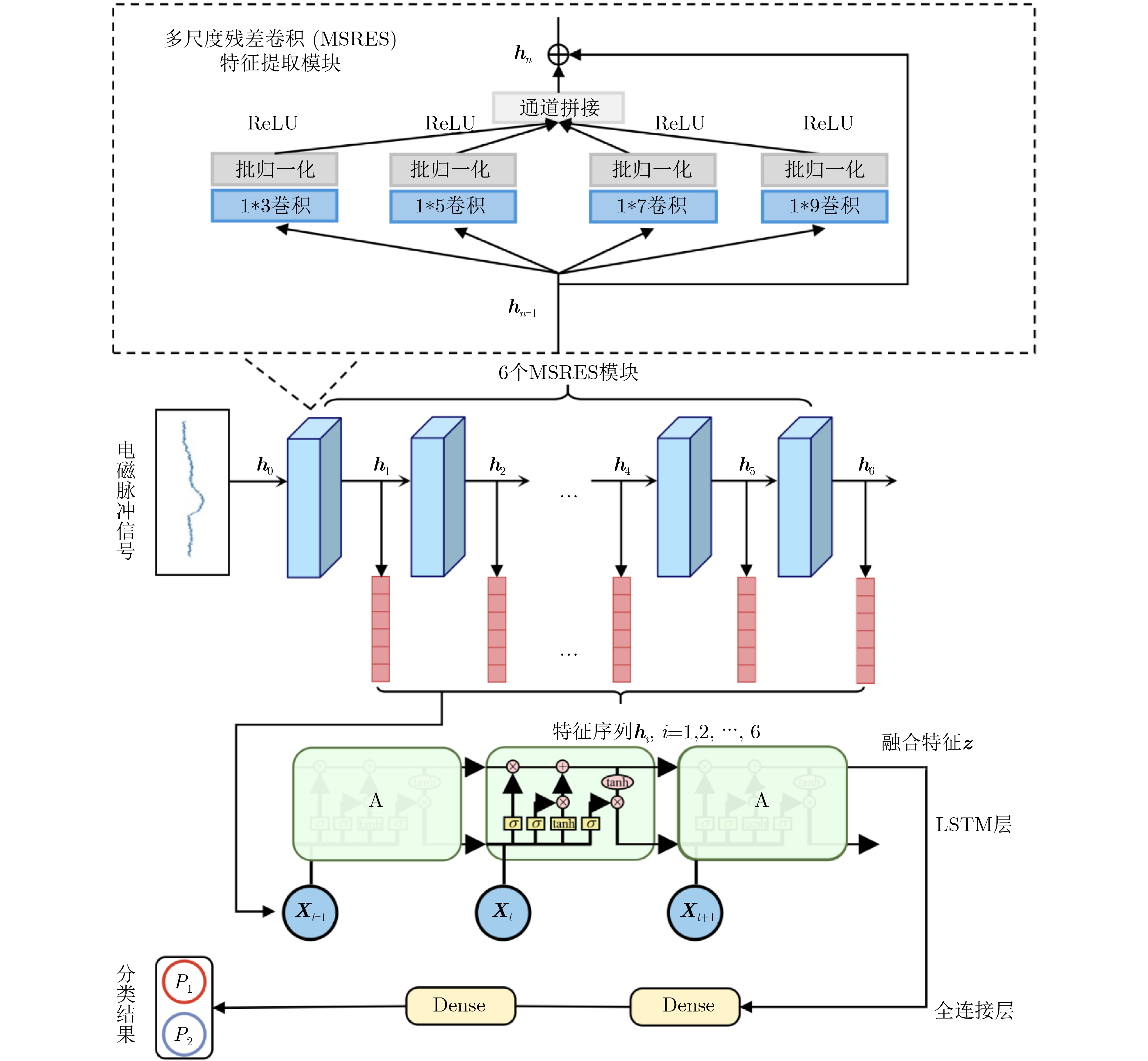
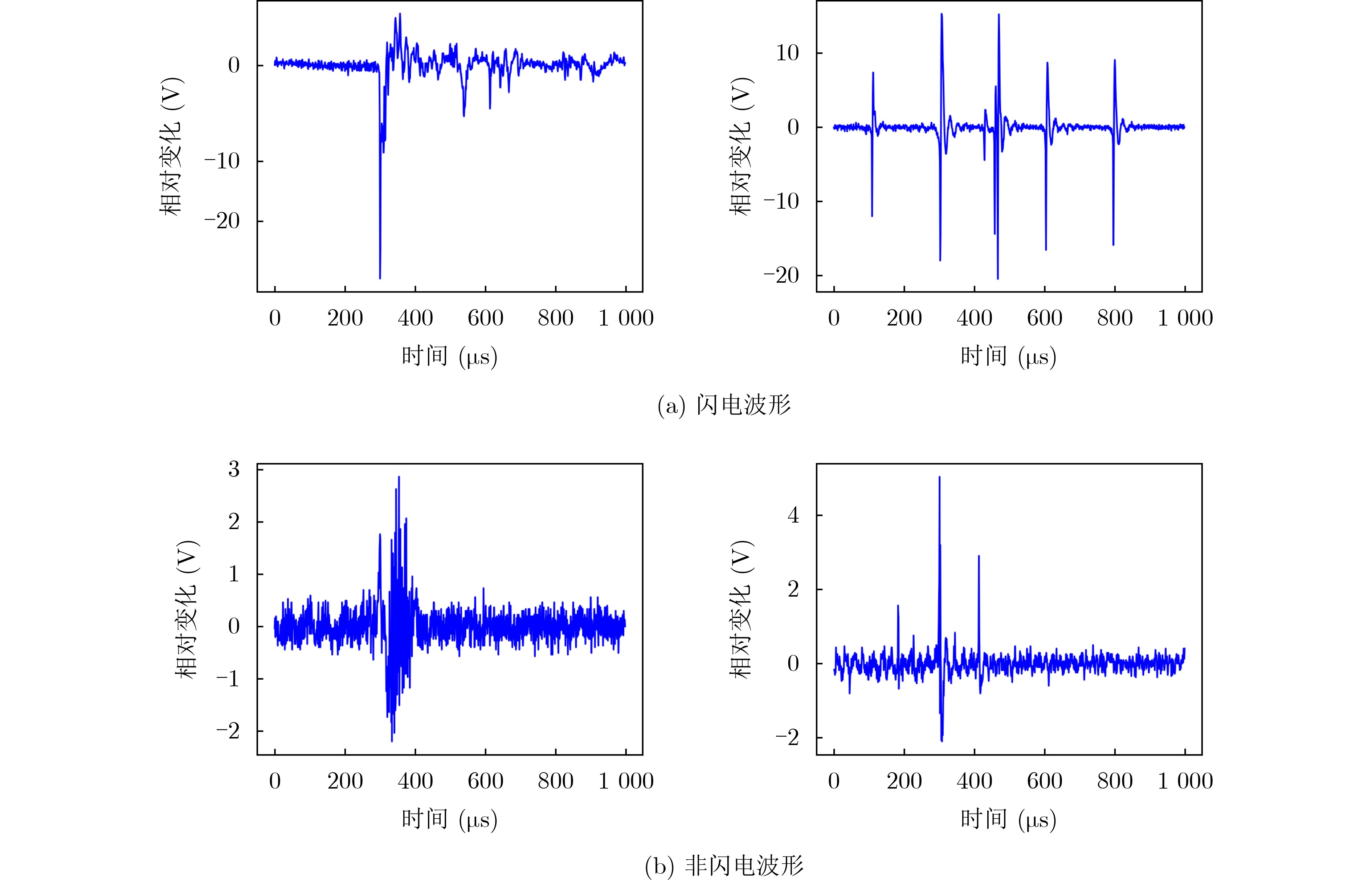
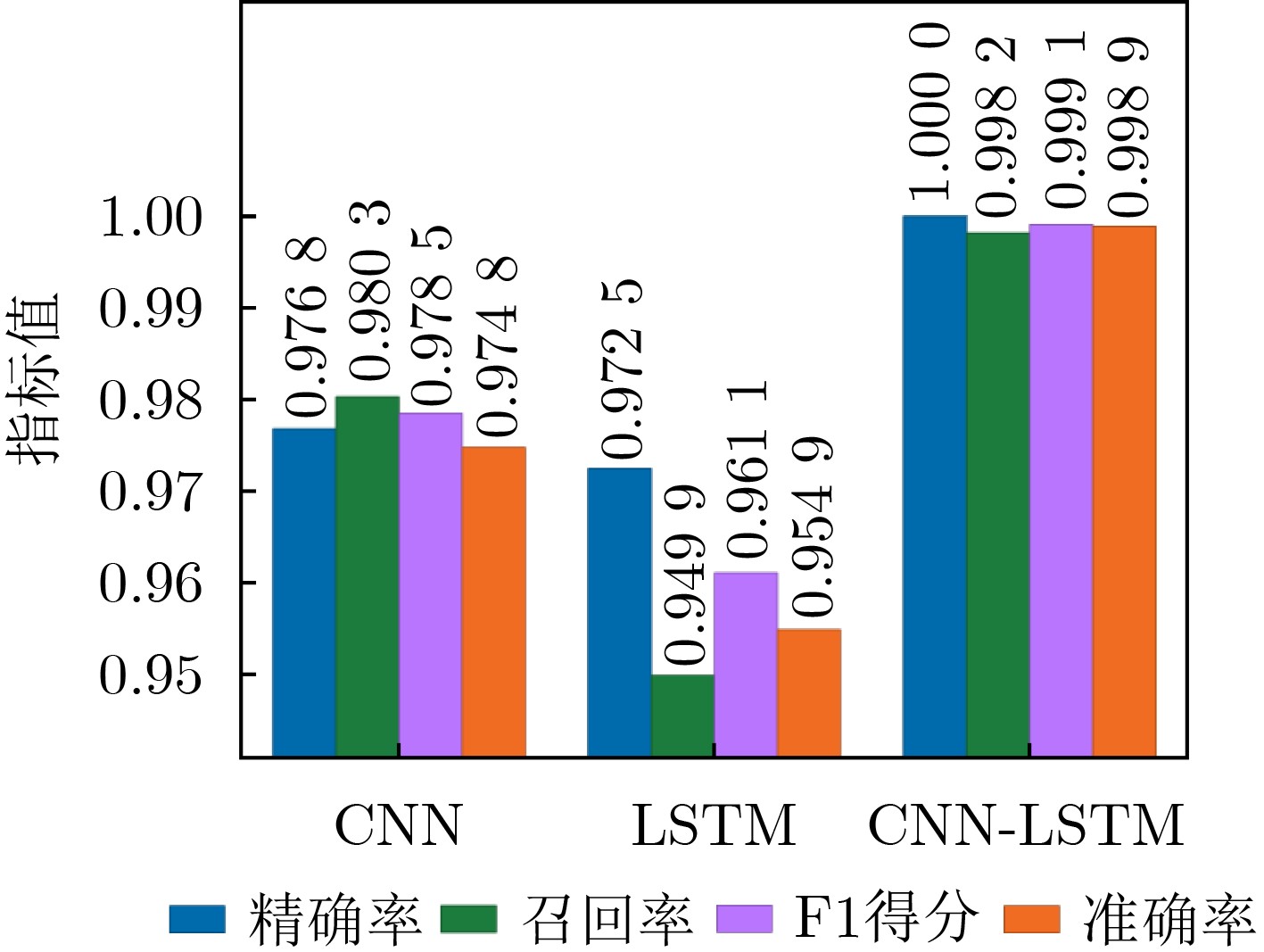
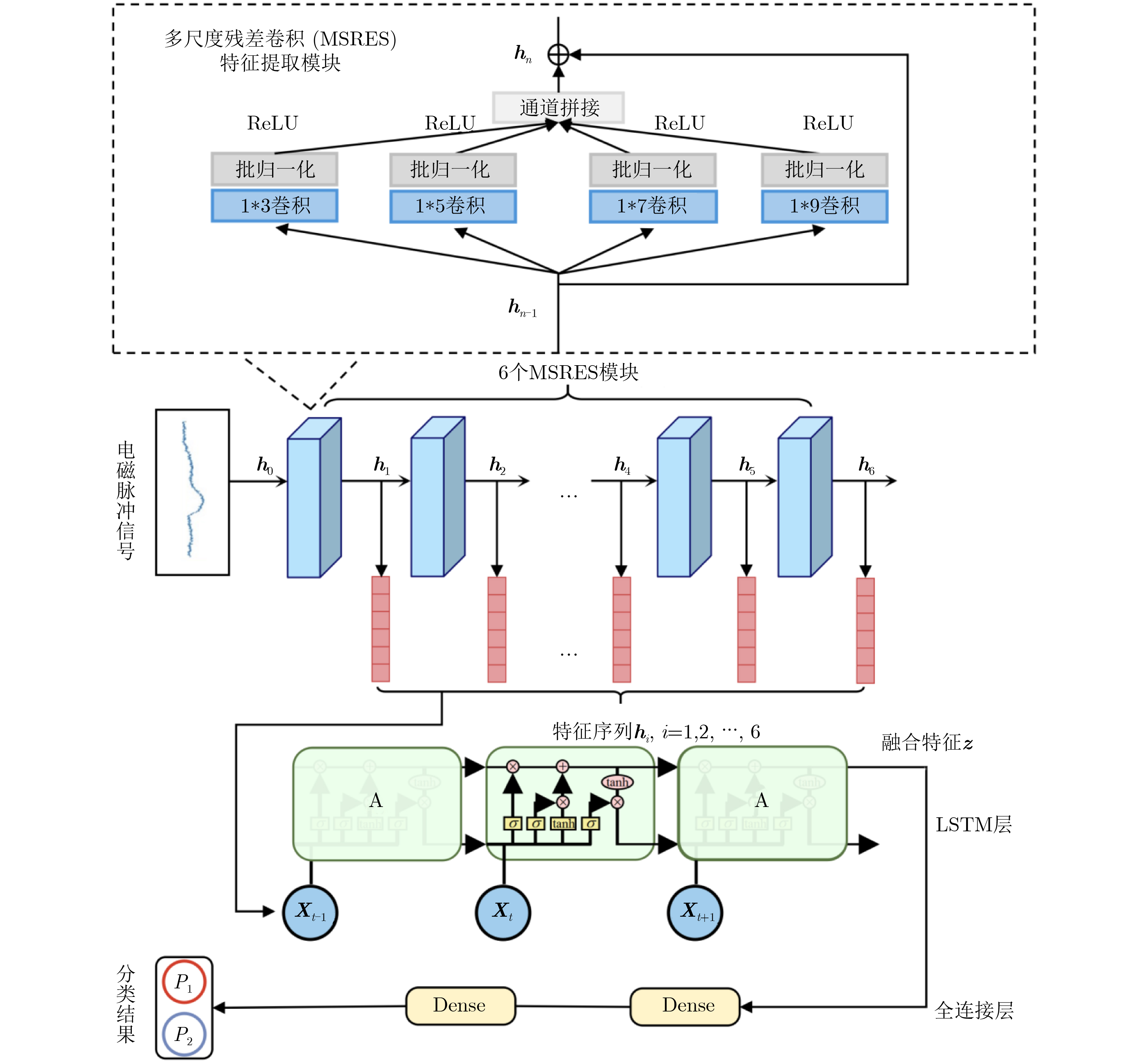
摘要: 由于人类活动产生的电磁干扰与真实的雷电电磁脉冲信号在时域和频域上高度混叠,如何高效、准确地区分雷电电磁信号与非雷电电磁信号,已成为雷电监测预警及灾害防御领域的关键问题。针对雷电电磁信号与人为干扰信号在波形形态上高度相似、对其诊断识别难度大的问题,该文提出一种基于多尺度残差卷积与不同网络层特征融合相结合的深度神经网络模型CNN-LSTM,用于雷电与非雷电电磁信号的二分类任务。通过多尺度残差网络模型逐层提取探测设备接收到的电磁波的多维度特征,将各卷积层输出的时域特征按照网络层深度的次序,构建为一个跨网络层的时域特征序列,并输入长短期记忆网络(LSTM)中进行自适应加权融合,该机制利用LSTM对序列信息的建模能力,学习不同层级特征的相对重要性,而非建模原始波形的时间动态。实验结果表明,所提诊断识别方法在真实雷电观测数据集上表现出优异的分类性能:其对雷电电磁信号的识别精确率达到100%,召回率为99.82%,F1得分为99.91%,整体准确率达99.89%。与多种经典基线模型相比,所提CNN-LSTM模型不仅能高效地识别出雷电样本,还能显著降低对非雷电干扰信号的误报率。此外,消融实验进一步验证了CNN网络在局部特征提取以及LSTM在跨层特征融合中的关键作用,证明了所提架构的合理性与有效性。
-
关键词:
- 雷电电磁脉冲信号 /
- 深度学习 /
- 卷积神经网络(CNN) /
- 长短期记忆网络(LSTM) /
- 特征融合
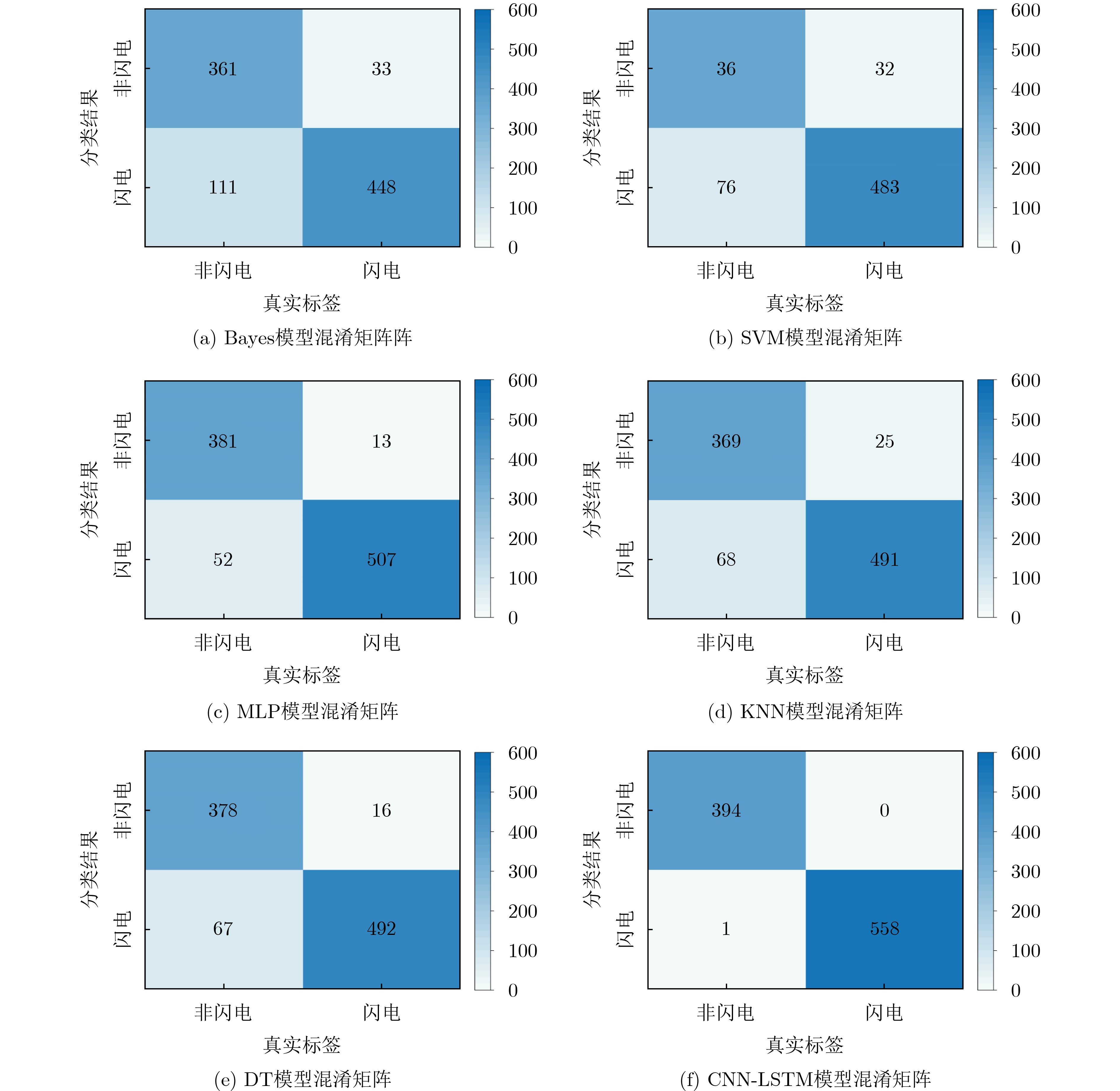
Abstract:Objective Lightning identification is essential for lightning observation, location, warning, and disaster prevention. Large volumes of Low-Frequency/Very-Low-Frequency (LF/VLF) Lightning Electromagnetic Pulse (LEMP) waveform data require automatic and accurate classification methods. Deep learning has been widely used for feature extraction and classification, providing a feasible approach for LEMP waveform identification. However, anthropogenic electromagnetic interference and natural LEMP signals often overlap in the time and frequency domains. Their waveform features are also complex and diverse, which limits the accuracy and generalization ability of existing identification algorithms. Therefore, a more efficient deep learning model is required to distinguish LEMP signals from non-lightning electromagnetic signals. Methods This paper proposes a Convolutional Neural Network and Long Short-Term Memory (CNN-LSTM) deep neural network model that integrates multi-scale residual convolution and cross-layer feature fusion. The model is designed for binary classification of LEMP and non-lightning electromagnetic signals and enables accurate diagnostic identification of LEMP signals. Using observational data from an LF/VLF lightning magnetic-field detection system, a multi-scale residual network is first used to extract multidimensional features from electromagnetic waveforms layer by layer. The time-domain features output by each convolutional layer are then organized into a cross-layer time-domain feature sequence according to network depth. This sequence is input into the LSTM module for adaptive weighted fusion. This mechanism uses the sequence modeling ability of LSTM to learn the relative importance of features at different hierarchical levels, rather than to model the temporal dynamics of the original waveform. Results and Discussions The proposed CNN-LSTM model achieves a precision of 100%, a recall of 99.82%, an F1-score of 99.91%, and an accuracy of 99.89%. It obtains the best performance across all evaluation metrics. The model effectively identifies LEMP samples and reduces the misclassification of non-lightning samples. The Bayes classifier achieves high precision (93.14%), but its recall is relatively low (80.14%). The Support Vector Machine (SVM) model improves on the Bayes classifier across all metrics, but it remains inferior to the proposed CNN-LSTM model. The MultiLayer Perceptron (MLP) and K-Nearest Neighbor (KNN) models also show limitations in precision, recall, and accuracy compared with CNN-LSTM. The Decision Tree (DT) model obtains reasonable results, but its precision and recall are lower than those of MLP and KNN, with a recall of only 88.01%. These results indicate that CNN-LSTM has clear advantages in LEMP waveform identification. This improvement is mainly attributed to the multi-scale residual CNN module, which automatically extracts low-level local features from raw waveform data. Additionally, the LSTM-based adaptive weighted fusion mechanism is applied to feature sequences from different network layers. As a feature integration tool across network depths, its input is an inter-layer feature sequence rather than an original waveform time series. This design improves the flexibility and discriminative ability of feature fusion, enables the model to learn the relative importance of features at different network depths, and supports effective aggregation of discriminative features. A confusion matrix was also generated to evaluate classification performance on the test set. Overall, comparison with baseline models confirms the superiority of the proposed model for LEMP waveform identification. Conclusions The CNN-LSTM model effectively identifies LEMP samples and reduces the misclassification of non-lightning samples. Compared with baseline models, it shows excellent identification performance in the binary classification of LEMP and non-lightning electromagnetic signals. The results also verify the effectiveness of convolutional feature extraction and LSTM-based cross-layer feature fusion for LEMP waveform identification. -
表 1 CNN-LSTM及基线模型性能对比(%)
模型 Precision Recall F1得分 Acc Bayes 93.14 80.14 86.15 84.89 SVM 93.79 86.40 89.94 88.67 MLP 97.50 90.70 93.98 93.18 KNN 95.16 87.84 91.35 90.24 DT 96.85 88.01 92.22 91.29 CNN-LSTM 100.00 99.82 99.91 99.89  下载: 导出CSV
-
[1] SABRI M H M, AHMAD M R, TAKAYANAGI Y, et al. Observation of tropical positive cloud-to-ground flashes accompanied by chaotic and regular pulse trains[J]. Journal of Atmospheric and Solar-Terrestrial Physics, 2024, 261: 106285. doi: 10.1016/j.jastp.2024.106285. [2] FENG Jizhou, YUAN Shanfeng, JIANG Rubin, et al. The impact of intracloud negative branches on continuing current in negative cloud-to-ground lightning[J]. Geophysical Research Letters, 2025, 52(17): e2025GL116612. doi: 10.1029/2025GL116612. [3] WU Ting, WANG Daohong, and TAKAGI N. High-accuracy classification of radiation waveforms of lightning return strokes[J]. Journal of Geophysical Research: Atmospheres, 2023, 128(14): e2023JD038715. doi: 10.1029/2023jd038715. [4] XIAO Lilang, CHEN Weijiang, WANG Yu, et al. Toward an interpretable CNN model for the classification of lightning-produced VLF/LF signals[J]. Journal of Geophysical Research: Atmospheres, 2023, 128(22): e2023JD039517. doi: 10.1029/2023JD039517. [5] KITAGAWA N and BROOK M. A comparison of intracloud and cloud-to-ground lightning discharges[J]. Journal of Geophysical Research: Atmospheres, 1960, 65(4): 1189–1201. doi: 10.1029/JZ065i004p01189. [6] SHAO Xuanmin, STANLEY M, REGAN A, et al. Total lightning observations with the new and improved Los Alamos Sferic Array (LASA)[J]. Journal of Atmospheric and Oceanic Technology, 2006, 23(10): 1273–1288. doi: 10.1175/JTECH1908.1. [7] BETZ H D, SCHMIDT K, OETTINGER P, et al. Lightning detection with 3-D discrimination of intracloud and cloud-to-ground discharges[J]. Geophysical Research Letters, 2004, 31(11): L11108. doi: 10.1029/2004GL019821. [8] 张旭荣, 张妙兰, 刘新中. 小波变换在核爆电磁脉冲信号识别中的应用[J]. 电子与信息学报, 1999, 21(5): 710–712.ZHANG Xurong, ZHANG Miaolan, and LIU Xinzhong. Studies of recognition methods of nuclear and lightning impulse signals with applications of wavelet transform[J]. Journal of Electronics & Information Technology, 1999, 21(5): 710–712. [9] HARIS F A, KADIR M Z A, SUDIN S, et al. Automated negative lightning return strokes classification system[J]. Journal of Physics: Conference Series, 2021, 2107: 012022. doi: 10.1088/1742-6596/2107/1/012022. [10] ZHU Shunxing, ZHANG Yang, FAN Yanfeng, et al. A lightning classification method based on convolutional encoding features[J]. Remote Sensing, 2024, 16(6): 965. doi: 10.3390/rs16060965. [11] ZHU Yanan, BITZER P, RAKOV V, et al. A machine-learning approach to classify cloud-to-ground and intracloud lightning[J]. Geophysical Research Letters, 2021, 48(1): e2020GL091148. doi: 10.1029/2020GL091148. [12] MOHAMMED A and KORA R. A comprehensive review on ensemble deep learning: Opportunities and challenges[J]. Journal of King Saud University-Computer and Information Sciences, 2023, 35(2): 757–774. doi: 10.1016/j.jksuci.2023.01.014. [13] GUI Jie, CHEN Tuo, ZHANG Jing, et al. A survey on self-supervised learning: Algorithms, applications, and future trends[J]. IEEE Transactions on Pattern Analysis and Machine Intelligence, 2024, 46(12): 9052–9071. doi: 10.1109/tpami.2024.3415112. [14] LU Jingyu. The dataset and MAE model code for “an efficient lightning classifier using a self-supervised learning neural network”[EB/OL]. Zenodo. https://doi.org/10.5281/zenodo.14556712, 2024. [15] PU Yunjiao, CUMMER S A, LYU Fanchao, et al. Unsupervised clustering and supervised machine learning for lightning classification: Application to identifying EIPs for ground-based TGF detection[J]. Journal of Geophysical Research: Atmospheres, 2023, 128(9): e2022JD038369. doi: 10.1029/2022jd038369. [16] CHENG Mingyue, TAO Xiaoyu, LIU Zhiding, et al. TimeMAE: Self-supervised representations of time series with decoupled masked autoencoders[C]. The Nineteenth ACM International Conference on Web Search and Data Mining, Boise, USA, 2026: 498–508. [17] PENG Changzhi, LIU Feifan, ZHU Baoyou, et al. A convolutional neural network for classification of lightning LF/VLF waveform[C]. The 2019 11th Asia-Pacific International Conference on Lightning, Hong Kong, China, 2019: 1–4. doi: 10.1109/APL.2019.8815977. [18] 王子欣, 项厚宏, 田波, 等. 电磁信号特征匹配表征的弱小目标恒虚警检测方法[J]. 电子与信息学报, 2025, 47(11): 4307–4317. doi: 10.11999/JEIT250589.WANG Zixin, XIANG Houhong, TIAN Bo, et al. Electromagnetic signal feature matching characterization for constant false alarm detection[J]. Journal of Electronics & Information Technology, 2025, 47(11): 4307–4317. doi: 10.11999/JEIT250589. [19] WANG Jiaquan, HUANG Qijun, MA Qiming, et al. Classification of VLF/LF lightning signals using sensors and deep learning methods[J]. Sensors, 2020, 20(4): 1030. doi: 10.3390/s20041030. [20] GAO Chao, WANG Jiaquan, ZHOU Xiao, et al. Classification of lightning electric field waveform based on deep residual one-dimensional convolutional network[M]. MENG Hongying, LEI Tao, LI Maozhen, et al. Advances in Natural Computation, Fuzzy Systems and Knowledge Discovery. Cham: Springer, 2021: 1648–1659. doi: 10.1007/978-3-030-70665-4_179. [21] QIAN Zheng, WANG Dongdong, SHI Xiangbo, et al. Lightning identification method based on deep learning[J]. Atmosphere, 2022, 13(12): 2112. doi: 10.3390/atmos13122112. [22] 颜康, 金炜东, 黄颖坤, 等. 基于元学习的畸变雷达电磁信号识别[J]. 电子与信息学报, 2022, 44(4): 1351–1357. doi: 10.11999/JEIT210190.YAN Kang, JIN Weidong, HUANG Yingkun, et al. Distorted radar electromagnetic signal recognition based on meta-learning[J]. Journal of Electronics & Information Technology, 2022, 44(4): 1351–1357. doi: 10.11999/JEIT210190. [23] ZHANG Xiaoyi, WANG Caixia, and TIAN Yangmeng. Classification and feature extraction of lightning electric field waveforms based on machine learning[C]. The 2022 IEEE 2nd International Conference on Computer Communication and Artificial Intelligence, Beijing, China, 2022: 199–204. doi: 10.1109/CCAI55564.2022.9807742. [24] FERREIRA G A V S, LEAL A F R, DIGANGI E A, et al. Residual neural network applied to lightning classification in a modern lightning location network[C]. The 37th International Conference on Lightning Protection, Dresden, Germany, 2024: 291–296. [25] XIAO Fang, MA Qiming, SONG Jiajun, et al. Study on multi-station identification technology of lightning electromagnetic pulses (LEMPs) based on deep learning[J]. Sensors, 2025, 25(23): 7217. doi: 10.3390/S25237217. -

 下载:
下载:

图(4) / 表(1)
计量
- 文章访问数: 1047
- HTML全文浏览量: 440
- PDF下载量: 65
- 被引次数: 0
