




Dual-Domain Differentiated Feature Extraction Network for MRI Reconstruction
-
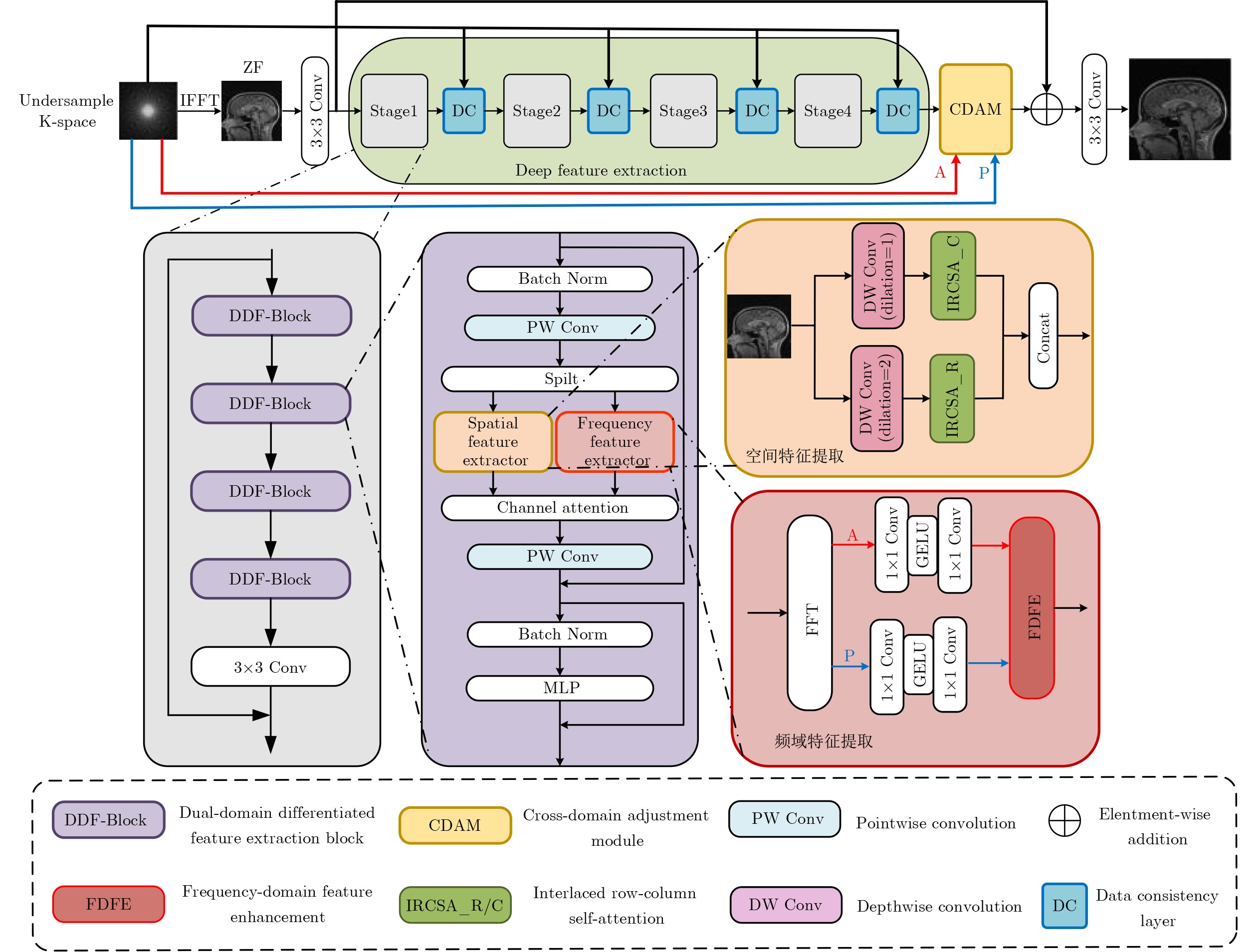
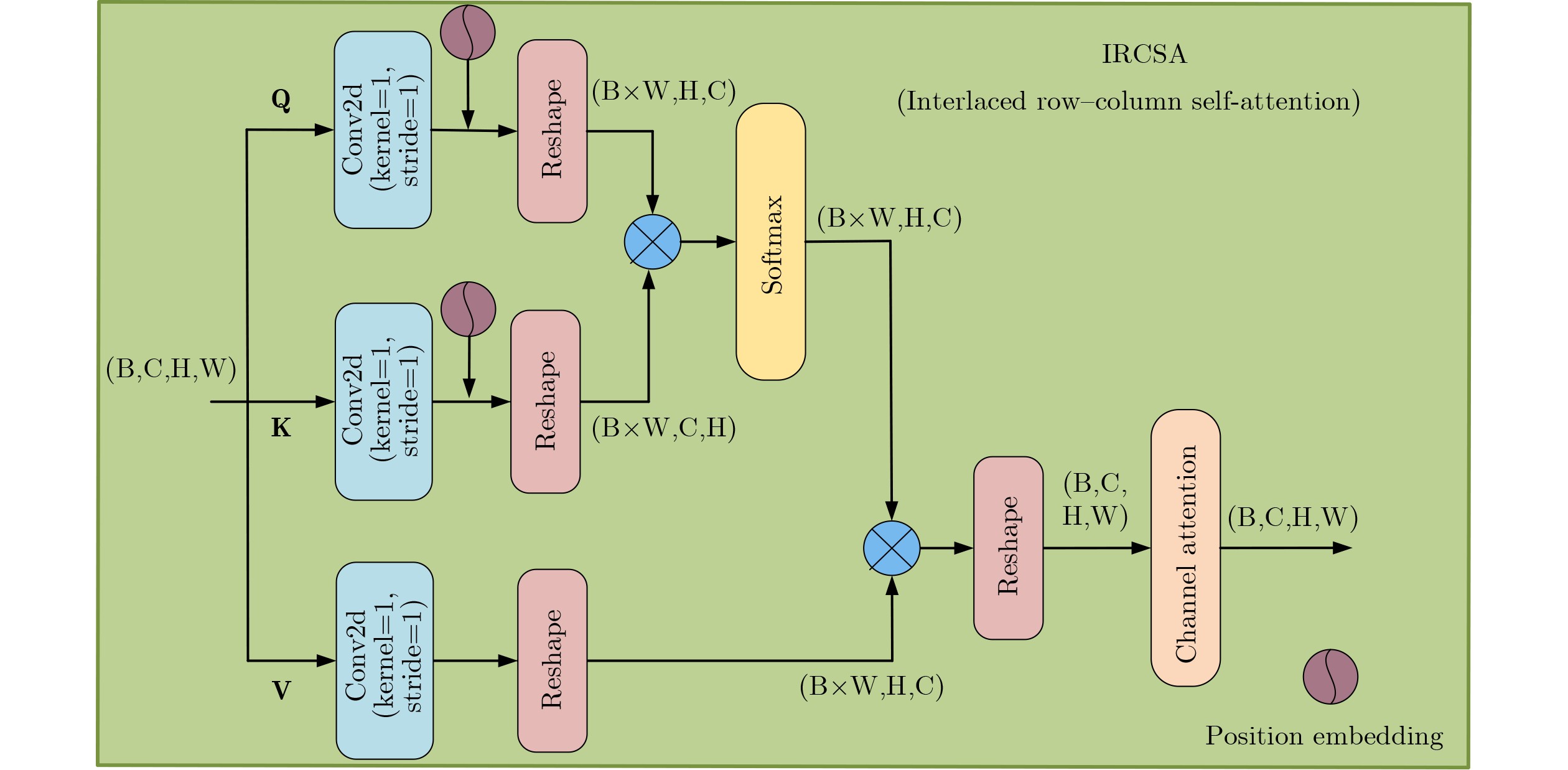
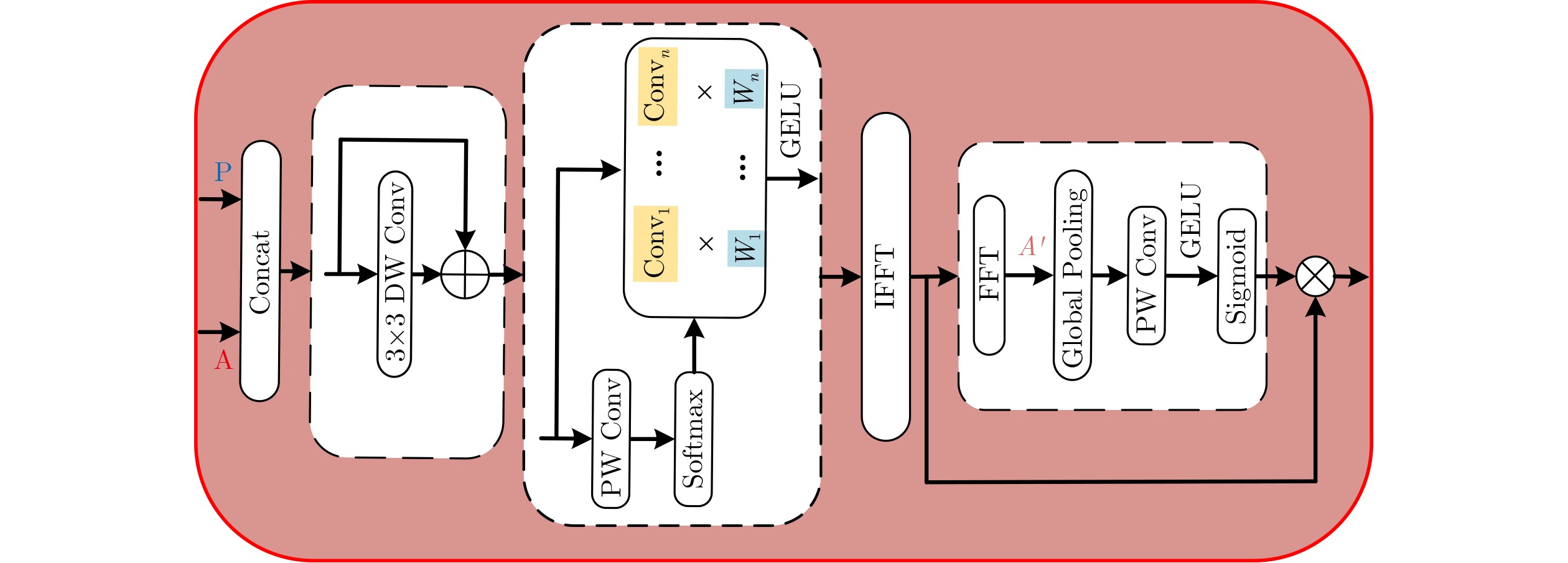
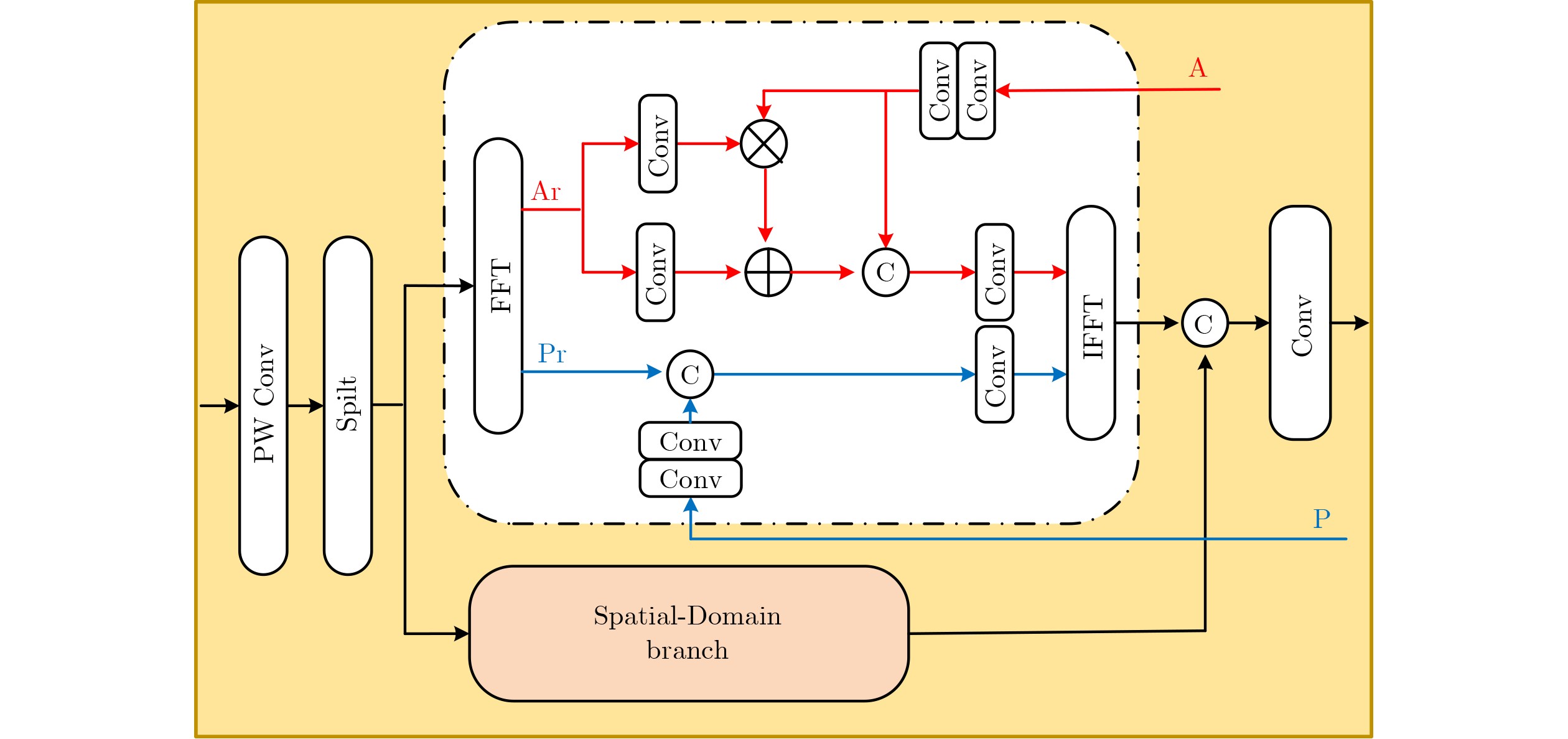
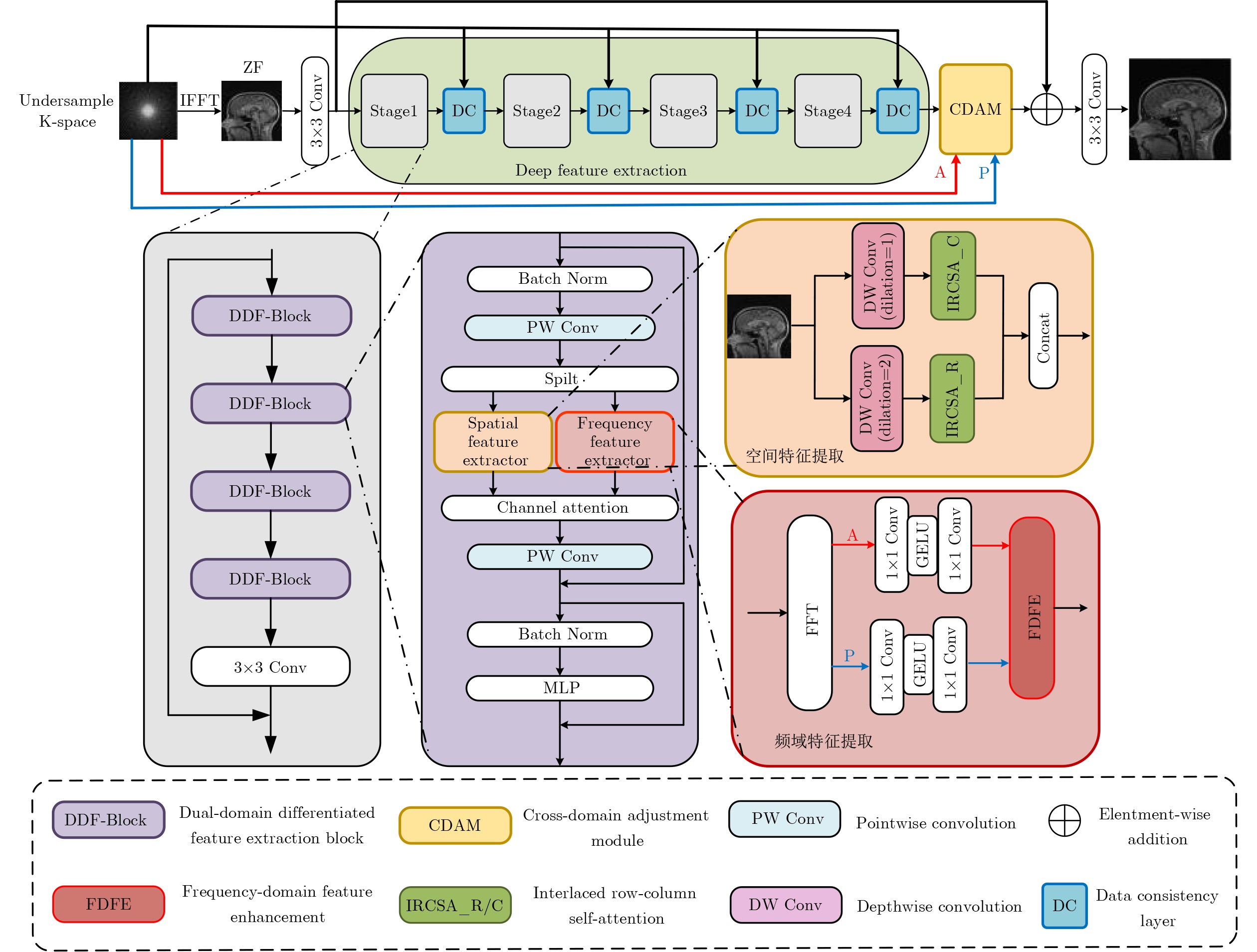
摘要: 在磁共振成像(MRI)中通过对$ k $空间数据进行欠采样可以加速成像,从欠采样数据中重建出高质量磁共振图像在临床诊断中具有重要价值。目前,利用空间域和频域双域特征的重建方式已成为主流,但现有双域MRI重建方法未能对空域和频域分别设计差异化的特征提取策略,且物理先验约束不足,容易在重建过程中丢失原始信息。因此,该文提出一种双域差异化特征提取的MRI重建网络。首先,在空间域中设计行–列交替自注意力机制同时结合深度卷积,以精细刻画各向异性结构与纹理细节,弥补传统卷积特征提取不足问题。其次,在频域中对幅频特性与相频特性进行独立建模,分别捕获强度信息与结构位置信息并引入频域特征增强模块,以充分利用频谱信息提高重建保真度。最后,通过在网络中加入数据一致性层并设计一种跨域调控模块,将物理先验与跨域信息相融合以强化测量约束并稳定重建过程。与6种MRI重建算法对比,该文模型在公开MRI数据集CC359和IXI上都优于对比算法,其中在高斯一维掩膜30%欠采样条件下,PSNR分别提升了0.17 dB, 0.23 dB,SSIM分別提升了
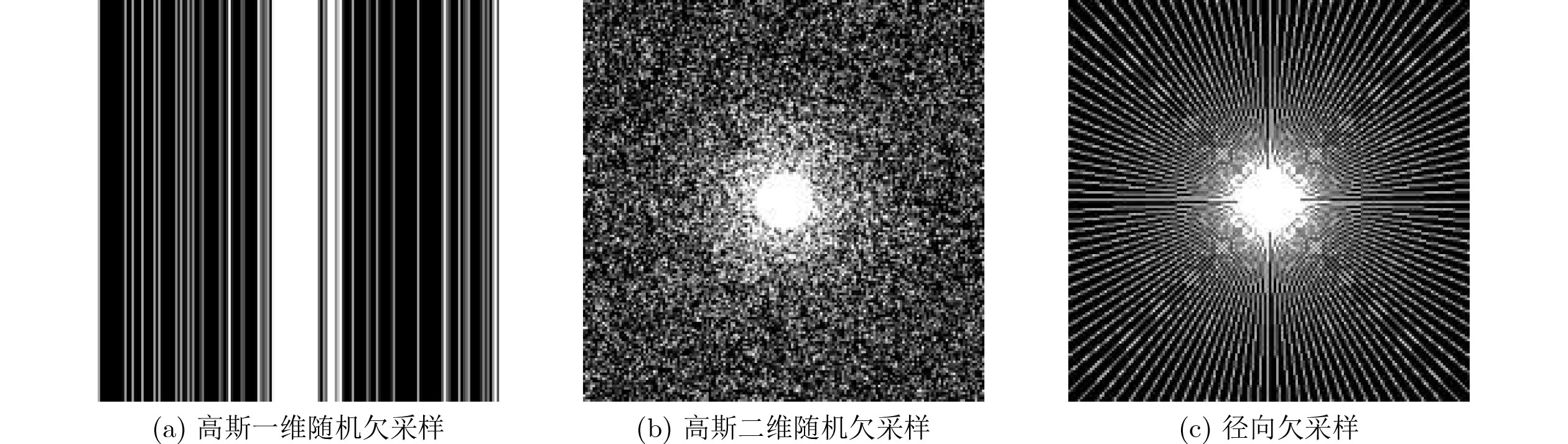
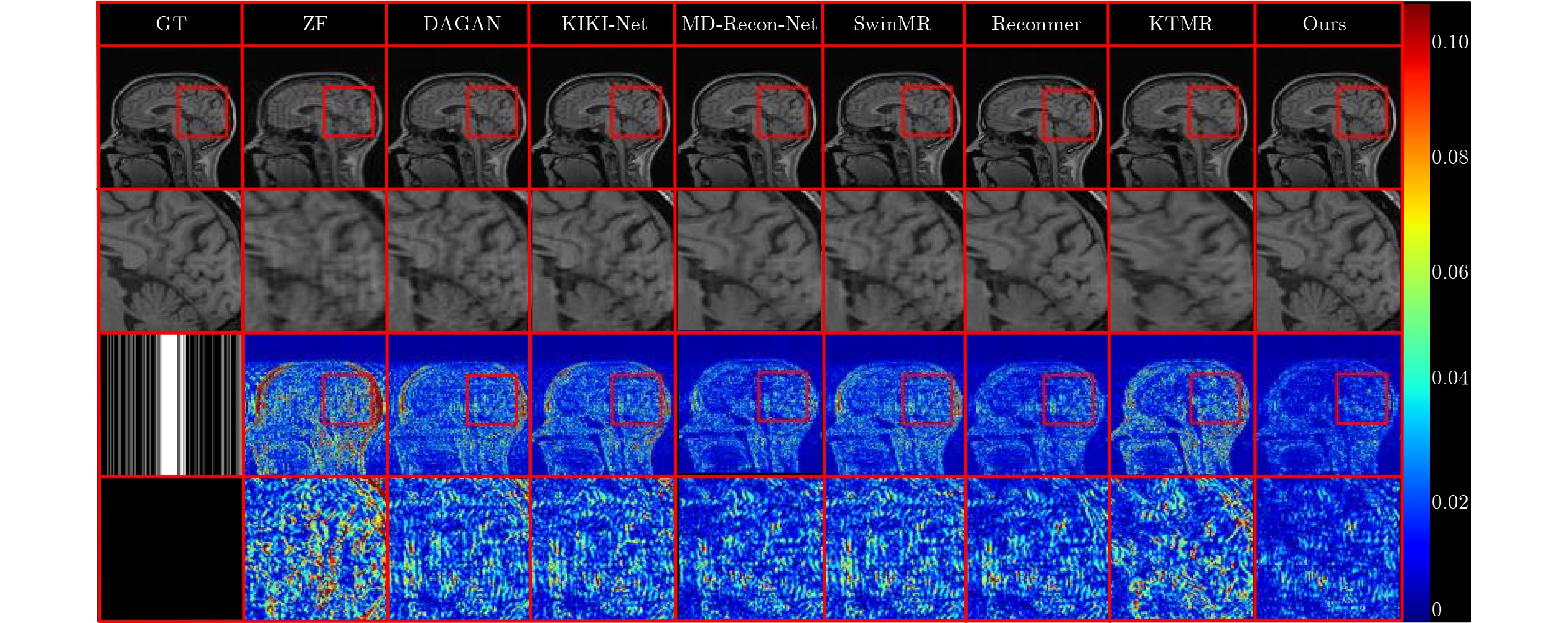
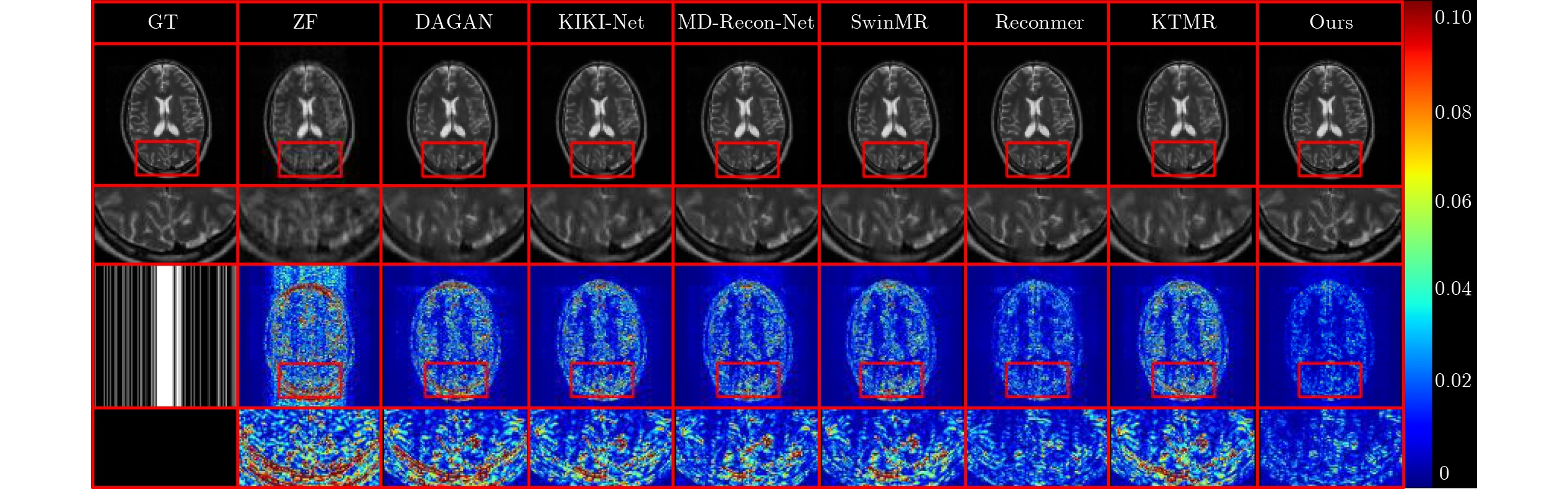
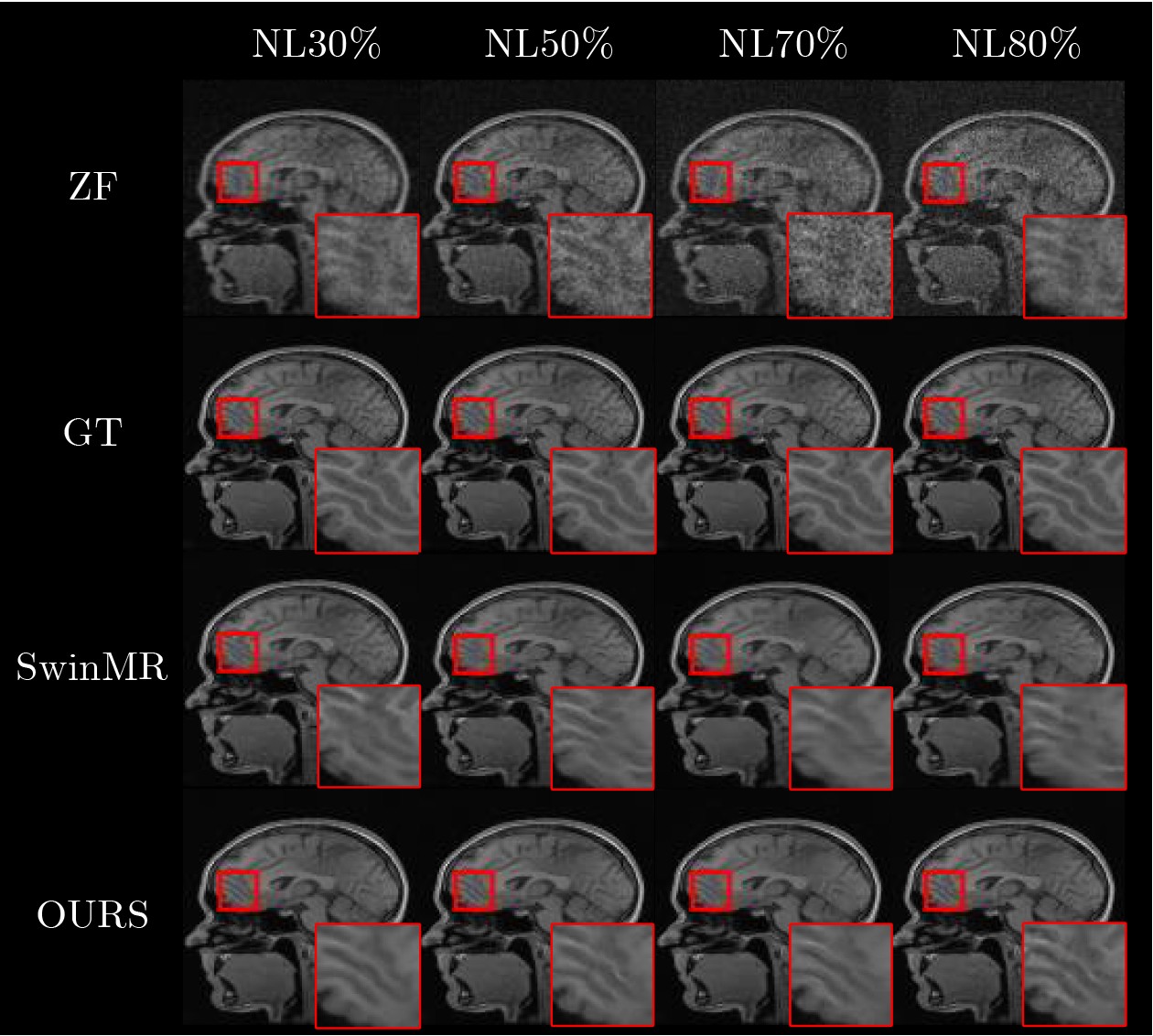
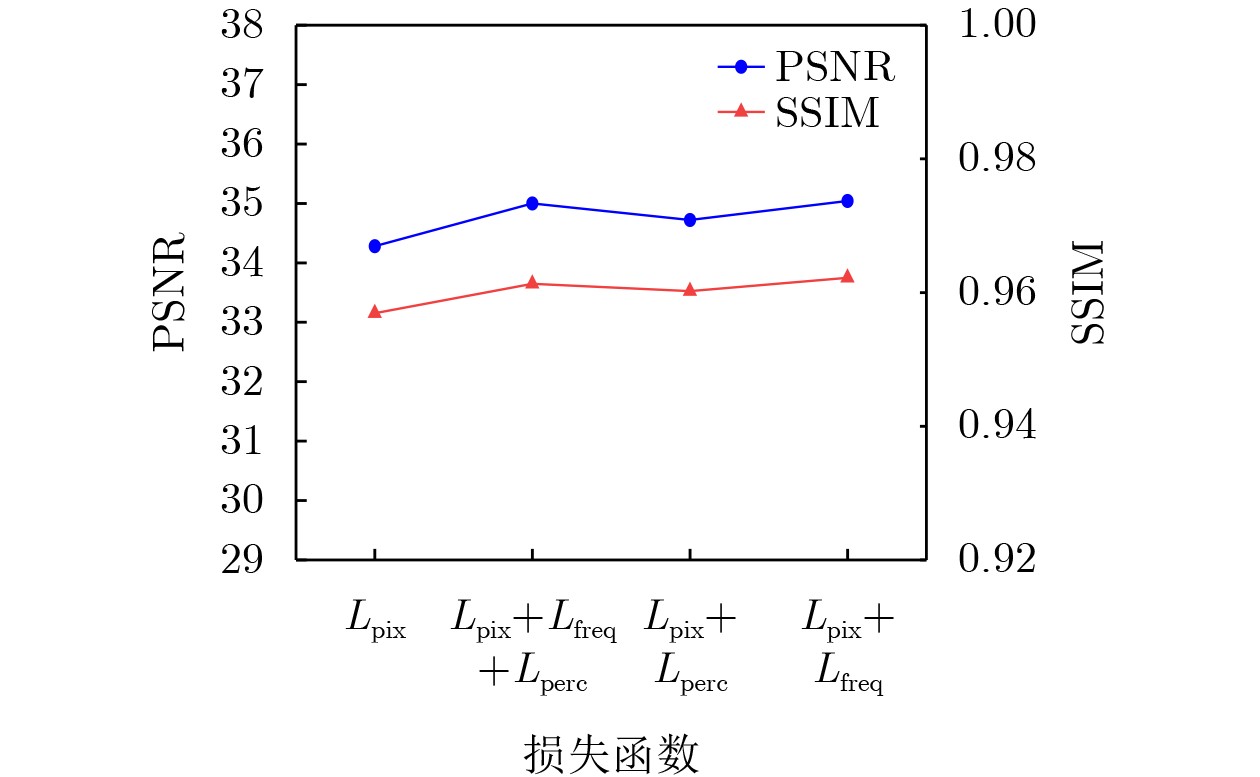
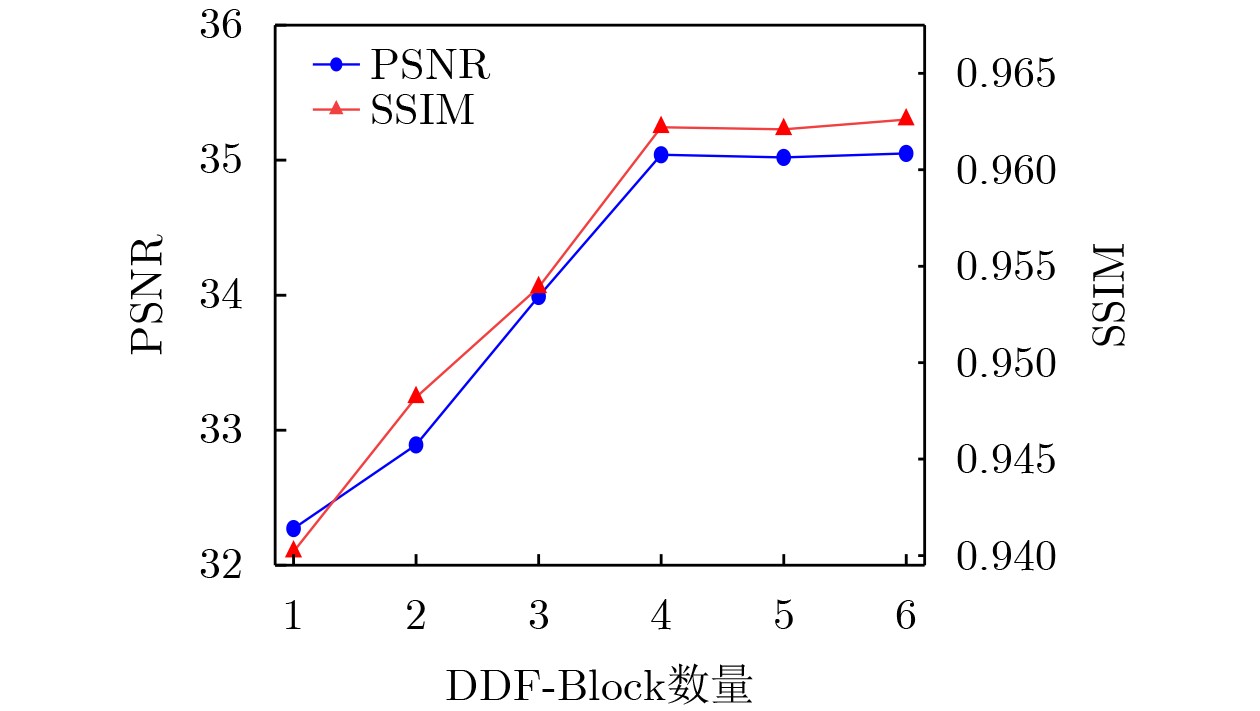
0.0037 ,0.0029 。Abstract:Objective In Magnetic Resonance Imaging (MRI), undersampling of k-space data is an effective approach to accelerating image acquisition. Reconstructing high-quality images from undersampled data is clinically important for improving diagnostic efficiency. Dual-domain reconstruction methods that jointly exploit spatial- and frequency-domain features are now widely used. However, existing dual-domain MRI reconstruction methods lack differentiated feature extraction strategies for the two domains and sufficient physical prior constraints, leading to the loss of original information during reconstruction. Methods To address these issues, this study proposes a Dual-Domain Differentiated Feature Extraction Network (DDF-Net) for MRI reconstruction. In the spatial domain, an interlaced row-column self-attention mechanism is combined with depthwise convolution to accurately capture anisotropic structures and texture details, addressing the limitations of conventional convolutional feature extraction. In the frequency domain, amplitude and phase characteristics are modeled independently to capture intensity and spatial location information, respectively. A frequency-domain feature enhancement module is used to fully exploit spectral information and improve reconstruction fidelity. Finally, a data consistency layer and a cross-domain adjustment module are incorporated to integrate physical priors and cross-domain information, reinforce measurement consistency, and stabilize reconstruction. Results and Discussions The proposed DDF-Net is evaluated on two publicly available MRI datasets, CC359 and IXI, and compared with six representative reconstruction algorithms, including DAGAN, KIKI-Net, MD-Recon-Net, SwinMR, Reconmer, and KTMR. As shown in Fig. 6 andFig. 7 , DDF-Net achieves the most faithful anatomical reconstruction under a one-dimensional Gaussian undersampling mask with a 30% sampling rate. It produces clearer cortical edges and finer texture details and effectively suppresses aliasing artifacts. The error maps exhibit more uniform residual distributions, indicating better consistency between the reconstructed and reference images. Quantitative comparisons (Table 1 andTable 2 ) show that DDF-Net attains the highest Peak Signal-to-Noise Ratio (PSNR) and Structural Similarity Index Measure (SSIM) values across all sampling patterns. Specifically, on the CC359 and IXI datasets, respectively, the improvements over the second-best method are 0.17 dB and 0.23 dB in PSNR and 0.0037 and 0.0029 in SSIM, yielding the best overall performance. These results demonstrate that differentiated feature extraction in the spatial and frequency domains enables DDF-Net to use complementary information from both domains for more accurate reconstruction. To further assess robustness, a noise experiment is conducted following the procedure used for SwinMR. Gaussian noise of varying intensities is added to the k-space data to vary the Noise Level (NL). As illustrated in Fig. 8 and summarized inTable 3 , DDF-Net is more robust to noise perturbations than SwinMR, maintaining higher PSNR and SSIM values under all tested noise conditions. Even at NL = 80%, DDF-Net effectively preserves most structural details, confirming that amplitude-phase separation and multiple data consistency layers jointly improve noise robustness and reconstruction stability.Conclusions This study proposes DDF-Net, an end-to-end network that addresses the limitations of existing dual-domain MRI reconstruction methods. These methods often lack differentiated feature extraction strategies for the two domains and sufficient physical prior constraints, which can lead to information loss during reconstruction. In the spatial domain, an interlaced row-column self-attention mechanism is designed to more effectively model local structures and texture details. In the frequency domain, amplitude-phase separation and a frequency-domain feature enhancement module improve the decoupling and utilization of spectral information. Furthermore, integrating a cross-domain adjustment module with multiple data consistency layers enhances cross-domain interaction and measurement consistency. Experimental results on the CC359 and IXI datasets demonstrate that DDF-Net achieves superior quantitative performance and visual reconstruction quality, recovering fine anatomical details. In addition, noise experiments confirm its robustness under complex conditions, showing that the network effectively preserves image details across different noise levels. Future work will focus on extending DDF-Net to unsupervised or semi-supervised learning frameworks to reduce dependence on labeled data and further enhance its potential for clinical applications in fast MRI reconstruction. -
表 1 不同方法在CC359数据集上的定量结果
重建方法 G1D G2D10% R10% 10% 30% 50% PSNR/SSIM PSNR/SSIM PSNR/SSIM PSNR/SSIM PSNR/SSIM ZF 23.19/ 0.6573 28.04/ 0.8791 32.86/ 0.8974 26.86/ 0.6813 24.02/ 0.6817 DAGAN[9] 27.55/ 0.8160 31.45/ 0.9239 37.02/ 0.9613 31.45/ 0.9169 28.16/ 0.8383 KIKI-Net[17] 28.12/ 0.8218 32.19/ 0.9303 37.27/ 0.9597 31.89/ 0.9207 28.67/ 0.8452 MD-Recon-Net[19] 29.36/ 0.8437 33.91/ 0.9583 37.73/ 0.9686 33.31/ 0.9233 29.71/ 0.8521 SwinMR[11] 29.91/ 0.8748 33.16/ 0.9439 39.47/ 0.9715 32.86/ 0.9239 30.34/ 0.8712 Reconmer[13] 30.54/ 0.8801 34.87/ 0.9595 39.71/ 0.9768 33.61/ 0.9265 31.25/ 0.8793 KTMR[14] 29.49/ 0.8598 32.67/ 0.9389 37.87/ 0.9610 32.17/ 0.9192 29.86/ 0.8608 本文 30.78/ 0.8842 35.04/ 0.9632 39.81/ 0.9779 33.76/ 0.9281 31.52/ 0.8831  下载: 导出CSV
表 2 不同方法在IXI数据集上的定量结果
重建方法 G1D G2D10% R10% 10% 30% 50% PSNR/SSIM PSNR/SSIM PSNR/SSIM PSNR/SSIM PSNR/SSIM ZF 23.19/ 0.6573 28.33/ 0.8855 32.98/ 0.8982 26.91/ 0.7238 24.37/ 0.6923 DAGAN[9] 27.95/ 0.8241 31.89/ 0.9342 37.02/ 0.9646 31.85/ 0.9226 28.42/ 0.8492 KIKI-Net[17] 28.42/ 0.8304 32.42/ 0.9377 37.52/ 0.9621 32.09/ 0.9234 28.69/ 0.8580 MD-Recon-Net[19] 29.96/ 0.8540 34.41/ 0.9598 37.91/ 0.9750 33.81/ 0.9282 29.49/ 0.8683 SwinMR[11] 30.42/ 0.8771 34.28/ 0.9651 39.54/ 0.9742 33.92/ 0.9271 31.08/ 0.8764 Reconmer[13] 30.69/ 0.8841 35.11/ 0.9662 39.59/ 0.9780 34.11/ 0.9262 31.71/ 0.8809 KTMR[14] 29.27/ 0.8612 32.92/ 0.9430 37.96/ 0.9654 32.89/ 0.9219 30.24/ 0.8674 本文 31.08/ 0.8972 35.34/ 0.9691 39.90/ 0.9809 34.21/ 0.9307 31.93/ 0.8952
下载: 导出CSV
表 3 CC359上不同算法采用G1D30%掩模在不同噪声下的定量结果分析
重建方法 NL30% NL50% NL70% NL80% PSNR/SSIM PSNR/SSIM PSNR/SSIM PSNR/SSIM ZF 26.08/ 0.7792 24.49/ 0.6819 22.19/ 0.5270 20.19/ 0.4219 SwinMR[11] 30.59/ 0.9121 28.43/ 0.9003 27.63/ 0.8748 27.25/ 0.8643 Ours 30.78/ 0.9172 29.54/ 0.9107 28.62/ 0.8909 28.32/ 0.8863
下载: 导出CSV
表 4 消融实验结果
IRCSA APS FDFE CDAM Batch Norm Layer Norm IXI CC359 PSNR/SSIM PSNR/SSIM √ √ √ √ 35.24/ 0.9661 34.83/ 0.9571 √ √ √ √ 35.30/ 0.9671 34.98/ 0.9579 √ √ √ √ 35.24/ 0.9665 34.78/ 0.9615 √ √ √ √ 35.29/ 0.9673 34.92/ 0.9597 √ √ √ √ √ 35.31/ 0.9676 34.98/ 0.9627 √ √ √ √ √ 35.34/ 0.9691 35.04/ 0.9632
下载: 导出CSV
表 5 不同网络结构配置的性能与复杂度对比
模型 DDF-Block层数 CDAM Params (M) FLOPs (G) Test Inference Time(s) CC359 PSNR/SSIM Case1 3 Π 6.52 136.27 0.764$ \pm $0.005 33.99/ 0.9539 Case2 4 10.95 205.45 1.137$ \pm $0.006 34.92/ 0.9597 Case3 5 Π 16.56 297.02 1.849$ \pm $0.005 35.02/ 0.9624 DDF-Net 4 Π 11.07 210.23 1.174$ \pm $0.007 35.04/ 0.9632
下载: 导出CSV
-
[1] 刘侠, 吕志伟, 李博, 等. 基于多尺度残差双域注意力网络的乳腺动态对比度增强磁共振成像肿瘤分割方法[J]. 电子与信息学报, 2023, 45(5): 1774–1785. doi: 10.11999/JEIT220362.LIU Xia, LÜ Zhiwei, LI Bo, et al. Segmentation algorithm of breast tumor in dynamic contrast-enhanced magnetic resonance imaging based on network with multi-scale residuals and dual-domain attention[J]. Journal of Electronics & Information Technology, 2023, 45(5): 1774–1785. doi: 10.11999/JEIT220362. [2] 宋笑影, 郝春雨, 柴利. 面向注意力缺陷多动障碍分类的多分辨率时空融合图卷积网络[J]. 电子与信息学报, 2025, 47(6): 1927–1936. doi: 10.11999/JEIT240872.SONG Xiaoying, HAO Chunyu, and CHAI Li. Multi-resolution spatio-temporal fusion graph convolutional network for attention deficit hyperactivity disorder classification[J]. Journal of Electronics & Information Technology, 2025, 47(6): 1927–1936. doi: 10.11999/JEIT240872. [3] SAFARI M, EIDEX Z, CHANG C W, et al. Advancing MRI reconstruction: A systematic review of deep learning and compressed sensing integration[J]. Biomedical Signal Processing and Control, 2026, 111: 108291. doi: 10.1016/J.bspc.2025.108291. [4] LYU Weiyi, FANG Xinming, HUANG Chaoyan, et al. Fast MRI reconstruction: A thorough survey from single-modal to multi-modal[J]. Expert Systems with Applications, 2025, 283: 127703. doi: 10.1016/J.eswa.2025.127703. [5] HAMILTON J, FRANSON D, and SEIBERLICH N. Recent advances in parallel imaging for MRI[J]. Progress in Nuclear Magnetic Resonance Spectroscopy, 2017, 101: 71–95. doi: 10.1016/j.pnmrs.2017.04.002. [6] 蒋明峰, 刘渊, 徐文龙, 等. 基于全变分扩展方法的压缩感知磁共振成像算法研究[J]. 电子与信息学报, 2015, 37(11): 2608–2612. doi: 10.11999/JEIT150179.JIANG Mingfeng, LIU Yuan, XU Wenlong, et al. The study of compressed sensing MR image reconstruction algorithm based on the extension of total variation method[J]. Journal of Electronics & Information Technology, 2015, 37(11): 2608–2612. doi: 10.11999/JEIT150179. [7] WANG Shanshan, SU Zhenghang, YING L, et al. Accelerating magnetic resonance imaging via deep learning[C]. Proceedings of 2016 IEEE 13th International Symposium on Biomedical Imaging (ISBI), Prague, Czech Republic, 2016: 514–517. doi: 10.1109/ISBI.2016.7493320. [8] SCHLEMPER J, CABALLERO J, HAJNAL J V, et al. A deep cascade of convolutional neural networks for dynamic MR image reconstruction[J]. IEEE Transactions on Medical Imaging, 2018, 37(2): 491–503. doi: 10.1109/TMI.2017.2760978. [9] YANG Guang, YU Simiao, DONG Hao, et al. DAGAN: Deep de-aliasing generative adversarial networks for fast compressed sensing MRI reconstruction[J]. IEEE Transactions on Medical Imaging, 2018, 37(6): 1310–1321. doi: 10.1109/TMI.2017.2785879. [10] HUANG Jiahao, DING Weiping, LV Jun, et al. Edge-enhanced dual discriminator generative adversarial network for fast MRI with parallel imaging using multi-view information[J]. Applied Intelligence, 2022, 52(13): 14693–14710. doi: 10.1007/s10489-021-03092-w. [11] HUANG Jiahao, FANG Yingying, WU Yinzhe, et al. Swin transformer for fast MRI[J]. Neurocomputing, 2022, 493: 281–304. doi: 10.1016/J.neucom.2022.04.051. [12] LIU Ze, LIN Yutong, CAO Yue, et al. Swin transformer: Hierarchical vision transformer using shifted windows[C]. Proceedings of 2021 IEEE/CVF International Conference on Computer Vision (ICCV), Montreal, Canada, 2021: 9992–10002. doi: 10.1109/ICCV48922.2021.00986. [13] GUO Pengfei, MEI Yiqun, ZHOU Jinyuan, et al. ReconFormer: Accelerated MRI reconstruction using recurrent transformer[J]. IEEE Transactions on Medical Imaging, 2024, 43(1): 582–593. doi: 10.1109/TMI.2023.3314747. [14] WU Zhengliang, LIAO Weibin, YAN Chao, et al. Deep learning based MRI reconstruction with transformer[J]. Computer Methods and Programs in Biomedicine, 2023, 233: 107452. doi: 10.1016/J.cmpb.2023.107452. [15] LIANG Jingyun, CAO Jiezhang, SUN Guolei, et al. SwinIR: Image restoration using Swin transformer[C]. Proceedings of 2021 IEEE/CVF International Conference on Computer Vision Workshops (ICCVW), Montreal, Canada, 2021: 1833–1844. doi: 10.1109/ICCVW54120.2021.00210. [16] RAMANARAYANAN S, RAHUL G S, AL FAHIM M, et al. SHFormer: Dynamic spectral filtering convolutional neural network and high-pass kernel generation transformer for adaptive MRI reconstruction[J]. Neural Networks, 2025, 187: 107334. doi: 10.1016/J.neunet.2025.107334. [17] EO T, JUN Y, KIM T, et al. KIKI‐net: Cross‐domain convolutional neural networks for reconstructing undersampled magnetic resonance images[J]. Magnetic Resonance in Medicine, 2018, 80(5): 2188–2201. doi: 10.1002/mrm.27201. [18] WANG Zhilun, JIANG Haitao, DU Hongwei, et al. IKWI-net: A cross-domain convolutional neural network for undersampled magnetic resonance image reconstruction[J]. Magnetic Resonance Imaging, 2020, 73: 1–10. doi: 10.1016/j.mri.2020.06.015. [19] RAN Maosong, XIA Wenjun, HUANG Yongqiang, et al. MD-Recon-Net: A parallel dual-domain convolutional neural network for compressed sensing MRI[J]. IEEE Transactions on Radiation and Plasma Medical Sciences, 2021, 5(1): 120–135. doi: 10.1109/trpms.2020.2991877. [20] LIU Yu, PANG Yanwei, LIU Xiaohan, et al. DIIK-Net: A full-resolution cross-domain deep interaction convolutional neural network for MR image reconstruction[J]. Neurocomputing, 2023, 517: 213–222. doi: 10.1016/j.neucom.2022.09.048. [21] LIU Qiaohong, ZHANG Weikun, ZHANG Yuting, et al. DGEDDGAN: A dual-domain generator and edge-enhanced dual discriminator generative adversarial network for MRI reconstruction[J]. Magnetic Resonance Imaging, 2025, 119: 110381. doi: 10.1016/J.mri.2025.110381. [22] 李秀梅, 丁林琳, 孙军梅, 等. SR-FDN: 面向图像细节恢复的频域扩散超分辨率重建网络[J]. 电子与信息学报, 2025, 47(10): 3941–3950. doi: 10.11999/JEIT250224.LI Xiumei, DING Linlin, SUN Junmei, et al. SR-FDN: A frequency-domain diffusion network for image detail restoration in super-resolution[J]. Journal of Electronics & Information Technology, 2025, 47(10): 3941–3950. doi: 10.11999/JEIT250224. -

 下载:
下载:

图(10) / 表(5)
计量
- 文章访问数: 217
- HTML全文浏览量: 38
- PDF下载量: 13
- 被引次数: 0
