




Real-Time Sub-bottom Horizon Picking Based on Maximum Correlated Kurtosis Deconvolution Combined with Continuity Constraint
-
摘要: 针对现有浅地层层界提取方法在在线应用中难以兼顾提取质量、虚警抑制与处理延迟的问题,该文提出了联合最大相关峭度解卷积与连续性约束的浅地层层界实时提取方法,并构建预处理、粗提取与精细提取的逐ping处理流程。预处理阶段采用带通滤波级联匹配滤波对回波信号增强,并对匹配滤波输出进行固定时延校正;粗提取阶段在多个切片步长下构造合成周期信号并应用最大相关峭度解卷积方法获得潜在层界序列,随后基于跨步长一致性对潜在层界进行筛选融合以抑制虚警;精细提取阶段引入层界连续性约束,对粗提取结果进行有效层界点的筛选、层界划分与曲线拟合修正,进一步抑制残余虚警并提高层界连续性。仿真结果表明,当回波信噪比高于–10 dB时,层界检测概率超过99.000%,虚警概率低于0.100%,层界定位误差约为1个样本点;实测数据处理结果显示,对不同层界的平均检测概率为91.833%,平均虚警概率为0.004%,平均定位误差约为10个样本点。仿真和实测数据处理均实现了海底表面和沉积层界的有效提取,验证了方法的有效性和实用价值。Abstract:
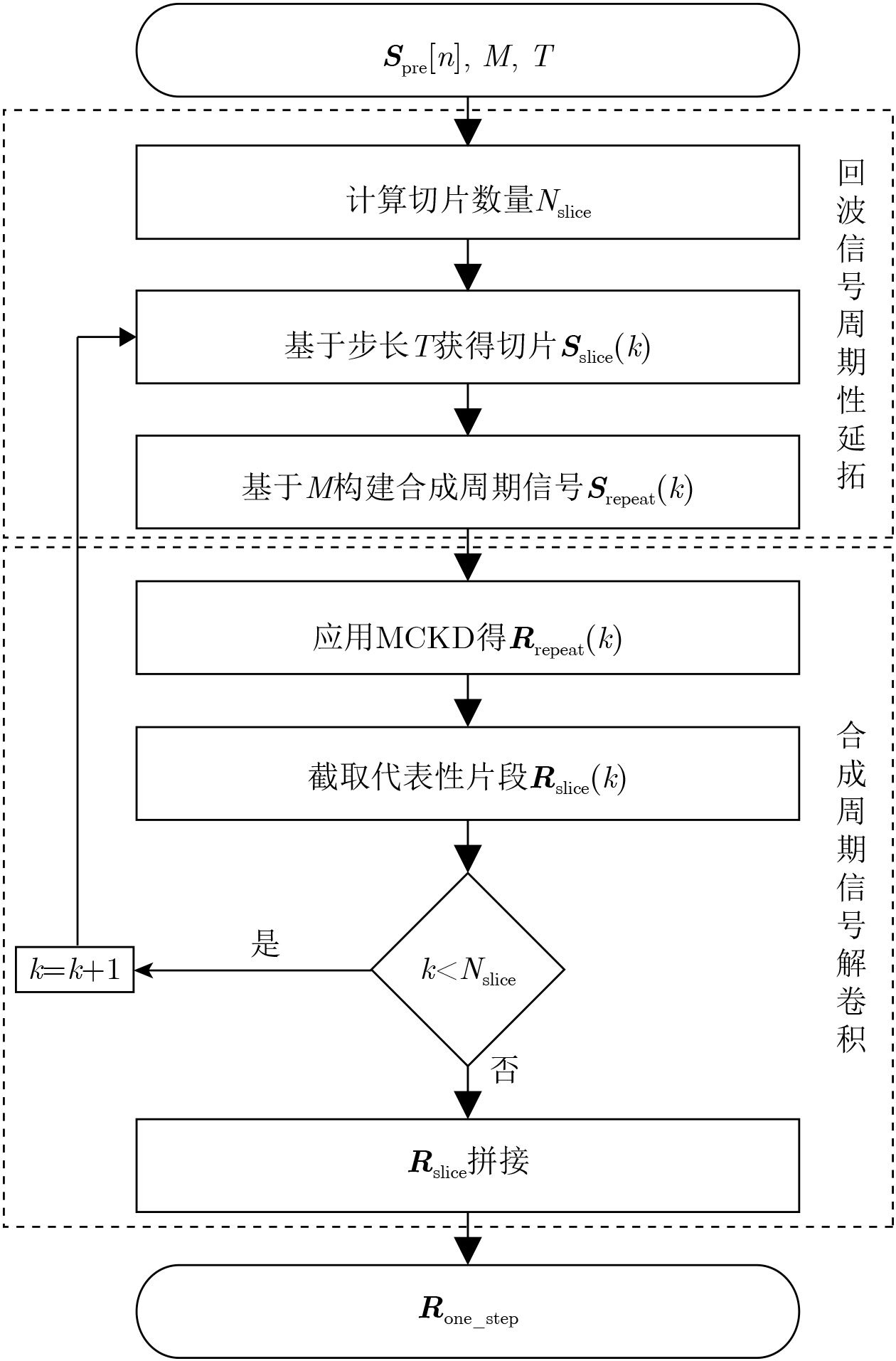
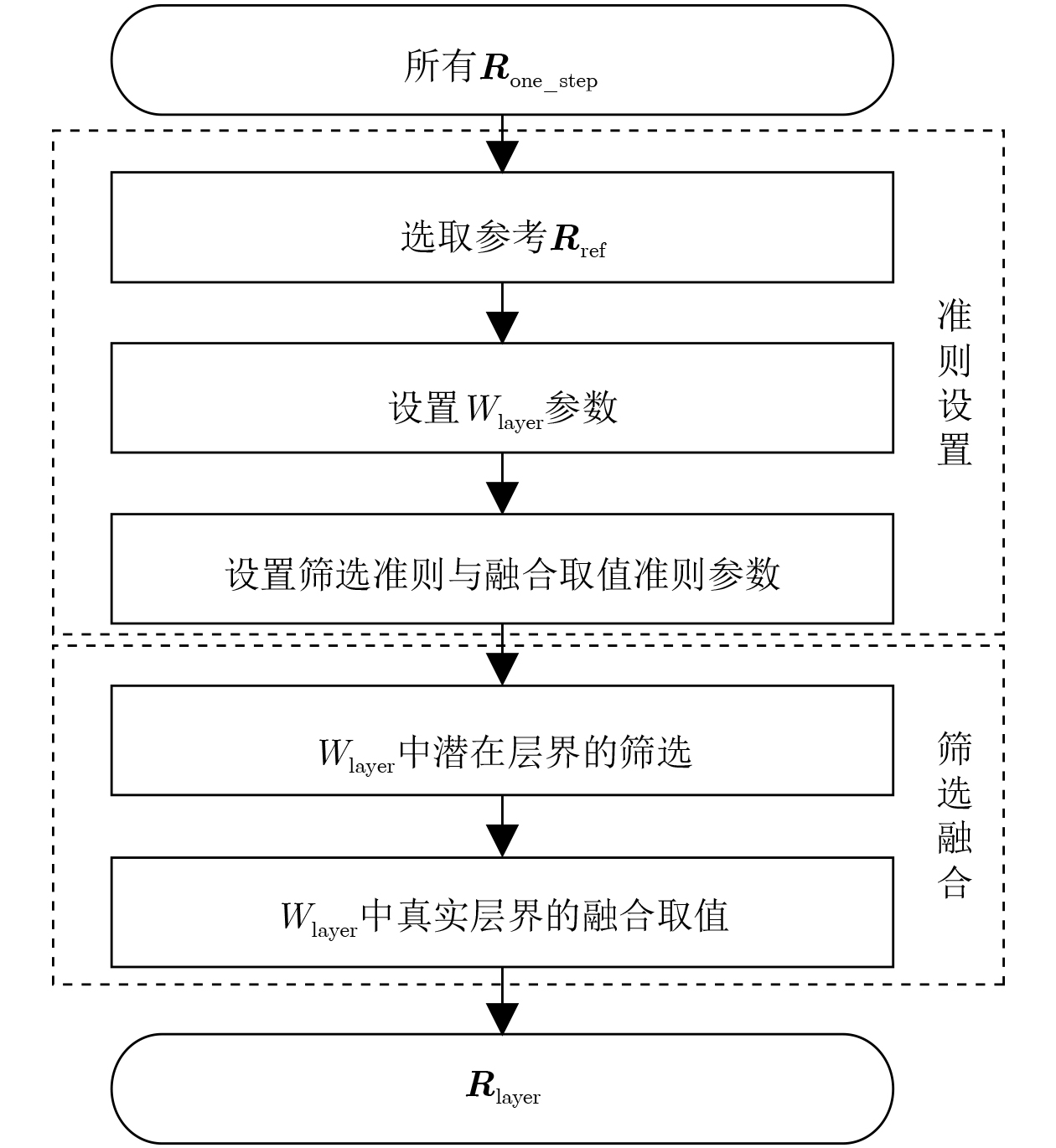
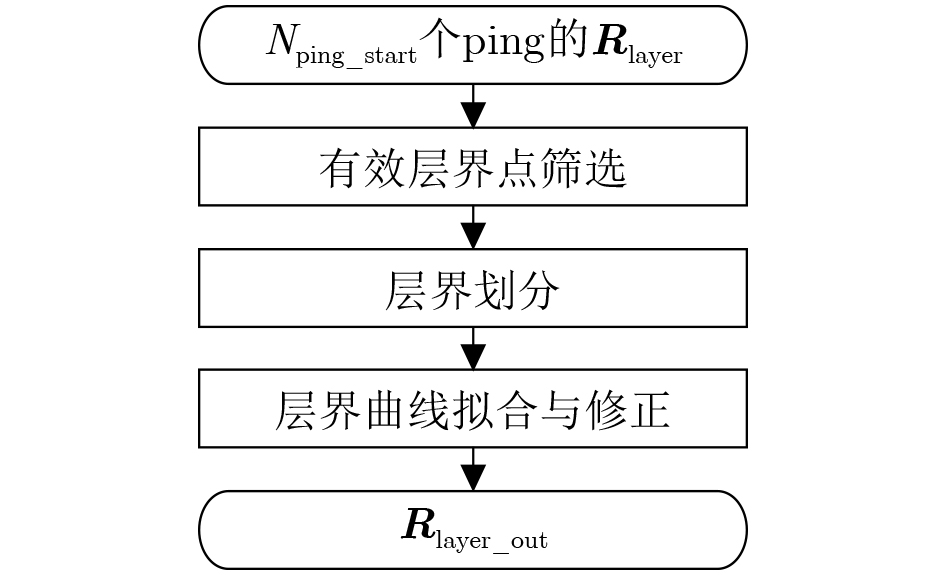
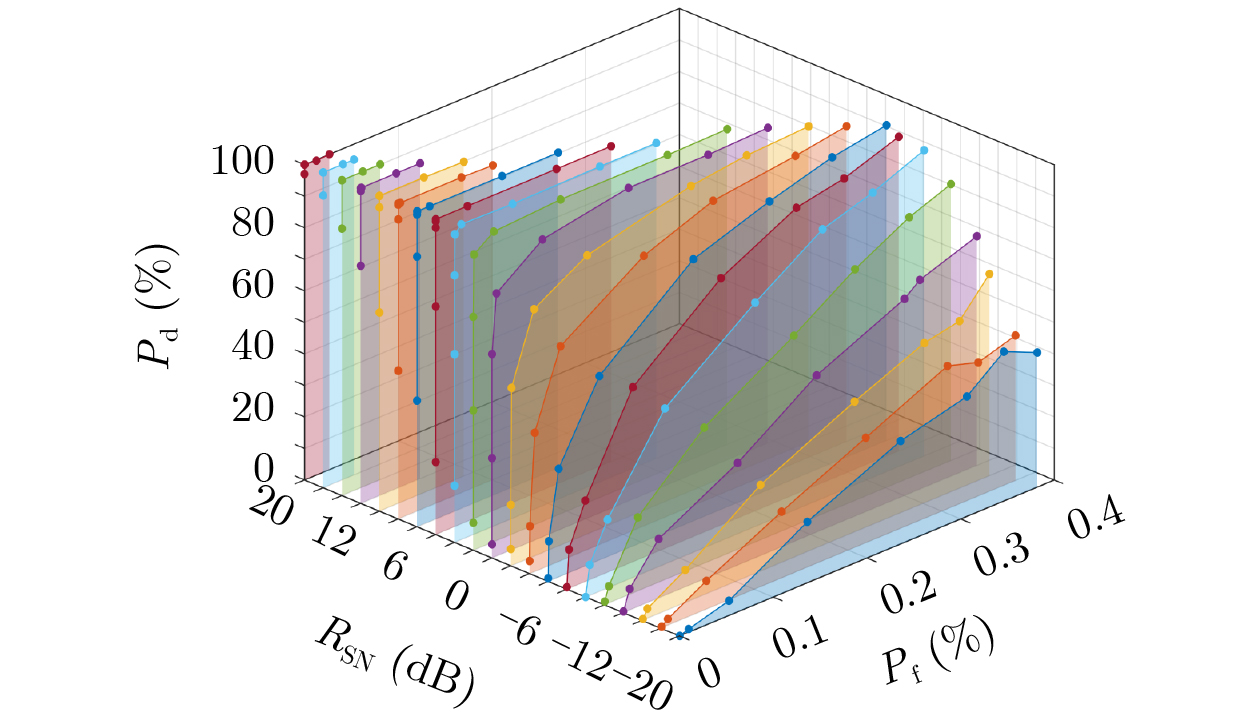
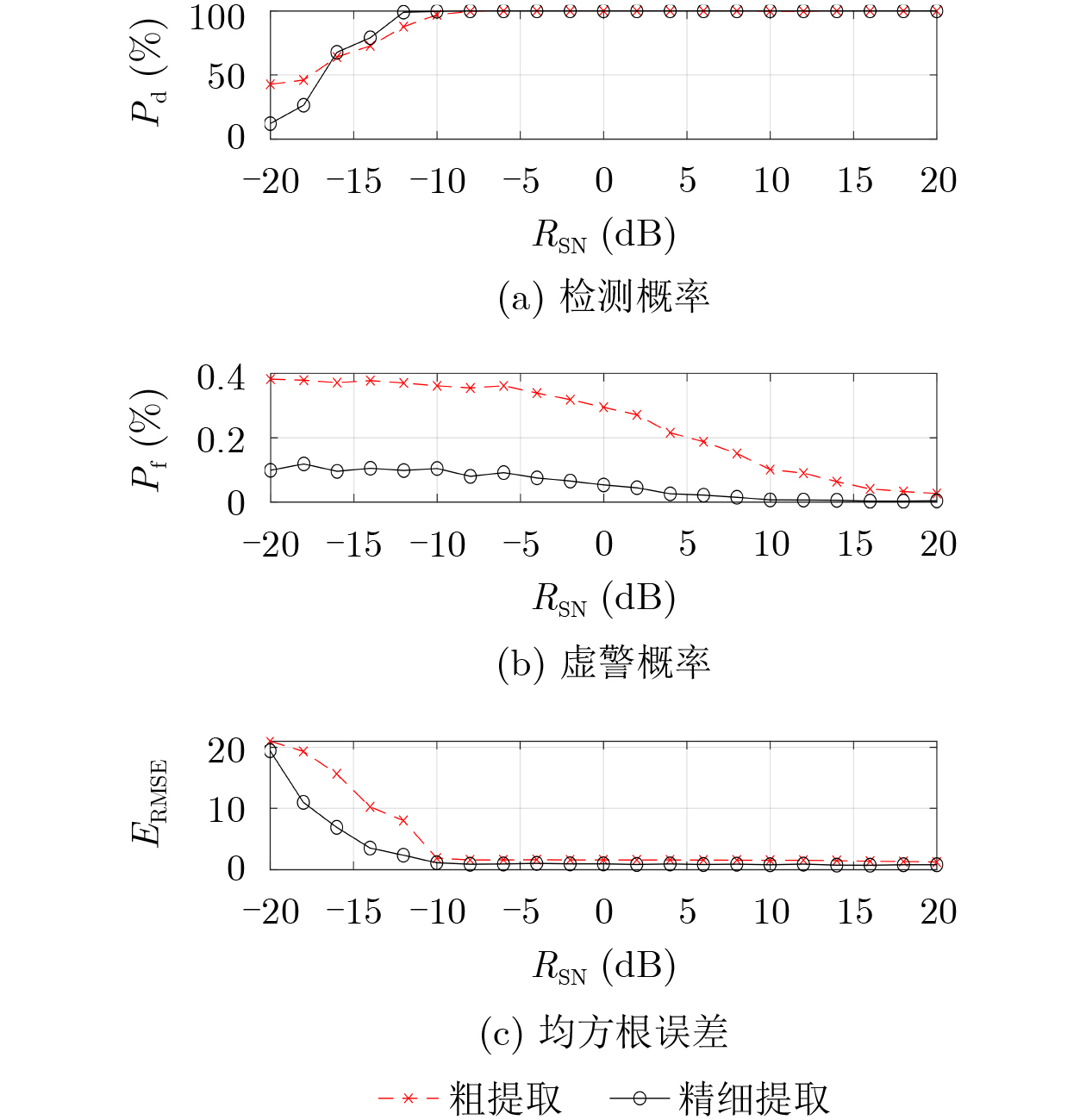
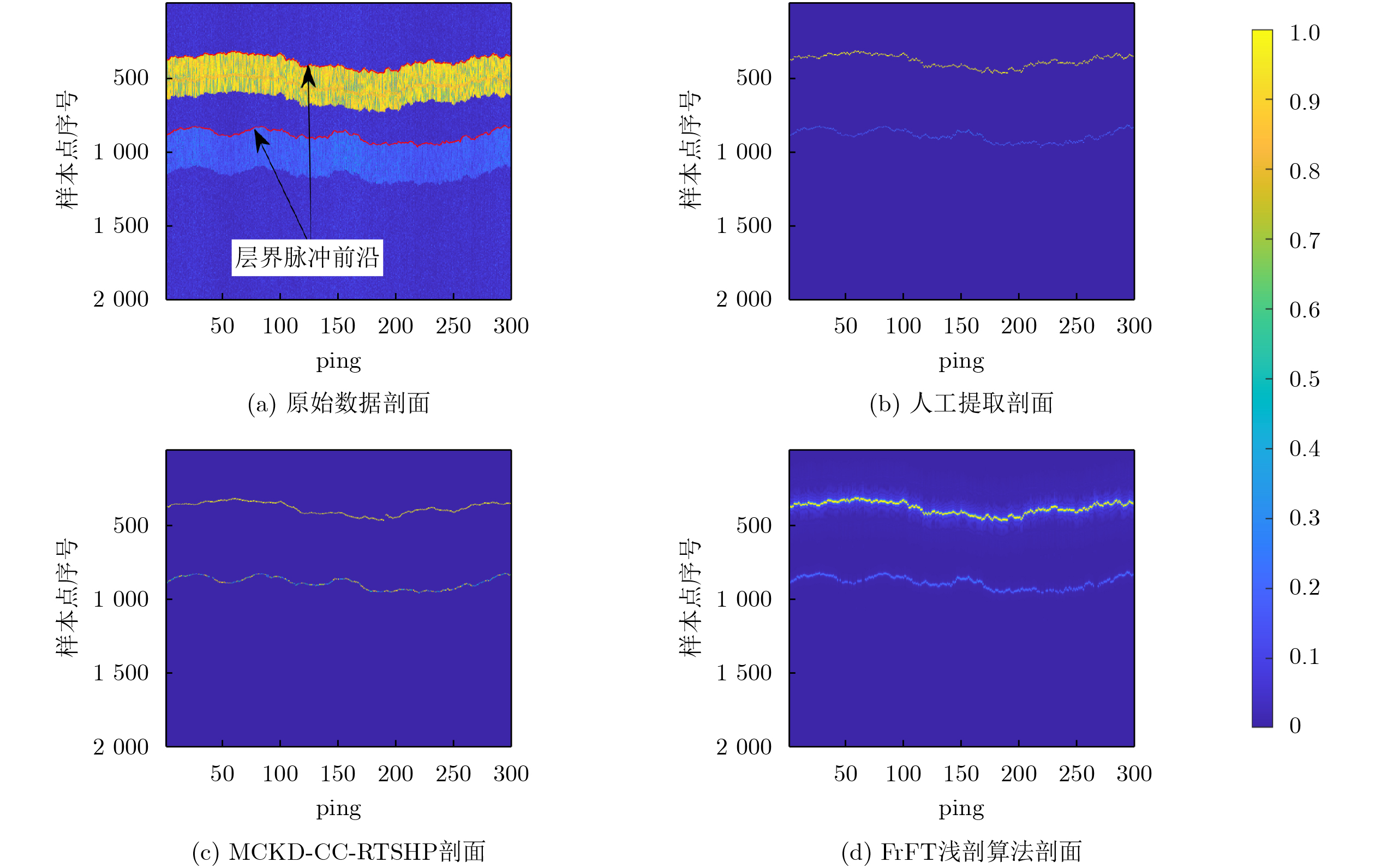
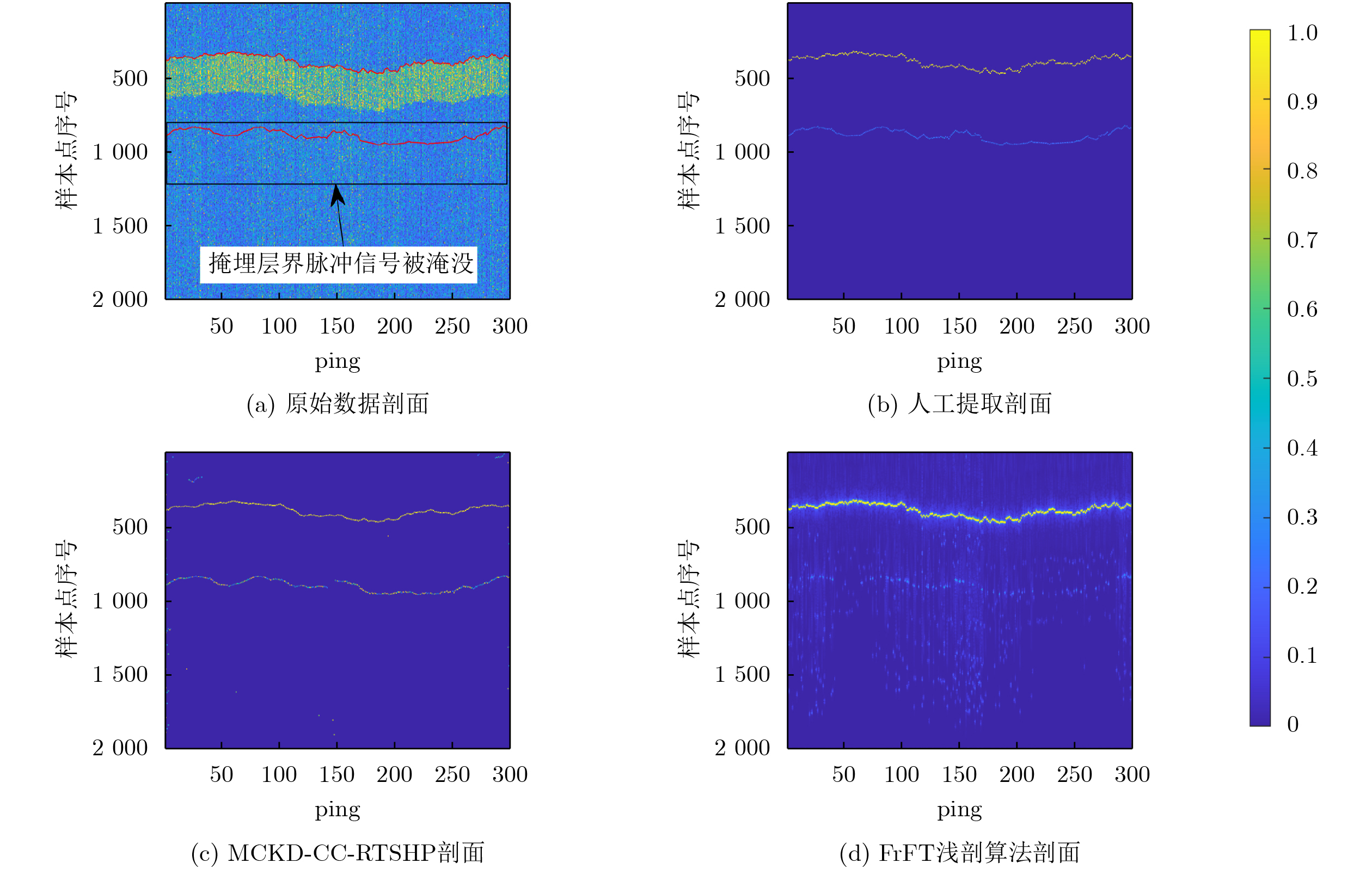
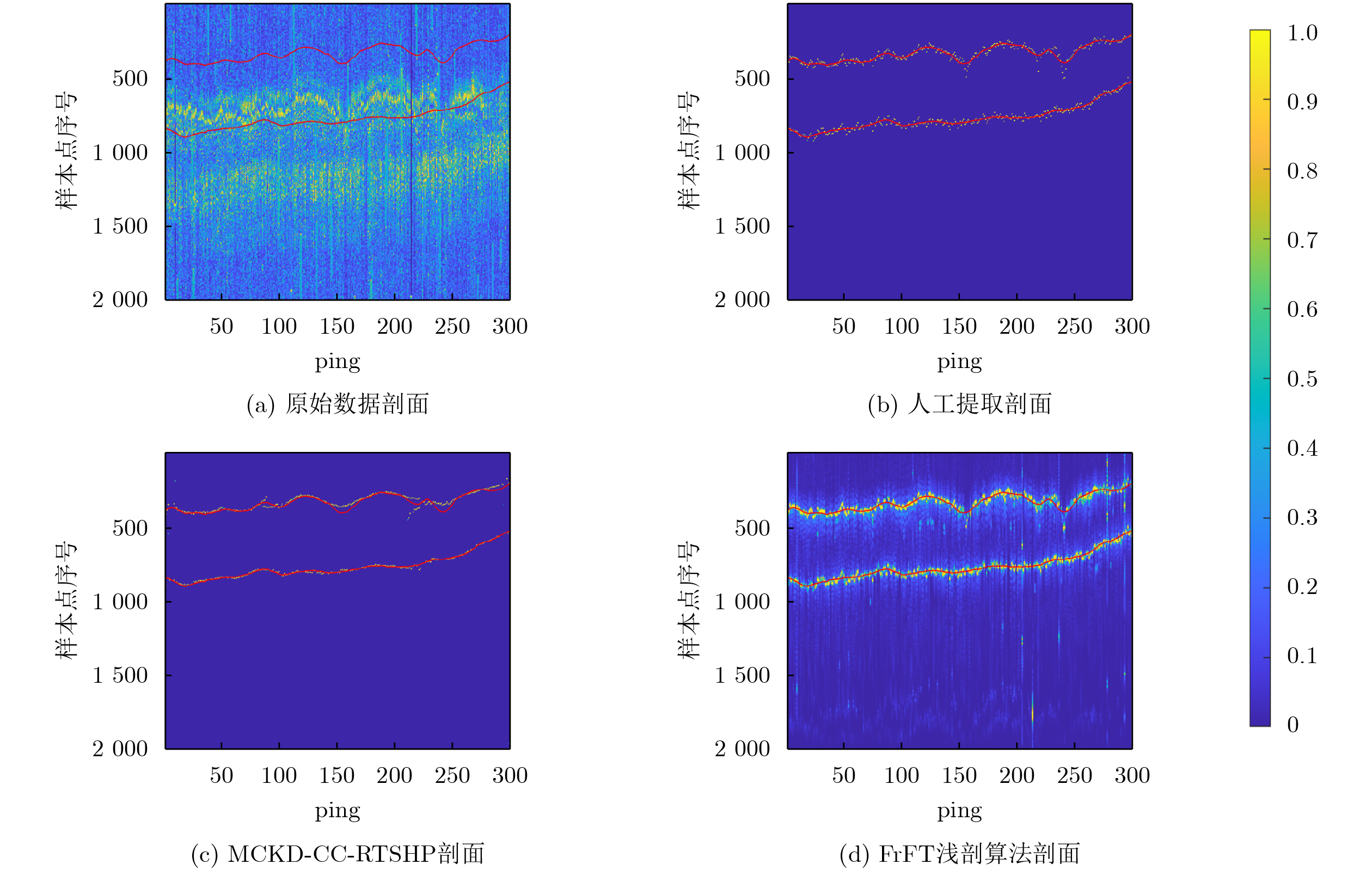
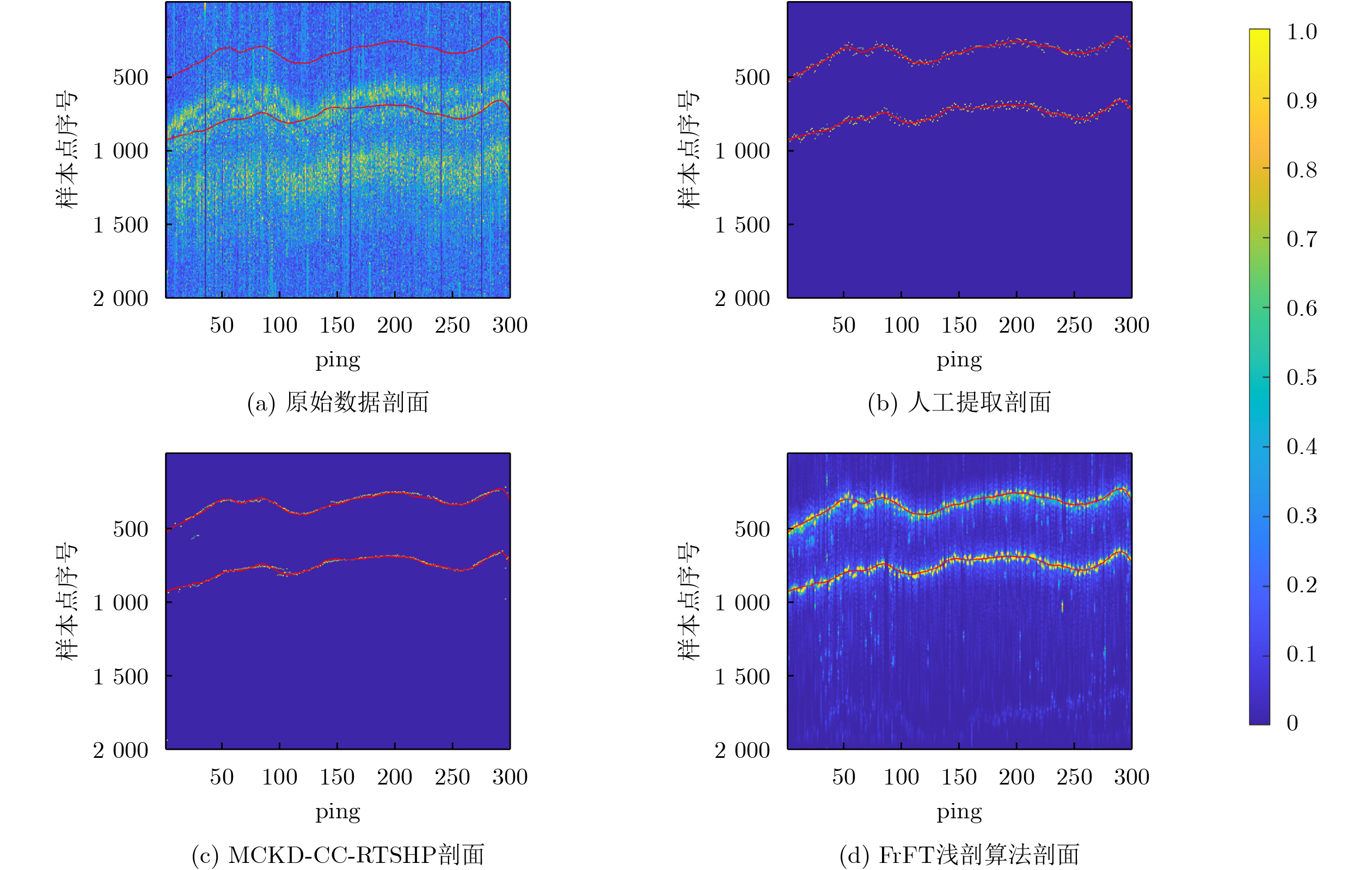
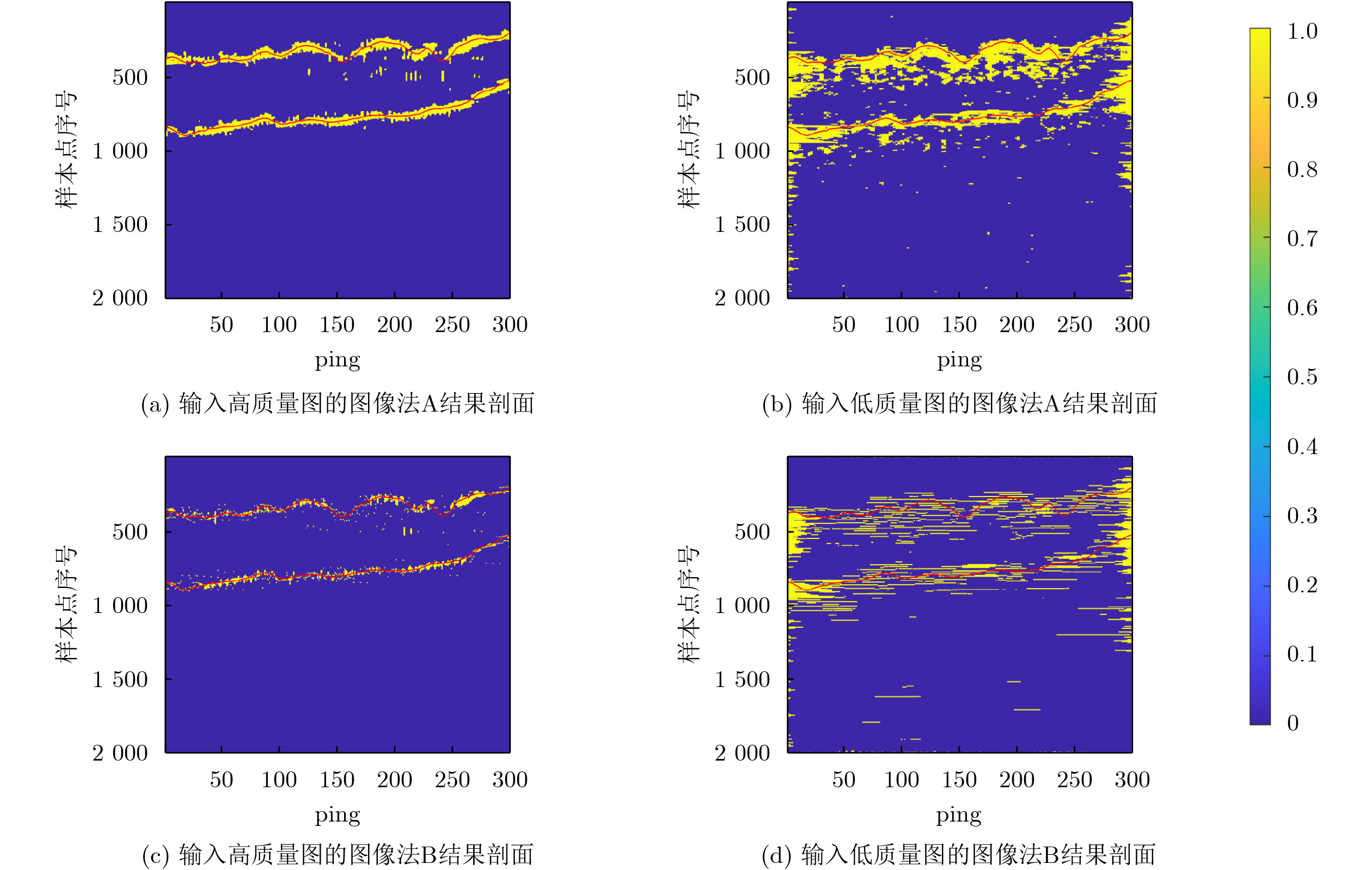
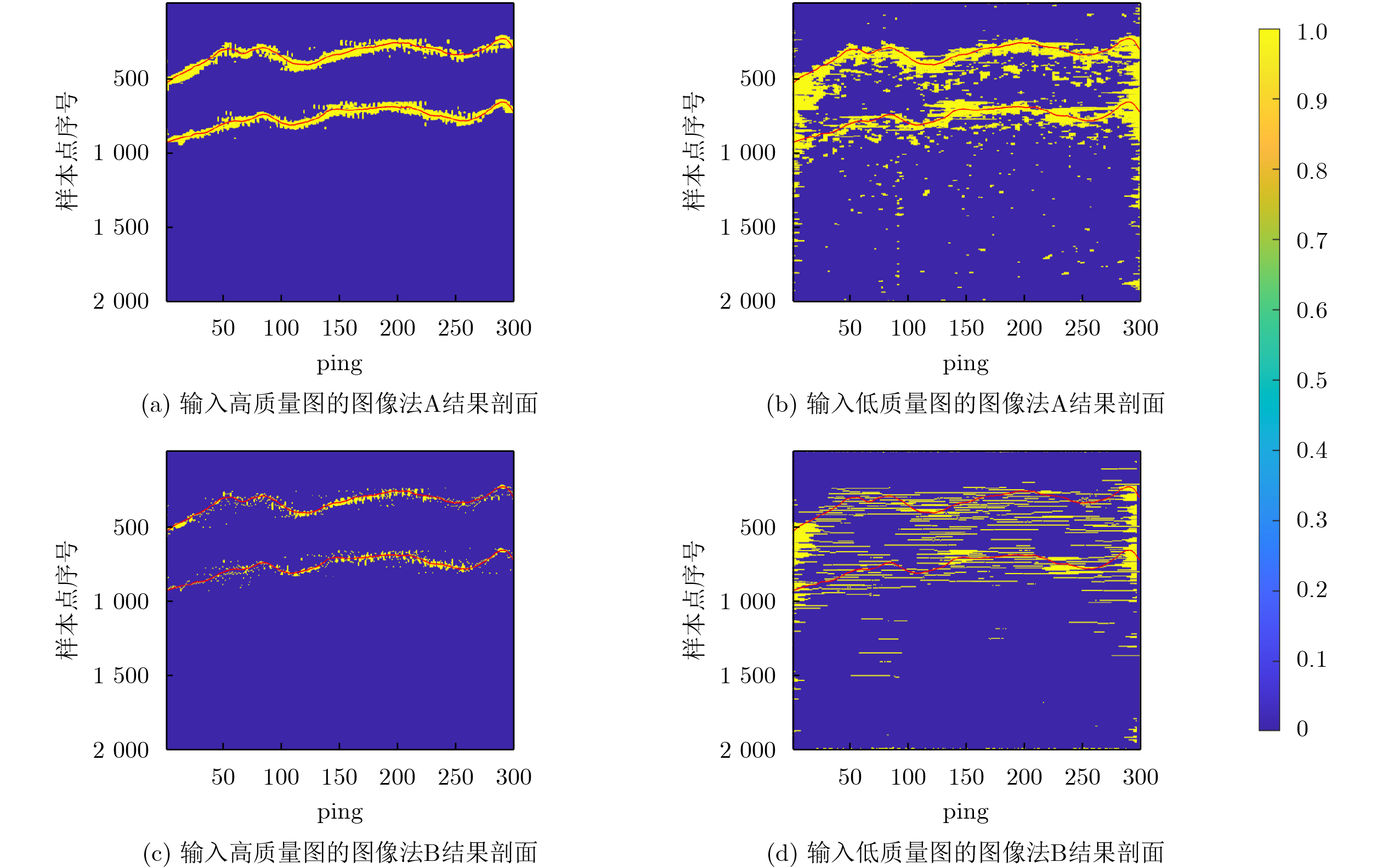
Objective Sub-bottom profiling is widely used in seabed geological and resource exploration, pipeline route inspection, and port and channel safety assessment. It is also a major topic in underwater acoustic detection. Accurate sub-bottom horizon picking is critical for interpreting sedimentary structures, analyzing seabed substrate characteristics, and identifying buried objects. However, existing horizon-picking methods often cannot balance picking quality, false-alarm suppression, and online real-time performance. To address this problem, this paper proposes a real-time sub-bottom horizon-picking method based on Maximum Correlated Kurtosis Deconvolution (MCKD) combined with continuity constraint. Methods The proposed method includes three stages: preprocessing, coarse horizon extraction, and fine horizon extraction. In preprocessing, raw echoes are enhanced by cascaded band-pass filtering and matched filtering. Fixed-delay correction is then performed to align the picked positions with pulse leading-edge arrivals. In coarse horizon extraction, synthesized periodic signals are constructed under multiple slicing step lengths. MCKD is then applied to enhance impulsive horizon responses and obtain potential horizon sequences. These candidates are screened and fused using a cross-step-length consistency criterion to suppress false alarms. In fine horizon extraction, a continuity constraint is applied within an online sliding window. This process removes isolated points, segments horizons, and performs curve fitting and correction, thereby further reducing residual false alarms and improving horizon continuity. Results and Discussions Simulation and field data experiments were conducted to evaluate detection probability, false-alarm probability, horizon positioning error, processing time, and extracted horizon profiles. Monte Carlo results show that fine horizon extraction further reduces false alarms and positioning errors while maintaining detection performance close to that of coarse horizon extraction ( Fig. 5 ,Fig. 6 ). When the echo Signal-to-Noise Ratio (SNR) is higher than –15 dB, the detection probability exceeds 70.000%, and the false-alarm probability remains below 0.200%. When the SNR is higher than –10 dB, the detection probability exceeds 99.000%, the false-alarm probability is below 0.100%, and the positioning error is close to one sample point (Fig. 6 ). In the sub-bottom survey simulation, the proposed method successfully extracts both the seabed surface and the buried sedimentary horizon under different noise conditions. Its results are more refined than those obtained using the Fractional Fourier Transform (FrFT)-based algorithm and are generally comparable to manual interpretation (Fig. 7 ,Fig. 8 ). Field data results further confirm the effectiveness of the method. In comparison with signal-based algorithms, the proposed method achieves an average detection probability of 91.833%, an average false-alarm probability of 0.004%, and an average positioning error of 10.15 samples. By contrast, the FrFT-based algorithm produces a much higher false-alarm probability of 3.987% (Table 1 ). In comparison with image-based algorithms, although their detection probabilities exceed 95%, their false-alarm probabilities and processing times are much higher than those of the proposed method (Table 2 ). Qualitative results also show that the extracted horizons agree well with manual interpretation trends. The proposed method yields lower background noise, avoids obvious large-scale false horizons, and preserves local fluctuations and possible interruptions in real horizons (Figs. 9 –12 ). Overall, the method provides a better balance for online horizon picking by combining acceptable detection probability and positioning accuracy with an extremely low false-alarm probability and real-time processing capability (Table 1 ,Table 2 ).Conclusions This study presents a real-time sub-bottom horizon-picking method based on MCKD combined with continuity constraint. The method is organized into preprocessing, coarse horizon extraction, and fine horizon extraction. It effectively extracts the seabed surface and sedimentary horizons while meeting real-time processing requirements. Simulation results show that, when the SNR exceeds –10 dB, the method achieves a detection probability greater than 99.000%, a false-alarm probability below 0.100%, and a positioning error close to one sample point. Field data processing results show an average detection probability of 91.833%, an average false-alarm probability of 0.004%, and an average positioning error of 10.15 samples. These results confirm the effectiveness and practical value of the proposed method for real-time sub-bottom horizon picking. The method maintains high detection performance, suppresses false alarms, and achieves millisecond-level processing, making it suitable for online sub-bottom horizon-picking tasks in practical applications. -
Key words:
- Sub-bottom profiling /
- Horizon picking /
- Correlated kurtosis /
- Deconvolution /
- Continuity constraint
-
表 1 不同信号类方法的实测层界提取性能参数
方法名称 MCKD-CC-RTSHP方法 FrFT浅剖算法 层界代号 L1,1 L1,2 L2,1 L2,2 L1,1 L1,2 L2,1 L2,2 $ {P}_{\mathrm{d}} $ (%) 90.000 92.000 94.000 91.333 100.000 100.000 100.000 100.000 $ {\overline{P}}_{\text{d}} $ (%) 91.833 100.000 $ {P}_{\mathrm{f}} $ (%) 0.006 0.006 0.002 0.002 3.978 3.978 3.995 3.995 $ {\overline{P}}_{\text{f}} $ (%) 0.004 3.987 $ {E}_{\mathrm{RMSE}} $ 14.65 6.38 8.57 11.01 9.10 8.08 8.06 9.13 $ {\overline{E}}_{\mathrm{RMSE}} $ 10.15 8.59 $ {t}_{\text{ping}} $ (ms) 11.994 11.840 8.798 9.028 $ {\overline{t}}_{\text{ping}} $ (ms) 11.917 8.913  下载: 导出CSV
表 2 不同图像类方法的实测层界提取性能参数
方法名称 图像法A 图像法B 层界代号 $ {\text{L}}_{1,1} $ $ {\text{L}}_{1,2} $ $ {\text{L}}_{2,1} $ $ {\text{L}}_{2,2} $ $ {\text{L}}_{1,1} $ $ {\text{L}}_{1,2} $ $ {\text{L}}_{2,1} $ $ {\text{L}}_{2,2} $ $ {P}_{\mathrm{d}} $ (%) 96.667 100.000 100.000 99.333 96.000 97.333 98.333 98.333 $ {\overline{P}}_{\text{d}} $ (%) 99.000 97.500 $ {P}_{\mathrm{f}} $ (%) 0.479 0.479 0.764 0.764 0.063 0.063 0.095 0.095 $ {\overline{P}}_{\text{f}} $ (%) 0.622 0.079 $ {E}_{\mathrm{RMSE}} $ 5.36 3.28 1.61 4.78 9.50 7.41 9.24 10.56 $ {\overline{E}}_{\mathrm{RMSE}} $ 3.76 9.18 $ {t}_{\text{img}} $ (ms) 791.488 791.828 1616.751 1668.398 $ {\overline{t}}_{\text{img}} $ (ms) 791.658 1642.575
下载: 导出CSV
-
[1] SHIN J, HA J, CHUN J H, et al. Field application of 3D chirp for geological surveys of shallow coastal regions[J]. Marine Geophysical Research, 2022, 43(2): 13. doi: 10.1007/s11001-022-09477-x. [2] ZHOU Qingjie, LI Xianfeng, ZHENG Jianglong, et al. Inversion of sub-bottom profile based on the sediment acoustic empirical relationship in the northern South China Sea[J]. Remote Sensing, 2024, 16(4): 631. doi: 10.3390/rs16040631. [3] LI Shaobo, ZHAO Jianhu, ZHANG Hongmei, et al. Sub-bottom sediment classification using reliable instantaneous frequency calculation and relaxation time estimation[J]. Remote Sensing, 2021, 13(23): 4809. doi: 10.3390/rs13234809. [4] LI Shaobo, ZHAO Jianhu, ZHANG Hongmei, et al. Automatic detection of pipelines from sub-bottom profiler sonar images[J]. IEEE Journal of Oceanic Engineering, 2022, 47(2): 417–432. doi: 10.1109/JOE.2021.3107609. [5] QU Ke, ZOU Binbin, CHEN Jingjing, et al. Experimental study of a broadband parametric acoustic array for sub-bottom profiling in shallow water[J]. Shock and Vibration, 2018, 2018: 3619257. doi: 10.1155/2018/3619257. [6] WANG Fangqi, FENG Yikai, LIU Senbo, et al. Artificial fish reef site evaluation based on multi-source high-resolution acoustic images[J]. Journal of Marine Science and Engineering, 2025, 13(2): 309. doi: 10.3390/jmse13020309. [7] LUO Jinhua, ZHU Peimin, ZHANG Zijian, et al. Seabed characterization based on the statistical classification using the seabed reflection amplitudes of sub-bottom profiler data[J]. Continental Shelf Research, 2024, 279: 105293. doi: 10.1016/J.CSR.2024.105293. [8] ZHOU Tian, SI Jikun, WANG Luyao, et al. Automatic detection of underwater small targets using forward-looking sonar images[J]. IEEE Transactions on Geoscience and Remote Sensing, 2022, 60: 4207912. doi: 10.1109/TGRS.2022.3181417. [9] 刘秀娟, 高抒, 赵铁虎. 浅地层剖面原始数据中海底反射信号的识别及海底地形的自动提取[J]. 物探与化探, 2009, 33(5): 576–579.LIU Xiujuan, GAO Shu, and ZHAO Tiehu. The recognition of the seabed reflection signal and the automatic pickup of seabed topography from the original data of sub-bottom profile[J]. Geophysical and Geochemical Exploration, 2009, 33(5): 576–579. [10] 罗进华, 丁维凤, 潘国富. 改进的滚动时窗法实现海底浅地层剖面反射层位自动拾取的研究[J]. 物探化探计算技术, 2008, 30(5): 363–367. doi: 10.3969/j.issn.1001-1749.2008.05.004.LUO Jinhua, DING Weifeng, and PAN Guofu. Research on automatic picking of the reflection horizons of subbottom profile based on the improved moving time-window method[J]. Computing Techniques for Geophysical and Geochemical Exploration, 2008, 30(5): 363–367. doi: 10.3969/j.issn.1001-1749.2008.05.004. [11] 丁维凤, 潘国富, 苟铮慷, 等. 基于能量比与互相关法的地震剖面反射同相轴交互自动拾取研究[J]. 海洋学报, 2012, 34(3): 87–91.DING Weifeng, PAN Guofu, GOU Zhengkang, et al. The research of interactive auto pickup of seismic enents based on energy ratio and cross-correlation[J]. Acta Oceanologica Sinica, 2012, 34(3): 87–91. [12] HE Linbang, ZHAO Jianhu, LU Jianhua, et al. High-accuracy acoustic sediment classification using sub-bottom profile data[J]. Estuarine, Coastal and Shelf Science, 2022, 265: 107701. doi: 10.1016/j.ecss.2021.107701. [13] 王文博, 任群言, 胡涛, 等. 利用混合图像处理方法提取浅层海底沉积层等效分层结构[J]. 哈尔滨工程大学学报, 2019, 40(7): 1251–1257. doi: 10.11990/jheu.201811036.WANG Wenbo, REN Qunyan, HU Tao, et al. Hybrid image processing method for extracting equivalent stratified structure of sediment in shallow sea water[J]. Journal of Harbin Engineering University, 2019, 40(7): 1251–1257. doi: 10.11990/jheu.201811036. [14] CHEN Pengcheng, LU Shaoping, and CAI Chen. Automated detection of hyperbola-shaped signature in subbottom profiler sonar image with morphological processing[J]. IEEE Transactions on Geoscience and Remote Sensing, 2024, 62: 5924414. doi: 10.1109/TGRS.2024.3443412. [15] LI Shaobo, ZHAO Jianhu, ZHANG Hongmei, et al. An integrated horizon picking method for obtaining the main and detailed reflectors on sub-bottom profiler sonar image[J]. Remote Sensing, 2021, 13(15): 2959. doi: 10.3390/rs13152959. [16] LI Shaobo, ZHAO Jianhu, ZHANG Hongmei, et al. A novel horizon picking method on sub-bottom profiler sonar images[J]. Remote Sensing, 2020, 12(20): 3322. doi: 10.3390/rs12203322. [17] LI Shaobo, ZHANG Yi, ZHAO Jianhu, et al. A comprehensive buried shipwreck detection method based on 3-D SBP data[J]. IEEE Journal of Oceanic Engineering, 2024, 49(2): 458–473. doi: 10.1109/JOE.2023.3318793. [18] 马鑫程, 宗在翔, 贾旭. 基于深度学习的浅地层剖面层界自动提取[J]. 海洋测绘, 2022, 42(5): 27–31. doi: 10.3969/j.issn.1671-3044.2022.05.006.MA Xincheng, ZONG Zaixiang, and JIA Xu. Automatic boundary extraction of SBP based on depth learning[J]. Hydrographic Surveying and Charting, 2022, 42(5): 27–31. doi: 10.3969/j.issn.1671-3044.2022.05.006. [19] FENG Jie, ZHAO Jianhu, ZHENG Gen, et al. Horizon picking from SBP images using physicals-combined deep learning[J]. Remote Sensing, 2021, 13(18): 3565. doi: 10.3390/rs13183565. [20] ZHU Jianjun, ZHOU Tian, LI Tie, et al. High-resolution sub-bottom profiling technology using parametric array and vector hydrophone[J]. Applied Acoustics, 2024, 223: 110077. doi: 10.1016/j.apacoust.2024.110077. [21] DENG Wu, LI Zhongxian, LI Xinyan, et al. Compound fault diagnosis using optimized MCKD and sparse representation for rolling bearings[J]. IEEE Transactions on Instrumentation and Measurement, 2022, 71: 3508509. doi: 10.1109/TIM.2022.3159005. [22] 古天龙, 张清智, 李晶晶. 基于时-频注意力机制网络的水声目标线谱增强[J]. 电子与信息学报, 2024, 46(1): 92–100. doi: 10.11999/JEIT230217.GU Tianlong, ZHANG Qingzhi, LI Jingjing. Line spectrum enhancement of underwater acoustic targets based on a time-frequency attention network[J]. Journal of Electronics & Information Technology, 2024, 46(1): 92–100. doi: 10.11999/JEIT230217. [23] 陈雯, 邹男, 张光普, 等. Alpha稳定分布噪声下的水声瞬态信号检测方法[J]. 电子与信息学报, 2025, 47(12): 5137–5145. doi: 10.11999/JEIT250500.CHEN Wen, ZOU Nan, ZHANG Guangpu, et al. Detection of underwater acoustic transient signals under alpha stable distribution noise[J]. Journal of Electronics & Information Technology, 2025, 47(12): 5137–5145. doi: 10.11999/JEIT250500. [24] 宁更新, 肖若君, 谢靓. 基于多分量LFM信号时频分析的水声多普勒和时延估计研究[J]. 电子与信息学报, 2024, 46(2): 688–696. doi: 10.11999/JEIT230068.NING Gengxin, XIAO Ruojun, XIE Liang. Estimation of underwater acoustic doppler factor and time delay based on time-frequency analysis of multi-component LFM signals[J]. Journal of Electronics & Information Technology, 2024, 46(2): 688–696. doi: 10.11999/JEIT230068. [25] MCDONALD G L, ZHAO Qing, and ZUO M J. Maximum correlated Kurtosis deconvolution and application on gear tooth chip fault detection[J]. Mechanical Systems and Signal Processing, 2012, 33: 237–255. doi: 10.1016/j.ymssp.2012.06.010. [26] MEINSHAUSEN N and BÜHLMANN P. Stability selection[J]. Journal of the Royal Statistical Society Series B: Statistical Methodology, 2010, 72(4): 417–473. doi: 10.1111/j.1467-9868.2010.00740.x. [27] 张红伟, 王海燕, 闫永胜, 等. 相似网络构建与表征的水下声信号检测[J]. 电子与信息学报, 2024, 46(1): 58–66. doi: 10.11999/JEIT230253.ZHANG Hongwei, WANG Haiyan, YAN Yongsheng, et al. Underwater acoustic signal detection using similarity network construction and representation[J]. Journal of Electronics & Information Technology, 2024, 46(1): 58–66. doi: 10.11999/JEIT230253. [28] JIN Yuchen, WAN Qiyu, WU Xuqing, et al. FPGA-accelerated deep neural network for real-time inversion of geosteering data[J]. Geoenergy Science and Engineering, 2023, 224: 211610. doi: 10.1016/j.geoen.2023.211610. [29] 朱建军, 魏玉阔, 杜伟东, 等. 基于分数阶傅里叶变换的Chirp浅剖精细探测方法[J]. 电子与信息学报, 2015, 37(1): 103–109. doi: 10.11999/JEIT140140.ZHU Jianjun, WEI Yukuo, DU Weidong, et al. Chirp sub-bottom profiling detailed detection method based on fractional fourier transform[J]. Journal of Electronics & Information Technology, 2015, 37(1): 103–109. doi: 10.11999/JEIT140140. -


 下载:
下载:


图(12) / 表(2)
计量
- 文章访问数: 525
- HTML全文浏览量: 282
- PDF下载量: 28
- 被引次数: 0
