




DeepION Model Evaluation for SPP Navigation Performance During Solar-active Periods
-
摘要: 精确的电离层建模对于空间天气监测和全球导航卫星系统(GNSS)定位至关重要,特别是在太阳活动导致地磁暴并引发电离层剧烈扰动的时段。该文提出一种基于深度算子网络的电离层建模框架——DeepION模型,用于预测电离层关键参数,包括斜向总电子含量(STEC)、垂直总电子含量(VTEC)以及由STEC推导的总电子含量变化率指数(ROTI)。模型以卷积神经网络作为分支网络,从GNSS观测数据中提取射线特征,同时主干网络结合周期时间编码与时空坐标实现电离层参数的连续推理与预测。利用覆盖2024年5月一次典型地磁暴事件的连续28天全球GNSS数据集对模型进行训练与评估后,DeepION模型在STEC预报、高分辨率VTEC重构以及基于ROTI的电离层不规则扰动预测方面表现出了较强的鲁棒性。与传统的CODE, NeQuick和Klobuchar模型相比,DeepION在电离层状态重构及GNSS单点定位(SPP)中均表现出更高的精度,并在扰动条件下显著降低了均方根误差(RMSE),其中中纬度区域的定位误差较现有模型降低约10%~50%。上述结果表明,所提DeepION模型在地磁暴扰动条件下能够有效提升电离层建模精度,并在单频GNSS定位改正中展现出良好的应用前景,为其在实际导航系统中的进一步应用奠定了基础。Abstract:
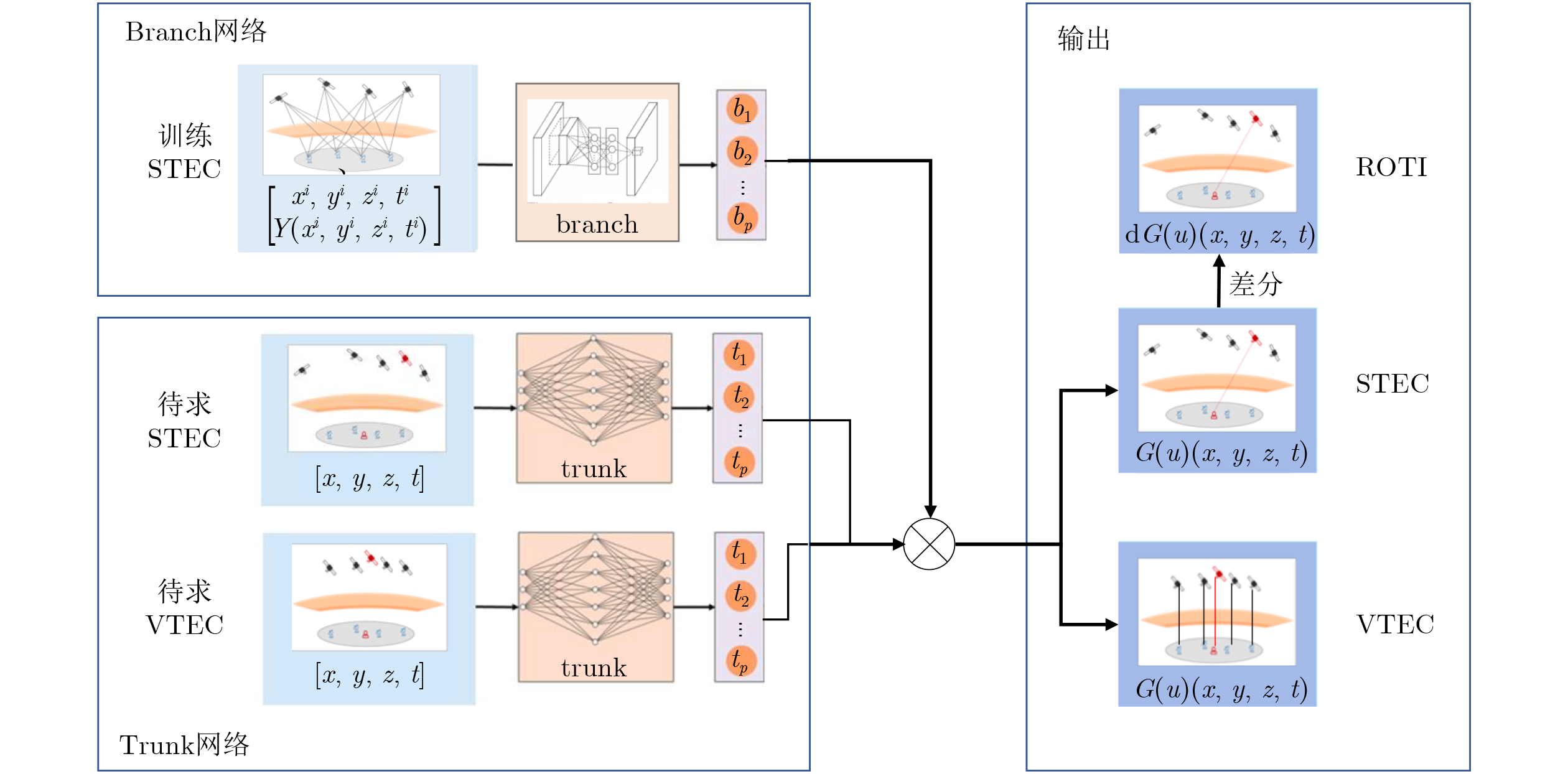
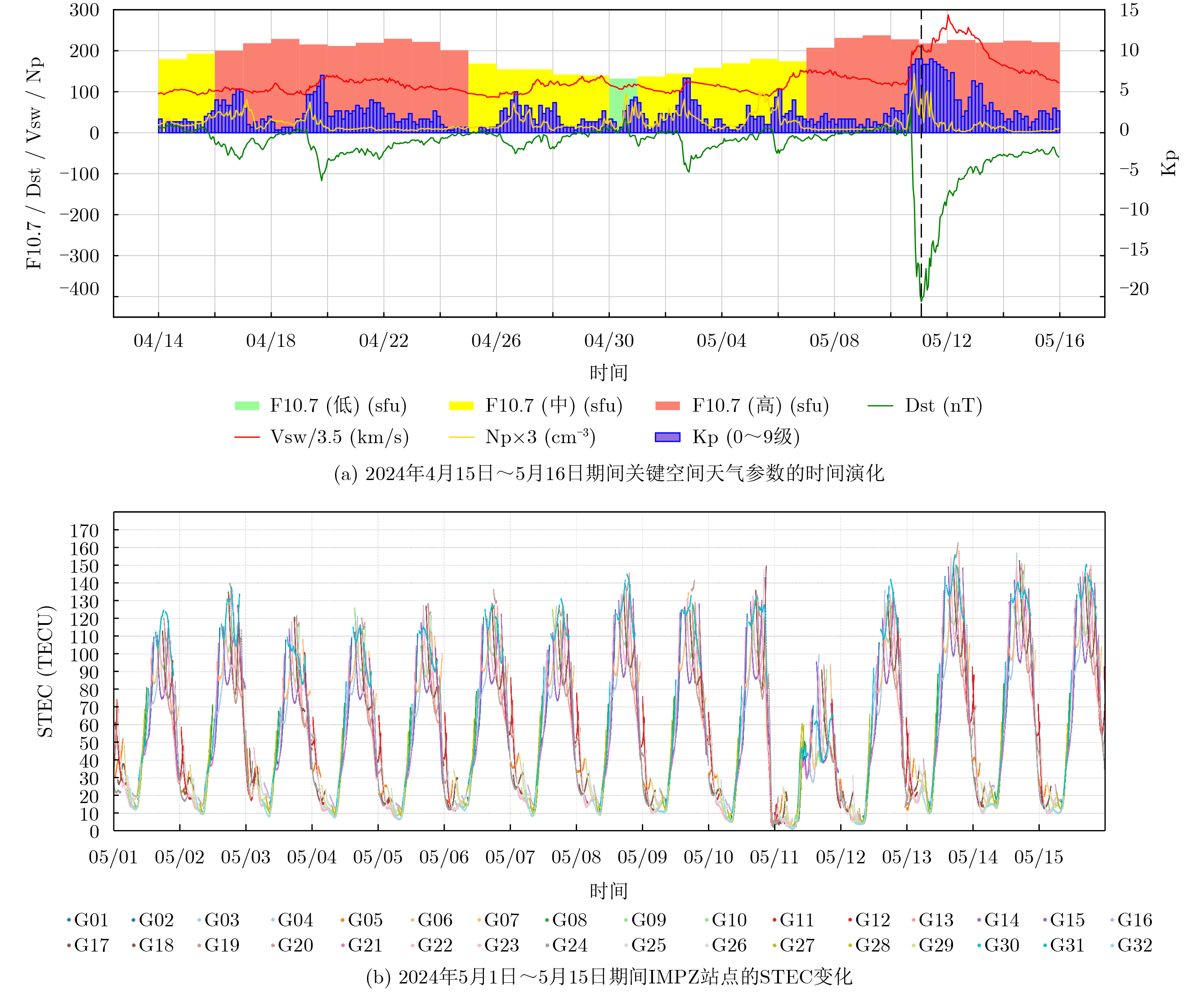
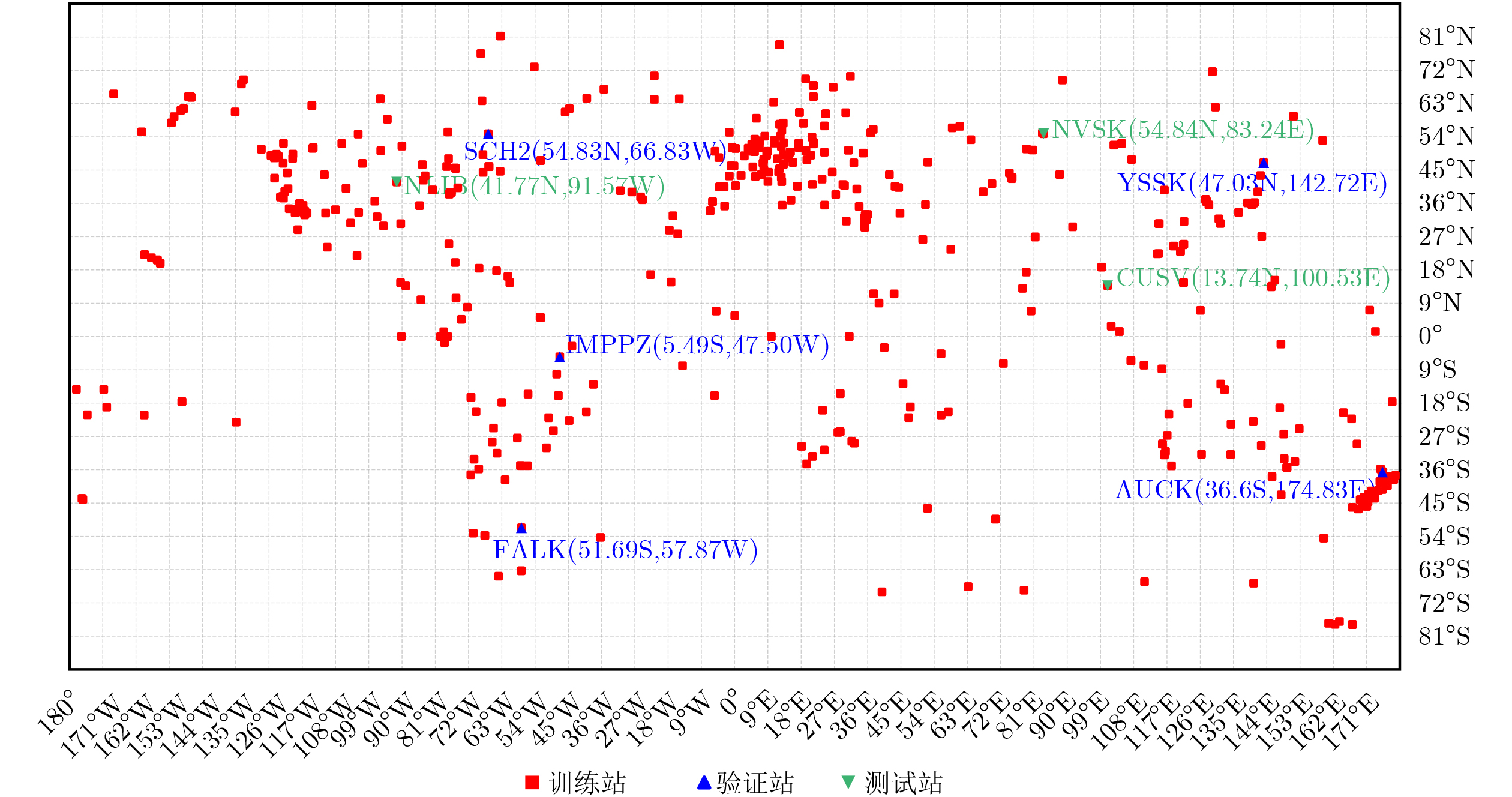
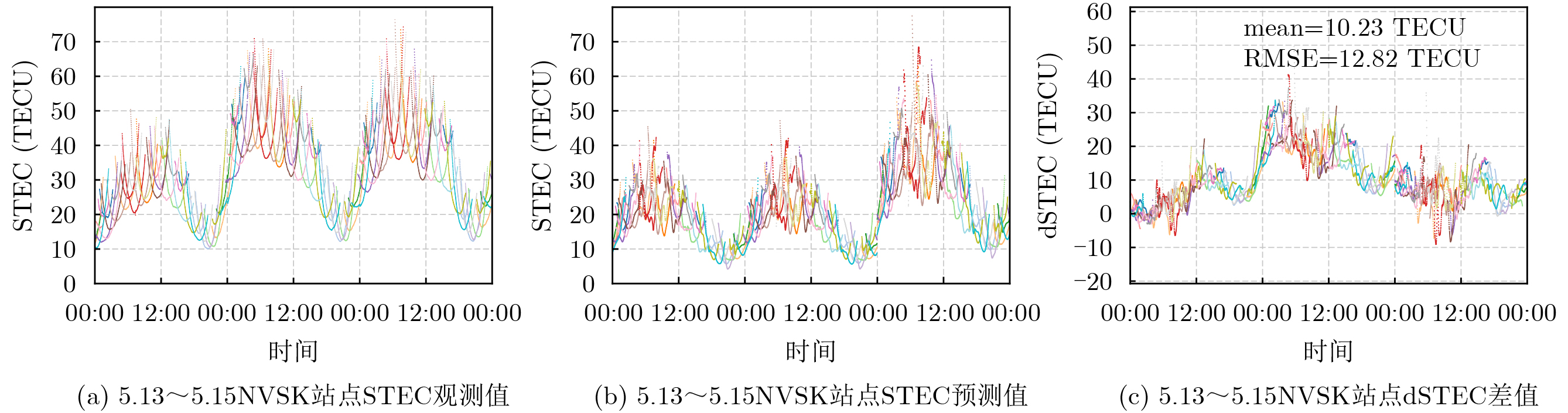
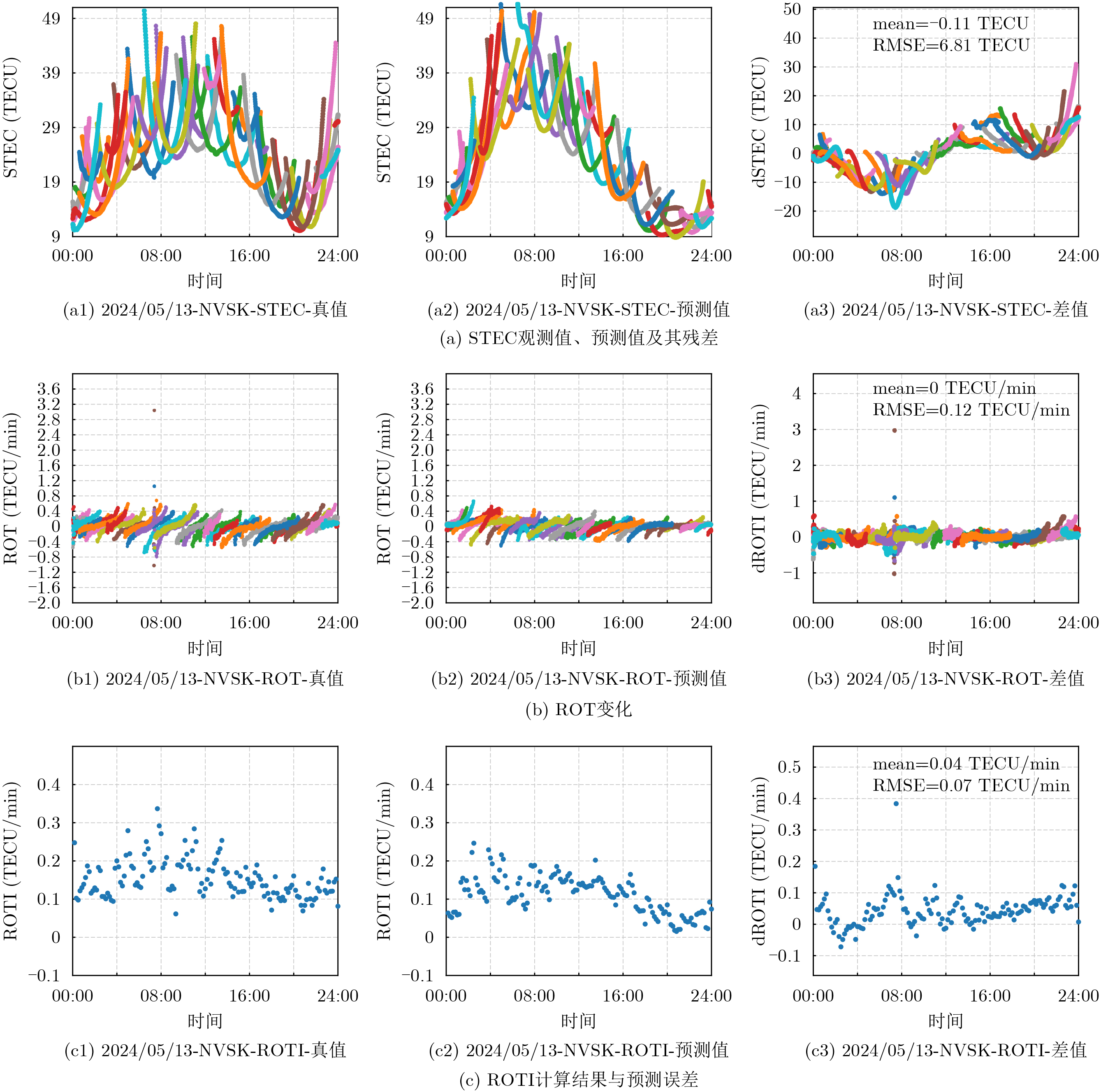
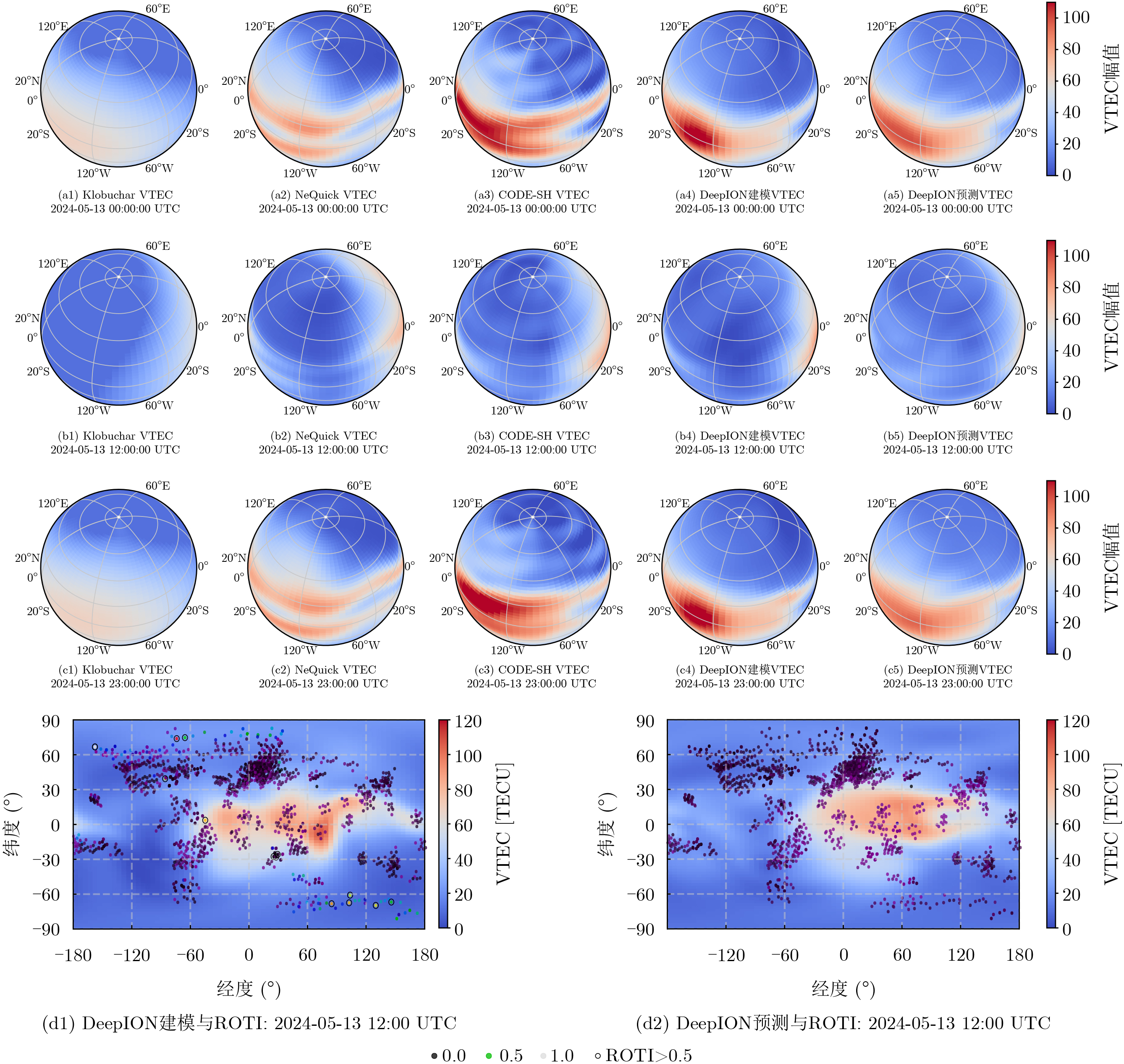
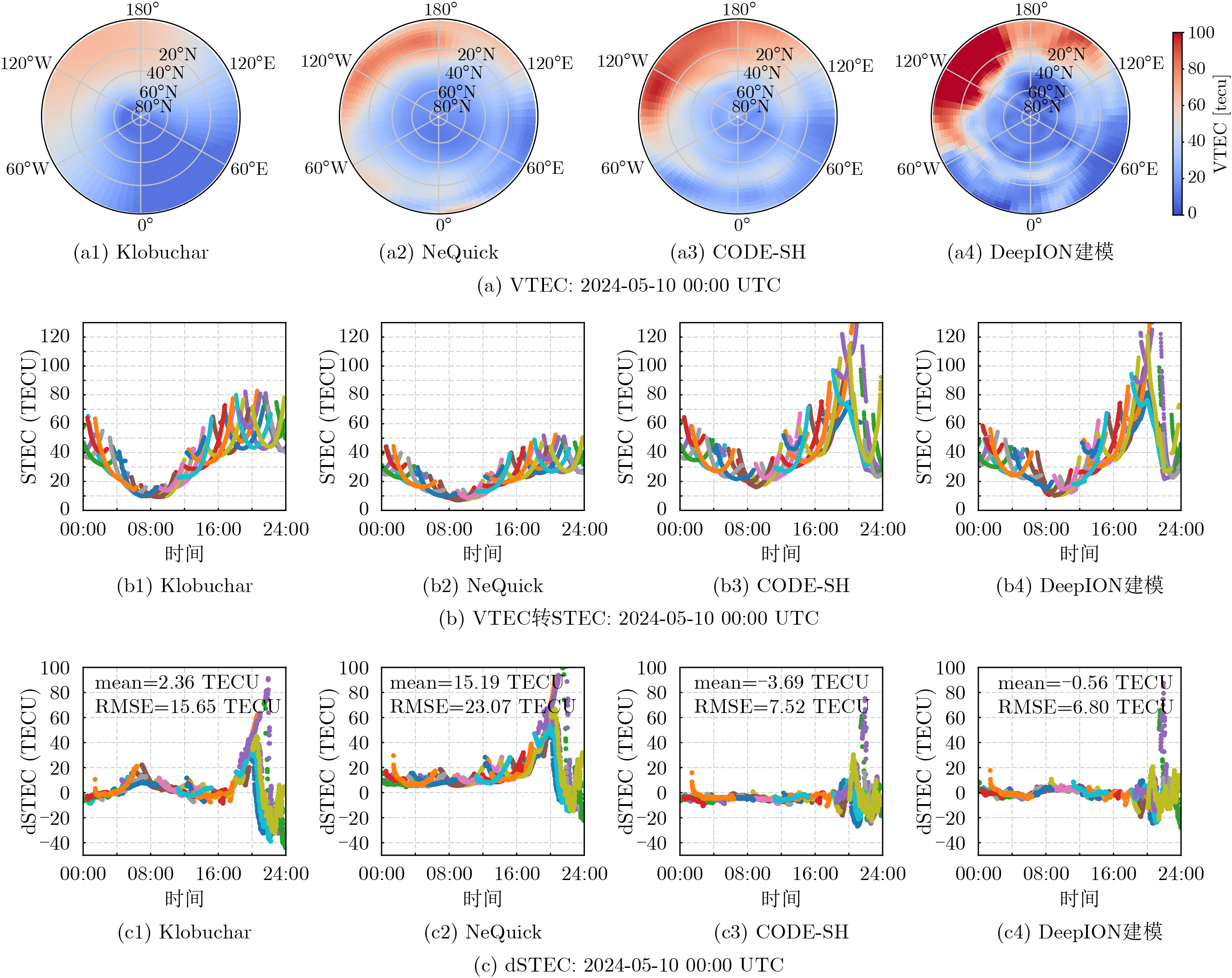
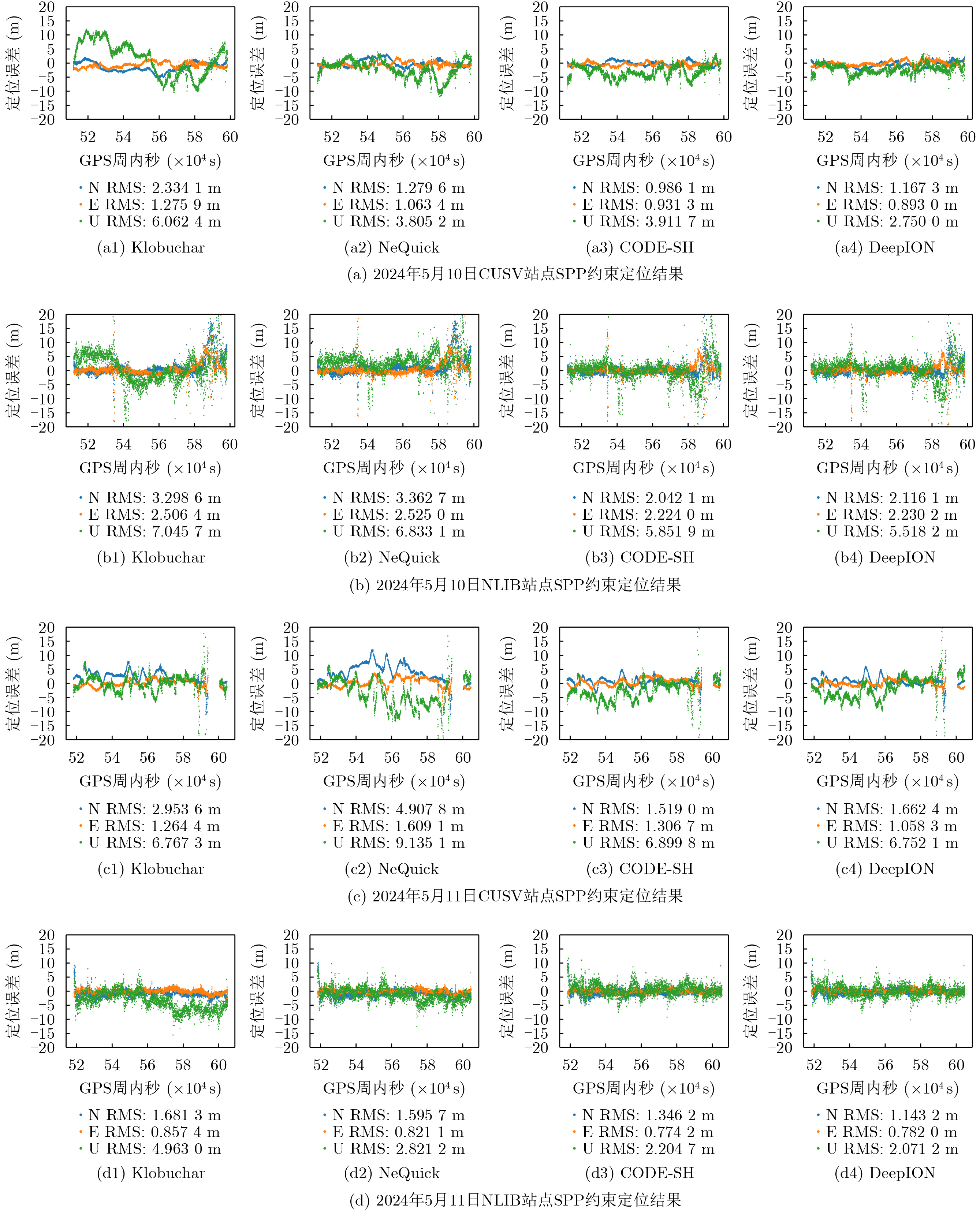
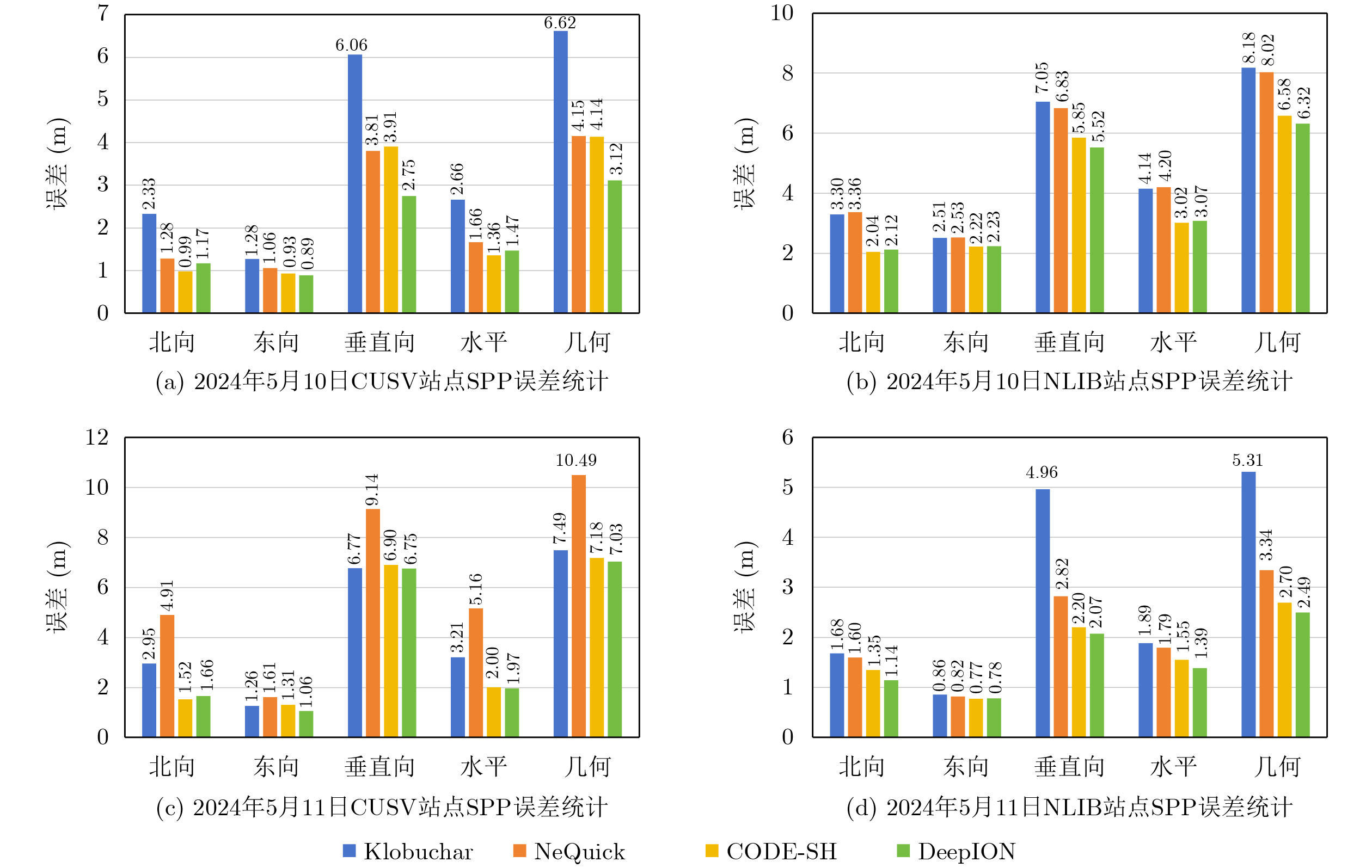
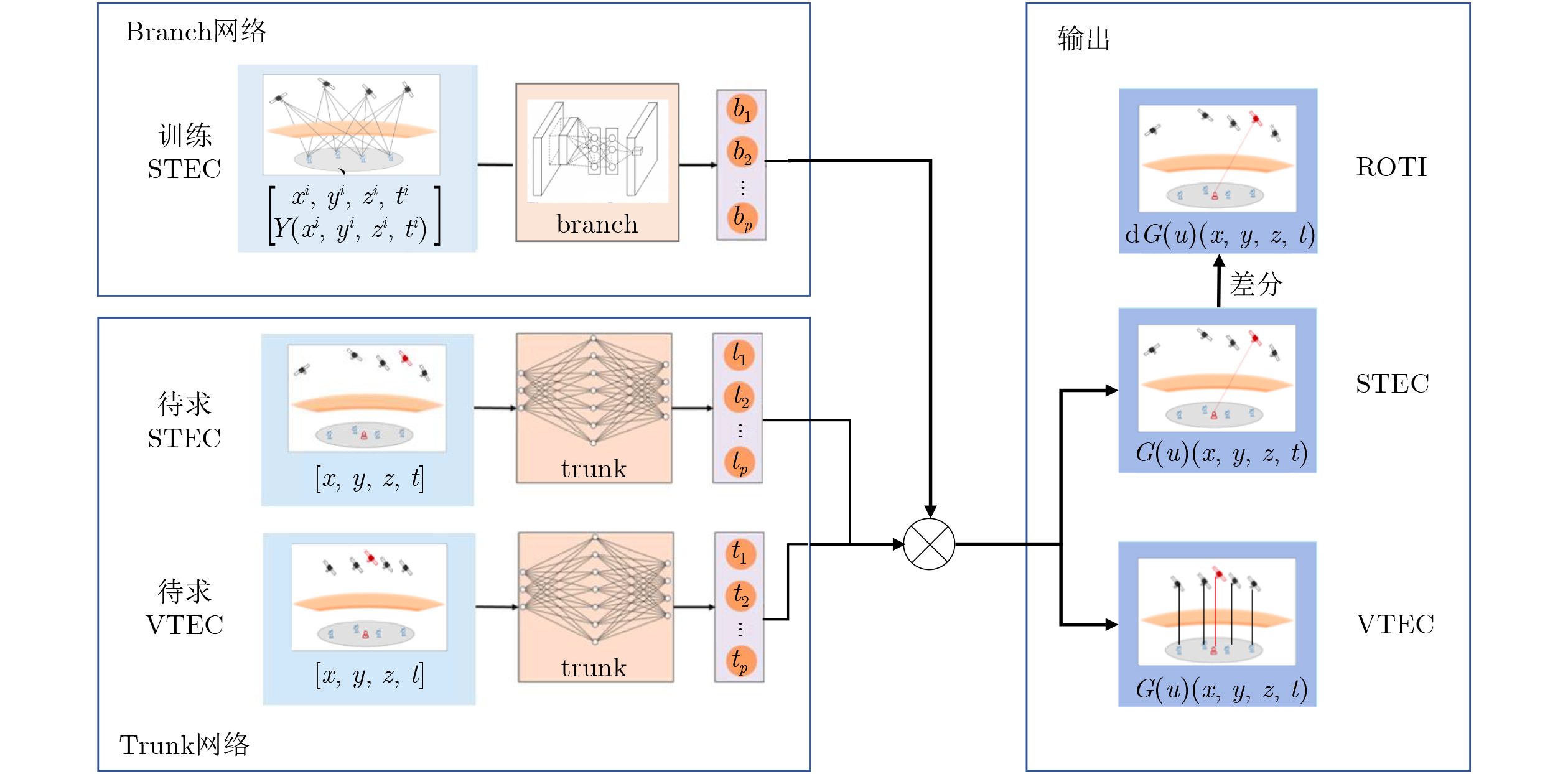
Objective Accurate characterization of ionospheric variability is essential for reliable Global Navigation Satellite System (GNSS) positioning, especially during geomagnetic storms, when rapid and highly structured disturbances occur. Existing empirical and physics-based ionospheric models often have limited ability to represent storm-time ionospheric dynamics and small-scale irregularities in real time. This study develops a unified data-driven ionospheric modeling framework that uses GNSS-derived Slant Total Electron Content (STEC) time series as input and learns spatiotemporal mappings to key ionospheric parameters, including Vertical Total Electron Content (VTEC) and the Rate Of TEC Index (ROTI). By using deep operator learning, the proposed framework improves short-term ionospheric modeling and forecasting under disturbed conditions and provides more reliable ionospheric corrections for single-frequency positioning. Methods A unified data-driven ionospheric modeling framework, named DeepION, is proposed based on the Deep Operator Network (DeepONet) architecture. The framework uses STEC time series as the primary input and learns nonlinear spatiotemporal mappings to key ionospheric parameters. DeepION models and predicts STEC and VTEC, whereas ROTI is derived from the predicted STEC series. In the network design, a Convolutional Neural Network (CNN) is used as the branch network to extract spatiotemporal features from historical STEC time series. The trunk network uses a multilayer fully connected structure with periodic time encoding. Its inputs include GNSS observation geometry and temporal information, which allows the model to capture the continuous temporal dynamics of ionospheric behavior. During data preprocessing, a VTEC-based modeling strategy is first used to estimate and remove receiver Differential Code Bias (DCB), thereby providing high-quality STEC observations. The model is then trained and validated using GNSS observations collected during the May 2024 geomagnetic storm. Its outputs include ray-path STEC values, gridded VTEC fields, and derived ROTI time series. The proposed framework is further evaluated by incorporating model-derived VTEC corrections into Single Point Positioning (SPP) experiments. Modeled and observed ionospheric parameters are compared under both geomagnetically quiet and disturbed conditions to assess the modeling accuracy and practical performance of DeepION. Results and Discussions The experimental results show that DeepION robustly characterizes ionospheric spatiotemporal variability under different space weather conditions. It captures both large-scale structures and small-scale disturbances during geomagnetic storms. For STEC forecasting, the model achieves a Root Mean Square Error (RMSE) of 12.82 TECU over a 3-day prediction horizon and maintains high consistency with GNSS observations ( Fig. 4 ). The model also predicts ionospheric irregularities accurately, as indicated by the close agreement between predicted and observed ROTI time series at the mid-latitude NVSK station (Fig. 5 ). For VTEC modeling, DeepION-generated global VTEC maps reproduce equatorial anomalies and storm-enhanced density regions. These maps closely match the Center for Orbit Determination in Europe Spherical Harmonic (CODE-SH) model and outperform the Klobuchar and NeQuick empirical models in spatial resolution and structural fidelity (Fig. 6 ). Further ray-path-level analysis shows that STEC derived from DeepION-based VTEC mapping yields the lowest residual error at the mid-to-high-latitude NLIB station. It achieves an RMSE of 6.80 TECU, outperforming Klobuchar and NeQuick and slightly improving on CODE-SH (Fig. 7 ). In GNSS positioning applications, the SPP results show that DeepION-derived ionospheric corrections consistently reduce positioning errors at both the CUSV and NLIB stations. The improvement is especially clear in the vertical and geometric components during storm-time conditions, indicating stronger robustness under intensified geomagnetic disturbances (Fig. 8 ,Fig. 9 ).Conclusions This study presents DeepION, a data-driven ionospheric modeling framework based on the DeepONet architecture. The framework learns spatiotemporal relationships between GNSS-derived STEC observations and key ionospheric parameters. With a CNN-based branch network and a periodically encoded trunk network, DeepION models and predicts STEC and VTEC, and then derives ROTI from the predicted STEC series. Experiments using global GNSS data during the May 2024 geomagnetic storm show that DeepION captures storm-time ionospheric variability and achieves stable performance in STEC forecasting and global VTEC reconstruction. Compared with conventional empirical and physics-based models, DeepION improves modeling accuracy and spatial representation. SPP experiments further show that ionospheric corrections derived from DeepION reduce positioning errors at both mid- and high-latitude stations, especially in the vertical and geometric components under disturbed geomagnetic conditions. These results indicate the practical value of DeepION for GNSS ionospheric correction during space weather events. Overall, DeepION provides a scalable framework for data-driven ionospheric modeling. Future work will extend it to multi-GNSS constellations, longer prediction lead times, and additional ionospheric observations. -
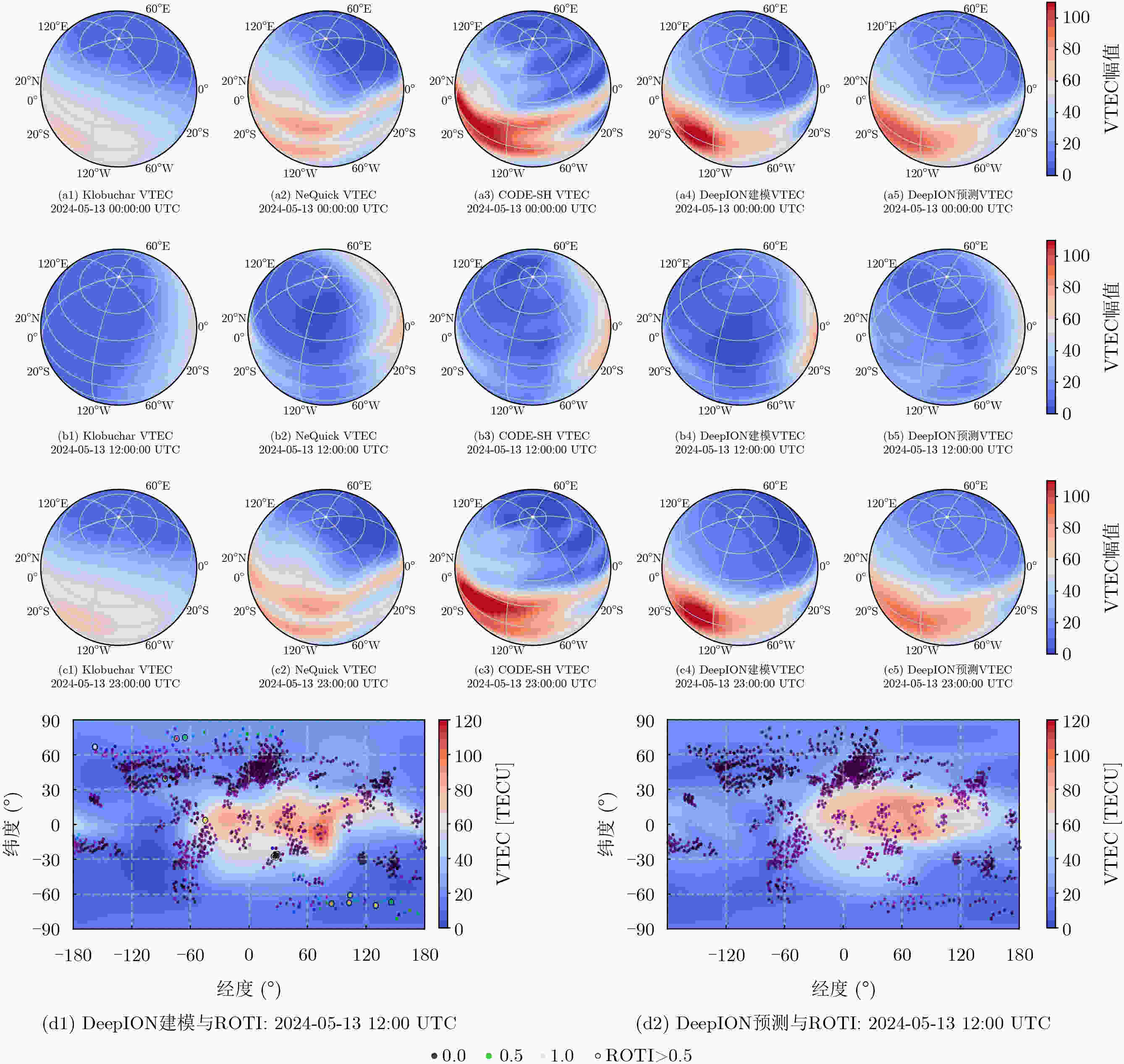
图 6 2024年5月13日00:00,12:00和23:00 UTC 3个典型时刻下,不同电离层模型的VTEC对比,及12:00 UTC时刻在DeepION-VTEC上叠加了观测与预测的ROTI值。
表 1 SPP解算的处理策略
类型 项目 解算策略 基本信息 时间范围 2024年5月10日 系统 仅使用GPS 频率与伪距类型 L1 C/A码,对应RINEX格式中的C1C 采样间隔 30 s 可建模误差 对流层 Saastamoinen模型 电离层 Klobuchar模型、NeQuick模型、CODE-SH模型及DeepION模型 随机与加权模型 高程角加权模型(伪距单位权中误差为0.3 m);15°以下加权降低 地球自转 通过卫星位置进行修正,$ {\omega }_{e}=7.292115\times {10}^{-5}\; \text{rad/s} $ 相对论效应 通过卫星钟差进行修正 PNT参数 卫星位置与卫星钟差 使用IGS广播星历(BRDC)计算 接收机位置与接收机钟差 通过最小二乘平差估计  下载: 导出CSV
表 2 2024年5月10日CUSV与NLIB站点的SPP定位精度统计结果(m)
方向 CUSV站点 NLIB站点 Klobuchar NeQuick CODE-SH DeepION Klobuchar NeQuick CODE-SH DeepION 北向 2.3341 1.2796 0.9861 1.1673 3.2986 3.3627 2.0421 2.1161 东向 1.2759 1.0634 0.9313 0.8930 2.5064 2.5250 2.2240 2.2302 垂直向 6.0624 3.8052 3.9117 2.7500 7.0457 6.8331 5.8519 5.5182 水平 2.6590 1.6635 1.3564 1.4695 4.1439 4.2043 3.0208 3.0744 几何 6.6186 4.1522 4.1388 3.1180 8.1763 8.0231 6.5823 6.3167
下载: 导出CSV
表 3 2024年5月11日CUSV与NLIB站点的SPP定位精度统计结果(m)
方向 CUSV站点 NLIB站点 Klobuchar NeQuick CODE-SH DeepION Klobuchar NeQuick CODE-SH DeepION 北向 2.9536 4.9078 1.5190 1.6624 1.6813 1.5957 1.3462 1.1432 东向 1.2644 1.6091 1.3067 1.0583 0.8574 0.8211 0.7742 0.7820 垂直向 6.7673 9.1351 6.8998 6.7521 4.9630 2.8212 2.2047 2.0712 水平 3.2130 5.1646 2.0033 1.9709 1.8876 1.7945 1.5518 1.3853 几何 7.4919 10.4935 7.1849 7.0338 5.3096 3.3439 2.6961 2.4935
下载: 导出CSV
-
[1] KAPLAN E D and HEGARTY C J. Understanding GPS/GNSS: Principles and Applications[M]. 3rd ed. Boston: Artech House, 2017, 1–7. [2] CESARONI C, SPOGLI L, and DE FRANCESCHI G. IONORING: Real-time monitoring of the total electron content over Italy[J]. Remote Sensing, 2021, 13(16): 3290. doi: 10.3390/rs13163290. [3] 贾琼琼, 周月颖. 非视距环境下核密度估计的全球卫星导航系统鲁棒定位方法[J]. 电子与信息学报, 2024, 46(8): 3246–3255. doi: 10.11999/JEIT231421.JIA Qiongqiong and ZHOU Yueying. Robust global satellite navigation system positioning for kernel density estimation in non-line-of-sight environment[J]. Journal of Electronics & Information Technology, 2024, 46(8): 3246–3255. doi: 10.11999/JEIT231421. [4] KLOBUCHAR J A. Ionospheric time-delay algorithm for single-frequency GPS users[J]. IEEE Transactions on Aerospace and Electronic Systems, 1987, AES-23(3): 325–331. doi: 10.1109/taes.1987.310829. [5] NAVA B, COÏSSON P, and RADICELLA S M. A new version of the NeQuick ionosphere electron density model[J]. Journal of Atmospheric and Solar-Terrestrial Physics, 2008, 70(15): 1856–1862. doi: 10.1016/j.jastp.2008.01.015. [6] BILITZA D, ALTADILL D, TRUHLIK V, et al. International Reference Ionosphere 2016: From ionospheric climate to real-time weather predictions[J]. Space Weather, 2017, 15(2): 418–429. doi: 10.1002/2016SW001593. [7] SCHAER S. Mapping and Predicting the Earth's Ionosphere Using the Global Positioning System[M]. Zürich, Switzerland: Institut für Geodäsie und Photogrammetrie, Eidg. Technische Hochschule Zürich, 1999. [8] HERNÁNDEZ-PAJARES M, JUAN J M, SANZ J, et al. The IGS VTEC maps: A reliable source of ionospheric information since 1998[J]. Journal of Geodesy, 2009, 83(3/4): 263–275. doi: 10.1007/s00190-008-0266-1. [9] JAKOWSKI N, STANKOV S M, and KLAEHN D. Operational space weather service for GNSS precise positioning[J]. Annales Geophysicae, 2005, 23(9): 3071–3079. doi: 10.5194/angeo-23-3071-2005. [10] 张旭, 杨杰. 融合电离层延迟改正与多频信号优化的全球导航卫星系统部分模糊度解算方法[J]. 电子与信息学报, 2025, 47(5): 1543–1553. doi: 10.11999/JEIT240682.ZHANG Xu and YANG Jie. Global navigation satellite system partial ambiguity resolution method integrating ionospheric delay correction and multi-frequency signal optimization[J]. Journal of Electronics & Information Technology, 2025, 47(5): 1543–1553. doi: 10.11999/JEIT240682. [11] LI Wang, HE Changyong, HU Andong, et al. A new method for improving the performance of an ionospheric model developed by multi-instrument measurements based on artificial neural network[J]. Advances in Space Research, 2021, 67(1): 20–34. doi: 10.1016/j.asr.2020.07.032. [12] REN Xiaochen, ZHAO Biqiang, REN Zhipeng, et al. Deep learning-based prediction of global ionospheric TEC during storm periods: Mixed CNN-BiLSTM method[J]. Space Weather, 2024, 22(7): e2024SW003877. doi: 10.1029/2024SW003877. [13] YANG Jiayue, HUANG Wengeng, ZHANG Lei, et al. Ionospheric TEC forecasting with ED-ConvLSTM-Res integrating multi-channel features[J]. Remote Sensing, 2025, 17(21): 3564. doi: 10.3390/rs17213564. [14] KASELIMI M, DOULAMIS N, DOULAMIS A, et al. Geometric deep learning for ionospheric TEC modeling using a temporal graph convolutional network[J]. Neural Computing and Applications, 2025, 37(22): 17179–17192. doi: 10.1007/s00521-025-11017-8. [15] SIVAKRISHNA K, RATNAM D V, and SIVAVARAPRASAD G. Support Vector Regression model to predict TEC for GNSS signals[J]. Acta Geophysica, 2022, 70(6): 2827–2836. doi: 10.1007/s11600-022-00954-w. [16] ZHU Fucheng, ZHI Nan, and FU Haiyang. A data-driven forecast model of ionospheric slant total electron content based on decision trees[C]. 2023 International Applied Computational Electromagnetics Society Symposium (ACES-China), Hangzhou, China, 2023: 1–3. doi: 10.23919/ACES-China60289.2023.10250081. [17] NATH S, CHETIA B, and KALITA S. Ionospheric TEC prediction using hybrid method based on ensemble empirical mode decomposition (EEMD) and long short-term memory (LSTM) deep learning model over India[J]. Advances in Space Research, 2023, 71(5): 2307–2317. doi: 10.1016/j.asr.2022.10.067. [18] SHAIKH M M, BUTT R A, and KHAWAJA A. Forecasting total electron content (TEC) using CEEMDAN LSTM model[J]. Advances in Space Research, 2023, 71(10): 4361–4373. doi: 10.1016/j.asr.2022.12.054. [19] TANG Jun, LI Yinjian, DING Mingfei, et al. An ionospheric TEC forecasting model based on a CNN-LSTM-attention mechanism neural network[J]. Remote Sensing, 2022, 14(10): 2433. doi: 10.3390/rs14102433. [20] ZHANG Renzhong, LI Haorui, SHEN Yunxiao, et al. Deep learning applications in ionospheric modeling: Progress, challenges, and opportunities[J]. Remote Sensing, 2025, 17(1): 124. doi: 10.3390/rs17010124. [21] SHI Zenghui, ZHI Nan, FU Haiyang, et al. A method for dSTEC interpolation: Ionosphere kernel estimation algorithm[J]. IEEE Transactions on Geoscience and Remote Sensing, 2022, 60: 5804318. doi: 10.1109/TGRS.2022.3218365. [22] SUI Yun, FU Haiyang, WANG Denghui, et al. Multilayer ionospheric model constrained by physical prior based on GNSS stations[J]. IEEE Journal of Selected Topics in Applied Earth Observations and Remote Sensing, 2023, 16: 1842–1857. doi: 10.1109/JSTARS.2023.3241321. [23] ZHOU Yang, LIU Jing, LI Shuhan, et al. Ionospheric TEC prediction based on ensemble learning models[J]. Space Weather, 2024, 22(3): e2023SW003790. doi: 10.1029/2023SW003790. [24] YANG T Y, LU Jianyong, YANG Yuyan, et al. GNSS–VTEC prediction based on CNN–GRU neural network model during high solar activities[J]. Scientific Reports, 2025, 15(1): 9109. doi: 10.1038/s41598-025-93628-8. [25] LU Lu, JIN Pengzhan, PANG Guofei, et al. Learning nonlinear operators via DeepONet based on the universal approximation theorem of operators[J]. Nature Machine Intelligence, 2021, 3(3): 218–229. doi: 10.1038/s42256-021-00302-5. [26] CAI Dijia, SHI Zenghui, FU Haiyang, et al. Global 4-D ionospheric STEC prediction based on DeepONet for GNSS rays[J]. IEEE Transactions on Geoscience and Remote Sensing, 2024, 62: 5801420. doi: 10.1109/TGRS.2024.3422150. [27] WANG Zitong, CAI Dijia, and FU Haiyang. Global ionospheric ROTI prediction based on DeepONet[C]. 2024 14th International Symposium on Antennas, Propagation and EM Theory (ISAPE), Hefei, China, 2024: 1–4. doi: 10.1109/ISAPE62431.2024.10840433. [28] HORNIK K. Approximation capabilities of multilayer feedforward networks[J]. Neural Networks, 1991, 4(2): 251–257. doi: 10.1016/0893-6080(91)90009-T. [29] CHEN Tianping, CHEN Hong, and LIU R W. Approximation capability in C R n by multilayer feedforward networks and related problems[J]. IEEE Transactions on Neural Networks, 1995, 6(1): 25–30. doi: 10.1109/72.363453. [30] GONZALEZ W D, JOSELYN J A, KAMIDE Y, et al. What is a geomagnetic storm?[J]. Journal of Geophysical Research: Space Physics, 1994, 99(A4): 5771–5792. doi: 10.1029/93JA02867. [31] BURTON R K, MCPHERRON R L, and RUSSELL C T. An empirical relationship between interplanetary conditions and Dst[J]. Journal of Geophysical Research, 1975, 80(31): 4204–4214. doi: 10.1029/JA080i031p04204. [32] MENVIELLE M, IYEMORI T, MARCHAUDON A, et al. Geomagnetic indices[M]. MANDEA M and KORTE M. Geomagnetic Observations and Models. Dordrecht: Springer, 2011: 183–228. doi: 10.1007/978-90-481-9858-0_8. [33] TAPPING K F. Recent solar radio astronomy at centimeter wavelengths: The temporal variability of the 10.7-cm flux[J]. Journal of Geophysical Research: Atmospheres, 1987, 92(D1): 829–838. doi: 10.1029/JD092iD01p00829. [34] TSURUTANI B T, GONZALEZ W D, GONZALEZ A L C, et al. Corotating solar wind streams and recurrent geomagnetic activity: A review[J]. Journal of Geophysical Research: Space Physics, 2006, 111(A7): A07S01. doi: 10.1029/2005JA011273. [35] LEANDRO R F. Precise point positioning with GPS: A new approach for positioning, atmospheric studies, and signal analysis[D]. [Ph. D. dissertation], University of New Brunswick, 2009. [36] ZHANG Baocheng, OU Jikun, YUAN Yunbin, et al. Extraction of line-of-sight ionospheric observables from GPS data using precise point positioning[J]. Science China Earth Sciences, 2012, 55(11): 1919–1928. doi: 10.1007/s11430-012-4454-8. [37] FELTENS J. The activities of the Ionosphere Working Group of the International GPS Service (IGS)[J]. GPS Solutions, 2003, 7(1): 41–46 doi: 10.1007/s10291-003-0051-9. [38] SARDÓN E, RIUS A, and ZARRAOA N. Estimation of the transmitter and receiver differential biases and the ionospheric total electron content from Global Positioning System observations[J]. Radio Science, 1994, 29(3): 577–586. doi: 10.1029/94RS00449. [39] HOQUE M M and JAKOWSKI N. Estimate of higher order ionospheric errors in GNSS positioning[J]. Radio Science, 2008, 43(5): RS5008. doi: 10.1029/2007rs003817. [40] XIANG Yan and GAO Yang. An enhanced mapping function with ionospheric varying height[J]. Remote Sensing, 2019, 11(12): 1497. doi: 10.3390/rs11121497. [41] JIN Shuanggen, WANG Jinling, and PARK P H. An improvement of GPS height estimations: Stochastic modeling[J]. Earth, Planets and Space, 2005, 57(4): 253–259. doi: 10.1186/BF03352561. [42] 杨东凯, 谭传瑞, 王峰, 等. 基于高度角随机模型的GNSS外辐射源雷达定位算法[J]. 电子与信息学报, 2024, 46(4): 1373–1381. doi: 10.11999/JEIT230462.YANG Dongkai, TAN Chuanrui, WANG Feng, et al. Elevation-dependent stochastic localization algorithm for GNSS-based passive radar[J]. Journal of Electronics & Information Technology, 2024, 46(4): 1373–1381. doi: 10.11999/JEIT230462. [43] 易卿武, 黄璐, 蔚保国, 等. 面向室内地下遮蔽空间的定位可信性提升方法[J]. 电子与信息学报, 2025, 47(5): 1529–1542. doi: 10.11999/JEIT240870.YI Qingwu, HUANG Lu, YU Baoguo, et al. Methods for enhancing positioning reliability in indoor and underground satellite-shielded environments[J]. Journal of Electronics & Information Technology, 2025, 47(5): 1529–1542. doi: 10.11999/JEIT240870. [44] MA Jiayu, FU Haiyang, HUBA J D, et al. A novel ionospheric inversion model: PINN-SAMI3 (physics informed neural network based on SAMI3)[J]. Space Weather, 2024, 22(4): e2023SW003823. doi: 10.1029/2023SW003823. [45] SUI Yun, FU Haiyang, DAI Yeying, et al. Global ionospheric 4-D tomography and forecast based on multisource DMD data assimilation[J]. IEEE Transactions on Geoscience and Remote Sensing, 2025, 63: 2004510. doi: 10.1109/TGRS.2025.3633701. [46] DAI Xinan, FU Haiyang, YAN Zichong, et al. Extreme solar storm reveals causal interactions in space weather[J]. arXiv preprint arXiv: 2508.06507, 2025. doi: 10.48550/arXiv.2508.06507. -

 下载:
下载:

图(9) / 表(3)
计量
- 文章访问数: 939
- HTML全文浏览量: 454
- PDF下载量: 54
- 被引次数: 0
