




An Overview of Key Technologies for 6G-Enabled Communication-Computing Integration and Energy-Efficiency Optimization
-
摘要: 随着以智能网联新能源汽车、人工智能终端、智能机器人为代表的新型智能终端快速普及,多模态大模型等新兴应用不断向端侧落地,泛在智能业务持续拓展。在此背景下,终端算力开销急剧增长。受制于体积、功耗与成本,智能终端设备普遍面临能耗过高、续航不足的问题。第6代(6G)无线通信网络通过无线接入网(RAN)架构增强与算力下沉,有望承接终端侧高能耗、高算力任务,赋能新型终端实现轻量化、低成本、长续航升级。该文首先阐述了增强型RAN赋能的6G端–边协同服务框架,并建立终端计算与传输能耗理论模型。然后,该文系统梳理了面向端–边协同推理的典型节能技术,并提出面向动态无线环境的通算联合自适应优化机制,实现通信与计算能耗的协同优化。最后,以具身智能终端为典型场景验证所提机制的节能效果,并总结当前研究在资源协同、全局优化与标准化落地等方面的挑战与未来方向。Abstract:
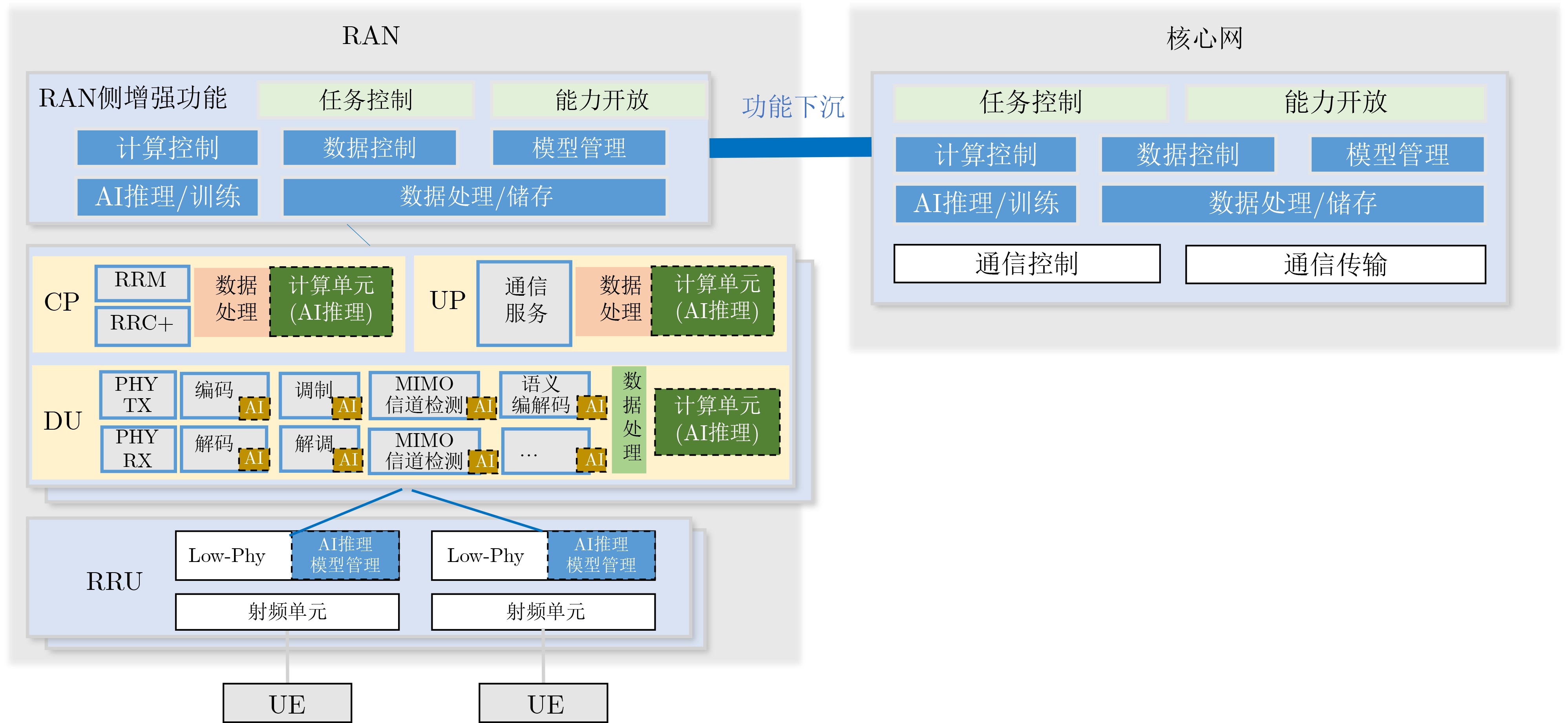
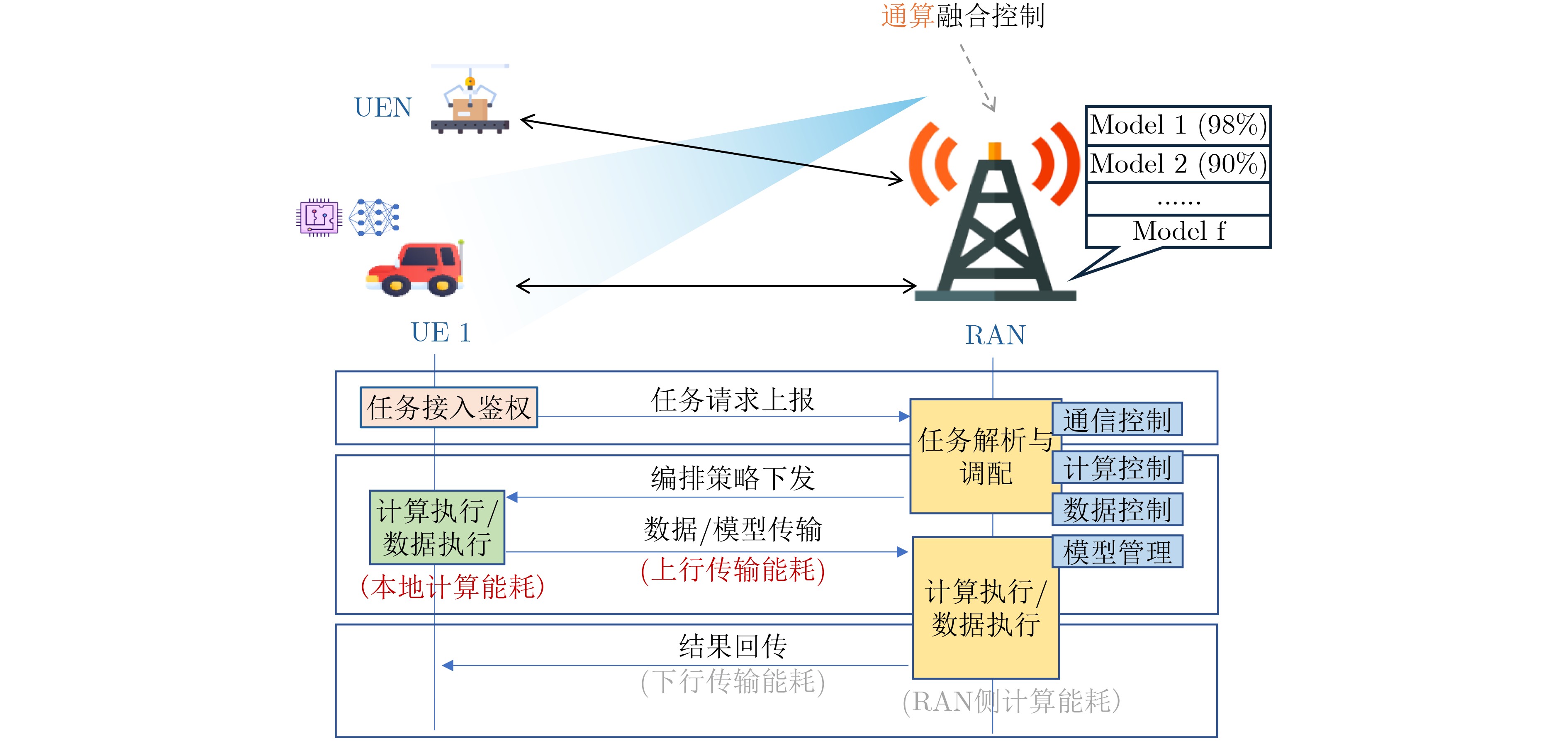
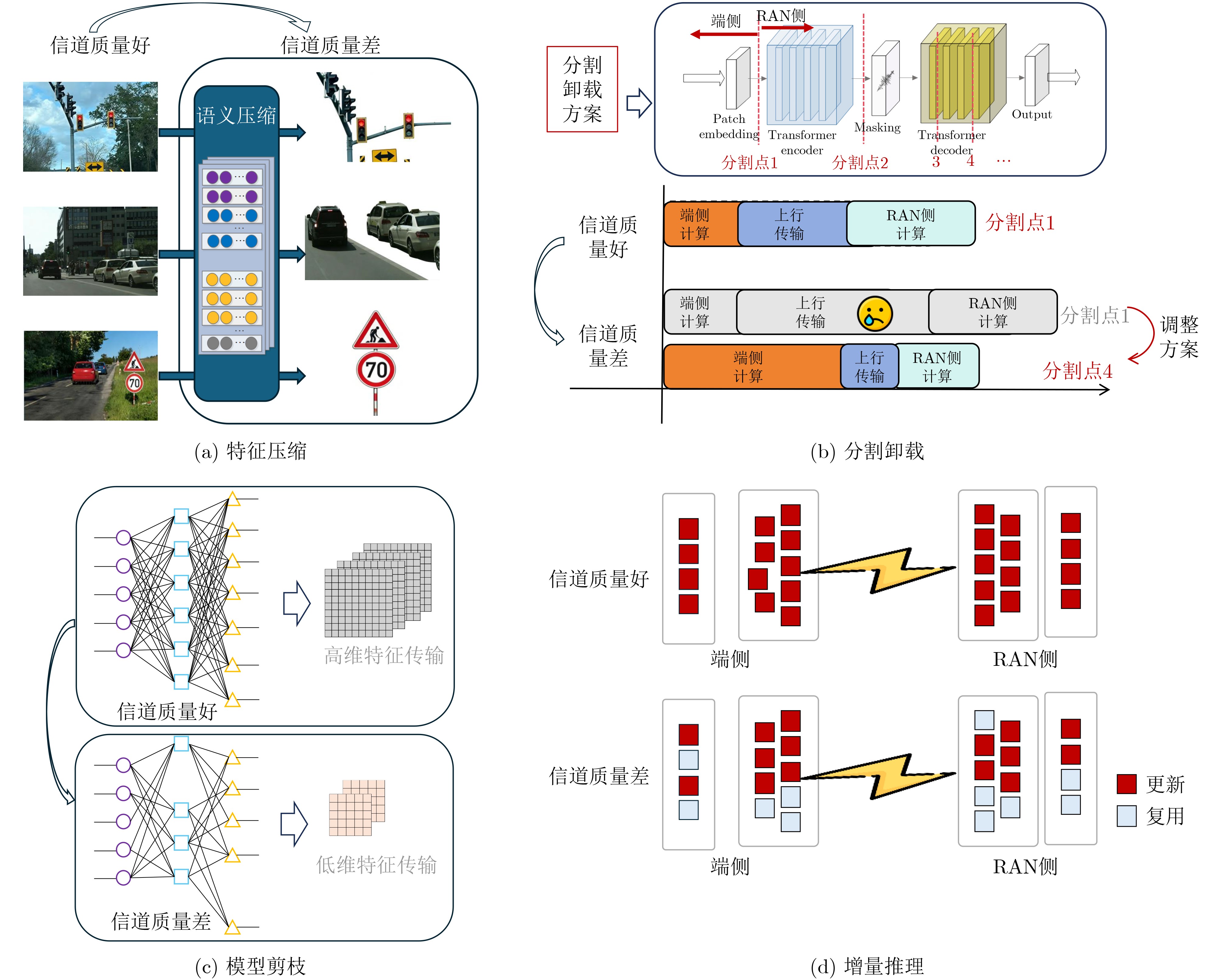
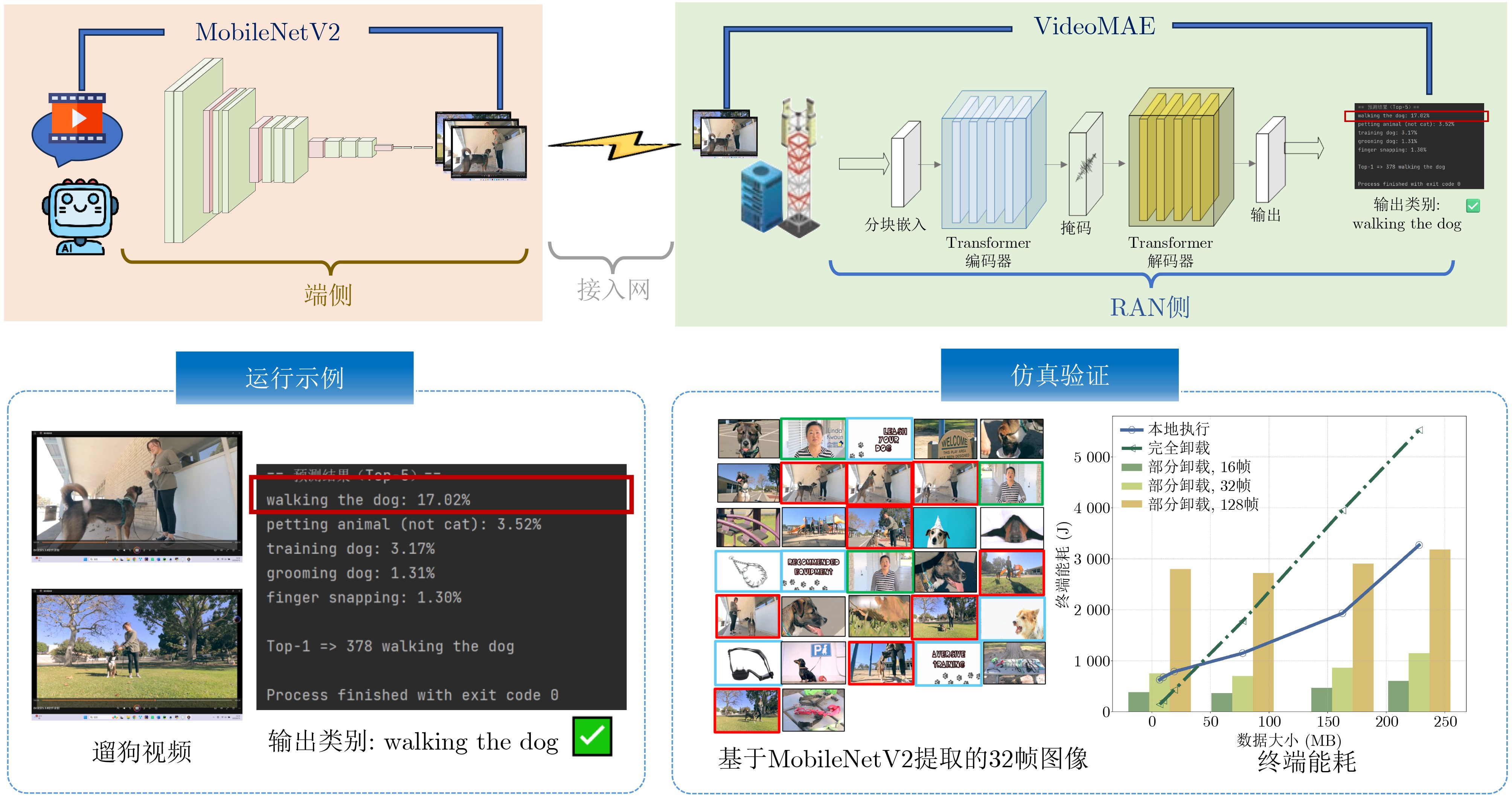
Significance Constrained by size, power consumption, and cost, emerging intelligent terminals often face excessive energy consumption and limited battery life. These limitations have become major bottlenecks to large-scale deployment. Compared with Fifth-Generation (5G) wireless networks, Sixth-Generation (6G) wireless networks are expected to enhance the Radio Access Network (RAN) architecture and move computing capability toward the RAN side. High-energy and compute-intensive Artificial Intelligence (AI) tasks that are originally executed by end devices can therefore be processed by the network. Through End-Edge Collaboration, emerging intelligent terminals can be upgraded toward lightweight design, low cost, and long battery life, thereby supporting the large-scale deployment of ubiquitous intelligence in 6G networks. Progress Current progress in Terminal Energy Consumption Optimization through 6G End-Edge Collaboration is reviewed, with emphasis on local execution, full offloading, and partial offloading. In local execution, User Equipment (UE) processes all tasks locally, which leads to high computing energy consumption. In full offloading, all tasks are transferred to the RAN. This reduces terminal-side computing energy consumption but can increase transmission energy consumption, especially under poor channel conditions. Partial offloading combines the benefits of both modes and optimizes energy consumption according to real-time network conditions. For partial offloading, four representative optimization techniques are summarized. (1) Feature Extraction and Filtering. Semantic encoding and information extraction are performed at the UE, and only task-relevant data are transmitted to the RAN. This reduces redundant data transmission and lowers transmission energy consumption. (2) Split Offloading. A large Deep Neural Network (DNN) is divided into layers according to its structure. Simpler shallow layers are processed at the UE, whereas more complex deep layers are offloaded to the RAN. This method balances terminal-side and RAN-side computational loads through End-Edge Collaborative Inference. (3) Model Lightweighting. Model complexity is reduced through pruning, quantization, and knowledge distillation, which lowers computational overhead while maintaining task performance. (4) Incremental Inference. Only changed data or updated features are processed, while historical computations are reused. This reduces redundant computation. Together, these techniques improve terminal performance and energy efficiency within the 6G End-Edge Collaboration framework. Conclusions This paper systematically reviews Terminal Energy Consumption Optimization for 6G End-Edge Collaboration. It summarizes the functional evolution of enhanced RAN, constructs an End-Edge Collaborative service framework for Communication-Computing Integration, and establishes a theoretical model of terminal computing energy consumption and transmission energy consumption. The composition and influencing factors of energy consumption under different offloading modes are clarified. Key energy optimization technologies, including Feature Extraction and Filtering, Split Offloading, Model Lightweighting, and Incremental Inference, are then discussed. To address energy consumption fluctuations caused by dynamic wireless channels, the paper proposes energy optimization mechanisms based on Adaptive Semantic Compression, Dynamic Split Offloading, Adaptive Model Pruning, and Incremental Inference. These mechanisms maintain a dynamic balance between energy optimization and task performance. Using embodied intelligent robot video understanding as a typical application scenario, a test platform is developed to verify the effectiveness of the proposed mechanisms. Current challenges and future research directions are also analyzed. Prospects Although End-Edge Collaborative energy-saving technologies have achieved initial progress, practical deployment still faces challenges in real network environments, dynamic wireless channels, and large-scale user access. Future research should examine the trade-off between optimization overhead and system robustness. It should also study dynamic communication-computing resource substitution modeling in stochastic resource environments, multi-user collaboration strategies, and global energy-efficiency optimization. As the technology matures, standardization and engineering implementation of End-Edge Collaborative energy-saving frameworks will become critical to the large-scale adoption of 6G applications. Future studies should further integrate algorithm design with network architecture, enabling practical deployment of low-power and high-efficiency intelligent communication systems. -
表 1 常见神经网络的计算模型参数
神经网络类型 核心计算模块 关键影响参数 计算复杂度
核心表达式内存访问次数
核心表达式典型适用场景 全连接网络
(Fully Connected Network, FCN)全连接层矩阵乘法 批大小$ B $、全连接层数$ L $、特征维度$ d $ $ O(B\times L\times {d}^{2}) $ $ 2Bd+{d}^{2} $ 简单特征分类、模型输出层 卷积神经网络-标准卷积
(Convolutional Neural Network, CNN)卷积运算 卷积核大小$ K\times K $、输入通道$ {C}_{\text{in}} $、输出通道$ {C}_{\text{out}} $、输入大小$ W\times H $、输出大小$ W'\times H' $、批大小$ B $ $ O(K\times K\times {C}_{\text{in}}\times {C}_{\text{out}}\times W\times H) $ $ \begin{array}{ll} BHW{C}_{\text{in}}+{K}^{2}{C}_{\text{in}}{C}_{\text{out}}+\\ BH'W'{C}_{\text{out}}\end{array} $ 图像分类、目标检测、视觉特征提取 CNN-深度可分离卷积(MobileNet) 深度卷积+逐点卷积 $ \begin{array}{l} O(K\times K\times {C}_{\text{in}}\times W\times H)+\\ O({C}_{\text{in}}\times {C}_{\text{out}}\times W\times H)\end{array} $ $ \begin{array}{l} 2BHW{C}_{\text{in}}+{K}^{2}{C}_{\text{in}}+\\ BHW{C}_{\text{in}}+{C}_{\text{in}}{C}_{\text{out}}\\ +BH'W'{C}_{\text{out}}\end{array} $ 端侧轻量级视觉任务、移动设备AI推理 CNN-分组卷积(ResNeXt) 分组卷积运算 分组数$ g $ $ O\left(\dfrac{K\times K\times {C}_{\text{in}}\times {C}_{\text{out}}\times W\times H}{g}\right) $ $ \begin{array}{l}BHW{C}_{\text{in}}+{K}^{2}{C}_{\text{in}}{C}_{\text{out}}/g+\\ BH'W'{C}_{\text{out}}\end{array} $ RAN侧视觉任务、多维度视觉特征提取 循环神经网络
(Recurrent Neural Network, RNN)递归矩阵乘法 序列长度$ T $、隐藏层维度$ H $、输入维度$ X $、批大小$ B $ 单向:$ O(T\times H\times (H+X)) $
双向:$ O(2\times T\times H\times (H+X)) $单向:$ BTH $
双向:$ 2BTH $短序列文本处理、时序信号简单预测 图神经网络
(Graph Neural Network, GNN)邻居聚合+稀疏矩阵乘法 层数$ L $、图中边的数量$ E $、节点特征维度$ d $ $ O(L\times E\times d) $ $ 2Nd+Ed $ 社交网络分析、推荐算法、知识图谱推理 长短期记忆网络
(Long Short-Term Memory, LSTM)多门控矩阵乘法 时间步数$ \mathrm{T} $、输入大小$ I $、隐藏层大小$ H $、批大小$ B $ $ O(\mathrm{T}\times (I\times H+H\times H)) $ $ BTH $ 长序列文本分析、时序数据预测、语音识别 Transformer-标准 自注意力机制+前馈网络 注意力层数$ L $、序列长度$ T $、模型维度$ {d}_{\mathrm{m}} $、前馈网络维度$ {d}_{\text{ff}} $、批大小$ B $ $ O(L\times T\times (T\times {d}_{\mathrm{m}}+{d}_{\mathrm{m}}\times {d}_{\text{ff}})) $ $ B{T}^{2}+BT{d}_{\text{ff}} $ 自然语言处理、长序列时序分析、多模态融合 Transformer-轻量(MobileBERT/Transformer-Tiny) 近似/线性注意力+前馈网络 轻量化模型注意力层数$ {L}_{\text{s}} $、序列长度$ T $、轻量化模型维度$ {d}_{\text{s}} $、批大小$ B $ $ O({L}_{\text{s}}({T}^{2}\times {d}_{\text{s}}+T\times d_{\text{s}}^{2})) $ $ B{T}^{2}+BT{d}_{\text{s}} $ 意图识别、事件抽取、文本分类、情感分析 Vision Transformer(ViT) 图像分块+自注意力+前馈网络 图像分块数$ {N}_{\text{clip}} $、批大小$ B $ $ \begin{array}{l} O({N}_{\text{clip}}\times L\times T\times (T\times {d}_{\mathrm{m}}\\+{d}_{\mathrm{m}}\times {d}_{\text{ff}}))\end{array}$ $ B{N}_{\text{clip}}{T}^{2}+B{N}_{\text{clip}}T{d}_{\text{ff}} $ 细粒度视觉识别、复杂场景
理解 下载: 导出CSV
表 2 传输能耗测试仿真参数配置
属性 值 载波频率 7 GHz 带宽 20 MHz 子载波间隔 30 kHz TTI 0.5 ms TDD帧结构 DDDSU(3DL:1GP:1UL) 信道模型 UMa in TR 38.901 UE最大发射功率 23 dBm 业务流量模型FTP 3 Case 1: File size = 4 MB, arrival rate λ = 0.004 Case 2: File size = 40 MB, arrival rate λ = 0.001
下载: 导出CSV
表 3 两种Case对应的SINR分布及单包传输能耗仿真结果(概率分布)
类别 10% 20% 30% 40% 50% 60% 70% 80% 90% 100% Case 1
(4MB)SINR(dB) 45.40 41.27 39.59 38.29 37.08 35.72 33.97 31.80 28.69 24.91 能耗(mJ) 1.2×10³ 4.1×10³ 1.1×10⁴ 2.5×10⁴ 5.6×10⁴ 1.1×10⁵ 2.5×10⁵ 4.4×10⁵ 4.5×10⁵ 2.1×10⁶ Case 2
(40MB)SINR(dB) 44.70 40.90 38.67 37.56 36.13 34.50 32.21 30.01 27.31 21.74 能耗(mJ) 1.5×10⁴ 4.8×10⁴ 1.0×10⁵ 2.3×10⁵ 7.7×10⁵ 1.7×10⁶ 4.2×10⁶ 4.4×10⁶ 5.1×10⁶ 2.2×10⁷
下载: 导出CSV
-
[1] TANG Qinqin, YANG Yutian, CUI Jiayi, et al. SeCo4: Co-design of sensing, communication, and computing for intelligent control in industrial cyber-physical systems[J]. IEEE Journal on Selected Areas in Communications, 2025, 43(10): 3362–3378. doi: 10.1109/JSAC.2025.3574623. [2] ETSI. 3GPP TR 32.972 Telecommunication management; study on system and functional aspects of energy efficiency in 5G networks[S]. 2024. [3] 3GPP TR 28.885 Study on energy efficiency and energy saving aspects of 5G advanced networks[S]. 2025. [4] 3GPP TR 28.913 Study on new aspects of Energy Efficiency (EE) for 5G phase 2[S]. 2025. [5] CAI Qing, ZHOU Yiqing, LIU Ling, et al. Prioritized assignment with task dependency in collaborative mobile edge computing[J]. IEEE Transactions on Mobile Computing, 2024, 23(12): 13505–13521. doi: 10.1109/TMC.2024.3427380. [6] LIU Guangyi, WANG Xinyao, CHEN Tianjiao, et al. QoAIS-guaranteed AI service offloading in IoV scenario enabled by 6G native AI network[J]. Journal of Information and Intelligence, 2026, 4(1): 54–66. doi: 10.1016/J.JIIXD.2025.12.003. [7] NVIDIA. White paper: NVIDIA ampere GA102 GPU architecture[EB/OL]. https://www.nvidia.com/content/PDF/nvidia-ampere-ga-102-gpu-architecture-whitepaper-v2.pdf. [8] JIA Yunjian, HUANG Zhen, LUO Kun, et al. Lightweight joint source-channel coding for semantic communications[J]. IEEE Communications Letters, 2023, 27(12): 3161–3165. doi: 10.1109/LCOMM.2023.3329533. [9] YU Xianhua, LI Dong, ZHANG Ning, et al. A novel lightweight joint source-channel coding design in semantic communications[J]. IEEE Internet of Things Journal, 2025, 12(11): 18447–18450. doi: 10.1109/JIOT.2025.3556909. [10] LIU Chuanhong, GUO Caili, YANG Yang, et al. Lightweight task-oriented semantic communication empowered by large-scale AI models[J]. IEEE Transactions on Vehicular Technology, 2025, 74(9): 14823–14827. doi: 10.1109/TVT.2025.3563635. [11] LIU Yaoqi, HAN Yinhe, LI Hongxin, et al. Computing over space: Status, challenges, and opportunities[J]. Engineering, 2025, 54: 20–25. doi: 10.1016/j.eng.2025.06.005. [12] HUANG Kaibin, LAN Qiao, LIU Zhiyan, et al. Semantic data sourcing for 6G edge intelligence[J]. IEEE Communications Magazine, 2023, 61(12): 70–76. doi: 10.1109/MCOM.001.2200962. [13] CAI Qing, ZHOU Yiqing, LIU Ling, et al. Query-aware semantic encoder-based resource allocation in task-oriented communications[J]. IEEE Transactions on Mobile Computing, 2025, 24(7): 6413–6429. doi: 10.1109/TMC.2025.3541636. [14] WANG Yining, CHEN Mingzhe, LUO Tao, et al. Performance optimization for semantic communications: An attention-based reinforcement learning approach[J]. IEEE Journal on Selected Areas in Communications, 2022, 40(9): 2598–2613. doi: 10.1109/JSAC.2022.3191112. [15] STRINATI E C and BARBAROSSA S. 6G networks: Beyond Shannon towards semantic and goal-oriented communications[J]. Computer Networks, 2021, 190: 107930. doi: 10.1016/j.comnet.2021.107930. [16] JIN Zhuoran, YUAN Hongbang, MEN Tianyi, et al. RAG-RewardBench: Benchmarking reward models in retrieval augmented generation for preference alignment[C]. The Findings of the Association for Computational Linguistics: ACL 2025, Vienna, Austria, 2025: 17061–17090. doi: 10.18653/v1/2025.findings-acl.877. [17] WEN Wen, XIE Renchao, TANG Qinqin, et al. Green orchestra: Joint spatiotemporal task scheduling and hybrid energy coordination in computing power networks[J]. IEEE Transactions on Cognitive Communications and Networking, 2026, 12: 5621–5637. doi: 10.1109/TCCN.2026.3656279. [18] CHEN Yuxuan, LI Rongpeng, YU Xiaoxue, et al. Adaptive layer splitting for wireless large language model inference in edge computing: A model-based reinforcement learning approach[J]. Frontiers of Information Technology & Electronic Engineering, 2025, 26(2): 278–292. doi: 10.1631/FITEE.2025.2400468. [19] JEONG H J, LEE H J, SHIN K Y, et al. PerDNN: Offloading deep neural network computations to pervasive edge servers[C]. 2020 IEEE 40th International Conference on Distributed Computing Systems (ICDCS), Singapore, Singapore, 2020: 1055–1066. doi: 10.1109/ICDCS47774.2020.00114. [20] MOHAMMED T, JOE-WONG C, BABBAR R, et al. Distributed inference acceleration with adaptive DNN partitioning and offloading[C]. IEEE INFOCOM 2020 - IEEE Conference on Computer Communications, Toronto, Canada, 2020: 854–863. doi: 10.1109/INFOCOM41043.2020.9155237. [21] LI Mingchu, ZHANG Wenteng, and XIA Dexin. Transformer inference acceleration in edge computing environment[C]. 2023 IEEE/ACM 23rd International Symposium on Cluster, Cloud and Internet Computing Workshops (CCGridW), Bangalore, India, 2023: 104–109. doi: 10.1109/CCGridW59191.2023.00030. [22] LIU Sicong, LUO Hao, LI Xiaochen, et al. AdaKnife: Flexible DNN offloading for inference acceleration on heterogeneous mobile devices[J]. IEEE Transactions on Mobile Computing, 2025, 24(2): 736–748. doi: 10.1109/TMC.2024.3466931. [23] LIU Zhicheng, SONG Jinduo, QIU Chao, et al. Hastening stream offloading of inference via multi-exit DNNs in mobile edge computing[J]. IEEE Transactions on Mobile Computing, 2024, 23(1): 535–548. doi: 10.1109/TMC.2022.3218724. [24] WANG Hongli, GUO Bin, LIU Jiaqi, et al. Context-aware adaptive surgery: A fast and effective framework for adaptative model partition[J]. The ACM on Interactive, Mobile, Wearable and Ubiquitous Technologies, 2021, 5(3): 131. doi: 10.1145/3478073. [25] ZAWISH M, DAVY S, and ABRAHAM L. Complexity-driven model compression for resource-constrained deep learning on edge[J]. IEEE Transactions on Artificial Intelligence, 2024, 5(8): 3886–3901. doi: 10.1109/TAI.2024.3353157. [26] PRADHAN C, LI Ang, SHE Changyang, et al. Computation offloading for IoT in C-RAN: Optimization and deep learning[J]. IEEE Transactions on Communications, 2020, 68(7): 4565–4579. doi: 10.1109/TCOMM.2020.2983142. [27] JANKOWSKI M, GÜNDÜZ D, and MIKOLAJCZYK K. Joint device-edge inference over wireless links with pruning[C]. 2020 IEEE 21st International Workshop on Signal Processing Advances in Wireless Communications (SPAWC), Atlanta, USA, 2020: 1–5. doi: 10.1109/SPAWC48557.2020.9154306. [28] YU Fang, CUI Li, WANG Pengcheng, et al. EasiEdge: A novel global deep neural networks pruning method for efficient edge computing[J]. IEEE Internet of Things Journal, 2021, 8(3): 1259–1271. doi: 10.1109/JIOT.2020.3034925. [29] JIA Yongzhe, LIU Bowen, ZHANG Xuyun, et al. Model pruning-enabled federated split learning for resource-constrained devices in artificial intelligence empowered edge computing environment[J]. ACM Transactions on Sensor Networks, 2024. doi: 10.1145/3687478. [30] ZHANG Cui, ZHANG Wenjun, WU Qiong, et al. Distributed deep reinforcement learning-based gradient quantization for federated learning enabled vehicle edge computing[J]. IEEE Internet of Things Journal, 2025, 12(5): 4899–4913. doi: 10.1109/JIOT.2024.3447036. [31] ZHANG Mingjin, SHEN Xiaoming, CAO Jiannong, et al. EdgeShard: Efficient LLM inference via collaborative edge computing[J]. IEEE Internet of Things Journal, 2025, 12(10): 13119–13131. doi: 10.1109/JIOT.2024.3524255. [32] ZHANG Kangkai, ZHANG Chunhui, LI Shikun, et al. Student network learning via evolutionary knowledge distillation[J]. IEEE Transactions on Circuits and Systems for Video Technology, 2022, 32(4): 2251–2263. doi: 10.1109/TCSVT.2021.3090902. [33] SUN Lu, LIU Ziqian, WAN Liangtian, et al. Cooperative knowledge-distillation-based tiny DNN for UAV-assisted mobile-edge network[J]. IEEE Internet of Things Journal, 2024, 11(18): 30204–30216. doi: 10.1109/JIOT.2024.3409813. [34] TANG Qinqin, XIE Renchao, YU F R, et al. Collective deep reinforcement learning for intelligence sharing in the internet of intelligence-empowered edge computing[J]. IEEE Transactions on Mobile Computing, 2023, 22(11): 6327–6342. doi: 10.1109/TMC.2022.3199812. [35] LU Jingfeng, LU Siliang, XU Jiawen, et al. Unknown fault diagnosis of motors based on incremental learning and edge computing[J]. IEEE Internet of Things Journal, 2025, 12(12): 22243–22256. doi: 10.1109/JIOT.2025.3550928. [36] WAN Xiaoxue, CEN Lihui, CHEN Xiaofang, et al. Multiview shapelet prototypical network for few-shot fault incremental learning[J]. IEEE Transactions on Industrial Informatics, 2024, 20(10): 11751–11762. doi: 10.1109/TII.2024.3413304. [37] YU Wanke and ZHAO Chunhui. Broad convolutional neural network based industrial process fault diagnosis with incremental learning capability[J]. IEEE Transactions on Industrial Electronics, 2020, 67(6): 5081–5091. doi: 10.1109/TIE.2019.2931255. [38] CHI Jiancheng, ZHOU Xiaobo, XIAO Fu, et al. Enhancing adaptability and efficiency of task offloading by broad learning in industrial IoT[J]. IEEE Transactions on Network Science and Engineering, 2025, 12(1): 263–276. doi: 10.1109/TNSE.2024.3493053. [39] LIU Zeyi, HE Xiao, Huang Biao, et al. Incremental Learning-Enabled Fault Diagnosis of Dynamic Systems: A Comprehensive Review[J]. IEEE Transactions on Cybernetics, 2024, 20(10): 5633–5649. doi: 10.1109/TCYB.2025.3586643. [40] JIN Zhuoran, CAO Pengfei, WANG Chenhao, et al. RWKU: Benchmarking real-world knowledge unlearning for large language models[C]. The 38th International Conference on Neural Information Processing Systems, Vancouver, Canada, 2024: 3117. [41] DING Ao, QIN Yong, WANG Biao, et al. An elastic expandable fault diagnosis method of three-phase motors using continual learning for class-added sample accumulations[J]. IEEE Transactions on Industrial Electronics, 2024, 71(7): 7896–7905. doi: 10.1109/TIE.2023.3301546. [42] SU Yongtao, LIU Yaoqi, ZHOU Yiqing, et al. Broadband LEO satellite communications: Architectures and key technologies[J]. IEEE Wireless Communications, 2019, 26(2): 55–61. doi: 10.1109/MWC.2019.1800299. [43] WANG Jialin, ZHANG Jianhua, SUN Yutong, et al. Electromagnetic wave property inspired radio environment knowledge construction and artificial intelligence based verification for 6G digital twin channel[J]. Frontiers of Information Technology & Electronic Engineering, 2025, 26(2): 260–277. doi: 10.1631/FITEE.2025.2400464. [44] YUAN Chunjing, LEI Tong, XUE Ze, et al. Service decoupling for open and intelligent service-based RAN[J]. Frontiers of Information Technology & Electronic Engineering, 2025, 26(2): 230–245. doi: 10.1631/FITEE.2025.2400248. [45] ZHANG Ruichen, LIU Guangyuan, LIU Yinqiu, et al. Toward edge general intelligence with agentic AI and agentification: Concepts, technologies, and future directions[J]. IEEE Communications Surveys & Tutorials, 2026, 28: 4285–4318. doi: 10.1109/COMST.2026.3651702. [46] LI Meng, HUANG Yudian, YU F R, et al. Ambient backscatter communication-assisted intelligent resource management for green industrial IoT[J]. IEEE Wireless Communications, 2025, 32(1): 174–181. doi: 10.1109/MWC.001.2400040. [47] CHEN Tianjiao, WANG Xiaoyun, HUA Meihui, et al. Incentive-based task offloading for digital twins in 6G native artificial intelligence networks: A learning approach[J]. Frontiers of Information Technology & Electronic Engineering, 2025, 26(2): 214–229. doi: 10.1631/FITEE.2025.2400240. [48] LIU Guangyi, DENG Juan, ZHU Yanhong, et al. 6G autonomous radio access network empowered by artificial intelligence and network digital twin[J]. Frontiers of Information Technology & Electronic Engineering, 2025, 26(2): 161–213. doi: 10.1631/FITEE.2025.2400569. [49] TONG Zhan, SONG Yibing, WANG Jue, et al. VideoMAE: Masked autoencoders are data-efficient learners for self-supervised video pre-training[C]. The 36th International Conference on Neural Information Processing Systems, New Orleans, USA, 2022: 732. [50] WANG Limin, HUANG Bingkun, ZHAO Zhiyu, et al. VideoMAE V2: Scaling video masked autoencoders with dual masking[C]. 2023 IEEE/CVF Conference on Computer Vision and Pattern Recognition (CVPR), Vancouver, Canada, 2023: 14549–14560. doi: 10.1109/CVPR52729.2023.01398. [51] FEICHTENHOFER C, FAN Haoqi, MALIK J, et al. SlowFast networks for video recognition[C]. 2019 IEEE/CVF International Conference on Computer Vision (ICCV), Seoul, Korea (South), 2019: 6201–6210. doi: 10.1109/ICCV.2019.00630. [52] PENG Yifan, LEE J, and WATANABE S. I3D: Transformer architectures with input-dependent dynamic depth for speech recognition[C]. ICASSP 2023 - 2023 IEEE International Conference on Acoustics, Speech and Signal Processing (ICASSP), Rhodes Island, Greece, 2023: 1–5. doi: 10.1109/ICASSP49357.2023.10096662. [53] SANDLER M, HOWARD A, ZHU Menglong, et al. MobileNetV2: Inverted residuals and linear bottlenecks[C]. 2018 IEEE/CVF Conference on Computer Vision and Pattern Recognition, Salt Lake City, USA, 2018: 4510–4520. doi: 10.1109/CVPR.2018.00474. -

 下载:
下载:

图(4) / 表(3)
计量
- 文章访问数: 587
- HTML全文浏览量: 413
- PDF下载量: 49
- 被引次数: 0
