




Customized Preparation of Single-Crystal Tungsten Tips and Surface Reconstruction Mechanism
-
摘要: 单晶钨针尖是常用的场致发射阴极材料,其尖端形貌直接影响场发射性能。然而,传统电化学腐蚀法制备的针尖呈现尖锥形貌,涂覆氧化锆涂层后很难获得有效发射。为此,该文提出电化学腐蚀与高温通氧处理相结合的工艺路线,系统研究了氧分压、温度及通氧时间对针尖形貌演化的影响。研究发现,氧分压决定重构方向:富氧条件下发生钝化重构,针尖形貌演变为“圆柱段+半球冠”结构,适用于热场发射阴极;欠氧条件下发生锐化重构,尖端曲率半径可缩减至28 nm,适用于冷场发射阴极。基于上述机制,该研究实现了对不同曲率半径针尖形貌尺寸的精确调控,突破了传统电化学腐蚀工艺的局限,实现了钨针尖的定制化制备与缺陷修正,为高性能场发射阴极的可控制备提供了新的技术路径。Abstract:
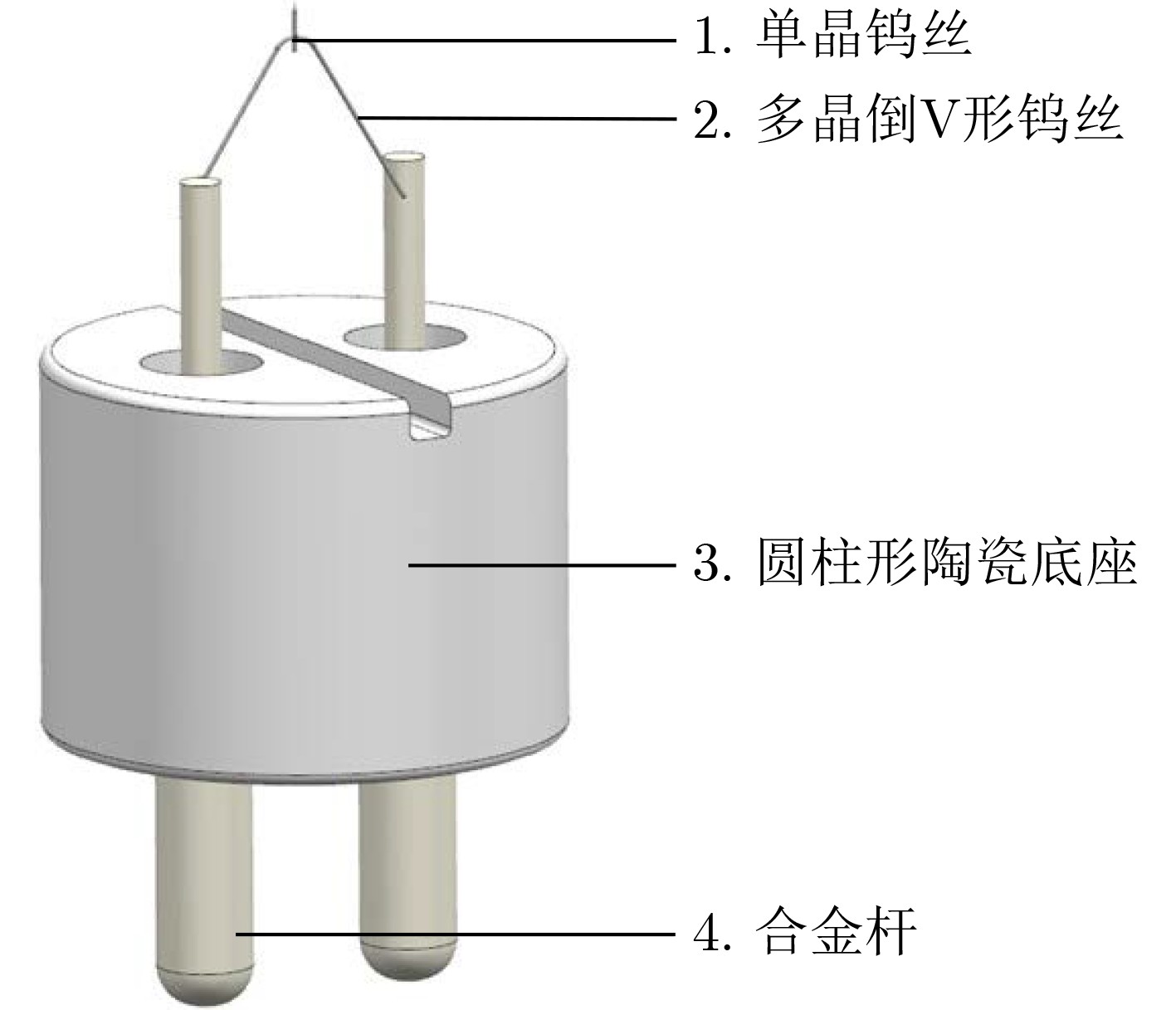
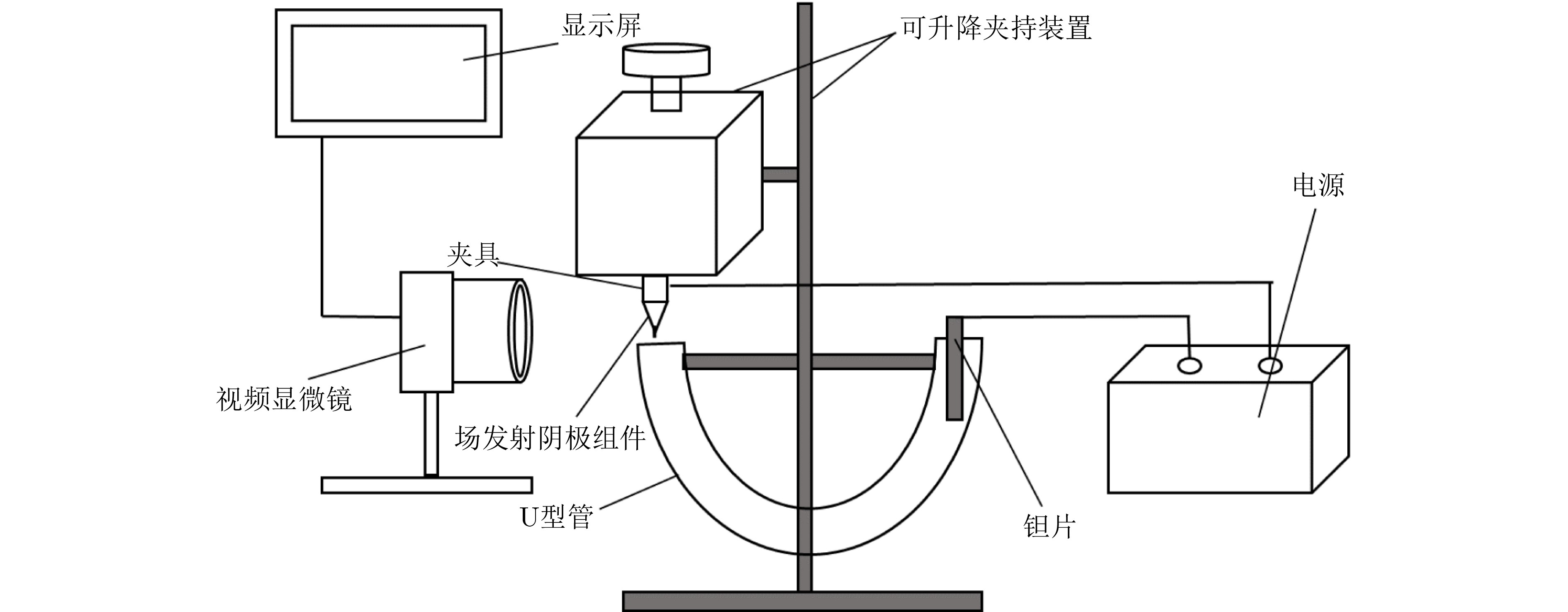
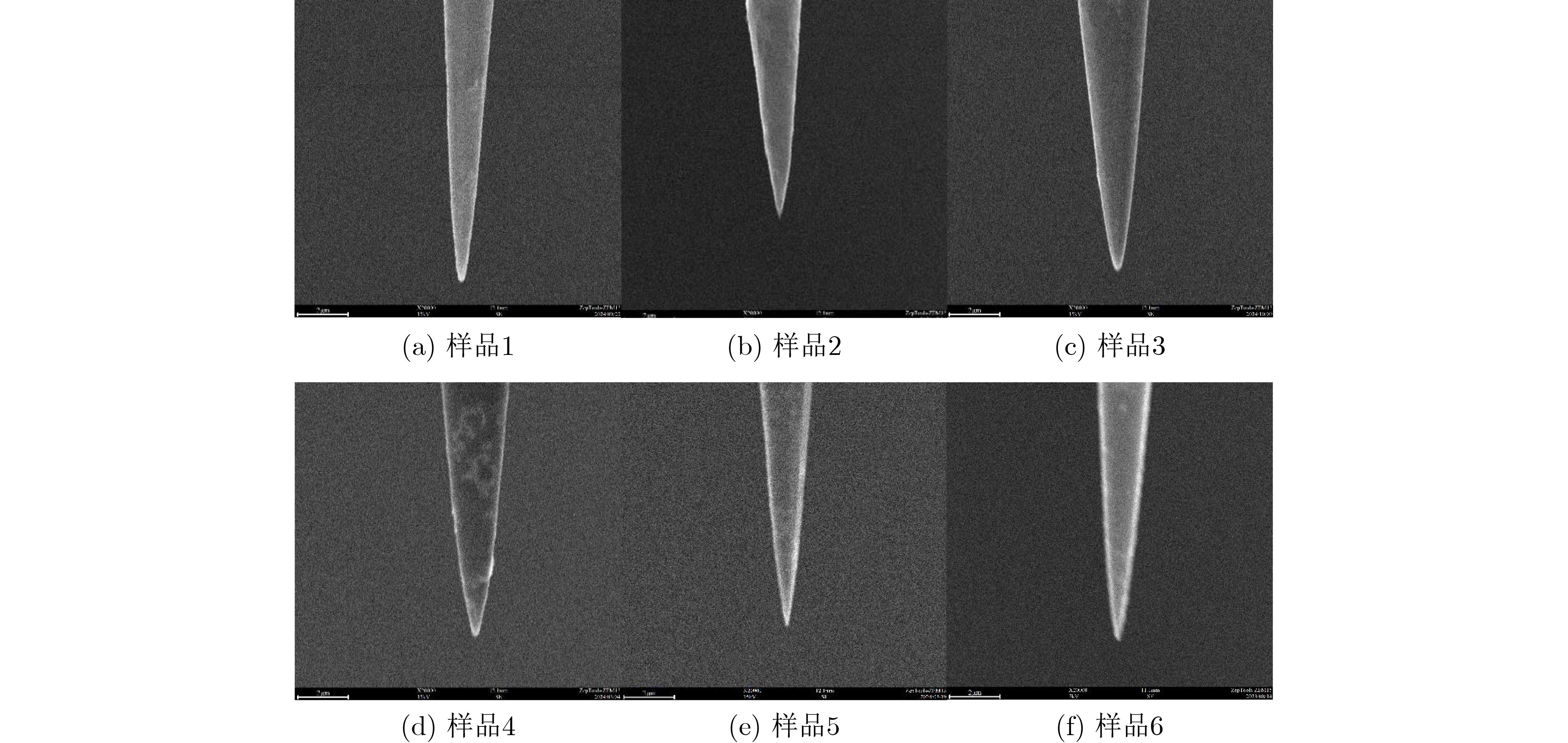
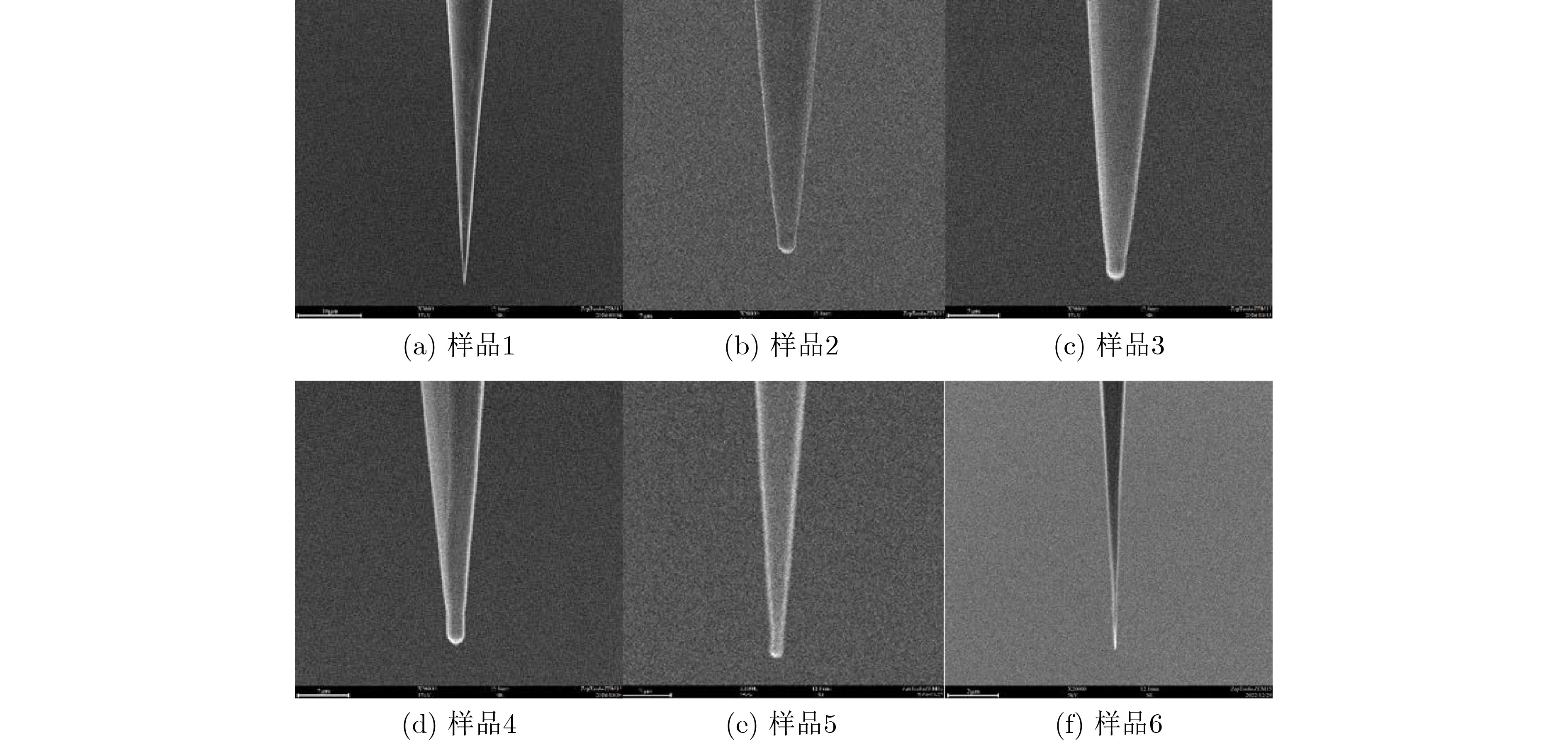
Objective Single-crystal tungsten is the preferred material for high-performance field emission cathodes, which are key components of advanced electron microscopes and electron beam lithography systems. However, fabricating single-crystal tungsten tips with precisely controlled geometry and clean surfaces remains challenging. Cold field emission cathodes require a tip radius of curvature below 100 nm, whereas Schottky-type thermal field emission cathodes require tip radii of 0.3~1.0 μm. Conventional electrochemical corrosion, the most widely used fabrication method, suffers from limited control of the cutoff timing, tip bending or passivation, residual surface contamination, and low yield. In addition, the anisotropy of single-crystal tungsten increases the difficulty of tip morphology control. This study aims to develop a controllable fabrication process for single-crystal tungsten field emitters that enables customized tip geometry and surface quality for different field emission applications while improving fabrication yield. Methods Single-crystal tungsten wires (diameter 0.12 mm, purity 99.95%, (100) orientation) were used as the starting material. The tips were first fabricated by electrochemical corrosion in 0.8 mol/L NaOH solution under a 10 V direct-current voltage with pulsed control (6 kHz, 100 μs pulse width) for 10 min. After corrosion, the samples were sequentially cleaned in ultrapure water and anhydrous ethanol and then dried with high-purity nitrogen. The cleaned samples were subsequently treated in an ultra-high-vacuum system (base pressure < 1 × 10⁻⁶ Pa) under controlled oxygen atmospheres. The treatment temperature (1 500~1 600 °C), oxygen flow rate (0.015~1.0 sccm), and treatment duration (5~1 440 min) were systematically varied while the vacuum level was maintained better than 1 × 10⁻⁴ Pa. Tip morphology was characterized by Scanning Electron Microscopy (SEM), and surface composition was analyzed by Energy Dispersive X-ray Spectroscopy (EDS). Geometric parameters, including the half-cone angle and tip radius, were measured using standardized procedures. Results and Discussions The combination of electrochemical corrosion and high-temperature oxygen treatment achieved both effective surface purification and controlled surface reconstruction. SEM observations revealed that the reconstruction pathway was governed by oxygen partial pressure ( Fig. 3 andFig. 4 ). Under oxygen-rich conditions (1.0 sccm, 1 500~1 600 °C), the tips underwent blunting surface reconstruction, evolving from an inverted cone into a characteristic “cylindrical segment + hemispherical cap” structure (Samples 2~5,Table 2 ). For Sample 3 treated at 1 500 °C for 10 min, the tip radius increased to 327 nm, whereas the half-cone angle decreased by 21%. Extending the treatment to 15 min (Sample 4) reduced the tip radius to 275 nm while substantially increasing the height of the cylindrical segment. Increasing the treatment temperature from 1 500 °C (Sample 2) to 1 600 °C (Sample 5) increased the reduction in half-cone angle from 11% to 25% and reduced the tip radius from 380 nm to 172 nm, indicating accelerated reconstruction kinetics. This anisotropic evolution is attributed to crystallographic orientation-dependent surface energies and preferential oxidation of specific crystal planes. Under oxygen-lean conditions (0.015 sccm, 1 500 °C, 1 440 min), sharpening surface reconstruction occurred, reducing the tip radius from 143 nm to 28 nm and the half-cone angle from 8° to 1° (Sample 6). By contrast, vacuum treatment at 1 500 °C removed surface contaminants without changing the tip geometry (Sample 1). EDS confirmed that the treated surfaces contained no detectable impurities other than trace carbon (Table 3 ), demonstrating that the proposed process simultaneously achieved surface purification and surface reconstruction. These results demonstrate that oxygen partial pressure determines the reconstruction pathway, with oxygen-rich conditions promoting blunting reconstruction and oxygen-lean conditions promoting sharpening reconstruction.Conclusions A combined process of electrochemical corrosion and high-temperature oxygen treatment was developed for the controllable fabrication of single-crystal tungsten field emitters. The process provides two complementary functions. High-temperature vacuum treatment removes residual contaminants generated during electrochemical corrosion, whereas oxygen treatment enables controlled surface reconstruction. By regulating the treatment temperature, oxygen flow rate, and treatment duration, the tip geometry can be tailored for different applications. Oxygen partial pressure is the key factor governing the reconstruction pathway. Under oxygen-rich conditions (1 500 °C, 1.0 sccm), blunting reconstruction produces a “cylindrical segment + hemispherical cap” structure suitable for Schottky-type thermal field emission cathodes with tip radii of 0.3~1.0 μm. Under oxygen-lean conditions (1 500 °C, 0.015 sccm), sharpening reconstruction produces nanoscale tips with radii as small as 28 nm, meeting the requirements of cold field emission cathodes and Scanning Tunneling Microscope (STM) probes. The surface reconstruction mechanism is governed by the selective oxidation of different tungsten crystal planes and the formation of volatile tungsten oxides, which redistribute surface energy and promote orientation-dependent surface evolution. Control experiments confirmed that comparable surface reconstruction did not occur under oxygen-free conditions at the same temperature, demonstrating the essential role of oxygen in initiating this process. The proposed process also corrects defects generated during electrochemical corrosion, improves fabrication yield and process robustness, and provides a practical technical route for manufacturing high-performance field emission cathodes. -
表 1 高温通氧工艺参数及处理前后数据对比表
编号 温度(°C) 氧流速(sccm) 通氧时长(min) 1 1500 0 0 2 1500 1.0 5 3 1500 1.0 10 4 1500 1.0 15 5 1600 1.0 5 6 1500 0.015 1440  下载: 导出CSV
表 2 高温通氧处理前后针尖尺寸数据对比表
编号 重构处理前 重构处理后 变化率 尖端曲率半径r0(nm) 半锥角α(°) 尖端曲率半径r1(nm) 半锥角α(°) Δr(%) Δα(%) 1 144 8 138 8 –4 0 2 146 9 380 8 160 –11 3 244 14 327 11 34 –21 4 229 14 275 10 20 –27 5 137 8 172 6 26 –25 6 143 8 28 1 –80 –88 注:Δr=(r1–r0)/r0⋅100%;Δα=(α1–α0)/ α0⋅100%。
下载: 导出CSV
表 3 重构处理后针尖表面元素组成
编号 W(wt%) O(wt%) C(wt%) 1 96.86 0 3.14 2 97.47 0.23 2.30 3 98.39 0 1.61 4 97.63 0.19 2.18 5 97.18 0 2.82 6 98.45 0 1.55
下载: 导出CSV
-
[1] MATĚJÍČEK J, VILÉMOVÁ M, REDNYK A, et al. Characteristics of tungsten prepared by hot pressing at high pressure[J]. Materials, 2025, 18(23): 5265. doi: 10.3390/ma18235265. [2] LI Duo, ZHU Zhuoyuan, ZHANG Zixin, et al. Position-dependent nanoindentation edge effect in single crystal tungsten via molecular dynamics simulations[J]. Journal of Materials Science, 2026, 61(13): 8626–8643. doi: 10.1007/s10853-026-12422-7. [3] 赵伟霞, 张利新, 刘俊标, 等. 磁浸没热场发射电子枪[J]. 光学精密工程, 2025, 33(11): 1700–1712. doi: 10.37188/OPE.20253311.1700.ZHAO Weixia, ZHANG Lixin, LIU Junbiao, et al. Thermal field electron gun immersed in magnetic lens field[J]. Optics and Precision Engineering, 2025, 33(11): 1700–1712. doi: 10.37188/OPE.20253311.1700. [4] 郭家美, 阴生毅, 张永清, 等. 电子显微镜阴极发展综述[J]. 电子显微学报, 2022, 41(6): 664–672. doi: 10.3969/j.issn.1000-6281.2022.06.013.GUO Jiamei, YIN Shengyi, ZHANG Yongqing, et al. A review of the development of electron microscope cathode[J]. Journal of Chinese Electron Microscopy Society, 2022, 41(6): 664–672. doi: 10.3969/j.issn.1000-6281.2022.06.013. [5] ZHANG Ruoqi, WANG Xiaoxia, and DING Shixian. Investigation on the impact of scandate-doped impregnant phase composition on cathode emission property[J]. Materials Chemistry and Physics, 2025, 345: 131145. doi: 10.1016/j.matchemphys.2025.131145. [6] 郭家美, 阴生毅, 孙万众, 等. 单晶钨针尖场发射体的制备及氧化特性分析[C]. 第二十二届真空电子学学术年会, 广州, 中国, 2024: 414–417. doi: 10.26914/c.cnkihy.2024.047653.GUO Jiamei, YIN Shengyi, SUN Wanzhong, et al. Preparation and oxidation characteristics analysis of single crystal tungsten tip field emitter[C]. The 22nd Annual Conference on Vacuum Electronics, Guangzhou, China, 2024: 414–417. doi: 10.26914/c.cnkihy.2024.047653. [7] GUO Xiaoguang, GOU Yongjun, DONG Zhigang, et al. Study on subsurface layer of nano-cutting single crystal tungsten in different crystal orientations[J]. Applied Surface Science, 2020, 526: 146608. doi: 10.1016/j.apsusc.2020.146608. [8] STUPIAN G W and LEUNG M S. A scanning tunneling microscope based on a motorized micrometer[J]. Review of Scientific Instruments, 1989, 60(2): 181–185. doi: 10.1063/1.1140458. [9] MORIKAWA H and GOTO K. Reproducible sharp-pointed tip preparation for field ion microscopy by controlled AC polishing[J]. Review of Scientific Instruments, 1988, 59(10): 2195–2197. doi: 10.1063/1.1139985. [10] BINNIG G, ROHRER H, GERBER C, et al. Surface studies by scanning tunneling microscopy[J]. Physical Review Letters, 1982, 49(1): 57–61. doi: 10.1103/PhysRevLett.49.57. [11] SUN Wanzhong, YIN Shengyi, GUO Jiamei, et al. Real-time image-based control technique of single crystal tungsten microtips in electrochemical corrosion[J]. e-Journal of Surface Science and Nanotechnology, 2024, 22(3): 266–272. doi: 10.1380/ejssnt.2024-018. [12] 郭家美, 阴生毅, 孙万众, 等. Zr/O/W肖特基式热场发射阴极界面发射性能研究[J]. 物理学报, 2026, 75(1): 010805. doi: 10.7498/aps.75.20251100.GUO Jiamei, YIN Shengyi, SUN Wanzhong, et al. Emission performance at the interface of Zr/O/W Schottky thermal field emission cathodes[J]. Acta Physica Sinica, 2026, 75(1): 010805. doi: 10.7498/aps.75.20251100. [13] DYKE W P and DOLAN W W. Field emission[M]. MARTON L. Advances in Electronics and Electron Physics. New York: Academic Press, 1956: 89–185. [14] HABAINY J, IYENGAR S, SURREDDI K B, et al. Formation of oxide layers on tungsten at low oxygen partial pressures[J]. Journal of Nuclear Materials, 2018, 506: 26–34. doi: 10.1016/j.jnucmat.2017.12.018. [15] NAGY D and HUMPHRY-BAKER S A. An oxidation mechanism map for tungsten[J]. Scripta Materialia, 2022, 209: 114373. doi: 10.1016/j.scriptamat.2021.114373. [16] CIFUENTES S C, MONGE M A, and PÉREZ P. On the oxidation mechanism of pure tungsten in the temperature range 600-800 °C[J]. Corrosion Science, 2012, 57: 114–121. doi: 10.1016/j.corsci.2011.12.027. [17] VITOS L, RUBAN A V, SKRIVER H L, et al. The surface energy of metals[J]. Surface Science, 1998, 411(1/2): 186–202. doi: 10.1016/S0039-6028(98)00363-X. [18] LAMBERT-MAURIAT C and OISON V. Density-functional study of oxygen vacancies in monoclinic tungsten oxide[J]. Journal of Physics: Condensed Matter, 2006, 18(31): 7361–7371. doi: 10.1088/0953-8984/18/31/028. [19] VADDIRAJU S, CHANDRASEKARAN H, and SUNKARA M K. Vapor phase synthesis of tungsten nanowires[J]. Journal of the American Chemical Society, 2003, 125(36): 10792–10793. doi: 10.1021/ja035868e. [20] 程旭. 密度泛函理论与实验结合的WO3表面与气体相互作用研究[D]. [博士论文], 兰州大学, 2024.CHENG Xu. Investigation of the interaction between WO3 surface and gases through the combination of density functional theory and experimental approaches[D]. [Ph. D. dissertation], Lanzhou University, 2024. [21] 徐季, 张建, 李孟杰, 等. 场发射冷阴极的技术现状及其应用研究进展[J]. 真空电子技术, 2020(3): 1–14. doi: 10.16540/j.cnki.cn11-2485/tn.2020.03.01.XU Ji, ZHANG Jian, LI Mengjie, et al. Technology status and application research progress of field emission cold cathodes[J]. Vacuum Electronics, 2020(3): 1–14. doi: 10.16540/j.cnki.cn11-2485/tn.2020.03.01. -

 下载:


图(6) / 表(3)
计量
- 文章访问数: 990
- HTML全文浏览量: 396
- PDF下载量: 57
- 被引次数: 0
